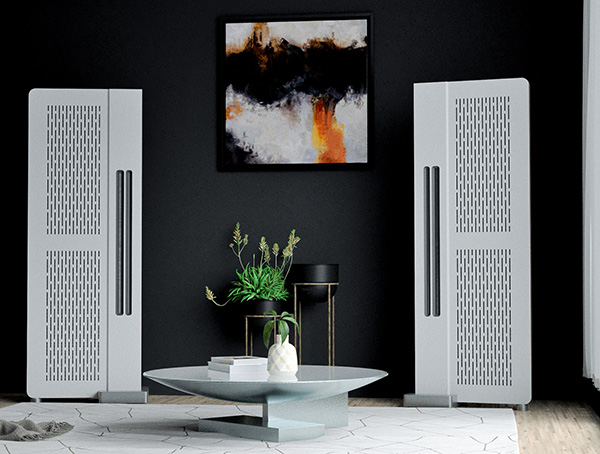
"Panel speakers that do bass? Sign me up!" That was my reaction when I first heard a pair of Diptyque Reference loudspeakers, at AXPONA 2023. The Reference is a 6'-tall, French planar magnetic speaker whose designers, Gilles Douziech and Eric Poix, make no secret of their love for Magnepan, the Minnesota company famed for its dipole panels. The French duo has improved on Magnepan's pioneering technology by addressing the number-one shortcoming of such designs: a lack of low-frequency extension.
I was instantly taken by the Diptyques' performance—not just by the effortless, lightning-quick transients that are a defining trait of well-designed panels but by the deep, grunty bass on Chris Jones's "No Sanctuary Here" and James Blake's "Limit To Your Love." On those tracks, the people running the room for Fidelity Imports, Diptyque's US distributor, practically dared visitors to complain about a lack of low-end extension. I don't believe anyone did.
Various other duties came first, but I was excited when a review was eventually arranged. The speakers ($57,995/pair) were delivered by Mike Hoatson of the Listening Room in Maryland, a third-generation audio retailer who sells a lot of Magnepans but is infectiously excited about the US brand's innovative Euro rivals. To sate my curiosity, he also brought a pair of high-end tubed monoblocks by another Fidelity Imports brand, Italy's Unison Research; see my review of the Reference amplifier on p.61. In the end, I preferred, and reviewed, the Diptyques with solid state amps I had on hand. I'll return to this.
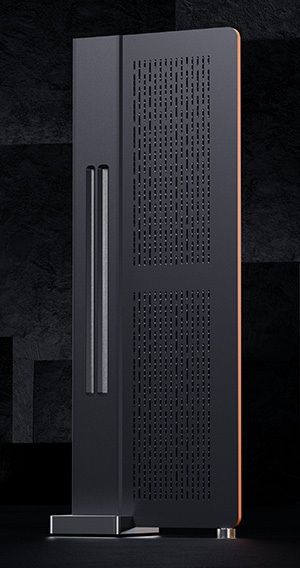
Hoatson, whose demeanor is half evangelist, half kid in a candy store, hooked up the towering Diptyques (71" tall, 26" wide, 189lb each; footnote 1) and explained a thing or two about their full-range planar drivers and patented magnet system. The technology allows the speakers to dig down to a claimed 22Hz (footnote 2). Diptyque says that "each bass cell is powered by two independent windings (vertical and horizontal)." That architecture, we're told, allows the Mylar membrane to vibrate using hundreds of small square motors. The crossed push-pull configuration has a voice coil on each side of the membrane, which the company claims "optimizes the motor structure." This is meant to accomplish "total vibration control, guaranteeing deep, linear, distortion-free bass with unmatched efficiency" compared with other planar magnetics.
I expected Hoatson to demo bass-heavy tracks, because that's the Diptyques' ultimate party trick. But my guest had something more original in mind. In the middle of April, Hoatson queued up the best Christmas music I've ever heard: Cancionero de Upsala by Ensemble Villancico Stockholm under Peter Pontvik (16/44.1 FLAC, Proprius/Qobuz). I learned that the Cancionero is a Spanish Renaissance songbook published in Venice in 1556. The only known surviving copy was discovered in 1907 in the collection of Sweden's Uppsala University. The book is a treasury of almost lusty secular and religious songs devoid of gloss and grandiosity. Though they reference religious themes such as Christmas and the veneration of the Virgin Mary, they're not especially sacred. On the 1996 Stockholm recording, reverence coexists with peasant clogs, handclaps, and earthy melodies made to be remembered. This music is written for fellow humans, not for angels or kings. Suddenly, through the Diptyques, warm, fallible people were singing in my room from what felt like five centuries earlier. I was moved—all the more because there's a simplicity of form here that fits with Renaissance humanism, which encouraged the idea that the divine can take on humble forms. It's the same impulse that led painters of the era to depict Mary as a real young woman rather than a gauzy icon.
 The unmitigated Gaul
Hoatson's voice, which can boom like a drill sergeant torture-testing a PA system, jerked me back to reality. In his affable way, he talked up the Diptyques, and I took copious notes.
At the heart of each Diptyque speaker is a 12µm-thin Mylar membrane—that's about one-sixth the thickness of a human hair—etched with a serpentine aluminum voice coil. This membrane is suspended between powerful magnetic arrays that cover both sides of the panel. When current passes through the coil, it interacts with the magnetic field, causing the diaphragm to move and produce sound. Unlike cone drivers, which act as pistons, and domes, which tend to beam at higher frequencies, this membrane moves in a distributed fashion—producing sound across its entire surface, with remarkable evenness and coherence.
The Diptyque team refers to its speakers as "isodynamic," meaning that the magnetic field strength remains very nearly consistent across the surface of the diaphragm. (In some planar designs, the field is stronger near the magnets, weaker in the middle or at the edges. That inconsistency can cause distortion, inefficiency, and tonal coloration.)
Next, Hoatson explained that Diptyque's patented "Push-Pull Bipolar Magnet" system holds the diaphragm between matched magnetic fields on both sides, which improves control and enhances performance especially at low frequencies, traditionally the Achilles' heel of planar speakers. He pointed out that the Reference speaker is a three-and-a-half-way design, "because the two voice coils on the bass drivers have slightly different crossover points."
Like Magnepans, all Diptyque speakers are dipoles: They emit sound from the front and back and produce very little energy to the sides. This figure-eight radiation pattern reduces sidewall reflections and increases the sense of spaciousness, especially in rooms carefully arranged or acoustically sympathetic. To perform at their best, the Diptyques need adequate space behind and to the sides, allowing the rearward radiation to interact naturally with the room.
Apart from the Mylar, the panels are built with a sandwich of MDF, steel, and damping felt that eliminates flexing. Hoatson says there's yet another material in the mix: The bass diaphragms' frames are made of a composite material the company claims is seven times more rigid than MDF.
Crossover points for the Reference speakers are set at 600Hz and 7kHz. The crossover filters use a gentle, 12dB/octave slope; this gradual transition between drivers helps give the speakers their coherence. They're rated at a nominal impedance of 4 ohms and have a specified sensitivity of 89dB/W/1m. They don't require massive amplification, but they do reward quality. A clean, well-controlled amplifier with good current delivery should bring out their dynamics and bass agility. Diptyque speakers work fine with tube amps but, I found, they shine with solid state power because they benefit from high current and tight control. The output impedance of even powerful tube amps tends to be relatively high, which means they have a low damping factor, so they can't control the diaphragm as well, especially in the bass. You'll hear it as looser transients, less definition down low, and sometimes as a slightly softened overall dynamic envelope. The result may be pleasing, but it won't reveal the full resolution or speed the speaker is capable of.
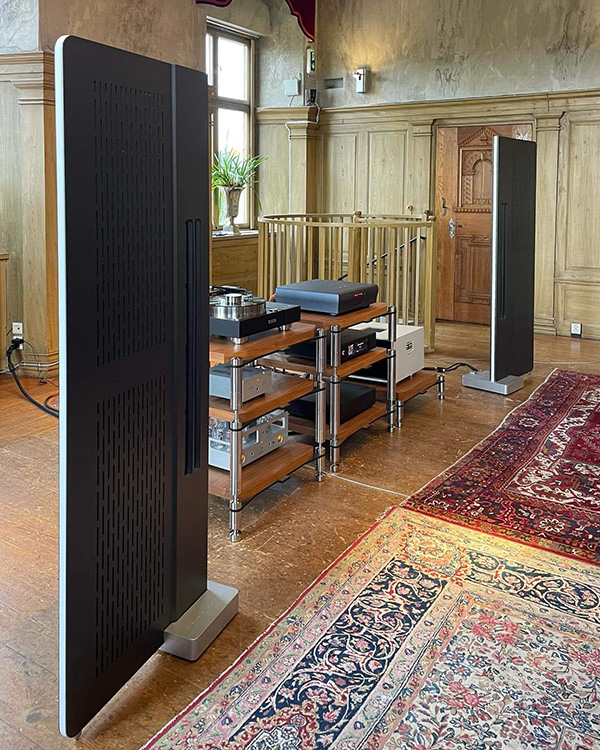 I auditioned the Diptyque Reference speakers with the top-flight Audia Flight FLS10 integrated solid state amplifier I assessed for Stereophile's February 2025 issue and my trusty, 25-year-old, recapped Krell FPB 200c power amp fed by my Benchmark HPA4 line stage. The digital front-end alternated between a Grimm MU1 and an Aurender A20, each running Roon.
Treble in paradise
I auditioned the Diptyque Reference speakers with the top-flight Audia Flight FLS10 integrated solid state amplifier I assessed for Stereophile's February 2025 issue and my trusty, 25-year-old, recapped Krell FPB 200c power amp fed by my Benchmark HPA4 line stage. The digital front-end alternated between a Grimm MU1 and an Aurender A20, each running Roon.
Treble in paradise
Stereophile isn't a home theater magazine, but right after I connected my TV to the Grimm MU1 via TosLink, and from there to the Audia Flight amp, my 14-year-old daughter ambled in with a movie request: Ratatouille. Not a bad choice, I thought. The Diptyques are essentially American technology heard through a French lens, so it seemed fitting and amusing to play this American take on French taste. Less than two minutes into the animated romp, there's a gunshot followed by a thunderclap. They have roughly the same pitch, but the Diptyques did a bang-up job of differentiating the sounds, rendering their reverb tails with outstanding realism. We were off to a good start. Later that night, I switched to music and noticed that the speakers seemed to subtly emphasize the upper midrange and lower treble, which had the effect of giving especially acoustic string instruments a sweet crispness, a light-footed vibe. By contrast, my reference speakers, the Focal Utopia Scala EVOs, are a hot cocoa drink: Especially when driven by tubes, they give a rich presentation that warms your insides. The Diptyques (with solid state) sounded temperamentally cooler but just as intimate; they're a wine spritzer or citrus drink. They supplied a mite less body but made up for it in fine detail. Always, they sounded articulate and ultraspeedy, reminiscent of large Magnepans and Apogees.
This was going to be easy, I thought: speakers that are clearly a home run, a month or so of pleasurable listening, a day or two of writing—done.
Hélas, as the French say. After a few days, the crispness I'd initially admired began to grate—not because the speakers changed but because I started to hear it as borderline etched. A second negative, almost the opposite of the first, became apparent, too: Every time I stood up, or raised myself even a little bit, the sound turned dull. When I lowered myself back into my chair, it brightened considerably—changing character, it seemed, with every inch my ears moved up or down. I'd never experienced that, but John Atkinson, Stereophile's former editor and longtime pater familias, had. "Ribbon tweeters are very directional in the vertical plane, as you found when you stood up," he replied when I emailed him for a sanity check. "Small changes in the vertical listening axis become critical." He added that in the 1990s, the magazine's Tom Norton did an in-house survey of seated listeners' ear height. The median, the study found, was 36". The variation was 33"–39", the range resulting from differences in chair and human height. (Sitting up in my Eames chair, my ear canals are 35" from the floor.) Every one of the participants in that test would have perceived the Diptyques' treble slightly differently. Clearly, to get the best sound from these speakers, adjustability is key.
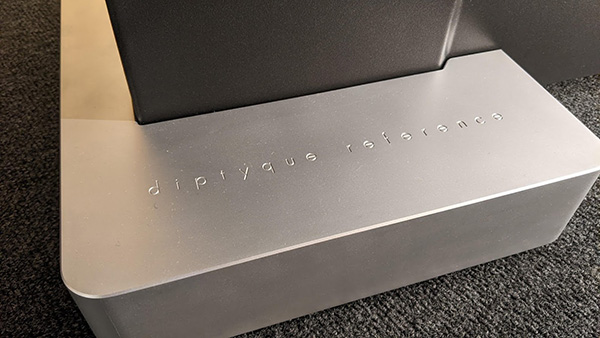 On Mike Hoatson's advice, I toed the Diptyques in more, but that didn't help things appreciably. Neither did moving them closer together or farther apart. What finally solved the edginess was this: With the help of an audiophile friend who was hearing the same effects, I played with the tilt control knob on the rear of the speakers, leaning them back. The maximum angle we could achieve was maybe 2°, but already that helped things quite a bit. I then wedged a couple of layers of standard-thickness cardboard under the front of the aluminum bases to tilt the speakers back another notch, beyond what the tilt knob had allowed. Instantly, the highs were more measured. The bass thickened and solidified a little, or perhaps it only seemed so now that the treble no longer demanded my attention. Either way, it was the first time I'd experienced such tiny positioning changes making such a huge difference (footnote 3).
Though the improvement was gratifying, remember that with speakers of this kind, perfect sonics for you may not be optimal for the person sitting next to you.
On Mike Hoatson's advice, I toed the Diptyques in more, but that didn't help things appreciably. Neither did moving them closer together or farther apart. What finally solved the edginess was this: With the help of an audiophile friend who was hearing the same effects, I played with the tilt control knob on the rear of the speakers, leaning them back. The maximum angle we could achieve was maybe 2°, but already that helped things quite a bit. I then wedged a couple of layers of standard-thickness cardboard under the front of the aluminum bases to tilt the speakers back another notch, beyond what the tilt knob had allowed. Instantly, the highs were more measured. The bass thickened and solidified a little, or perhaps it only seemed so now that the treble no longer demanded my attention. Either way, it was the first time I'd experienced such tiny positioning changes making such a huge difference (footnote 3).
Though the improvement was gratifying, remember that with speakers of this kind, perfect sonics for you may not be optimal for the person sitting next to you.
Footnote 1: This applies to the speaker I reviewed, which Diptyque informally called the Reference MkI Evo. The Evo incorporated several of the upgrades that are now part of the recently launched Reference MkII. The MkII has new high-end capacitors and a larger aluminum foot for more stability. The size of the driver membrane remains the same, but the modular frame is now slightly larger (73.2"H × 28"W)—for easier servicing, Hoatson says. These changes address several minor issues described later in this review. Footnote 2: This ability to move lots of air is directly related to membrane size. A single Reference has 698in2 (almost 5ft2) of Mylar. For comparison, Diptyque's DP 160 MkII, at $30,000/pair, has 524in2 (3.6ft2) of membrane per speaker and goes down to a claimed 30Hz.
Footnote 3: Based on customer feedback, Diptyque equipped the recently launched MkII version of the Reference with an extended-range tilt control, eliminating the need for cardboard fixes.
The unmitigated GaulHoatson's voice, which can boom like a drill sergeant torture-testing a PA system, jerked me back to reality. In his affable way, he talked up the Diptyques, and I took copious notes.
I auditioned the Diptyque Reference speakers with the top-flight Audia Flight FLS10 integrated solid state amplifier I assessed for Stereophile's February 2025 issue and my trusty, 25-year-old, recapped Krell FPB 200c power amp fed by my Benchmark HPA4 line stage. The digital front-end alternated between a Grimm MU1 and an Aurender A20, each running Roon.
Treble in paradiseStereophile isn't a home theater magazine, but right after I connected my TV to the Grimm MU1 via TosLink, and from there to the Audia Flight amp, my 14-year-old daughter ambled in with a movie request: Ratatouille. Not a bad choice, I thought. The Diptyques are essentially American technology heard through a French lens, so it seemed fitting and amusing to play this American take on French taste. Less than two minutes into the animated romp, there's a gunshot followed by a thunderclap. They have roughly the same pitch, but the Diptyques did a bang-up job of differentiating the sounds, rendering their reverb tails with outstanding realism. We were off to a good start. Later that night, I switched to music and noticed that the speakers seemed to subtly emphasize the upper midrange and lower treble, which had the effect of giving especially acoustic string instruments a sweet crispness, a light-footed vibe. By contrast, my reference speakers, the Focal Utopia Scala EVOs, are a hot cocoa drink: Especially when driven by tubes, they give a rich presentation that warms your insides. The Diptyques (with solid state) sounded temperamentally cooler but just as intimate; they're a wine spritzer or citrus drink. They supplied a mite less body but made up for it in fine detail. Always, they sounded articulate and ultraspeedy, reminiscent of large Magnepans and Apogees.
On Mike Hoatson's advice, I toed the Diptyques in more, but that didn't help things appreciably. Neither did moving them closer together or farther apart. What finally solved the edginess was this: With the help of an audiophile friend who was hearing the same effects, I played with the tilt control knob on the rear of the speakers, leaning them back. The maximum angle we could achieve was maybe 2°, but already that helped things quite a bit. I then wedged a couple of layers of standard-thickness cardboard under the front of the aluminum bases to tilt the speakers back another notch, beyond what the tilt knob had allowed. Instantly, the highs were more measured. The bass thickened and solidified a little, or perhaps it only seemed so now that the treble no longer demanded my attention. Either way, it was the first time I'd experienced such tiny positioning changes making such a huge difference (footnote 3).
Footnote 1: This applies to the speaker I reviewed, which Diptyque informally called the Reference MkI Evo. The Evo incorporated several of the upgrades that are now part of the recently launched Reference MkII. The MkII has new high-end capacitors and a larger aluminum foot for more stability. The size of the driver membrane remains the same, but the modular frame is now slightly larger (73.2"H × 28"W)—for easier servicing, Hoatson says. These changes address several minor issues described later in this review. Footnote 2: This ability to move lots of air is directly related to membrane size. A single Reference has 698in2 (almost 5ft2) of Mylar. For comparison, Diptyque's DP 160 MkII, at $30,000/pair, has 524in2 (3.6ft2) of membrane per speaker and goes down to a claimed 30Hz.