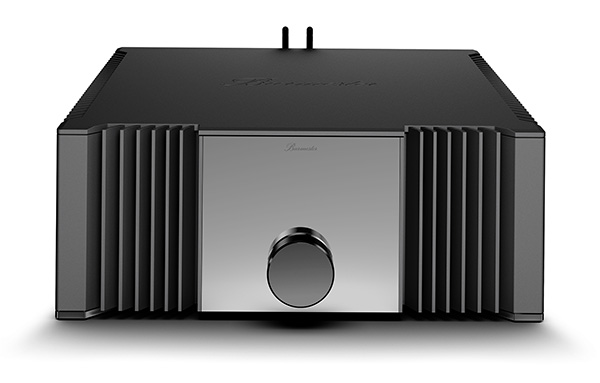
My first response, upon being offered for review the new Burmester 232 Classic Line modular class-AB dual-mono integrated amplifier ($25,000), was apprehension—but not because of the product itself, and certainly not because of the Burmester brand.
I had already been won over by the pair of Burmester 218 Top Line stereo power amplifiers ($50,000/each) I reviewed in the October 2024 issue. I wrote in my conclusion: "Their sound is so natural and complete that amidst the miracle of music, analytical thoughts inevitably cede to satisfaction, smiles, and wonder. ... Their sound ... was world-class. No matter how dynamic and taxing the music, ... listening to them was a consistent joy."
My concerns, rather, centered on reviewing yet another five-figure integrated whose technology had presumably trickled far down from on high. I've reviewed several "entry-level" integrateds from prestige companies, all with excellent reputations. Each time, I've felt that while that proprietary technology had indeed trickled down, it had picked up a few contaminants along the way. Feeding those concerns was the realization that the 232 integrated was the latest addition to Burmester's "entry-level" Classic Line. Because there are three increasingly more expensive, and presumably more refined, lines above Classic—Top, Reference, and Signature—I feared that what I'd hear would leave me disappointed.
Happily, such thoughts vanished early into my first listening session—and this was before I learned that the 232's technology is new and destined to trickle up. All it took was to quiet my mind, play some good music, and give my ears precedence over my fears.
What it is
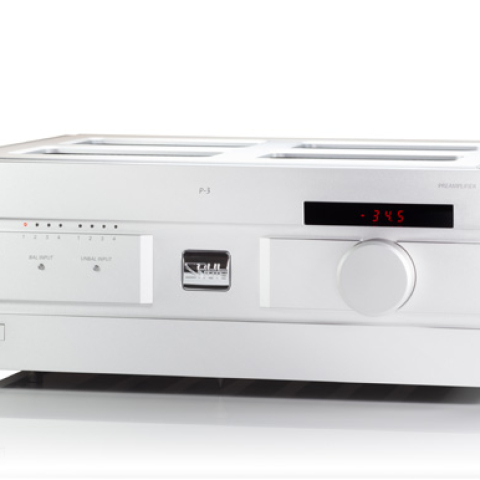
The 232 is a class-AB modular integrated amplifier that outputs 95Wpc into 8 ohms and 155Wpc into 4 ohms; these specs apply to the 230V European version (footnote 1). It's the first product to feature Burmester's new external design, with a large, easily readable and navigable front-panel display, and it's said to "contain new, modern elements" yet to "preserve the Burmester heritage." The 232 can integrate into a home theater system via HDMI-ARC and connect to digital sources, including CD players, via S/PDIF and AES3. It contains a 6.3mm headphone jack on its rear panel.
 And it has options: an optional Roon Ready DAC/streamer module ($10,000) and phono module ($5000). The DAC/streamer, which I discuss below, supports resolutions up to 32/384 by USB—32/768 is planned for a future firmware update—and 32/768 for files played from an SD card or USB flash drive. It works with Apple AirPlay, Tidal Connect, Qobuz Connect, Spotify Connect, and internet radio. The phono module works with MC cartridges only. Because my system is only equipped for file- and silver-disc playback, I could not evaluate the phono stage, which is based on the Burmester 077 Reference preamplifier and Phono Preamplifier 100, though at just $5000, it's surely a limited implementation of those more expensive products.
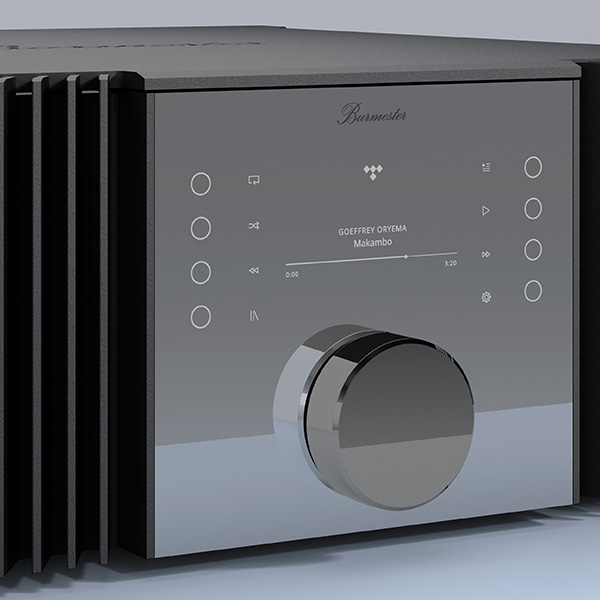
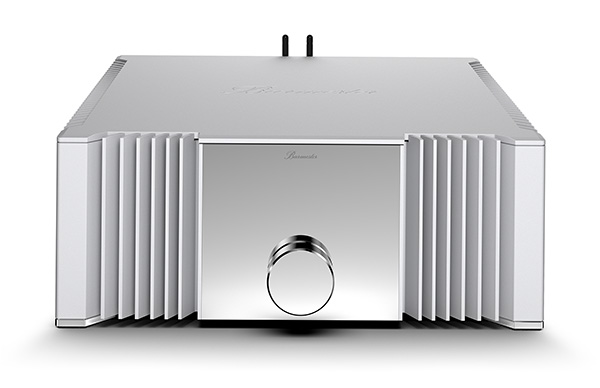
Although 99% of owners will use the 232 as a full-function integrated amplifier, you can also use it as a preamplifier, pairing it with separate power amplifiers. Most operations are carried out with its new (to Burmester), large, haptic, adaptive rotary-control knob, located beneath its easily readable front-panel display, and the eight touch buttons that surround the display. To quote the manual (footnote 2), which for now is only available online, "In addition to controlling classic functions such as input selection, volume adjustment, or scrolling through playlists, the rotary control in the 232 also acts as a power switch." Alternately, you can operate the 232 with its small, lightweight remote control, which I mainly used as a volume control, or with the all-new Burmester Conduct app, which you can download from the Apple App Store or Google Play.
And it has options: an optional Roon Ready DAC/streamer module ($10,000) and phono module ($5000). The DAC/streamer, which I discuss below, supports resolutions up to 32/384 by USB—32/768 is planned for a future firmware update—and 32/768 for files played from an SD card or USB flash drive. It works with Apple AirPlay, Tidal Connect, Qobuz Connect, Spotify Connect, and internet radio. The phono module works with MC cartridges only. Because my system is only equipped for file- and silver-disc playback, I could not evaluate the phono stage, which is based on the Burmester 077 Reference preamplifier and Phono Preamplifier 100, though at just $5000, it's surely a limited implementation of those more expensive products.
Although 99% of owners will use the 232 as a full-function integrated amplifier, you can also use it as a preamplifier, pairing it with separate power amplifiers. Most operations are carried out with its new (to Burmester), large, haptic, adaptive rotary-control knob, located beneath its easily readable front-panel display, and the eight touch buttons that surround the display. To quote the manual (footnote 2), which for now is only available online, "In addition to controlling classic functions such as input selection, volume adjustment, or scrolling through playlists, the rotary control in the 232 also acts as a power switch." Alternately, you can operate the 232 with its small, lightweight remote control, which I mainly used as a volume control, or with the all-new Burmester Conduct app, which you can download from the Apple App Store or Google Play.
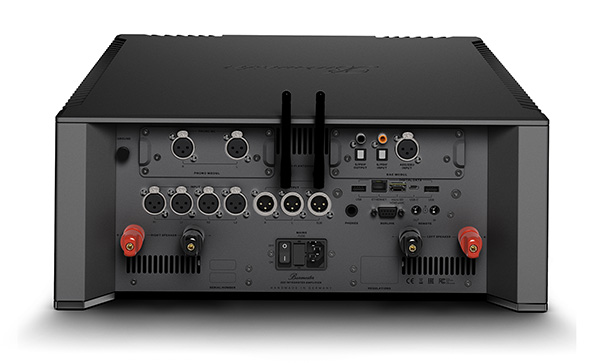 The 232's rear panel contains an "earthing screw," two pairs of balanced analog inputs, slots for its phono and digital modules, a single set of balanced analog line-level "preamp" outputs, a balanced mono subwoofer output, a pair of loudspeaker binding posts, remote-out and remote-in sockets, BurLink (for custom integration/external control), a 6.3mm headphone output, 15A IEC connector, fuse, and main on/off toggle switch. There are slots for the digital module and phono (both filled in my version). Surprisingly, the 232 chassis has connectors for two small antennas (Wi-Fi and Bluetooth), three USB ports (USB-B 2.0 and 3.0 plus USB-C), an Ethernet/LAN port, an HDMI ARC input, and a microSD slot. In short, this is because the 232, while strictly analog in the signal path, is controlled by the central SBC (single-board computer) module, even when the digital module is not installed; more on this later. All is intelligently labeled and laid out.
The digital module includes optical and coaxial digital outputs and inputs plus a balanced electrical digital input. Various settings enable file playback from a NAS, from an attached computer (which may be equipped with Roon), from Burmester network devices or similar UPnP-enabled servers, or from a USB stick formatted as NTFS, FAT32, or ext2/3/4. Computer playback is limited to 32/48, 32/96, and 32/192. You can also stream wired or wirelessly via AirPlay or Bluetooth and play internet radio. Other features, which will become available via a software upgrade after I submit this review, are discussed below.
Toggling the rear panel's main power switch to "on" puts the unit in standby. To turn it fully on, you either depress the front panel's rotary encoder or the corresponding button on the remote.
The 232's rear panel contains an "earthing screw," two pairs of balanced analog inputs, slots for its phono and digital modules, a single set of balanced analog line-level "preamp" outputs, a balanced mono subwoofer output, a pair of loudspeaker binding posts, remote-out and remote-in sockets, BurLink (for custom integration/external control), a 6.3mm headphone output, 15A IEC connector, fuse, and main on/off toggle switch. There are slots for the digital module and phono (both filled in my version). Surprisingly, the 232 chassis has connectors for two small antennas (Wi-Fi and Bluetooth), three USB ports (USB-B 2.0 and 3.0 plus USB-C), an Ethernet/LAN port, an HDMI ARC input, and a microSD slot. In short, this is because the 232, while strictly analog in the signal path, is controlled by the central SBC (single-board computer) module, even when the digital module is not installed; more on this later. All is intelligently labeled and laid out.
The digital module includes optical and coaxial digital outputs and inputs plus a balanced electrical digital input. Various settings enable file playback from a NAS, from an attached computer (which may be equipped with Roon), from Burmester network devices or similar UPnP-enabled servers, or from a USB stick formatted as NTFS, FAT32, or ext2/3/4. Computer playback is limited to 32/48, 32/96, and 32/192. You can also stream wired or wirelessly via AirPlay or Bluetooth and play internet radio. Other features, which will become available via a software upgrade after I submit this review, are discussed below.
Toggling the rear panel's main power switch to "on" puts the unit in standby. To turn it fully on, you either depress the front panel's rotary encoder or the corresponding button on the remote.
 Burmester 232 development
To explore the thinking and technology behind the 232, Simon Pope, Burmester's perpetually affable global PR specialist, who is also a choral singer, and whose wry sense of humor is as British as it gets, connected me with Alexander Rüger, who developed the analog section of the 232 and contributed to the power supply and digital converter.
Rüger explained that the 232 represents Burmester's first implementation of some new electronic concepts. It's a "complete device" that, on the digital side, only needs a home network and loudspeakers to serve as a "complete stereo."
"We are quite a new team here, with new ideas," he said. "Some of the preamplifier parts are new, the DAC is completely new, and the aesthetics are new. The amplifier is mainly based on our 032, but we have implemented a dual mono concept for better channel separation and a little more punch. I think we have created quite a good balance between the old sound and technology, new concepts, and the new demands of the market. We haven't reinvented the wheel, but we spent a lot of time balancing every section of the amplifier and lowering the noisefloor while maintaining the warm Burmester sound that is known for its details and depth."
Rüger noted that the DAC was developed especially to work with and complement the 232. Ditto the preamplifier technology. One main difference between the preamplifier section in the 232 and Burmester's forthcoming 249 top-level preamplifier is that the 232's signal path is asymmetrical, while the 249's will be completely symmetrical.
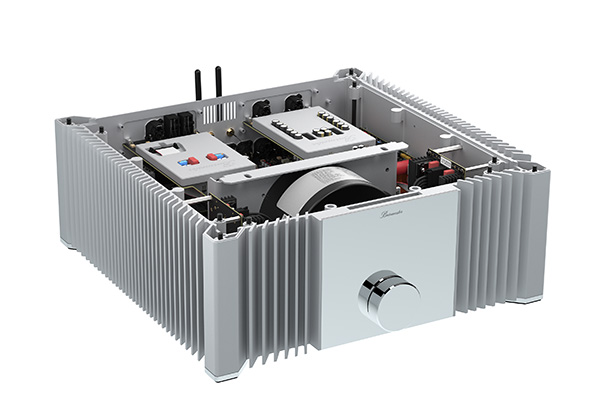 "What's special about the 232 is the small things," he said. "You have to tweak, you have to try to reduce the signal/noise ratio even further. Balancing and grounding all the 232's component parts was a significant consideration. We galvanically separated and isolated every signal that comes from the digital control units; this is essential in an asymmetric unit. It requires a lot of circuitry, but it's worth it. We were also careful to control where the return currents flow so they would not impact the analog ground. To implement dual mono, we developed a big transformer with two separate windings and our own rectification and capacitors."
Rüger hinted at some forthcoming software updates that should be available by press time. Then he connected me with Pascal Bings, a 20-year Burmester engineer who holds the title "Product Owner Research and Development." Over WhatsApp, Bings explained his title and role. "You can think of the 'Product Owner' as the bridge between users/customers, engineering, design, and management. In the context of developing a high-end integrated amplifier with a large software component, a Product Owner typically defines what the product should be able to do (features, sound modes, connectivity, app functions, ...), collects and translates customer needs into clear requirements for the engineering teams, prioritizes the development work (what needs to come first, what is optional, what is critical), works closely with hardware, software, and UX teams to ensure everything fits together smoothly, reviews and approves results while making sure the final product behaves as intended, and keeps the big picture in mind so that the product is coherent, intuitive, and meets its quality goals."
In short, the Product Owner is the person who brings it all together. Bings also speaks excellent English.
Bings spent a while explaining how Burmester chose the DAC chip used in the 232. Rather than go by numbers, measurements, and reputation, Burmester assembled an evaluation board to compare how different DACs sounded and performed under identical conditions. "It's all about the sound rather than about the best [DAC-chip] marketing," he said. "We don't care if it's AKM or ESS, Wolfson or another brand." They chose a chip by ESS.
"What's special about the 232 is the small things," he said. "You have to tweak, you have to try to reduce the signal/noise ratio even further. Balancing and grounding all the 232's component parts was a significant consideration. We galvanically separated and isolated every signal that comes from the digital control units; this is essential in an asymmetric unit. It requires a lot of circuitry, but it's worth it. We were also careful to control where the return currents flow so they would not impact the analog ground. To implement dual mono, we developed a big transformer with two separate windings and our own rectification and capacitors."
Rüger hinted at some forthcoming software updates that should be available by press time. Then he connected me with Pascal Bings, a 20-year Burmester engineer who holds the title "Product Owner Research and Development." Over WhatsApp, Bings explained his title and role. "You can think of the 'Product Owner' as the bridge between users/customers, engineering, design, and management. In the context of developing a high-end integrated amplifier with a large software component, a Product Owner typically defines what the product should be able to do (features, sound modes, connectivity, app functions, ...), collects and translates customer needs into clear requirements for the engineering teams, prioritizes the development work (what needs to come first, what is optional, what is critical), works closely with hardware, software, and UX teams to ensure everything fits together smoothly, reviews and approves results while making sure the final product behaves as intended, and keeps the big picture in mind so that the product is coherent, intuitive, and meets its quality goals."
In short, the Product Owner is the person who brings it all together. Bings also speaks excellent English.
Bings spent a while explaining how Burmester chose the DAC chip used in the 232. Rather than go by numbers, measurements, and reputation, Burmester assembled an evaluation board to compare how different DACs sounded and performed under identical conditions. "It's all about the sound rather than about the best [DAC-chip] marketing," he said. "We don't care if it's AKM or ESS, Wolfson or another brand." They chose a chip by ESS.
 What's brand new
When we spoke, Bings was testing beta software slated for release in January 2026. On that day, he was evaluating two sets of filter presets, one to control harmonics, the other to adjust rolloff. Though he was exploring 13 options, he expected to whittle those down to a final choice of five filter presets, whose sound users could easily differentiate. Bings stressed that everything in the 232 is new. That includes its streaming implementation and all the work necessary to ensure the stability of clocking via I2S. "We wanted to make sure every bit is correct," he said. "We assembled a big software team with experience in automotive audio, where standards and knowledge are pretty high. Our biggest priority was handling the clocks right to get good signal quality and not add too much. It required a lot of components. Rather than one thing that made the system so special, it took lots of small steps." I expect that's what Rüger meant when he underscored the importance of "the small things."
"It will take some time to bring NAS support to market," Bings said. "Meanwhile, you can put a microSD card in the device, copy music from your computer onto the microSD card, and play it through the 232. It will show up in your network as a NAS drive." I learned about this option too late to test it, so I could not test whether it yields better sound than files on a USB stick. Bings postulated that the choice may ultimately depend upon the relative quality of the card and the stick. Bings uses a ScanDisc microSD card intended for use in cameras; I used an old ScanDisc USB 3.1 stick. Apples, oranges, lemons ... .
Discussing other present and future options, he noted forthcoming customizable filter and input presets for each digital source (stick, SD card, Tidal, Qobuz, NAS, etc.). Meanwhile, it's possible to enable or disable the headphone output so that you can leave headphones connected 24/7. There is a dashboard site where you can store your favorite settings for quick access. "For example, you could put the headphone on/off setting on your dashboard, and in two clicks, open the app and turn the headphones on or off," Bings said.
Setup/review strategy/listening
At 64lb, the Burmester 232 is not prohibitively heavy. Still, I asked friend Scott Campbell to help lift it onto the second shelf of my Grand Prix Monza double rack so that I wouldn't scratch it. Connecting Nordost Odin 2 speaker cables to its easily grasped speaker lugs and an AudioQuest 15A variable-current Dragon power cable to its IEC connector was easy.
Examining the bottom of the unit, I discovered thin felt pads rather than dedicated footers. Since I hadn't yet received a link to an online manual or conducted technical interviews, I checked with Norm Steinke, Burmester's US sales manager, to see if he objected to me trying aftermarket supports. Once he gave the okay, it took all of 15 minutes to learn how much better the unit sounded when supported by Wilson Pedestals. "Dramatically quieter backgrounds," I scribbled in my characteristically hideous handwriting. "A HUGE improvement. Everything seems louder because it stands out more against a blacker background." Bass was strong and excellent from the get-go, but now it sounded even more controlled. I urge prospective owners to explore different support options and to use whatever works best for their sound and wallet.
Weeks later, when I spoke with Rüger, he explained Burmester's footer rationale: "We know that high-end audio guys often want to tweak units with their own feet. It's quite senseless for us to tell them which feet to use. So, we just put table-protection pads under it." I took this as confirmation that it was fair to continue the review with Pedestals in place.
Footnote 1: According to Burmester engineer Alexander Rüger, "The output power of the 232 at 120V is identical to or slightly better than that at 230V."
Footnote 2: See manuals.burmester.de/en/232-integrated-amplifier/.
The 232 is a class-AB modular integrated amplifier that outputs 95Wpc into 8 ohms and 155Wpc into 4 ohms; these specs apply to the 230V European version (footnote 1). It's the first product to feature Burmester's new external design, with a large, easily readable and navigable front-panel display, and it's said to "contain new, modern elements" yet to "preserve the Burmester heritage." The 232 can integrate into a home theater system via HDMI-ARC and connect to digital sources, including CD players, via S/PDIF and AES3. It contains a 6.3mm headphone jack on its rear panel.
And it has options: an optional Roon Ready DAC/streamer module ($10,000) and phono module ($5000). The DAC/streamer, which I discuss below, supports resolutions up to 32/384 by USB—32/768 is planned for a future firmware update—and 32/768 for files played from an SD card or USB flash drive. It works with Apple AirPlay, Tidal Connect, Qobuz Connect, Spotify Connect, and internet radio. The phono module works with MC cartridges only. Because my system is only equipped for file- and silver-disc playback, I could not evaluate the phono stage, which is based on the Burmester 077 Reference preamplifier and Phono Preamplifier 100, though at just $5000, it's surely a limited implementation of those more expensive products.
Although 99% of owners will use the 232 as a full-function integrated amplifier, you can also use it as a preamplifier, pairing it with separate power amplifiers. Most operations are carried out with its new (to Burmester), large, haptic, adaptive rotary-control knob, located beneath its easily readable front-panel display, and the eight touch buttons that surround the display. To quote the manual (footnote 2), which for now is only available online, "In addition to controlling classic functions such as input selection, volume adjustment, or scrolling through playlists, the rotary control in the 232 also acts as a power switch." Alternately, you can operate the 232 with its small, lightweight remote control, which I mainly used as a volume control, or with the all-new Burmester Conduct app, which you can download from the Apple App Store or Google Play.
The 232's rear panel contains an "earthing screw," two pairs of balanced analog inputs, slots for its phono and digital modules, a single set of balanced analog line-level "preamp" outputs, a balanced mono subwoofer output, a pair of loudspeaker binding posts, remote-out and remote-in sockets, BurLink (for custom integration/external control), a 6.3mm headphone output, 15A IEC connector, fuse, and main on/off toggle switch. There are slots for the digital module and phono (both filled in my version). Surprisingly, the 232 chassis has connectors for two small antennas (Wi-Fi and Bluetooth), three USB ports (USB-B 2.0 and 3.0 plus USB-C), an Ethernet/LAN port, an HDMI ARC input, and a microSD slot. In short, this is because the 232, while strictly analog in the signal path, is controlled by the central SBC (single-board computer) module, even when the digital module is not installed; more on this later. All is intelligently labeled and laid out.
Burmester 232 developmentTo explore the thinking and technology behind the 232, Simon Pope, Burmester's perpetually affable global PR specialist, who is also a choral singer, and whose wry sense of humor is as British as it gets, connected me with Alexander Rüger, who developed the analog section of the 232 and contributed to the power supply and digital converter.
"What's special about the 232 is the small things," he said. "You have to tweak, you have to try to reduce the signal/noise ratio even further. Balancing and grounding all the 232's component parts was a significant consideration. We galvanically separated and isolated every signal that comes from the digital control units; this is essential in an asymmetric unit. It requires a lot of circuitry, but it's worth it. We were also careful to control where the return currents flow so they would not impact the analog ground. To implement dual mono, we developed a big transformer with two separate windings and our own rectification and capacitors."
Rüger hinted at some forthcoming software updates that should be available by press time. Then he connected me with Pascal Bings, a 20-year Burmester engineer who holds the title "Product Owner Research and Development." Over WhatsApp, Bings explained his title and role. "You can think of the 'Product Owner' as the bridge between users/customers, engineering, design, and management. In the context of developing a high-end integrated amplifier with a large software component, a Product Owner typically defines what the product should be able to do (features, sound modes, connectivity, app functions, ...), collects and translates customer needs into clear requirements for the engineering teams, prioritizes the development work (what needs to come first, what is optional, what is critical), works closely with hardware, software, and UX teams to ensure everything fits together smoothly, reviews and approves results while making sure the final product behaves as intended, and keeps the big picture in mind so that the product is coherent, intuitive, and meets its quality goals."
In short, the Product Owner is the person who brings it all together. Bings also speaks excellent English.
What's brand newWhen we spoke, Bings was testing beta software slated for release in January 2026. On that day, he was evaluating two sets of filter presets, one to control harmonics, the other to adjust rolloff. Though he was exploring 13 options, he expected to whittle those down to a final choice of five filter presets, whose sound users could easily differentiate. Bings stressed that everything in the 232 is new. That includes its streaming implementation and all the work necessary to ensure the stability of clocking via I2S. "We wanted to make sure every bit is correct," he said. "We assembled a big software team with experience in automotive audio, where standards and knowledge are pretty high. Our biggest priority was handling the clocks right to get good signal quality and not add too much. It required a lot of components. Rather than one thing that made the system so special, it took lots of small steps." I expect that's what Rüger meant when he underscored the importance of "the small things."
At 64lb, the Burmester 232 is not prohibitively heavy. Still, I asked friend Scott Campbell to help lift it onto the second shelf of my Grand Prix Monza double rack so that I wouldn't scratch it. Connecting Nordost Odin 2 speaker cables to its easily grasped speaker lugs and an AudioQuest 15A variable-current Dragon power cable to its IEC connector was easy.
Footnote 1: According to Burmester engineer Alexander Rüger, "The output power of the 232 at 120V is identical to or slightly better than that at 230V."