I first heard about Devialet and their inaugural product, the D-Premier integrated amplifier, in show reports from the 2009 Salon Haute Fidélité Paris show. Fascinated by its idiosyncratic design and ignorant of the boundaries of my own comprehension, I looked up the patents. I learned that my grasp of electrical engineering and French was woeful—but Devialet's flag was planted in my consciousness.
There's undeniable allure in tales of a genius novel solution to a problem. Some turn out to be genuine breakthroughs. Others, on closer inspection, just present a new set of compromises. Invariably they're steeped in layers of marketing spin.
In the time since that futile slog through the patents, Devialet's place in this hierarchy and the cleverness of their proprietary ADH amplification topology has become clear to me, in part due to John Atkinson's review of the D-Premier in 2012 and Jim Austin's review of the Expert 140 Pro in 2019. If you want to understand the technology, read them. This review, which focuses on the Astra, Devialet's latest amplifier, will focus on what those previous reviews didn't explore in full and on what's new in the Astra.
Following a proliferation of amplifier models, Devialet's lineup is back to the way it began, with just one model. The Astra ($20,000) is capable of 300Wpc into 4 ohms and 150Wpc into 8 ohms—sufficient to satiate most speakers in most rooms. Should more power be warranted, a second Astra, each used as a monoblock amplifier, doubles the power to 600Wpc into 4 ohms—less than the 1kWpc the now-discontinued top Expert Pro model was capable of in dual mono but still a lot of power. As Devialet's chief product and technical officer Jean-Loup Afresne told me, "We do estimate that Astra's performance improvements are worth a few less watts."
Those improvements include a redesigned power supply boasting lower noise and the latest iteration of Devialet's patented amplification topology, ADH NextGen, which is also found in their Phantom Ultimate speakers. According to Afresne, the new topology improves total harmonic distortion (THD) in the upper frequencies. The Astra also uses a new version of their software platform, called DOS3, which runs on a new chip that allows Devialet to implement more CPU-intensive streaming protocols. Among them are Google Cast and Tidal Connect.
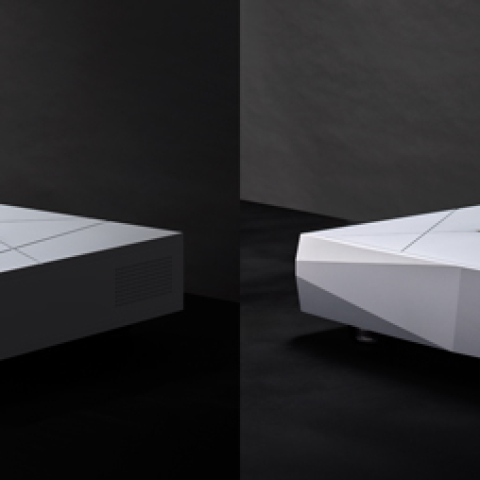
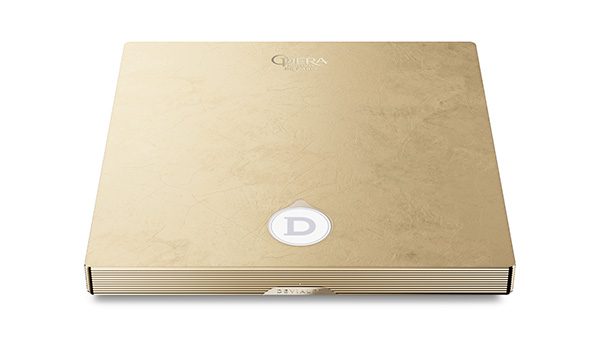
The design fundamentals of its predecessors remain. The slenderness of the chassis means there's not much space for a screen, except on top. But unlike the older models, the Astra is no longer made to be mountable to a wall—did anyone do that—so the circular, high-resolution monochrome display can only be seen if you're standing over it.
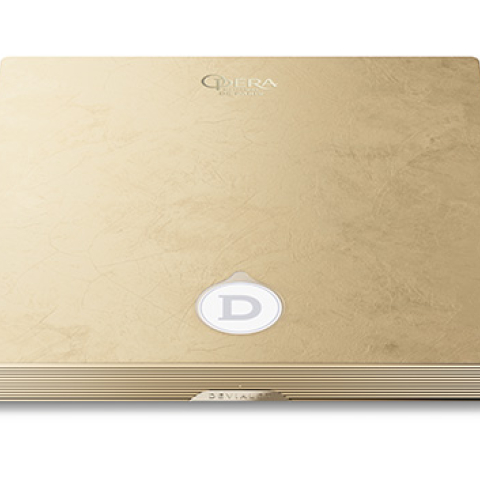
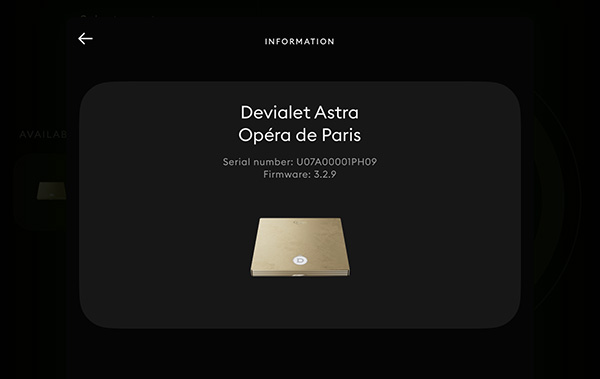
The Astra's finish is far more fingerprint resistant than that of previous models, but the Astra still ships with white cotton gloves in the box. Devialet calls the default finish Light Bronze, and indeed it has faint but pleasing warmth. Should that be too austere or insufficiently extravagant, an extra $5000 gets you the Opéra de Paris version, which is functionally identical but covered in 23-karat gold leaf. If that sentence prompted a loud nasal exhalation, that option isn't for you.
 Connectivity
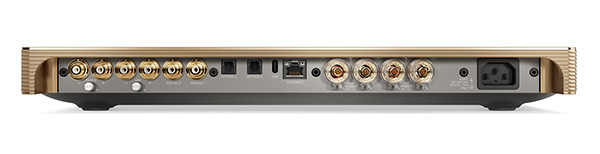
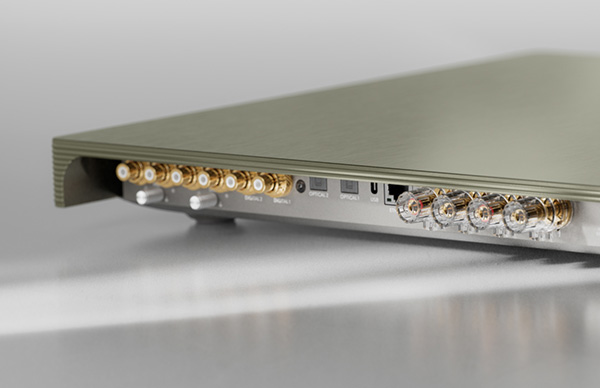
On prior models, the rear section had a removable cover for easier access to the connectors beneath it. That feature is gone, as the chassis is now milled from a solid block of aluminum. This improves the unit's visual appeal, but it makes connecting cables more irritating. I found connecting a turntable grounding wire very frustrating. Eventually, I flipped the Astra over, and it went more smoothly. Flipping it over was easy enough, since it weighs only 16.1lb (7.3kg). Also, most users will suffer through such fiddly setup frustrations only once or twice. While a review's requisite cable switching exhausted my vocabulary of invectives across several languages, I'll concede that for such an ambitious visual design, the connector layout and placement is justifiable. The physical connectors, some of which can be configured as outputs as well as inputs, are six RCA sockets, defaulting to a stereo input pair each of phono and line, plus two S/PDIF digital inputs. The phono input can be reconfigured to line in. There are also two TosLink, one USB-C, and one Ethernet RJ45 connector. There's no AES3, I2S, or analog XLR. If this connectivity seems meager (though it will suffice in most setups), wireless support is more plentiful. Streaming is supported over Google Cast, Apple AirPlay2, Bluetooth 5.3, UPnP, Spotify Connect, Tidal Connect, Audirvana, and Roon. Devialet says that Qobuz Connect is close to launching and might be available by the time you read this.
Take the wheel
The Astra's chassis has just two physical buttons, for Bluetooth pairing and power. Almost all interactions with the Astra are relegated to the app and the remote control. That remote is pretty special: A big wheel surrounding four touch buttons and a dot-matrix display that turns on when the wheel is touched. The remote has weight to it and rubber feet, so it stays put when you interact with it. Knob-feel aficionados take note: The wheel's rotation resistance and scale of volume change when you turn it feels tuned to near perfection. Some may complain about the fact that it's stepless, though others will cheer. A USB-C charging port lets you replenish the proprietary battery. It connects to the amplifier over Bluetooth instead of the more common infrared or radio frequency. I consistently forgot about the power switch on its bottom, leaving it on, but I still only charged it once during the review period.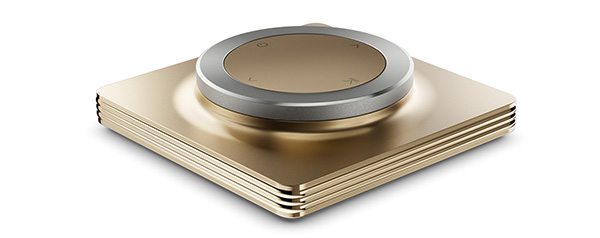 Less ideal is that the physical buttons of older models have been replaced on the remote with touch-sensitive icons so subtle that in dim light, at some angles, they're practically invisible. You quickly memorize them of course. Even so, having to long-press play/pause to activate input-selection mode feels needlessly cumbersome. (Doing it in the app—about which more below—is hardly better.)
It doesn't help that the remote control doesn't tell you which input you've switched to. And when an input is set to fixed volume, both the main display and the remote still show whatever setting the wheel is dialed to, even though it's irrelevant to the output.
Some of this might be fixable via firmware updates; we'll see.
Less ideal is that the physical buttons of older models have been replaced on the remote with touch-sensitive icons so subtle that in dim light, at some angles, they're practically invisible. You quickly memorize them of course. Even so, having to long-press play/pause to activate input-selection mode feels needlessly cumbersome. (Doing it in the app—about which more below—is hardly better.)
It doesn't help that the remote control doesn't tell you which input you've switched to. And when an input is set to fixed volume, both the main display and the remote still show whatever setting the wheel is dialed to, even though it's irrelevant to the output.
Some of this might be fixable via firmware updates; we'll see.
 A new app
Previous versions of the amplifier used the Devialet Expert Remote app. Instead, the Astra uses the same app "Phantom speakers use, called simply "Devialet." The app guided me through an uneventful firmware upgrade when the amplifier first powered up. All listening was done using firmware version 3.2.1. Prior Devialet amplifier models let the user save settings for things like input mapping to a memory card you'd then slot into the amplifier. This has been modernized to instead synchronize via the internet. I struggle to imagine how the configurator could be any more intuitive. One peculiarity is that the app lets you create configurations but not update them. This caused excessive clutter until I noticed an Edit button at devialet.com. Reliance on internet connectivity and the upkeep of Devialet's web services strikes me as a potential limitation on the Astra's longevity. Jean-Loup Afresne told me they're considering ways to mitigate this dependency.
At the time of the review, the app (version 1.25.2) exhibited several quirks on my iPhone 15 Pro, including an array of visual glitches and, briefly, listing a second Astra that didn't exist. The app reverted to the Start screen every time I opened it, which made it necessary to burrow into the interface again whenever I wanted to adjust things such as SAM speaker optimization.
Thankfully, software is easier to upgrade than hardware, and Devialet assured Stereophile that the app and operational firmware will continue to be refined.
Adaptability
There's a lot less elbow room at the switching-amplifier bar than there was 17 years ago when the D-Premier first appeared, but Devialet retains a competitive moat that few are equipped to conquer: an ever-expanding database of speaker measurements supporting SAM (Speaker Active Matching), which uses DSP to optimize the operation of included loudspeakers. Jim Austin's review of the Devialet Expert 140 Pro has more information about how this works.
 At the time I prepared this review, the SAM database contained about 1200 speaker models including the Focal Scala Utopias I've used since 2012 (footnote 1). With SAM switched on, the most immediately evident effect was deeper bass—not by the amount Jim experienced through the Revel Ultima2 Salon2s, which rattled the windows at the far end of the room (an apparent malfunction of that earlier version of SAM), but as though the rolloff is nudged downward a useful few Hz. While looking for bass-heavy music to explore the effect, I noticed that on Rhythm & Sound w/The Artists, by Rhythm & Sound and collaborators (16/44.1 FLAC, Burial Mix/Tidal), soundstage width improved, and depth improved a little. On Peter Gregson's self-titled album (24/96 FLAC, Decca/Tidal), I heard a slight smearing of his delicate electroacoustic textures with SAM fully on, but by setting it to around 50%, I was able to retain some of the bass and soundstage improvement while minimizing textural blurring—a net improvement. For me, these effects were small, similar in magnitude to the differences among DACs, though they surely will depend on what speakers you're using.
Should SAM not fully scratch your itch, more sound sculpting is possible using a fixed-frequency two-band EQ that's adjustable from –12dB to 12dB in 1dB increments. Each input can be configured with its own custom EQ adjustments—or none at all—so you can have a setting that's adapted to, eg, TV viewing via TosLink, or a rumble-taming bass dip attached to a phono stage. There's also a balance setting, though you can't EQ each speaker individually. Limiting the EQ to two bands and not allowing the user to set the Q value are reasonable safety precautions, but a 12dB boost is enormous, so proceed with care.
The Astra's Analog Devices SHARC ADSP-2156x chip can support Dirac, but Devialet said that implementing Dirac is not on their roadmap.
At the time I prepared this review, the SAM database contained about 1200 speaker models including the Focal Scala Utopias I've used since 2012 (footnote 1). With SAM switched on, the most immediately evident effect was deeper bass—not by the amount Jim experienced through the Revel Ultima2 Salon2s, which rattled the windows at the far end of the room (an apparent malfunction of that earlier version of SAM), but as though the rolloff is nudged downward a useful few Hz. While looking for bass-heavy music to explore the effect, I noticed that on Rhythm & Sound w/The Artists, by Rhythm & Sound and collaborators (16/44.1 FLAC, Burial Mix/Tidal), soundstage width improved, and depth improved a little. On Peter Gregson's self-titled album (24/96 FLAC, Decca/Tidal), I heard a slight smearing of his delicate electroacoustic textures with SAM fully on, but by setting it to around 50%, I was able to retain some of the bass and soundstage improvement while minimizing textural blurring—a net improvement. For me, these effects were small, similar in magnitude to the differences among DACs, though they surely will depend on what speakers you're using.
Should SAM not fully scratch your itch, more sound sculpting is possible using a fixed-frequency two-band EQ that's adjustable from –12dB to 12dB in 1dB increments. Each input can be configured with its own custom EQ adjustments—or none at all—so you can have a setting that's adapted to, eg, TV viewing via TosLink, or a rumble-taming bass dip attached to a phono stage. There's also a balance setting, though you can't EQ each speaker individually. Limiting the EQ to two bands and not allowing the user to set the Q value are reasonable safety precautions, but a 12dB boost is enormous, so proceed with care.
The Astra's Analog Devices SHARC ADSP-2156x chip can support Dirac, but Devialet said that implementing Dirac is not on their roadmap.
 The phono stage
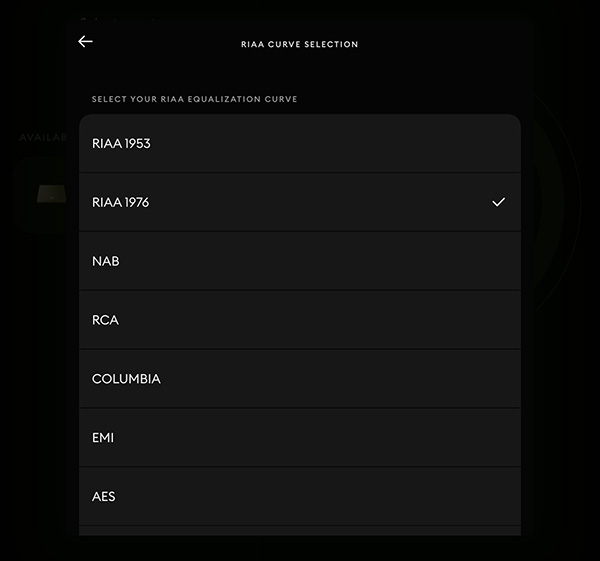
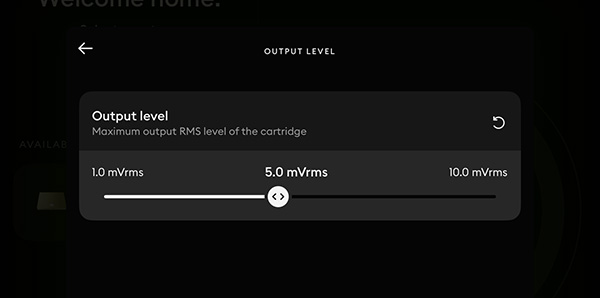
Devialet's website boldly proclaims the Astra to possess "The most advanced phono stage ever created." The Gold Note PH-1000 (reviewed in Stereophile by Michael Fremer) would like a word about that—but it's true that the Astra lets you configure an impressively wide range of EQ curves, loading, and channel-balance settings. The electrical settings are applied in the analog domain, while the chosen EQ curve is applied after conversion to digital. I don't think I have any records made for anything but the RIAA 1976 curve, so that's what I stuck with. I mounted a Concorde MKII Elite, Ortofon's top deejay cartridge, on a Jelco SA-750D arm on my Dr. Feickert Woodpecker turntable. This cartridge isn't (yet) included in Devialet's database of preconfigured cartridges, so I manually configured its high 8.5mV output. Resistance and impedance settings are seemingly ignored for MM configurations. That's okay: One-size-fits-all MM loading is usually fine.
The result on MM is a remarkably low noisefloor and a well-balanced, inoffensive sound. But when I substituted the Lejonklou Slipsik 8, an MM-only phono preamp with no user-configurable settings, which retails for $1995, the sound was more spacious, dynamic, and colorful. Sheherazaad's "Dhund Lo Mujhe," from Qasr (Erased Tapes Records ERATP164LE), went from nice to riveting. Goosebumps that had been absent billowed across my forearms.
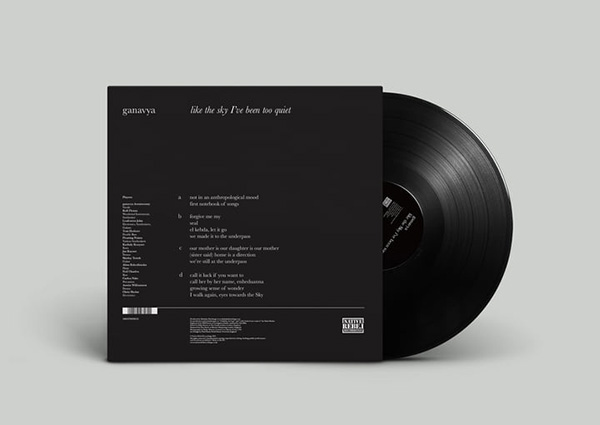 Switching to an Ortofon 2M Black, which does have a preset in Devialet's cartridge configurator, immediately showed what even high-end deejay cartridges sacrifice for the sake of durability: On Ganavya's Like the Sky I've Been Too Quiet (Native Rebel Recordings NRR0008LP), the scale of the soundspace expanded dramatically, and the sounds enveloping her voice became at once both more majestic and more intimate. So, although it was bested by the Lejonklou in unsubtle ways, the Astra can do ample justice to the differences between MM cartridges in this price range.
 My moving coil Dynavector XX-2 MkII also had a preset available. It sounded better than the 2M Black, as the price warrants, with a generous extra dose of liquidity, heft, and dimensionality in both voices and instruments, as on Björk's sonically diverse Cornucopia Live (LP, One Little Independent Records TPLP2008). As the Dynavector is my daily driver, I associate its sound with how it performs through my Manley Steelhead, against which the phono stage on the Astra stands little chance; after all, the phono-only Steelhead cost $10,899. Still, plugged into the Astra, the wondrous qualities I love the Steelhead for came through beautifully, surviving the digital detour practically unscathed.
For users with a modestly priced turntable setup, who primarily listen to digital but wish to maintain the ability to play records, the Astra's phono stage is wholly sufficient. Archival projects—you can configure S/PDIF output to digitize vinyl—can benefit from the wide range of EQ curves. But those who consider vinyl vital—for whom it is a primary means of consuming music—may want to use a separate phono preamp.
Digging digital
My moving coil Dynavector XX-2 MkII also had a preset available. It sounded better than the 2M Black, as the price warrants, with a generous extra dose of liquidity, heft, and dimensionality in both voices and instruments, as on Björk's sonically diverse Cornucopia Live (LP, One Little Independent Records TPLP2008). As the Dynavector is my daily driver, I associate its sound with how it performs through my Manley Steelhead, against which the phono stage on the Astra stands little chance; after all, the phono-only Steelhead cost $10,899. Still, plugged into the Astra, the wondrous qualities I love the Steelhead for came through beautifully, surviving the digital detour practically unscathed.
For users with a modestly priced turntable setup, who primarily listen to digital but wish to maintain the ability to play records, the Astra's phono stage is wholly sufficient. Archival projects—you can configure S/PDIF output to digitize vinyl—can benefit from the wide range of EQ curves. But those who consider vinyl vital—for whom it is a primary means of consuming music—may want to use a separate phono preamp.
Digging digital
In contrast to the phono pre, adding an external DAC is pointless since the Astra is internally digital. But to see if its handling of digital would fare better than its phono preamp, I fed my old Weiss DAC202 over S/PDIF from the Astra and into my MBL C51 integrated amplifier. I bought the Weiss in 2011 after extensive comparisons with the Devialet D-Premier. I mostly agreed with myself from 15 years ago: The Weiss edged out the Astra's internal DAC by a fractional but meaningful margin. The cloud of sound projected by the Weiss, for example on Nils Petter Molvær's Khmer Live in Bergen (24/48, Edition Records/Tidal), tickled my synapses slightly more effectively than the more grounded—and more full-bodied—rendition of the Astra's analog output. Some listeners may lean the other way. An integrated DAC getting this close indicates exemplary performance.
My preferred streaming interface is Roon, which works with the Astra's volume control. The specifications Devialet provided say that files delivered over the network with a sampling rate of 192kHz are downsampled to 96kHz, but Roon's signal-path display indicated that it remained at 192kHz until conversion.
I found Tidal Connect sonically indistinguishable from the same tracks played back from Tidal via Roon, though Tidal Connect was sometimes a struggle to activate: The Play button was unresponsive until I'd selected Tidal Connect as the input several times in the app. An inconvenience: You can't set the volume via the Tidal app when using Tidal Connect. Still, I'm not going to complain about having an opportunity to use the wheel on the Astra's delightful remote control. A larger issue is that the Play/Pause button on the remote doesn't work with Tidal Connect, so it's back to the app for that. Also not working: gapless playback. Streams that were gapless with Tidal Connect through my Grimm MU2 had gaps when played by the Devialet Astra.
Amplification comparison
I bought the Weiss in 2011 after extensive comparisons with the Devialet D-Premier. I mostly agreed with myself from 15 years ago: The Weiss edged out the Astra's internal DAC by a fractional but meaningful margin. The cloud of sound projected by the Weiss, for example on Nils Petter Molvær's Khmer Live in Bergen (24/48, Edition Records/Tidal), tickled my synapses slightly more effectively than the more grounded—and more full-bodied—rendition of the Astra's analog output. Some listeners may lean the other way. An integrated DAC getting this close indicates exemplary performance.
My preferred streaming interface is Roon, which works with the Astra's volume control. The specifications Devialet provided say that files delivered over the network with a sampling rate of 192kHz are downsampled to 96kHz, but Roon's signal-path display indicated that it remained at 192kHz until conversion.
I found Tidal Connect sonically indistinguishable from the same tracks played back from Tidal via Roon, though Tidal Connect was sometimes a struggle to activate: The Play button was unresponsive until I'd selected Tidal Connect as the input several times in the app. An inconvenience: You can't set the volume via the Tidal app when using Tidal Connect. Still, I'm not going to complain about having an opportunity to use the wheel on the Astra's delightful remote control. A larger issue is that the Play/Pause button on the remote doesn't work with Tidal Connect, so it's back to the app for that. Also not working: gapless playback. Streams that were gapless with Tidal Connect through my Grimm MU2 had gaps when played by the Devialet Astra.
Amplification comparison
Like the Astra, my MBL C51 uses a novel class-D topology; MBL calls it LASA, for Linear Analog Switching Amplifier. (John Atkinson's review of the MBL C15 monoblock has more on the topic.) Unlike Devialet's ADH, this maintains an analog signal path, which let me compare the sound of the two amplifiers using just the Astra's DAC. They sounded remarkably similar: effortless bass extension and control, silky midrange liquidity, with a masterful coherency to the sound. The Necks' "Signal" from Travel (16/44.1, Northern Spy/Tidal) is a long track. It's fully improvised jazz, but it's arranged like ambient: You can leave the room and return without feeling like you've missed anything. (Not that you'd want to.) Its length and consistency of sound invited me to switch amplifiers midsong, where I found the Astra to be slightly more open in the treble. It was not brighter or more incisive, but cymbals and the highest piano overtones were more alive and present: More fraîcheur, to exercise my still-meager French. On Evan Fraser & Vir McCoy's "Rare Earth," from Guardians (16/44.1, Interchill Records/Tidal), I found a smidge more texture in Soriah's lowest throat-singing notes and the dubby bassline through the MBL but more bass depth, control, and punch with the Devialet.
 Switching my 92dB/2.83V/1m-sensitive Focal Scala Utopia speakers to the 87dB/2.83V/1m-sensitive Silent Pound Bloom (review forthcoming), which aren't in the SAM database yet, the Astra still wouldn't exhaust its power reserves before my ears tapped out. Baker, Beck, Wyskida's Trzecia (Drugi) (44.1/16 FLAC, Cruel Nature Records/Tidal) combines Aidan Baker's lysergic processed guitar; the late Daron Beck's labyrinthine textures from piano, organ, and synth; and Tim Wyskida's ritualistic drumming into a monstrous entity that invites violently loud playback. The Astra maintained exquisite control and color fidelity even through the most intense crescendos, particularly the ultra-dense third track. 90dB levels at 11'–12' from the speakers sounded effortless. That's too loud for extended listening, but the Astra's sound remained remarkably nonfatiguing, lending credence to Devialet's claim of lower distortion in high frequencies, even at higher power.
 All together now
If you pursue getting drunk on sound, the Astra may still be for you: It's not the beverage but the designated driver that gets you there and home safely and unobtrusively, letting you indulge in whatever hedonism you prefer along the way. If vinyl is big in your life, playback can be improved substantially by adding a phono preamp at an additional tenth of its price. Its performance through Roon or digital inputs is nearly irreproachable. We'll see what the measurements say, but with digital I'm expecting the Astra to equal or surpass the D-Premier's immaculate technical performance.
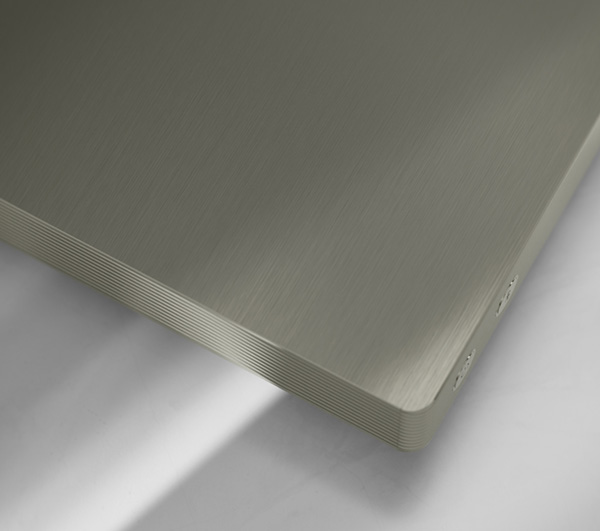 As a singular centerpiece to a digital system—just add speakers—the Astra's sleek beauty matches its imperturbable sonics. Its adaptability across input and output configurations, SAM, equalizer, and subwoofer support makes it an unusually safe bet, but never boring or dull—no matter what future rooms and speakers it gets to perform with. There may be a few software kinks to iron out, but even today—17 years after the D-Premier's introduction—there's nothing quite like a Devialet amplifier. They're the real deal
Footnote 1: Want to see if your speakers are listed? Consult devialet.com/en-us/expert-pro-sam-ready-speakers/.
ConnectivityOn prior models, the rear section had a removable cover for easier access to the connectors beneath it. That feature is gone, as the chassis is now milled from a solid block of aluminum. This improves the unit's visual appeal, but it makes connecting cables more irritating. I found connecting a turntable grounding wire very frustrating. Eventually, I flipped the Astra over, and it went more smoothly. Flipping it over was easy enough, since it weighs only 16.1lb (7.3kg). Also, most users will suffer through such fiddly setup frustrations only once or twice. While a review's requisite cable switching exhausted my vocabulary of invectives across several languages, I'll concede that for such an ambitious visual design, the connector layout and placement is justifiable. The physical connectors, some of which can be configured as outputs as well as inputs, are six RCA sockets, defaulting to a stereo input pair each of phono and line, plus two S/PDIF digital inputs. The phono input can be reconfigured to line in. There are also two TosLink, one USB-C, and one Ethernet RJ45 connector. There's no AES3, I2S, or analog XLR. If this connectivity seems meager (though it will suffice in most setups), wireless support is more plentiful. Streaming is supported over Google Cast, Apple AirPlay2, Bluetooth 5.3, UPnP, Spotify Connect, Tidal Connect, Audirvana, and Roon. Devialet says that Qobuz Connect is close to launching and might be available by the time you read this.
The Astra's chassis has just two physical buttons, for Bluetooth pairing and power. Almost all interactions with the Astra are relegated to the app and the remote control. That remote is pretty special: A big wheel surrounding four touch buttons and a dot-matrix display that turns on when the wheel is touched. The remote has weight to it and rubber feet, so it stays put when you interact with it. Knob-feel aficionados take note: The wheel's rotation resistance and scale of volume change when you turn it feels tuned to near perfection. Some may complain about the fact that it's stepless, though others will cheer. A USB-C charging port lets you replenish the proprietary battery. It connects to the amplifier over Bluetooth instead of the more common infrared or radio frequency. I consistently forgot about the power switch on its bottom, leaving it on, but I still only charged it once during the review period.
Less ideal is that the physical buttons of older models have been replaced on the remote with touch-sensitive icons so subtle that in dim light, at some angles, they're practically invisible. You quickly memorize them of course. Even so, having to long-press play/pause to activate input-selection mode feels needlessly cumbersome. (Doing it in the app—about which more below—is hardly better.)
It doesn't help that the remote control doesn't tell you which input you've switched to. And when an input is set to fixed volume, both the main display and the remote still show whatever setting the wheel is dialed to, even though it's irrelevant to the output.
A new appPrevious versions of the amplifier used the Devialet Expert Remote app. Instead, the Astra uses the same app "Phantom speakers use, called simply "Devialet." The app guided me through an uneventful firmware upgrade when the amplifier first powered up. All listening was done using firmware version 3.2.1. Prior Devialet amplifier models let the user save settings for things like input mapping to a memory card you'd then slot into the amplifier. This has been modernized to instead synchronize via the internet. I struggle to imagine how the configurator could be any more intuitive. One peculiarity is that the app lets you create configurations but not update them. This caused excessive clutter until I noticed an Edit button at devialet.com. Reliance on internet connectivity and the upkeep of Devialet's web services strikes me as a potential limitation on the Astra's longevity. Jean-Loup Afresne told me they're considering ways to mitigate this dependency.
There's a lot less elbow room at the switching-amplifier bar than there was 17 years ago when the D-Premier first appeared, but Devialet retains a competitive moat that few are equipped to conquer: an ever-expanding database of speaker measurements supporting SAM (Speaker Active Matching), which uses DSP to optimize the operation of included loudspeakers. Jim Austin's review of the Devialet Expert 140 Pro has more information about how this works.
At the time I prepared this review, the SAM database contained about 1200 speaker models including the Focal Scala Utopias I've used since 2012 (footnote 1). With SAM switched on, the most immediately evident effect was deeper bass—not by the amount Jim experienced through the Revel Ultima2 Salon2s, which rattled the windows at the far end of the room (an apparent malfunction of that earlier version of SAM), but as though the rolloff is nudged downward a useful few Hz. While looking for bass-heavy music to explore the effect, I noticed that on Rhythm & Sound w/The Artists, by Rhythm & Sound and collaborators (16/44.1 FLAC, Burial Mix/Tidal), soundstage width improved, and depth improved a little. On Peter Gregson's self-titled album (24/96 FLAC, Decca/Tidal), I heard a slight smearing of his delicate electroacoustic textures with SAM fully on, but by setting it to around 50%, I was able to retain some of the bass and soundstage improvement while minimizing textural blurring—a net improvement. For me, these effects were small, similar in magnitude to the differences among DACs, though they surely will depend on what speakers you're using.
Should SAM not fully scratch your itch, more sound sculpting is possible using a fixed-frequency two-band EQ that's adjustable from –12dB to 12dB in 1dB increments. Each input can be configured with its own custom EQ adjustments—or none at all—so you can have a setting that's adapted to, eg, TV viewing via TosLink, or a rumble-taming bass dip attached to a phono stage. There's also a balance setting, though you can't EQ each speaker individually. Limiting the EQ to two bands and not allowing the user to set the Q value are reasonable safety precautions, but a 12dB boost is enormous, so proceed with care.
The Astra's Analog Devices SHARC ADSP-2156x chip can support Dirac, but Devialet said that implementing Dirac is not on their roadmap.
The phono stageDevialet's website boldly proclaims the Astra to possess "The most advanced phono stage ever created." The Gold Note PH-1000 (reviewed in Stereophile by Michael Fremer) would like a word about that—but it's true that the Astra lets you configure an impressively wide range of EQ curves, loading, and channel-balance settings. The electrical settings are applied in the analog domain, while the chosen EQ curve is applied after conversion to digital. I don't think I have any records made for anything but the RIAA 1976 curve, so that's what I stuck with. I mounted a Concorde MKII Elite, Ortofon's top deejay cartridge, on a Jelco SA-750D arm on my Dr. Feickert Woodpecker turntable. This cartridge isn't (yet) included in Devialet's database of preconfigured cartridges, so I manually configured its high 8.5mV output. Resistance and impedance settings are seemingly ignored for MM configurations. That's okay: One-size-fits-all MM loading is usually fine.
Switching to an Ortofon 2M Black, which does have a preset in Devialet's cartridge configurator, immediately showed what even high-end deejay cartridges sacrifice for the sake of durability: On Ganavya's Like the Sky I've Been Too Quiet (Native Rebel Recordings NRR0008LP), the scale of the soundspace expanded dramatically, and the sounds enveloping her voice became at once both more majestic and more intimate. So, although it was bested by the Lejonklou in unsubtle ways, the Astra can do ample justice to the differences between MM cartridges in this price range.
My moving coil Dynavector XX-2 MkII also had a preset available. It sounded better than the 2M Black, as the price warrants, with a generous extra dose of liquidity, heft, and dimensionality in both voices and instruments, as on Björk's sonically diverse Cornucopia Live (LP, One Little Independent Records TPLP2008). As the Dynavector is my daily driver, I associate its sound with how it performs through my Manley Steelhead, against which the phono stage on the Astra stands little chance; after all, the phono-only Steelhead cost $10,899. Still, plugged into the Astra, the wondrous qualities I love the Steelhead for came through beautifully, surviving the digital detour practically unscathed.
In contrast to the phono pre, adding an external DAC is pointless since the Astra is internally digital. But to see if its handling of digital would fare better than its phono preamp, I fed my old Weiss DAC202 over S/PDIF from the Astra and into my MBL C51 integrated amplifier.
I bought the Weiss in 2011 after extensive comparisons with the Devialet D-Premier. I mostly agreed with myself from 15 years ago: The Weiss edged out the Astra's internal DAC by a fractional but meaningful margin. The cloud of sound projected by the Weiss, for example on Nils Petter Molvær's Khmer Live in Bergen (24/48, Edition Records/Tidal), tickled my synapses slightly more effectively than the more grounded—and more full-bodied—rendition of the Astra's analog output. Some listeners may lean the other way. An integrated DAC getting this close indicates exemplary performance.
Like the Astra, my MBL C51 uses a novel class-D topology; MBL calls it LASA, for Linear Analog Switching Amplifier. (John Atkinson's review of the MBL C15 monoblock has more on the topic.) Unlike Devialet's ADH, this maintains an analog signal path, which let me compare the sound of the two amplifiers using just the Astra's DAC. They sounded remarkably similar: effortless bass extension and control, silky midrange liquidity, with a masterful coherency to the sound. The Necks' "Signal" from Travel (16/44.1, Northern Spy/Tidal) is a long track. It's fully improvised jazz, but it's arranged like ambient: You can leave the room and return without feeling like you've missed anything. (Not that you'd want to.) Its length and consistency of sound invited me to switch amplifiers midsong, where I found the Astra to be slightly more open in the treble. It was not brighter or more incisive, but cymbals and the highest piano overtones were more alive and present: More fraîcheur, to exercise my still-meager French. On Evan Fraser & Vir McCoy's "Rare Earth," from Guardians (16/44.1, Interchill Records/Tidal), I found a smidge more texture in Soriah's lowest throat-singing notes and the dubby bassline through the MBL but more bass depth, control, and punch with the Devialet.
Switching my 92dB/2.83V/1m-sensitive Focal Scala Utopia speakers to the 87dB/2.83V/1m-sensitive Silent Pound Bloom (review forthcoming), which aren't in the SAM database yet, the Astra still wouldn't exhaust its power reserves before my ears tapped out. Baker, Beck, Wyskida's Trzecia (Drugi) (44.1/16 FLAC, Cruel Nature Records/Tidal) combines Aidan Baker's lysergic processed guitar; the late Daron Beck's labyrinthine textures from piano, organ, and synth; and Tim Wyskida's ritualistic drumming into a monstrous entity that invites violently loud playback. The Astra maintained exquisite control and color fidelity even through the most intense crescendos, particularly the ultra-dense third track. 90dB levels at 11'–12' from the speakers sounded effortless. That's too loud for extended listening, but the Astra's sound remained remarkably nonfatiguing, lending credence to Devialet's claim of lower distortion in high frequencies, even at higher power.
All together nowIf you pursue getting drunk on sound, the Astra may still be for you: It's not the beverage but the designated driver that gets you there and home safely and unobtrusively, letting you indulge in whatever hedonism you prefer along the way. If vinyl is big in your life, playback can be improved substantially by adding a phono preamp at an additional tenth of its price. Its performance through Roon or digital inputs is nearly irreproachable. We'll see what the measurements say, but with digital I'm expecting the Astra to equal or surpass the D-Premier's immaculate technical performance.
As a singular centerpiece to a digital system—just add speakers—the Astra's sleek beauty matches its imperturbable sonics. Its adaptability across input and output configurations, SAM, equalizer, and subwoofer support makes it an unusually safe bet, but never boring or dull—no matter what future rooms and speakers it gets to perform with. There may be a few software kinks to iron out, but even today—17 years after the D-Premier's introduction—there's nothing quite like a Devialet amplifier. They're the real deal
Footnote 1: Want to see if your speakers are listed? Consult devialet.com/en-us/expert-pro-sam-ready-speakers/.