Silver platters and I began divorce proceedings over a decade ago. The separation began when the husband and I contemplated liberating ourselves from crime-ridden East Oakland and moving to placid Port Townsend (where anarchist deer, rather than Norteño gang members, wreak havoc on our daily lives). There was no way I was going to haul 55 big boxes of CDs 846 miles and have no place to put them.
I refused to part with my vocal CDs. Ditto for my LPs and 78s, though my only turntable was destroyed in transit. All that media plus eight large boxes of CDs and SACDs that inexplicably slipped through the cracks and remained unsold at moving time ended up in a huge, diesel-belching van that destroyed all semblance of tranquility in our new, usually quiet neighborhood.
The vocal discs now reside in the music room, where they call to me like sirens. The unprocessed CDs and SACDs are secreted in another deep place—beneath a card table in my office—awaiting the time when I rip and then sell them. In August, they will have gathered dust for 12 years.
Having no room to store additional physical media, I started to beg record label publicists to instead send hi-resolution files. Getting hi-rez was a challenge, especially in the early days when I was virtually the only music reviewer insisting on it.
For the past few years, silver platters have played virtually no role in my life. I own a dCS Rossini Transport, but I was forced to remove it from my equipment rack to make room for review devices.
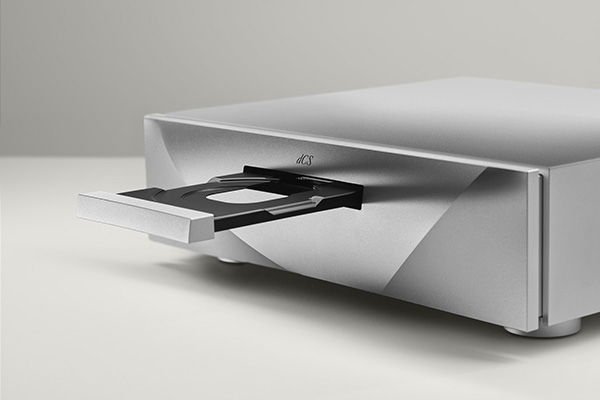
Having not heard a single silver disc in 24 months, except at audio shows, the notion of reviewing the new dCS Varèse CD/SACD Transport ($39,950) may seem odd. Yet the curious assortment of atoms and empty space that constitutes the brain of JVS was excited by the opportunity to discover how much joy and richness could be retrieved from the playback medium at the heart of the digital recording revolution.
 What it is
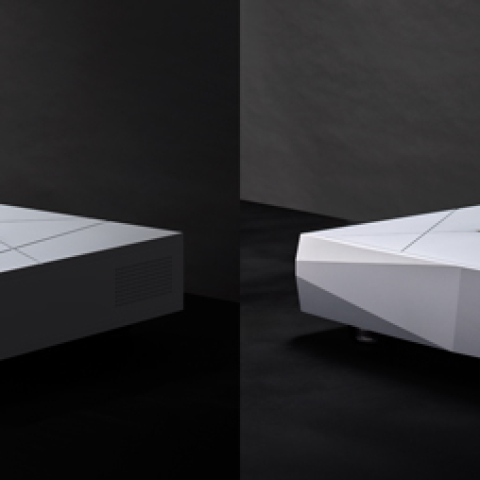
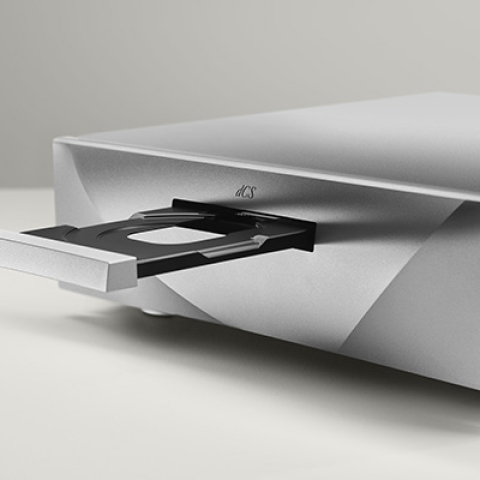
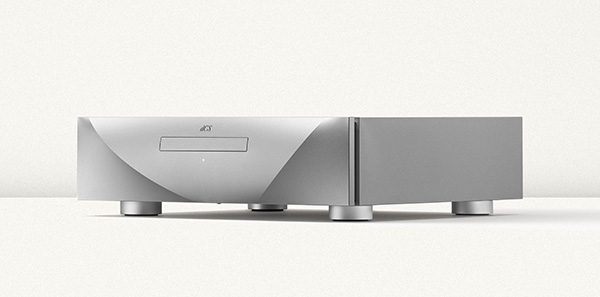
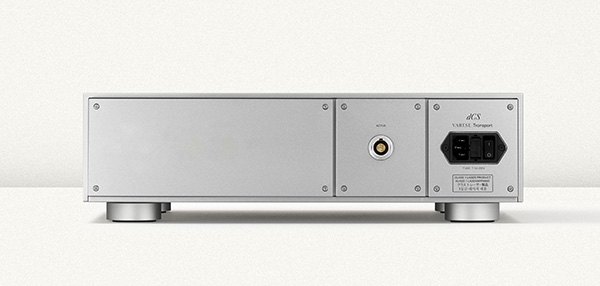
The elegant face of the Varèse Transport, which contains its front-loading transport tray and, directly below it, a teeny status LED, is as uncluttered as can be. Ditto for the rear, which contains a single ACTUS output port (for connection to the Varèse Core) and a combined power socket, fuse, and power switch. You will likely not notice the two small buttons beyond its bottom edge: The middle one toggles between on, standby, and sleep, and the button three-quarters of the way across opens and closes the transport tray. Nor will you think much of the status LED's light show, which remains bright white most of the time but pulses when the connection is incomplete. (Other light show states: Dim = standby, red = sleep, magenta = installing a firmware upgrade, off = off.) Clearly there must be something special going on inside to justify the price tag. To get the skinny, I spoke by Zoom with James Cook, Cambridge-based dCS product marketing manager, and Emron Mangelson, director, dCS North America. Despite rumors to the contrary, Cook assured me that the only element shared by the Rossini, Vivaldi, and Varèse Transports is their Denon & Marantz CD/SACD mechanism. "Everything else is unique," he said.
"The transport has three essential jobs. First, it must extract bit-perfect data from the disc. Simultaneously, it must minimize vibrations that might generate electronic and acoustic noise. Third, it must be able to accept an external clock signal so that it can be clocked by a master clock's more accurate clock circuitry. The D&M mechanism does all three of those things for both CDs and SACDs.
"We've done a huge amount of mechanical work to give the transport a proper, noise-free housing to perform well in. The chassis, circuit board, and power supply designs are entirely new. In both the Rossini and Vivaldi Transports, the chassis was constructed of six different pieces. With the Varèse, there are only two pieces that come together a bit like a clamshell to form pretty much a completely electrically sealed unit."
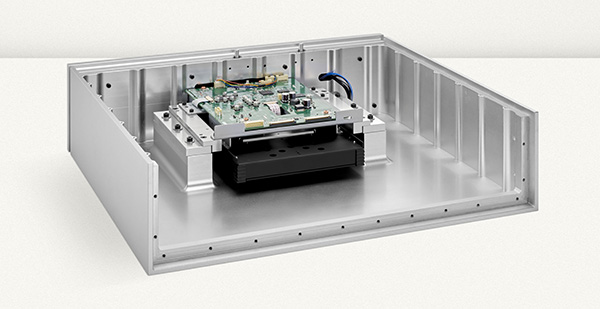 dCS feels that how you mount the transport mechanism to the chassis is of paramount importance. In the Varèse Transport, the mechanism is mounted to the top plate of the chassis via two aluminum "almost stalactites," which extend down from the heavy billet of unbroken aluminum that is the top plate.
"Mounting onto the two stalactites provided the best isolation we could get," Cook said. "It allows us to fine-tune the mounting to adjust for slight deviations in mechanical tolerances. The Varèse Transport's mechanical construction is a lot more advanced than anything we've done previously, and it contributes to the most stable transport that we have ever made by quite a significant margin."
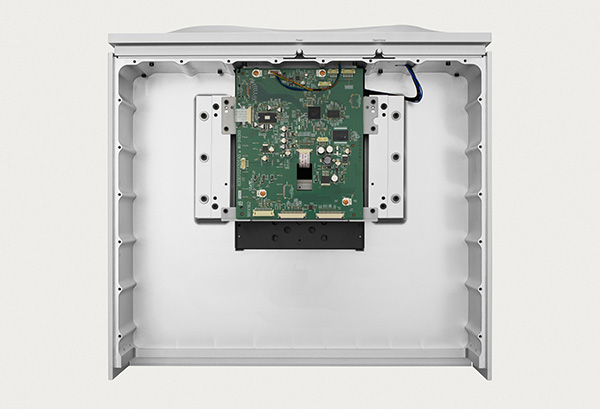
All electronic components are mounted on a single, innovative circuit board. This allows extra space to separate and isolate the power supply modules in the bottom left-hand corner of the unit, away from the clock circuitry in the top right corner and the computer in another corner that runs the ACTUS interface, encodes, and decodes.
dCS feels that how you mount the transport mechanism to the chassis is of paramount importance. In the Varèse Transport, the mechanism is mounted to the top plate of the chassis via two aluminum "almost stalactites," which extend down from the heavy billet of unbroken aluminum that is the top plate.
"Mounting onto the two stalactites provided the best isolation we could get," Cook said. "It allows us to fine-tune the mounting to adjust for slight deviations in mechanical tolerances. The Varèse Transport's mechanical construction is a lot more advanced than anything we've done previously, and it contributes to the most stable transport that we have ever made by quite a significant margin."
All electronic components are mounted on a single, innovative circuit board. This allows extra space to separate and isolate the power supply modules in the bottom left-hand corner of the unit, away from the clock circuitry in the top right corner and the computer in another corner that runs the ACTUS interface, encodes, and decodes.
 Clocking
The Varèse Transport incorporates dCS's standard clock circuitry with a 27MHz oscillator. When the external Varèse Clock generates a master clock signal for the whole system, the transport locks onto that master clock signal and adjusts its own oscillators to match. "The transport uses those oscillators to carry out necessary internal operations that include running the CD mechanism or clocking the audio output from the mechanism itself to make sure that we're getting samples that are free from jitter," Cook said. "A key difference between the Varèse Transport and pretty much anything else that exists on the market currently is that it sends the data out asynchronously. Other transports, including the Vivaldi and the Rossini, use a synchronous interface—something like AES or S/PDIF—that by its nature has quality limitations. This is why we've shifted to using ACTUS interconnects in the Varèse system. Getting asynchronous data out of the Varèse Transport and feeding it in native format into the Varèse Core for the rest of the audio processing makes quite a bit of difference."
"When we first heard the transport at dCS headquarters, the difference was stunning," Mangelson said.
Cook clarified that the Varèse system always utilizes a master clock signal to keep the clocks in the transport and the other units synchronized. "The external clock signal acts as a reference for each of the unit's own internal clocks. Once they lock up to it, it enables them to speed up or slow down so that everything in the Varèse system operates in synch. At no point does that master clock signal replace anything. It essentially works to improve the quality of each of the internal clock circuits and make sure that they're all singing from the same hymn sheet and keeping the same time." How English of it.
Mangelson's turn. "The Varèse system, even without its master clock, has intrinsically lower jitter than a full Vivaldi system with an external Master Clock," he noted. "The TOMIX timing protocol we use in Varèse is far more precise than anything we've used before."
Cook noted that all the power supplies in individual Varèse units lock synchronously to the master clock, thereby controlling playback at direct multiples of 44.1kHz. No noise is injected back into the system. This allows the Varèse Transport to use a quiet switching power supply that operates at the same frequencies as the audio.
"One part of the secret sauce to dCS performance is the way in which we deploy our clocks," Mangelson said. "Even the displays are clocked to the audio clocks. This eliminates noise that customarily arises when display microprocessors run at completely different nonmultiples of audio. That's why you don't need to shut off dCS displays in order to eliminate noise."
 Other considerations
Another difference between the Varèse Transport and the upsampling transports for Rossini and Vivaldi is that the Varèse Transport always plays back in native resolution. Rather than upsample, it sends everything to the Core. If the user wants to convert PCM to DSD, conversion occurs in the Core. Cook noted that dCS performs upsampling differently than some other companies. "We don't use linear interpolation," he said. "We upsample without adding or subtracting anything. The process is completely transparent."
At least one audio company known primarily for its DACs maintains that CDs have the potential to sound better than files. dCS, however, remains agnostic about sources.
"You can get fantastic sound quality, even from Red Book CDs," Cook insisted. "In our units, if you use a master clock, CD playback should deliver sound comparable to files ripped from that CD. The provenance of file and disc just need to be the same. The Varèse system will make the best of whatever source material is fed to it."
During a long conversation about bit rates, I mentioned that John Atkinson, in his measurements, sometimes comments on the actual dynamic resolution capability of DACs under review. Cook claimed that because dCS DACs "whack up" any distortion as noise to around 350kHz, they can achieve true 24-bit dynamic resolution.
Vinyl is much worse. "Vinyl as a format is conservatively 13 bits at most," he said, meaning that the dynamic range with vinyl is equivalent to 13 bits in a digital system (footnote 1). "The dynamics physically aren't there with the vinyl medium in the same way that they would be with digital. But it should be noted that dynamic resolution is not as linear in the ear as it is when drawing it out as numbers.
So, for example, 16 bits on a CD can sound really damn good if it's well-dithered to deliver dynamic resolution far beyond what the medium of a CD supposedly allows." At the conversation's end, Cook summarized his thoughts about the Varèse CD/SACD Transport. "The Varèse Transport is the quietest, most stable, lowest jitter transport that we have ever made by quite a significant margin. It is also the easiest to use, with one connection in and out. Plug it into the Core, turn it on, and everything comes online. There's no need for separate clock connections, choice of sync modes or upsampling methods. None of that. It's a plug-and-play job. It may be very technologically advanced, but it's quite understated in how simple it is to use."
 Why is so little in Serinusland simple?
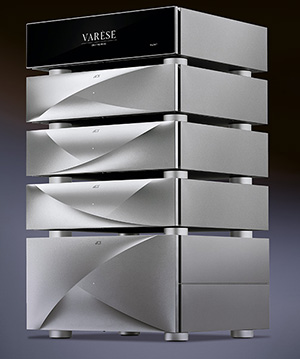
Placing the Varèse Transport in my rack was easy. Putting the same Wilson Audio Pedestals under it that I use under my other Varèse gear, connecting the supplied ACTUS cable to an open port on the Varèse Core, and using the same brand/model of power cable that I use in my file playback setup was equally simple.
Ditto for playback, also simple. Although I needed to leave my seat to change discs, all other functions, including opening and closing the tray, selecting which track to play, and adjusting volume could be performed from my listening position using the dCS Mosaic ACTUS app (though I favor the Varèse remote control for adjusting volume). Comparing disc and file playback, I could remain seated and use the app to seamlessly move between them.
Sometimes I preferred to open and close the tray using the button on the transport's bottom edge and control playback from the Varèse Display. In contrast to players with big colorful screens that display album cover art and other information, on the Varèse tracks were only identified by a number. I happily used booklets and disc jackets to identify which track was playing.
I did everything I could to level the playing field between disc and file playback. I disconnected all Nordost QKore grounding devices from components on the file-playback side. I moved four power cables and two pairs of Nordost QWave and QSine devices to ensure that neither playback medium had an unfair advantage over the other. Because expensive power cables do not grow on trees, this was a far more time-consuming process than I wish to recount.
My thanks to Joe Reynolds, Meredith Gabor, and Michael Taylor of Nordost as well as to Bill Low, Garth Powell, and Stephen Mejias of AudioQuest for making this journey possible (footnote 2). Finally, I made sure I was comparing apples to apples—physical discs to rips of the files they contain. I could not, for example, compare a DSD-native SACD of one of Michael Tilson Thomas and the San Francisco Symphony's Mahler symphonies to the 24/96 stream on Qobuz. Even in the case of pianist Murray Perahia's 16/44.1 recording of Handel and Scarlatti, which you can stream in 16/44.1, I did not know if the 16/44.1 files on Qobuz were exactly the same as those on the CD.
My thanks to Scott Campbell for taking one of my Murray Perahia CDs to his house and ripping it to a 16/44.1 AIFF file using bit-perfect ripping software, transferring the files to a USB-B stick, and bringing everything back in time to allow me to complete this review.
Footnote 1: A resolution of 13 bits is correct when averaged across the entire audioband but LP actually has >16-bit resolution in the low treble where the ear is most sensitive.—John Atkinson
Footnote 2: Equal thanks to John Giolas, Gary Breustle, Hans Brackmann, Gabriel Jones, Norm Varney, and the many folks at dCS, D'Agostino, Wilson, Innuos, Grand Prix, Artnovion, AXISS distribution, Bart Andeer, and more for having my back. Gratitude abounds.
What it isThe elegant face of the Varèse Transport, which contains its front-loading transport tray and, directly below it, a teeny status LED, is as uncluttered as can be. Ditto for the rear, which contains a single ACTUS output port (for connection to the Varèse Core) and a combined power socket, fuse, and power switch. You will likely not notice the two small buttons beyond its bottom edge: The middle one toggles between on, standby, and sleep, and the button three-quarters of the way across opens and closes the transport tray. Nor will you think much of the status LED's light show, which remains bright white most of the time but pulses when the connection is incomplete. (Other light show states: Dim = standby, red = sleep, magenta = installing a firmware upgrade, off = off.) Clearly there must be something special going on inside to justify the price tag. To get the skinny, I spoke by Zoom with James Cook, Cambridge-based dCS product marketing manager, and Emron Mangelson, director, dCS North America. Despite rumors to the contrary, Cook assured me that the only element shared by the Rossini, Vivaldi, and Varèse Transports is their Denon & Marantz CD/SACD mechanism. "Everything else is unique," he said.
dCS feels that how you mount the transport mechanism to the chassis is of paramount importance. In the Varèse Transport, the mechanism is mounted to the top plate of the chassis via two aluminum "almost stalactites," which extend down from the heavy billet of unbroken aluminum that is the top plate.
ClockingThe Varèse Transport incorporates dCS's standard clock circuitry with a 27MHz oscillator. When the external Varèse Clock generates a master clock signal for the whole system, the transport locks onto that master clock signal and adjusts its own oscillators to match. "The transport uses those oscillators to carry out necessary internal operations that include running the CD mechanism or clocking the audio output from the mechanism itself to make sure that we're getting samples that are free from jitter," Cook said. "A key difference between the Varèse Transport and pretty much anything else that exists on the market currently is that it sends the data out asynchronously. Other transports, including the Vivaldi and the Rossini, use a synchronous interface—something like AES or S/PDIF—that by its nature has quality limitations. This is why we've shifted to using ACTUS interconnects in the Varèse system. Getting asynchronous data out of the Varèse Transport and feeding it in native format into the Varèse Core for the rest of the audio processing makes quite a bit of difference."
Other considerationsAnother difference between the Varèse Transport and the upsampling transports for Rossini and Vivaldi is that the Varèse Transport always plays back in native resolution. Rather than upsample, it sends everything to the Core. If the user wants to convert PCM to DSD, conversion occurs in the Core. Cook noted that dCS performs upsampling differently than some other companies. "We don't use linear interpolation," he said. "We upsample without adding or subtracting anything. The process is completely transparent."
Why is so little in Serinusland simple?Placing the Varèse Transport in my rack was easy. Putting the same Wilson Audio Pedestals under it that I use under my other Varèse gear, connecting the supplied ACTUS cable to an open port on the Varèse Core, and using the same brand/model of power cable that I use in my file playback setup was equally simple.
Footnote 1: A resolution of 13 bits is correct when averaged across the entire audioband but LP actually has >16-bit resolution in the low treble where the ear is most sensitive.—John Atkinson