Wilson Audio of Provo, Utah, is executing a multiyear revision of their product line, resulting mostly in a series of "remastered" redesigns that carry in their names the designation "V." The latest V model is the Sabrina V, which replaces the prior SabrinaX. "V" refers to Wilson's proprietary V-Material first used in the Chronosonic XVX. This is the third iteration of the Sabrina series. Other current Wilsons designated V are the Alexx V, the Alexia V, and the Sasha V. The Chronosonic XVX uses the V-Material but precedes the "V" revisions; the 50th anniversary WATT/Puppy also uses the V-Material but doesn't carry a "V" designation.
For some audiophiles, "bigger is better" is a common and valid aspirational path—and there's no doubt that larger speakers, when designed correctly, can deliver more scale and deeper, more abundant bass, and that can be a source of much fun and satisfaction. Those familiar with Wilson Audio Specialties know that they offer really big speakers, but not exclusively. At the small end of their lineup is the two-way TuneTot, intended to sit on stands or shelves, and the Alida CSC, which can be mounted to vertical surfaces. In addition to taste, logistics and budget typically dictate: Hi-fi is the art of the possible.
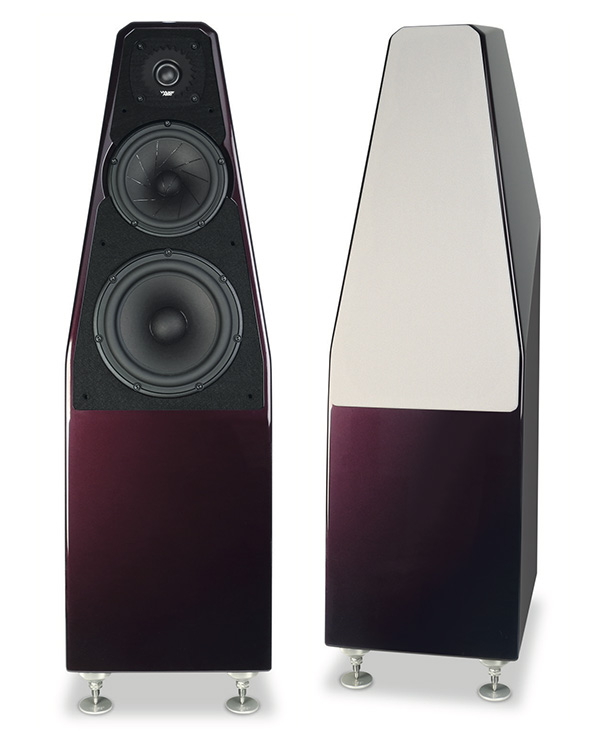
The Sabrina V ($28,500/pair in standard finishes) is a three-way, single-cabinet floorstander. (Every larger Wilson speaker comprises at least two separate boxes that connect together.) It is the smallest floorstander in the current Wilson line, with the most economical price. However, size, price, and substance are all relative. The Sabrina V is all-Wilson, sculpted and substantial.
I previously reviewed and then purchased and lived with the Sasha DAW and the Sasha V loudspeakers. A year ago now, we relocated, and I needed to fit my reference system into a multipurpose music room. I traded the Sasha Vs for the somewhat smaller 50th Anniversary WATT/Puppy, which was brand new. The difference in size isn't large, but it's just enough: It fits perfectly. I now have elbow room while playing my upright piano. It also weighs 85lb less, which makes it easier to move around.
The opportunity to evaluate the Sabrina V continues my downsizing experiments, though at the moment I have no plans to replace my WATT/Puppies.
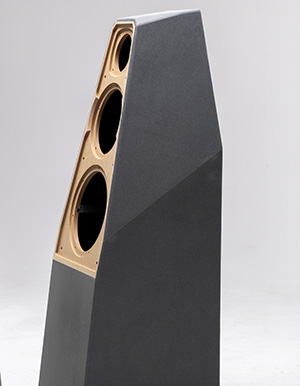 Table of contents
Those who know Wilson Audio's products will find much familiar about the new Sabrina V, but there are also some important changes, in design as well as hardware. The exterior dimensions are 38 31/32" H × 12" W × 15 3/8" D, the last two dimensions measured at the base. That's almost the same as the previous model: The V version is taller than the X by slightly less than an inch. This small difference, plus a change in the midrange drivers, contributes to a weight gain of 11lb, up to 123lb per speaker.
The cabinet is shaped like an obelisk but with only a subtle taper; the 15 3/8" base depth drops to 6½" at the top, and the 12" width becomes approximately 6". These modest dimensions make the Sabrina V far less imposing in the home environment than Wilson's bigger models. Their configuration maximizes the cubic inches of chamber in which the woofer is housed.
The quality of the paint is superb, as always with Wilson. The reflective Ethereal White pair (a new color) is highlighted by a subtle bevel on the sides that creates interesting reflections. They reflected, during daytime, colors from outdoors, and at night, the blue illumination from the meters of my McIntosh equipment. Sexy!
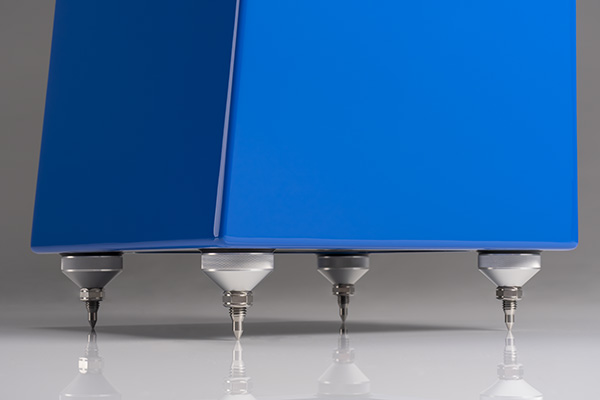
Other changes visible from the outside include resistors mounted on the rear that can be changed easily by the user; these are a part of the crossover but also serve as protective fuses: They'll blow if a massive current surge hits. A newly designed V-Material spike interface called V-MCD has been integrated with the bottom of the enclosure, providing improved vibration damping with any chosen spikes. The Sabrina V's bass-reflex design, with its rear-ported woofer and rear-vented midrange driver, continues unchanged: The hefty, finely machined aluminum woofer port is a hardware standout. A pair of heavy-duty speaker taps completes the rear-mounted hardware; Wilson doesn't support biwiring.
Inside, the crossovers now include two new capacitors. Wilson notes, "The soul of the Sabrina V resides in its crossover. ... At the heart of this crossover are Wilson Audio's uniquely wound AudioCapX-WA capacitors, produced in-house. A variant first introduced in the Sasha V ... improves high-frequency micro-detail and spatial clarity. ... Bass integration is also enhanced through the development of a new woofer capacitor." CEO-designer Daryl Wilson exercises his chef 's prerogative, keeping crossover values to himself.
Wilson Audio Specialties has for years utilized proprietary cabinet materials, assigning each a letter. X-Material is employed for enclosures and internal bracing. V-Material is used at interface locations for vibration control. Though, consistent with other recent loudspeaker remasters, the Sabrina carries the "V" designation, the Sabrina introduces a material that Wilson hasn't used before, designated H-Material, employed on the front baffle, to which the drivers are mounted. Wilson says the H-Material was "developed as a high-density composite with organic and phenolic properties. ... H-Material is similar to X-Material in inflexibility, yet slightly softer with different construction, which lends itself to be more musical in the midrange."
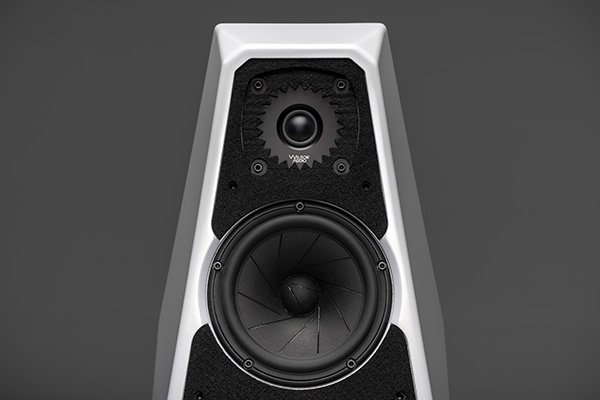 With the speaker grilles removed, the most important change from prior Sabrina models stares you in the face: the integration of Wilson's 7" alnico (aluminum nickel cobalt) QuadraMag midrange driver. This paper pulp composite cone driver has been used in other Wilson floorstanders for some time. This is not trickle-down technology, it's the same driver used in those other speakers. Wilson doesn't use cheaper products in any of its models. Wilson Brand Ambassador Peter McGrath described this to me: "The approach that Daryl (Wilson) takes adds tremendous legitimacy to that phrase 'They're all cut from the same cloth.'"
The tweeter is also new to the Sabrina line: Wilson's 1" Convergent Synergy Carbon (CSC) doped-silk dome tweeter was first used in the Alexx V. As there, in the Sabrina it is housed in its own sealed carbon-fiber chamber, designed to absorb the rear wave and dissipate its energy as heat. Just below the tweeter is the aforementioned 7" midrange. Below the midrange is a single, 8" paper pulp woofer, the same woofer used in the WATT/Puppy and Sasha V, but those speakers use two instead of one.
The Sabrina is not a point-source loudspeaker—no concentric drivers here—but it is closer to point source than most larger speakers. The physical closeness of all the drivers can be expected to contribute to image cohesion and clarity, especially considering that the three drivers cluster close to listeners' average ear height. That's an advantage larger speakers can't offer—though Wilson addresses this on its larger models by allowing the drivers to be aimed and adjusted forward and back. That doesn't create a point source, but it accomplishes something similar.
Looking at Wilson's published specifications for the Sabrina V, one item stands out. Compared to the SabrinaX, the Sabrina V's low-frequency extension dropped 4Hz, from 31Hz down to 27Hz, with a specified variance of ±3dB, same as before. How was this extra reach achieved? "[Along] with the external aesthetic changes we made, we also made some internal modifications," Daryl Wilson told me. "The space gained with subtle dimensional stretching translated to an increased internal volume for the woofer. The added space behind the woofer ... increased low-frequency performance." The low-frequency reach of the SabrinaX easily covered the upright acoustic bass and its 41.2Hz frequency. But the lowest note on a standard piano, an A, sounds at 27.5Hz, so the Sabrina V's frequency response now encompasses the whole piano. So while the SabrinaX was arguably full-range despite its small size, the Sabrina V makes a better case, reproducing the vast majority of Western Classical, jazz, and rock/pop music (footnote 1).
Other Sabrina V specifications remain the same as or very close to those of the prior Sabrina model. Sensitivity is rated the same 87dB/1W/1m, measured at 1kHz. The nominal impedance remains 4 ohms, though the stated minimum is slightly different; the Sabrina V's low impedance point sits at 2.23 ohms @ 121Hz, slightly lower than the SabrinaX's. When I ran this by Peter McGrath, he responded, "There are speakers that approach this quality in terms of loudness and bass, but none that are as easily driven as the Sabrina V is. Despite all the commentators, low impedance is not a challenge for a good amp. Those are issues that were dispensed with 20 years ago! Any dealer that we would use will have amps that can drive the Sabrina." (footnote 2)
With the speaker grilles removed, the most important change from prior Sabrina models stares you in the face: the integration of Wilson's 7" alnico (aluminum nickel cobalt) QuadraMag midrange driver. This paper pulp composite cone driver has been used in other Wilson floorstanders for some time. This is not trickle-down technology, it's the same driver used in those other speakers. Wilson doesn't use cheaper products in any of its models. Wilson Brand Ambassador Peter McGrath described this to me: "The approach that Daryl (Wilson) takes adds tremendous legitimacy to that phrase 'They're all cut from the same cloth.'"
The tweeter is also new to the Sabrina line: Wilson's 1" Convergent Synergy Carbon (CSC) doped-silk dome tweeter was first used in the Alexx V. As there, in the Sabrina it is housed in its own sealed carbon-fiber chamber, designed to absorb the rear wave and dissipate its energy as heat. Just below the tweeter is the aforementioned 7" midrange. Below the midrange is a single, 8" paper pulp woofer, the same woofer used in the WATT/Puppy and Sasha V, but those speakers use two instead of one.
The Sabrina is not a point-source loudspeaker—no concentric drivers here—but it is closer to point source than most larger speakers. The physical closeness of all the drivers can be expected to contribute to image cohesion and clarity, especially considering that the three drivers cluster close to listeners' average ear height. That's an advantage larger speakers can't offer—though Wilson addresses this on its larger models by allowing the drivers to be aimed and adjusted forward and back. That doesn't create a point source, but it accomplishes something similar.
Looking at Wilson's published specifications for the Sabrina V, one item stands out. Compared to the SabrinaX, the Sabrina V's low-frequency extension dropped 4Hz, from 31Hz down to 27Hz, with a specified variance of ±3dB, same as before. How was this extra reach achieved? "[Along] with the external aesthetic changes we made, we also made some internal modifications," Daryl Wilson told me. "The space gained with subtle dimensional stretching translated to an increased internal volume for the woofer. The added space behind the woofer ... increased low-frequency performance." The low-frequency reach of the SabrinaX easily covered the upright acoustic bass and its 41.2Hz frequency. But the lowest note on a standard piano, an A, sounds at 27.5Hz, so the Sabrina V's frequency response now encompasses the whole piano. So while the SabrinaX was arguably full-range despite its small size, the Sabrina V makes a better case, reproducing the vast majority of Western Classical, jazz, and rock/pop music (footnote 1).
Other Sabrina V specifications remain the same as or very close to those of the prior Sabrina model. Sensitivity is rated the same 87dB/1W/1m, measured at 1kHz. The nominal impedance remains 4 ohms, though the stated minimum is slightly different; the Sabrina V's low impedance point sits at 2.23 ohms @ 121Hz, slightly lower than the SabrinaX's. When I ran this by Peter McGrath, he responded, "There are speakers that approach this quality in terms of loudness and bass, but none that are as easily driven as the Sabrina V is. Despite all the commentators, low impedance is not a challenge for a good amp. Those are issues that were dispensed with 20 years ago! Any dealer that we would use will have amps that can drive the Sabrina." (footnote 2)
 Ready, set, go
The Sabrina Vs were shipped to my home in double cardboard boxes heavily wrapped in plastic, strapped to a wooden pallet. This differs from the packaging of larger Wilson models, which arrive in rough but sturdy wooden crates, like the Ark of the Covenant in Raiders of the Lost Ark. I recommend adding screw-in casters to your purchase; they are not expensive and can be purchased easily from Wilson. They make placement a breeze, since you can roll them around and listen before you install the included spiked footers and then fine-tune placement. I didn't have casters, but my older son Peter was visiting, so I put him to work. The per channel weight of the Sabrina V is 37lb less than that of the WATT/Puppy, but the two-box design of the latter means they are actually easier to move around: Just pull them apart and move each part separately.
Footnote 1: Stereophile's criteria for "full-range," as used most importantly in the loudspeaker category of Recommended Components, incorporate not just low-end reach but also the quantity of low bass. This depends in turn on room size and room contents, including intentional room treatments. All this together renders "full-range" a subjective concept, at least as Stereophile views it.
Footnote 2: For what it's worth, I agree with the sentiment: Speakers typically require less power than their systems' curators for optimal performance. Minimum power, though, is real—as Wilson would surely agree, since they specify a minimum power of 50Wpc for the Sabrina V. I'll add however that occasionally upping the power from apparently excessive to apparently grossly excessive can realize some sonic gains, for reasons I don't presume to understand.—Jim Austin
Table of contentsThose who know Wilson Audio's products will find much familiar about the new Sabrina V, but there are also some important changes, in design as well as hardware. The exterior dimensions are 38 31/32" H × 12" W × 15 3/8" D, the last two dimensions measured at the base. That's almost the same as the previous model: The V version is taller than the X by slightly less than an inch. This small difference, plus a change in the midrange drivers, contributes to a weight gain of 11lb, up to 123lb per speaker.
With the speaker grilles removed, the most important change from prior Sabrina models stares you in the face: the integration of Wilson's 7" alnico (aluminum nickel cobalt) QuadraMag midrange driver. This paper pulp composite cone driver has been used in other Wilson floorstanders for some time. This is not trickle-down technology, it's the same driver used in those other speakers. Wilson doesn't use cheaper products in any of its models. Wilson Brand Ambassador Peter McGrath described this to me: "The approach that Daryl (Wilson) takes adds tremendous legitimacy to that phrase 'They're all cut from the same cloth.'"
Ready, set, goThe Sabrina Vs were shipped to my home in double cardboard boxes heavily wrapped in plastic, strapped to a wooden pallet. This differs from the packaging of larger Wilson models, which arrive in rough but sturdy wooden crates, like the Ark of the Covenant in Raiders of the Lost Ark. I recommend adding screw-in casters to your purchase; they are not expensive and can be purchased easily from Wilson. They make placement a breeze, since you can roll them around and listen before you install the included spiked footers and then fine-tune placement. I didn't have casters, but my older son Peter was visiting, so I put him to work. The per channel weight of the Sabrina V is 37lb less than that of the WATT/Puppy, but the two-box design of the latter means they are actually easier to move around: Just pull them apart and move each part separately.
Footnote 1: Stereophile's criteria for "full-range," as used most importantly in the loudspeaker category of Recommended Components, incorporate not just low-end reach but also the quantity of low bass. This depends in turn on room size and room contents, including intentional room treatments. All this together renders "full-range" a subjective concept, at least as Stereophile views it.