Sidebar 3: Measurements
I measured one of the Diptyque Reference loudspeakers in RvB's listening room, driving it with his Krell FPB 200c amplifier. I used DRA Labs' MLSSA system with a calibrated DPA 4006 microphone to examine the speaker's behavior in the farfield and an Earthworks QTC-40 mike for the nearfield responses. I managed to maneuver the heavy loudspeaker onto a small dolly for the measurements and positioned it so that it fired along the listening room's diagonal to push back in time the reflections of the Diptyque's output from the sidewalls. Nevertheless, the first reflection from the ground still occurred earlier than is usually the case with my testing. I therefore measured the response and dispersion with the microphone at 1m rather than my usual 50".
This introduced an additional variable. The underlying assumption when a loudspeaker's frequency response is being measured is that the distance from the speaker to the microphone is significantly greater than the largest dimension of the speaker's drive-unit array. This is the case with conventional moving coil loudspeakers at my usual 50" distance, where the microphone is in the speaker's farfield. But this won't be the case with a panel loudspeaker, where the radiating array is large; a proximity effect will tilt up the measured and perceived response at low frequencies (footnote 1). In addition, my usual nearfield measurement at low frequencies will not show the effect of the dipole cancellation, as the antiphase backwave increasingly wraps around to cancel the speaker's direct output as the frequency decreases.
Diptyque specifies the Diptyque Reference's voltage sensitivity as 89dB/W/1m; my estimate was 91.8dB(B)/2.83V/1m. Given that the Diptyque's average impedance is close to 4 ohms, 2.83V will be equivalent to 2W into that load rather than 1W. Adjusting my estimate for that difference gives a sensitivity within experimental error of the specified figure.
It's difficult to predict how these high-Q drum-skin resonances affect the sound. With small-scale chamber-music and human-voice recordings, they are unlikely to be directly excited. But they might be audible with full-scale orchestral recordings and rock music, though they will also tend to compensate for the fact that with a dipole speaker, the reflections of the speaker's backward-firing sound from the wall behind it will cancel the front-firing sound below a frequency that depends on the panel's size.
Footnote 1: Martin Colloms discusses proximity effect in the seventh edition of High Performance Loudspeakers (p.221), referring to work performed by Stanley Lipshitz and John Vanderkooy in 1986. See stereophile.com/content/book-review-high-performance-loudspeakers-seventh-edition. Footnote 2: EPDR is the resistive load that gives rise to the same peak dissipation in an amplifier's output devices as the loudspeaker. See "Audio Power Amplifiers for Loudspeaker Loads," JAES, Vol.42 No.9, September 1994, and stereophile.com/reference/707heavy/index.html. Footnote 3: See, for example, my discussion of this behavior here and here.
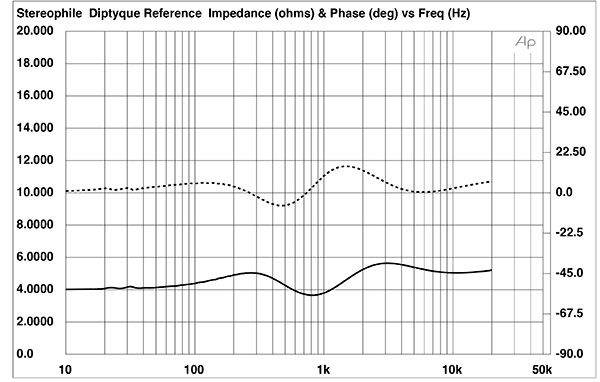
Fig.1 Diptyque Reference, electrical impedance (solid) and phase (dashed) (2 ohms/vertical div.).
I used Dayton Audio's DATS V2 system to measure the impedance magnitude and phase. The Diptyque's nominal impedance is specified as 4 ohms. The impedance magnitude (fig.1, solid trace) remains between 4 ohms and 5 ohms over most of the audioband, with a minimum value of 3.66 ohms at 813Hz. The electrical phase angle (fig.1, dotted trace) has a generally low value; as a result, the effective resistance, or EPDR (footnote 2), is close to 4 ohms from 10Hz to 384Hz and above 2.6kHz. However, it does drop below 3 ohms in the octave above 840Hz, with a minimum value of 2.54 ohms at 1.15kHz. Even so, the Diptyque Reference is not a difficult load for the partnering amplifier.
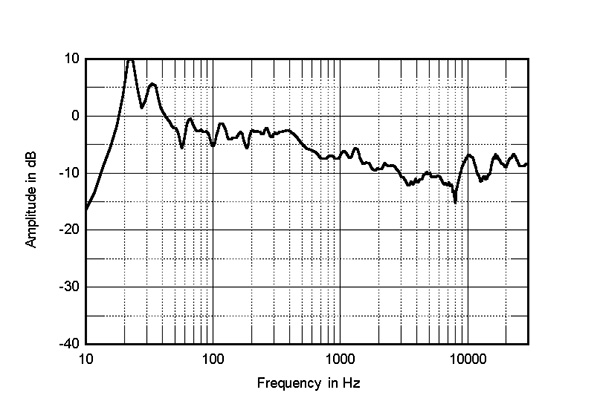
Fig.2 anechoic response on the center of the middle tweeter axis at 1m, averaged across 30° horizontal window and corrected for microphone response, with the summed nearfield woofer panel responses plotted below 300Hz.
The black trace above 300Hz in fig.2 shows the Diptyque Reference's response at 1m, averaged across a 30° horizontal window centered on an axis level with the central tweeter panel. As explained earlier, the proximity effect gently tilts up the response below the low treble. But other than a small lack of energy in the mid-treble, the trace is smooth.
The trace below 300Hz shows the summed nearfield output of the two bass panels. The response is even in the mid- and upper-bass regions, but there are two large peaks in the low bass centered on 32Hz and 22Hz. These are due to the low-frequency panels' fundamental "drum-skin" resonances (footnote 3). The small wrinkles at these frequencies in the Diptyque's impedance traces correlate with these resonances.
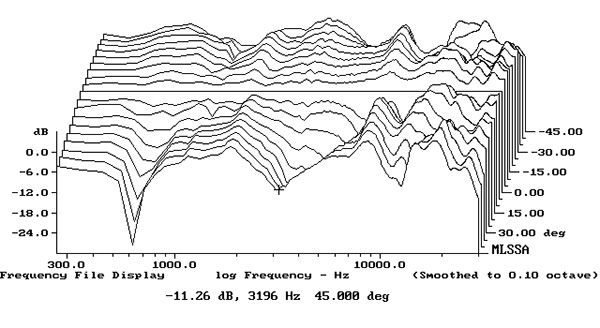
Fig.3 Diptyque Reference, lateral response family at 1m, normalized to response on center of middle tweeter axis, from back to front: differences in response 45–5° off axis on woofer side, reference response, differences in response 5–45° off axis on tweeter side.
The Diptyque's horizontal radiation pattern, normalized to the response on the center of the middle tweeter panel, which therefore appears as a straight line, is shown in fig.3. With the high-frequency panels placed to the side of the midrange panels, there is a complex pattern of peaks and suckouts on the tweeter side of the baffle, which is shown to the front of this graph. The radiation pattern is considerably more even on the woofer side of the baffle, which suggests that the woofers should be placed on the speakers' outside edges so that reflections from the sidewalls will be uniform.
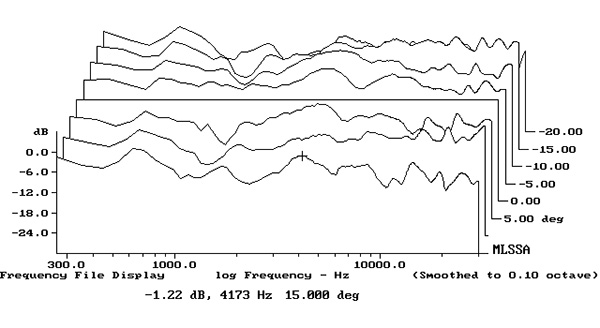
Fig.4 Diptyque Reference, vertical response family at 1m, normalized to response on center of middle tweeter axis, from back to front: differences in response 20–5° above axis, reference response, differences in response 5–10° below axis.
Fig.4 shows the Diptyque Reference's dispersion in the vertical plane, again normalized to the response on the central tweeter axis, which is 38" from the floor. This graph is difficult to interpret, but it suggests that the slight lack of energy in the mid-treble tends to fill in 5° above and below the central axis.
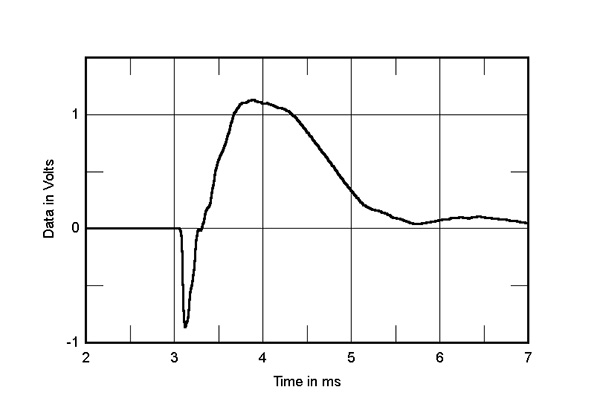
Fig.5 Diptyque Reference, step response on center of middle tweeter axis at 1m (5ms time window, 30kHz bandwidth).
In the time domain, the Diptyque's step response on the tweeter axis (fig.5) shows that the tweeter and midrange panels are connected in inverted acoustic polarity and that their outputs are coincident in time. The woofer panels are connected in positive polarity, and other than a small discontinuity at 3.3ms, the decay of the upper-frequency drivers' step smoothly blends with the start of the woofer's step. This all implies an optimal crossover topology.
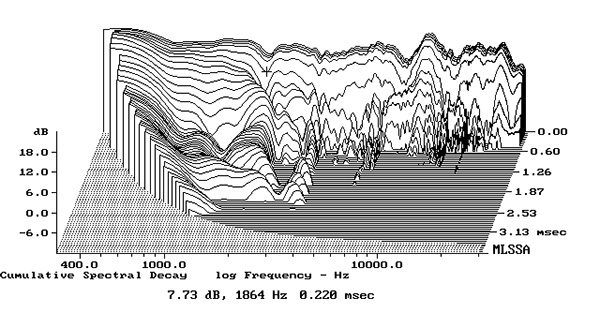
Fig.6 Diptyque Reference, cumulative spectral-decay plot on center of middle tweeter axis at 1m (0.15ms risetime).
The Diptyque Reference's cumulative spectral-decay, or waterfall, plot (fig.6) is cleaner than I expect from a panel speaker, where large diaphragms tend to "shimmer" in a Chaotic manner around their average position.
Drawing inferences from the measurements of a large panel loudspeaker like this is difficult. Given that a panel speaker's dipolar interaction with the room's acoustics is very different from that of a conventional box speaker, which radiates omnidirectionally at low frequencies but becomes more directional in the top octaves, the measured results can differ from the listening impressions. Nevertheless, the Diptyque Reference's measured performance is typical of what I expect from a large panel speaker, and its response is actually smoother in the upper midrange and treble than the response of similar speakers from Quad, Magnepan, and Apogee that I have measured over the years.—John Atkinson
Footnote 1: Martin Colloms discusses proximity effect in the seventh edition of High Performance Loudspeakers (p.221), referring to work performed by Stanley Lipshitz and John Vanderkooy in 1986. See stereophile.com/content/book-review-high-performance-loudspeakers-seventh-edition. Footnote 2: EPDR is the resistive load that gives rise to the same peak dissipation in an amplifier's output devices as the loudspeaker. See "Audio Power Amplifiers for Loudspeaker Loads," JAES, Vol.42 No.9, September 1994, and stereophile.com/reference/707heavy/index.html. Footnote 3: See, for example, my discussion of this behavior here and here.