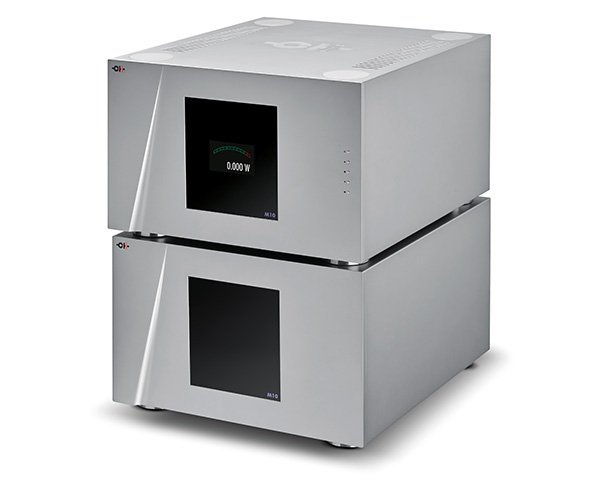
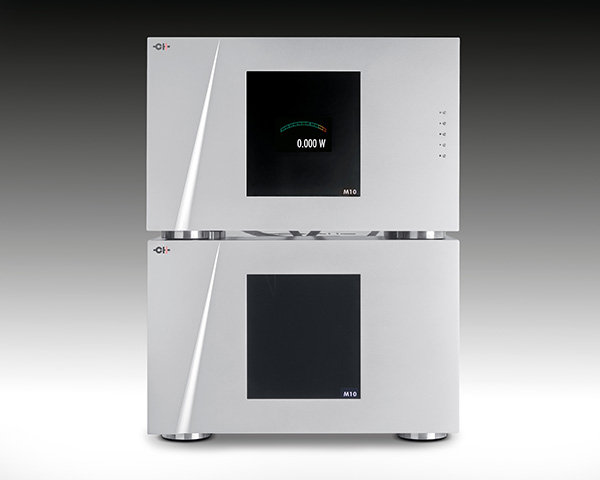
A mono pair of CH Precision M10s ($210,000/pair as reviewed) declares its presence in capital letters. Each channel consists of two large units, each almost 2' high, linked by a total of four umbilical cords. While the "lighter" amplifier unit weighs almost 117lb, the toroidal transformer–based power supply unit tops out at nearly 172lb. That's a lot of metal.
If you dare stack the two units one atop the other (I had no choice in my modest-sized music room), each stack proclaims might and—given the front panel's minimalist Swiss styling—refinement.
On the levels of sound and music, the M10s offer something else entirely. As much as dynamics, even on dynamically limited 16/44.1 material, can be breathtaking from amplifiers that, in mono configuration, output 600Wpc into 4 ohms, there's another descriptor that more accurately encapsulates the M10's gifts. That word is "mastery." Rivaling most of the amplifiers I've had in-house for review in the past year, the M10s open their capacitors wide, welcome whatever is channeled to them, and pass it along with absolute confidence. They find no need to editorialize. Beyond the fact that they have their own distinct sound—I've never heard an amplifier that doesn't—what the M10s receive is what they send out into the world.
Under the imposing hood
"All CH amplifiers can be configured as either stereo or mono amplifiers," Kevin Wolff, CH Precision's director of global sales, explained soon after he and John Giolas, VP of marketing for both Wattson Audio and CH Precision, visited Port Townsend to install the M10s in my music room. "They can also be configured in various modes, including stereo, mono, bridged, and biamp." Audiophiles who begin with an M10 stereo configuration can easily upgrade to mono by purchasing an M10 upgrade amplifier and moving one of the input modules. An installer can perform the switch within 10 minutes in the comfort of the home listening environment. Another upgrade, which again is performed in house without need to ship units back and forth, installs two additional modules to enable the M10s to drive a passive subwoofer or work with speakers that have external crossovers. "Every amplifier in the CH Precision lineup, starting with our smallest, the A1.5, has more than adequate power to run a passive subwoofer and main array," Wolff said. Of course, if money is no object, space is plentiful, and the subwoofers are passive, an audiophile could run four M10 mono amps, ie, eight units total, for the main array and passive subwoofer. While Wolff has seen several such systems power unusually large speakers with passive subs, I have yet to be invited to such an installation, which is often located abroad.
Not only do these mono amps occupy considerable space, but they also require four 20-amp power cables, two per power supply, and three hours of warm-up time to reach the optimal internal temperature where they sound their best.
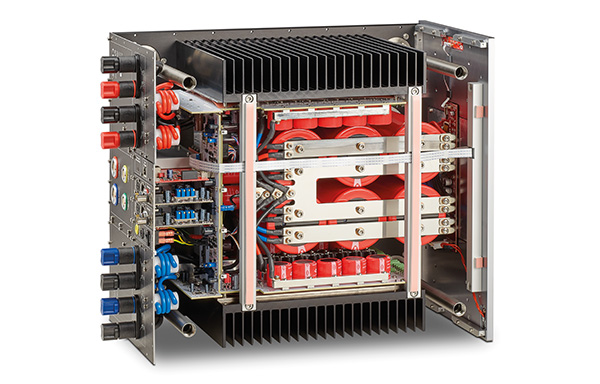
CH splits the amp into two boxes, analog and power, to isolate the noisiest element in the amplifier, the two 1800VAC toroidal transformers in each power supply. Which is not to say that the entire power supply is in that box. The amplifier unit also houses part of the power supply in the form of various sizes of power-storing capacitors, putting the charge very close to where it will be needed for dynamic peaks.
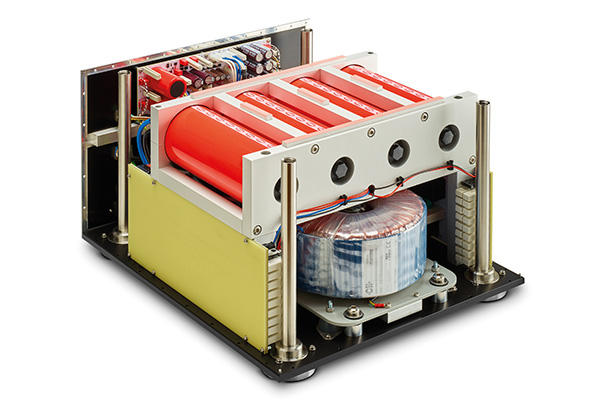 "Small caps in a power supply provide speed and liquidity," Wolff said. "Small caps may run out of power quickly, but larger capacitors tend to be slow. To address this, we've built what we believe is a fairly unique, three-stage power supply that holds enormous amounts of power reserves in three progressively larger-sized capacitors. We start with very small capacitors, located right next to the output devices in the analog unit, that provide speed and liquidity and are replenished quickly. When the small capacitors run out of power, as when driving a big crescendo in a Mahler symphony, rather than reverting to the transformer for power or replenishment they draw upon medium or much larger-sized capacitors that fill the huge center section of the amplifier. The largest capacitors I've ever seen in a commercial amp are in the third stage, the power supply chassis. In total, the M10's capacitance is 1 farad, or 1,000,000µF, operating at less than 100V. That's an enormous amount of power reserve.
"Our goal is to avoid drawing power directly from the transformer and instead let it fill the large caps. Only when those storage capacitors run out of power must you rely on power coming directly from the two transformers in each amplifier. Due to the electrical frequency (50Hz and 60Hz, depending on market), there is some smearing in the time domain at the multiples, which in the US is 60Hz, 120Hz, 240Hz, etc. By drawing power from the large storage reservoir, we avoid this. This is why we have multiple capacitor stages with caps of different sizes, all proprietary, that are built to exacting tolerances. We want to maintain sweetness even during the most outrageous crescendos, so you can hear the flute in its precise location in the orchestra while the rest of the world is thundering down around it."
Wolff told me that he'd seen people fall in love with the sound of voices amplified by 50Wpc amplifiers only to discover that those amplifiers fall apart on a Mahler symphony. Some weeks later, I twice experienced exactly that at Warsaw Audio Video 2025.
Wolff also said that one of the keys to CH Precision's success is that almost half their employees are engineers tasked with creating new solutions. One of those solutions is ExactBias.
"Small caps in a power supply provide speed and liquidity," Wolff said. "Small caps may run out of power quickly, but larger capacitors tend to be slow. To address this, we've built what we believe is a fairly unique, three-stage power supply that holds enormous amounts of power reserves in three progressively larger-sized capacitors. We start with very small capacitors, located right next to the output devices in the analog unit, that provide speed and liquidity and are replenished quickly. When the small capacitors run out of power, as when driving a big crescendo in a Mahler symphony, rather than reverting to the transformer for power or replenishment they draw upon medium or much larger-sized capacitors that fill the huge center section of the amplifier. The largest capacitors I've ever seen in a commercial amp are in the third stage, the power supply chassis. In total, the M10's capacitance is 1 farad, or 1,000,000µF, operating at less than 100V. That's an enormous amount of power reserve.
"Our goal is to avoid drawing power directly from the transformer and instead let it fill the large caps. Only when those storage capacitors run out of power must you rely on power coming directly from the two transformers in each amplifier. Due to the electrical frequency (50Hz and 60Hz, depending on market), there is some smearing in the time domain at the multiples, which in the US is 60Hz, 120Hz, 240Hz, etc. By drawing power from the large storage reservoir, we avoid this. This is why we have multiple capacitor stages with caps of different sizes, all proprietary, that are built to exacting tolerances. We want to maintain sweetness even during the most outrageous crescendos, so you can hear the flute in its precise location in the orchestra while the rest of the world is thundering down around it."
Wolff told me that he'd seen people fall in love with the sound of voices amplified by 50Wpc amplifiers only to discover that those amplifiers fall apart on a Mahler symphony. Some weeks later, I twice experienced exactly that at Warsaw Audio Video 2025.
Wolff also said that one of the keys to CH Precision's success is that almost half their employees are engineers tasked with creating new solutions. One of those solutions is ExactBias.
 "Manufacturer XYZ may claim they biased their amp to 10W class-A before it slips into class-AB," Wolff noted. "Technically, that means it's an AB amp. CH Precision constantly adjusts bias and compares the amp's temperature at the device level. To make this possible, they use a five-legged transistor where the two extra legs provide data. We constantly monitor the incoming signal and the temperature of each output device and adjust bias to maintain stability throughout. The M10s like running in the mid-40°C range, but we can adjust the bias so they sound good (if not as good) at 20°C."
Wolff said he never saw the M10s output more than 50Wpc in my room. I decided to confirm this for myself later on. He also said he's seen the M10s output in excess of 2500W with large, insensitive speakers or at shows when exhibitors play uncompressed music really loud. If we'd turned the volume up that loud in my music room, I doubt I could have continued my reviewing career.
"Manufacturer XYZ may claim they biased their amp to 10W class-A before it slips into class-AB," Wolff noted. "Technically, that means it's an AB amp. CH Precision constantly adjusts bias and compares the amp's temperature at the device level. To make this possible, they use a five-legged transistor where the two extra legs provide data. We constantly monitor the incoming signal and the temperature of each output device and adjust bias to maintain stability throughout. The M10s like running in the mid-40°C range, but we can adjust the bias so they sound good (if not as good) at 20°C."
Wolff said he never saw the M10s output more than 50Wpc in my room. I decided to confirm this for myself later on. He also said he's seen the M10s output in excess of 2500W with large, insensitive speakers or at shows when exhibitors play uncompressed music really loud. If we'd turned the volume up that loud in my music room, I doubt I could have continued my reviewing career.
 Special features
According to Wolff, all solid state amplifiers use local feedback, global feedback, or a mixture of the two. Global feedback can limit harmonic distortion to "vanishingly low levels," but using too much global feedback can make an amplifier sound lifeless. Feedback is also used to reduce an amplifier's output impedance, which seems to be the main focus here. (See below.)
Since their very first amplifier, CH Precision has allowed users to vary the ratio of local to global feedback. In the M10, you can change the ratio by a single percentage point, while in the lower-priced M1.1 you can only alter the ratio in 10% increments. All feedback-ratio adjustments are performed by dealers during the initial installation. If a CH Precision amplifier owner switches speakers, dealers are expected to return to perform further adjustments. No dealer is needed, however. The adjustment is easily accomplished from the front panel or the mobile app, which for now is Android-only.
"When I've adjusted M10s, I've never used more than 4% global feedback," Wolff said. "Global feedback tightens the amplifier's sound. It maintains all the correct timing cues, without time smearing, by adjusting the output impedance or damping factor. But on a speaker like your Wilson Alexia V's that have only one set of speaker terminals, if you use too much global feedback, it may fix the bass but negatively impact the midrange and the upper frequencies. When I adjusted your M10s in your room, we only added 1% global feedback. We agreed that 2% and 3% global feedback diminished overall performance. We never tried anything beyond 3% because I know from experience not to bother when the speakers are set up correctly, which yours are."
The M10s also allow you to set the optimum gain in relation to your line stage and cabling. There is no absolute optimal gain or input sensitivity setting; everything is system-, room-, and cable-dependent. In my room and system, Wolff adjusted the M10s' input sensitivity by 0.5dB increments until we found what sounded best. We made the opposite adjustment on the L10 preamplifier, which also allows for fine gain adjustments.
Florian Cossy speaks
CH Precision founder, CEO, and former chief designer Florian Cossy added additional commentary. "From the release of our first amp, the A1, over 12 years ago, we focused on two things. The first was the match between the amp and the speaker. Some believe you need a huge damping factor to enable an amplifier to work as a perfect voltage source. But in some cases, that's not true. Instead, we play with the damping factor by adjusting the amount of global feedback to achieve the optimal coupling between power amplifier, speaker, and room. In the M10, as Kevin explained, that adjustment is in 1% increments. "In the real world, speakers should be driven with current, not voltage. That's my opinion, at least. What makes a speaker driver move is the image of the current you send to it; it's not the image of the voltage you send to it. The reason we drive them in voltage is because speaker manufacturers develop speakers with voltage sources. But because that's an imperfect way to develop them, we compensate by adjusting the global feedback, which mimics a little bit of the current-driven mode.
"When we first developed our global feedback adjustment, some in the industry said it would be impossible to do because it wasn't stable. They were incorrect.
"The second thing we addressed is bias. ExactBias ensures that bias into the output transistors remains stable regardless of time, temperature, and the music you are playing (footnote 1). Our circuitry is really fast—faster than most amplifiers currently adjust bias in response to music."
I asked why the M10s take three hours to warm up from standby. Cossy pointed to their huge heatsinks and the amount of heat the M10 generates. If he had designed smaller heatsinks, warm-up time would have been less, but the amps would have gotten very hot.
"Having two cabinets for the M10 ensures that we have plenty of energy, stored locally, to respond to almost any demand," he said. "We don't rely too heavily on the transformers which are housed separately and are there to fill the capacitors."
Setup challenges
As with all CH Precision gear, the front panel is dominated by a large display. The one on the amplifier panel can be programmed to show input, input impedance termination, low pass filter (if employed), absolute phase polarity, mute, instantaneous power, amplifier mode, and more. Mine were set to show instantaneous power consumption. The front panel has an illumined logo in the top left corner that lights during standby but can be turned off during operation. Five small buttons aligned vertically to the right of the display enable users to control and set a host of options. I left most of the button-pushing to Wolff. I only used the top button, which toggled the amps between on and idle.
Footnote 1: ExactBias operates in the M10's output stage.
"All CH amplifiers can be configured as either stereo or mono amplifiers," Kevin Wolff, CH Precision's director of global sales, explained soon after he and John Giolas, VP of marketing for both Wattson Audio and CH Precision, visited Port Townsend to install the M10s in my music room. "They can also be configured in various modes, including stereo, mono, bridged, and biamp." Audiophiles who begin with an M10 stereo configuration can easily upgrade to mono by purchasing an M10 upgrade amplifier and moving one of the input modules. An installer can perform the switch within 10 minutes in the comfort of the home listening environment. Another upgrade, which again is performed in house without need to ship units back and forth, installs two additional modules to enable the M10s to drive a passive subwoofer or work with speakers that have external crossovers. "Every amplifier in the CH Precision lineup, starting with our smallest, the A1.5, has more than adequate power to run a passive subwoofer and main array," Wolff said. Of course, if money is no object, space is plentiful, and the subwoofers are passive, an audiophile could run four M10 mono amps, ie, eight units total, for the main array and passive subwoofer. While Wolff has seen several such systems power unusually large speakers with passive subs, I have yet to be invited to such an installation, which is often located abroad.
"Small caps in a power supply provide speed and liquidity," Wolff said. "Small caps may run out of power quickly, but larger capacitors tend to be slow. To address this, we've built what we believe is a fairly unique, three-stage power supply that holds enormous amounts of power reserves in three progressively larger-sized capacitors. We start with very small capacitors, located right next to the output devices in the analog unit, that provide speed and liquidity and are replenished quickly. When the small capacitors run out of power, as when driving a big crescendo in a Mahler symphony, rather than reverting to the transformer for power or replenishment they draw upon medium or much larger-sized capacitors that fill the huge center section of the amplifier. The largest capacitors I've ever seen in a commercial amp are in the third stage, the power supply chassis. In total, the M10's capacitance is 1 farad, or 1,000,000µF, operating at less than 100V. That's an enormous amount of power reserve.
"Manufacturer XYZ may claim they biased their amp to 10W class-A before it slips into class-AB," Wolff noted. "Technically, that means it's an AB amp. CH Precision constantly adjusts bias and compares the amp's temperature at the device level. To make this possible, they use a five-legged transistor where the two extra legs provide data. We constantly monitor the incoming signal and the temperature of each output device and adjust bias to maintain stability throughout. The M10s like running in the mid-40°C range, but we can adjust the bias so they sound good (if not as good) at 20°C."
Wolff said he never saw the M10s output more than 50Wpc in my room. I decided to confirm this for myself later on. He also said he's seen the M10s output in excess of 2500W with large, insensitive speakers or at shows when exhibitors play uncompressed music really loud. If we'd turned the volume up that loud in my music room, I doubt I could have continued my reviewing career.
Special featuresAccording to Wolff, all solid state amplifiers use local feedback, global feedback, or a mixture of the two. Global feedback can limit harmonic distortion to "vanishingly low levels," but using too much global feedback can make an amplifier sound lifeless. Feedback is also used to reduce an amplifier's output impedance, which seems to be the main focus here. (See below.)
CH Precision founder, CEO, and former chief designer Florian Cossy added additional commentary. "From the release of our first amp, the A1, over 12 years ago, we focused on two things. The first was the match between the amp and the speaker. Some believe you need a huge damping factor to enable an amplifier to work as a perfect voltage source. But in some cases, that's not true. Instead, we play with the damping factor by adjusting the amount of global feedback to achieve the optimal coupling between power amplifier, speaker, and room. In the M10, as Kevin explained, that adjustment is in 1% increments. "In the real world, speakers should be driven with current, not voltage. That's my opinion, at least. What makes a speaker driver move is the image of the current you send to it; it's not the image of the voltage you send to it. The reason we drive them in voltage is because speaker manufacturers develop speakers with voltage sources. But because that's an imperfect way to develop them, we compensate by adjusting the global feedback, which mimics a little bit of the current-driven mode.
As with all CH Precision gear, the front panel is dominated by a large display. The one on the amplifier panel can be programmed to show input, input impedance termination, low pass filter (if employed), absolute phase polarity, mute, instantaneous power, amplifier mode, and more. Mine were set to show instantaneous power consumption. The front panel has an illumined logo in the top left corner that lights during standby but can be turned off during operation. Five small buttons aligned vertically to the right of the display enable users to control and set a host of options. I left most of the button-pushing to Wolff. I only used the top button, which toggled the amps between on and idle.
Footnote 1: ExactBias operates in the M10's output stage.