Note: As we arrive onsite to prepare for our coverage of High End Vienna and its many satellite shows, we share more of Jason Victor Serinus and Rogier van Bakel's coverage of Europe's second most important audio show, Audio Video Warsaw. Audio Video Warsaw 2026 will take place this fall, October 23-25, 2026. For Jason and Rogier's previous Warsaw show coverage, go here.
The final day of Audio Video Warsaw 2025 ended with claims that it was the second or third largest audio show in the world. Unique visitors reached a record 14,881. (High End may not count unique visitors, but the final High End Munich 2025 show claimed 11,675 non-trade visitors, plus 10,562 trade visitors.) Warsaw's exhibitor count—230—could not touch Munich High End 2025's 501 exhibitors and almost 1000 brands, but it is nonetheless quite impressive. The number of international press attending reached a record 71. As a measure of Warsaw's rapidly increasingly importance, show organizer Adam Miokrzycki has planned to add six more big rooms in the PGE Naradowy Stadium in 2026.
My day began with two notifications. First, after I had stuck to my guns and insisted that something was amiss in the Dutch & Dutch room, I learned that they had recalibrated their new loudspeaker's interaction with the exhibit room and lowered the treble by 1.5dB. I'm sure that made a positive difference. Second, after the first day of the show, the folks in the large Wilson/D'Agostino/dCS room in the Stadium re-evaluated the sound of every cable and device in an equipment chain that included products from three cable manufacturers, After doing so, they removed one company's power conditioner and cabling. My hunch is that company's products were incompatible with products from the other two cable companies. Regardless, once the tonal balance was fixed, the room went on to win a Best Sound award from one publication.
I regret that I did not have time to revisit either room. Instead, I began my last day at the show with a wild goose chase, and ended with the mind-blowingly impressive world premiere of Raidho of Denmark's Reference TD3.10 loudspeaker. Reserving that high for the very end of this report, I'll start on a much lower note, and quickly work our way up.
At Jim Austin's request, I returned to the Stadium for a second listen to an electronics brand, then just starting to reach the United States, that sounded subpar in Munich. If in Munich, with floorstanding speakers unknown to me, it sounded bright and unmusical, in Warsaw, it came across as flat and dull. Given that the floorstanders in Warsaw were a different pair of unknowns, with horn drivers, the only thing I could responsibly conclude is that the electronics revealed the deficiencies of the speaker with which they were associated. Why point the finger at the speakers? Because as much as they sounded acceptable on simple fare (e.g., a jazz trio), they butchered multiple instruments and lines in a complex Mahler symphony. A speaker is not ready for prime time when I can hear far more of Mahler's score through the increasingly distorting speakers of the stock audio system in my 31-year-old Toyota Corolla DX.
Needing uplift, I headed to the Golden Tulip and what has been my two-time favorite room in Warsaw, the exhibit from Galeria Audio of Wrocław in southeast Poland. This time, in place of CDs and Goldmund amplification, I found LPs.
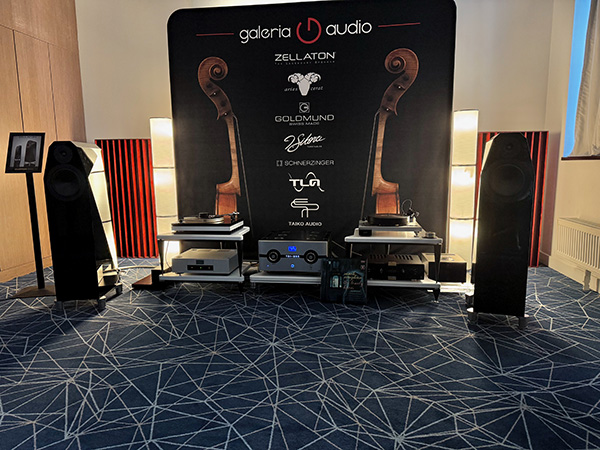 The system, consisting of a J.Sikora Aspire turntable, an unheard Taiko Extreme music server, Goldmund Memesis PH 3.8 Nextgen phono preamplifier, a Greek TLA TSI-300 integrated hybrid amplifier, Zellaton loudspeakers, and Schnerzinger cabling, sounded fabulous. Even without the low mood lighting I'd enjoyed in previous years (which was hardly conducive to cueing up LPs). Harry Belafonte's Belafonte Sings the Blues LP sounded beautiful, warm, and smooth—truly distingué. Kudos to Galeria Audio's Roman Witkoiski-Richter for playing an entire side at a time. (Just one request: please bring your anything-but-shy wife next time. I missed another opportunity to be swept off my feet and waltzed around the exhibit room.)
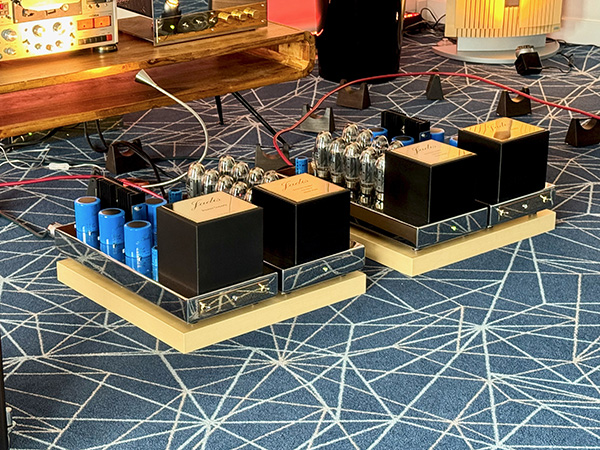 The blues also reigned in Franco Serblin's customary room in the Golden Tulip. With every seat full, it took me a bit to spy a seat in the sweet spot—and, faster than someone a third my age could dart, threw my notebook on the chair and my corpus thereupon. From my new perch, I could fully appreciate what a compellingly air-filled presentation the union of Franco Serblin speakers and Jadis tubed electronics produced. But when the tape source began playing the classic Proprius recording of Adam's "O Holy Night" in Danish—ironically, shortly before the celebration of All Hallow's Eve and its pagan antecedent—I fled. When oh when will audiophiles finally replace an admittedly excellent 49-year-old analog recording of a Christmas hymn with other new, equally well-recorded, season-appropriate choral music?
Skipping a room where the music was so loud that it grossly overloaded the acoustic, I headed to Polish distributor RCM Audio's room for a system that consisted of an SME Model 35 turntable with My Sonic Lab Eminent EX cartridge, RCM Audio Big Phono phono stage, Vitus SL-103 preamp and SM-025 monoblocks, YG Acoustics Hailey 3 speakers, Furutech Project V1, DAS 4.1 cables and Power Vault E distribution block, NeoHighend racks, and Acoustic Manufacture room treatments. From Miles Davis's final recording, Miles & Quincy: Live at Monterey, the wonderful Kerry St. James cued up "Miles Ahead." The sound was ideally colorful and honest rather than souped up. Thank goodness for that.
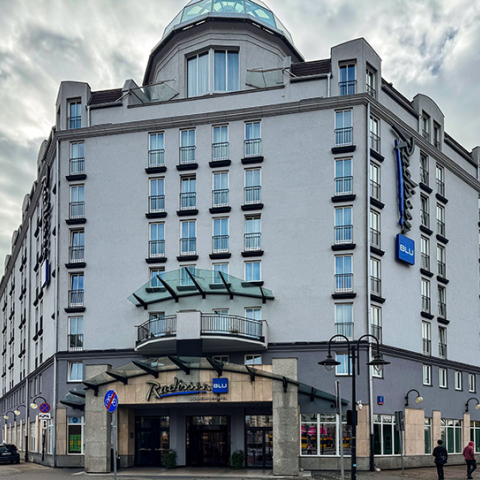
Having ceded rooms with speakers by Estelon, YG Acoustics, and more to my colleague Rogier van Bakel and finding nothing else in Golden Tulip worth writing about, I headed back to the Blu Sobieski. That's where my audiophile equivalent of an Easter egg discovery hunt began.
The blues also reigned in Franco Serblin's customary room in the Golden Tulip. With every seat full, it took me a bit to spy a seat in the sweet spot—and, faster than someone a third my age could dart, threw my notebook on the chair and my corpus thereupon. From my new perch, I could fully appreciate what a compellingly air-filled presentation the union of Franco Serblin speakers and Jadis tubed electronics produced. But when the tape source began playing the classic Proprius recording of Adam's "O Holy Night" in Danish—ironically, shortly before the celebration of All Hallow's Eve and its pagan antecedent—I fled. When oh when will audiophiles finally replace an admittedly excellent 49-year-old analog recording of a Christmas hymn with other new, equally well-recorded, season-appropriate choral music?
Skipping a room where the music was so loud that it grossly overloaded the acoustic, I headed to Polish distributor RCM Audio's room for a system that consisted of an SME Model 35 turntable with My Sonic Lab Eminent EX cartridge, RCM Audio Big Phono phono stage, Vitus SL-103 preamp and SM-025 monoblocks, YG Acoustics Hailey 3 speakers, Furutech Project V1, DAS 4.1 cables and Power Vault E distribution block, NeoHighend racks, and Acoustic Manufacture room treatments. From Miles Davis's final recording, Miles & Quincy: Live at Monterey, the wonderful Kerry St. James cued up "Miles Ahead." The sound was ideally colorful and honest rather than souped up. Thank goodness for that.
Having ceded rooms with speakers by Estelon, YG Acoustics, and more to my colleague Rogier van Bakel and finding nothing else in Golden Tulip worth writing about, I headed back to the Blu Sobieski. That's where my audiophile equivalent of an Easter egg discovery hunt began.
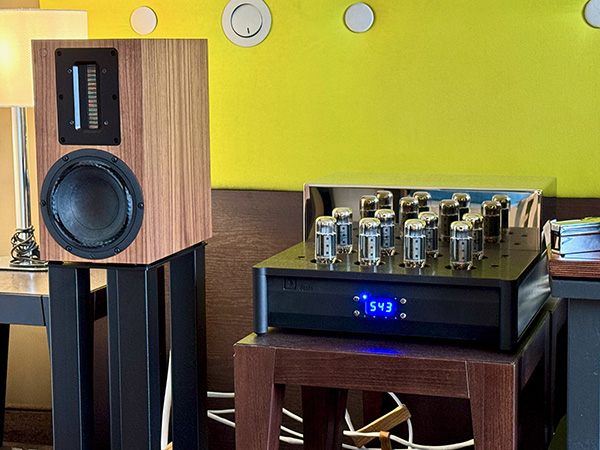 First up, a showing of relatively new OePhi Audio loudspeakers, electronics, and cables from Denmark. OePhi's pairing with Doshi tube electronics produced very good, straight-ahead sound with good bass. Alas, only on the third track, Chris Stapleton's "Death Row," did exhibitor Joakim Juhl raise the volume to a level where the sound came alive.
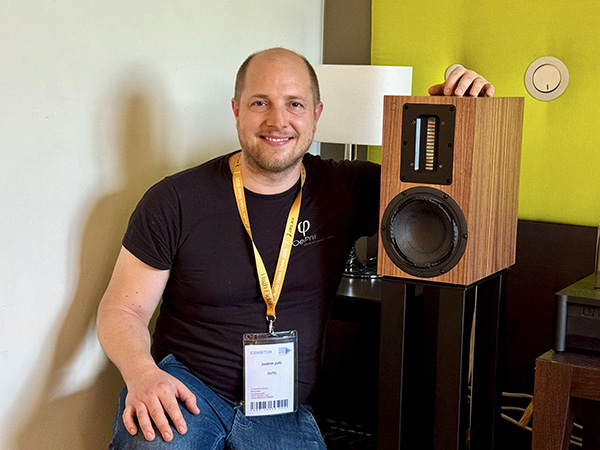 Juhl (shown above) began building speakers just a short time ago, after he made enough money from his company's cable sales to branch out. In no time, HiFi+ called OePhi's Immanence loudspeaker their "Speaker of the Year." With attention to timing as the speaker's secret sauce, OePhi's bookshelf loudspeakers (9500 Euros) are worth checking out.
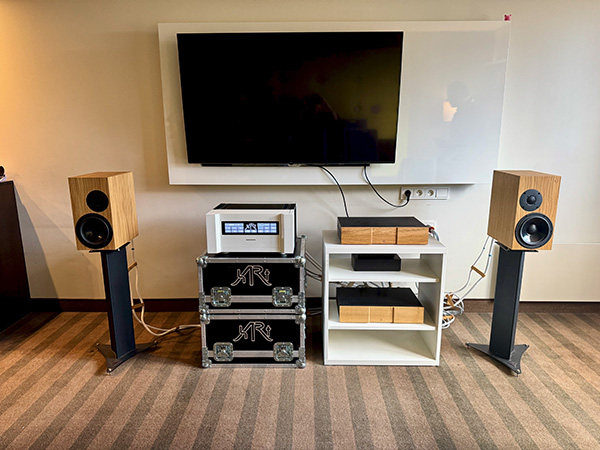 Curiously, I found OePhi's system next door, with its lower priced speaker, more colorful. Depth was good and bass surprisingly solid. On Bernard Allison's "Tin Pan Alley" and a recording of Strauss's "Explosive-Polka," the system threw an impressively wide soundstage. Color me impressed.
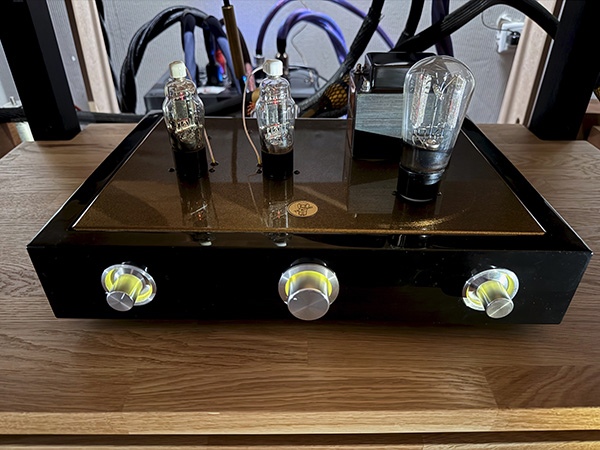
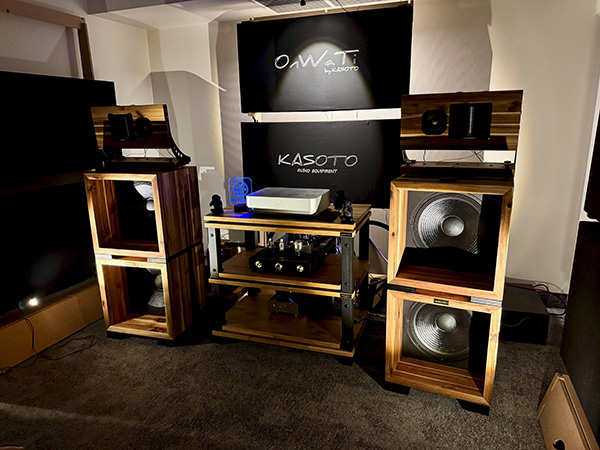 I could not get enough of the OrWaTi system. Custom-made by a gifted man nicknamed Kasoto, who is mainly a furniture designer, the system is only available in Poland. The speakers, an open baffle design with 15" woofers, an EMS midrange, and USA-made tweeters (whose name I didn't catch), were complemented by a NUC running Audirvana software, an Audio Aviator DAC with a tubed analog stage that uses a Philips TDA1541A chip from the '80s, and a TR Audio tube amplifier that outputs a maximum of 3 watts.
 Although, when I asked for something out of the ordinary, Kasoto proffered Anette Askvik's show staple, "Liberty," its timbres were so beautiful that I sat transfixed. It was very hard to leave this room.
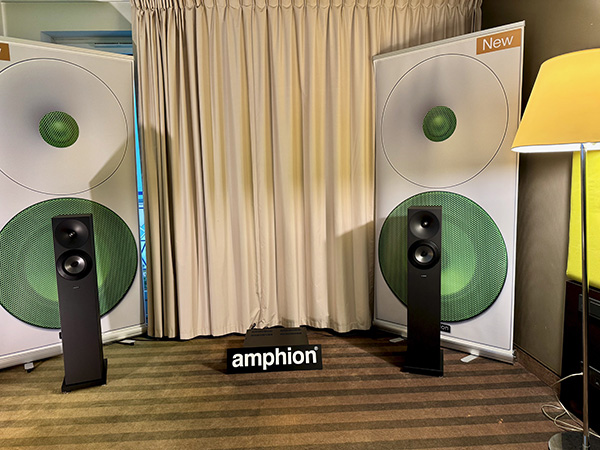 Amphion of Finland's goal was to build a simple system that would work well in average-sized rooms and not cost anywhere near what many systems cost these days. After pairing its speaker (5000 Euros) with an SPL Director D/A and preamp, the company streamed from Qobuz and used Audirvana Studio to upsample to DSD. When we compared the sound of a track from a Schubert Piano Trio that I know really well with and without DSD upsampling, I found good old PCM transmitted far more natural midrange warmth through this system.
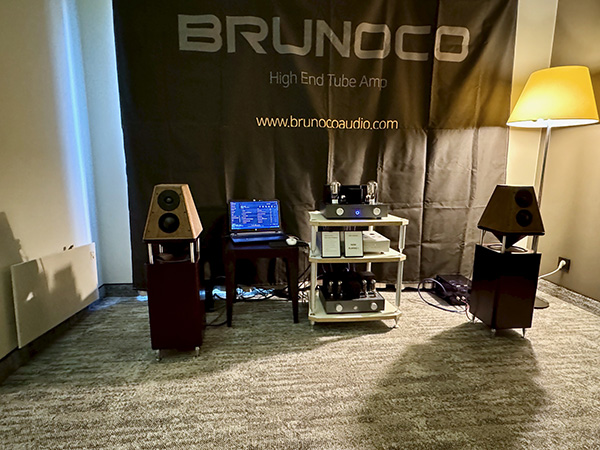 Kiho Kim of Brunoco Audio traveled from Korea to exhibit at his first international audio show. Kim explained that he has been building equipment for 40 years, and sells his equipment direct.
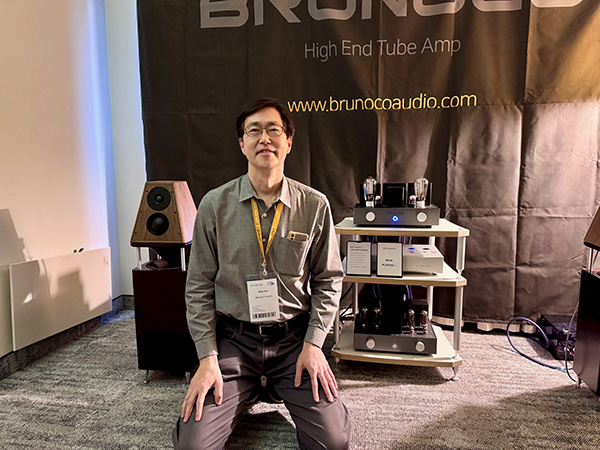
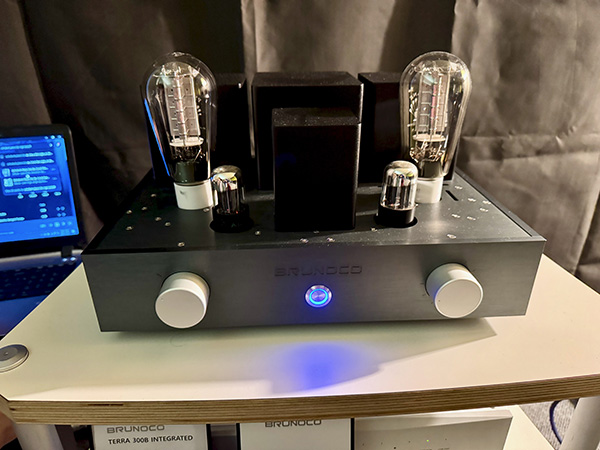 The system excelled on vocals. On Carol Kidd's "When I Dream," for example, Brunoco amplification, which outputs up to 8 watts per channel, lent a seductively warm singing quality to Kidd's voice. (Brunoco's Kiho Kim is shown below.)
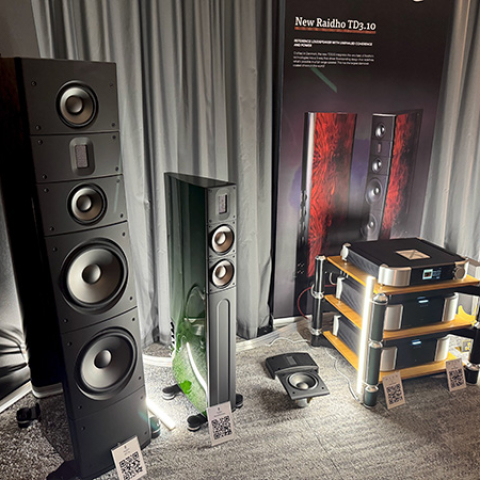
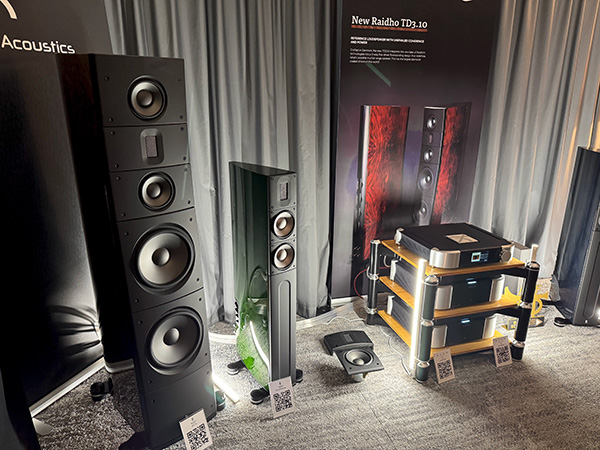
 I ended the show with an alternate reality: a powerhouse system from Raidho and Simaudio. Headlining the show—it really was a show all in itself—stood Raidho's new TD3.10 3-way, five-driver floorstander that is claimed to utilize "the largest diamond-coated drivers in the world."
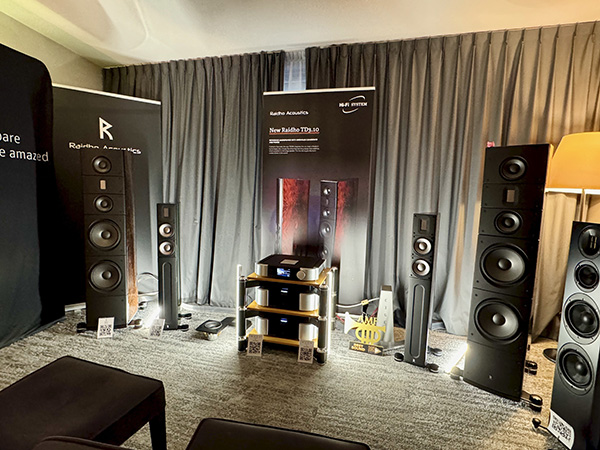 Whether the Raidho speaker will prove a girl's best friend—I know someone is going to understand that reference—remains to be seen, but it certainly blew my mind.
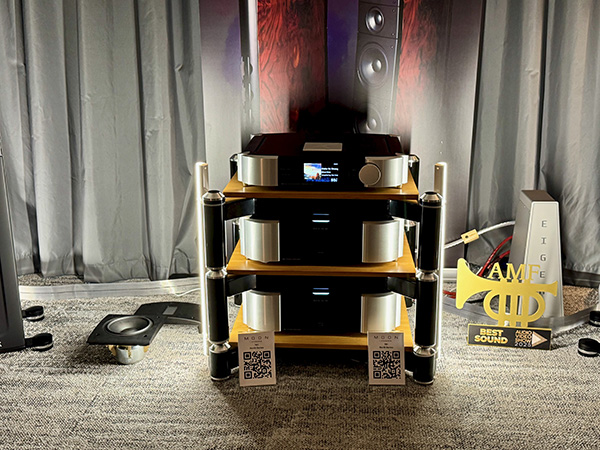 Through Moon North Star Collection 791 and 761 components—I reviewed the North Star Collection's top 891 and 861 components in the December 2024 issue, and found them superb—I heard Ghost Rider's "Make Us Stronger" at top volume. The DSP levels were, at the least, consistently in the low 90s, and probably rose significantly higher during peaks. Yet there wasn't a hint of harshness, brightness, or brittleness—nothing that would cause the ears to bleed. I sat dumbfounded by the exceptionally smooth response of the tweeter in the Raidho TD3.10.
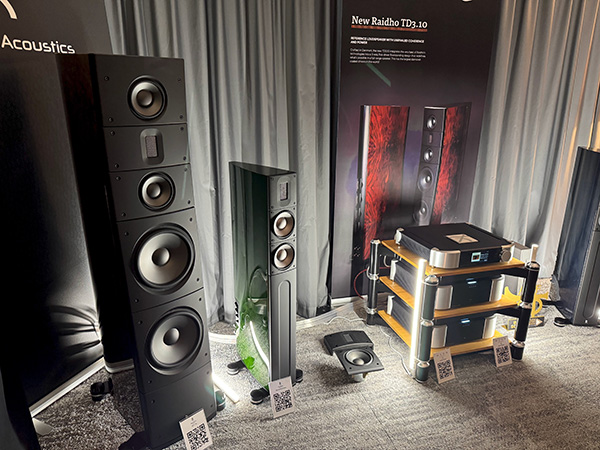 When Chuck Mangione's "Children of Sanchez" was also played at high volume, it similarly sailed through the ear bleed test. As the music continued, I stared at Raidho's new TD3.10 3-way loudspeaker with a mixture of awe and amazement.
What better way to end an audio show?
Rogier van Bakel's final Warsaw manifesto is posted here.
When Chuck Mangione's "Children of Sanchez" was also played at high volume, it similarly sailed through the ear bleed test. As the music continued, I stared at Raidho's new TD3.10 3-way loudspeaker with a mixture of awe and amazement.
What better way to end an audio show?
Rogier van Bakel's final Warsaw manifesto is posted here.
At Jim Austin's request, I returned to the Stadium for a second listen to an electronics brand, then just starting to reach the United States, that sounded subpar in Munich. If in Munich, with floorstanding speakers unknown to me, it sounded bright and unmusical, in Warsaw, it came across as flat and dull. Given that the floorstanders in Warsaw were a different pair of unknowns, with horn drivers, the only thing I could responsibly conclude is that the electronics revealed the deficiencies of the speaker with which they were associated. Why point the finger at the speakers? Because as much as they sounded acceptable on simple fare (e.g., a jazz trio), they butchered multiple instruments and lines in a complex Mahler symphony. A speaker is not ready for prime time when I can hear far more of Mahler's score through the increasingly distorting speakers of the stock audio system in my 31-year-old Toyota Corolla DX.
The system, consisting of a J.Sikora Aspire turntable, an unheard Taiko Extreme music server, Goldmund Memesis PH 3.8 Nextgen phono preamplifier, a Greek TLA TSI-300 integrated hybrid amplifier, Zellaton loudspeakers, and Schnerzinger cabling, sounded fabulous. Even without the low mood lighting I'd enjoyed in previous years (which was hardly conducive to cueing up LPs). Harry Belafonte's Belafonte Sings the Blues LP sounded beautiful, warm, and smooth—truly distingué. Kudos to Galeria Audio's Roman Witkoiski-Richter for playing an entire side at a time. (Just one request: please bring your anything-but-shy wife next time. I missed another opportunity to be swept off my feet and waltzed around the exhibit room.)
The blues also reigned in Franco Serblin's customary room in the Golden Tulip. With every seat full, it took me a bit to spy a seat in the sweet spot—and, faster than someone a third my age could dart, threw my notebook on the chair and my corpus thereupon. From my new perch, I could fully appreciate what a compellingly air-filled presentation the union of Franco Serblin speakers and Jadis tubed electronics produced. But when the tape source began playing the classic Proprius recording of Adam's "O Holy Night" in Danish—ironically, shortly before the celebration of All Hallow's Eve and its pagan antecedent—I fled. When oh when will audiophiles finally replace an admittedly excellent 49-year-old analog recording of a Christmas hymn with other new, equally well-recorded, season-appropriate choral music?
First up, a showing of relatively new OePhi Audio loudspeakers, electronics, and cables from Denmark. OePhi's pairing with Doshi tube electronics produced very good, straight-ahead sound with good bass. Alas, only on the third track, Chris Stapleton's "Death Row," did exhibitor Joakim Juhl raise the volume to a level where the sound came alive.
Juhl (shown above) began building speakers just a short time ago, after he made enough money from his company's cable sales to branch out. In no time, HiFi+ called OePhi's Immanence loudspeaker their "Speaker of the Year." With attention to timing as the speaker's secret sauce, OePhi's bookshelf loudspeakers (9500 Euros) are worth checking out.
Curiously, I found OePhi's system next door, with its lower priced speaker, more colorful. Depth was good and bass surprisingly solid. On Bernard Allison's "Tin Pan Alley" and a recording of Strauss's "Explosive-Polka," the system threw an impressively wide soundstage. Color me impressed.
I could not get enough of the OrWaTi system. Custom-made by a gifted man nicknamed Kasoto, who is mainly a furniture designer, the system is only available in Poland. The speakers, an open baffle design with 15" woofers, an EMS midrange, and USA-made tweeters (whose name I didn't catch), were complemented by a NUC running Audirvana software, an Audio Aviator DAC with a tubed analog stage that uses a Philips TDA1541A chip from the '80s, and a TR Audio tube amplifier that outputs a maximum of 3 watts.
Although, when I asked for something out of the ordinary, Kasoto proffered Anette Askvik's show staple, "Liberty," its timbres were so beautiful that I sat transfixed. It was very hard to leave this room.
Amphion of Finland's goal was to build a simple system that would work well in average-sized rooms and not cost anywhere near what many systems cost these days. After pairing its speaker (5000 Euros) with an SPL Director D/A and preamp, the company streamed from Qobuz and used Audirvana Studio to upsample to DSD. When we compared the sound of a track from a Schubert Piano Trio that I know really well with and without DSD upsampling, I found good old PCM transmitted far more natural midrange warmth through this system.
Kiho Kim of Brunoco Audio traveled from Korea to exhibit at his first international audio show. Kim explained that he has been building equipment for 40 years, and sells his equipment direct.
The system excelled on vocals. On Carol Kidd's "When I Dream," for example, Brunoco amplification, which outputs up to 8 watts per channel, lent a seductively warm singing quality to Kidd's voice. (Brunoco's Kiho Kim is shown below.)
I ended the show with an alternate reality: a powerhouse system from Raidho and Simaudio. Headlining the show—it really was a show all in itself—stood Raidho's new TD3.10 3-way, five-driver floorstander that is claimed to utilize "the largest diamond-coated drivers in the world."
Whether the Raidho speaker will prove a girl's best friend—I know someone is going to understand that reference—remains to be seen, but it certainly blew my mind.
Through Moon North Star Collection 791 and 761 components—I reviewed the North Star Collection's top 891 and 861 components in the December 2024 issue, and found them superb—I heard Ghost Rider's "Make Us Stronger" at top volume. The DSP levels were, at the least, consistently in the low 90s, and probably rose significantly higher during peaks. Yet there wasn't a hint of harshness, brightness, or brittleness—nothing that would cause the ears to bleed. I sat dumbfounded by the exceptionally smooth response of the tweeter in the Raidho TD3.10.
When Chuck Mangione's "Children of Sanchez" was also played at high volume, it similarly sailed through the ear bleed test. As the music continued, I stared at Raidho's new TD3.10 3-way loudspeaker with a mixture of awe and amazement.
What better way to end an audio show?
Rogier van Bakel's final Warsaw manifesto is posted here.