Think Pieces

Sort By:  Post Date TitlePublish Date

Why John Atkinson Believes Measurements Matter

Back in 2013, I took the train to Stamford to give a presentation to the Connecticut Audio Society to help celebrate their 30th anniversary. On March 6 I returned to the CAS, but this time via Zoom. I talked about a subject close to my heart: measurements and their connections with accuracy and/or musical enjoyment. The video is now posted to the CAS YouTube channel—it runs for 2+ hours but I think Stereophile readers will find what I had to say stimulating, perhaps even sometimes controversial.

My presentation takes up the first 21 minutes and is followed by a Q&A with the CAS members. (Great questions, guys!) At 1:18:00 I give a tour of my listening room, where two of my cats decide to make a cameo appearance.

Bob Katz on Loudspeaker Isolation

(Photo by Mary Kent)

Of late, Stereophile has written a lot about vibration-isolating footers under loudspeakers. The idea of isolating loudspeaker vibrations from floors is controversial. Many (perhaps most) designers believe that dynamic loudspeakers in particular—those with significant moving mass in their cones—should be rigidly connected to the floor as is typically done with spikes. A rigid connection of the speaker to the floor reduces the Newton-1 reactive motion of the cabinet in response to the motion of the cones, heavy woofers in particular. Cabinet motion could be expected to smear the loudspeaker's sound.

Humidity, Concert Hall Sound & Spectral Tilt

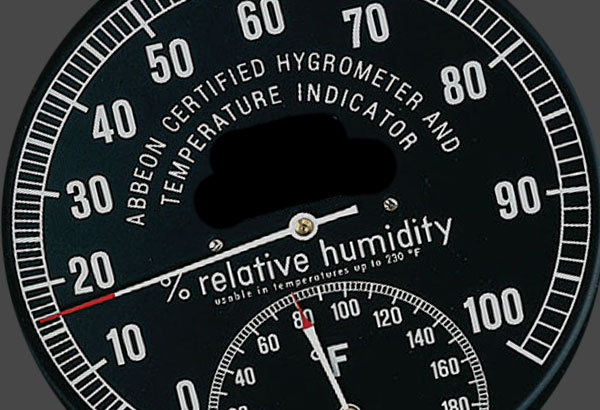
I want to talk about the acoustics of live music and recordings. As I write this I'm back in Boston for a week, re-calibrating my ears with (excuse the expression) the "absolute sound" of live music in various concert halls. On Friday the Boston Symphony played symphonies by Mozart and Shostakovich, producing (as always) magnificent sound with the aid of Symphony Hall's near-legendary acoustics.

Improving on Perfection?

Most audiophiles are aware of the modification and add-on aftermarket. A few have learned the hard way that modifier competence varies from primitive magic and sales hype to real engineering skill. Some modifiers are serious audiophiles who are also good technicians; others are scam artists whose only goal is to make a quick buck on the latest fad. If you have only a rudimentary understanding of electronics, you may not be able to make a distinction. Even the most jaded and battle-hardened among us can still be hooked and reeled in by a slick sales presentation.

A High-Resolution Audio Primer

January's Industry Update included a report on a scientific article presented at last year's AES meeting, in which the authors used test tones and a modest audio system (albeit in an anechoic chamber) to prove that listeners can discriminate between high-rez and CD-rez audio. This is important because scientific evidence of an audible difference between high-rez and CD-rez music is considered weak by some, even as anecdotal evidence grows stronger by the day.

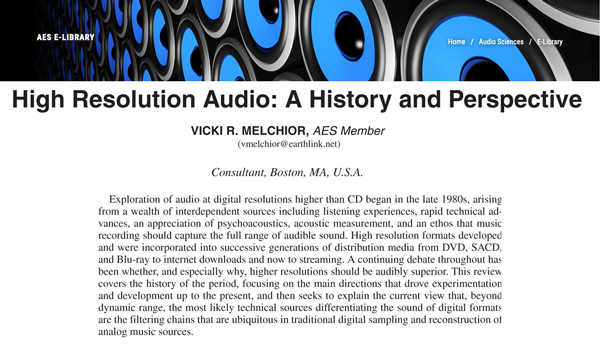
As I pondered this, I recalled a recent paper I'd seen in the Journal of the Audio Engineering Society but hadn't yet read. "High Resolution Audio: A History and Perspective," which the AES has made available free online, does precisely what the title says: reviews the history of digital audio beyond CD-rez and frames the issue of high-rez audio's audible superiority on the basis of the available evidence.

"Isn't Our Hobby the Greatest?"

As per our ritual, Karim and Dan arrived at my door in late afternoon, bearing our ritual's customary offerings: dark beer, wine, cold pork sandwiches, fruit and chocolate tarts, good music on well-recorded CDs, and audio hardware to try out on the host's hi-fi—on this particular Friday, my hi-fi. It's what we did: break bread while gabbing like regular folk about regular things, then bolt for the listening room for an evening of hi-fi fun.

The Ghost in the Machine

"The crying rain like a trumpet sang
And asked for no applause.
"—Bob Dylan, "Lay Down Your Weary Tune"

I remember as a toddler sitting in the kitchen on a highchair, watching my mother smoke a cigarette, apply red lipstick, and tune a turquoise table radio from one news station to another. Between the strange, nattering voices, the radio emitted a sharp hissing sound. That's my first memory of human voices coming from a little box.

Advertisement
Advertisement
Advertisement