Photo: Carl Zapp
Jonathan Tinn of Blue Light Audio, importer of darTZeel electronics and a partner in Playback Designs with DSD expert Andreas Koch, loves vinyl (footnote 1). He approached Wave Kinetics' Matt Schuster and proposed that they together produce a turntable. Schuster is a Stanford grad whose background is in applied mathematics and engineering. After getting Tinn's requirements, he set about assembling a team to aid in the design—which, he says, involved measurements and a lot of listening.
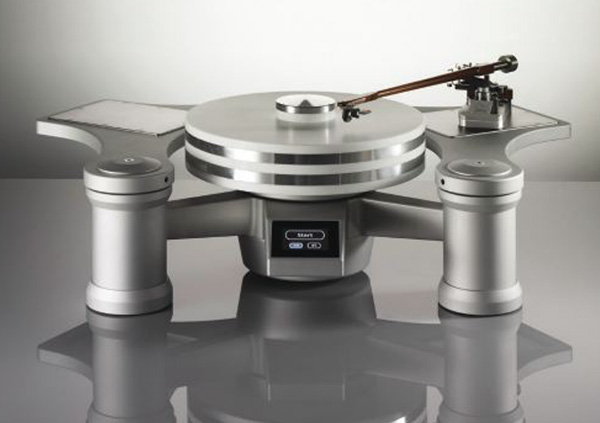
What Matt Schuster came up with is the Wave Kinetics NVS Reference turntable ($45,000, footnote 2), a direct-drive design made in a California factory that specializes in microrobotics. It's as handsome as it is high-tech.
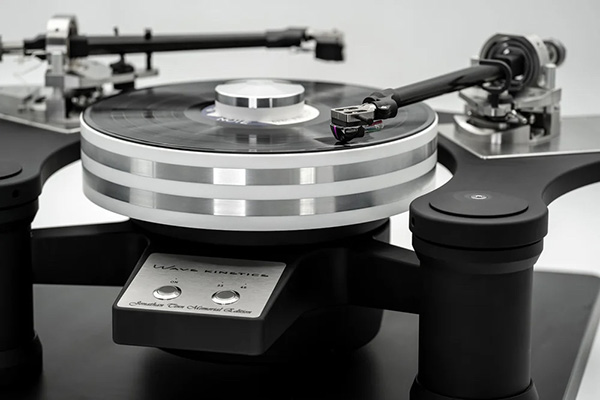
Though the NVS Reference is dramatic in every aspect of its appearance, the eye is first drawn to its layer cake of a platter: three slabs of aluminum interleaved with two slabs of a mass-loaded white polymer, bolted and glued together under "fantastic pressure," Matt Schuster told me, and weighing about 30lb.
A large sculpted pod directly under the platter holds the motor, a custom DC design governed by a "laboratory-grade" commercial servo-controller with an active, ultrasonic feedback loop that produces a claimed speed accuracy of 1 part per million.
Given that most LPs are pressed somewhat eccentrically, I'm not sure the race for speed accuracy is all that critical, or that the possible trade-off in "jitter" needed to produce such accuracy is a worthwhile one. Schuster said that he's well aware of the jitter/brightness problems servo systems can cause as they constantly compensate for deviations from the desired speed, and that the prevention of constant over- and undershooting was part of the design from the beginning. Each NVS Reference is individually tuned using "a 17 degrees of freedom tuning model" (whatever that might be) that's said to prevent large over-/undershoots.
The controller is housed in a modestly sized, all-business box of brushed aluminum with an On/Off switch, two Ethernet communications ports, and an IEC inlet for the AC cord. The NVS's least attractive component, it can be moved well away from the 'table itself.
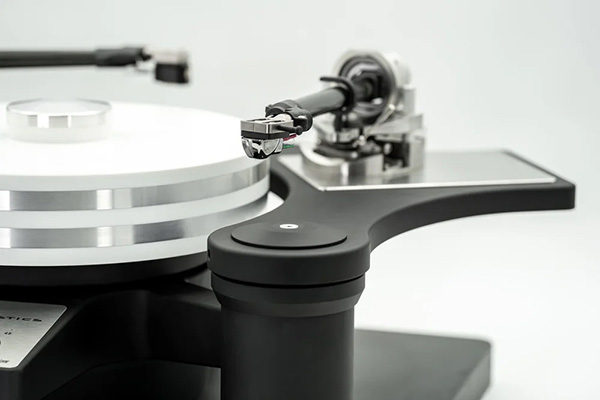
The main body, the three fat support pillars, and the platform on which the turntable sits are machined from billets of solid aluminum to a tolerance of 0.001" using state-of-the-art, five-axis CNC tools. Cantilevered platforms on the main platform incorporate two cutouts, to which are bolted two 18lb armboards of stainless steel.
The platform includes proprietary vibration-damping material, while the pillars incorporate a tuned suspension that uses custom viscoelastic dampers. There's also an internal system of vibration damping. Together, these systems deal with floor- and airborne vibrations, as well as vibrations generated by the NVS's motor and drive train.
Wave Kinetics began as a manufacturer of passive vibration-control systems designed to be placed under audio components. Their website used to include a page of a type found on too many audiophile tech sites. Click on a link labeled "The Truth" and you'll find the pros and cons of many vibration-damping systems both passive and active, as well as the pros and cons of using certain materials: ceramic, carbon fiber, Sorbothane, etc. Scroll to the bottom and, under "Wave Kinetics," you can read about their system, for which they list only pros—no cons. But "The Truth" is that
every system and technology has pros
and cons—even vinyl playback.
But I found it easy to look past informative handouts that have one foot in science and the other in self-serving promotion: Schuster and his team have made a serious attempt to produce a state-of-the-art direct-drive turntable.
 Setup and Use:
 Matt Schuster and a friend delivered and set up the Wave Kinetics NVS Reference atop my HRS SXR Signature rack (the Signature model is an upgraded version that features, among other improvements, rigid struts across the front and rear of each shelf-supporting platform).
First, they placed on the shelf a damped aluminum platform, into which were machined shallow receptacles for the turntable's three pillars. I later found that tapping lightly on the platform while music played produced a ringy resonance through the speakers, indicating a relative liveliness; ie, it wasn't particularly well damped. Once the 'table was in place, it could be made level by rotating its pillars' feet. Other than plugging in the motor-controller cables and the power cord, that's all there was to it.
Joel Durand was also on hand, to install and set up his graceful Telos tonearm ($16,500; see review below). As much as I looked forward to hearing and reviewing the Telos, assessing the turntable with an unfamiliar arm was impossible; I asked Wave Kinetics for a second armboard, cut for the
Kuzma 4Point. While waiting for that to arrive, I listened to a Lyra Titan
i cartridge mounted in the Telos and thoroughly enjoyed what I heard—but what was I hearing? More about the Telos later.
A conveniently placed, touch-sensitive fluorescent screen lets you select 33 1/3 or 45rpm, and Start/Stop. Wave Kinetics supplies a small screw-on record puck, made of a layer each of aluminum and that white polymer. It's not particularly heavy, and because it doesn't have a washer, screwing it down didn't press an LP's outer edge firmly against the platter.
The only annoying aspect of using the NVS was that its platter is slightly oversized: Lifting an LP from it requires a fingernail dug under its edge. Nail biters, you have been warned. Also, the white platter effectively camouflages dust; it's important to wipe with a Swiffer or microfiber cloth before listening sessions.
The NVS operated flawlessly in the months I had it here, though a few times, when I pushed the Start button, the platter wouldn't achieve the correct speed. The solution was to power down the motor controller and restart—not really a problem, but . . . rebooting is for computers.
 Comparing Apples to Apples Bears Fruit:
 With the Kuzma 4Point mounted on the NVS Reference's second armboard, I could directly compare the Wave Kinetics with my
Continuum Audio Labs Caliburn turntable, much as I'd recently done with the Onedof 'table (reviewed in this column in July 2012). To make instantaneous comparisons, I also made 24-bit/96kHz recordings of LPs played on both 'tables using MSB's professional-grade Platinum Studio analog-to-digital converter. I used the
Lyra Atlas phono cartridge in both turntables. So with the turntable being the only variable, and with but a few seconds to swap out 4Point headshells, the listening began.
The impulse of the stylus touching the record surface was a compact, short-lived, tonally neutral, extremely well-damped
tick. It didn't take long to hear that the NVS produced dead-quiet backgrounds similar to the blacknesses produced by the Caliburn and Onedof. Only the best 'tables I've heard (which are not necessarily the most expensive, the
VPI Classic 3 being a case in point) can manage this level of deep, satisfying nothingness, out of which the music seems to leap. Only the best belt drives and the
Rockport Technologies System III Sirius, another direct-drive model, have managed this kind of background blackness.
The NVS's bass extension and control were uncannily similar to the Caliburn's, though textures were slightly drier. As that slight dryness made its way up the audioband, it was particularly noticeable (though only in direct comparisons of the 'tables) with cymbals and other instruments rich in high-frequency transients.
The 'tables tracked closely in image and soundstage three-dimensionality, though the Continuum produced greater depth and put images in slightly greater relief. Unlike the Onedof, which was easy to identify because of its unusual smoothness (without loss of fine detail or transient speed and clarity), the overall sounds of the Continuum and Wave Kinetics were more similar than different.
Both 'tables reproduced well-recorded pianos with a fine balance of felt-on-string attack, sounding-board sustain, and natural decay. The NVS's slight overall dryness at first sounded like greater resolution of detail, but over time it became clear that there was a bit less complexity and delicacy to attacks; the lower register sounded slightly less woody, while the upper octaves of the keyboard were ever so slightly less bell-toned and a bit more tinkly—but here I'm talking musical and sonic minutiae compared to a significant difference in price.

The LP tracks I recorded for my instantaneous A/B comparisons were: "Don't Know Why," from the new Quality Record Pressings edition of Norah Jones's
Come Away With Me, mastered by Kevin Gray (and vastly superior to Bernie Grundman's mastering of the original, done before Grundman's major upgrade of his cutting chain); "They Say It's Wonderful," from ORG's 45rpm edition of
John Coltrane and Johnny Hartman; "Meet Me in Dreamland," from the 45rpm ORG edition of Thelonious Monk's
The London Collection, Volume 1 (a limited-edition treasure not to be missed); Kreisler's
Tempo di Menuetto, from Bob Ludwig's remastering of violinist Arturo Delmoni and pianist Meg Bachman Vas's
Songs My Mother Taught Me (John Marks Records); "Zoltan," from Music Matters' 45rpm reissue of Larry Young's
Unity; "You Took Advantage of Me," from ORG's 45rpm edition of Ella Fitzgerald's
Sings the Rodgers and Hart Songbook, Volume 1; "Love the One You're With," from Classic Records' reissue of
Stephen Stills; and, finally, "It's Now or Never," from Analogue Productions' 45rpm set of Elvis Presley's
24 Karat Hits!
These comparisons made clear that while I wouldn't want to bet on my ability to tell which was which in a double-blind test (though I think I could), there was a consistent difference between the two versions of each track, one recorded with each turntable. But was it worth paying more than twice the price of the Wave Kinetics for the Continuum Caliburn? We make that kind of call with every piece of gear we buy.
What were the major differences? The piano told all. With the Delmoni and Monk tracks, the complexity of the attacks and the microdynamic expression were key indicators. The recordings were difficult to distinguish on the basis of timbre, but the NVS's attack was somewhat muted and flattened by comparison, decays less distinct, and images slightly flattened. Monk ends a phrase by pressing a key a bit harder for emphasis, then begins the next with a softer touch. Those differences were more apparent with the Continuum.
The tiny microdynamic shifts that produce a sense of aliveness were also somewhat diminished. The Monk track was the one I'd use to tell which was which in a double-blind test, though Elvin Jones's drums in "Zoltan" would also be a dead giveaway—as would keying in to Woody Shaw and Joe Henderson's opening statement of the theme: trumpet left, tenor sax right. The cymbals were ever so slightly softened and less well delineated via the NVS, as were the trumpet's and sax's attacks.
Easily Drawn Conclusions: Picked nits and fine-toothed combs aside, the $45,000 Wave Kinetics NVS is a superbly designed and executed world-class turntable that comes tantalizingly close to matching the Continuum Caliburn's sound. Its build quality is exceedingly high, its visual appeal undeniable. I also like that it's made in the US. It produced a solid, precise, well-controlled sound that was not overdamped or too analytical, and that reliably sets the table for whatever colors you might want to add or subtract with your choice of associated gear. A top-shelf turntable that's easy to recommend.
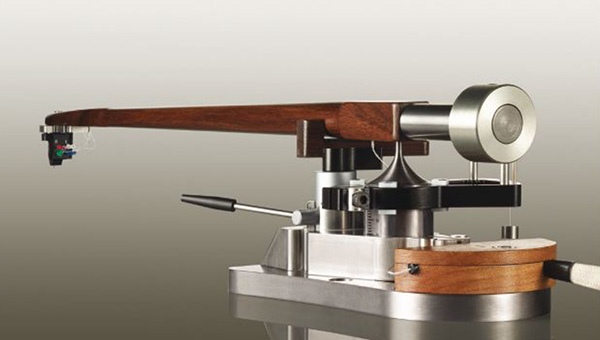
Photo: Carl Zapp
The Durand Telos tonearm
At $16,500, the Telos is the most expensive tonearm I've seen, and the top model made by Durand Tonearms LLC (footnote 2). Designer Joel Durand is clearly a perfectionist, and over the years he's attracted a large and enthusiastic following for his wooden-tubed tonearms, much as has Frank Schröder.
The presentation is spectacular. The Telos comes in an absolutely beautiful, attaché-style case of wood. Durand includes a full set of high-quality tools and setup accessories. You get an LED flashlight, a loupe in a leather pouch, a pivot-to-spindle-distance gauge nicely machined from metal, and a Mint alignment gauge of etched glass.
The 12", medium-mass arm is made of a superbly sculpted and finished piece of wood (species not specified) in what Durand calls a "constrained unipivot" design using a Swiss-made point of nonmagnetic stainless steel around which pivots a cup of sapphire set within the wood of the arm.
The armtube itself is a lathe-turned wonder featuring a flattened, tapered front that forms the headshell, A channel within the tube the wire that runs from the cartridge clips to the RCA plugs , and a square rear section that accepts the stem of a massive cylindrical counterweight that appears to be of stainless steel.
The "constrained" part of the bearing description refers to a secondary system designed to provide lateral stability and to allow for relatively easy adjustment of azimuth. It consists of a thin metal rod that exits at a 90° angle from the side of the arm, and rides on a goalpost-like rail assembly perpendicular to the first rod.
The amount of downforce can be varied by adjusting, on the perpendicular rod, the distance from the armtube of a sliding weight. The string-and-weight antiskating mechanism fits (with an O-ring) to the end of the perpendicular rod, and can be adjusted only by swapping among the various supplied string-and-weight assemblies. The pivot point is part of a massive cylindrical assembly within the main base that can be locked or unlocked and raised or lowered. Though the vertical-tracking and stylus-rake angles can't be adjusted on the fly, a precision gauge on the arm assembly's side allows easily repeatable adjustment of the height. The goalpost-like azimuth-adjustment rod resides on an assembly that's pressure fitted to the cylindrical assembly, and can be slid up and down on the shaft and then locked.
The headshell has a single, centered hole. The cartridge is mounted to a beautifully machined stainless-steel carrier into which a brass nut is first placed in a groove, trapped there by the cartridge top plate but free to slide within the groove. With the carrier screwed into the headshell, the cartridge is free to slide fore and aft within the carrier to adjust overhang. It's ingenious and effective—though when the screw is loose, both offset angle and overhang are in play, so be careful.
Overall, while Durand's design includes a number of unique setup features, with a few caveats space doesn't permit detailing here, the Telos was no more difficult to set up than an arm with a slotted headshell and other, more conventional and familiar features.
Durand's website says that, in the design of the Telos, the "research was guided by the use of computer simulation tools, FEA [Finite Element Analysis], physical experiments, and highly trained listening." In the search for tonearm perfection, "some conventional and commonly accepted wisdom was abandoned." Clearly, the discards included the "wisdom" of lowering the arm's center of gravity by placing the counterweight lower than the pivot point, as in arms from Graham Engineering, Kuzma, Spiral Groove, Triplanar, and others.
The stub that carries the Telos's counterweight is in line with the bearing. The instructions also say that, contrary to "conventional wisdom," the arm might sound better with a lighter weight farther away from the pivot rather than a heavier weight closer to the pivot.
I don't see this as a matter of "conventional wisdom." It's physics, plain and simple. When you combine a high center of gravity with a relatively light bearing load that's partially unloaded by the azimuth-adjustment stabilizer system (no wonder the sound changes, and for the better, as you slide the perpendicular weight away from the goalpost and toward the pivot point where it adds downforce mass), add a long tonearm's less responsive moment of inertia compared to that of a 9" arm, and move the counterweight farther from the pivot point, you
don't get better mechanical performance—though you might prefer the sound.
When I used the Telos to play an LP with a high-amplitude, narrow-Q warp—one that both the Graham Phantom Supreme II and Kuzma 4Point had been able to track—the stylus was thrown out of the groove for a split second with each revolution. With flat LPs, however, the Telos was an excellent tracker, and its horizontal and vertical resonant frequencies were right in the pocket at around 9Hz, according to the
Hi-Fi News & Record Review Test Record.
All that said, and despite my prejudice against wooden tonearms—it seems to me that a relatively long piece of wood of narrow diameter is a resonant object easily affected by changes of humidity and temperature—the Telos sounded positively, addictively
glorious with the Lyra Titan
i or Lyra Atlas cartridge mounted in its headshell.
Silky, luxurious, relaxing, smooth, detailed, utterly nonmechanical—acoustic instruments, especially strings and voices, were reproduced with a thoroughly natural and convincing ease. The air abounded with harmonic richness. The sense of relaxed, musical flow produced by the Telos was uncanny.
If you like the sound of the violin, whether unaccompanied or in a chamber ensemble or orchestra, the Telos will drop your jaw so far you'll need orthodontic surgery. I found myself pulling violin recordings from all over my collection and being mesmerized by the silky, natural sound of bows drawn across strings. If you've heard that live, you'll recognize it here.
But while the Telos's bass response was very good, especially well textured, and relatively well controlled, the arm lacked the Kuzma's bottom-octave solidity and punch. Rock music was better served elsewhere.
I also found that the Telos amplified minor pops and clicks that other arms mostly ignored. That struck me as not a testament to its sensitivity or its ability to resolve detail, but rather indicated a resonant quality that amplified rather than suppressed such impulses.
I completely understand what Telos enthusiasts like about it, in terms of its exquisite structural integrity and build quality and its absolutely mesmerizing sound. Through the use of carefully chosen materials, it has been skillfully tuned to produce textures and colors in perfect balance—it never sounded tubby or bloomy or soft or oversaturated, and it perfectly complemented the Wave Kinetics NVS Reference turntable's slight tendency toward dryness—an ideal combination. Despite my carping, I think Joel Durand has produced a beautifully made, sonically brilliant, and in many ways utterly ingenious and original tonearm.
Given the requirements of my job, I ultimately prefer the more neutral sound of the
Kuzma 4Point,
Graham Phantom Supreme II and
Continuum Audio Labs Cobra. But that's just me. I suppose the Telos enthusiasts will say that I prefer the dark, the mechanical, and the lifeless. Let the hate mail rain down!
Footnote 1: Jonathan Tinn passed away from cancer in 2023.
Footnote 2: Wave Kinetics. Web:
www.wave-kinetics.com. US Distributor: Blue Light Audio, Portland, OR (2012). The Audio Association, Anaheim Hills, CA (2026). Tel: (310) 739-3400. Email:
info@theaudioassociation.com. Web:
www.theaudioassociation.com.
Footnote 3: Durand Tonearms LLC, 4414 NE 104th Place, Seattle, WA 9126. Tel: (206) 979-9774. Web:
www.durand-tonearms.com.