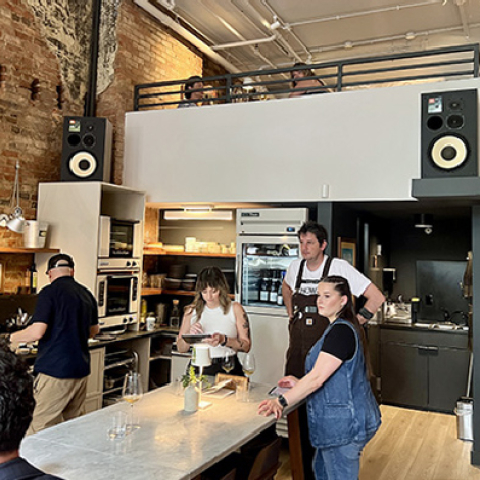
Sound Attic founder and owner Charles Weiner with wife and strategic adviser Lauren Weiner (center) and student interns.
In some ways, the Sound Attic, a new dealership in Tampa, Florida, seems like a traditional brick-and-mortar hi-fi store. It does what such stores do: It sells a selection of hi-fi gear across a range of prices. But there's more to the story, according to Sound Attic founder/owner Charles Weiner, who
Stereophile interviewed by phone and email.
"We represent a number of traditional hi-fi brands and operate as a showroom," Weiner said. "What's a bit different is that it's largely student run and built around introducing younger people to two-channel listening."
The vision is ambitious. The Sound Attic is "a student-driven, professionally guided listening gallery, where college students help run the space while gaining real-world experience in audio, design, marketing, and storytelling," Weiner said. "The concept is built around the idea that high-end audio can also serve as a cultural and educational platform, with 100% of our profits reinvested into student opportunities, arts programming, and education."
Student internships are the core of the program. Currently, there are seven interns on staff from the University of South Florida (USF), where there's a School of Music and a commercial music program. Also in the works are programs with additional schools, including the University of Tampa, Hillsborough Community College, St. Petersburg College, and the Ringling College of Art and Design in Sarasota.
"The model here is experiential learning," Weiner said. "They are learning by doing. And this is not the kind of internship where you're sort of sitting around. You are literally shaping the direction of the Sound Attic. They are writing the employee handbook, or the brand book, building it all up from the start." Intern duties so far have included social media, graphic design, digital marketing, sales, community outreach, event planning, and more.
"The space itself was designed in collaboration with students," Weiner said. The space was developed as a co-op model pairing students with professional designers. Chloe Green, an interior design student at the University of Tampa, played a key role as part of a collaborative design team that included House of Fleck Interiors and House of Tropi Design Studio.
Every intern is compensated. Compensation is not tied to financial need, as is typical in work-study programs. "Our interns are paid in a real, structured way," Weiner said. "It's not token or just minimum wage for the sake of it. Most roles are hourly or project based, and we try to keep it in line with, or better than, what they'd typically make in other student or entry-level jobs." "We also have what we call a Cultural Impact Bonus, where students can earn additional compensation tied to meaningful contributions, whether that's helping with a sale, creating content that performs, or advancing a key project. The idea is that the work itself is real, and the compensation reflects that."
The program is new and evolving, with student input. Weiner is full of ideas. "We want lectures from professors from USF and the School of Music talking about music appreciation. How cool would it be to hear about American jazz and then listen to it on the different systems that are here?" Weiner hopes to expand into the community, and even beyond. He hopes the store will become a cultural hub for music appreciation.
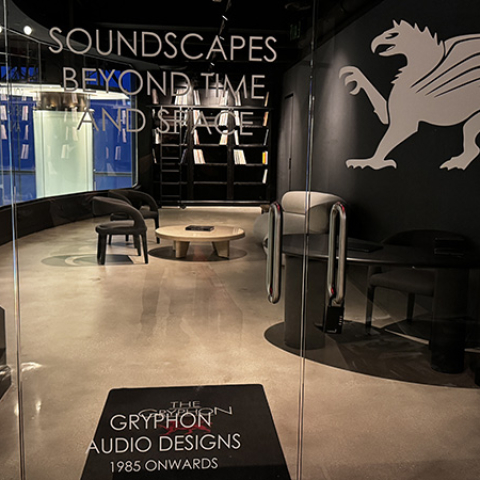
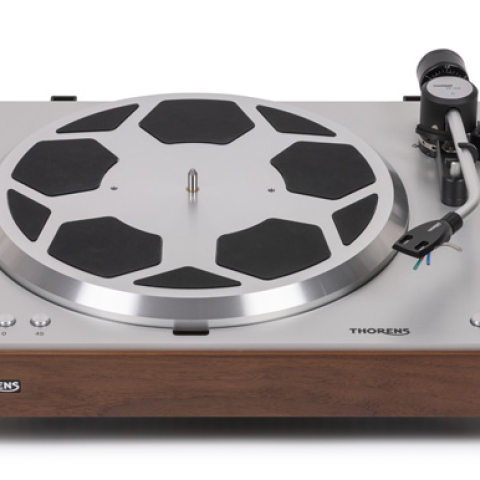
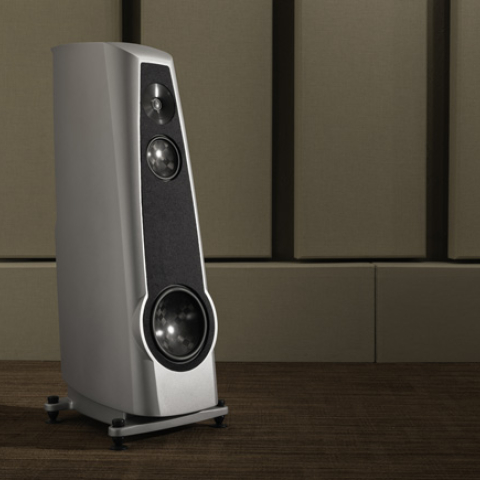
In many ways, it's not that different from other hi-fi dealerships. The demo rooms have names. The Heritage Room has products from some of the industry's longest-running companies, including Luxman and Klipsch. The Statement room contains premium equipment from high-end companies including Burmester and Accuphase, and top-level speakers from Bowers & Wilkins. There's a room inspired by pro audio, with ATC and Genelec speakers. Then there's the
de rigueur headphone bar, with six stations and well-known brands: Stax, Audio-Technica, Woo Audio.
At the time we spoke, the store, which focuses on two-channel audio—no home theater or custom install—carried 16 brands, including both high-end and lifestyle products, across a range of prices.
"We really wanted brands that we could do something different with," Weiner said. "A great example is Burmester, which for us I would almost characterize as sort of a cultural partnership." Before the store opened, two student seniors were sent on their first business trip—to the Porsche Experience Center in Atlanta, where Burmester was presenting some training events. (Burmester is Porsche's most premium in-car hi-fi option.) "We have a lead intern who's a senior at USF, graduating with a degree in marketing, who's been working very closely with Luke Bennett, who's with Burmester North America, really building out ... our marketing for Burmester."
"The mission is where it's this notion of luxury that gives back," he added. Buying a luxury hi-fi is no longer just an act of consumption. It is also, Weiner said, "an act of patronage."
Weiner also hopes that in time the Sound Attic concept might expand to serve as a model program for other regions and communities—to help support their local university students with an eye toward the hi-fi industry's future.