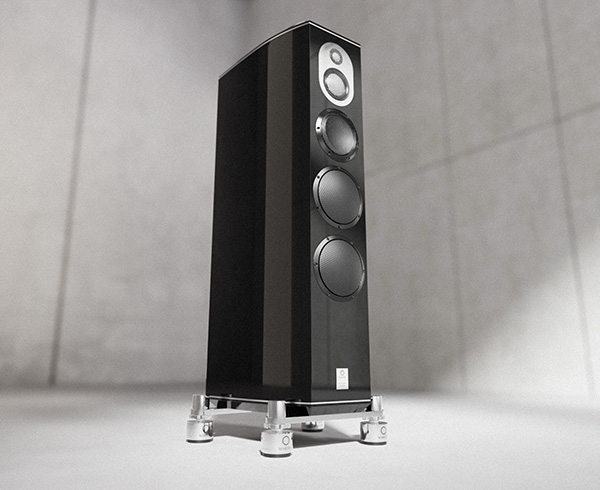
As I prepared this review of the Marten Mingus Septet Statement Edition loudspeaker ($199,000/pair), I asked the Marten people to tell me something about the company and its values. Here's the reply I received via Marten's Martin, Global Sales Manager Martin Dunhoff:
Marten designer Leif Olofsson obviously believes it's worth it.
On timing
I find it odd that in our industry there isn't more focus on time. After all, we live in time, we hear in time. We hear not frequency but time-varying pressure against our eardrums. You could almost argue that frequency is an abstraction, except for the fact that our ears are designed to detect those variations in the pressure against our eardrums—the more regular ones—as pitch, frequency's music analog and, with rhythm, one of the two most important components of music. That makes a focus on frequency natural enough, even if frequency isn't quite as fundamental as time. Transient-perfect loudspeakers aren't a new idea. Even ignoring single-driver speakers (which are intrinsically transient-perfect), the timeline traces back at least to the Dahlquist DQ-10, which was realized in 1972. Externally, the DG-10 resembled a Quad electrostatic, but behind the sock were five dynamic drivers mounted in an array, sloped to align the drivers' acoustical centers. Three years later came the Technics SB-7000, a minifridge–sized ported bass unit topped like a wedding cake with midrange and tweeter enclosures staggered to align the drivers' acoustical centers. As I discuss in this month's As We See It, the main obstacle to transient-perfect behavior in a loudspeaker is the crossover. Those seeking transient perfection (or near-perfection) have three options: Digitize the input, use no crossover at all, or use a first-order crossover. The Technics SB-7000 was the first speaker to use all–first-order crossovers in the interest of timing perfection.
A few years later, four companies—Spica, Vandersteen, Thiel, and Dunlavy—would adopt first-order crossovers and work to solve the engineering problems such crossovers introduce.
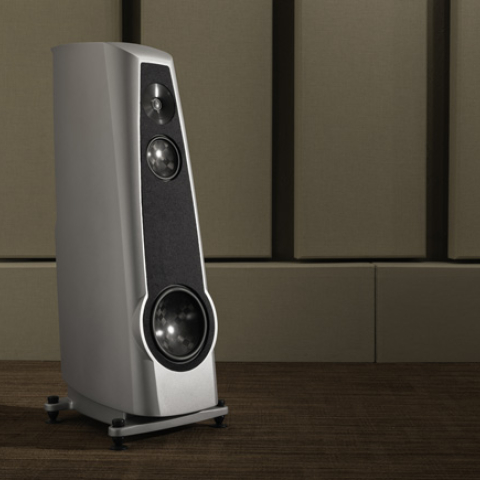
 The Marten Mingus Septet Statement Edition
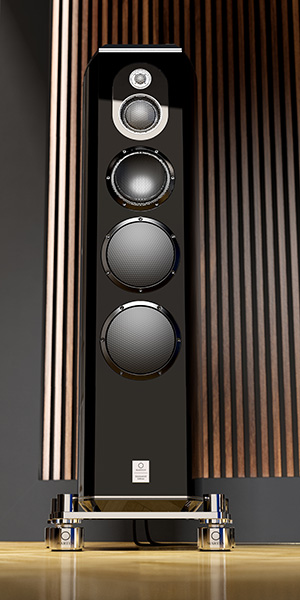
The Marten Mingus Septet Statement Edition is the flagship speaker in Marten's second-from-top Mingus series; Coltrane is their top series. It was designed from the ground up to preserve phase relationships among its five active front-panel drivers. The Septet employs only first-order crossovers. I wrote that the crossover is the main obstacle to transient-perfect behavior, but there is another, as suggested in the description above of the Technics SB-7000. Most big drivers are deeper than most small drivers. If you align their fronts on a speaker's baffle, the big drivers' acoustical centers are farther back. Different companies have accounted for this in different ways: Spica and Thiel with a sloped front baffle, Vandersteen and Dahlquist by staggering drivers under a sock.
Marten uses custom drivers with shallow acoustical centers. They mount those drivers on a flat vertical baffle, coming very close to physically aligning their acoustical centers. In this way, Marten avoids some of the problems that other manufacturers have had to grapple with—problems arising mainly from having parts extend in front of other (sound-producing) parts for sound to bounce off.
First-order crossover filters roll off very slowly, at 6dB/octave. That means that each driver's meaningful response extends well beyond the crossover point, so there's a lot of overlap between frequency-adjacent drivers, leading to reinforcement and cancellation, especially as you move off the preferred listening axis. That makes it much harder to maintain a flat, even frequency response.
The simultaneous goals of time coincidence and even frequency response, then, are at best challenging and at worst mutually exclusive. It's surely part of what led Marten to advise that listeners listen at least 3m away from the speakers and ideally 3.5m. The extra space gives the drivers the distance they need to stitch their outputs together and for the frequency response to even out. It is also, surely, why Marten suggests toeing the speakers in toward the listening position: On-axis behavior is usually more linear than off-axis behavior.
 More on Marten's drivers
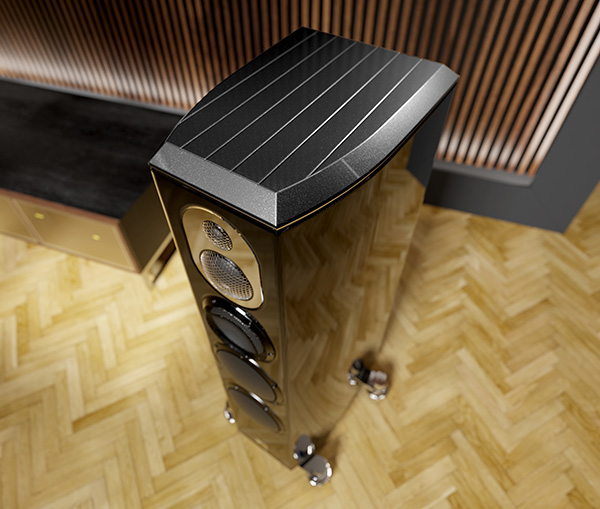
Herb Reichert likes to say that things "sound like what they're made of." The Marten Mingus Septet has seven drivers, two of them passive. Those drivers' vibrating parts are made of diamond (tweeter), beryllium (upper midrange), ceramic (lower midrange), and aluminum honeycomb (woofers and passive radiators). That's a lot of different materials. While Herb's statement is true more often than not—things sound like what they are made of most of the time—careful engineering can produce exceptions, drivers that add no sound of their own to the sound they're reproducing. That's what's meant by "pistonic": It moves forward and back like a piston and doesn't bend or change shape. Marten worked with Accuton to develop a range of drivers called Cell. Accuton Cell drivers were developed especially to solve the flat-baffle time-alignment problem. Cell drivers, though—and related custom drivers—are also used by companies that do not pursue time alignment: Estelon, Tidal, and Gauder Akustik all use drivers from or based on the Accuton Cell series. That indicates, presumably, that the opportunity to achieve timing excellence is not their only virtue.
Accuton worked with Marten to develop custom drivers based on the Cell philosophy. Every driver on the Septet is customized to some degree. The amount of customization varies. The Septet's diamond-dome tweeter is said to handle frequencies from 6kHz to 60kHz—though because of the first-order crossover, it will be called on to produce sound at frequencies well below 6kHz. Anyone worried that diamond will sound bright—I'm not one of them—can be reassured: I heard no brightness from these speakers. In its marketing, Marten suggests that the first-order crossover softens any harshness, which may mean that tweeter-range harshness is a consequence of time-domain misbehavior.
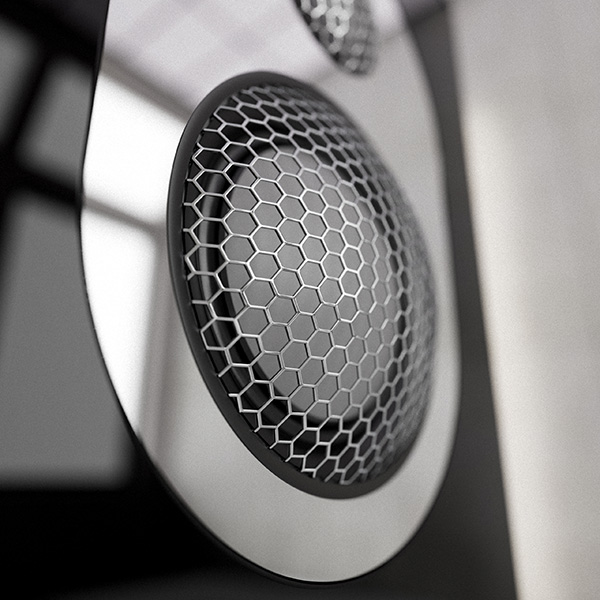 The Septet's beryllium-diaphragm upper-midrange driver handles mainly frequencies between 800Hz and 6kHz—though, again, because first-order crossovers are used, it will make audible sound well above 6kHz and well below 800Hz.
Why use different materials—diamond in the tweeter but beryllium in the midrange? Because while beryllium isn't as stiff as diamond, it's cheaper. Its first breakup mode, though lower in frequency than diamond's, is still far above the range the driver will be reproducing—indeed far above the audible frequency range. But the main advantage of beryllium is self-damping. It doesn't ring, which is especially important in this driver because it covers the presence region, the range the ear is most sensitive to. The inverted ceramic/sapphire dome used in the lower-midrange driver will certainly be pistonic in its relatively narrow 200– 800Hz passband. Why ceramic? It too has excellent self-damping. And while it's significantly heavier than beryllium, it is also much stiffer: Beryllium's stiffness is great in a 3" dome but not sufficient for a 7" inverted dome. A lower-midrange driver needs to be very stiff, but it doesn't need to be as light.
Why inverted? Inverting it moves the voice coil farther forward; together with a slightly raised edge, this positions the driver's acoustical center very close to the front baffle.
Finally there's the bass system: Two 8" aluminum-honeycomb sandwich woofers assisted by two 10" passive radiators around back (footnote 1). The woofers are customized versions of Accuton's "stock" aluminum-honeycomb cone woofers. Customized how? I read online that the two woofers are tuned to different resonant frequencies to spread out any resonant peak. Perhaps there's extra damping to support use outside their normal passband and to ensure that the woofers and radiators work together optimally.
Compared to a conventional bass-reflex design, passive radiators should produce better-controlled bass and more even bass response. Marten specifies –2dB at 23Hz; below this, the output is expected to drop off at 24dB/octave.
I haven't yet mentioned the cabinet. The Mingus is built up of laminated layers of "high-spec" MDF, joined together under pressure by vibration-damping adhesive—not as fancy as the Kevlar and carbon fiber found in Marten's Coltrane series but effective at suppressing cabinet vibrations.
The Marten Mingus Septet is a big, beautiful, classically proportioned four-way with five active drivers plus two passive radiators—utilizing a wide range of modern materials—and a cabinet made from wood-veneered MDF, with driver domes and cones made from a variety of rigid modern materials. What sets it apart from other speakers is first-order crossovers and time-coincident design realized on a vertical, non-sloped baffle.
And what about the Statement Edition? It adds Jorma Statement cables internally, which have upgraded copper and better shielding, leading, Marten says, to a "more natural, transparent sound." The Statement version is said to employ higher-quality crossover components that add precision to the first-order crossover network. Product documentation says these upgrades result in a more transparent soundstage, more precise tweeter and upper-midrange driver performance—these two points presumably linked—enhanced dynamics, and more powerful and controlled bass. Marten calls these upgrades the "ultimate refinement" of the Mingus Septet concept.
The Septet's beryllium-diaphragm upper-midrange driver handles mainly frequencies between 800Hz and 6kHz—though, again, because first-order crossovers are used, it will make audible sound well above 6kHz and well below 800Hz.
Why use different materials—diamond in the tweeter but beryllium in the midrange? Because while beryllium isn't as stiff as diamond, it's cheaper. Its first breakup mode, though lower in frequency than diamond's, is still far above the range the driver will be reproducing—indeed far above the audible frequency range. But the main advantage of beryllium is self-damping. It doesn't ring, which is especially important in this driver because it covers the presence region, the range the ear is most sensitive to. The inverted ceramic/sapphire dome used in the lower-midrange driver will certainly be pistonic in its relatively narrow 200– 800Hz passband. Why ceramic? It too has excellent self-damping. And while it's significantly heavier than beryllium, it is also much stiffer: Beryllium's stiffness is great in a 3" dome but not sufficient for a 7" inverted dome. A lower-midrange driver needs to be very stiff, but it doesn't need to be as light.
Why inverted? Inverting it moves the voice coil farther forward; together with a slightly raised edge, this positions the driver's acoustical center very close to the front baffle.
Finally there's the bass system: Two 8" aluminum-honeycomb sandwich woofers assisted by two 10" passive radiators around back (footnote 1). The woofers are customized versions of Accuton's "stock" aluminum-honeycomb cone woofers. Customized how? I read online that the two woofers are tuned to different resonant frequencies to spread out any resonant peak. Perhaps there's extra damping to support use outside their normal passband and to ensure that the woofers and radiators work together optimally.
Compared to a conventional bass-reflex design, passive radiators should produce better-controlled bass and more even bass response. Marten specifies –2dB at 23Hz; below this, the output is expected to drop off at 24dB/octave.
I haven't yet mentioned the cabinet. The Mingus is built up of laminated layers of "high-spec" MDF, joined together under pressure by vibration-damping adhesive—not as fancy as the Kevlar and carbon fiber found in Marten's Coltrane series but effective at suppressing cabinet vibrations.
The Marten Mingus Septet is a big, beautiful, classically proportioned four-way with five active drivers plus two passive radiators—utilizing a wide range of modern materials—and a cabinet made from wood-veneered MDF, with driver domes and cones made from a variety of rigid modern materials. What sets it apart from other speakers is first-order crossovers and time-coincident design realized on a vertical, non-sloped baffle.
And what about the Statement Edition? It adds Jorma Statement cables internally, which have upgraded copper and better shielding, leading, Marten says, to a "more natural, transparent sound." The Statement version is said to employ higher-quality crossover components that add precision to the first-order crossover network. Product documentation says these upgrades result in a more transparent soundstage, more precise tweeter and upper-midrange driver performance—these two points presumably linked—enhanced dynamics, and more powerful and controlled bass. Marten calls these upgrades the "ultimate refinement" of the Mingus Septet concept.
 Setup and listening
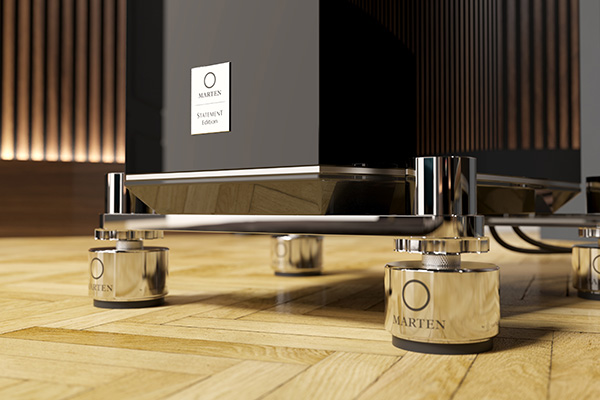
The speakers arrived in two large, wheeled shipping containers. These are big, heavy speakers, but wheels and handles on the crates and casters on the speakers made it possible for me to set them up by myself. Once they were roughly where I wanted them, I used a low-clearance jack to lift the speakers' fronts then rears and replace the casters with the provided Marten-branded IsoAcoustics footers. These footers are Marten's stock feet, so there was no opportunity to compare, but in several other contexts I've found IsoAcoustics footers very effective, including on a pair of very different speakers—Audio Note AN-Es—currently set up in my Maine house. I set up the speakers using Marten's fairly specific guidance—a roughly equilateral setup with at least 10' or so between the speakers and the listener, with the speakers toed in. I made sure they were more than 32.5" from the front wall and "not ... close" to the sidewalls, as advised. In-room symmetry was the one part of Marten's setup directions I was unable to comply with. As always in my room, the setup was asymmetric, with the right speaker some 3' from a record shelf (a decent diffuser at high and high-mid frequencies) and the left speaker very far from any wall: In fact, there's a dining area between that speaker and the nearest wall. I toed the Septets in just a little at first, but once I learned about the first-order crossovers, I aimed them straight at the listening seat so that most of the sound I was hearing was direct and on axis. Marten recommends a minimum of 50 hours of burn-in and says the speakers reach their full potential after about 200 hours—a burn-in CD is included—but the pair I received was already burned in. After the initial setup, I connected the Septets to the rest of my system—most directly to the Goldmund Telos 3200 monoblocks I reviewed for the December 2025 Stereophile. Later, I would substitute the Gryphon Antileon Revelation Stereo amplifier, in for review.
I was immediately pleased with what I heard: rich, full, detailed, with no hint of brightness. Dual-mono pink noise was precisely centered, its image thin, as it should be. Proper reproduction of well-recorded piano is one of my most important criteria in evaluating a loudspeaker; apparently it isn't easy to achieve. Coloration in almost any frequency range affects it, and good piano sound is highly dependent on the accuracy of transients. Well-recorded piano sounded natural and lifelike.
On the back of each Septet is a four-position knob that adjusts the woofer sensitivity in 1dB steps (footnote 2). With most acoustic music I found this change hardly noticeable—the effect on an upright bass in a jazz quartet was surprisingly small—but when I put on some EDM from Tom Fine's Qobuz Bass Test playlist (footnote 3), the efficacy of the bass control quickly became apparent.
As Jason Victor Serinus has been mentioning lately, a review is a moving target. Like most audiophile folk, reviewers are always in pursuit of better sound, for our pleasure and to make our systems better reviewing tools. Partly we seek improvement through new equipment, but it's also about room treatment and setup, which we typically adjust whenever new components arrive.
Some weeks after I set up the Martens, I paid a visit to Rockport Technologies' new industrial facility in Westbrook, Maine. Rockport has been moving in slowly, and they recently set up a listening space. It was largish, rectangular, with walls of—I think—PVC cladding, which is somewhat sound-absorbing. Speaker positions were still being fine-tuned, but the speakers were well out into the room, perhaps 10'. After a quick tour of the factory-to-be, we sat down to listen.
I noticed the soundstage right way. It extended a few feet beyond the sidewalls and very far back—it was deep—but it ended precisely at the front wall. I already knew that moving speakers out from the wall would expand image depth, but the precise correlation with the position of the front wall was new.
Inspired, back in New York, I moved the Martens a couple of feet farther out from the front wall. I moved the listening seat back by about the same amount. After some fine-tuning, the speakers ended up just under 11' apart and 10.5' from my ears, precisely level, and toed in toward my ears. I'd never listened with speakers so far out into the room before, with any speakers—mainly because it was now impossible to sit at one of the places at the dining table.
The sound, though, was transformed. Yes, the transformation was mainly in soundstage depth, but this had corollary payoffs, which I'll discuss below in more detail. Well-recorded jazz combos now seemed more or less natural-sized, as if filling a stage at a jazz club from a seat perhaps 10' from the stage—about the distance from the speaker plane to my listening seat.
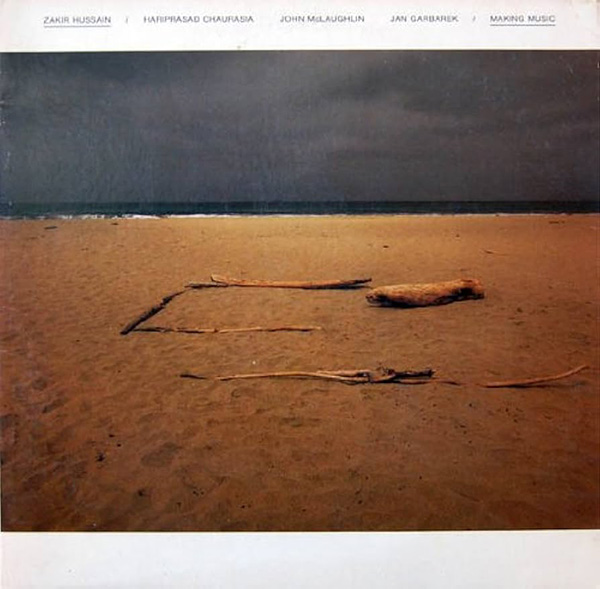 When the sound is new and fresh, you want to hear everything at once; I'm sure you know the feeling. I pulled out a new ECM record—from the label's Luminessence vinyl reissue series—and put it on. The album was Making Music, by Zakir Hussain, Hariprasad Chaurasia, John McLaughlin, and Jan Garbarek (LP, ECM 1349, engineered by Jan Erik Kongshaug at Rainbow Studio in Oslo, Norway, and produced, of course, by Manfred Eicher). If I'd heard this album before, I didn't, and don't, remember it.
Did these speakers ever love this album! I couldn't get enough of the woody articulation of the tabla and the various other percussion instruments (a ghatam—clay pot—and what looks on the cover like a pakhavaj, a long drum from northern India). John McLaughlin's guitar—probably a Wechter custom steel string made to optimize transient clarity—sounded similarly crisp and articulate, its resonance full. Hussain's voice and Chaurasia's flutes simply hung there in space. All these sounds filled the space between the speakers and my front wall in a most natural, relaxed, intoxicating way. I closed my eyes and pictured little sonic sprites flashing around the room.
Later, I put the same album on digitally, streamed from Qobuz (16/44.1 FLAC, ECM/Qobuz). I was listening to Qobuz via Innuos Sense, the Innuos streaming app, and when the album was over, the app supplied related music from several Indian artists, among them Ali Akbar Khan (footnote 4), specifically "Tarana in Adana" from the album Legacy: 16th–18th Century Music from India (16/44.1 FLAC, AMMP/Qobuz) with Swapan Chaudhuri on tabla supplementing Khan's sarod. This music blends complex harmonies with most satisfying transient sounds. Again, these speakers adored this music—this style of music, apparently.
When the sound is new and fresh, you want to hear everything at once; I'm sure you know the feeling. I pulled out a new ECM record—from the label's Luminessence vinyl reissue series—and put it on. The album was Making Music, by Zakir Hussain, Hariprasad Chaurasia, John McLaughlin, and Jan Garbarek (LP, ECM 1349, engineered by Jan Erik Kongshaug at Rainbow Studio in Oslo, Norway, and produced, of course, by Manfred Eicher). If I'd heard this album before, I didn't, and don't, remember it.
Did these speakers ever love this album! I couldn't get enough of the woody articulation of the tabla and the various other percussion instruments (a ghatam—clay pot—and what looks on the cover like a pakhavaj, a long drum from northern India). John McLaughlin's guitar—probably a Wechter custom steel string made to optimize transient clarity—sounded similarly crisp and articulate, its resonance full. Hussain's voice and Chaurasia's flutes simply hung there in space. All these sounds filled the space between the speakers and my front wall in a most natural, relaxed, intoxicating way. I closed my eyes and pictured little sonic sprites flashing around the room.
Later, I put the same album on digitally, streamed from Qobuz (16/44.1 FLAC, ECM/Qobuz). I was listening to Qobuz via Innuos Sense, the Innuos streaming app, and when the album was over, the app supplied related music from several Indian artists, among them Ali Akbar Khan (footnote 4), specifically "Tarana in Adana" from the album Legacy: 16th–18th Century Music from India (16/44.1 FLAC, AMMP/Qobuz) with Swapan Chaudhuri on tabla supplementing Khan's sarod. This music blends complex harmonies with most satisfying transient sounds. Again, these speakers adored this music—this style of music, apparently.
 The sound I was hearing clarified something. Because of the extra space the sound now occupied, sounds that had been forced close together now relaxed apart. As the sound relaxed, so did this listener. Imaging isn't, as some audiophiles and audio writers imply, mere sonic decoration. Imaging is how sounds, or their impressions, arrange themselves in space. When imaging is poor—even when it's very good but not as good as it could be—sounds are squeezed together in a way that makes music harder for the ear-brain to unpack. This characteristic—I'll call it soundstage compression—obscures important detail and increases listener stress, which you only notice once you experience a soundfield in which musical images are better separated, in at least two dimensions, and you relax.
Final thoughts
The sound I was hearing clarified something. Because of the extra space the sound now occupied, sounds that had been forced close together now relaxed apart. As the sound relaxed, so did this listener. Imaging isn't, as some audiophiles and audio writers imply, mere sonic decoration. Imaging is how sounds, or their impressions, arrange themselves in space. When imaging is poor—even when it's very good but not as good as it could be—sounds are squeezed together in a way that makes music harder for the ear-brain to unpack. This characteristic—I'll call it soundstage compression—obscures important detail and increases listener stress, which you only notice once you experience a soundfield in which musical images are better separated, in at least two dimensions, and you relax.
Final thoughts
The audibility of time distortion in a loudspeaker has, like many things in audio, been debated—in fact hotly disputed. Some dismiss it. Consensus says it's icing on an already delicious cake—that if the cake isn't otherwise great, you can't taste it. Because of the necessity of first-order crossovers, and the problems they create, most loudspeaker designers think it isn't worth the trouble.
For certain test signals and crossover points—and certain carefully selected musical sounds—the audibility of time-domain distortion is indisputable, in this listener's opinion. Was this time-domain refinement what made my experience with these speakers so special, or was it something else? It seems very likely to me that the very special characteristics I heard—natural, pleasure-giving transients (piano, tabla, acoustic guitar), notable delicacy, and superb 3D imaging—are timing-related. After all, timing is the most obvious distinguishing feature of the Marten Mingus Septet Statement Edition. Timing, though, is just part of an uncommonly ambitious and thoughtful design, executed at a very high level.
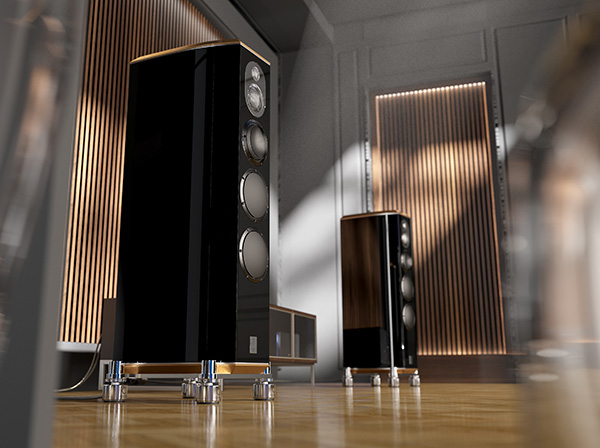 What I am sure of is that I've just heard some of the best sound I've heard in my listening room, or even elsewhere, as in, top two or three. For certain aspects of the sound, including 3D imaging, it was the very best. This is at least partly due to the fortuitous setup I eventually achieved, which these speakers loved; nevertheless, it shows what the Septets are capable of.
This is one (rather, two) of a small handful of speakers I've auditioned that I've found to be free of meaningful faults—that recover so much music and deliver it in such a pleasurable way that I could happily live with them forever.
What I am sure of is that I've just heard some of the best sound I've heard in my listening room, or even elsewhere, as in, top two or three. For certain aspects of the sound, including 3D imaging, it was the very best. This is at least partly due to the fortuitous setup I eventually achieved, which these speakers loved; nevertheless, it shows what the Septets are capable of.
This is one (rather, two) of a small handful of speakers I've auditioned that I've found to be free of meaningful faults—that recover so much music and deliver it in such a pleasurable way that I could happily live with them forever.
Footnote 1: These rear-facing passive radiators are not intended to be time-coincident with the other drivers. Footnote 2: JA's measurements, which I did not see until my listening was complete, indicate 0.6dB steps. Footnote 3: See open.qobuz.com/playlist/21395182. I listened to several tracks including "Bass at 100 M.P.H." by Bassotronics and "Chameleon" by Trentemøller. Tom's playlist lets you sample many different kinds of bass in different kinds of music. Musicians include The Chieftains with Sinead O'Connor, Rage Against the Machine, Bob Marley & the Wailers, Aretha Franklin, and the Rolling Stones. Footnote 4: Fun story. Akbar Kahn founded the Ali Akbar College of Music in San Francisco in 1967 and became an important fixture in the San Francisco cultural scene. In 1974, Zakir Hussain (the leader on Making Music, who at the time was living in Mickey Hart's Marin County barn) met up for dinner with John McLaughlin at Ali Akbar Kahn's San Francisco home. They brought their instruments. McLaughlin later said that after five minutes, it seemed like they'd been playing together for decades. It was the core of what would soon become the band Shakti, which fused the music of northern and southern India with Jazz.
Marten was founded back in 1998, but Leif [Olofsson], our founder and chief engineer, started making speakers long before that. ... He wanted to hear music as it was in real life. ... Leif wanted to make a speaker that accurately reproduced the truth and beauty of natural sound. To achieve these goals, he experimented very early with using drivers and tweeters with hard surfaces, ceramics and, later, diamond, beryllium, and aluminum. He soon realized that these materials were able to provide a new type of listening experience. ... It was demanding and difficult to implement—for instance, all the components in the crossover filter must be of very high quality. But he was now able to create a speaker with almost no distortion. The desire to improve and test new solutions and materials has always been one of the key factors for Marten. This led to the use of ... first-order crossover filters.There it is, that last bit: first-order crossover filters. First-order crossovers are such a pain that most manufacturers avoid them. Yet first-order crossover filters are essential for true time-domain integrity. Only designers who think timing matters—a lot—go to the extra trouble. It's quite a lot of extra trouble.
I find it odd that in our industry there isn't more focus on time. After all, we live in time, we hear in time. We hear not frequency but time-varying pressure against our eardrums. You could almost argue that frequency is an abstraction, except for the fact that our ears are designed to detect those variations in the pressure against our eardrums—the more regular ones—as pitch, frequency's music analog and, with rhythm, one of the two most important components of music. That makes a focus on frequency natural enough, even if frequency isn't quite as fundamental as time. Transient-perfect loudspeakers aren't a new idea. Even ignoring single-driver speakers (which are intrinsically transient-perfect), the timeline traces back at least to the Dahlquist DQ-10, which was realized in 1972. Externally, the DG-10 resembled a Quad electrostatic, but behind the sock were five dynamic drivers mounted in an array, sloped to align the drivers' acoustical centers. Three years later came the Technics SB-7000, a minifridge–sized ported bass unit topped like a wedding cake with midrange and tweeter enclosures staggered to align the drivers' acoustical centers. As I discuss in this month's As We See It, the main obstacle to transient-perfect behavior in a loudspeaker is the crossover. Those seeking transient perfection (or near-perfection) have three options: Digitize the input, use no crossover at all, or use a first-order crossover. The Technics SB-7000 was the first speaker to use all–first-order crossovers in the interest of timing perfection.
The Marten Mingus Septet Statement EditionThe Marten Mingus Septet Statement Edition is the flagship speaker in Marten's second-from-top Mingus series; Coltrane is their top series. It was designed from the ground up to preserve phase relationships among its five active front-panel drivers. The Septet employs only first-order crossovers. I wrote that the crossover is the main obstacle to transient-perfect behavior, but there is another, as suggested in the description above of the Technics SB-7000. Most big drivers are deeper than most small drivers. If you align their fronts on a speaker's baffle, the big drivers' acoustical centers are farther back. Different companies have accounted for this in different ways: Spica and Thiel with a sloped front baffle, Vandersteen and Dahlquist by staggering drivers under a sock.
More on Marten's driversHerb Reichert likes to say that things "sound like what they're made of." The Marten Mingus Septet has seven drivers, two of them passive. Those drivers' vibrating parts are made of diamond (tweeter), beryllium (upper midrange), ceramic (lower midrange), and aluminum honeycomb (woofers and passive radiators). That's a lot of different materials. While Herb's statement is true more often than not—things sound like what they are made of most of the time—careful engineering can produce exceptions, drivers that add no sound of their own to the sound they're reproducing. That's what's meant by "pistonic": It moves forward and back like a piston and doesn't bend or change shape. Marten worked with Accuton to develop a range of drivers called Cell. Accuton Cell drivers were developed especially to solve the flat-baffle time-alignment problem. Cell drivers, though—and related custom drivers—are also used by companies that do not pursue time alignment: Estelon, Tidal, and Gauder Akustik all use drivers from or based on the Accuton Cell series. That indicates, presumably, that the opportunity to achieve timing excellence is not their only virtue.
The Septet's beryllium-diaphragm upper-midrange driver handles mainly frequencies between 800Hz and 6kHz—though, again, because first-order crossovers are used, it will make audible sound well above 6kHz and well below 800Hz.
Why use different materials—diamond in the tweeter but beryllium in the midrange? Because while beryllium isn't as stiff as diamond, it's cheaper. Its first breakup mode, though lower in frequency than diamond's, is still far above the range the driver will be reproducing—indeed far above the audible frequency range. But the main advantage of beryllium is self-damping. It doesn't ring, which is especially important in this driver because it covers the presence region, the range the ear is most sensitive to. The inverted ceramic/sapphire dome used in the lower-midrange driver will certainly be pistonic in its relatively narrow 200– 800Hz passband. Why ceramic? It too has excellent self-damping. And while it's significantly heavier than beryllium, it is also much stiffer: Beryllium's stiffness is great in a 3" dome but not sufficient for a 7" inverted dome. A lower-midrange driver needs to be very stiff, but it doesn't need to be as light.
Setup and listeningThe speakers arrived in two large, wheeled shipping containers. These are big, heavy speakers, but wheels and handles on the crates and casters on the speakers made it possible for me to set them up by myself. Once they were roughly where I wanted them, I used a low-clearance jack to lift the speakers' fronts then rears and replace the casters with the provided Marten-branded IsoAcoustics footers. These footers are Marten's stock feet, so there was no opportunity to compare, but in several other contexts I've found IsoAcoustics footers very effective, including on a pair of very different speakers—Audio Note AN-Es—currently set up in my Maine house. I set up the speakers using Marten's fairly specific guidance—a roughly equilateral setup with at least 10' or so between the speakers and the listener, with the speakers toed in. I made sure they were more than 32.5" from the front wall and "not ... close" to the sidewalls, as advised. In-room symmetry was the one part of Marten's setup directions I was unable to comply with. As always in my room, the setup was asymmetric, with the right speaker some 3' from a record shelf (a decent diffuser at high and high-mid frequencies) and the left speaker very far from any wall: In fact, there's a dining area between that speaker and the nearest wall. I toed the Septets in just a little at first, but once I learned about the first-order crossovers, I aimed them straight at the listening seat so that most of the sound I was hearing was direct and on axis. Marten recommends a minimum of 50 hours of burn-in and says the speakers reach their full potential after about 200 hours—a burn-in CD is included—but the pair I received was already burned in. After the initial setup, I connected the Septets to the rest of my system—most directly to the Goldmund Telos 3200 monoblocks I reviewed for the December 2025 Stereophile. Later, I would substitute the Gryphon Antileon Revelation Stereo amplifier, in for review.
When the sound is new and fresh, you want to hear everything at once; I'm sure you know the feeling. I pulled out a new ECM record—from the label's Luminessence vinyl reissue series—and put it on. The album was Making Music, by Zakir Hussain, Hariprasad Chaurasia, John McLaughlin, and Jan Garbarek (LP, ECM 1349, engineered by Jan Erik Kongshaug at Rainbow Studio in Oslo, Norway, and produced, of course, by Manfred Eicher). If I'd heard this album before, I didn't, and don't, remember it.
Did these speakers ever love this album! I couldn't get enough of the woody articulation of the tabla and the various other percussion instruments (a ghatam—clay pot—and what looks on the cover like a pakhavaj, a long drum from northern India). John McLaughlin's guitar—probably a Wechter custom steel string made to optimize transient clarity—sounded similarly crisp and articulate, its resonance full. Hussain's voice and Chaurasia's flutes simply hung there in space. All these sounds filled the space between the speakers and my front wall in a most natural, relaxed, intoxicating way. I closed my eyes and pictured little sonic sprites flashing around the room.
The sound I was hearing clarified something. Because of the extra space the sound now occupied, sounds that had been forced close together now relaxed apart. As the sound relaxed, so did this listener. Imaging isn't, as some audiophiles and audio writers imply, mere sonic decoration. Imaging is how sounds, or their impressions, arrange themselves in space. When imaging is poor—even when it's very good but not as good as it could be—sounds are squeezed together in a way that makes music harder for the ear-brain to unpack. This characteristic—I'll call it soundstage compression—obscures important detail and increases listener stress, which you only notice once you experience a soundfield in which musical images are better separated, in at least two dimensions, and you relax.
Final thoughtsThe audibility of time distortion in a loudspeaker has, like many things in audio, been debated—in fact hotly disputed. Some dismiss it. Consensus says it's icing on an already delicious cake—that if the cake isn't otherwise great, you can't taste it. Because of the necessity of first-order crossovers, and the problems they create, most loudspeaker designers think it isn't worth the trouble.
What I am sure of is that I've just heard some of the best sound I've heard in my listening room, or even elsewhere, as in, top two or three. For certain aspects of the sound, including 3D imaging, it was the very best. This is at least partly due to the fortuitous setup I eventually achieved, which these speakers loved; nevertheless, it shows what the Septets are capable of.
This is one (rather, two) of a small handful of speakers I've auditioned that I've found to be free of meaningful faults—that recover so much music and deliver it in such a pleasurable way that I could happily live with them forever.
Footnote 1: These rear-facing passive radiators are not intended to be time-coincident with the other drivers. Footnote 2: JA's measurements, which I did not see until my listening was complete, indicate 0.6dB steps. Footnote 3: See open.qobuz.com/playlist/21395182. I listened to several tracks including "Bass at 100 M.P.H." by Bassotronics and "Chameleon" by Trentemøller. Tom's playlist lets you sample many different kinds of bass in different kinds of music. Musicians include The Chieftains with Sinead O'Connor, Rage Against the Machine, Bob Marley & the Wailers, Aretha Franklin, and the Rolling Stones. Footnote 4: Fun story. Akbar Kahn founded the Ali Akbar College of Music in San Francisco in 1967 and became an important fixture in the San Francisco cultural scene. In 1974, Zakir Hussain (the leader on Making Music, who at the time was living in Mickey Hart's Marin County barn) met up for dinner with John McLaughlin at Ali Akbar Kahn's San Francisco home. They brought their instruments. McLaughlin later said that after five minutes, it seemed like they'd been playing together for decades. It was the core of what would soon become the band Shakti, which fused the music of northern and southern India with Jazz.