Historical

Sort By:  Post Date TitlePublish Date

Wharfedale Diamond loudspeaker
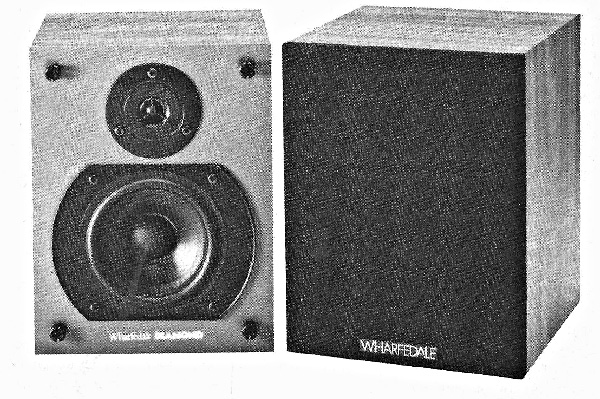
It wasn't too many years ago that no audio perfectionist would even consider owning speakers having woofers of less than a 12" diameter. Everyone knew that it took a BIG speaker to reproduce real bass, and pointed at the size of a double bass and an organ bass pipe as proof that there was no way of circumventing that particular law of physics.
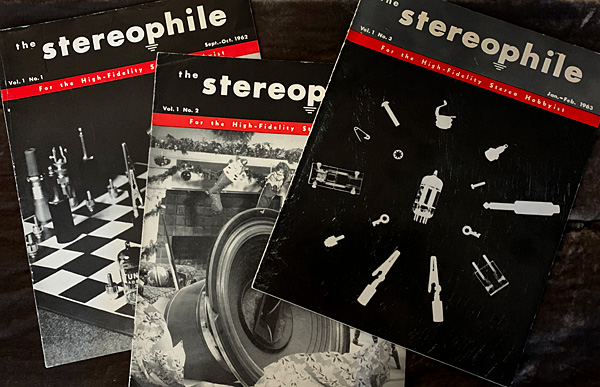
60 Years of Stereophile!

It was September 1962. In the UK, the Beatles were recording their first single, "Love Me Do," at London's Abbey Road Studios. And in the US, a young journalist, J. Gordon Holt, born in North Carolina but raised in Australia from 1935 to 1947, had become dissatisfied with the advertiser-friendly atmosphere at High Fidelity magazine, for which he had been the audio editor. Holt quit High Fidelity and, after a brief stint with phono cartridge manufacturer Weathers, published the first issue of what was then called The Stereophile.

KLH Model Twelve loudspeaker

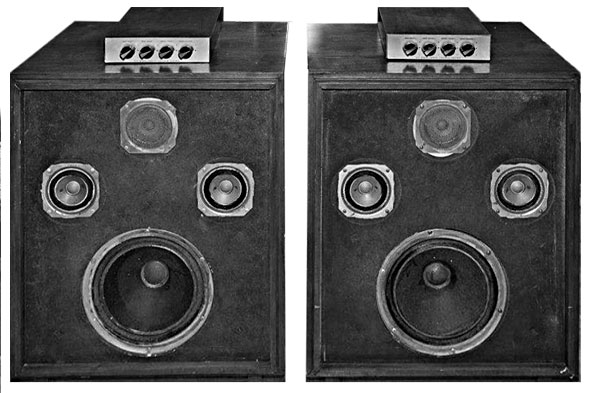
The idea of a loudspeaker system whose frequency response could be tailored to suit room acoustics and/or personal taste is one that has always appealed to the high-fidelity perfectionist. Ideally, such a loudspeaker would allow you to raise or lower the level of any part of the audio spectrum to correct for, say, a sharp 370Hz room resonance or a mild absorptive condition that weakens, say, the 800Hz–3kHz range. Obviously, though, this kind of flexibility would require an infinite number of bandpass networks, each with its own volume control—which is an obvious impracticality.

Janszen Z-600, Z-900, & Z-960 loudspeakers

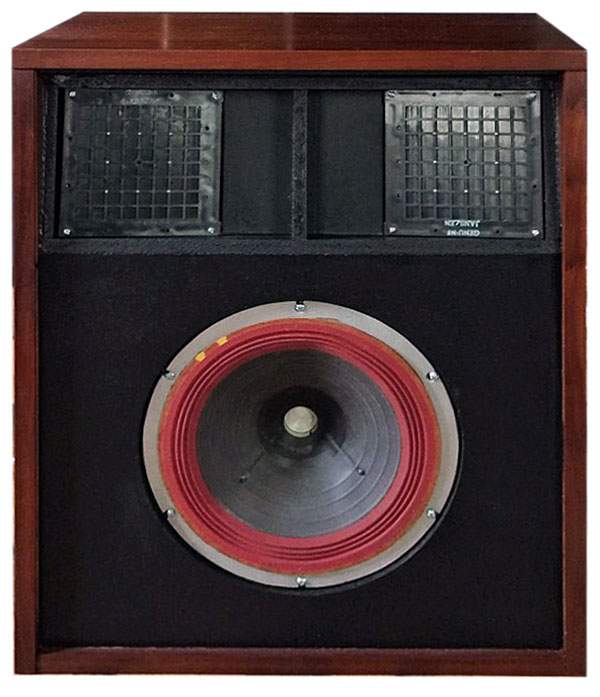
The Z-600 is the latest of the "console" (as opposed to "bookshelf") systems made by Neshaminy Corp., and using Janszen electrostatic tweeters (footnote 1) and a Neshaminy-designed 11" woofer. The nominal crossover frequency is 1500Hz, with a broad overlap between the woofer's top and the low end of the paralleled tweeters. Tweeter level is not adjustable (footnote 2).

dbx 700 digital audio processor

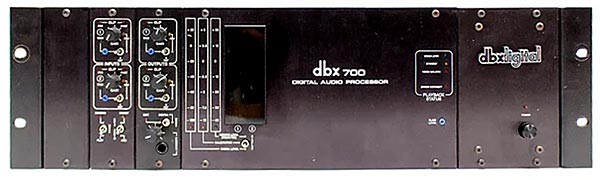
As ALF would say, "There's more than one way to cook a cat." We've been so overwhelmed with linear pulse-code modulation (PCM) recording, we forget there are other ways to pass from the analog domain to the digital.

One of these is delta modulation. The Greek delta (which in its upper-case, block-letter form, looks like an equilateral triangle) is the mathematical symbol for the difference between two quantities; accordingly, in delta modulation, we record not the absolute value of a signal sample, but the difference between successive samples.

Sony PCM F1 Digital Audio Converter

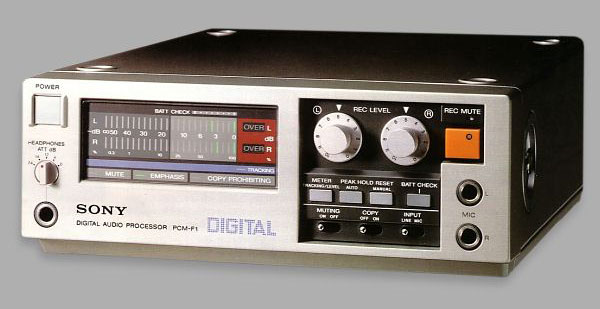
In 1978, when I reviewed Sony's first audiophile-type PCM-1 converter, I earned the undying scorn of a large segment of audiophilia by reporting that, on the basis of a rather short testing period (which did however include some live recording), I was unable to hear anything the matter with its sound. Four years later, but after substantially more testing, I am obliged to report the same thing about the PCM-l's son, the PCM-Fl.

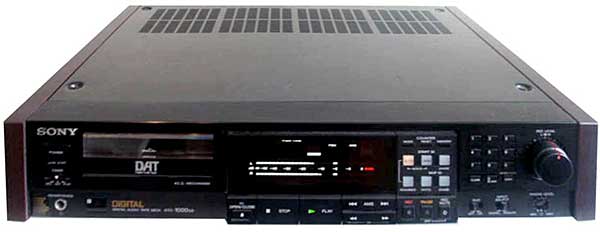
Sony DTC-1000ES R-DAT recorder & Sony PCM-1630 A/D converter

With the furor over the launch of DAT (digital audio tape), it is worth remembering that commercial digital recorders have been with us for some time now: it is now nearly a decade since studio PCM converters were first successfully used for audio recording in conjunction with a VCR (which uses a helical spiral recording via a spinning drum to achieve the high writing speed).

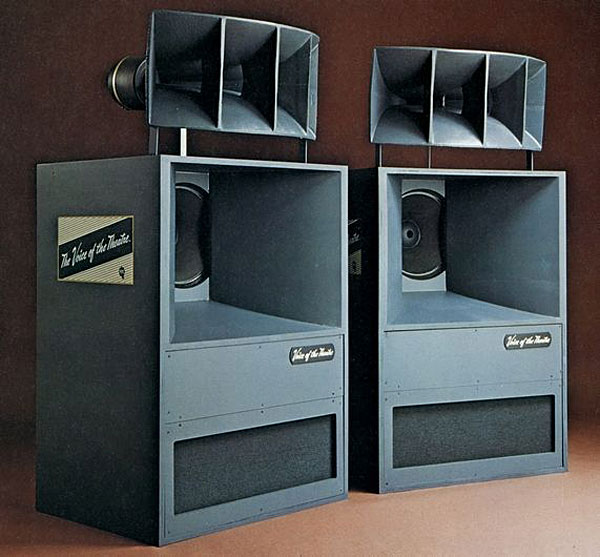
Altec A-7 & Electro-Voice Patrician 800 loudspeakers

In the introduction to "Recommended Components" in the final issue in Volume One of what was then called The Stereophile, published in May 1966, founder J. Gordon Holt briefly described his Top-Rated Loudspeaker Systems.

Altec A-7
A highly efficient horn-loaded system for use in large to very large listening rooms (at least 15' from the listening area), or for very high-volume "Row-A" listening. Excellent woofer-tweeter blending, moderately deep (useful 45Hz limit in most rooms) and very taut, well-defined low end. Highs smooth and slightly soft, yielding most natural high-end quality at high listening levels. Middles smooth, rather forward, placing closely miked instruments somewhat in front of the system itself.

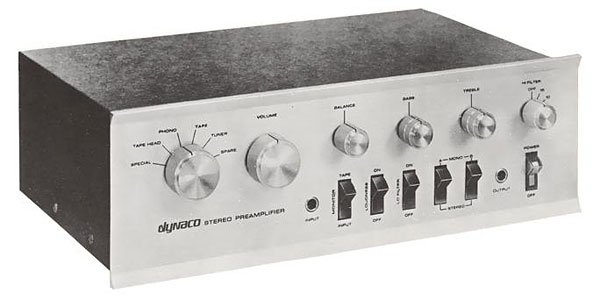
Dynaco PAT-4 preamplifier

This review of one of the first solid-state preamplifiers was published in 1968. It includes some of JGH's first thoughts on the ongoing subject of "Accuracy vs. Musicality."

Preview, from July 1968 (Vol.2 No.6): Overall sound extremely good, but phono sounds slightly lacking in deep bass, despite impeccable measurements. Scratch filter judged very highly effective, but tone controls felt to be less than ideal be cause of excessively coarse action and marked tendency to affect midrange output. Spring-return Tape Monitor switch probably will not appeal to serious tapesters. This preamp is slated for a full report in the next issue.

Advertisement
Advertisement
Advertisement