I was born and raised in Argentina. Ever since I was a kid, I've been fascinated by machines. My mother used to call me "Botones" (Spanish for "Buttons") because I pressed every button and turned every knob I encountered. I was particularly interested in machines that played music, especially my dad's Grundig console, which sounded like a warm breeze in a beautiful sunset. It's hardly surprising that I pursued an education in the sciences.
I was a graduate student in physics at the University of Chicago in the late 1990s and a poor, inquisitive audiophile. I tried to improve my mid-fi audio equipment in whatever ways I could, which mostly meant opening things up and tinkering. Every day on my way to the physics research building, I walked by the research lab's dumpster. It was a magical place, where I often found interesting discarded equipment. I once found a 500W Variac—very heavy. I put it in a cardboard box and carried it to my apartment, a 20-minute walk. I still have that Variac. It has proved useful over the years.
Another time I found a low-noise, dual-rail power supply in the dumpster. I had the perfect use for it: cleaner power to feed my Sony ES CD player's analog output stage. The modification involved cutting the power traces to the analog output section and connecting the components to the new supply. I was even able to mount the new power supply inside the CD player's chassis.
The result was transformative, much more dramatic than previous upgrades I'd tried, like replacing the output op-amps with better parts and the electrolytic coupling capacitors with film capacitors. With the new power supply, the sound became more relaxed, spacious, and tonally richer.
This was my first meaningful encounter with what would later become widespread wisdom: Reducing power supply noise makes for better sound. But in that case, the improved power was feeding an analog stage. It's no great surprise that it worked.
The Aurender N50
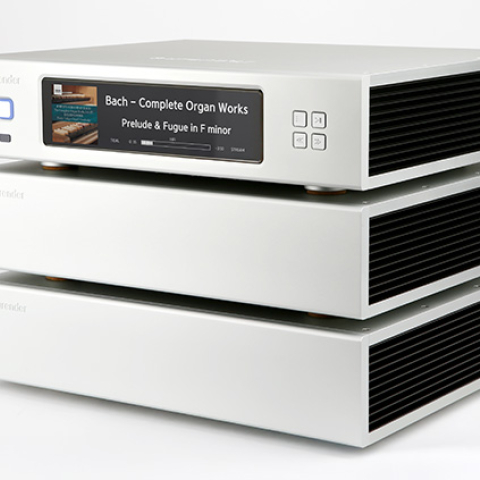
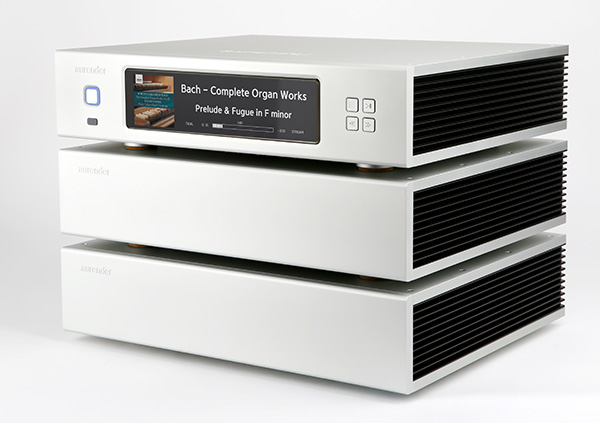
Aurender calls the N50 ($38,500) a "digital transport." That's an accurate description, since it does roughly the same thing a CD transport does but for streamed music and local files: It takes music data streamed from a streaming service or stored in its internal SSDs or USB-connected media and outputs it as a clean digital signal for an external digital-to-analog converter (DAC) to decode.
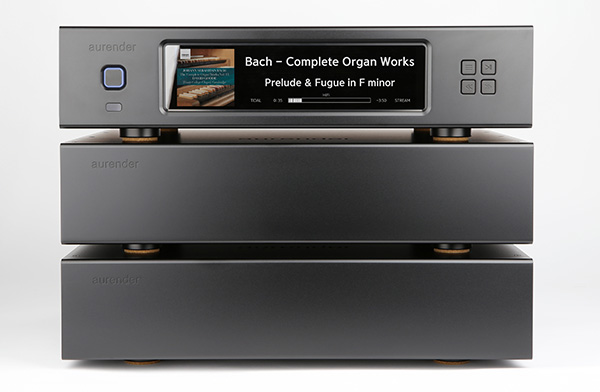
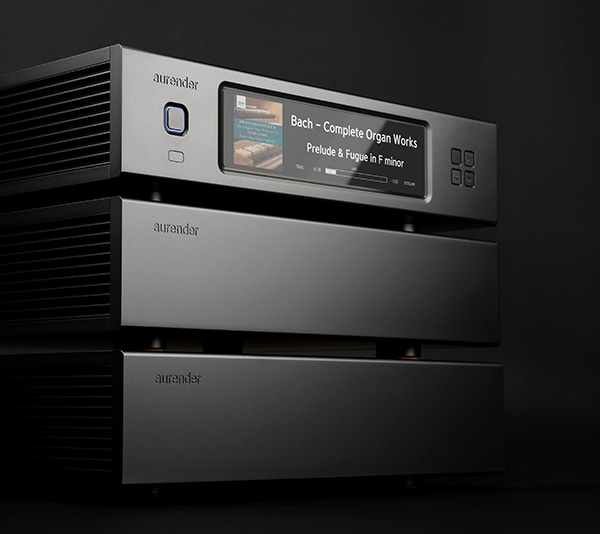
The N50 fills three chassis—Aurender calls them "units"—connected by three cables. The server unit houses the computer components, internal storage, and a USB Audio output module. The audio unit takes audio data from the server and assembles the digital data for delivery to a DAC. Its design is intended to maximize the quality of the digital signal going to the DAC with the most accurate timing possible and the least amount of electrical noise. The power unit holds independent power supplies for each of the other two units, isolating them from external electrical and mechanical noise and from each other.
The server unit is the brain of the system, where all data manipulation is done. It sports an 8.8"-wide screen that displays album art and playback information. The display is crisp, clear, and easily seen from across the room. On the left side is an On/Off button, and on the right are four square buttons: Display Menu, Play/Pause, Previous Track, and Next Track. A nice, machined-aluminum remote control covers those same functions and others.
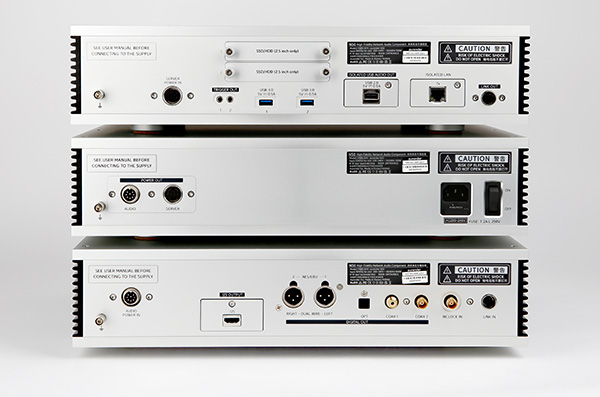
The server unit includes a newly designed USB Audio output with full galvanic isolation—decoupling electrical connections between the server and audio output stages—and common-mode noise rejection, blocking high-frequency noise from the computer components.
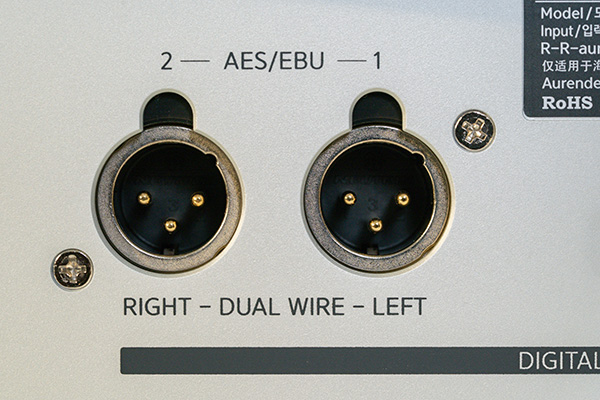
The audio unit is dedicated to outputting S/PDIF and similar digital audio signals. The outputs include the usual electrical S/PDIF, optical S/PDIF (TosLink), AES3 (the "pro," balanced variant of S/PDIF), and dual-wire AES3 (for use with dCS and Esoteric DACs). A custom module bay can accommodate an I2S-over-HDMI output module (standard), an MSB ProISL output module (optional, for use with MSB DACs), or a CH Link HD output module (optional, for use with CH Precision DACs—available soon).
According to Aurender, the audio unit incorporates a carefully designed clock (footnote 1) to produce a precise timing signal with extremely low frequency drift. It further optimizes the digital signal by minimizing electrical noise.
It is interesting that the USB Audio output is on the server unit while the rest of the outputs are on the dedicated audio unit. Why? I didn't get an answer from Aurender, but here's what seems likely. The USB audio protocol incorporates flow control: The DAC talks back to the server to control data flow so that the DAC-side data buffer neither empties nor overflows. Such interactions require back-and-forth communication with the computer components in the server, which means electronic noise. Meanwhile, the audio unit is designed to produce synchronous digital audio data, where precise timing and low electrical noise are critical. Aurender made the choice to keep the audio unit solely devoted to the synchronous outputs, free of contamination the USB output might bring.
 Are bits just bits?
If the data received by the DAC is identical to the source, then the conversion to analog should be perfect—shouldn't it? That's not quite the whole story: As we convert digital samples back to an analog signal, we need to get the timing right. Consider: If we take a digital track corresponding to a 1kHz tone and play the samples at half-speed, we'll hear a 500Hz tone instead. So no, bits aren't just bits: Decoding them properly depends on timing. Timing is critical in a DAC. Nowadays, clocks in digital systems are extremely accurate on average. Fast deviations from the standard clock frequency are usually unnoticeable. However, if a clock slowly drifts from its average frequency, the result can be audible. This low-frequency drift is called phase noise. In the time domain, it becomes "phase noise jitter." Minimizing this kind of jitter is critical, as explained in numerous articles over the years (footnote 2). But—wait—didn't we banish jitter years ago? The landmark study, by Benjamin and Gannon (1998), found that jitter was detectable only at much higher levels than those found in modern digital audio systems. But back then, they were listening for audible distortion. Subsequently, many smart people—smart people who listen—have argued that certain kinds of jitter at much lower levels can be perceived in careful listening. In particular, phase noise jitter—jitter resulting in a clock frequency drift on the order of hundreds of Hertz—has been found to affect sound quality.
Another gremlin to look out for is electrical noise: It can induce jitter by making the detection of the transition of digital levels less well-defined in time. Additionally, noise can percolate through to the DAC's analog output circuits.
What all this boils down to is, high-quality synchronous digital data output requires the highest possible timing precision, the lowest low-frequency drift, and the lowest electrical and mechanical noise.
Back to the N50
The N50 was designed to address the points mentioned above. It has a high-quality clock, a low-noise power supply, and a rigid chassis to minimize vibration-induced jitter.
The server, the N50's brain, is fanless—hence, silent—and designed for optimal performance and low (electrical) noise operation.
The audio unit incorporates a clock architecture designed to minimize both slow and fast frequency drifts, minimizing jitter-induced issues in the sound.
The power supply unit sports separate transformers and power regulation for the server and audio units, maximizing the quality of the power supplied to each unit and minimizing electrical noise produced in the server from percolating to the audio unit.
Why care about a synchronous S/PDIF output when asynchronous USB works as well as it does? In my experience and the experiences of many others, S/PDIF connections sound more natural—more effortless—than USB connections. The second reason is that some interesting DACs only support S/PDIF—likely because the designers had the same experience with other digital interfaces.
 The N50 experience
Unboxing and setting up the N50 was a pleasure—and a workout. Three large, heavy boxes arrived containing the three chassis. Except for the weight, setup was a breeze: The three umbilical cables—two power cables and a data cable—fit one way only. Connect it all together, plug the power supply unit into the wall, attach an Ethernet cable, and the hardware setup is done. The next step is configuring the N50 to play music. The Conductor app
The Aurender Conductor app is available for iOS and Android. After I downloaded it to my iPad, the app saw the N50 immediately and connected to it quickly.
The Aurender N50 supports streaming from Tidal, Qobuz, Spotify, and Internet radio. It can of course also play back local files. It will pass along pretty much any file format you throw at it, at any sample rate currently in use (footnote 3).
The Conductor app is well-designed, mature, and well-supported. It worked flawlessly in my testing. The first setup step is to connect to your streaming music provider; Tidal and Qobuz are natively supported. Spotify also appears in the app; choosing it opens the Spotify app.
Once your streaming service is connected, your favorites appear in the main window. You can click on any of them to play that album, track, or playlist. Navigation is intuitive. Search is unified: Searching once covers local files and installed streaming services (Tidal and/or Qobuz), but the results are presented separately—just click on an icon at the top of the search results to display results from local files or a streaming service.
If you own music files, you can either load them onto the server—no internal storage is provided, but two SSD drive bays let you roll your own—connect a USB drive to one of the server inputs, or point the server to your network-attached storage (NAS) device. I started by loading files to internal storage; Aurender provided an SSD as a courtesy to this reviewer. To speed up copying files, I connected a USB drive containing my files to the server and used Conductor to copy them to the internal SSD. Incremental file additions can be done quickly and conveniently over the network. Alternatively, if your files are on a NAS, you can mount the NAS using the Conductor app and use it the same way you would use the internal drives. In all cases, Conductor will scan your library to capture the metadata stored with the files.
I have grown to love the music-discovery features in various digital music devices. Conductor itself does not support music discovery when playing local files, but it does support Tidal and Qobuz Autoplay, the music-discovery engines that kick in once the last track in the queue is played on those streaming services.
Track metadata is of key importance these days, especially if your local library is large. In this respect, Aurender is no better nor worse than other server makers (with the exception of Roon, which for information-rich music playback is in a class of its own). For local content, Conductor relies on local metadata stored in the files. It is possible to use the app to do some metadata editing, and this edited metadata will be saved in the files themselves (footnote 4). This way, your edits will be preserved even when those files are accessed by other players or platforms. Conductor also offers limited access to Wikipedia for album and artist information. The app exposes all the metadata from streaming services including PDF liner notes if the service provides them. One current limitation of the Conductor app: If you have digital liner notes stored with your local music files, you can only access them through Conductor's folder-navigation feature.
Overall, the Conductor app is a pleasure to use: polished, complete, and easy to navigate. It has filtering, by recently added, format, sample rate, bit depth, and favorite tracks. It supports gapless playback, a feature sometimes neglected but of key importance for fans of classical music and some other genres. It does not support the grouping of tracks by composition; to my knowledge, Roon is the only platform that can do this.
The N50 supports Apple's AirPlay 2 and UPnP file streaming, though for UPnP streaming, you will need a third-party control app such as MConnect. Qobuz Connect and Spotify Connect are both supported—you can use the N50 with those apps controlling playback—but Tidal Connect is not.
Prefer to use Roon? The N50 is a Roon Ready certified endpoint and works flawlessly with Roon. I have been a daily Roon user for more than 10 years, so I know the system well. Roon is a sleek, mature, information-rich playback platform with deep metadata and a great music-discovery engine. Its integration of local and streamed music is superior, and it supports multiroom playback. For the informational richness of the music-playback experience, no app I'm aware of can match it. Yet, I found Conductor to be a worthy alternative, especially when sound quality is considered.
 Playback formats and Digital Signal Processing
Most digital music is encoded in the Pulse Code Modulation (PCM) audio standard. PCM is divided into two "families" of sample rates, 44.1kHz and its multiples and 48kHz and its multiples (footnote 5). The 44.1kHz family corresponds to the original CD standard. The N50 supports upsampling of PCM data within each of these families by a factor of 2, 4, 8, or 16, but only through the outputs in the audio unit. The USB Audio output on the server does not support upsampling. The N50 can play back DSD data three ways: as DSD-over-PCM (DoP), natively (but only via its USB and I2S outputs), and transcoding to PCM (for DACs that support neither DoP nor native DSD). Those with substantial MQA libraries can enable MQA core decoding (first unfold) via a one-time payment of $49.99 to cover licensing fees. Otherwise, MQA-encoded data is simply sent along to be decoded by an MQA-capable DAC. If you connect a USB DAC to the server's USB Audio output, the N50 will know the sample rates supported. If the incoming rate is not supported by the DAC, the N50 will transcode it (footnote 6) to an appropriate rate. This does not happen with the outputs in the audio unit: If we play a 384kHz file to a DAC connected to the coaxial S/PDIF output, which has a maximum rate of 192kHz, the data will not be transcoded to the lower rate. The sound will be distorted. Aurender is looking at adding settings to configure the N50 to transcode to DAC-supported rates at the audio unit's outputs.
 Sound
Sound
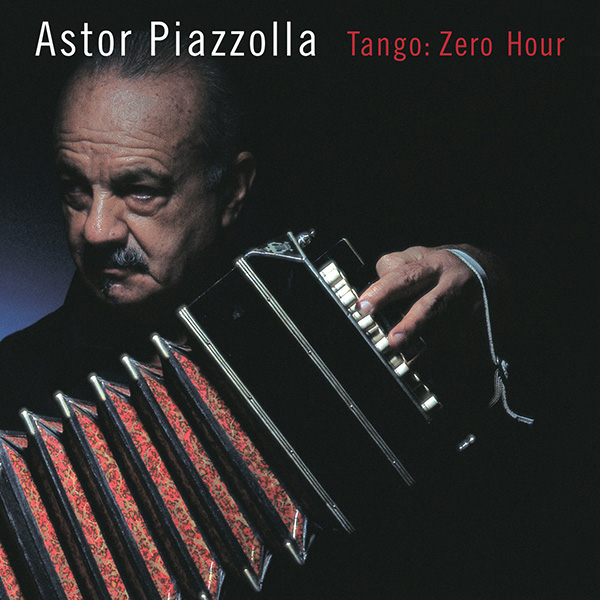
Can a digital transport even have a sound? For me the answer is yes, absolutely. If you have experienced different CD transports feeding the same DAC, then this is familiar territory. I'll start with one of my favorite tracks, Astor Piazzolla's "Contrabajísimo," from his album Tango: Zero Hour, from the album The American Clavé Recordings (DSD64 rip from SACD, Nonesuch; available on streaming services as 24/88.2 FLAC). With its masculine bass at the beginning and its sweet, feminine violin passages, this track is the musical equivalent of the starkly delineated gender roles in Tango dancing. The composition has tremendous bite: The sharpness of the percussion notes, the texture of the bass and the bandoneon (footnote 7), and the bravado with which this music is played come together into a powerful rendition. The sound of this track, played back on the N50 through its dual-wire AES3 connection to my dCS Rossini APEX DAC, was spacious and effortless with sharply delineated tonal colors. It simply sounded right: mesmerizing and memorable, not mechanical or sterile.
You will likely not be shocked by my choice for the next track: an interpretation of Piazzolla's "Libertango" by the 12 Cellists of the Berlin Philharmonic, from their album Hora Cero (24/96 FLAC, Sony Classical/Qobuz). This is a fascinating track, not only because of its musical beauty but also due to the nature of the recording: 12 cellos playing together produce a dense soundscape with gobs of inner detail and nuance challenging for any system to reproduce. The S/PDIF connection excels at conveying the resolution of each of the instruments in space and tone, with a natural texture to the celli sound. By comparison, the Roon playback, both to the N50 but also to the Rossini DAC directly, was less polished and less dexterous.
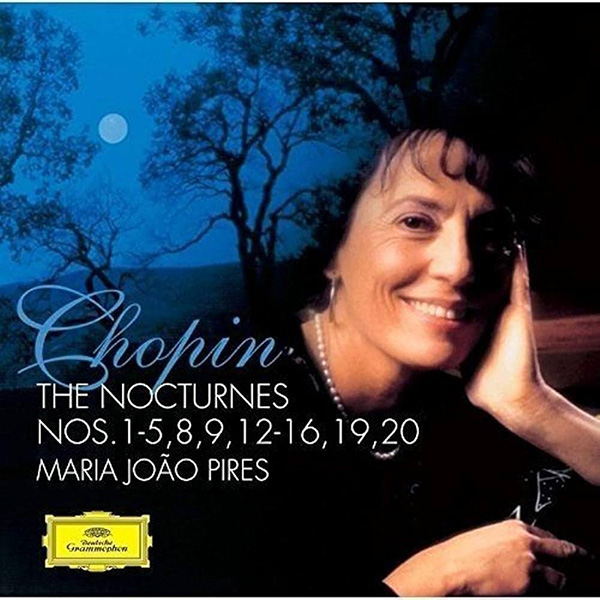 In 1996, I learned about a new, complete set of Chopin Nocturnes played by Maria João Pires. I loved Pires's rendition of Chopin's piano concertos, so I assumed this would be an amazing set. I was right: Over the subsequent 30 years, these two silver discs (16/44.1 CD, Deutsche Grammophon 447 096-2) have seen the interior of my players more than any other, by a long shot. It has become my favorite recorded performance of the Nocturnes. The tone and decay of the piano transcend what I expect from the CD medium. The N50's reproduction was outstanding in its portrayal of the instrument and its player. The impact, tone, and decay were masterful, again over dual-wire AES3.
Another interesting track is "The Smell of the Sea," from Alan Mayer's album Mirage (16/44.1 FLAC, Records DK/Tidal). This track has an interesting arrangement of low-level instrumentation that played back beautifully through the S/PDIF connection.
How was the N50 as a Roon endpoint? It functioned perfectly, but compared to playback of files stored on the Aurender N50's SSD drive, playback with Roon sounded slightly muddy. Roon playback consistently sounded less sweet, with less color.
Playback from the single-ended S/PDIF output was, to my ears, indistinguishable from the dual-wire AES3 connection.
How did the N50's galvanically isolated USB Audio output, on the server unit, compare to dual-wire AES3 and S/PDIF? Playing to the Rossini's USB input, the USB connection had a sound signature similar to Roon's: a slight muddiness and roughness contrasting to the ease and space of S/PDIF.
I mentioned that upsampling on the N50 was optional. Upsampling added a little bit of air at the top, but it felt like air from a different room than the one on the recording. Upsampled, the tone of Pires's piano notes was less convincing, thinner and lacking some of the harmonic richness I heard through the raw S/PDIF.
If an all-digital server can make a difference in how music sounds—and it can—then what about streaming? Does streamed music sound different—better or worse—than the same music served locally? To make this an apples-to-apples comparison, I compared Qobuz-streamed tracks to the same tracks purchased and downloaded from Qobuz. I did not detect a difference between these two.
In 1996, I learned about a new, complete set of Chopin Nocturnes played by Maria João Pires. I loved Pires's rendition of Chopin's piano concertos, so I assumed this would be an amazing set. I was right: Over the subsequent 30 years, these two silver discs (16/44.1 CD, Deutsche Grammophon 447 096-2) have seen the interior of my players more than any other, by a long shot. It has become my favorite recorded performance of the Nocturnes. The tone and decay of the piano transcend what I expect from the CD medium. The N50's reproduction was outstanding in its portrayal of the instrument and its player. The impact, tone, and decay were masterful, again over dual-wire AES3.
Another interesting track is "The Smell of the Sea," from Alan Mayer's album Mirage (16/44.1 FLAC, Records DK/Tidal). This track has an interesting arrangement of low-level instrumentation that played back beautifully through the S/PDIF connection.
How was the N50 as a Roon endpoint? It functioned perfectly, but compared to playback of files stored on the Aurender N50's SSD drive, playback with Roon sounded slightly muddy. Roon playback consistently sounded less sweet, with less color.
Playback from the single-ended S/PDIF output was, to my ears, indistinguishable from the dual-wire AES3 connection.
How did the N50's galvanically isolated USB Audio output, on the server unit, compare to dual-wire AES3 and S/PDIF? Playing to the Rossini's USB input, the USB connection had a sound signature similar to Roon's: a slight muddiness and roughness contrasting to the ease and space of S/PDIF.
I mentioned that upsampling on the N50 was optional. Upsampling added a little bit of air at the top, but it felt like air from a different room than the one on the recording. Upsampled, the tone of Pires's piano notes was less convincing, thinner and lacking some of the harmonic richness I heard through the raw S/PDIF.
If an all-digital server can make a difference in how music sounds—and it can—then what about streaming? Does streamed music sound different—better or worse—than the same music served locally? To make this an apples-to-apples comparison, I compared Qobuz-streamed tracks to the same tracks purchased and downloaded from Qobuz. I did not detect a difference between these two.
 Conclusions
Some time ago, long before the Winter Olympics started, YouTube served me a video of American figure skater Ilia Malinin performing his free-skate routine at the Grand Prix 2025 finals. This is not the type of material I would normally watch, but the music was interesting, so I didn't click away. I watched a captivating performance, stunning in its precision, ease, and fluidity. It was more than a series of leaps and spins: Technical mastery and artistry came together in a cohesive way, the total bigger and more beautiful than the sum of the parts.
My experience with the Aurender N50 was similar. It's a superbly executed piece of gear with a well-defined purpose at which it excels. The ease, tonality, and expansiveness of the music it serves up to my dCS Rossini APEX DAC are above and beyond what I had heard before.
Who is the Aurender N50 server for? Anyone seeking top performance from a highest-quality DAC should consider this unit, assuming the DAC supports one of the outputs on the audio unit.
Among devices I've tried, the robust experience that this transport provides is in a class of its own. Highly recommended.
Footnote 1: Aurender describes the clock architecture as "FPGA-disciplined, OCXO-referenced, VCXO topology." The OCXO (oven-controlled crystal oscillator) provides a precise and stable reference, while the VCXO (voltage-controlled crystal oscillator) is driven by the OCXO and provides a high-spectral-purity clock signal. The net result is a precise clock frequency devoid of slow or fast frequency drifts. Footnote 2: For example, if the clock frequency drifts up and down 200 times a second, the result will be that a 1kHz tone will get two additional spurious tones: one at 800Hz, and one at 1.2kHz (1kHz ±200Hz). The relative magnitude of these spurious tones compared to the main signal increases as the frequency drift gets bigger. Search for "Audio Precision TN-23" if you're interested in a detailed explanation of jitter in digital audio systems. Also see this 1993 article in Stereophile. Footnote 3: See the Specifications sidebar for rates supported for each output. Output resampling for compatibility is not currently fully supported for the audio unit outputs; more on this later in this review.
Footnote 4: If you're serious about maintaining a music library, you'll want to use a third-party metadata editor. If you've stored your files on the N50, you can easily access them from your computer to curate their metadata.
Footnote 5: These two sampling frequencies come from choices made at the dawn of digital audio and were based on a convenient choice for storing digital audio in video recording equipment.
Footnote 6: Transcoding is the conversion of one digital format to another. For example, converting 24/192 to 24/96, or converting DSD to PCM.
Footnote 7: The bandoneon is a boxy-looking accordion-style instrument that was invented in Germany in the early 1800s and became a staple in Argentinian brothels and cafes in the late 1800s as the centerpiece instrument in Tango dance and music.
Aurender calls the N50 ($38,500) a "digital transport." That's an accurate description, since it does roughly the same thing a CD transport does but for streamed music and local files: It takes music data streamed from a streaming service or stored in its internal SSDs or USB-connected media and outputs it as a clean digital signal for an external digital-to-analog converter (DAC) to decode.
Are bits just bits?If the data received by the DAC is identical to the source, then the conversion to analog should be perfect—shouldn't it? That's not quite the whole story: As we convert digital samples back to an analog signal, we need to get the timing right. Consider: If we take a digital track corresponding to a 1kHz tone and play the samples at half-speed, we'll hear a 500Hz tone instead. So no, bits aren't just bits: Decoding them properly depends on timing. Timing is critical in a DAC. Nowadays, clocks in digital systems are extremely accurate on average. Fast deviations from the standard clock frequency are usually unnoticeable. However, if a clock slowly drifts from its average frequency, the result can be audible. This low-frequency drift is called phase noise. In the time domain, it becomes "phase noise jitter." Minimizing this kind of jitter is critical, as explained in numerous articles over the years (footnote 2). But—wait—didn't we banish jitter years ago? The landmark study, by Benjamin and Gannon (1998), found that jitter was detectable only at much higher levels than those found in modern digital audio systems. But back then, they were listening for audible distortion. Subsequently, many smart people—smart people who listen—have argued that certain kinds of jitter at much lower levels can be perceived in careful listening. In particular, phase noise jitter—jitter resulting in a clock frequency drift on the order of hundreds of Hertz—has been found to affect sound quality.
The N50 was designed to address the points mentioned above. It has a high-quality clock, a low-noise power supply, and a rigid chassis to minimize vibration-induced jitter.
The N50 experienceUnboxing and setting up the N50 was a pleasure—and a workout. Three large, heavy boxes arrived containing the three chassis. Except for the weight, setup was a breeze: The three umbilical cables—two power cables and a data cable—fit one way only. Connect it all together, plug the power supply unit into the wall, attach an Ethernet cable, and the hardware setup is done. The next step is configuring the N50 to play music. The Conductor app
The Aurender Conductor app is available for iOS and Android. After I downloaded it to my iPad, the app saw the N50 immediately and connected to it quickly.
Playback formats and Digital Signal ProcessingMost digital music is encoded in the Pulse Code Modulation (PCM) audio standard. PCM is divided into two "families" of sample rates, 44.1kHz and its multiples and 48kHz and its multiples (footnote 5). The 44.1kHz family corresponds to the original CD standard. The N50 supports upsampling of PCM data within each of these families by a factor of 2, 4, 8, or 16, but only through the outputs in the audio unit. The USB Audio output on the server does not support upsampling. The N50 can play back DSD data three ways: as DSD-over-PCM (DoP), natively (but only via its USB and I2S outputs), and transcoding to PCM (for DACs that support neither DoP nor native DSD). Those with substantial MQA libraries can enable MQA core decoding (first unfold) via a one-time payment of $49.99 to cover licensing fees. Otherwise, MQA-encoded data is simply sent along to be decoded by an MQA-capable DAC. If you connect a USB DAC to the server's USB Audio output, the N50 will know the sample rates supported. If the incoming rate is not supported by the DAC, the N50 will transcode it (footnote 6) to an appropriate rate. This does not happen with the outputs in the audio unit: If we play a 384kHz file to a DAC connected to the coaxial S/PDIF output, which has a maximum rate of 192kHz, the data will not be transcoded to the lower rate. The sound will be distorted. Aurender is looking at adding settings to configure the N50 to transcode to DAC-supported rates at the audio unit's outputs.
SoundCan a digital transport even have a sound? For me the answer is yes, absolutely. If you have experienced different CD transports feeding the same DAC, then this is familiar territory. I'll start with one of my favorite tracks, Astor Piazzolla's "Contrabajísimo," from his album Tango: Zero Hour, from the album The American Clavé Recordings (DSD64 rip from SACD, Nonesuch; available on streaming services as 24/88.2 FLAC). With its masculine bass at the beginning and its sweet, feminine violin passages, this track is the musical equivalent of the starkly delineated gender roles in Tango dancing. The composition has tremendous bite: The sharpness of the percussion notes, the texture of the bass and the bandoneon (footnote 7), and the bravado with which this music is played come together into a powerful rendition. The sound of this track, played back on the N50 through its dual-wire AES3 connection to my dCS Rossini APEX DAC, was spacious and effortless with sharply delineated tonal colors. It simply sounded right: mesmerizing and memorable, not mechanical or sterile.
In 1996, I learned about a new, complete set of Chopin Nocturnes played by Maria João Pires. I loved Pires's rendition of Chopin's piano concertos, so I assumed this would be an amazing set. I was right: Over the subsequent 30 years, these two silver discs (16/44.1 CD, Deutsche Grammophon 447 096-2) have seen the interior of my players more than any other, by a long shot. It has become my favorite recorded performance of the Nocturnes. The tone and decay of the piano transcend what I expect from the CD medium. The N50's reproduction was outstanding in its portrayal of the instrument and its player. The impact, tone, and decay were masterful, again over dual-wire AES3.
Another interesting track is "The Smell of the Sea," from Alan Mayer's album Mirage (16/44.1 FLAC, Records DK/Tidal). This track has an interesting arrangement of low-level instrumentation that played back beautifully through the S/PDIF connection.
ConclusionsSome time ago, long before the Winter Olympics started, YouTube served me a video of American figure skater Ilia Malinin performing his free-skate routine at the Grand Prix 2025 finals. This is not the type of material I would normally watch, but the music was interesting, so I didn't click away. I watched a captivating performance, stunning in its precision, ease, and fluidity. It was more than a series of leaps and spins: Technical mastery and artistry came together in a cohesive way, the total bigger and more beautiful than the sum of the parts.
Footnote 1: Aurender describes the clock architecture as "FPGA-disciplined, OCXO-referenced, VCXO topology." The OCXO (oven-controlled crystal oscillator) provides a precise and stable reference, while the VCXO (voltage-controlled crystal oscillator) is driven by the OCXO and provides a high-spectral-purity clock signal. The net result is a precise clock frequency devoid of slow or fast frequency drifts. Footnote 2: For example, if the clock frequency drifts up and down 200 times a second, the result will be that a 1kHz tone will get two additional spurious tones: one at 800Hz, and one at 1.2kHz (1kHz ±200Hz). The relative magnitude of these spurious tones compared to the main signal increases as the frequency drift gets bigger. Search for "Audio Precision TN-23" if you're interested in a detailed explanation of jitter in digital audio systems. Also see this 1993 article in Stereophile. Footnote 3: See the Specifications sidebar for rates supported for each output. Output resampling for compatibility is not currently fully supported for the audio unit outputs; more on this later in this review.