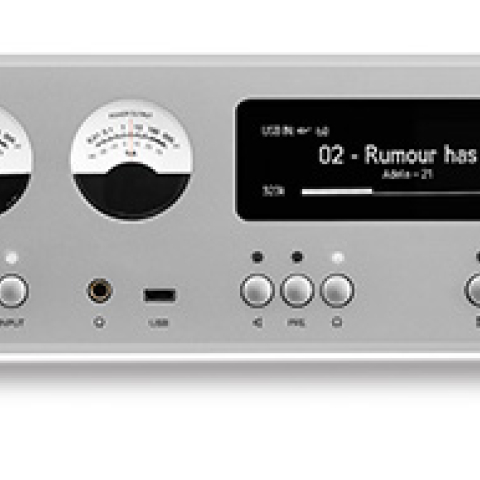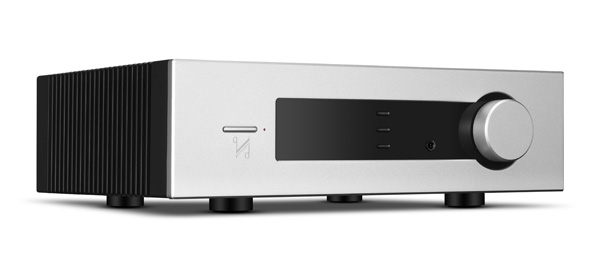
I am grateful MoFi sent me Quad's flagship Platina Integrated ($5495) because by the time I got it wired up and running on three inputs, I could tell how its basic character reflected the aesthetic values championed by Quad founder Peter Walker.
Original Quad ESL speakers and KT66-based Quad II amplification are, for me, the starting points of a British sound I have devoted a major portion of my audio life to exploring and continue to find satisfying.
I like British amplifiers because they emphasize drive, palpability, and tonal realism. Tone, transients, textures, and tempi are presented with a lively energy and a pleasurably detailed realism that make my Falcon LS3/5a's sound like Quad ESLs.
The Platina Series includes two other components: the Platina Stream, which has only digital inputs, and the Platina CDT, which is a matching CD transport designed to sit next to this Platina Integrated and the Platina Stream.
The Quad Platina
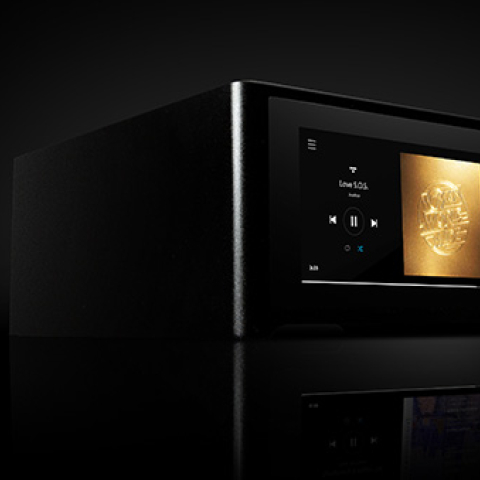
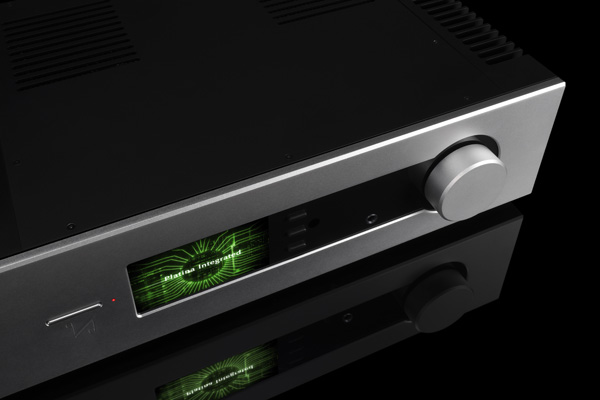
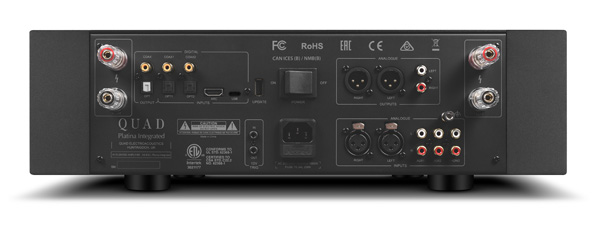
According to the user manual, the Platina integrated weighs 37.7 lb (17.1kg) and measures 17.5" (445mm) wide × 5.3" (134.5mm) high × 13.7" (348mm) deep. The amplifier is solid state, and its output stage operates in class-AB. It's specified to produce 200Wpc into 8 ohms and 310Wpc into 4 ohms. (I'm always curious what amplifiers can do into 15 ohms, but that never gets measured) Its gain is 30dB. Maximum output current is specified as 20A, which causes me to wonder why they don't also state the maximum output voltage (footnotes 1 & 2). Despite having a name that evokes platinum, the Platina isn't ostentatious. Its stealth-looking front panel features a 2.5" knob, four rectangular buttons, a ¼" headphone jack, and a 4.3" IPS LCD screen. Inputs are myriad: two pairs of RCA, one balanced XLR pair, one RCA for phono with a ground wire tie-down, two coaxial (S/PDIF), two optical, one USB-C, one HDMI ARC, and a 12V trigger. Outputs consist of two pairs of speaker-wire binding posts, one pair RCA and one pair XLR (for using the Platina as a preamplifier), plus one optical, one coaxial, and a 12V trigger.
 There's a streaming input and a DAC featuring the ES9038PRO DAC chip, with five filter choices. Via USB or Ethernet, the DAC is specified to convert PCM up to 768kHz and native DSD up to DSD512. The digital section has TOSLINK and S/PDIF outputs that support sampling frequencies between 44.1kHz and 192kHz.
The all-analog line-level preamp section has no specified gain. There is, however, a phono input, with selectable gain of 46dB, 52dB, or 60dB. Input sensitivity is 5mV for full output (MM phono). Loading for MM phono is 50k ohms with 100pF capacitance. The only output impedances specified are 75 ohms (for the digital section) and 120 ohms, which must be for the preamp section. The impedance at the speaker outputs isn't specified.
Curiously, specs for the headphone amplifier do not include gain, power, voltage, or current. They do mention output impedance (2.35 ohms) and a "load impedance" of 20–600 ohms.
Quad is an IAG company, and like most other IAG products (footnote 3), the Platina is manufactured at the IAG factory in China. It comes in either black or silver.
There's a streaming input and a DAC featuring the ES9038PRO DAC chip, with five filter choices. Via USB or Ethernet, the DAC is specified to convert PCM up to 768kHz and native DSD up to DSD512. The digital section has TOSLINK and S/PDIF outputs that support sampling frequencies between 44.1kHz and 192kHz.
The all-analog line-level preamp section has no specified gain. There is, however, a phono input, with selectable gain of 46dB, 52dB, or 60dB. Input sensitivity is 5mV for full output (MM phono). Loading for MM phono is 50k ohms with 100pF capacitance. The only output impedances specified are 75 ohms (for the digital section) and 120 ohms, which must be for the preamp section. The impedance at the speaker outputs isn't specified.
Curiously, specs for the headphone amplifier do not include gain, power, voltage, or current. They do mention output impedance (2.35 ohms) and a "load impedance" of 20–600 ohms.
Quad is an IAG company, and like most other IAG products (footnote 3), the Platina is manufactured at the IAG factory in China. It comes in either black or silver.
 Setup
Out of the box, the Quad Platina reminded me of the original Quad II tube amplifier, designed by Peter Walker, which I used with my Rogers LS3/5a's in the 1980s (footnote 4). Even more, it reminded me of the Creek 4240 I used with those same speakers for almost 10 years.
The cover of the Quad Platina's 18-page user manual is made of thick, glossy paper in British Racing Green. After the obligatory safety information, the manual names every button, knob, and hole on the front and rear panels. Starting on p.8, there's a section labeled Menu Options, under which is the greatest invention since corrugated metal: a Menu Tree. This chart is easy to read and understand. It shows all the choices for each of the 16 menu categories. That approach suits my type of brain. It made my Platina Integrated experience completely unstressed. In a matter of minutes, the Quad Platina was up and running via three inputs: USB from my computer playing Qobuz, S/PDIF from the TEAC VRDS-701T CD transport, and analog from my Dr. Feickert Blackbird turntable.
I used Cardas Clear Beyond to connect the EMT 912-HI tonearm (wielding either of two cartridges; see below) to the Platina's MC phono input and AudioQuest Yosemite to connect the Sorane SA-1.2 tonearm. I used Black Cat Coppertone interconnects between the Quad integrated and Lab12's Melto2 phono stage.
Setup
Out of the box, the Quad Platina reminded me of the original Quad II tube amplifier, designed by Peter Walker, which I used with my Rogers LS3/5a's in the 1980s (footnote 4). Even more, it reminded me of the Creek 4240 I used with those same speakers for almost 10 years.
The cover of the Quad Platina's 18-page user manual is made of thick, glossy paper in British Racing Green. After the obligatory safety information, the manual names every button, knob, and hole on the front and rear panels. Starting on p.8, there's a section labeled Menu Options, under which is the greatest invention since corrugated metal: a Menu Tree. This chart is easy to read and understand. It shows all the choices for each of the 16 menu categories. That approach suits my type of brain. It made my Platina Integrated experience completely unstressed. In a matter of minutes, the Quad Platina was up and running via three inputs: USB from my computer playing Qobuz, S/PDIF from the TEAC VRDS-701T CD transport, and analog from my Dr. Feickert Blackbird turntable.
I used Cardas Clear Beyond to connect the EMT 912-HI tonearm (wielding either of two cartridges; see below) to the Platina's MC phono input and AudioQuest Yosemite to connect the Sorane SA-1.2 tonearm. I used Black Cat Coppertone interconnects between the Quad integrated and Lab12's Melto2 phono stage.
 Listening to phono
When I played a test pressing of the Acoustic Sounds remastering of Skip James's Devil Got My Woman (CS00982), my first impression with the Quad Platina MC phono input was oh my Lord! That's a real British phono stage! I was using My Sonic Lab's 0.6 ohm Ultra Eminent Ex moving coil into the Platina's fixed 360 ohm load, and the sound was nearly irreproachable. The test pressing sounded more like my original first pressing than it did using Audio Note UK's IO II MC into the AN-S4 SUT and then into the Lab12 Melto2 MM phono stage. My Sonic Lab recommends a 400 ohm load for the Ultra Eminent Ex, and the Platina's 360 demonstrated the wisdom of that recommendation: Transparency seemed flawless. Recordings presented as structured and whole-feeling in a way and to an extent that did not permit my mind to think hi-fi thoughts. I just listened and enjoyed. After that, when I listened to a 58-year-old first pressing of the 1968 Vanguard issue, with the My Sonic Lab feeding the Platina, what I heard was smoother, sweeter, more ephemeral, and—dare I say it?—less compressed. Skip's voice felt less restrained, more oaring. His guitar strings felt looser, his piano notes more vibrant. The Quad's pacing and vocal intelligibility sparked memories of playing this disc through Musical Fidelity's classic A1 integrated designed by Tim de Paravicini. Both amplifiers played tone forward and tempo positive. The MC input of the Platina produced a firmer, better-defined leading edge than the Kitsuné KTE LCR-1 MK5 and my Lab12 Melto2.
The most fun I have with my Record Doctor disc-cleaning machine is cleaning my extra-scruffy "old dog" records, the ones with spindle marks, a haze of scratches, and a spattering of tiny white bird droppings that make the needle skip. My Deutsche Grammophon disc (LP, 2531 194) with Maurizio Pollini playing Beethoven's Klavierkonzert 5 was hazy and bird-spattered, but after cleaning it sounded crisp and quiet. Side 1 sounded pretty—yes, I mean pretty—and easy-flowing, with everything exposed, especially the reverb. Pollini played with great agency, and the effect was hallucinogenic. I could feel his finger flesh on the keys. I could meld into his absorbed thinking. The Vienna Philharmonic was masterfully directed by Karl Böhm, who waved out strong rhythms that put my mind in a trance.
Sonics-wise, this was a memorable audio moment accomplished by a top-quality phono cartridge feeding a tone-perfect phono stage that breezed through this super-dynamic program with pro-style ease. The Quad's phono stage stayed calm and steady as it showed off all those Pollini excitements.
 Listening to Qobuz via USB
If I'd ever met a hippie girl named Licorice, I would have married her and lived in a cottage, drunk potions, cast spells, and sung Scottish folk songs. But so far, the closest I've gotten to that fantasy is hearing elfin Scots singer Christina "Licorice" McKechnie sing backup and play percussion on The Incredible String Band's 1967 album The 5000 Spirits or the Layers of the Onion (16/44.1 FLAC, Rhino-Elektra/Qobuz). According to the album's producer, Joe Boyd, whose book White Bicycles I read last summer, "She had a small, sweet face marred by a chipped front tooth she never sought to repair. Her dark hair hung down uncombed. ... She rarely spoke, and when she did it was in a high, squeaky voice with the thickest of Scots accents." (footnote 5) Licorice was the girlfriend of ISB's Robin Williamson, and her force-of-nature presence gave the trio extra visual and emotional depth. Later, when the band became a duo, Williamson's songwriting partner Mike Heron brought in his girlfriend, Rose Simpson.
My Licorice fantasy began the night I heard pirate radio deejay John Peel play a track off The 5000 Spirits or the Layers of the Onion. Since then, I have regarded this album as a poetic masterpiece with onion-like layers of sound and word associations.
True to its British roots, the Platina integrated presented these quirky, minstrel-like tunes with an I-am-there presence and an intimate mood that made USB streaming sound almost analog.
Back to analog
During a recent adventure in Concord, Massachusetts, I was able to experience a clean, fresh-sounding dub from a master tape of The Freewheelin' Bob Dylan played back on a Sony APR-5003V deck into an enormous (10' high) pair of field-coil RCA theater horns. What came out sounded maximally compelling, distinctly unprocessed, utterly transparent, and dynamically charged. It came across with the presence and clarity of a field recording.
 The first thing I did when I got home was stream Freewheelin's "A Hard Rain's a-Gonna Fall" from Qobuz (24/96 FLAC, Columbia/Qobuz)—just to see how it would sound through my little Gold Badges. What I heard was explicit and detailed, with saturated tone. It was more intense and satisfying—and closer to my friend's master—than I imagined it could be. I blame the Platina DAC via its USB input.
Next, I tried the 45rpm reissue of Freewheelin' from Mobile Fidelity (MFSL 2-378). It was not as direct and transparent as the 15ips dub, but its fine tone and rhythmic authority precipitated ad hoc sing-alongs and repeat plays. For that, I'm blaming the Platina's five-star moving coil phono input.
I'd be remiss if I didn't verify the phono stage's five-starness by trying the Denon DL-103 into the Platina's MC stage, which has a fixed load resistance of 360 ohms. Usually I use the 103 with my EM/IA SUT, but Denon's recommended shunt load is 400 ohms, so I thought I'd see how many stars the Platina phono might earn with a cartridge many audiophiles use in the real world.
Short answer: five stars! I was taken aback. The DL-103 didn't sound anywhere near this exciting with the Lab12 Melto2 set to 400 ohms, and the Lab12 Melto2 is my current daily-driver reference phono stage. The Quad's MC stage maximized the 103's virtues and minimized its liabilities, imbuing it with extra drive and a vibrant, breathy immediacy that easily upstaged its subliminally blurred conical-stylusness. I thought: I've never enjoyed the DL-103 more.
Any examination of the Platina's phono stage must include an audition of its MM section. To that end, I tried Nagaoka's MP-200 moving permalloy cartridge. Playing the MoFi Freewheelin' was a rare, surprising letdown. Those fantastic transients I was getting with Denon's DL-103 were gone. With the MP-200, what most folks call "definition" was reduced more than I thought it should be. Flow was good, as was viscosity, but the water was too warm for swimming. No goose bumps.
The Ortofon 2M Black LVB 250
The first thing I did when I got home was stream Freewheelin's "A Hard Rain's a-Gonna Fall" from Qobuz (24/96 FLAC, Columbia/Qobuz)—just to see how it would sound through my little Gold Badges. What I heard was explicit and detailed, with saturated tone. It was more intense and satisfying—and closer to my friend's master—than I imagined it could be. I blame the Platina DAC via its USB input.
Next, I tried the 45rpm reissue of Freewheelin' from Mobile Fidelity (MFSL 2-378). It was not as direct and transparent as the 15ips dub, but its fine tone and rhythmic authority precipitated ad hoc sing-alongs and repeat plays. For that, I'm blaming the Platina's five-star moving coil phono input.
I'd be remiss if I didn't verify the phono stage's five-starness by trying the Denon DL-103 into the Platina's MC stage, which has a fixed load resistance of 360 ohms. Usually I use the 103 with my EM/IA SUT, but Denon's recommended shunt load is 400 ohms, so I thought I'd see how many stars the Platina phono might earn with a cartridge many audiophiles use in the real world.
Short answer: five stars! I was taken aback. The DL-103 didn't sound anywhere near this exciting with the Lab12 Melto2 set to 400 ohms, and the Lab12 Melto2 is my current daily-driver reference phono stage. The Quad's MC stage maximized the 103's virtues and minimized its liabilities, imbuing it with extra drive and a vibrant, breathy immediacy that easily upstaged its subliminally blurred conical-stylusness. I thought: I've never enjoyed the DL-103 more.
Any examination of the Platina's phono stage must include an audition of its MM section. To that end, I tried Nagaoka's MP-200 moving permalloy cartridge. Playing the MoFi Freewheelin' was a rare, surprising letdown. Those fantastic transients I was getting with Denon's DL-103 were gone. With the MP-200, what most folks call "definition" was reduced more than I thought it should be. Flow was good, as was viscosity, but the water was too warm for swimming. No goose bumps.
The Ortofon 2M Black LVB 250
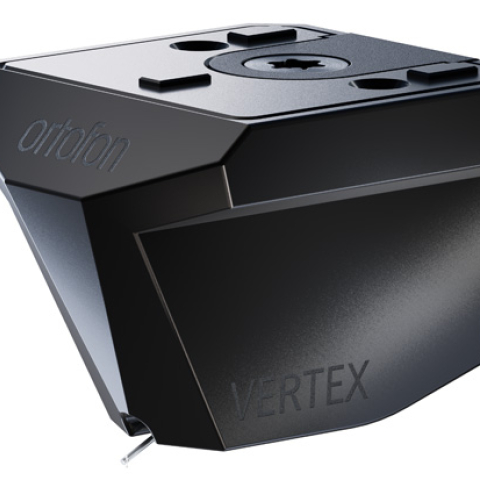
Since I first reviewed it, Ortofon's $1150 2M Black LVB 250 moving magnet cartridge has upstaged the $509 Nagaoka MP-200, Goldring's $975 high-output moving coil Eroica HX, and Grado's $400 Platinum3 High as my favorite high-output cartridge. Through the Quad Platina's MM input, the LVB 250 was the opposite of a letdown. It danced and sang and played records with the same bouncy, unaffected charm as the Hana Umami Blue ($2500). In my system, the LVB 250 does not sound like any of Ortofon's other moving magnet cartridges. It's more relaxed and flexible. Fluffier. More cheerful. More tactile. More spacious and 3D. More intense. Rhythms are less staid, and images are more vividly illuminated than they are with Ortofon's regular 2M Black. The LVB 250 is a unique, beautiful-sounding cartridge that deserves a long run anchoring midlevel systems.
Through the MM input, the Quad Platina's phono stage showed itself to be world-class extraordinary. It made cartridges sound strong and exciting. I'd pay $5000 for just the phono stage.
Headphones
Most nights, I lie on my bed and listen to music through headphones. Not infrequently, I fall asleep with the headphones on, streaming music straight into my dreams. There are few recordings I'd rather stream to my dreams than Dylan's Freewheelin'. Absorbing Zimmy's poetry and folk philosophy lets me wake up feeling wiser and saner. Grado's new Signature HP100 SE dynamic headphone costs $2495. It performs like it cost twice that much. The HP100 SE is specified as 117dB/mW sensitive, with a 38 ohm impedance.
The Platina's headphone amplifier made this combination of transducers—the HP100 SE headphones and Ortofon's 2M Black LVB 250 cartridge—sound quick, light on their feet, pure-air transparent, and delightfully musical. My brain kept wondering why anyone would ask for more.
With their high sensitivity those Grados are easy to drive. HiFiMan's new Susvara Unveiled, a hi-rez planar magnetic with a 45 ohm impedance is more of a challenge because it's only 86dB sensitive. It therefore requires a substantial gain.
Once upon a time, I knew a young woman named Lizzy. She told me she came to New York to be a singer but was having a tough go getting started. We became friendly because more than anything, she loved talking about music and songwriting and speculating about what gives songs the power to capture people's minds. Because I was an artist, she kept asking, "How do I know when my song is good? How do I know when it's finished?"
 One day, I ran into her on Houston Street, and she was excited to show me a CD of her album—for a surprisingly major label—which had just come out. It was called Born to Die (24/44.1 FLAC, Polydor/Qobuz), and it was issued under her stage name, Lana Del Rey. I was blown away. I haven't seen Lizzy since that day, but I've followed her career, and every time I play Born to Die, I remember her burning eyes and urgent questions.
When I played that album through the Platina, HiFiMan's Susvara Unveiled sucked up a lot of amplifier gain. It sounded okay if I wasn't listening too close, but when I did listen close, it sounded slow, closed in, and compressed—not as fresh-awake or transparent as it did with the Grado HP100 SE.
To get a better read on the Platina headphone amp's ability to deliver current and voltage, I tried one more headphone: the 250 ohm Beyerdynamic DT 880 Pro. My 880 is dirty and worn because I've put a lot of hours on it. I've used it more than other headphones in my herd because it plays smooth, tonally neutral, and supremely well-sorted. You really could mix a record with these.
With the Quad Platina, the Beyer transduced Lana Del Rey's Born to Die the way her engineers probably heard it. It made their track-to-track production choices seem more obvious, wiser, and more effective than I had previously found them. But what I heard lacked sparkle and immediacy; it was a little soft on the edges.
The Platina's headphone amp responded poorly to challenging loads but gloriously to easy loads.
Pre-out
One day, I ran into her on Houston Street, and she was excited to show me a CD of her album—for a surprisingly major label—which had just come out. It was called Born to Die (24/44.1 FLAC, Polydor/Qobuz), and it was issued under her stage name, Lana Del Rey. I was blown away. I haven't seen Lizzy since that day, but I've followed her career, and every time I play Born to Die, I remember her burning eyes and urgent questions.
When I played that album through the Platina, HiFiMan's Susvara Unveiled sucked up a lot of amplifier gain. It sounded okay if I wasn't listening too close, but when I did listen close, it sounded slow, closed in, and compressed—not as fresh-awake or transparent as it did with the Grado HP100 SE.
To get a better read on the Platina headphone amp's ability to deliver current and voltage, I tried one more headphone: the 250 ohm Beyerdynamic DT 880 Pro. My 880 is dirty and worn because I've put a lot of hours on it. I've used it more than other headphones in my herd because it plays smooth, tonally neutral, and supremely well-sorted. You really could mix a record with these.
With the Quad Platina, the Beyer transduced Lana Del Rey's Born to Die the way her engineers probably heard it. It made their track-to-track production choices seem more obvious, wiser, and more effective than I had previously found them. But what I heard lacked sparkle and immediacy; it was a little soft on the edges.
The Platina's headphone amp responded poorly to challenging loads but gloriously to easy loads.
Pre-out
One of my favorite features on any integrated amplifier is a line-level output: Pre Out. In my job, it's a blessing to be able to switch power amplifiers at will without having to wrangle sources into a separate preamp like my HoloAudio Serene. I used the Platina as a preamp with my Elekit TU-8900 equipped with ultraquiet Ray Tubes, and it was easy to see how it—the Platina's preamp stage—affected system sound. The Platina's preamp was not as invisible as the HoloAudio Serene, but it had a little more push and presence, which made recordings sound exciting. Images had more density, which compensated for the slight loss of transparency. If you've never owned a Serene, you'd never know the Platina pre was not perfectly transparent.
 Conclusion
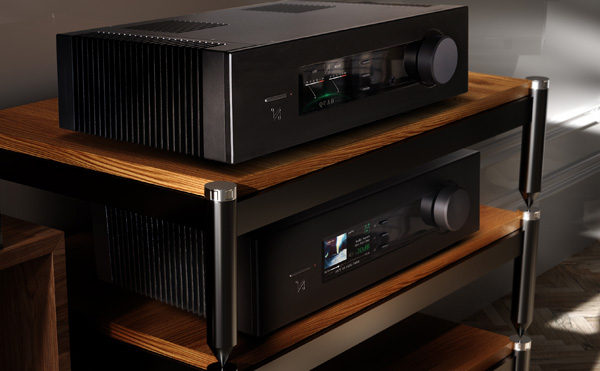
Before I listened to it, I could not have imagined that the Quad Platina Integrated would deliver this much listening pleasure. I would not have predicted how much something as silly as a Menu Tree for setup could increase those pleasures. CDs, LPs, and Qobuz from my computer via USB were presented with clarity, vigor, and luxury-class élan. The Platina described forms in a precise, detailed fashion that completely satisfied my left brain while producing tones, tempi, and atmospheres that pleased my right brain. Like the Creek 4240 I enjoyed every day for 10 years, the Platina's lively, well-balanced persona made it an integrated amp I could retire with. I don't know who designed this solidly built product, but I am sure Quad founder Peter Walker would nod in approval if he were alive to experience it.
Footnote 1: No maximum output voltage is specified, but the sensitivity—input voltage at full output—is specified, as 1.2V RMS. Since gain is specified as 30dB, which corresponds to a factor of 31.6, the implicitly specified maximum output voltage is 1.2V × 31.6 = 37.9V RMS. The maximum voltage will be limited by the rail voltage, while the maximum current will be limited by the limitations of the output devices themselves. High impedance—let us say 8 ohms—should give an indication of the rail voltage, so the rail voltage is somewhere near 38V. This gives a maximum output power into 8 ohms of (38V)2/8 ohms = 180.5W, just below the specified maximum—so maybe the rail voltage is 40V instead of 38V. 40V into 8 ohms gives a current of just 5A; here, the output power is voltage limited. At lower impedances—around 3 ohms—it will be current limited. The specified 310Wpc into 4 ohms—still in the voltage-limited region—corresponds to 35.2V. Why not 40V? Because those limitations—current at low impedance, voltage at high impedance—are asymptotic only. At real-world values of impedance, both current and voltage are limited, for several reasons, most often and prominently sagging voltage in the power supply. Note, however, that in his measurements, Technical Editor Paul Miller found that the Platina's dynamic performance exceeded its rated power into both 8 ohms and 4 ohms. Anyway, none of this will impact this amplifier's performance at reasonable impedances and listening volumes: Miller concluded that the Platina is "beefy enough to handle all likely partnering speakers."—Jim Austin
Footnote 2: Regarding Herb's question about a 15 ohm load: At such a high impedance, it will be substantially voltage limited. Assuming the 40V rail voltage is correct, the output power into 15 ohms will be 106W. Don't worry about the small number: voltage-limited means that the amplifier's full gain is supported. A 15 ohm load just doesn't need much current.—Jim Austin
Footnote 3: The exception is Luxman, whose products are manufactured in Japan, and a few premium IAG loudspeakers, including the Wharfedale Dovedale, are assembled in the UK from parts manufactured at IAG's China facilities.
Footnote 4: See keith-snook.info/quad-ii-valve-power-amplifier.html.
Footnote 5: See Joe Boyd, White Bicycles, Serpent's Tail Press, p.186.
According to the user manual, the Platina integrated weighs 37.7 lb (17.1kg) and measures 17.5" (445mm) wide × 5.3" (134.5mm) high × 13.7" (348mm) deep. The amplifier is solid state, and its output stage operates in class-AB. It's specified to produce 200Wpc into 8 ohms and 310Wpc into 4 ohms. (I'm always curious what amplifiers can do into 15 ohms, but that never gets measured) Its gain is 30dB. Maximum output current is specified as 20A, which causes me to wonder why they don't also state the maximum output voltage (footnotes 1 & 2). Despite having a name that evokes platinum, the Platina isn't ostentatious. Its stealth-looking front panel features a 2.5" knob, four rectangular buttons, a ¼" headphone jack, and a 4.3" IPS LCD screen. Inputs are myriad: two pairs of RCA, one balanced XLR pair, one RCA for phono with a ground wire tie-down, two coaxial (S/PDIF), two optical, one USB-C, one HDMI ARC, and a 12V trigger. Outputs consist of two pairs of speaker-wire binding posts, one pair RCA and one pair XLR (for using the Platina as a preamplifier), plus one optical, one coaxial, and a 12V trigger.
There's a streaming input and a DAC featuring the ES9038PRO DAC chip, with five filter choices. Via USB or Ethernet, the DAC is specified to convert PCM up to 768kHz and native DSD up to DSD512. The digital section has TOSLINK and S/PDIF outputs that support sampling frequencies between 44.1kHz and 192kHz.
The all-analog line-level preamp section has no specified gain. There is, however, a phono input, with selectable gain of 46dB, 52dB, or 60dB. Input sensitivity is 5mV for full output (MM phono). Loading for MM phono is 50k ohms with 100pF capacitance. The only output impedances specified are 75 ohms (for the digital section) and 120 ohms, which must be for the preamp section. The impedance at the speaker outputs isn't specified.
Curiously, specs for the headphone amplifier do not include gain, power, voltage, or current. They do mention output impedance (2.35 ohms) and a "load impedance" of 20–600 ohms.
Setup
Out of the box, the Quad Platina reminded me of the original Quad II tube amplifier, designed by Peter Walker, which I used with my Rogers LS3/5a's in the 1980s (footnote 4). Even more, it reminded me of the Creek 4240 I used with those same speakers for almost 10 years.
The cover of the Quad Platina's 18-page user manual is made of thick, glossy paper in British Racing Green. After the obligatory safety information, the manual names every button, knob, and hole on the front and rear panels. Starting on p.8, there's a section labeled Menu Options, under which is the greatest invention since corrugated metal: a Menu Tree. This chart is easy to read and understand. It shows all the choices for each of the 16 menu categories. That approach suits my type of brain. It made my Platina Integrated experience completely unstressed. In a matter of minutes, the Quad Platina was up and running via three inputs: USB from my computer playing Qobuz, S/PDIF from the TEAC VRDS-701T CD transport, and analog from my Dr. Feickert Blackbird turntable.
Listening to phonoWhen I played a test pressing of the Acoustic Sounds remastering of Skip James's Devil Got My Woman (CS00982), my first impression with the Quad Platina MC phono input was oh my Lord! That's a real British phono stage! I was using My Sonic Lab's 0.6 ohm Ultra Eminent Ex moving coil into the Platina's fixed 360 ohm load, and the sound was nearly irreproachable. The test pressing sounded more like my original first pressing than it did using Audio Note UK's IO II MC into the AN-S4 SUT and then into the Lab12 Melto2 MM phono stage. My Sonic Lab recommends a 400 ohm load for the Ultra Eminent Ex, and the Platina's 360 demonstrated the wisdom of that recommendation: Transparency seemed flawless. Recordings presented as structured and whole-feeling in a way and to an extent that did not permit my mind to think hi-fi thoughts. I just listened and enjoyed. After that, when I listened to a 58-year-old first pressing of the 1968 Vanguard issue, with the My Sonic Lab feeding the Platina, what I heard was smoother, sweeter, more ephemeral, and—dare I say it?—less compressed. Skip's voice felt less restrained, more oaring. His guitar strings felt looser, his piano notes more vibrant. The Quad's pacing and vocal intelligibility sparked memories of playing this disc through Musical Fidelity's classic A1 integrated designed by Tim de Paravicini. Both amplifiers played tone forward and tempo positive. The MC input of the Platina produced a firmer, better-defined leading edge than the Kitsuné KTE LCR-1 MK5 and my Lab12 Melto2.
Listening to Qobuz via USBIf I'd ever met a hippie girl named Licorice, I would have married her and lived in a cottage, drunk potions, cast spells, and sung Scottish folk songs. But so far, the closest I've gotten to that fantasy is hearing elfin Scots singer Christina "Licorice" McKechnie sing backup and play percussion on The Incredible String Band's 1967 album The 5000 Spirits or the Layers of the Onion (16/44.1 FLAC, Rhino-Elektra/Qobuz). According to the album's producer, Joe Boyd, whose book White Bicycles I read last summer, "She had a small, sweet face marred by a chipped front tooth she never sought to repair. Her dark hair hung down uncombed. ... She rarely spoke, and when she did it was in a high, squeaky voice with the thickest of Scots accents." (footnote 5) Licorice was the girlfriend of ISB's Robin Williamson, and her force-of-nature presence gave the trio extra visual and emotional depth. Later, when the band became a duo, Williamson's songwriting partner Mike Heron brought in his girlfriend, Rose Simpson.
During a recent adventure in Concord, Massachusetts, I was able to experience a clean, fresh-sounding dub from a master tape of The Freewheelin' Bob Dylan played back on a Sony APR-5003V deck into an enormous (10' high) pair of field-coil RCA theater horns. What came out sounded maximally compelling, distinctly unprocessed, utterly transparent, and dynamically charged. It came across with the presence and clarity of a field recording.
The first thing I did when I got home was stream Freewheelin's "A Hard Rain's a-Gonna Fall" from Qobuz (24/96 FLAC, Columbia/Qobuz)—just to see how it would sound through my little Gold Badges. What I heard was explicit and detailed, with saturated tone. It was more intense and satisfying—and closer to my friend's master—than I imagined it could be. I blame the Platina DAC via its USB input.
Next, I tried the 45rpm reissue of Freewheelin' from Mobile Fidelity (MFSL 2-378). It was not as direct and transparent as the 15ips dub, but its fine tone and rhythmic authority precipitated ad hoc sing-alongs and repeat plays. For that, I'm blaming the Platina's five-star moving coil phono input.
I'd be remiss if I didn't verify the phono stage's five-starness by trying the Denon DL-103 into the Platina's MC stage, which has a fixed load resistance of 360 ohms. Usually I use the 103 with my EM/IA SUT, but Denon's recommended shunt load is 400 ohms, so I thought I'd see how many stars the Platina phono might earn with a cartridge many audiophiles use in the real world.
Since I first reviewed it, Ortofon's $1150 2M Black LVB 250 moving magnet cartridge has upstaged the $509 Nagaoka MP-200, Goldring's $975 high-output moving coil Eroica HX, and Grado's $400 Platinum3 High as my favorite high-output cartridge. Through the Quad Platina's MM input, the LVB 250 was the opposite of a letdown. It danced and sang and played records with the same bouncy, unaffected charm as the Hana Umami Blue ($2500). In my system, the LVB 250 does not sound like any of Ortofon's other moving magnet cartridges. It's more relaxed and flexible. Fluffier. More cheerful. More tactile. More spacious and 3D. More intense. Rhythms are less staid, and images are more vividly illuminated than they are with Ortofon's regular 2M Black. The LVB 250 is a unique, beautiful-sounding cartridge that deserves a long run anchoring midlevel systems.
Most nights, I lie on my bed and listen to music through headphones. Not infrequently, I fall asleep with the headphones on, streaming music straight into my dreams. There are few recordings I'd rather stream to my dreams than Dylan's Freewheelin'. Absorbing Zimmy's poetry and folk philosophy lets me wake up feeling wiser and saner. Grado's new Signature HP100 SE dynamic headphone costs $2495. It performs like it cost twice that much. The HP100 SE is specified as 117dB/mW sensitive, with a 38 ohm impedance.
One day, I ran into her on Houston Street, and she was excited to show me a CD of her album—for a surprisingly major label—which had just come out. It was called Born to Die (24/44.1 FLAC, Polydor/Qobuz), and it was issued under her stage name, Lana Del Rey. I was blown away. I haven't seen Lizzy since that day, but I've followed her career, and every time I play Born to Die, I remember her burning eyes and urgent questions.
When I played that album through the Platina, HiFiMan's Susvara Unveiled sucked up a lot of amplifier gain. It sounded okay if I wasn't listening too close, but when I did listen close, it sounded slow, closed in, and compressed—not as fresh-awake or transparent as it did with the Grado HP100 SE.
To get a better read on the Platina headphone amp's ability to deliver current and voltage, I tried one more headphone: the 250 ohm Beyerdynamic DT 880 Pro. My 880 is dirty and worn because I've put a lot of hours on it. I've used it more than other headphones in my herd because it plays smooth, tonally neutral, and supremely well-sorted. You really could mix a record with these.
One of my favorite features on any integrated amplifier is a line-level output: Pre Out. In my job, it's a blessing to be able to switch power amplifiers at will without having to wrangle sources into a separate preamp like my HoloAudio Serene. I used the Platina as a preamp with my Elekit TU-8900 equipped with ultraquiet Ray Tubes, and it was easy to see how it—the Platina's preamp stage—affected system sound. The Platina's preamp was not as invisible as the HoloAudio Serene, but it had a little more push and presence, which made recordings sound exciting. Images had more density, which compensated for the slight loss of transparency. If you've never owned a Serene, you'd never know the Platina pre was not perfectly transparent.
ConclusionBefore I listened to it, I could not have imagined that the Quad Platina Integrated would deliver this much listening pleasure. I would not have predicted how much something as silly as a Menu Tree for setup could increase those pleasures. CDs, LPs, and Qobuz from my computer via USB were presented with clarity, vigor, and luxury-class élan. The Platina described forms in a precise, detailed fashion that completely satisfied my left brain while producing tones, tempi, and atmospheres that pleased my right brain. Like the Creek 4240 I enjoyed every day for 10 years, the Platina's lively, well-balanced persona made it an integrated amp I could retire with. I don't know who designed this solidly built product, but I am sure Quad founder Peter Walker would nod in approval if he were alive to experience it.
Footnote 1: No maximum output voltage is specified, but the sensitivity—input voltage at full output—is specified, as 1.2V RMS. Since gain is specified as 30dB, which corresponds to a factor of 31.6, the implicitly specified maximum output voltage is 1.2V × 31.6 = 37.9V RMS. The maximum voltage will be limited by the rail voltage, while the maximum current will be limited by the limitations of the output devices themselves. High impedance—let us say 8 ohms—should give an indication of the rail voltage, so the rail voltage is somewhere near 38V. This gives a maximum output power into 8 ohms of (38V)2/8 ohms = 180.5W, just below the specified maximum—so maybe the rail voltage is 40V instead of 38V. 40V into 8 ohms gives a current of just 5A; here, the output power is voltage limited. At lower impedances—around 3 ohms—it will be current limited. The specified 310Wpc into 4 ohms—still in the voltage-limited region—corresponds to 35.2V. Why not 40V? Because those limitations—current at low impedance, voltage at high impedance—are asymptotic only. At real-world values of impedance, both current and voltage are limited, for several reasons, most often and prominently sagging voltage in the power supply. Note, however, that in his measurements, Technical Editor Paul Miller found that the Platina's dynamic performance exceeded its rated power into both 8 ohms and 4 ohms. Anyway, none of this will impact this amplifier's performance at reasonable impedances and listening volumes: Miller concluded that the Platina is "beefy enough to handle all likely partnering speakers."—Jim Austin