I'm known as an unrepentant tube-amplifier devotee and turntable missionary. I spin vinyl in listening spaces, make jazz-vinyl videos, and review turntables, cartridges, and record cleaning machines. I'm a semi-Luddite for whom streaming is a last resort rather than a daily need. I prefer the analog-playback setup gauntlet to the setup gauntlet that comes with streaming amplifiers and network bridges. Each new digital component that enters my space requires navigating menus and connections—a stark contrast to the straightforward ritual of the needle drop. There is much to be said for the immediacy of analog in our increasingly digital world. If the growing popularity of vinyl listening rooms (footnote 1) is an indicator, I'm not alone in thinking so.
Setting up one of these streaming contraptions is often a challenge: You coax the amplifier to whisper to an app, which must negotiate with LAN or Bluetooth or Wi-Fi. Then you must negotiate with the audio device via the app and hunt down files on Qobuz, Tidal, Spotify, or your local networked library. It should work simply—automatically even—but has that truly ever happened? By the time this multiway union has been consummated, I could have blasted through side A of Revolver or Hit Me Hard and Soft followed by a moment of Zen with an Elvin Jones drum solo.
Still: As Bob Dylan famously rasped, "He not busy being born is busy dying." So, when offered the AVM Evolution AS 5.3 streaming amplifier ($12,999 in black or silver finish) for review, I grabbed the bull by the horns—er, by its Bluetooth and Wi-Fi antennae.
Design
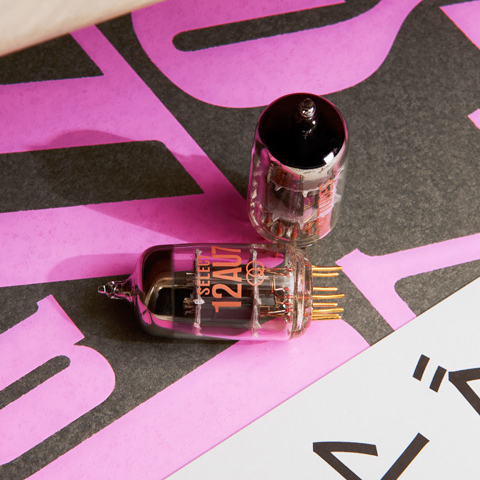
The AS 5.3 is encased in a screwless aluminum housing that stands 16.9" wide, 4.8" high, and 13.7" deep and weighs 24.25lb. The main thing that sets it apart from similar devices is the combination of tubes and class-D—a pair of ECC83/12AX7 tubes in the preamp stage and a Pascal-based class-D module in the output stage, the latter capable of 180Wpc into 8 ohms or 350Wpc into 4 ohms. In an email conversation, AVM owner and principal designer Udo Besser expressed his and his company's sonic values. "AVM is striving to deliver full, rich sound with well-seasoned details," he wrote. "Also, extended, comfortable listening without ear fatigue is important. Reproducing recorded sound with substance that transports the emotion captured in the recording." I could get onboard with all of that. Besser himself is responsible for the AS 5.3's big-picture design. His digital-side AVM colleagues handled the DAC section, the "analog team" developed the signal processing, AVM cofounder Günther Mania contributed to the tube-stage design, and the "software team" developed the streaming engine.
"The main challenges are staying up to date with new functions and formats," Besser said, "combining digital and analog in one single chassis" while "building a really great sounding product which can handle the demands of any speakers that may be combined with our amp. And to make everything as easy as possible to operate."
The AS 5.3 has an almost-twin sister. "The sister model AS 3.3 does not have the tube module and hence works completely in solid state. What makes it special is that the module may be removed or retrofitted, and the AS will automatically configure itself into an AS 5.3 when the tube module is installed and into an AS 3.3 when not installed." Does that mean that you can use the AS 5.3 with or without tubes? Not unless you can figure out how to open the screwless chassis. But don't you have to do that anyway to replace the tubes?
AVM uses proprietary circuitry said to extend the tube lifespan to 20,000 hours. "When the unit is powered, it warms up the tubes gently and shows its progress on the touchscreen with a counter," Besser explained. "This gentle warmup extends the life expectancy dramatically, to far over 20,000 hours. There's also the fact that the tubes are in a preamp section with net-zero gain; that, too, means less tube stress."
 On the DAC side, the AS 5.3 employs four channels of an ESS9028 PRO Double-Quad DAC chip for each (L, R) channel (footnote 2). "Using quadruple DACs averages out the ups and downs of single DACs, helping create a more true-to-life sound," Besser explained. Via the streaming inputs, the DAC handles DSD up to DSD256 and PCM up to 32/384. Via the DAC inputs, the AS 5.3 is capable of converting music data up to 24/96 (TosLink) and 24/192 (electrical coax S/ PDIF).
When asked what care was taken to prevent noise and interference between the switch-mode power supply and the tubes, Besser said, "We use only ultraquiet, switch-mode power supplies and add two-fold filtering afterwards for the various sections (digital, analog, display)." Beyond that, the most important factor is layout. "Putting sensitive parts far away from big distortion components is the key. All PCBs are multilayered, which shields as well."
Construction
On the DAC side, the AS 5.3 employs four channels of an ESS9028 PRO Double-Quad DAC chip for each (L, R) channel (footnote 2). "Using quadruple DACs averages out the ups and downs of single DACs, helping create a more true-to-life sound," Besser explained. Via the streaming inputs, the DAC handles DSD up to DSD256 and PCM up to 32/384. Via the DAC inputs, the AS 5.3 is capable of converting music data up to 24/96 (TosLink) and 24/192 (electrical coax S/ PDIF).
When asked what care was taken to prevent noise and interference between the switch-mode power supply and the tubes, Besser said, "We use only ultraquiet, switch-mode power supplies and add two-fold filtering afterwards for the various sections (digital, analog, display)." Beyond that, the most important factor is layout. "Putting sensitive parts far away from big distortion components is the key. All PCBs are multilayered, which shields as well."
Construction
Because there are no screws, I couldn't get a good look inside the AS 5.3's casing. So I grabbed a flashlight and peered in through the top-mounted, dark-tinted, 3" × 11" glass display. I saw empty real estate and densely stacked circuit boards. Two 12AX7 tubes were visible on one of those PCBs. Besser told me that the AS 5.3 "uses the entire body and aluminum housing for cooling. Superhigh efficiency and based on a double-stabilized power supply."
Besser was tight-lipped about what's inside except to say that the wire is AVM's own alloy, a "seasoned mix of copper/silver, price sadly skyrocketing right now."
I'd have described the chassis as "handcrafted from a single billet of aluminum," but it wasn't. "That is impossible," Besser stated. "But our supplier is within seven miles of our factory, in Baden Baden. They make all the aluminum for AVM and have for 40 years. The metal parts are made by our direct neighbor; the PCB assembly is in the same street about a ½ mile away." A local supply chain ensures quality control and speaks to AVM's German manufacturing heritage.
The front panel
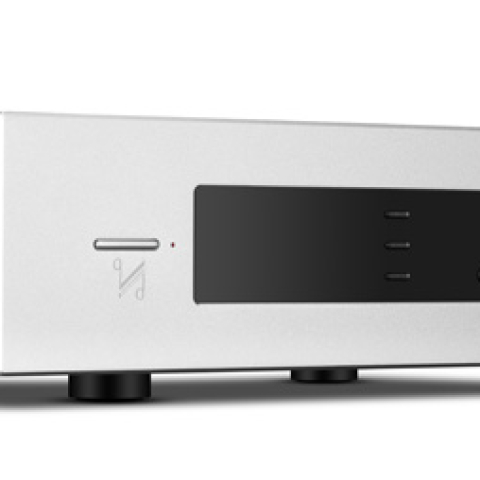
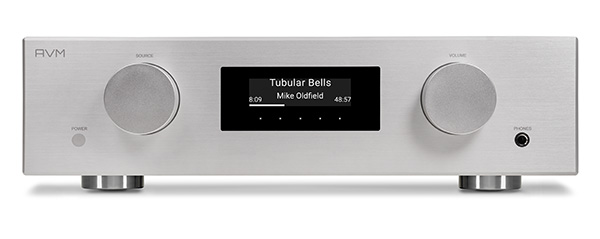
The AS 5.3's smooth fascia has two large round dials, one on each end—one for input selection, the other for the volume control. These flank a 5" × 2" dimmable glass display with "touchpoint sensor technology and proximity sensor," the AVM website notes. A power button anchors the lower left corner of the unit's face, flush with the surface, balanced by a 6.3mm headphone jack on the right, which connects to a dedicated headphone amplifier. But about that volume control:
"AVM makes their own, very advanced volume controls, utilizing four PGAs"—that's short for "programmable-gain amplifier"—"in parallel," Besser noted. "This design has three benefits: 200 volume steps, short signal paths, and isolation from other internal devices."
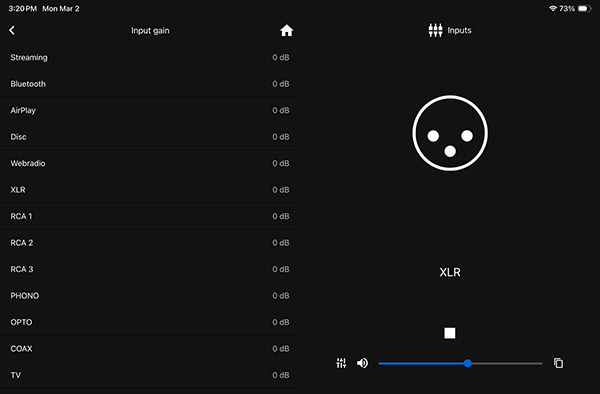
Around back, the AS 5.3 features a master power switch, IEC receptacle, antenna posts for Wi-Fi and Bluetooth, Ethernet, S/ PDIF, HDMI-ARC, and TosLink inputs, four analog-input pairs (including one phono) on RCA, a single pair of XLR inputs, a fixed line-level output on RCA, and a variable line (preamp) output on both RCA and XLR. Then finally the main event: two pairs of loudspeaker binding posts.
That phono input is configurable for either MM or MC, with selectable gain and adjustable loading, capacitive for the former, resistive for the latter.
Streaming is supported via hardwired (10/100Mbps) RJ45 and Wi-Fi and AVM's X-Stream engine. The AS 5.3 supports AirPlay2, Qobuz, Roon Ready, Spotify, and Tidal Connect, and Bluetooth 5.0.
 The Cellini finish
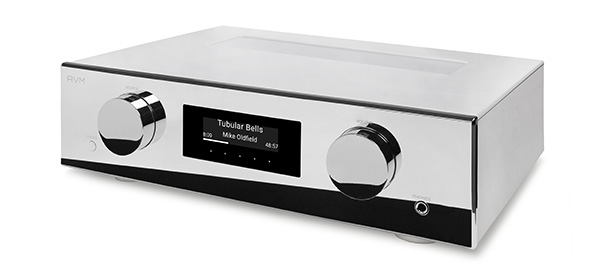
My review sample was finished in silver brushed aluminum, one of the two standard finishes. It felt sleek to the touch. Those who want something flashier can choose the Cellini finish, which adds a cool grand to the price. The name references 16th century Italian sculptor Benvenuto Cellini, and the finish includes a polished, mirror-finish chrome-plated front panel and rotary knobs "handcrafted at the AVM factory in Malsch," the website notes. "Making the Cellini front panel is a nightmare," Besser wrote. "The rejection rate of panels is above 50%. We build the Cellini on order and outside of the normal production line. The knobs and all the buttons also come in the Cellini finish. The prices for manufacturing chrome finishes have gone up for environmental reasons, which we respect in full."
The AS 5.3 sits on four round feet constructed from POM and aluminum with a rubber damper.
Setup
I slid the AVM into my rack and attached the antennas—then my streaming anxiety started up. Between the slim aluminum remote control, the touchscreen, and the AVM app on my iPhone 17 Pro, I had three ways to control the AS 5.3; which should I choose? In a way I am the ultimate tester for complex streaming devices, because I lack both digital skill and patience. Companies that make devices like this should hire me to try them out. If I'm happy, they can be sure their device is user-friendly.
Spotify and Qobuz connected easily enough in the app. Frustration came when I tried to configure the phono stage via the front-panel touchscreen. I encountered options galore—so many options—but navigating them proved maddening. I pressed Menu but couldn't get past Tone Control. MM was the factory default—so where was MC? Eric Smith of Fidelity Imports got me past this roadblock once, but the next day I was stuck there again.
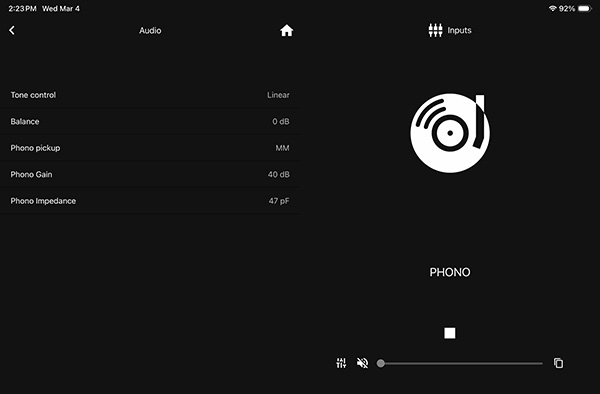 Eventually, I abandoned the touchscreen. The app did everything better and was easier to understand. Through the app, I could easily toggle between MM and MC, adjust gain, loading—and tone controls if I wanted (I didn't). Streaming Spotify and Qobuz through the app worked flawlessly. Just a few minutes in, and the touchscreen and remote control were already obsolete. The app handled everything, with one exception: I had to turn the physical input dial to select the phono input, or I got nothing. Still, this was a pretty good showing for app control. I found myself wondering: Why include three control methods when one clearly works best?
I gleaned from my email exchanges with Besser that to voice the AS 5.3's phono stage, AVM used cartridges from Ortofon ("Cadenza Black, mainly"), Goldnote, Nagaoka, Benz Micro, Audio-Technica, and "many more."
Listening
Eventually, I abandoned the touchscreen. The app did everything better and was easier to understand. Through the app, I could easily toggle between MM and MC, adjust gain, loading—and tone controls if I wanted (I didn't). Streaming Spotify and Qobuz through the app worked flawlessly. Just a few minutes in, and the touchscreen and remote control were already obsolete. The app handled everything, with one exception: I had to turn the physical input dial to select the phono input, or I got nothing. Still, this was a pretty good showing for app control. I found myself wondering: Why include three control methods when one clearly works best?
I gleaned from my email exchanges with Besser that to voice the AS 5.3's phono stage, AVM used cartridges from Ortofon ("Cadenza Black, mainly"), Goldnote, Nagaoka, Benz Micro, Audio-Technica, and "many more."
Listening
I often begin my Listening sections aiming to use records that test specific parameters of phono playback, but then quickly return to records I simply love. This time my return was to Ralph Towner's Batik (1978, ECM Records ECM 1121), Johnny Hodges and Wild Bill Davis's Blue Rabbit (1964, Verve Records V-8599), Billie Holiday's Velvet Mood (1958, Verve Records MGV-8096), Frank Sinatra's In the Wee Small Hours (1955, Capitol Records W-581), Grant Green's Street of Dreams (1967, Blue Note BST 84253), and Kraftwerk's Tour de France (2009, Kling Klang 50999 9 66109 1 6). I dove headfirst into the AS 5.3's onboard phono stage, attaching the VPI Goldy MC cartridge, which was connected to the tonearm on the J.Sikora Aspire turntable. A pair of AudioQuest William Tell Zero speaker cables connected the AS 5.3 with my Voxativ Ampeggio 2024 loudspeakers.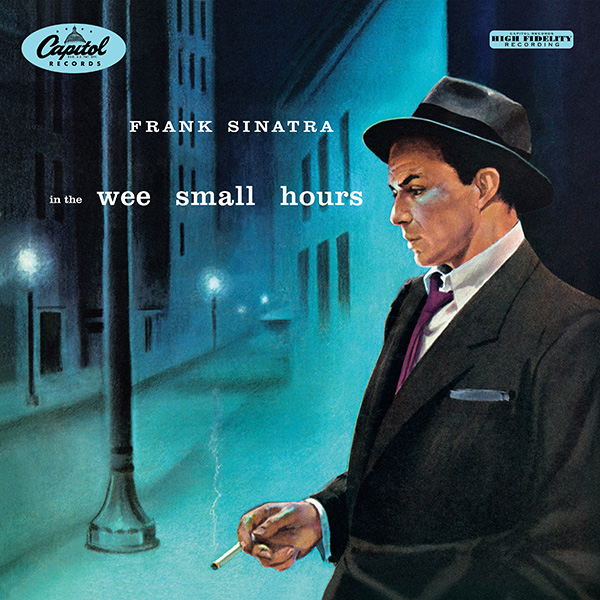 Right out of the gate, this combination hit me as sweet, pristine, unnervingly detailed, microscopic—like a surgeon with an eyepiece operating under hot lights. Images were compact but razorsharp. The AS 5.3's presentation was immaculately groomed, like a finely mown lawn. Billie Holiday's and Sinatra's voices arrived at my ears with startling immediacy. Johnny Hodges's alto saxophone sang with liquid lyricism. Grant Green's guitar growled with street-corner conviction, and Kraftwerk's synthesizers pulsed with erotic, otherworldly electricity.
Not everything was perfect. Bass wasn't earth-shaking, which I largely credited to the Voxativs, whose large, transmission-like bass design produced bass down to 60Hz or so that is ample but somewhat soft. The phono presentation, with the built-in phono preamp, lacked the visceral incisiveness and soundstage depth I get with the best stand-alone phono stages. Yet the AVM AS 5.3's vinyl presentation was engaging. I was impressed.
Right out of the gate, this combination hit me as sweet, pristine, unnervingly detailed, microscopic—like a surgeon with an eyepiece operating under hot lights. Images were compact but razorsharp. The AS 5.3's presentation was immaculately groomed, like a finely mown lawn. Billie Holiday's and Sinatra's voices arrived at my ears with startling immediacy. Johnny Hodges's alto saxophone sang with liquid lyricism. Grant Green's guitar growled with street-corner conviction, and Kraftwerk's synthesizers pulsed with erotic, otherworldly electricity.
Not everything was perfect. Bass wasn't earth-shaking, which I largely credited to the Voxativs, whose large, transmission-like bass design produced bass down to 60Hz or so that is ample but somewhat soft. The phono presentation, with the built-in phono preamp, lacked the visceral incisiveness and soundstage depth I get with the best stand-alone phono stages. Yet the AVM AS 5.3's vinyl presentation was engaging. I was impressed.
 Kraftwerk proved surprisingly, gloriously spatial through the AS 5.3. Occasionally, I felt that the AS 5.3 was gripping the music a little too tightly, yet that pristine, laser-focused imaging kept dragging me back. The AS 5.3 was relentlessly, almost eerily quiet, and superbly resolving. Class-D modules aside, it resembled something human.
Then I slipped the Manley Chinook phono stage into the chain, wired with AudioQuest Pegasus RCA interconnects from stage to amp, and the music exhaled. That subtle tightness, that sense of the music being held on a short leash, was gone. The Chinook isn't as spookily silent as the AS 5.3's internal phono stage, but what it surrendered in noisefloor it reclaimed in soul, tone, and spatial grandeur. The soundstage opened. Images ballooned from miniatures into flesh-and-blood presences. Voices and instruments became similarly large-scaled. Tone deepened. Texture bloomed.
Which means, obviously, that the other parts of the AS 5.3—its tubed preamplifier and its class-D amplifier—were capable of producing this kind of sound. The AS 5.3's onboard phono stage earns its stripes for its exceptional layering, forensic resolution, and an uncanny quiet—a strong performance for a built-in phono stage. But with phono at least, and the front-end stuff I have here, it was apparently the weak link. The Chinook was more satisfying.
So then I switched to streaming
Kraftwerk proved surprisingly, gloriously spatial through the AS 5.3. Occasionally, I felt that the AS 5.3 was gripping the music a little too tightly, yet that pristine, laser-focused imaging kept dragging me back. The AS 5.3 was relentlessly, almost eerily quiet, and superbly resolving. Class-D modules aside, it resembled something human.
Then I slipped the Manley Chinook phono stage into the chain, wired with AudioQuest Pegasus RCA interconnects from stage to amp, and the music exhaled. That subtle tightness, that sense of the music being held on a short leash, was gone. The Chinook isn't as spookily silent as the AS 5.3's internal phono stage, but what it surrendered in noisefloor it reclaimed in soul, tone, and spatial grandeur. The soundstage opened. Images ballooned from miniatures into flesh-and-blood presences. Voices and instruments became similarly large-scaled. Tone deepened. Texture bloomed.
Which means, obviously, that the other parts of the AS 5.3—its tubed preamplifier and its class-D amplifier—were capable of producing this kind of sound. The AS 5.3's onboard phono stage earns its stripes for its exceptional layering, forensic resolution, and an uncanny quiet—a strong performance for a built-in phono stage. But with phono at least, and the front-end stuff I have here, it was apparently the weak link. The Chinook was more satisfying.
So then I switched to streaming
I connected Qobuz using the AVM RC X app. I selected "Premium" from bitrate options. Familiar songs materialized in front of me with astounding detail, scale, and image placement—as if I was wearing a pair of very good, stadium-sized headphones. I played Underworld's A Hundred Days Off (16/44.1 FLAC, V2/Qobuz), Pat Metheny Group's We Live Here (16/44.1, FLAC, Geffen Records/Qobuz), Steely Dan's Everything Must Go (16/44.1, FLAC, Reprise/Qobuz), and Massive Attack's Mezzanine (16/44.1, FLAC, Virgin/Qobuz). Playing streaming versions of the same albums I'd played on vinyl proved instructive. Most came across as hyper-resolved but bloodless, like refrigerated Jell-O. The AS 5.3 maintained its fine separation, layering, quiet background, and near-clinical detail retrieval. Bass lacked weight; dryness was noted. Still, the machine's command of texture and scale kept me riveted.
I found myself wondering: Perhaps the immaculate, slightly forward Voxativs were a less-than-ideal fit with the AVMs. The sonic character of the AVMs and the Voxativs had some things in common. Maybe it was too much of a good thing.
Enter the Super Nines
Playing streaming versions of the same albums I'd played on vinyl proved instructive. Most came across as hyper-resolved but bloodless, like refrigerated Jell-O. The AS 5.3 maintained its fine separation, layering, quiet background, and near-clinical detail retrieval. Bass lacked weight; dryness was noted. Still, the machine's command of texture and scale kept me riveted.
I found myself wondering: Perhaps the immaculate, slightly forward Voxativs were a less-than-ideal fit with the AVMs. The sonic character of the AVMs and the Voxativs had some things in common. Maybe it was too much of a good thing.
Enter the Super Nines
Swapping the Voxativ Ampeggio loudspeakers for the DeVore Fidelity Super Nines changed the streaming picture entirely. The DeVore speakers, with their dual 6" midrange/bass drivers, delivered more weight, deeper bass, and darker tone—if not quite the single-minded purity of the Ampeggios. Dance music cranked harder, jazz lost none of its pizazz, and the soundstage transformed from a dazzling, delicate, precision panorama into a room-filling, earth-connected, bass-driven masterclass.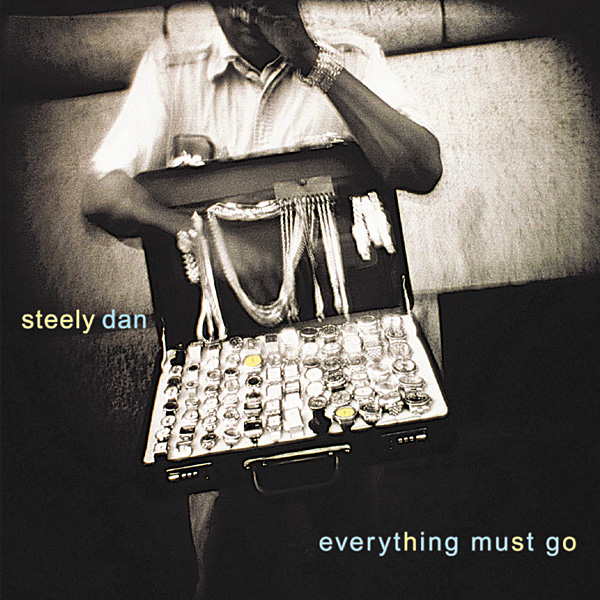 The streamed Everything Must Go played with more voluminous bass and rhythmic punch; other instruments were well layered on a lush, romantic stage. Each 16th note in drummer Keith Carlock's hi-hat patterns cut through, alongside his famously funky bass drum and tom work, brought to life by the Super Nines. Music was toe-tapping, head-bobbing, and fully scaled. "Pixeleen" moved like a sleek downhill racer; "Godwhacker" bumped righteously; "Green Book" nailed pacing and punch. Energetic. Deep-toned. Well-defined.
One thing was impressive about the AS 5.3: Its sonic character didn't change much between phono and streaming—just a sliver less bass weight and harmonic richness with streaming. The DeVore Super Nines added flesh and blood, meat on the bones. The streamed sounds gained balance, with more specific imaging—a Super Nines trademark.
Mezzanine arrived with its melodic menace and sonic grandeur intact, its airless dub-dread rendered like a body submerged in crude oil. Metheny's We Live Here played large in scale yet intimate in delivery. The brain-drilling synths and harrowing production of Underworld's A Hundred Days Off conjured a 24-hour rave with the exits welded shut. The AS 5.3 dazzled me with its driving sense of rhythm, undaunted resolution, and low-end, thrill-ride bass gravitas.
Much like its phono stage, the AS 5.3's streaming identity is tightly woven and superbly layered. When matched with an appropriate speaker, bass possessed warmth and weight, forceful and direct.
Streaming vs CD
The streamed Everything Must Go played with more voluminous bass and rhythmic punch; other instruments were well layered on a lush, romantic stage. Each 16th note in drummer Keith Carlock's hi-hat patterns cut through, alongside his famously funky bass drum and tom work, brought to life by the Super Nines. Music was toe-tapping, head-bobbing, and fully scaled. "Pixeleen" moved like a sleek downhill racer; "Godwhacker" bumped righteously; "Green Book" nailed pacing and punch. Energetic. Deep-toned. Well-defined.
One thing was impressive about the AS 5.3: Its sonic character didn't change much between phono and streaming—just a sliver less bass weight and harmonic richness with streaming. The DeVore Super Nines added flesh and blood, meat on the bones. The streamed sounds gained balance, with more specific imaging—a Super Nines trademark.
Mezzanine arrived with its melodic menace and sonic grandeur intact, its airless dub-dread rendered like a body submerged in crude oil. Metheny's We Live Here played large in scale yet intimate in delivery. The brain-drilling synths and harrowing production of Underworld's A Hundred Days Off conjured a 24-hour rave with the exits welded shut. The AS 5.3 dazzled me with its driving sense of rhythm, undaunted resolution, and low-end, thrill-ride bass gravitas.
Much like its phono stage, the AS 5.3's streaming identity is tightly woven and superbly layered. When matched with an appropriate speaker, bass possessed warmth and weight, forceful and direct.
Streaming vs CD
How would my Tascam CD player and HoloAudio May DAC, connected to one of the AS 5.3's analog inputs, handle the same titles from a silver disc that I'd streamed or played on vinyl? The May proved more soulful than the AS 5.3's DAC, with more bass weight, warmth, and punch, a larger (though more diffuse) soundstage, and a less persnickety, more lived-in sound. It couldn't match the AS 5.3's detail, layering, and crispness, but it served a more satisfying meal.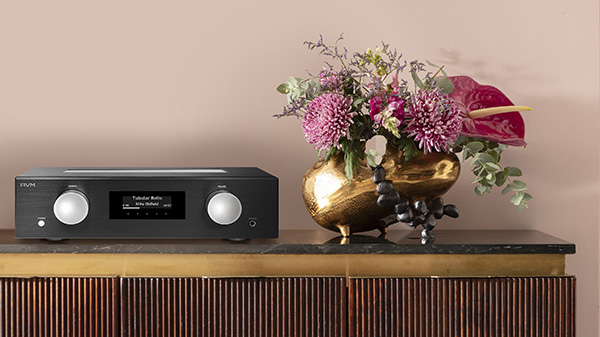 Conclusion
I did much of my auditioning with the Voxativ Ampeggio 2024 speakers. The Ampeggios and the AVM Evolution AS 5.3 share similar sonic attributes to produce too much of a good thing. The DeVore Super Nines brought something new to the party: extra warmth, weight, and humanity—a better match. The result was sound that, while less detailed, crisp, and incisive, was warmer and more human. Which colored my earlier observations. The AVM Evolution AS 5.3 Streaming Amplifier packs an exceptional phono stage—not as good as my Manley, but good. It has plenty of power, a well-designed, usable app, and it works as well with analog sources as with digital. It all fits into a relatively lightweight package. If its feature set, performance, and price match your needs, give the AS 5.3 a serious listen. But choose speakers carefully.
Footnote 1: Or vinyl itself for that matter. In the May 2026 Industry Update, we reported that vinyl sales exceeded $1 billion last year—the first time that has happened (in real, not adjusted, dollars) since 1983. Footnote 2: A single ES9028PRO chip contains eight individual DACs.
The AS 5.3 is encased in a screwless aluminum housing that stands 16.9" wide, 4.8" high, and 13.7" deep and weighs 24.25lb. The main thing that sets it apart from similar devices is the combination of tubes and class-D—a pair of ECC83/12AX7 tubes in the preamp stage and a Pascal-based class-D module in the output stage, the latter capable of 180Wpc into 8 ohms or 350Wpc into 4 ohms. In an email conversation, AVM owner and principal designer Udo Besser expressed his and his company's sonic values. "AVM is striving to deliver full, rich sound with well-seasoned details," he wrote. "Also, extended, comfortable listening without ear fatigue is important. Reproducing recorded sound with substance that transports the emotion captured in the recording." I could get onboard with all of that. Besser himself is responsible for the AS 5.3's big-picture design. His digital-side AVM colleagues handled the DAC section, the "analog team" developed the signal processing, AVM cofounder Günther Mania contributed to the tube-stage design, and the "software team" developed the streaming engine.
On the DAC side, the AS 5.3 employs four channels of an ESS9028 PRO Double-Quad DAC chip for each (L, R) channel (footnote 2). "Using quadruple DACs averages out the ups and downs of single DACs, helping create a more true-to-life sound," Besser explained. Via the streaming inputs, the DAC handles DSD up to DSD256 and PCM up to 32/384. Via the DAC inputs, the AS 5.3 is capable of converting music data up to 24/96 (TosLink) and 24/192 (electrical coax S/ PDIF).
When asked what care was taken to prevent noise and interference between the switch-mode power supply and the tubes, Besser said, "We use only ultraquiet, switch-mode power supplies and add two-fold filtering afterwards for the various sections (digital, analog, display)." Beyond that, the most important factor is layout. "Putting sensitive parts far away from big distortion components is the key. All PCBs are multilayered, which shields as well."
ConstructionBecause there are no screws, I couldn't get a good look inside the AS 5.3's casing. So I grabbed a flashlight and peered in through the top-mounted, dark-tinted, 3" × 11" glass display. I saw empty real estate and densely stacked circuit boards. Two 12AX7 tubes were visible on one of those PCBs. Besser told me that the AS 5.3 "uses the entire body and aluminum housing for cooling. Superhigh efficiency and based on a double-stabilized power supply."
The AS 5.3's smooth fascia has two large round dials, one on each end—one for input selection, the other for the volume control. These flank a 5" × 2" dimmable glass display with "touchpoint sensor technology and proximity sensor," the AVM website notes. A power button anchors the lower left corner of the unit's face, flush with the surface, balanced by a 6.3mm headphone jack on the right, which connects to a dedicated headphone amplifier. But about that volume control:
The Cellini finishMy review sample was finished in silver brushed aluminum, one of the two standard finishes. It felt sleek to the touch. Those who want something flashier can choose the Cellini finish, which adds a cool grand to the price. The name references 16th century Italian sculptor Benvenuto Cellini, and the finish includes a polished, mirror-finish chrome-plated front panel and rotary knobs "handcrafted at the AVM factory in Malsch," the website notes. "Making the Cellini front panel is a nightmare," Besser wrote. "The rejection rate of panels is above 50%. We build the Cellini on order and outside of the normal production line. The knobs and all the buttons also come in the Cellini finish. The prices for manufacturing chrome finishes have gone up for environmental reasons, which we respect in full."
I slid the AVM into my rack and attached the antennas—then my streaming anxiety started up. Between the slim aluminum remote control, the touchscreen, and the AVM app on my iPhone 17 Pro, I had three ways to control the AS 5.3; which should I choose? In a way I am the ultimate tester for complex streaming devices, because I lack both digital skill and patience. Companies that make devices like this should hire me to try them out. If I'm happy, they can be sure their device is user-friendly.
Eventually, I abandoned the touchscreen. The app did everything better and was easier to understand. Through the app, I could easily toggle between MM and MC, adjust gain, loading—and tone controls if I wanted (I didn't). Streaming Spotify and Qobuz through the app worked flawlessly. Just a few minutes in, and the touchscreen and remote control were already obsolete. The app handled everything, with one exception: I had to turn the physical input dial to select the phono input, or I got nothing. Still, this was a pretty good showing for app control. I found myself wondering: Why include three control methods when one clearly works best?
I gleaned from my email exchanges with Besser that to voice the AS 5.3's phono stage, AVM used cartridges from Ortofon ("Cadenza Black, mainly"), Goldnote, Nagaoka, Benz Micro, Audio-Technica, and "many more."
I often begin my Listening sections aiming to use records that test specific parameters of phono playback, but then quickly return to records I simply love. This time my return was to Ralph Towner's Batik (1978, ECM Records ECM 1121), Johnny Hodges and Wild Bill Davis's Blue Rabbit (1964, Verve Records V-8599), Billie Holiday's Velvet Mood (1958, Verve Records MGV-8096), Frank Sinatra's In the Wee Small Hours (1955, Capitol Records W-581), Grant Green's Street of Dreams (1967, Blue Note BST 84253), and Kraftwerk's Tour de France (2009, Kling Klang 50999 9 66109 1 6). I dove headfirst into the AS 5.3's onboard phono stage, attaching the VPI Goldy MC cartridge, which was connected to the tonearm on the J.Sikora Aspire turntable. A pair of AudioQuest William Tell Zero speaker cables connected the AS 5.3 with my Voxativ Ampeggio 2024 loudspeakers.
Right out of the gate, this combination hit me as sweet, pristine, unnervingly detailed, microscopic—like a surgeon with an eyepiece operating under hot lights. Images were compact but razorsharp. The AS 5.3's presentation was immaculately groomed, like a finely mown lawn. Billie Holiday's and Sinatra's voices arrived at my ears with startling immediacy. Johnny Hodges's alto saxophone sang with liquid lyricism. Grant Green's guitar growled with street-corner conviction, and Kraftwerk's synthesizers pulsed with erotic, otherworldly electricity.
Kraftwerk proved surprisingly, gloriously spatial through the AS 5.3. Occasionally, I felt that the AS 5.3 was gripping the music a little too tightly, yet that pristine, laser-focused imaging kept dragging me back. The AS 5.3 was relentlessly, almost eerily quiet, and superbly resolving. Class-D modules aside, it resembled something human.
Then I slipped the Manley Chinook phono stage into the chain, wired with AudioQuest Pegasus RCA interconnects from stage to amp, and the music exhaled. That subtle tightness, that sense of the music being held on a short leash, was gone. The Chinook isn't as spookily silent as the AS 5.3's internal phono stage, but what it surrendered in noisefloor it reclaimed in soul, tone, and spatial grandeur. The soundstage opened. Images ballooned from miniatures into flesh-and-blood presences. Voices and instruments became similarly large-scaled. Tone deepened. Texture bloomed.
I connected Qobuz using the AVM RC X app. I selected "Premium" from bitrate options. Familiar songs materialized in front of me with astounding detail, scale, and image placement—as if I was wearing a pair of very good, stadium-sized headphones. I played Underworld's A Hundred Days Off (16/44.1 FLAC, V2/Qobuz), Pat Metheny Group's We Live Here (16/44.1, FLAC, Geffen Records/Qobuz), Steely Dan's Everything Must Go (16/44.1, FLAC, Reprise/Qobuz), and Massive Attack's Mezzanine (16/44.1, FLAC, Virgin/Qobuz).
Playing streaming versions of the same albums I'd played on vinyl proved instructive. Most came across as hyper-resolved but bloodless, like refrigerated Jell-O. The AS 5.3 maintained its fine separation, layering, quiet background, and near-clinical detail retrieval. Bass lacked weight; dryness was noted. Still, the machine's command of texture and scale kept me riveted.
Swapping the Voxativ Ampeggio loudspeakers for the DeVore Fidelity Super Nines changed the streaming picture entirely. The DeVore speakers, with their dual 6" midrange/bass drivers, delivered more weight, deeper bass, and darker tone—if not quite the single-minded purity of the Ampeggios. Dance music cranked harder, jazz lost none of its pizazz, and the soundstage transformed from a dazzling, delicate, precision panorama into a room-filling, earth-connected, bass-driven masterclass.
The streamed Everything Must Go played with more voluminous bass and rhythmic punch; other instruments were well layered on a lush, romantic stage. Each 16th note in drummer Keith Carlock's hi-hat patterns cut through, alongside his famously funky bass drum and tom work, brought to life by the Super Nines. Music was toe-tapping, head-bobbing, and fully scaled. "Pixeleen" moved like a sleek downhill racer; "Godwhacker" bumped righteously; "Green Book" nailed pacing and punch. Energetic. Deep-toned. Well-defined.
How would my Tascam CD player and HoloAudio May DAC, connected to one of the AS 5.3's analog inputs, handle the same titles from a silver disc that I'd streamed or played on vinyl? The May proved more soulful than the AS 5.3's DAC, with more bass weight, warmth, and punch, a larger (though more diffuse) soundstage, and a less persnickety, more lived-in sound. It couldn't match the AS 5.3's detail, layering, and crispness, but it served a more satisfying meal.
ConclusionI did much of my auditioning with the Voxativ Ampeggio 2024 speakers. The Ampeggios and the AVM Evolution AS 5.3 share similar sonic attributes to produce too much of a good thing. The DeVore Super Nines brought something new to the party: extra warmth, weight, and humanity—a better match. The result was sound that, while less detailed, crisp, and incisive, was warmer and more human. Which colored my earlier observations. The AVM Evolution AS 5.3 Streaming Amplifier packs an exceptional phono stage—not as good as my Manley, but good. It has plenty of power, a well-designed, usable app, and it works as well with analog sources as with digital. It all fits into a relatively lightweight package. If its feature set, performance, and price match your needs, give the AS 5.3 a serious listen. But choose speakers carefully.
Footnote 1: Or vinyl itself for that matter. In the May 2026 Industry Update, we reported that vinyl sales exceeded $1 billion last year—the first time that has happened (in real, not adjusted, dollars) since 1983. Footnote 2: A single ES9028PRO chip contains eight individual DACs.