Sidebar 3: Measurements
In common with all recent Quad amplifiers, the Platina is a proven class-AB design powered, in this instance, by a large and compliantly mounted 630VA toroidal transformer that feeds separate PSUs for its left- and right-channel output stages. There's necessarily some protection built in for when the output devices are driving very low-impedance loads. The dynamic power profile (fig.1) shows the 2 ohm delivery reaching 661W but falling back to 405W into 1 ohm as the Platina's 20A current limit is reached.
Otherwise, this amplifier competes head-on with similarly compact class-D solutions courtesy of its power output of 222Wpc into 8 ohms and 340Wpc into 4 ohms, figures comfortably ahead of the 200W and 310W specifications (all ref. 1kHz at 1% THD).
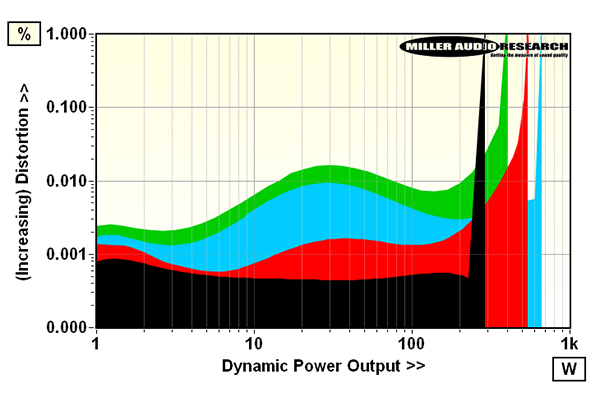
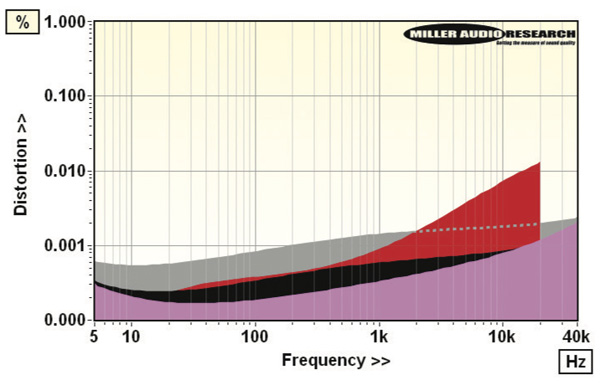
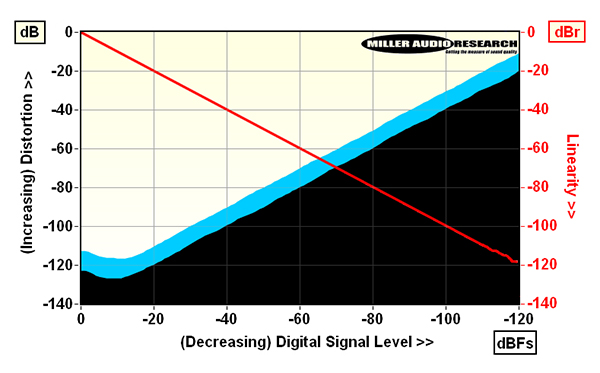
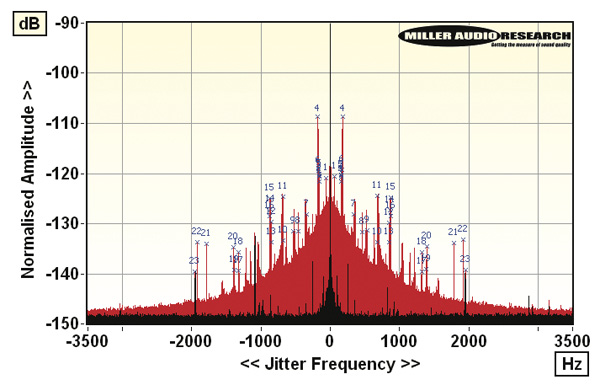
Fig.1 Quad Platina, dynamic power output (ref. 1kHz/10ms) vs distortion into 8 ohms (black), 4 ohms (red), 2 ohms (blue), and 1 ohm (green).
Moreover, there's enough flexibility in the PSU regulation to support an uplift to 288Wpc and 540Wpc into 8 and 4 ohms under dynamic conditions (black and red traces, fig.1). Clearly, this modest-looking amplifier is beefy enough to handle all likely partnering speakers. The nominal gain is 24.1dB, with ±6dB of input trim taking this to a maximum of 30dB. Both figures are low for an integrated amplifier, where 40dB or more is common, but with modern balanced line sources this is perfectly adequate, requiring a 2.5V balanced input for the rated 200Wpc output at 24dB gain. At this setting, the Platina enjoys a very generous A-weighted S/N ratio of 93dB (ref. 0dBW).
Fig.2 Quad Platina, distortion vs frequency, ref. 5Hz–40kHz at 100mW into 8 ohms (gray), 1W into 8 ohms (black), 10W into 8 ohms (pink), and ref. 20Hz–20kHz at 100W into 8 ohms (red).
Distortion is also very low, and reasonably steady with level, from 0.0004% at 1W (black trace, fig.2) to 0.0003% at 10W (pink trace) and 0.0007% at 100W (red trace; all ref. 1kHz into 8 ohms), but it's the minimal uplift in THD with frequency that's most impressive—just 0.00015%–0.0011% (ref. 20Hz–20kHz at 10W into 8 ohms). This is also reflected in the steady output impedance of 0.015 ohms (20Hz–10kHz), rising to 0.04 ohms at 20kHz and 0.55 ohms at 100kHz. The response is similarly uniform, at –0.1dB at 20kHz and –1dB at 100kHz, with some treble rolloff into smaller loads (–0.35dB at 20kHz into 2 ohms).
Fig.3 Quad Platina, distortion vs 24/48 signal level over a 120dB range (1kHz, black; 20kHz, blue) plus resolution/linearity (1kHz, red trace and Y axis).
Fig.4 Quad Platina, high-resolution jitter plot with 24/48 data comparing "Wide" (red) with "Normal" (black) DPLL bandwidths.
The ES9038PRO-based DAC board offers a maximum 3.92V output via the balanced XLR outputs from a moderate 54 ohm source impedance, earning it a wide 114dB A-weighted S/N ratio. Distortion, once again, is extremely low, at 0.00007%– 0.0004% (ref. 0dBFS, 20Hz–20kHz), falling to a minimum of 0.00001%–0.0001% over the top 10dB of its dynamic range (ref. 20Hz–20kHz; fig.3), while resolution is good to ±0.2dB over a full 110dB (red trace, fig.3). Suppression of jitter depends on the DPLL setting. In the preferred "Normal" (strictly, narrow) mode, it falls to a low ~11ps (all sample rates), increasing to 180ps in the "Wide" DPLL setting (black vs red spectra, fig.4). The latter option should only be used if the Platina fails to lock onto, eg, a slightly wayward Class 2 digital source in "Normal" mode.
As ever, response, stopband rejection, and time-domain behavior are all determined by which of the five digital filters is selected. The linear- and minimum-phase "fast" filters have the greatest ringing but superior 75–83dB stopband rejection, while reaching out to –0.0dB at 20kHz, –0.25dB at 45kHz, and –1.1dB at 90kHz with 48kHz, 96kHz, and 192kHz files, respectively. The linear- and minimum-phase "slow" derivatives roll off to –3.4dB and –5.0dB at 20kHz, respectively, with CD and 48kHz sources; –4.9dB and –7.8dB at 45kHz with 96kHz streams; and –5.2dB and –7.5dB at 90kHz, respectively, with 192kHz files. Both these options trade their earlier treble rolloff for reduced time-domain ringing and worse 14–18dB stopband rejection; they are arguably better suited to higher (96kHz+) sample rates. The final "hybrid" filter offers the deepest 100dB alias rejection, but also some in-band ripple in the –0.3dB at 16kHz to –12dB at 20kHz brickwall response (ref. CD or 48kHz media). Finally, bear in mind that none of these filters is engaged in "Upsampling" mode—a default in the ESS DAC that allows third-party algorithms, including MQA, to be applied.—Paul Miller