German aesthetes are fond of saying "Das Auge isst mit": "The eye feasts too." In audio terms, your ears do the listening, but your eyes want their share of pleasure.
I thought of that expression after I opened the T+A Symphonia's double factory box. This German-built all-in-one has an attractive, subtly beveled, anodized-aluminum chassis that's a few inches narrower and lower (14.9" W × 3.9" H) than the typical stereo amplifier. At 13.7lb, it isn't heavy either, though it feels substantial, even dense, conveying a sense of quality. Looking at the Symphonia gave me a case of Ebenmäßigkeitsentzückung—a feeling of delight brought on by an object's symmetry. Those Germans have a word for everything (footnote 1).
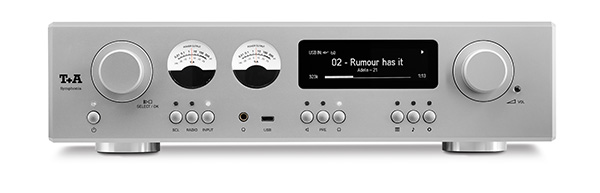
The Symphonia looks understated, which is surprising considering that its silver-gray fascia is chockablock with controls. I counted 10 small round buttons, a knob on either end—play/pause control on the left, volume on the right—a text-only white-on-black display, two small white VU meters, a Pentaconn headphone jack, and a USB-C port. If you fondly remember Dieter Rams's product designs for Braun of the 1970s and '80s, you may appreciate this T+A aesthetic. While not looking retro exactly, it shares with Rams's work an understated, hyperorganized quality despite all those front-panel features.
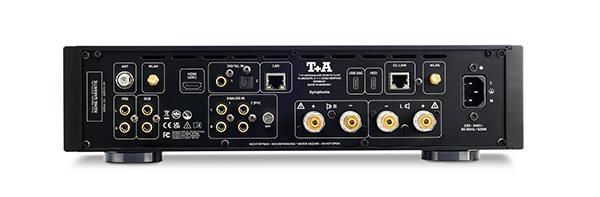 Around back, the Symphonia sports several inputs, analog and digital: two analog on RCA, two USB, two S/PDIF (coaxial and TosLink), and an HDMI ARC bus. Via the menu function, the second analog input can be configured to accept the signal from an MM or high-output MC phono cartridge and do with it what needs doing. Close by is a 75 ohm antenna input suitable for either a domestic aerial or a cable connection: Yes, it's for radio. There's also a place to plug in the two included Wi-Fi antennas—I preferred the hardwired advantage of an Ethernet hookup—an analog pre-out to connect active speakers or an external power amplifier, two subwoofer outputs, and a standard IEC socket.
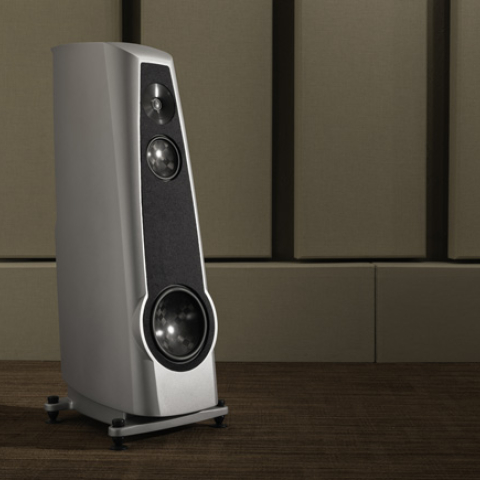
I was able to make all the basic connections in under two minutes. Forgoing the black plastic factory power cord, I used an AudioQuest High-Current Tornado cable, plugged in a Vodka CAT5 cable, then connected my favorite floorstanders—the Estelon X Diamond Mk IIs I reviewed in Stereophile's January 2025 issue—with AudioQuest Thunderbird Zero banana-terminated cables. (As an aside, I'm done with spade lugs. When combined with stiff, thick cables, they've been known to snap speaker-terminal stems right off an amp's backside. Banana plugs require less finger acrobatics and are quicker and drama-free.)
Making the connections was easy. Getting (streaming) music was a little harder. The Symphonia unit I received for review defaulted to playing radio, and since I had neither connected the supplied wire-type radio antenna nor tuned to an FM station, I heard static.
Around back, the Symphonia sports several inputs, analog and digital: two analog on RCA, two USB, two S/PDIF (coaxial and TosLink), and an HDMI ARC bus. Via the menu function, the second analog input can be configured to accept the signal from an MM or high-output MC phono cartridge and do with it what needs doing. Close by is a 75 ohm antenna input suitable for either a domestic aerial or a cable connection: Yes, it's for radio. There's also a place to plug in the two included Wi-Fi antennas—I preferred the hardwired advantage of an Ethernet hookup—an analog pre-out to connect active speakers or an external power amplifier, two subwoofer outputs, and a standard IEC socket.
I was able to make all the basic connections in under two minutes. Forgoing the black plastic factory power cord, I used an AudioQuest High-Current Tornado cable, plugged in a Vodka CAT5 cable, then connected my favorite floorstanders—the Estelon X Diamond Mk IIs I reviewed in Stereophile's January 2025 issue—with AudioQuest Thunderbird Zero banana-terminated cables. (As an aside, I'm done with spade lugs. When combined with stiff, thick cables, they've been known to snap speaker-terminal stems right off an amp's backside. Banana plugs require less finger acrobatics and are quicker and drama-free.)
Making the connections was easy. Getting (streaming) music was a little harder. The Symphonia unit I received for review defaulted to playing radio, and since I had neither connected the supplied wire-type radio antenna nor tuned to an FM station, I heard static.
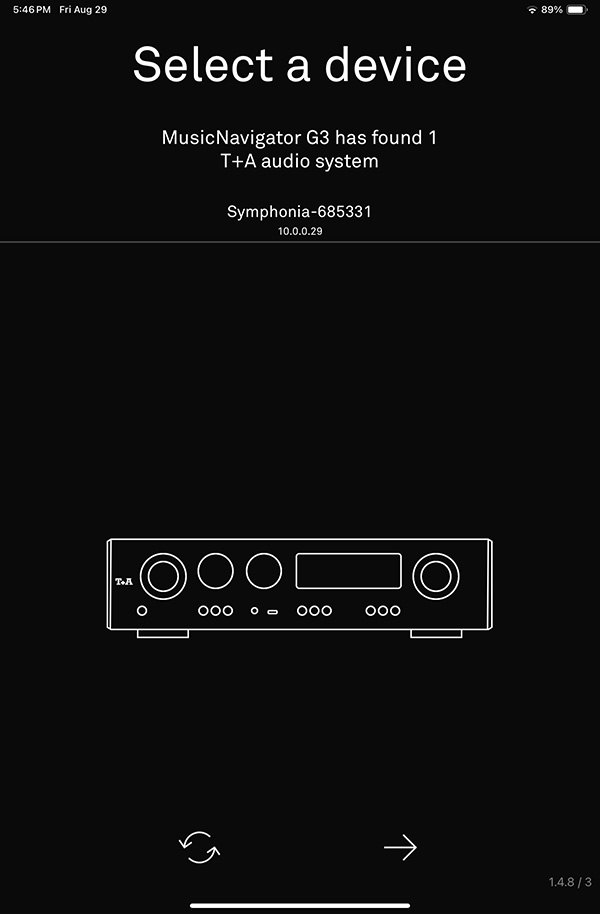 At this point, I was stuck. I can usually figure out how to set up a streamer without cracking the manual, but none of the Symphonia's controls provided an obvious pathway to Qobuz, Tidal, Amazon Music, et cetera. The solution was to download the T+A MusicNavigator G3 app and sign in from my mobile device (footnote 2). At first, I couldn't find the app by typing in its name at the App Store because the mighty Apple doesn't recognize the plus sign in the name. To find it, you have to type "TA."
Conveniently, the Symphonia, which arrived in mid-June, was ready for Qobuz Connect, which had been announced at High End Munich barely a month before. I tapped the speaker icon in the bottom right corner of the Qobuz screen on my iPhone, chose "Symphonia" from the list, and instantly connected the app to the T+A product. Neat. Then I did the same with the Tidal desktop app on my MacBook Air.
About two weeks later, the Symphonia's Roon certification came through, and Roon became, as always, my interface of choice.
Kind of Blau
At this point, I was stuck. I can usually figure out how to set up a streamer without cracking the manual, but none of the Symphonia's controls provided an obvious pathway to Qobuz, Tidal, Amazon Music, et cetera. The solution was to download the T+A MusicNavigator G3 app and sign in from my mobile device (footnote 2). At first, I couldn't find the app by typing in its name at the App Store because the mighty Apple doesn't recognize the plus sign in the name. To find it, you have to type "TA."
Conveniently, the Symphonia, which arrived in mid-June, was ready for Qobuz Connect, which had been announced at High End Munich barely a month before. I tapped the speaker icon in the bottom right corner of the Qobuz screen on my iPhone, chose "Symphonia" from the list, and instantly connected the app to the T+A product. Neat. Then I did the same with the Tidal desktop app on my MacBook Air.
About two weeks later, the Symphonia's Roon certification came through, and Roon became, as always, my interface of choice.
Kind of Blau
Via the settings menu, you can customize the color of the circular VU meters by individually adjusting the intensity of red, green, and blue values, which gives you countless possibilities for just the right hue. I chose a blue shade that might irritate certain trademark lawyers in Binghamton. You can't elect to have the meters light up while switching off the rest of the unit's little lights—it's all or nothing. Nor can you change the color of the screen or darken it entirely. The Symphonia's OLED display is monochrome, composed of largish dots rather than tiny pixels—think dot-matrix, not laser. The screen is high-contrast, legible in any lighting, built to last for decades, and emits very little EMI. T+A has used them across its product lines for years. It's a pragmatic choice, and it lends the Symphonia an olde-worlde undertone that may not charm everyone. The T+A's display is a stark contrast to, for example, the 12.6" capacitive touchscreen panel on the HiFi Rose RS520 amp/streamer I reviewed in Stereophile's July 2023 issue. The HiFi Rose has crisp, high-rez visuals for user information and album art. The T+A approach says "precision instrument," while HiFi Rose gestures toward a glossy, touchscreen future. Whether you prefer the humbler glow or the digital dazzle depends less on merit than on temperament.
The Symphonia's volume knob "is used to set your preferred volume in accurate 1.5dB increments," the manual says. On my specimen, the volume went up to 70. You can change this and expand the limit up to 99, but I wouldn't advise it unless you have very low-sensitivity speakers. The Estelons, with their 88dB/2.83V/1m sensitivity spec, were driven to very serious SPLs around the 60 mark. Any higher, and you'd hear every microdetail right until your cochleae tap out.
 Vorsprung Durch Technik
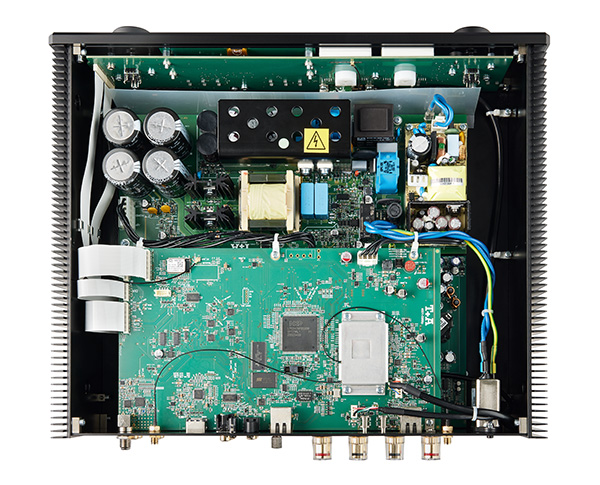
I think of the Symphonia as an amplifier first and foremost, and in that capacity, it impressed right away. The amp's performance comes courtesy of the Purifi Eigentakt technology that T+A licenses then puts its own spin on. Eigentakt—German for "self-timing" or "inner rhythm"—leapfrogs the Hypex NCore tech that came before it. (Both were invented by Belgian engineer Bruno Putzeys, formerly of Philips and Grimm Audio.) NCore modules earned a loyal following for their control, grip, and tonal honesty, even if many listeners found them emotionally restrained, more calculating than compelling. Eigentakt offers higher loop gain, near-zero output impedance, and a THD+N figure that borders on the theoretical floor. It also breathes better. Gone is the faint sterility that could creep into long NCore sessions; in its place is a supple, wide-open presentation that manages to be both revealing and effortless. Brands like NAD, Buckeye, and Apollon have used Eigentakt technology in truly excellent amps. My ears told me that T+A may have gone them one better.
"Other companies use an OEM board sold by Purifi Eigentakt, which is indeed a very serious implementation of class-D topology," Jim Shannon, T+A's press relations officer, told me in an email. "Our team felt that they could improve it by implementing [Eigentakt tech] on our own circuit board that also uses what we have learned about all aspects of amplifier design, including high-voltage power supply rails."
Some of the Symphonia's factory measurements provoke a double take and a nod of respect. A damping factor of 800? As a quick refresher, damping factor is the ratio of a speaker's nominal impedance to the output impedance of the amplifier. The higher the number, the better the amplifier is at controlling the speaker's drivers after the signal stops. This is especially desirable in the bass, where woofers tend to keep moving unless reined in. A number above 400 means obsessively minimizing resistance in the output stage, which implies minimal series resistance throughout the output path. To hit 800, everything in the design, from the power supply to the output terminals, has to be optimized. In practice, anything above 100 or 200 already does the job; around 200, cable and driver resistance dominate, so real-world gains get small. But T+A doesn't design to meet expectations. The company would rather exceed them, with the kind of rigor that says, "close enough" isn't.
It's the same with several other Symphonia specs. For instance, most amplifier manufacturers achieve a frequency response down to around 18–20Hz, because that's already at or below the lowest audible fundamentals and roughly where the best full-range speakers bottom out. T+A specifies the Symphonia's frequency range as 1Hz to 60kHz (footnote 3), meaning that the amp's bandwidth extends linearly from just above DC (direct current) to well into ultrasonic territory. That 1Hz number means the amplifier's internal circuitry has such a wide low-frequency extension that electrically it can pass signals down to near-DC with an essentially flat amplitude response. No, you can't hear 1Hz, but the ultralow-frequency extension suggests that the amp won't introduce phase shift or artificial rolloff anywhere near the audible range—the better to ensure minimal coloration in even the deepest bass.
In a similar vein, T+A builds its power supplies around capacitors that can recharge 100,000 times per second, roughly 2000 times faster than standard designs. That demands ultralow ESR (equivalent series resistance), the parasitic resistance that infects all capacitors. This helps minimize voltage droop and preserves transient snap under fast load changes. As Mae West said, "Too much of a good thing is wonderful."
Schön, aber ...
How about niggles? Negatives? I can think of a few, such as the absence of XLR inputs and outputs. There likely isn't enough space for those on the half-pint rear panel, plus I suppose T+A wants to differentiate the Symphonia from its twice-as-pricey bigger brother, the R 2500 R (reviewed by Tom Fine in Stereophile's August 2024 issue; footnote 4). Next: The SRC-2 remote control has no fewer than 51 buttons, as if you're operating an especially full-featured AV receiver. Its main shortcoming is that the large center button, which falls under your thumb when you balance the remote in your hand, isn't for play/pause but to confirm menu choices. The play/pause control is farther down, and small like the others. Finding it by touch in a semidark room is a challenge.
There's also the necessarily diminutive size of the Symphonia's display: only 4" wide and less than 1¼" tall. I'm not wedded to big displays, but small ones have downsides: absent album art and track information that's illegible from across the room. With big displays, when the music continues with Roon Radio or Qobuz Suggests, all it takes is a quick glance to see what's playing now. Unless you sit close to the Symphonia, it leaves you guessing, and you'll have to squint hard—or do what's surely assumed and consult the music app on your mobile device. To be fair, while it may not be exactly how I roll, in this respect the Symphonia is no different from my favorite reference streamer, the Grimm MU1, which I love.
The Symphonia screen shows only the first 17–19 characters of a song title, and those don't scroll, leading to some unintentionally smutty surprises. Truncated, "Waiting for the Weekend" becomes "Waiting for the Wee," while "I Explore the Bracken" renders "I Explore the Bra." Mrs. Lovejoy types might want to keep the smelling salts handy.
Achtung Baby, I'm listening
Like other pedigreed amplifiers, the Symphonia scoffs at objectivist notions that all well-designed amps sound the same. I like the new (2024) Quad 33 and Quad 303 preamplifier and amplifiers so much that I bought the threesome: the 33 plus two 303s configured as monoblocks. One evening, I listened to Pierre Boulez and the Chicago Symphony Orchestra's performance of Bartók's The Miraculous Mandarin (16/44.1 FLAC, Deutsche Grammophon/Qobuz). I enjoyed the piece on the Quad equipment, but it emotionally shook me half an hour later, when I replayed it via the Symphonia. More bass grip, more color, more engagement. There's violence, luridness, and turpitude in the piece, and the T+A brought it out in full.
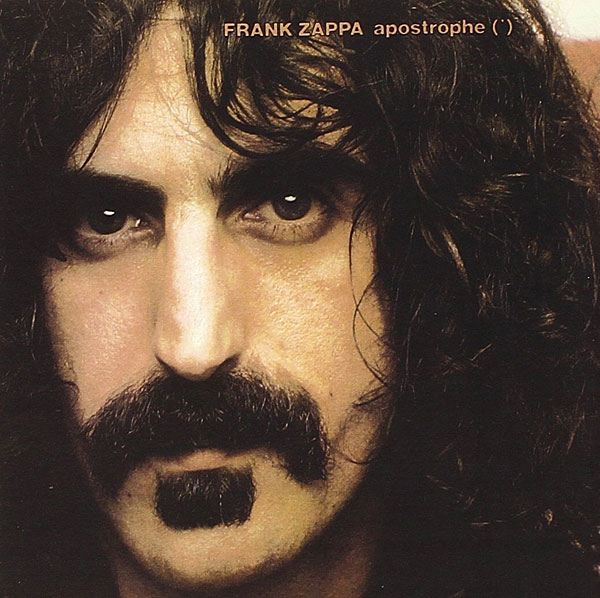 I don't think I'd listened to Frank Zappa's Apostrophe (24/192 FLAC, Zappa Records/Qobuz) in a dozen years, but what a pleasure to hear that brilliant record again on the Estelons via the T+A. The clarity was fantastic. On "Father O'Blivion," I'd always heard the phrase as "Good morning Johannes," but this time I understood that Zappa actually sings "Good morning your highness." I'm not proud of that mondegreen—an error is an error—but give me this: I was plausibly wrong. Zappa was so full of liturgical mischief and blasphemous in-jokes that "Good Morning Johannes" fits the song, especially considering that the titular character is a priest. "Johannes" sounds like the name of a medieval monk shuffling into view with a thurible and vague regrets about the choirboy incident.
This extra insight into a familiar piece of music was not uncommon with the Symphonia, as I discovered when listening to the studio version of Talking Heads' "Take Me to the River," from the new reissue of More Songs About Buildings and Food (24/192 FLAC, Rhino/Warner/Qobuz). Around 3:21, on the 10th pass of the trademark unison riff played on a synthesizer and a clean electric guitar, the keyboard part is suddenly sharp by a semitone. I hadn't noticed that before. The band and producer Brian Eno surely did: They probably liked that weird little lurch, which fits Talking Heads' ethos, especially when covering an Al Green song with punk-funk nerves.
I don't think I'd listened to Frank Zappa's Apostrophe (24/192 FLAC, Zappa Records/Qobuz) in a dozen years, but what a pleasure to hear that brilliant record again on the Estelons via the T+A. The clarity was fantastic. On "Father O'Blivion," I'd always heard the phrase as "Good morning Johannes," but this time I understood that Zappa actually sings "Good morning your highness." I'm not proud of that mondegreen—an error is an error—but give me this: I was plausibly wrong. Zappa was so full of liturgical mischief and blasphemous in-jokes that "Good Morning Johannes" fits the song, especially considering that the titular character is a priest. "Johannes" sounds like the name of a medieval monk shuffling into view with a thurible and vague regrets about the choirboy incident.
This extra insight into a familiar piece of music was not uncommon with the Symphonia, as I discovered when listening to the studio version of Talking Heads' "Take Me to the River," from the new reissue of More Songs About Buildings and Food (24/192 FLAC, Rhino/Warner/Qobuz). Around 3:21, on the 10th pass of the trademark unison riff played on a synthesizer and a clean electric guitar, the keyboard part is suddenly sharp by a semitone. I hadn't noticed that before. The band and producer Brian Eno surely did: They probably liked that weird little lurch, which fits Talking Heads' ethos, especially when covering an Al Green song with punk-funk nerves.
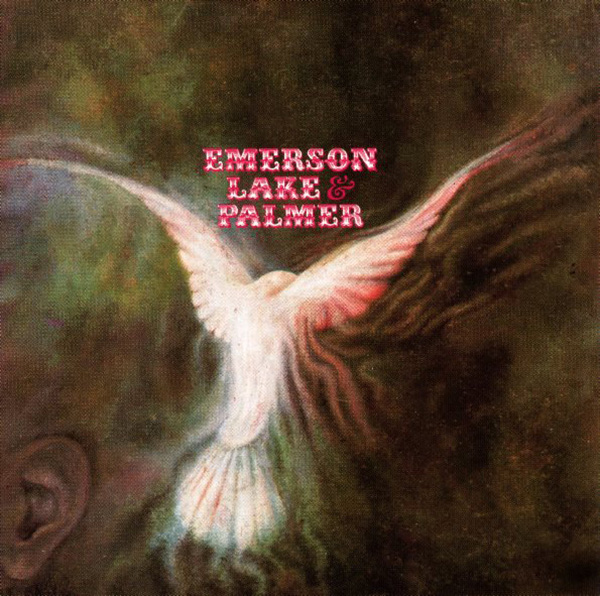 Another good example of the Symphonia as a musical excavation instrument is the intro of "Take a Pebble," off Emerson, Lake & Palmer, that group's still-spectacular debut album (24/96 FLAC, BMG/Qobuz). Keith Emerson bypasses the grand piano's keyboard, raking and plucking strings by hand, a technique he borrowed from avant-garde classical pianists like Henry Cowell and jazz experimenters like Cecil Taylor. With the T+A in my system, I could clearly hear the sympathetic resonance. Certain piano strings ring gently, almost imperceptibly, set in motion by the vibration of nearby tones.
The ELP recording made me wonder about instruments designed to use this phenomenon to full effect. Via Wikipedia, I learned about tarafdar strings—the sympathetic strings on classical Indian instruments like the sitar, sarod, and sarangi. They're not played directly but vibrate in response when the main strings generate harmonically related pitches. In search of audiophile-approved examples, I found sitarist Anoushka Shankar's lovely Rise (16/44.1 FLAC, Angel Records/Qobuz). During quieter passages, you can hear the sympathetic strings glow like heat radiating off pavement. For instance, on "Prayer in Passing," the main strings ring and decay into a soft, glowing bed of resonance. I heard it again during "Voice of the Moon"; the passage from 2:30–3:00 is especially rich with overtone bloom.
Another good example of the Symphonia as a musical excavation instrument is the intro of "Take a Pebble," off Emerson, Lake & Palmer, that group's still-spectacular debut album (24/96 FLAC, BMG/Qobuz). Keith Emerson bypasses the grand piano's keyboard, raking and plucking strings by hand, a technique he borrowed from avant-garde classical pianists like Henry Cowell and jazz experimenters like Cecil Taylor. With the T+A in my system, I could clearly hear the sympathetic resonance. Certain piano strings ring gently, almost imperceptibly, set in motion by the vibration of nearby tones.
The ELP recording made me wonder about instruments designed to use this phenomenon to full effect. Via Wikipedia, I learned about tarafdar strings—the sympathetic strings on classical Indian instruments like the sitar, sarod, and sarangi. They're not played directly but vibrate in response when the main strings generate harmonically related pitches. In search of audiophile-approved examples, I found sitarist Anoushka Shankar's lovely Rise (16/44.1 FLAC, Angel Records/Qobuz). During quieter passages, you can hear the sympathetic strings glow like heat radiating off pavement. For instance, on "Prayer in Passing," the main strings ring and decay into a soft, glowing bed of resonance. I heard it again during "Voice of the Moon"; the passage from 2:30–3:00 is especially rich with overtone bloom.
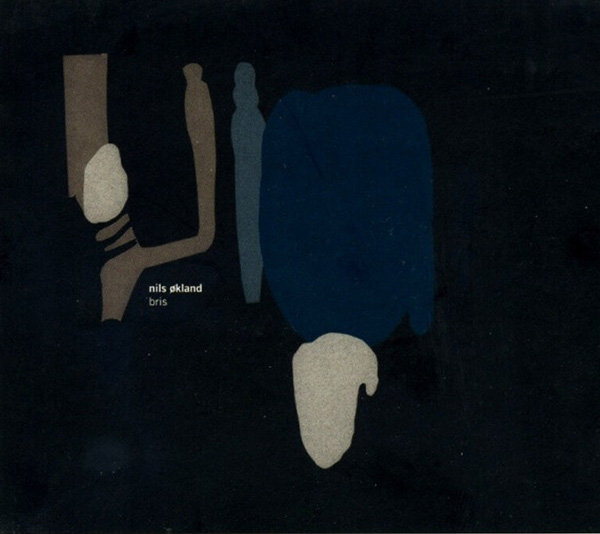 Still chasing this alluring effect, I time-traveled to Scandinavia in pursuit of its hardanger fiddle, a traditional Norwegian instrument that looks a lot like a violin. Four of the eight or nine strings are bowed; underneath are the sympathetic strings. The sound is resonant, haunting, and a bit eerie—perfect for Norwegian folk music, which tends to lean melancholic or mystical. On Bris, by hardanger virtuoso Nils Økland (24/44.1 FLAC, Rune Grammofon/Qobuz), from 2004, I found the tracks "Seil," "Flyt," and "Bønn" to have an eldritch, unsettling beauty that unfolded unreservedly through the Symphonia.
Earlier that day, I'd played violinist Andrew Bird's hypnotic Echolocations: River (16/44.1 FLAC, Wegawam/Qobuz), a solo album he recorded while standing ankle-deep in the Los Angeles River beneath the Glendale–Hyperion Bridge. Bird chose the spot to capture the natural echoes of water and concrete walls, using the environment as instrumentation. It's not that his music intrinsically resembles Økland's, but I could certainly see the American adopting the Norwegian's instrument and running away with the results. Here's hoping.
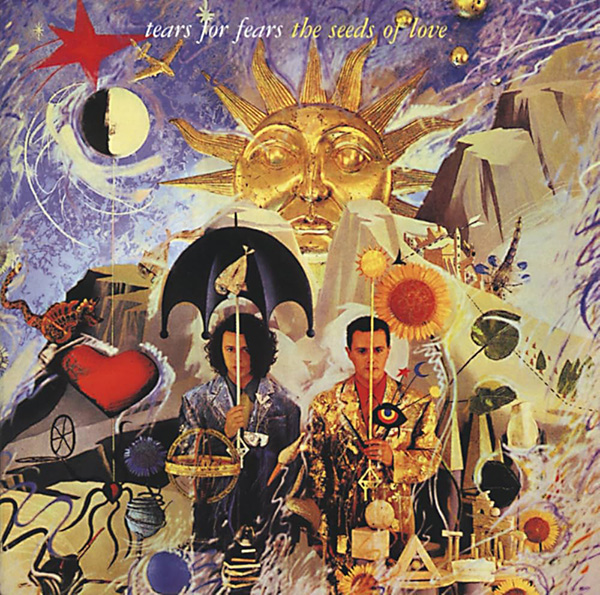
Via the 6 ohm, 4.4mm balanced Pentaconn jack on the Symphonia's fascia, and using the superlative HiFiMan Susvara Unveiled headphones, I listened to "Standing on the Corner of the Third World" by Tears for Fears (The Seeds of Love, 16/44.1 FLAC, UMC/Qobuz). Then I did it again for the sheer pleasure of it, enjoying the unusual refinement in the bass harmonics during the second verse and the satiny smoothness of Curt Smith's vocals. When the low strings of an acoustic guitar and the bass played the same motif, the T+A-HiFiMan combo made it easy to focus on each instrument separately.
Still chasing this alluring effect, I time-traveled to Scandinavia in pursuit of its hardanger fiddle, a traditional Norwegian instrument that looks a lot like a violin. Four of the eight or nine strings are bowed; underneath are the sympathetic strings. The sound is resonant, haunting, and a bit eerie—perfect for Norwegian folk music, which tends to lean melancholic or mystical. On Bris, by hardanger virtuoso Nils Økland (24/44.1 FLAC, Rune Grammofon/Qobuz), from 2004, I found the tracks "Seil," "Flyt," and "Bønn" to have an eldritch, unsettling beauty that unfolded unreservedly through the Symphonia.
Earlier that day, I'd played violinist Andrew Bird's hypnotic Echolocations: River (16/44.1 FLAC, Wegawam/Qobuz), a solo album he recorded while standing ankle-deep in the Los Angeles River beneath the Glendale–Hyperion Bridge. Bird chose the spot to capture the natural echoes of water and concrete walls, using the environment as instrumentation. It's not that his music intrinsically resembles Økland's, but I could certainly see the American adopting the Norwegian's instrument and running away with the results. Here's hoping.
Via the 6 ohm, 4.4mm balanced Pentaconn jack on the Symphonia's fascia, and using the superlative HiFiMan Susvara Unveiled headphones, I listened to "Standing on the Corner of the Third World" by Tears for Fears (The Seeds of Love, 16/44.1 FLAC, UMC/Qobuz). Then I did it again for the sheer pleasure of it, enjoying the unusual refinement in the bass harmonics during the second verse and the satiny smoothness of Curt Smith's vocals. When the low strings of an acoustic guitar and the bass played the same motif, the T+A-HiFiMan combo made it easy to focus on each instrument separately.
 I have a McIntosh MHA100 headphone amplifier that I use as my reference, and while it's top-notch, the T+A gave me more—mostly better instrument separation and a slightly more lyrical presentation. If you were to buy a Symphonia and never use it to power your speakers, employing it purely as a standalone headphone amp, I'd understand.
The last Wort
I have a McIntosh MHA100 headphone amplifier that I use as my reference, and while it's top-notch, the T+A gave me more—mostly better instrument separation and a slightly more lyrical presentation. If you were to buy a Symphonia and never use it to power your speakers, employing it purely as a standalone headphone amp, I'd understand.
The last Wort
Herford, T+A's home town, is close to Hamelin, the place immortalized in the fairy tale of the Pied Piper, whose music was literally impossible to resist. That's fitting. With its crisp dynamics, taut, brawny bass, and feather-light treble detail, the Symphonia drew me in, unfailingly. It delivers way more audiophile gravitas than its size suggests. Although it lacks the excellent built-in CD player and the balanced connections of the bigger R 2500 R, the Symphonia is just as powerful and leaves surprisingly little on the table. It's a miniature Meisterstück that should make the shortlist for Stereophile's Component of the Year
Footnote 1: Well, almost. This coinage comes from a droll little lexicon called Schottenfreude, by Ben Schott, in which the author proposes clever neologisms for phenomena that Germans should have a word for but don't. The immodest length of the imagined compound words is part of what makes them funny—but of course the expanse of letters is also a feature (or a bug) of actual German. As Mark Twain wrote in "The Awful German Language," from A Tramp Abroad: "These things are not words, they are alphabetical processions." Footnote 2: The Symphonia manual says it's for security reasons: "These access data can only be created by means of the T+A MusicNavigator G3 App with the OAuth (Open Authorisation) Protocol." Footnote 3: The preamplifier section extends even further: 0.5Hz to 300kHz. Footnote 4: I compared the Symphonia to the R 2500 R that T+A lent me for a few weeks. Try as I might, with my eyes closed, I couldn't detect any meaningful differences. That's the first time in my experience that a high-quality class-AB amplifier didn't audibly beat an upscale class-D contender. 2025 may be the year that we achieve parity between the two classes.
Around back, the Symphonia sports several inputs, analog and digital: two analog on RCA, two USB, two S/PDIF (coaxial and TosLink), and an HDMI ARC bus. Via the menu function, the second analog input can be configured to accept the signal from an MM or high-output MC phono cartridge and do with it what needs doing. Close by is a 75 ohm antenna input suitable for either a domestic aerial or a cable connection: Yes, it's for radio. There's also a place to plug in the two included Wi-Fi antennas—I preferred the hardwired advantage of an Ethernet hookup—an analog pre-out to connect active speakers or an external power amplifier, two subwoofer outputs, and a standard IEC socket.
I was able to make all the basic connections in under two minutes. Forgoing the black plastic factory power cord, I used an AudioQuest High-Current Tornado cable, plugged in a Vodka CAT5 cable, then connected my favorite floorstanders—the Estelon X Diamond Mk IIs I reviewed in Stereophile's January 2025 issue—with AudioQuest Thunderbird Zero banana-terminated cables. (As an aside, I'm done with spade lugs. When combined with stiff, thick cables, they've been known to snap speaker-terminal stems right off an amp's backside. Banana plugs require less finger acrobatics and are quicker and drama-free.)
Making the connections was easy. Getting (streaming) music was a little harder. The Symphonia unit I received for review defaulted to playing radio, and since I had neither connected the supplied wire-type radio antenna nor tuned to an FM station, I heard static.
At this point, I was stuck. I can usually figure out how to set up a streamer without cracking the manual, but none of the Symphonia's controls provided an obvious pathway to Qobuz, Tidal, Amazon Music, et cetera. The solution was to download the T+A MusicNavigator G3 app and sign in from my mobile device (footnote 2). At first, I couldn't find the app by typing in its name at the App Store because the mighty Apple doesn't recognize the plus sign in the name. To find it, you have to type "TA."
Conveniently, the Symphonia, which arrived in mid-June, was ready for Qobuz Connect, which had been announced at High End Munich barely a month before. I tapped the speaker icon in the bottom right corner of the Qobuz screen on my iPhone, chose "Symphonia" from the list, and instantly connected the app to the T+A product. Neat. Then I did the same with the Tidal desktop app on my MacBook Air.
About two weeks later, the Symphonia's Roon certification came through, and Roon became, as always, my interface of choice.
Via the settings menu, you can customize the color of the circular VU meters by individually adjusting the intensity of red, green, and blue values, which gives you countless possibilities for just the right hue. I chose a blue shade that might irritate certain trademark lawyers in Binghamton. You can't elect to have the meters light up while switching off the rest of the unit's little lights—it's all or nothing. Nor can you change the color of the screen or darken it entirely. The Symphonia's OLED display is monochrome, composed of largish dots rather than tiny pixels—think dot-matrix, not laser. The screen is high-contrast, legible in any lighting, built to last for decades, and emits very little EMI. T+A has used them across its product lines for years. It's a pragmatic choice, and it lends the Symphonia an olde-worlde undertone that may not charm everyone. The T+A's display is a stark contrast to, for example, the 12.6" capacitive touchscreen panel on the HiFi Rose RS520 amp/streamer I reviewed in Stereophile's July 2023 issue. The HiFi Rose has crisp, high-rez visuals for user information and album art. The T+A approach says "precision instrument," while HiFi Rose gestures toward a glossy, touchscreen future. Whether you prefer the humbler glow or the digital dazzle depends less on merit than on temperament.
Vorsprung Durch TechnikI think of the Symphonia as an amplifier first and foremost, and in that capacity, it impressed right away. The amp's performance comes courtesy of the Purifi Eigentakt technology that T+A licenses then puts its own spin on. Eigentakt—German for "self-timing" or "inner rhythm"—leapfrogs the Hypex NCore tech that came before it. (Both were invented by Belgian engineer Bruno Putzeys, formerly of Philips and Grimm Audio.) NCore modules earned a loyal following for their control, grip, and tonal honesty, even if many listeners found them emotionally restrained, more calculating than compelling. Eigentakt offers higher loop gain, near-zero output impedance, and a THD+N figure that borders on the theoretical floor. It also breathes better. Gone is the faint sterility that could creep into long NCore sessions; in its place is a supple, wide-open presentation that manages to be both revealing and effortless. Brands like NAD, Buckeye, and Apollon have used Eigentakt technology in truly excellent amps. My ears told me that T+A may have gone them one better.
How about niggles? Negatives? I can think of a few, such as the absence of XLR inputs and outputs. There likely isn't enough space for those on the half-pint rear panel, plus I suppose T+A wants to differentiate the Symphonia from its twice-as-pricey bigger brother, the R 2500 R (reviewed by Tom Fine in Stereophile's August 2024 issue; footnote 4). Next: The SRC-2 remote control has no fewer than 51 buttons, as if you're operating an especially full-featured AV receiver. Its main shortcoming is that the large center button, which falls under your thumb when you balance the remote in your hand, isn't for play/pause but to confirm menu choices. The play/pause control is farther down, and small like the others. Finding it by touch in a semidark room is a challenge.
Like other pedigreed amplifiers, the Symphonia scoffs at objectivist notions that all well-designed amps sound the same. I like the new (2024) Quad 33 and Quad 303 preamplifier and amplifiers so much that I bought the threesome: the 33 plus two 303s configured as monoblocks. One evening, I listened to Pierre Boulez and the Chicago Symphony Orchestra's performance of Bartók's The Miraculous Mandarin (16/44.1 FLAC, Deutsche Grammophon/Qobuz). I enjoyed the piece on the Quad equipment, but it emotionally shook me half an hour later, when I replayed it via the Symphonia. More bass grip, more color, more engagement. There's violence, luridness, and turpitude in the piece, and the T+A brought it out in full.
I don't think I'd listened to Frank Zappa's Apostrophe (24/192 FLAC, Zappa Records/Qobuz) in a dozen years, but what a pleasure to hear that brilliant record again on the Estelons via the T+A. The clarity was fantastic. On "Father O'Blivion," I'd always heard the phrase as "Good morning Johannes," but this time I understood that Zappa actually sings "Good morning your highness." I'm not proud of that mondegreen—an error is an error—but give me this: I was plausibly wrong. Zappa was so full of liturgical mischief and blasphemous in-jokes that "Good Morning Johannes" fits the song, especially considering that the titular character is a priest. "Johannes" sounds like the name of a medieval monk shuffling into view with a thurible and vague regrets about the choirboy incident.
This extra insight into a familiar piece of music was not uncommon with the Symphonia, as I discovered when listening to the studio version of Talking Heads' "Take Me to the River," from the new reissue of More Songs About Buildings and Food (24/192 FLAC, Rhino/Warner/Qobuz). Around 3:21, on the 10th pass of the trademark unison riff played on a synthesizer and a clean electric guitar, the keyboard part is suddenly sharp by a semitone. I hadn't noticed that before. The band and producer Brian Eno surely did: They probably liked that weird little lurch, which fits Talking Heads' ethos, especially when covering an Al Green song with punk-funk nerves.
Another good example of the Symphonia as a musical excavation instrument is the intro of "Take a Pebble," off Emerson, Lake & Palmer, that group's still-spectacular debut album (24/96 FLAC, BMG/Qobuz). Keith Emerson bypasses the grand piano's keyboard, raking and plucking strings by hand, a technique he borrowed from avant-garde classical pianists like Henry Cowell and jazz experimenters like Cecil Taylor. With the T+A in my system, I could clearly hear the sympathetic resonance. Certain piano strings ring gently, almost imperceptibly, set in motion by the vibration of nearby tones.
Still chasing this alluring effect, I time-traveled to Scandinavia in pursuit of its hardanger fiddle, a traditional Norwegian instrument that looks a lot like a violin. Four of the eight or nine strings are bowed; underneath are the sympathetic strings. The sound is resonant, haunting, and a bit eerie—perfect for Norwegian folk music, which tends to lean melancholic or mystical. On Bris, by hardanger virtuoso Nils Økland (24/44.1 FLAC, Rune Grammofon/Qobuz), from 2004, I found the tracks "Seil," "Flyt," and "Bønn" to have an eldritch, unsettling beauty that unfolded unreservedly through the Symphonia.
Earlier that day, I'd played violinist Andrew Bird's hypnotic Echolocations: River (16/44.1 FLAC, Wegawam/Qobuz), a solo album he recorded while standing ankle-deep in the Los Angeles River beneath the Glendale–Hyperion Bridge. Bird chose the spot to capture the natural echoes of water and concrete walls, using the environment as instrumentation. It's not that his music intrinsically resembles Økland's, but I could certainly see the American adopting the Norwegian's instrument and running away with the results. Here's hoping.
I have a McIntosh MHA100 headphone amplifier that I use as my reference, and while it's top-notch, the T+A gave me more—mostly better instrument separation and a slightly more lyrical presentation. If you were to buy a Symphonia and never use it to power your speakers, employing it purely as a standalone headphone amp, I'd understand.
The last WortHerford, T+A's home town, is close to Hamelin, the place immortalized in the fairy tale of the Pied Piper, whose music was literally impossible to resist. That's fitting. With its crisp dynamics, taut, brawny bass, and feather-light treble detail, the Symphonia drew me in, unfailingly. It delivers way more audiophile gravitas than its size suggests. Although it lacks the excellent built-in CD player and the balanced connections of the bigger R 2500 R, the Symphonia is just as powerful and leaves surprisingly little on the table. It's a miniature Meisterstück that should make the shortlist for Stereophile's Component of the Year
Footnote 1: Well, almost. This coinage comes from a droll little lexicon called Schottenfreude, by Ben Schott, in which the author proposes clever neologisms for phenomena that Germans should have a word for but don't. The immodest length of the imagined compound words is part of what makes them funny—but of course the expanse of letters is also a feature (or a bug) of actual German. As Mark Twain wrote in "The Awful German Language," from A Tramp Abroad: "These things are not words, they are alphabetical processions." Footnote 2: The Symphonia manual says it's for security reasons: "These access data can only be created by means of the T+A MusicNavigator G3 App with the OAuth (Open Authorisation) Protocol." Footnote 3: The preamplifier section extends even further: 0.5Hz to 300kHz. Footnote 4: I compared the Symphonia to the R 2500 R that T+A lent me for a few weeks. Try as I might, with my eyes closed, I couldn't detect any meaningful differences. That's the first time in my experience that a high-quality class-AB amplifier didn't audibly beat an upscale class-D contender. 2025 may be the year that we achieve parity between the two classes.