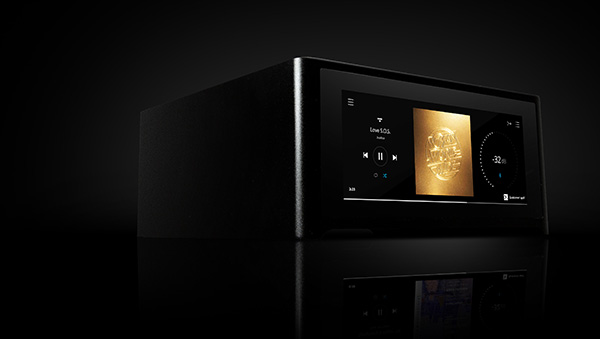
After I reviewed NAD's Masters Series M10 streaming integrated amplifier in January 2020 (footnote 1), I bought the review sample to use as my daily driver. Not only did I appreciate the fact that the M10 was no bigger than it needed to be—it measures just 8.5" W × 3.9" H × 10.25" D and weighs less than 10lb—it is Roon Ready and includes a free license to use Dirac Live LE Room Correction. (This can be upgraded to a paid Dirac Live Full Frequency version.) The amplifier is supplied with a USB microphone that can be used to measure the responses of the owner's loudspeakers at the listening position. The Dirac app then creates a digital filter to optimize the sound and sends it to the M10 with the BluOS app, where the class-D amplifier's digital signal processing corrects the signal on the fly. "As much as I love the unequalized [KEF] LS50s," I wrote in my review, "their presentation corrected with Dirac Live was addictive."
The M10 cost $2499 at the time of my review. In 2022, NAD replaced it with a revised version, the M10 V2, which cost $2749 and incorporated updated "Hybrid Digital" Hypex nCore output stages, dual subwoofer outputs for enhanced bass and 4.2 surround setups, and two-way Bluetooth for wireless headphone use.
I never tried the V2, but when NAD introduced the M10 V3 ($2999) in late 2024, I felt a follow-up review was appropriate (footnote 2).
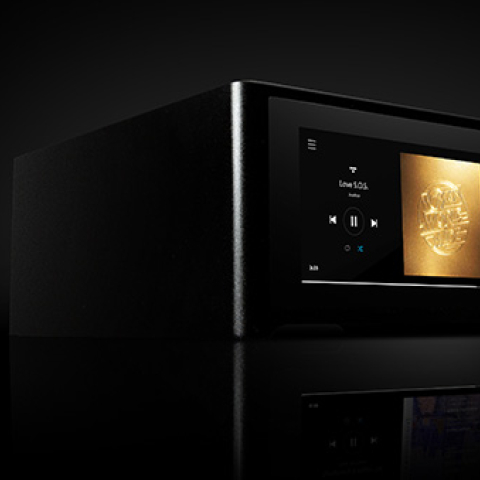
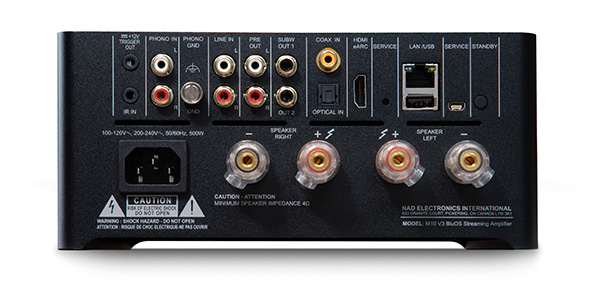
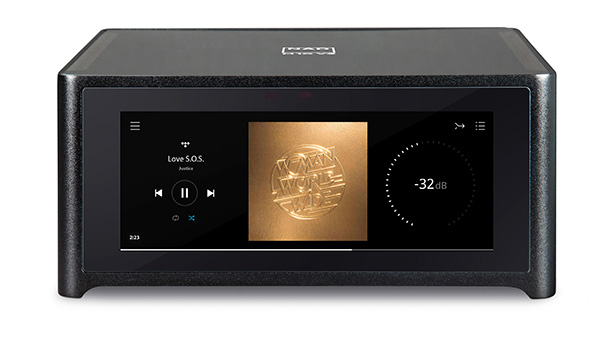
The V3 still has Gorilla Glass top and front panels, a four-color 7" touch screen on its front panel, and a USB microphone to use with Dirac Live, but the original amplifier's ESS Sabre DAC chip has been replaced with the higher-performance, 32-bit, 768kHz Sabre ES9039 chip. The new M10 adds a remote control, a moving magnet phono input, and support for optional Dirac Live Bass Control. In late September 2025, Qobuz Connect joined Spotify Connect and Tidal Connect so that now the M10 works directly with the native apps for those three streaming services.
 Listening
The BluOS app says that disabling A/V mode, which compensates for the latency with video sources, "prefers quality over speed and is best for audio-only sources," so I made sure A/V mode was turned off. I started my auditioning with audio data sourced from my Roon Nucleus+ via an Ethernet connection, with the M10 V3 driving the Dynaudio Contour 20 Black Edition loudspeakers I reviewed in the November 2025 issue. I didn't use Dirac Live LE correction. With the original M10 and the Dynaudios, I was used to setting the amplifier's volume to "–17dB" to achieve a comfortable listening level. Whoa! The V3 was much louder at that volume setting.
I grabbed the remote control and backed off the volume; with it set it to "–24dB," the amplifier sounded at the level I had been expecting. (The V3's remote control also worked with the M10 V1.)
Prior to listening to the NAD M10 V3, I had been using the Dynaudio speakers with the MBL N31 processor ($19,980 with optional Roon Ready module) and Parasound JCA100 Tribute monoblocks ($30,000/ pair). It didn't come as a surprise that the NAD, at a price just 6% of that of the MBL/Parasound combo, had less low-frequency authority and a shallower soundstage. It was a surprise how close the NAD got.
 Playing the stereo version of Art Pepper Meets the Rhythm Section (24/192 FLAC, Craft Recordings/Qobuz) with the M10 V3, Pepper's alto saxophone was reproduced with palpable presence, and Philly Joe Jones's kickdrum and Paul Chambers's double bass, if not as weighty as I was used to on the big rig, were still articulate. Overall, the presentation was very close to that of the original M10. But in level-matched comparisons of the two M10s, I felt that the V3's treble was slightly less forgiving than the V1 of recordings that were overcooked in this region, including Bruce Hornsby's "The Way It Is" from his live download album Noisemakers Summer 2007 (256kbps MP3—after all these years, I still marvel at how Hornsby works a Bach Two-Part Invention into his piano solo in this track).
NAD's parent company, Lenbrook, acquired the assets of MQA in 2023, so I checked that the V3 is compatible with MQA-encoded files. When I played Romance from Britten's Variations on a Theme of Frank Bridge (from The MQA Experience, 24/44.1 FLAC, 2L/Qobuz), Roon unfolded the data to 352.8kHz, which the V3 played at full resolution and sample rate. It sounded superb!
Playing the stereo version of Art Pepper Meets the Rhythm Section (24/192 FLAC, Craft Recordings/Qobuz) with the M10 V3, Pepper's alto saxophone was reproduced with palpable presence, and Philly Joe Jones's kickdrum and Paul Chambers's double bass, if not as weighty as I was used to on the big rig, were still articulate. Overall, the presentation was very close to that of the original M10. But in level-matched comparisons of the two M10s, I felt that the V3's treble was slightly less forgiving than the V1 of recordings that were overcooked in this region, including Bruce Hornsby's "The Way It Is" from his live download album Noisemakers Summer 2007 (256kbps MP3—after all these years, I still marvel at how Hornsby works a Bach Two-Part Invention into his piano solo in this track).
NAD's parent company, Lenbrook, acquired the assets of MQA in 2023, so I checked that the V3 is compatible with MQA-encoded files. When I played Romance from Britten's Variations on a Theme of Frank Bridge (from The MQA Experience, 24/44.1 FLAC, 2L/Qobuz), Roon unfolded the data to 352.8kHz, which the V3 played at full resolution and sample rate. It sounded superb!
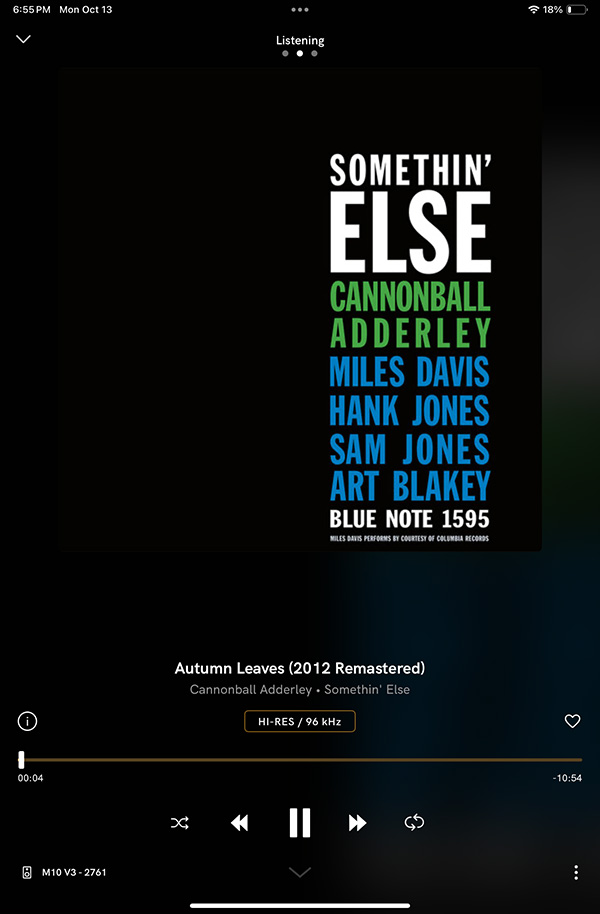 Toward the end of the time the M10 V3 resided in my listening room, its BluOS firmware was upgraded to v4.12.4, which allowed it to be used with Qobuz Connect. I installed the app on my iPad mini. The Qobuz app recognized the amplifier as "M10 V3-2761" and indicated that it would accept data with a sample rate up to 192kHz. I selected it as the audio output device and played the 2012-remastered version of Cannonball Adderley's "Autumn Leaves" (24/96 FLAC, from Somethin' Else, Blue Note/Qobuz), which I had just been playing with Roon.
Hmm. Miles Davis's trumpet sounded slightly more vivid when played back with Qobuz Connect than with Roon; Sam Jones's double bass had a touch more weight. I went back to Roon, making sure that the volume was identical. Yep, both trumpet and bass sounded a touch more laid-back with Roon. Admittedly just a touch, but that there was a difference at all is a mystery, given that the M10 V3 was decoding the same data sourced from my network with both apps.
There was a quirk with Qobuz Connect: Whenever I paused playback, the app defaulted to my iPad mini as the player when I next pressed Play. Not a big deal, as I could change the output device by pressing on the orange icon on the bottom right of the Connect screen. Presumably this can be fixed with a future firmware or software update.
As my only phono cartridge is a Linn Arkiv B low-output moving coil, I initially thought I wouldn't be able to audition the M10 V3's moving magnet phono stage. But then I remembered that I had a Black Head step-up transformer in my accessories cupboard. In 1985, I had commissioned the late Tim de Paravicini to design this SUT to be sold for less than £50 through the Hi-Fi News & Record Review Accessories Club. It offers 20dB of gain with a measured input impedance of 830 ohms at 1kHz.
Toward the end of the time the M10 V3 resided in my listening room, its BluOS firmware was upgraded to v4.12.4, which allowed it to be used with Qobuz Connect. I installed the app on my iPad mini. The Qobuz app recognized the amplifier as "M10 V3-2761" and indicated that it would accept data with a sample rate up to 192kHz. I selected it as the audio output device and played the 2012-remastered version of Cannonball Adderley's "Autumn Leaves" (24/96 FLAC, from Somethin' Else, Blue Note/Qobuz), which I had just been playing with Roon.
Hmm. Miles Davis's trumpet sounded slightly more vivid when played back with Qobuz Connect than with Roon; Sam Jones's double bass had a touch more weight. I went back to Roon, making sure that the volume was identical. Yep, both trumpet and bass sounded a touch more laid-back with Roon. Admittedly just a touch, but that there was a difference at all is a mystery, given that the M10 V3 was decoding the same data sourced from my network with both apps.
There was a quirk with Qobuz Connect: Whenever I paused playback, the app defaulted to my iPad mini as the player when I next pressed Play. Not a big deal, as I could change the output device by pressing on the orange icon on the bottom right of the Connect screen. Presumably this can be fixed with a future firmware or software update.
As my only phono cartridge is a Linn Arkiv B low-output moving coil, I initially thought I wouldn't be able to audition the M10 V3's moving magnet phono stage. But then I remembered that I had a Black Head step-up transformer in my accessories cupboard. In 1985, I had commissioned the late Tim de Paravicini to design this SUT to be sold for less than £50 through the Hi-Fi News & Record Review Accessories Club. It offers 20dB of gain with a measured input impedance of 830 ohms at 1kHz.
 I connected my vinyl playback rig—the Arkiv B fitted to a Linn Ekos tonearm and a Linn Sondek LP12 turntable with its Lingo power supply—to the Black Head and the NAD M10 V3's phono input. I took a deep breath, crossed my fingers, and played a test pressing of Sasha Matson's Fillmore Street/Little Woodstar album on Albany Records, which I produced and which, like the 2012 Cannonball Adderley album, was mastered by Kevin Gray. Interesting. I remember the Black Head as sounding sweet back in the day, and the balance with the SUT feeding the NAD's phono input did indeed sound sweet, though there was no lack of high-frequency detail. Alvester Garnett's cymbals on Fillmore Street's first movement had sufficient "splash."
Using the Matson album, I performed level-matched comparisons between the LP played via the M10 V3's phono input and the 24/96 FLAC files streamed with Qobuz Connect. The LP's low frequencies sounded powerful and extended; the double bass and kickdrum were more clearly articulated with the digital version but somewhat less warm. The midrange seemed palpable with both media; on balance I slightly preferred the LP's presentation.
I connected my vinyl playback rig—the Arkiv B fitted to a Linn Ekos tonearm and a Linn Sondek LP12 turntable with its Lingo power supply—to the Black Head and the NAD M10 V3's phono input. I took a deep breath, crossed my fingers, and played a test pressing of Sasha Matson's Fillmore Street/Little Woodstar album on Albany Records, which I produced and which, like the 2012 Cannonball Adderley album, was mastered by Kevin Gray. Interesting. I remember the Black Head as sounding sweet back in the day, and the balance with the SUT feeding the NAD's phono input did indeed sound sweet, though there was no lack of high-frequency detail. Alvester Garnett's cymbals on Fillmore Street's first movement had sufficient "splash."
Using the Matson album, I performed level-matched comparisons between the LP played via the M10 V3's phono input and the 24/96 FLAC files streamed with Qobuz Connect. The LP's low frequencies sounded powerful and extended; the double bass and kickdrum were more clearly articulated with the digital version but somewhat less warm. The midrange seemed palpable with both media; on balance I slightly preferred the LP's presentation.
 Summing Up
NAD's M10 V3 is a worthy successor to the original M10, preserving all the performance and operational aspects that I liked while adding an excellent moving magnet phono stage, a remote control, and compatibility with Qobuz Connect.
Footnote 1: See my review for a full description of the M10's inputs, features, and capabilities.
Footnote 2: NAD Electronics International, 633 Granite Court, Pickering, Ontario L1W 3K1, Canada. Tel: (905) 831-6555. Fax: (905) 831-6936. Web: www.nadelectronics.com.
ListeningThe BluOS app says that disabling A/V mode, which compensates for the latency with video sources, "prefers quality over speed and is best for audio-only sources," so I made sure A/V mode was turned off. I started my auditioning with audio data sourced from my Roon Nucleus+ via an Ethernet connection, with the M10 V3 driving the Dynaudio Contour 20 Black Edition loudspeakers I reviewed in the November 2025 issue. I didn't use Dirac Live LE correction. With the original M10 and the Dynaudios, I was used to setting the amplifier's volume to "–17dB" to achieve a comfortable listening level. Whoa! The V3 was much louder at that volume setting.
Playing the stereo version of Art Pepper Meets the Rhythm Section (24/192 FLAC, Craft Recordings/Qobuz) with the M10 V3, Pepper's alto saxophone was reproduced with palpable presence, and Philly Joe Jones's kickdrum and Paul Chambers's double bass, if not as weighty as I was used to on the big rig, were still articulate. Overall, the presentation was very close to that of the original M10. But in level-matched comparisons of the two M10s, I felt that the V3's treble was slightly less forgiving than the V1 of recordings that were overcooked in this region, including Bruce Hornsby's "The Way It Is" from his live download album Noisemakers Summer 2007 (256kbps MP3—after all these years, I still marvel at how Hornsby works a Bach Two-Part Invention into his piano solo in this track).
Toward the end of the time the M10 V3 resided in my listening room, its BluOS firmware was upgraded to v4.12.4, which allowed it to be used with Qobuz Connect. I installed the app on my iPad mini. The Qobuz app recognized the amplifier as "M10 V3-2761" and indicated that it would accept data with a sample rate up to 192kHz. I selected it as the audio output device and played the 2012-remastered version of Cannonball Adderley's "Autumn Leaves" (24/96 FLAC, from Somethin' Else, Blue Note/Qobuz), which I had just been playing with Roon.
Hmm. Miles Davis's trumpet sounded slightly more vivid when played back with Qobuz Connect than with Roon; Sam Jones's double bass had a touch more weight. I went back to Roon, making sure that the volume was identical. Yep, both trumpet and bass sounded a touch more laid-back with Roon. Admittedly just a touch, but that there was a difference at all is a mystery, given that the M10 V3 was decoding the same data sourced from my network with both apps.
I connected my vinyl playback rig—the Arkiv B fitted to a Linn Ekos tonearm and a Linn Sondek LP12 turntable with its Lingo power supply—to the Black Head and the NAD M10 V3's phono input. I took a deep breath, crossed my fingers, and played a test pressing of Sasha Matson's Fillmore Street/Little Woodstar album on Albany Records, which I produced and which, like the 2012 Cannonball Adderley album, was mastered by Kevin Gray. Interesting. I remember the Black Head as sounding sweet back in the day, and the balance with the SUT feeding the NAD's phono input did indeed sound sweet, though there was no lack of high-frequency detail. Alvester Garnett's cymbals on Fillmore Street's first movement had sufficient "splash."
Summing UpNAD's M10 V3 is a worthy successor to the original M10, preserving all the performance and operational aspects that I liked while adding an excellent moving magnet phono stage, a remote control, and compatibility with Qobuz Connect.
Footnote 1: See my review for a full description of the M10's inputs, features, and capabilities.