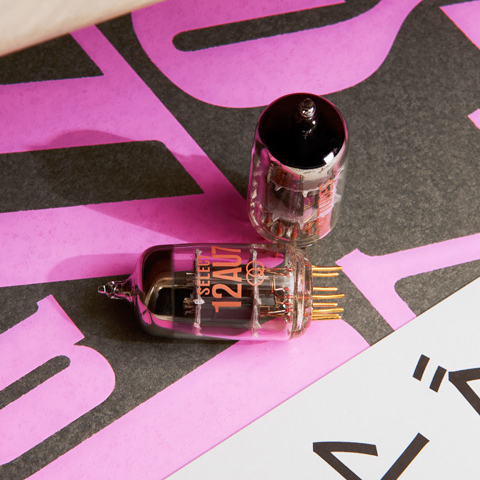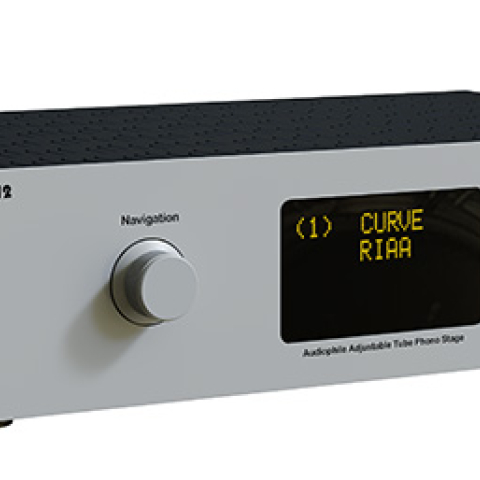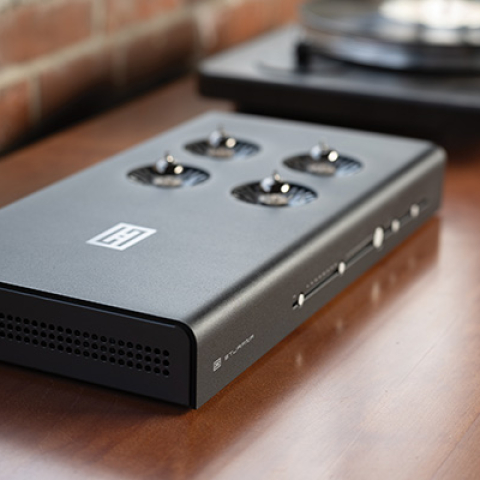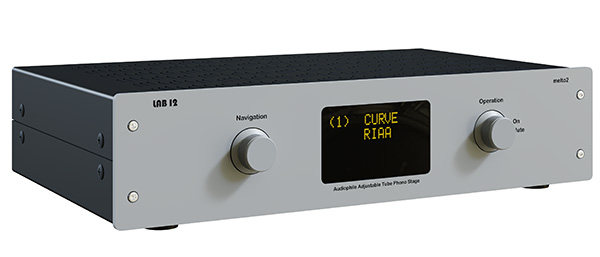
On the front page of its owner's manual, Greek amplifier manufacturer Lab12 describes the Melto2 ($4995, footnote 1) as a "Remote Controlled, Fully Adjustable Phono Preamplifier." I'd describe it as a clear-speaking, fun-to-use, cartridge- and record-collector's dream. Plus: It's got tubes.
Apart from delivering an uncanny level of silence and transparency, the #1 special thing Lab12's tube phono stage can do is allow users to fine-tune resistance, capacitance, and gain to create maximally effective loads for both moving coil and moving magnet cartridges. These diverse capabilities allowed me to coax maximum performance out of the widest possible range of phono cartridges. Which makes it just the kind of phono equalizer I've been looking for.
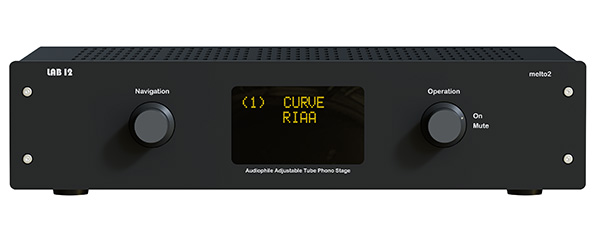
The front panel of the Melto2 reads as both timeless and price defiant. It looks neither expensive nor cheap but rather well-built and sensible, in audio's middle range.
On the left side of the front panel is a knob labeled "Navigation," which operates the Melto2's menu, the doorway to its operating system. It's the first audio-component menu that made me look forward to using it.
The menu starts by asking the user to choose one of the Melto2's three RCA inputs. Then it prompts them to select cartridge type—MC or MM—then Gain, High (58/64dB) or Low (38dB). The user is then prompted to choose an equalization curve: Columbia, Decca, or RIAA. The next step (for a moving magnet cartridge) is setting capacitance—Low, 100pF, 200pF, or 300pF—and impedance (resistance): 12.5k, 13k, 14k, 17k, 25k, 27k, 30k, 32k, 36k, 40k, and 47k ohms. (This, to me, is a high-value feature.) For moving coils, there's the high-gain impedance (resistance): 25, 27, 34, 40, 60, 66, 73, 79, 88, and 100 ohms, plus High. Notice how many choices there are below 100 ohms. The choices for MC loads at Low Gain are 100, 110, 135, 165, 240, 265, 300, 315, 350, and 400 ohms, plus High Impedance. Notice how subtly you can adjust above 100 ohms.
That's what I mean by "fine tuning."
The Melto2 owner's manual states, "When MC setting is selected, Lundahl step up transformers take care of the low-level MC signal before the tube and equalizer stages. When MM setting is selected, Lundahl transformers are totally bypassed."
I asked Stratos Vichos, Lab12's managing director, how so many different loadings are possible. He answered by email. "The input cartridge load on each input of the Melto2 is defined/set by switching passive components located after the secondary coil of the Lundahl step-up transformer," he said, referring to the Melto2's MC operation. "With this topology, the cartridge is always directly connected to the primary coil of the Lundahl step-up transformer." With an MM cartridge, the Melto2 uses shunt resistors at the input of the RIAA circuit.
 Then I asked, what is the core material on these step-ups?
"Regarding the LL9226 transformer, Lundahl uses a unique process of making the amorphous core. The material is 2714A," a cobalt-based "soft-metallic" amorphous alloy (footnote 2).
Also in the front-panel menu, users can choose between Stereo or Mono and 12 levels of brightness for the OLED panel. All Menu functions may be adjusted while a record is playing via a plastic, palm-sized remote control.
To the right of the appropriately sized OLED display is a second knob, which I used only once. You can think of it as a mute switch or as a sort of Standby switch. It has two positions, On and Mute. I imagine it's there mainly to maintain Lab12's 'two thing' style, where every component chassis features either two knobs or two meters symmetrically arranged. As when I reviewed Lab12's Mighty and Pre1 amplifier and line stage, I found this architectural symmetry visually appealing.
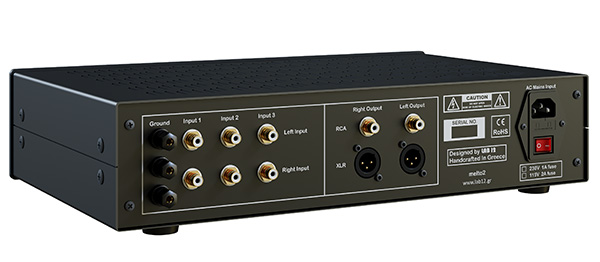
There is no such symmetry on the rear panel. I found three RCA inputs next to three speaker-type binding posts for grounding that can accept banana plugs, spades, or plain wire and be wrench-tightened. There are two L–R output pairs (one RCA, one XLR) and an IEC socket with the power switch below.
The Lab12 warranty is five years.
Then I asked, what is the core material on these step-ups?
"Regarding the LL9226 transformer, Lundahl uses a unique process of making the amorphous core. The material is 2714A," a cobalt-based "soft-metallic" amorphous alloy (footnote 2).
Also in the front-panel menu, users can choose between Stereo or Mono and 12 levels of brightness for the OLED panel. All Menu functions may be adjusted while a record is playing via a plastic, palm-sized remote control.
To the right of the appropriately sized OLED display is a second knob, which I used only once. You can think of it as a mute switch or as a sort of Standby switch. It has two positions, On and Mute. I imagine it's there mainly to maintain Lab12's 'two thing' style, where every component chassis features either two knobs or two meters symmetrically arranged. As when I reviewed Lab12's Mighty and Pre1 amplifier and line stage, I found this architectural symmetry visually appealing.
There is no such symmetry on the rear panel. I found three RCA inputs next to three speaker-type binding posts for grounding that can accept banana plugs, spades, or plain wire and be wrench-tightened. There are two L–R output pairs (one RCA, one XLR) and an IEC socket with the power switch below.
The Lab12 warranty is five years.
 My system changes daily
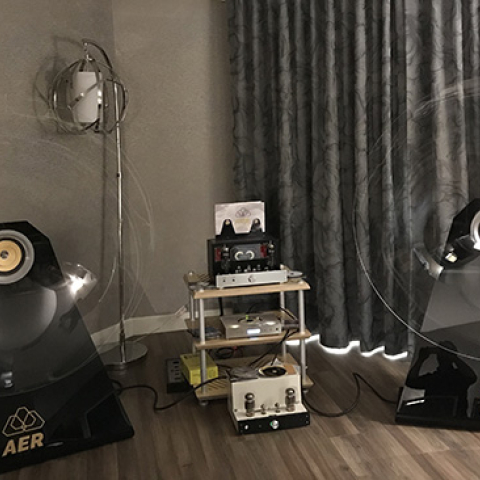
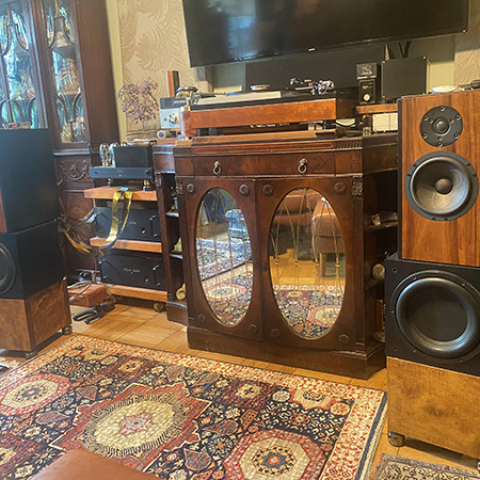
Analog playback is rife with variables—not least the fact that every record player sounds different than every other record player. Which means the best I can hope for in this Dream is to present a few notes about what I noticed while Lab12's Melto2 phono amplifier was in my system. With the hope of making these descriptions more comprehensible, and because I think every variable matters, I want to describe the system I used to make these observations.
My setup is anchored by the long-serving Spin Doctor–tuned Dr. Feickert Blackbird turntable with two tonearms: The first 'arm is an EMT 912-HI with a My Sonic Lab Ultra Eminent Ex moving coil cartridge and a Cardas Clear Beyond tonearm cable. The second 'arm is a Sorane SA-1.2 equipped for use with removable headshells; I use it with a revolving door of cartridges. The Sorane was connected to the Lab12 Melto2 with an AudioQuest Yosemite tonearm cable.
I used Lab12's knack mk2 power cable to plug the Melto2 into my AudioQuest Niagara 1000 power conditioner. The Melto2's output was transmitted by a pair of Black Cat Coppertone RCA interconnects into the HoloAudio Serene line-level preamp. The preamp, in turn, fed the First Watt SIT4 power amplifier via AudioQuest Black Beauty interconnects. Cardas Clear Beyond speaker cables connected the SIT4 to my Falcon Gold Badge speakers. This system is optimized for the three T's: tone, texture, tempo.
I've been using the discontinued Black Cat Coppertone cables, made by the late Chris Sommovigo, an old friend, as the output for all my phono stages because over time they have proven to be maximally invisible at this signal level.
By providing a welcoming impedance to the infant signal, tonearm cables establish the tone and transient character of the entire system. If I use an external MC step-up transformer, there will be a second pair of audio cables before the RIAA stage. These wires should be carefully chosen to achieve maximum transparency. More transparency is a result of fewer logs jamming up the signal pathway.
With the My Sonic Lab Ultra Eminent Ex
The My Sonic Lab Ultra Eminent Ex is my reference moving coil phono cartridge. It has an internal impedance of 0.6 ohm, yet its manual says to load it at 100 to 800 ohms, with "400 ohms as ideal." Its 0.3mV output suggested it might work at the Melto2's Low (58dB) MC gain, which allows the load resistance to be set at 400 ohms.
 When I tried the Eminent Ex at 400 ohms with the Lab12, my respect for this phono amplifier was immediately set—in stone. I played music by my favorite early European composer, John Dowland (1563–1626), off one of my forever-favorite Argo discs, Metaphysical Tobacco (Songs and Dances by Dowland, East and Holborne) (LP, ZRG 572). This first-pressing stereo recording from 1968 is an apex-level treat for lovers of early music—like me. With the Eminent Ex and the Melto2, vocals were as pure of tone as I've ever heard them through the Falcons. But what really held my attention was the exquisitely rendered harpsichord. Its size and position in space were distinct and captivating. It moved these death- and lust-drenched poems along with stern funerary cadences, forcing my mind to picture meetings with former lovers on the other side.
Folks, this is the most wickedly sensuous, purely poetic music I know, and the Lab12/My Sonic Lab combo let heart-quivering portions of Dowland's "cruel love" stimulate my romantic cravings.
The title of that LP comes from words written by composer Michael East (1580–1648):
When I tried the Eminent Ex at 400 ohms with the Lab12, my respect for this phono amplifier was immediately set—in stone. I played music by my favorite early European composer, John Dowland (1563–1626), off one of my forever-favorite Argo discs, Metaphysical Tobacco (Songs and Dances by Dowland, East and Holborne) (LP, ZRG 572). This first-pressing stereo recording from 1968 is an apex-level treat for lovers of early music—like me. With the Eminent Ex and the Melto2, vocals were as pure of tone as I've ever heard them through the Falcons. But what really held my attention was the exquisitely rendered harpsichord. Its size and position in space were distinct and captivating. It moved these death- and lust-drenched poems along with stern funerary cadences, forcing my mind to picture meetings with former lovers on the other side.
Folks, this is the most wickedly sensuous, purely poetic music I know, and the Lab12/My Sonic Lab combo let heart-quivering portions of Dowland's "cruel love" stimulate my romantic cravings.
The title of that LP comes from words written by composer Michael East (1580–1648):
 Then the Tzar entered the room
I remember a night about 10 years ago when Berlin-based tonearm designer Frank Schröder showed me a prototype of a moving coil phono cartridge he was co-creating. It was lying in a box and looked like a solid chunk of blue-tinted translucent acrylic with the longest cantilever I've ever seen sticking straight out along the cartridge's bottom face. I spotted two tiny copper coils built into the cantilever near the cantilever's tip and two thin copper wires glued to the cantilever's sides. "What's up with that cantilever?" I asked. Smiling proudly, Frank said, "This is a new version of the Neumann DST 62 made by my friend in Siberia." That—the Neumann part—got my attention. In the circles I run in, the DST 62 is a sacred artifact that very few have seen let alone experienced. Frank said it had extremely low compliance, and that we were about to hear it in our friend's system.
When the first side finished, Frank asked in a whisper if I liked it. I couldn't help but smile and curse a little, "That's the best damn cartridge I've ever heard!" That was 10 years ago. Schröder's plastic chunk had not yet been christened.
When Robin Wyatt's Robyatt Audio became the American distributor, he named it the Tzar (footnote 3). The finished version uses a heavy aluminum body and sold for $10,000—and still does. Art Dudley reviewed it in Listening #157 and Listening #200, and Michael Fremer reviewed two updated versions in 2020. I've heard it a few times in one or another of Wyatt's systems. It's easy to identify by its unique, force-forward personality. There's also a version with a wood and brass body ($11,500) and another with an integral headshell that costs $13,950.
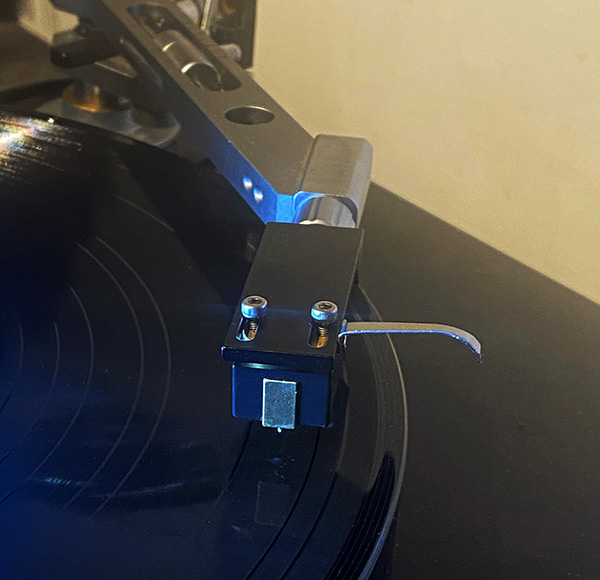
The version I'm describing in this column—the Tzar Audiology DST V1 Black Knight Corian—has only been out for about a year. It has one significant update: a Corian body. It sells for $11,000. Robin Wyatt says the sonic differences are relatively small—maybe a bit more precision in the soundstage rendering. "It's a little more refined and open," Robin added in an email. "Same weight, slam, and dynamics."
 I lowered the Tzar into the grooves of Zino Francescatti playing the Paganini Concerto No.1 in D Major for violin and orchestra, Op.6, on Columbia ML4315. This first experience was memorable for a couple of reasons. First, the Tzar's cantilever did not noticeably deflect when its 17gm mass, tracking at 4gm, hit the vinyl. The Tzar's compliance is not specified, but it has the stiffest cantilever I've used since the Kondo Audio Note IO2 (footnote 4). The Black Knight–Sorane SA-1.2 tonearm combination resonated at exactly 10Hz and tracked the fifth level on Shure's Era IV test record. The Tzar Black Knight Corian plowed the grooves of this 1950 Columbia pressing like a supertanker through the Panama Canal. No twitchy cantilever action. I know that sounds glib, but the Tzar's super-steady tracking is the most obvious aspect of its distinctive personality: Tugboat-like torque is one of the Tzar's chief pleasures. Art Dudley described the Tzar's demeanor as "like a freight train rumbling through my room."
Behind that groove-tracking authority, I heard a solidly structured vision of Zino Francescatti and the Philadelphia orchestra. Behind that solidly constructed vision, I found the hearts and minds of poets, buried in the Tzar's robust tone. This Tzar seduced me with all those things it could do that other cartridges could not.
I lowered the Tzar into the grooves of Zino Francescatti playing the Paganini Concerto No.1 in D Major for violin and orchestra, Op.6, on Columbia ML4315. This first experience was memorable for a couple of reasons. First, the Tzar's cantilever did not noticeably deflect when its 17gm mass, tracking at 4gm, hit the vinyl. The Tzar's compliance is not specified, but it has the stiffest cantilever I've used since the Kondo Audio Note IO2 (footnote 4). The Black Knight–Sorane SA-1.2 tonearm combination resonated at exactly 10Hz and tracked the fifth level on Shure's Era IV test record. The Tzar Black Knight Corian plowed the grooves of this 1950 Columbia pressing like a supertanker through the Panama Canal. No twitchy cantilever action. I know that sounds glib, but the Tzar's super-steady tracking is the most obvious aspect of its distinctive personality: Tugboat-like torque is one of the Tzar's chief pleasures. Art Dudley described the Tzar's demeanor as "like a freight train rumbling through my room."
Behind that groove-tracking authority, I heard a solidly structured vision of Zino Francescatti and the Philadelphia orchestra. Behind that solidly constructed vision, I found the hearts and minds of poets, buried in the Tzar's robust tone. This Tzar seduced me with all those things it could do that other cartridges could not.
Footnote 1: Lab12, K. Varnali 57A, Metamorfosi, 144 52 Athens, Greece. Tel: +30 2102845173. Email: contact@lab12.gr. US distributor: Web: mofidistribution.com/
Footnote 2: See metglas.com/wp-content/uploads/2016/12/2714A-Technical-Bulletin.pdf.
Footnote 3: Tzar Audiology, Robyatt Audio LLC. Tel: (908) 334-3241. Email: info@robyattaudio.com. Web: Robyattaudio.com
Footnote 4: Online sources suggest that the Kondo Audio Note IO2 (aka IO ii) had a compliance of about 6cu. Anything below 10 is considered low.
Then I asked, what is the core material on these step-ups?
"Regarding the LL9226 transformer, Lundahl uses a unique process of making the amorphous core. The material is 2714A," a cobalt-based "soft-metallic" amorphous alloy (footnote 2).
Also in the front-panel menu, users can choose between Stereo or Mono and 12 levels of brightness for the OLED panel. All Menu functions may be adjusted while a record is playing via a plastic, palm-sized remote control.
My system changes dailyAnalog playback is rife with variables—not least the fact that every record player sounds different than every other record player. Which means the best I can hope for in this Dream is to present a few notes about what I noticed while Lab12's Melto2 phono amplifier was in my system. With the hope of making these descriptions more comprehensible, and because I think every variable matters, I want to describe the system I used to make these observations.
The My Sonic Lab Ultra Eminent Ex is my reference moving coil phono cartridge. It has an internal impedance of 0.6 ohm, yet its manual says to load it at 100 to 800 ohms, with "400 ohms as ideal." Its 0.3mV output suggested it might work at the Melto2's Low (58dB) MC gain, which allows the load resistance to be set at 400 ohms.
Poor is the life that misses the lovers' greatest treasure,
Innumerable kisses, which end in endless pleasure.
O then if this be so, shall I a virgin die? Fie no!
When I tried the Eminent Ex at 400 ohms with the Lab12, my respect for this phono amplifier was immediately set—in stone. I played music by my favorite early European composer, John Dowland (1563–1626), off one of my forever-favorite Argo discs, Metaphysical Tobacco (Songs and Dances by Dowland, East and Holborne) (LP, ZRG 572). This first-pressing stereo recording from 1968 is an apex-level treat for lovers of early music—like me. With the Eminent Ex and the Melto2, vocals were as pure of tone as I've ever heard them through the Falcons. But what really held my attention was the exquisitely rendered harpsichord. Its size and position in space were distinct and captivating. It moved these death- and lust-drenched poems along with stern funerary cadences, forcing my mind to picture meetings with former lovers on the other side.
Folks, this is the most wickedly sensuous, purely poetic music I know, and the Lab12/My Sonic Lab combo let heart-quivering portions of Dowland's "cruel love" stimulate my romantic cravings.
The title of that LP comes from words written by composer Michael East (1580–1648):
O Metaphysical Tobacco
Fetched as far as from Morocco
Thy searching fume,
Exhales the rheum,
O Metaphysical Tobacco
Then the Tzar entered the roomI remember a night about 10 years ago when Berlin-based tonearm designer Frank Schröder showed me a prototype of a moving coil phono cartridge he was co-creating. It was lying in a box and looked like a solid chunk of blue-tinted translucent acrylic with the longest cantilever I've ever seen sticking straight out along the cartridge's bottom face. I spotted two tiny copper coils built into the cantilever near the cantilever's tip and two thin copper wires glued to the cantilever's sides. "What's up with that cantilever?" I asked. Smiling proudly, Frank said, "This is a new version of the Neumann DST 62 made by my friend in Siberia." That—the Neumann part—got my attention. In the circles I run in, the DST 62 is a sacred artifact that very few have seen let alone experienced. Frank said it had extremely low compliance, and that we were about to hear it in our friend's system.
I lowered the Tzar into the grooves of Zino Francescatti playing the Paganini Concerto No.1 in D Major for violin and orchestra, Op.6, on Columbia ML4315. This first experience was memorable for a couple of reasons. First, the Tzar's cantilever did not noticeably deflect when its 17gm mass, tracking at 4gm, hit the vinyl. The Tzar's compliance is not specified, but it has the stiffest cantilever I've used since the Kondo Audio Note IO2 (footnote 4). The Black Knight–Sorane SA-1.2 tonearm combination resonated at exactly 10Hz and tracked the fifth level on Shure's Era IV test record. The Tzar Black Knight Corian plowed the grooves of this 1950 Columbia pressing like a supertanker through the Panama Canal. No twitchy cantilever action. I know that sounds glib, but the Tzar's super-steady tracking is the most obvious aspect of its distinctive personality: Tugboat-like torque is one of the Tzar's chief pleasures. Art Dudley described the Tzar's demeanor as "like a freight train rumbling through my room."
Behind that groove-tracking authority, I heard a solidly structured vision of Zino Francescatti and the Philadelphia orchestra. Behind that solidly constructed vision, I found the hearts and minds of poets, buried in the Tzar's robust tone. This Tzar seduced me with all those things it could do that other cartridges could not.
Footnote 1: Lab12, K. Varnali 57A, Metamorfosi, 144 52 Athens, Greece. Tel: +30 2102845173. Email: contact@lab12.gr. US distributor: Web: mofidistribution.com/