It's been said before, but the essential truth remains as shiny as a new 2A3 tube: A well-made, good-sounding integrated amplifier is a sonic marvel, a triumph of audio engineering.
Sound quality is just the beginning. Consider economics. An integrated amplifier is gentler on the wallet than often-cumbersome separate pre and power amplifiers. It's the Marie Kondo of the audio world, decluttering your hi-fi rack with hardnosed efficiency. Fewer connections mean even more value—fewer expensive cables—less fuss, and a refined, all-inclusive electrical architecture tucked into one (often but not always sleek) chassis.
Sometimes they're as powerful as stand-alone amplifiers if not more so. We live in an era where watts are cheap, now more than ever. The latest iteration, class-D, has taken its place as a high-fidelity source to be reckoned with.
The modern integrated amplifier goes back to hi-fi's first golden age, beginning in 1958 with the H.H. Scott Type 299, which had custom output transformers, machined-aluminum knobs, and a pair of 7189 output tubes (a higher-power EL84) per channel. Solid state amplifiers followed in the early 1970s—the Sansui AU-555A, Marantz 1060, Yamaha CA-1000, Pioneer SA-7500—paving the way for today's class-D integrateds.
Some audiophiles still turn up their noses at class-D amplification, but they're refusing to smell the coffee. My very first Stereophile review, in 2016, was of the Spec RPA-W7EX Real-Sound power amplifier. That Spec amp sounded startlingly like my preferred analog. In fact, as I wrote at the time, "The amplifier had sonic qualities I usually associate with tube amplification: sweet'n'saturated tonal colors and palpable instrumental textures, coupled to startling microdynamics that left me slack-jawed in wonder, enjoying LPs anew for hours on end. Disc after disc, I felt I was experiencing fresh musical truths."
The RA280
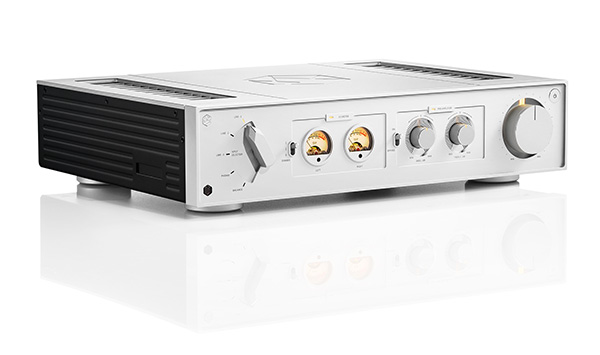
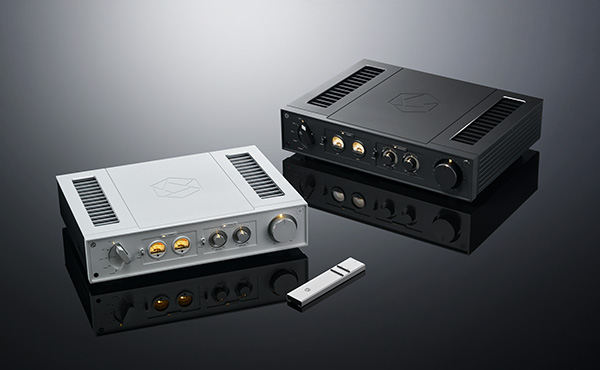
I have again found myself taken by a class-D proposition, this time from Korea's HiFi Rose. Encased in a robust aluminum shell, the RA280 Integrated Amplifier ($3395) claims 250Wpc into 4 or 8 ohms. Its sleek remote exudes minimalist appeal; its phono stage is suitable for moving magnet cartridges; and its exterior design is so aesthetically pleasing I found myself practically hypnotized as I took it in. The newer RA280 boasts power similar to that of its big brother RA180, but the RA280, though not without some whimsical design traits, is more conventional overall.
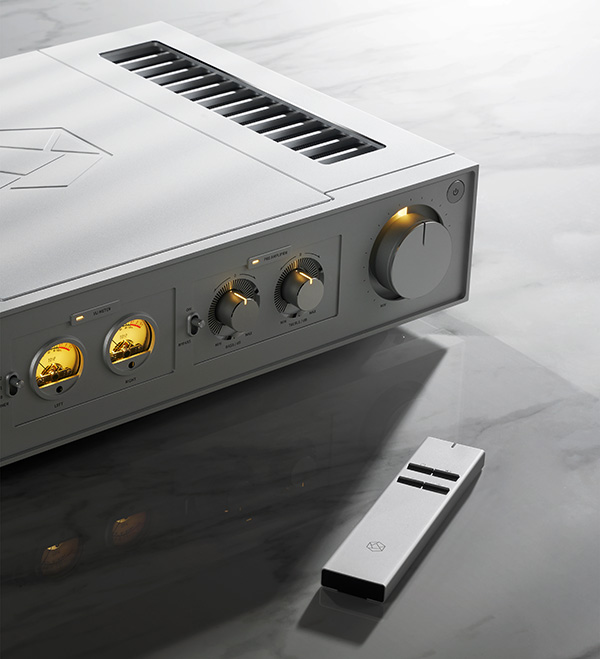
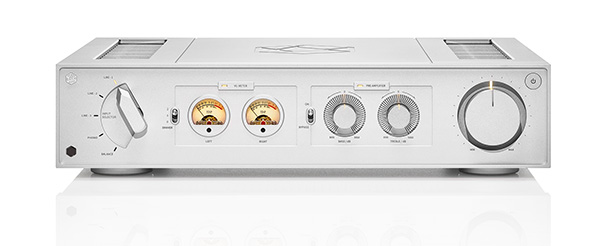 The RA280 is smallish—it stands about 17" wide, 14" deep, and 4" high—and weighs just under 21lb. Once it was positioned on my alamander rack, I was taken with the intricate beauty of the 280's 30mm-thick anodized fascia and its elegant aluminum controls. Inside and out, the 280 was designed by the HiFi Rose design team and its lead developer, Mr. Son, at the company's R&D Center in Seoul, South Korea. That thick fascia features lovely back lighting and laser markings to make an impression of precise shapes and fine detail. Those controls include a chunky selector switch with a sword-like point, allowing you to choose among four line-level inputs (one of them on balanced XLR connectors) plus phono on RCA. The other controls are a power button, a large, backlit volume control knob that fronts an ALPS potentiometer, bypassable tone controls with a ±15dB range, and a switch to dim or illuminate the two small but bold VU meters. A thin, wafer-sized remote control lets you power on, adjust volume, and mute the music—though when I pressed it, the tone control backlighting sometimes blinked maniacally, as if to make its presence known.
The top plate is thick, too: 12mm. Engraved upon it is the HiFi Rose logo and two elongated heat-dissipation vents lined with SECC, which I learned is electro-galvanized zinc-coated steel. This coating is said to resist rust and corrosion. The 280's sides, rear panel, and bottom plate are also made of SECC and are integrated into a single piece through a press-forming process.
The RA280 is smallish—it stands about 17" wide, 14" deep, and 4" high—and weighs just under 21lb. Once it was positioned on my alamander rack, I was taken with the intricate beauty of the 280's 30mm-thick anodized fascia and its elegant aluminum controls. Inside and out, the 280 was designed by the HiFi Rose design team and its lead developer, Mr. Son, at the company's R&D Center in Seoul, South Korea. That thick fascia features lovely back lighting and laser markings to make an impression of precise shapes and fine detail. Those controls include a chunky selector switch with a sword-like point, allowing you to choose among four line-level inputs (one of them on balanced XLR connectors) plus phono on RCA. The other controls are a power button, a large, backlit volume control knob that fronts an ALPS potentiometer, bypassable tone controls with a ±15dB range, and a switch to dim or illuminate the two small but bold VU meters. A thin, wafer-sized remote control lets you power on, adjust volume, and mute the music—though when I pressed it, the tone control backlighting sometimes blinked maniacally, as if to make its presence known.
The top plate is thick, too: 12mm. Engraved upon it is the HiFi Rose logo and two elongated heat-dissipation vents lined with SECC, which I learned is electro-galvanized zinc-coated steel. This coating is said to resist rust and corrosion. The 280's sides, rear panel, and bottom plate are also made of SECC and are integrated into a single piece through a press-forming process.
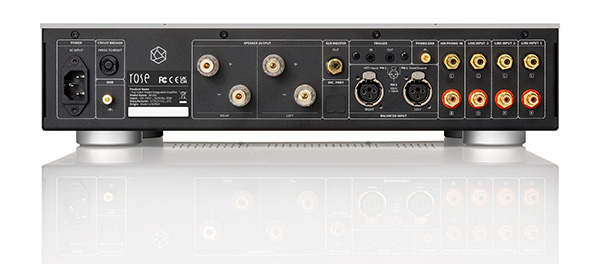 Around back, you'll find the usual ins and outs: an IEC receptacle, a breaker reset button, a pair of loudspeaker binding posts, connectors for the aforementioned inputs, plus 1.5mm trigger inputs and outputs including a ground nut for phono. There is no master power switch. Once powered down via the front-panel button, the RA280 remains in standby mode until you pull the plug.
The unit's four feet are constructed from machined solid aluminum, "providing robust support for the product while effectively suppressing unwanted vibrations," I was informed by Sean Kim, HiFi Rose's chief operating officer, in an email.
Design
Around back, you'll find the usual ins and outs: an IEC receptacle, a breaker reset button, a pair of loudspeaker binding posts, connectors for the aforementioned inputs, plus 1.5mm trigger inputs and outputs including a ground nut for phono. There is no master power switch. Once powered down via the front-panel button, the RA280 remains in standby mode until you pull the plug.
The unit's four feet are constructed from machined solid aluminum, "providing robust support for the product while effectively suppressing unwanted vibrations," I was informed by Sean Kim, HiFi Rose's chief operating officer, in an email.
Design
The RA280 employs a custom GaNFET (gallium nitride field effect transistor) "class-AD" output stage and a SiC (silicon carbide) power supply. The RA180 also used GaNFETs, but these GaNFETs are different from those GaNFETs: Where the RA180 uses Infineon GaNFETs, the RA280 uses Renesas (previously Transphorm) GaNFETs. The HiFi Rose website says that their GaNFETs surpass the devices used in traditional class-D amplifiers, delivering "sound quality comparable to analog." The circuit board is laid out in a dual-mono configuration, though there is no special shielding to separate the L and R channels. What specifically are the advantages of GaNFETs? "Our GaNFETs offer dramatically faster switching speeds and significantly reduced dead-time—down to one-tenth compared to traditional silicon-based MOSFETs," Kim wrote. "This breakthrough enables more accurate signal reproduction, lower distortion, and greater efficiency, resulting in exceptionally clean, detailed, and natural sound that rivals analog performance."
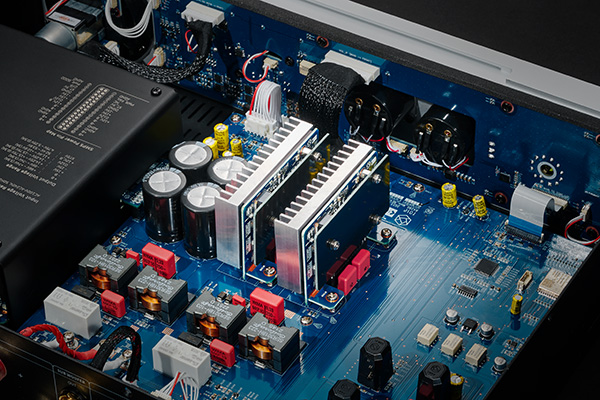 "Revolutionary" is how the company describes the RA280's class-AD amplification. "The RA280's GaNFETs enable significantly higher ... switching frequencies—over 600kHz—compared to the 300–450kHz range typically achievable with conventional silicon MOSFETs," Kim wrote. "This increase in switching frequency directly contributes to cleaner signal reconstruction, reduced distortion, and greater headroom in the analog output stage. It allows for the use of more precise output filters, which play a crucial role in translating PWM signals back into analog waveforms without coloration or high-frequency artifacts.
"Switching frequency alone does not define sound quality," Kim continued. "It's the result of a comprehensive approach—including fast switching devices, precise feedback control, clean power delivery, and carefully engineered analog filtering—that gives the RA280 its highly detailed, natural sound.
"Class-D amplifiers output a squarewave, which is then converted into a sinewave through integration using an LC filter, before being sent to the speaker," Kim explained. "During this process, carrier noise originating from the switching frequency is introduced into the sinewave. The two-stage analog filter used in the RA280 reduces carrier noise by approximately 10 times compared to a conventional one-stage filter, resulting in significantly higher fidelity audio reproduction."
The website further states that the "inclusion of a 2.5 power factor correction circuit and a high-capacity condenser maintains excellent performance even under rapid load changes, ensuring consistent and high-quality sound."
What is this "2.5 power factor correction circuit"? Kim: "The RA280 features a high-performance power supply system based on a switch-mode power supply (SMPS) design, which includes a power factor correction (PFC) stage. The '2.5' figure is not a formal technical term but rather an internal descriptor referring to the PFC stage's capacity and responsiveness under dynamic loads. The goal of this stage is to stabilize the AC input power and reduce harmonic distortion in the power line. By using a SiC FET–based PFC stage in combination with large-capacity capacitors, the RA280 maintains a consistent and clean DC voltage, even during sudden current demands from the amplifier. This contributes to improved dynamics, reduced noisefloor, and more stable performance across all volume levels."
"Revolutionary" is how the company describes the RA280's class-AD amplification. "The RA280's GaNFETs enable significantly higher ... switching frequencies—over 600kHz—compared to the 300–450kHz range typically achievable with conventional silicon MOSFETs," Kim wrote. "This increase in switching frequency directly contributes to cleaner signal reconstruction, reduced distortion, and greater headroom in the analog output stage. It allows for the use of more precise output filters, which play a crucial role in translating PWM signals back into analog waveforms without coloration or high-frequency artifacts.
"Switching frequency alone does not define sound quality," Kim continued. "It's the result of a comprehensive approach—including fast switching devices, precise feedback control, clean power delivery, and carefully engineered analog filtering—that gives the RA280 its highly detailed, natural sound.
"Class-D amplifiers output a squarewave, which is then converted into a sinewave through integration using an LC filter, before being sent to the speaker," Kim explained. "During this process, carrier noise originating from the switching frequency is introduced into the sinewave. The two-stage analog filter used in the RA280 reduces carrier noise by approximately 10 times compared to a conventional one-stage filter, resulting in significantly higher fidelity audio reproduction."
The website further states that the "inclusion of a 2.5 power factor correction circuit and a high-capacity condenser maintains excellent performance even under rapid load changes, ensuring consistent and high-quality sound."
What is this "2.5 power factor correction circuit"? Kim: "The RA280 features a high-performance power supply system based on a switch-mode power supply (SMPS) design, which includes a power factor correction (PFC) stage. The '2.5' figure is not a formal technical term but rather an internal descriptor referring to the PFC stage's capacity and responsiveness under dynamic loads. The goal of this stage is to stabilize the AC input power and reduce harmonic distortion in the power line. By using a SiC FET–based PFC stage in combination with large-capacity capacitors, the RA280 maintains a consistent and clean DC voltage, even during sudden current demands from the amplifier. This contributes to improved dynamics, reduced noisefloor, and more stable performance across all volume levels."
 Setup
Setup
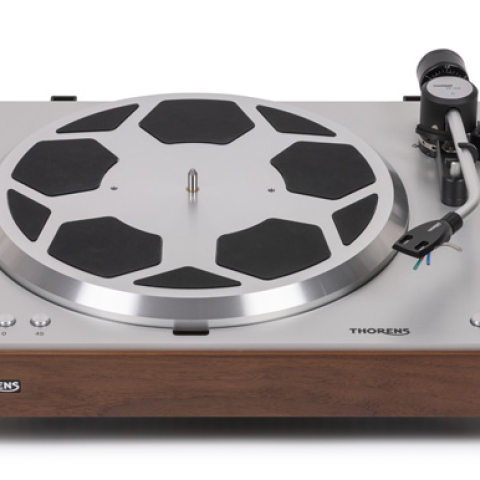
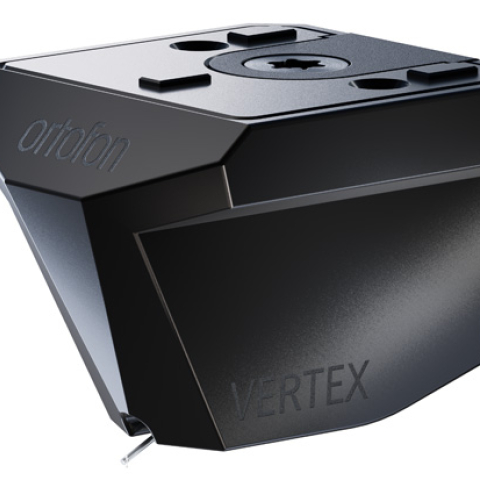
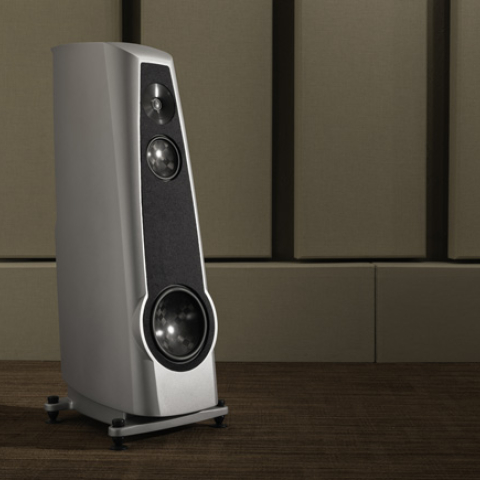
I evaluated the RA280 with both digital and analog—with my Tascam CD player with the HoloAudio May DAC and with my Thorens TD 124 turntable with the Korf TA-SF9R tonearm and an Ortofon LVB 50 moving magnet cartridge sending signal to the RA280's MM phono stage. I used three different pairs of speakers: Wharfedale Super Linton, GoldenEar BRX, and Voxativ Ampeggio 2024.
I found that the AudioQuest William Tell speaker cables were not a good fit with the RA280. I opted instead for Keith Aschenbrenner's less detailed but more organic-sounding Auditorium 23 speaker cables, now sadly out of production.
Listening
I played a slew of music as I worked to nail down the RA280's specific mojo. On vinyl, I played Kraftwerk's Tour de France (Kling Klang 50999 9 66109 1 6), the Analogue Productions reissue of Joe Pass's Portraits of Duke Ellington (Pablo Records 2310 716), César Franck's Symphony in D Minor with Pierre Monteux conducting the Chicago Symphony Orchestra (RCA Victor Red Seal LSC 2514), a prized pressing of Rimsky-Korsakov's Scheherazade, with the Minneapolis Symphony Orchestra conducted by Antal Doráti (Mercury Living Presence SR90195), and the atmospheric No Deal by Belgian vocalist Melanie de Biasio ([PIAS] Recordings Belgium PIAS-B335LP). On digital, Miles Davis's Filles de Kilimanjaro (Columbia CK 86555), Paul Motian's On Broadway, Vol.1 (Winter & Winter 919 038-2), Thievery Corporation's The Richest Man in Babylon (Eighteenth Street Lounge Music PM 751), and master drummer Johnathan Blake's Passage (Blue Note 00602448875624) offered up their pointilized souls.
On the A side of Kraftwerk's Tour de France, a relentless 4/4 bass drum pulses as layered synths morph, phase, squiggle, and squirm, and an ominous baritone voice issues commands like an AI call to worship. This hypnotic music sounds different on every system.
 Using the amplifier's MM phono stage and the Wharfedale Super Lintons, which are in for review, the RA280 rendered Tour de France as taut and penetrating as I've heard it. Image specificity was first-rate. Synths were crisply layered. Those ominous baritone vocals emerged from precise positions within a soundstage of adequate width but limited depth. Overall—overall recordings—soundstage depth was an area where the RA280 fell short of more expensive integrateds including, for example, the Unison Research S6 Black Edition ($6999) and the Riviera Labs Levante ($16,500). Still, I heard fantastic punch, a strong sense of flow, intimacy, and physicality. I was caught up in the life force and drive the RA280 extracted from recordings.
Whatever the recording, the HiFi Rose integrated's sound was slightly dry, which contributed to sharp image focus. This was evident on Portraits of Duke Ellington from Joe Pass's superbly resolved electric hollow-body guitar. Bobby Durham's muscular drumming was precisely rendered, and bassist Ray Brown's sound benefited from an extended low end.
Indeed, while the RA280 was linear and surgically clean, at the same time it managed to endow music with a dark, sensuous tonality. This warmth produced a burnished tonal color that added richness to Pass's guitar, in particular.
With some recordings, the RA280 exhibited an excitable side. This was evident, for example, with the César Franck record, when, during crescendos, higher-end energy (upper midrange, treble) seemed exaggerated. This did not come across as distortion; indeed, these dazzling salvos could be fun and informative, rendering upper mids and treble with extreme focus. I'm inclined to think of this as macrodynamics that were especially intense in the top half or so of the audible frequency range. This helped with instrumental separation and detail retrieval, but occasionally it encouraged me to turn the music down.
Using the amplifier's MM phono stage and the Wharfedale Super Lintons, which are in for review, the RA280 rendered Tour de France as taut and penetrating as I've heard it. Image specificity was first-rate. Synths were crisply layered. Those ominous baritone vocals emerged from precise positions within a soundstage of adequate width but limited depth. Overall—overall recordings—soundstage depth was an area where the RA280 fell short of more expensive integrateds including, for example, the Unison Research S6 Black Edition ($6999) and the Riviera Labs Levante ($16,500). Still, I heard fantastic punch, a strong sense of flow, intimacy, and physicality. I was caught up in the life force and drive the RA280 extracted from recordings.
Whatever the recording, the HiFi Rose integrated's sound was slightly dry, which contributed to sharp image focus. This was evident on Portraits of Duke Ellington from Joe Pass's superbly resolved electric hollow-body guitar. Bobby Durham's muscular drumming was precisely rendered, and bassist Ray Brown's sound benefited from an extended low end.
Indeed, while the RA280 was linear and surgically clean, at the same time it managed to endow music with a dark, sensuous tonality. This warmth produced a burnished tonal color that added richness to Pass's guitar, in particular.
With some recordings, the RA280 exhibited an excitable side. This was evident, for example, with the César Franck record, when, during crescendos, higher-end energy (upper midrange, treble) seemed exaggerated. This did not come across as distortion; indeed, these dazzling salvos could be fun and informative, rendering upper mids and treble with extreme focus. I'm inclined to think of this as macrodynamics that were especially intense in the top half or so of the audible frequency range. This helped with instrumental separation and detail retrieval, but occasionally it encouraged me to turn the music down.
 The RA280's moving magnet phono stage was exceptional—another surprise. Indeed, its smoothness and liquidity tempered those intense dynamic peaks. Interestingly, when I set up my Kuzma CAR-30 MC cartridge and ran the output into a Grimm PW1 phono stage and on to one of the RA280's line-level inputs, those higher-range dynamic peaks were back. This suggests to me that the HiFi Rose's phono stage provides a bit of dynamic compression, usefully offsetting those intense higher-end dynamics.
The RA280 rendered Rimsky-Korsakov's classic Scheherazade with all the melodic and rhythmic charge and excitement I've come to love, while de Biasio's No Deal presented moody vocals, flute, guitar, bass, piano, and drums within an enormous soundfield.
Again and again, the RA280 acquitted itself with separation and focus I'd expect from a more expensive amplifier. These recordings confirmed the RA280 as a highly resolving, tonally rich amplifier that brought out the visceral heart of every recording.
The RA280's moving magnet phono stage was exceptional—another surprise. Indeed, its smoothness and liquidity tempered those intense dynamic peaks. Interestingly, when I set up my Kuzma CAR-30 MC cartridge and ran the output into a Grimm PW1 phono stage and on to one of the RA280's line-level inputs, those higher-range dynamic peaks were back. This suggests to me that the HiFi Rose's phono stage provides a bit of dynamic compression, usefully offsetting those intense higher-end dynamics.
The RA280 rendered Rimsky-Korsakov's classic Scheherazade with all the melodic and rhythmic charge and excitement I've come to love, while de Biasio's No Deal presented moody vocals, flute, guitar, bass, piano, and drums within an enormous soundfield.
Again and again, the RA280 acquitted itself with separation and focus I'd expect from a more expensive amplifier. These recordings confirmed the RA280 as a highly resolving, tonally rich amplifier that brought out the visceral heart of every recording.
 I switched from the Wharfedale speakers to my GoldenEar BRX standmounts, a pair of which costs about the same as the RA280. The 1957 jazz romp The Poll Winners (LP, Contemporary M3535)—Barney Kessel's brisk guitar, Shelly Manne's playful drumming, Ray Brown's deep-furrowed bass—reinforced my perception that this is an amplifier that manages to combine lush, dark tone with a vibrant soul.
Reflecting my priorities, my vinyl front-end provides a more visceral, powerful, and connected musical experience than my digital. In my system, digital tends to round music's edges, rendering sound more homogeneous. When I played CDs with the RA280 in the system, this worked to musical advantage. Playing Miles Davis's Filles de Kilimanjaro on CD (Columbia CK 86555), I heard a lush halo around Tony Williams's cymbal array, and I could "see" the mammoth space of CBS 30th Street Studio. The borders of that cavernous space, originally the Adams-Parkhurst Memorial Presbyterian Church, get lost in some systems, but the RA280 nailed it. It was very explicit.
Taking this virtue a touch too far, the RA280 sounded surgical on keyboardist Suzanne Dean's "Rhythm River," from Dreams Come True (CD, NOVA 8808-2). Yet it also created lovely instrumental sustain, punchy electric bass, smack-hard bass drum, and generally excellent separation and precise placement. This was the first time I've heard my CD of the album better the vinyl. The vinyl sounded sleepy by comparison.
I switched from the Wharfedale speakers to my GoldenEar BRX standmounts, a pair of which costs about the same as the RA280. The 1957 jazz romp The Poll Winners (LP, Contemporary M3535)—Barney Kessel's brisk guitar, Shelly Manne's playful drumming, Ray Brown's deep-furrowed bass—reinforced my perception that this is an amplifier that manages to combine lush, dark tone with a vibrant soul.
Reflecting my priorities, my vinyl front-end provides a more visceral, powerful, and connected musical experience than my digital. In my system, digital tends to round music's edges, rendering sound more homogeneous. When I played CDs with the RA280 in the system, this worked to musical advantage. Playing Miles Davis's Filles de Kilimanjaro on CD (Columbia CK 86555), I heard a lush halo around Tony Williams's cymbal array, and I could "see" the mammoth space of CBS 30th Street Studio. The borders of that cavernous space, originally the Adams-Parkhurst Memorial Presbyterian Church, get lost in some systems, but the RA280 nailed it. It was very explicit.
Taking this virtue a touch too far, the RA280 sounded surgical on keyboardist Suzanne Dean's "Rhythm River," from Dreams Come True (CD, NOVA 8808-2). Yet it also created lovely instrumental sustain, punchy electric bass, smack-hard bass drum, and generally excellent separation and precise placement. This was the first time I've heard my CD of the album better the vinyl. The vinyl sounded sleepy by comparison.
 Drummer and composer Paul Motian graced some of the greatest jazz recordings ever, and his work as leader is justifiably renowned. is albums on ECM, Soul Note, JMT, and Winter & Winter are classics, celebrated for his playful, swinging rhythm, which was picked up by exceptional bandmates including Joe Lovano, Bill Frisell, Geri Allen, and Ben Monder.
On On Broadway, Vol.1 (Winter & Winter 919 029-2), Motian focuses on the standards repertoire he favored in his later years. The RA280 brought clarity and depth to Motian's brushes and Charlie Haden's acoustic bass, while the studio's dimensions were so evident I could see them—a familiar pattern with this amplifier. The sound remained dry, mining every detail and ambient cue from this early 2000s CD. The RA280 fleshed out previously unheard details, another thing I heard again and again.
The pulsating, exotic dance grooves of Thievery Corporation's The Richest Man in Babylon (Eighteenth Street Lounge Music PM 751) and the intricate swelter of Johnathan Blake's Passage (Blue Note B003706102) showcased contrasting characteristics of the RA280. While The Richest Man in Babylon radiated a luminous, buoyant electronic sheen with physical weight and lush smoothness, Passage burst with live, dynamic energy.
Finally, I exchanged the GoldenEar BRX standmounts with my floorstanding Voxativ Ampeggio 2024s. I thought it might be too much of a good thing, but the RA280's highly resolving character mated well with the Ampeggio 2024's similarly decisive full-range drivers with their Simili Japon paper cones. The pairing also produced enough bass to make my floor vibrate and rendered all genres of music I played lively and animated. Electrifying. Thievery Corporation's rhythmic journeys played with weight and presence. Blake's buoyant jazz resonated with keening intensity.
The RA280 made music stand at attention, every melodic and rhythmic message a bold declaration.
Drummer and composer Paul Motian graced some of the greatest jazz recordings ever, and his work as leader is justifiably renowned. is albums on ECM, Soul Note, JMT, and Winter & Winter are classics, celebrated for his playful, swinging rhythm, which was picked up by exceptional bandmates including Joe Lovano, Bill Frisell, Geri Allen, and Ben Monder.
On On Broadway, Vol.1 (Winter & Winter 919 029-2), Motian focuses on the standards repertoire he favored in his later years. The RA280 brought clarity and depth to Motian's brushes and Charlie Haden's acoustic bass, while the studio's dimensions were so evident I could see them—a familiar pattern with this amplifier. The sound remained dry, mining every detail and ambient cue from this early 2000s CD. The RA280 fleshed out previously unheard details, another thing I heard again and again.
The pulsating, exotic dance grooves of Thievery Corporation's The Richest Man in Babylon (Eighteenth Street Lounge Music PM 751) and the intricate swelter of Johnathan Blake's Passage (Blue Note B003706102) showcased contrasting characteristics of the RA280. While The Richest Man in Babylon radiated a luminous, buoyant electronic sheen with physical weight and lush smoothness, Passage burst with live, dynamic energy.
Finally, I exchanged the GoldenEar BRX standmounts with my floorstanding Voxativ Ampeggio 2024s. I thought it might be too much of a good thing, but the RA280's highly resolving character mated well with the Ampeggio 2024's similarly decisive full-range drivers with their Simili Japon paper cones. The pairing also produced enough bass to make my floor vibrate and rendered all genres of music I played lively and animated. Electrifying. Thievery Corporation's rhythmic journeys played with weight and presence. Blake's buoyant jazz resonated with keening intensity.
The RA280 made music stand at attention, every melodic and rhythmic message a bold declaration.
 Conclusion
While it requires cautious pairing with complementary system components—that mainly means a more measured, less dynamic front-end—the HiFi Rose RA280 delivers a wealth of sonic virtues out of proportion to its price. It's a powerful amplifier with unflagging drive, excellent separation of instrumental lines, tonal richness, wide-open focus, lucidity, tangible, physical images, and intense dynamics. Recommended.
I have again found myself taken by a class-D proposition, this time from Korea's HiFi Rose. Encased in a robust aluminum shell, the RA280 Integrated Amplifier ($3395) claims 250Wpc into 4 or 8 ohms. Its sleek remote exudes minimalist appeal; its phono stage is suitable for moving magnet cartridges; and its exterior design is so aesthetically pleasing I found myself practically hypnotized as I took it in. The newer RA280 boasts power similar to that of its big brother RA180, but the RA280, though not without some whimsical design traits, is more conventional overall.
The RA280 is smallish—it stands about 17" wide, 14" deep, and 4" high—and weighs just under 21lb. Once it was positioned on my alamander rack, I was taken with the intricate beauty of the 280's 30mm-thick anodized fascia and its elegant aluminum controls. Inside and out, the 280 was designed by the HiFi Rose design team and its lead developer, Mr. Son, at the company's R&D Center in Seoul, South Korea. That thick fascia features lovely back lighting and laser markings to make an impression of precise shapes and fine detail. Those controls include a chunky selector switch with a sword-like point, allowing you to choose among four line-level inputs (one of them on balanced XLR connectors) plus phono on RCA. The other controls are a power button, a large, backlit volume control knob that fronts an ALPS potentiometer, bypassable tone controls with a ±15dB range, and a switch to dim or illuminate the two small but bold VU meters. A thin, wafer-sized remote control lets you power on, adjust volume, and mute the music—though when I pressed it, the tone control backlighting sometimes blinked maniacally, as if to make its presence known.
The top plate is thick, too: 12mm. Engraved upon it is the HiFi Rose logo and two elongated heat-dissipation vents lined with SECC, which I learned is electro-galvanized zinc-coated steel. This coating is said to resist rust and corrosion. The 280's sides, rear panel, and bottom plate are also made of SECC and are integrated into a single piece through a press-forming process.
Around back, you'll find the usual ins and outs: an IEC receptacle, a breaker reset button, a pair of loudspeaker binding posts, connectors for the aforementioned inputs, plus 1.5mm trigger inputs and outputs including a ground nut for phono. There is no master power switch. Once powered down via the front-panel button, the RA280 remains in standby mode until you pull the plug.
The RA280 employs a custom GaNFET (gallium nitride field effect transistor) "class-AD" output stage and a SiC (silicon carbide) power supply. The RA180 also used GaNFETs, but these GaNFETs are different from those GaNFETs: Where the RA180 uses Infineon GaNFETs, the RA280 uses Renesas (previously Transphorm) GaNFETs. The HiFi Rose website says that their GaNFETs surpass the devices used in traditional class-D amplifiers, delivering "sound quality comparable to analog." The circuit board is laid out in a dual-mono configuration, though there is no special shielding to separate the L and R channels. What specifically are the advantages of GaNFETs? "Our GaNFETs offer dramatically faster switching speeds and significantly reduced dead-time—down to one-tenth compared to traditional silicon-based MOSFETs," Kim wrote. "This breakthrough enables more accurate signal reproduction, lower distortion, and greater efficiency, resulting in exceptionally clean, detailed, and natural sound that rivals analog performance."
"Revolutionary" is how the company describes the RA280's class-AD amplification. "The RA280's GaNFETs enable significantly higher ... switching frequencies—over 600kHz—compared to the 300–450kHz range typically achievable with conventional silicon MOSFETs," Kim wrote. "This increase in switching frequency directly contributes to cleaner signal reconstruction, reduced distortion, and greater headroom in the analog output stage. It allows for the use of more precise output filters, which play a crucial role in translating PWM signals back into analog waveforms without coloration or high-frequency artifacts.
"Switching frequency alone does not define sound quality," Kim continued. "It's the result of a comprehensive approach—including fast switching devices, precise feedback control, clean power delivery, and carefully engineered analog filtering—that gives the RA280 its highly detailed, natural sound.
"Class-D amplifiers output a squarewave, which is then converted into a sinewave through integration using an LC filter, before being sent to the speaker," Kim explained. "During this process, carrier noise originating from the switching frequency is introduced into the sinewave. The two-stage analog filter used in the RA280 reduces carrier noise by approximately 10 times compared to a conventional one-stage filter, resulting in significantly higher fidelity audio reproduction."
SetupI evaluated the RA280 with both digital and analog—with my Tascam CD player with the HoloAudio May DAC and with my Thorens TD 124 turntable with the Korf TA-SF9R tonearm and an Ortofon LVB 50 moving magnet cartridge sending signal to the RA280's MM phono stage. I used three different pairs of speakers: Wharfedale Super Linton, GoldenEar BRX, and Voxativ Ampeggio 2024.
I played a slew of music as I worked to nail down the RA280's specific mojo. On vinyl, I played Kraftwerk's Tour de France (Kling Klang 50999 9 66109 1 6), the Analogue Productions reissue of Joe Pass's Portraits of Duke Ellington (Pablo Records 2310 716), César Franck's Symphony in D Minor with Pierre Monteux conducting the Chicago Symphony Orchestra (RCA Victor Red Seal LSC 2514), a prized pressing of Rimsky-Korsakov's Scheherazade, with the Minneapolis Symphony Orchestra conducted by Antal Doráti (Mercury Living Presence SR90195), and the atmospheric No Deal by Belgian vocalist Melanie de Biasio ([PIAS] Recordings Belgium PIAS-B335LP). On digital, Miles Davis's Filles de Kilimanjaro (Columbia CK 86555), Paul Motian's On Broadway, Vol.1 (Winter & Winter 919 038-2), Thievery Corporation's The Richest Man in Babylon (Eighteenth Street Lounge Music PM 751), and master drummer Johnathan Blake's Passage (Blue Note 00602448875624) offered up their pointilized souls.
Using the amplifier's MM phono stage and the Wharfedale Super Lintons, which are in for review, the RA280 rendered Tour de France as taut and penetrating as I've heard it. Image specificity was first-rate. Synths were crisply layered. Those ominous baritone vocals emerged from precise positions within a soundstage of adequate width but limited depth. Overall—overall recordings—soundstage depth was an area where the RA280 fell short of more expensive integrateds including, for example, the Unison Research S6 Black Edition ($6999) and the Riviera Labs Levante ($16,500). Still, I heard fantastic punch, a strong sense of flow, intimacy, and physicality. I was caught up in the life force and drive the RA280 extracted from recordings.
Whatever the recording, the HiFi Rose integrated's sound was slightly dry, which contributed to sharp image focus. This was evident on Portraits of Duke Ellington from Joe Pass's superbly resolved electric hollow-body guitar. Bobby Durham's muscular drumming was precisely rendered, and bassist Ray Brown's sound benefited from an extended low end.
The RA280's moving magnet phono stage was exceptional—another surprise. Indeed, its smoothness and liquidity tempered those intense dynamic peaks. Interestingly, when I set up my Kuzma CAR-30 MC cartridge and ran the output into a Grimm PW1 phono stage and on to one of the RA280's line-level inputs, those higher-range dynamic peaks were back. This suggests to me that the HiFi Rose's phono stage provides a bit of dynamic compression, usefully offsetting those intense higher-end dynamics.
I switched from the Wharfedale speakers to my GoldenEar BRX standmounts, a pair of which costs about the same as the RA280. The 1957 jazz romp The Poll Winners (LP, Contemporary M3535)—Barney Kessel's brisk guitar, Shelly Manne's playful drumming, Ray Brown's deep-furrowed bass—reinforced my perception that this is an amplifier that manages to combine lush, dark tone with a vibrant soul.
Drummer and composer Paul Motian graced some of the greatest jazz recordings ever, and his work as leader is justifiably renowned. is albums on ECM, Soul Note, JMT, and Winter & Winter are classics, celebrated for his playful, swinging rhythm, which was picked up by exceptional bandmates including Joe Lovano, Bill Frisell, Geri Allen, and Ben Monder.
ConclusionWhile it requires cautious pairing with complementary system components—that mainly means a more measured, less dynamic front-end—the HiFi Rose RA280 delivers a wealth of sonic virtues out of proportion to its price. It's a powerful amplifier with unflagging drive, excellent separation of instrumental lines, tonal richness, wide-open focus, lucidity, tangible, physical images, and intense dynamics. Recommended.