The NuPrime brand may not be familiar to many readers of Stereophile, though a quick search reveals coverage in a 10-year-old report, a side reference in a 2022 review of a different product, and most recently, a brief mention of the product I'm reviewing—the NuPrime MCX-800AD—at High End Munich 2025. In the early years of this century, Stereophile reviewed several NuForce products as well; Jason Lim founded NuPrime after NuForce was sold.
NuPrime calls the MCX-800AD ($3995) an "Immersive Audio Processor," but that's not really what it is, so I don't know why they call it that. NuPrime lists it on its website under both "Amplifiers" and "Multi-Channel DACs." So what is it, a floor wax or a dessert topping?
The MCX-800AD is an eight-channel D/A converter with source selection and volume control plus eight channels of built-in power amplification. It does no decoding, DSP, or EQ.
What it is then is a digitally enabled integrated amplifier. Eight-channel integrated amplifiers are rare, but this is an ideal combination for anyone who wants to play multichannel files on a computer with Roon, JRiver, Audirvana,etc., because a computer has a USB output and the MCX-800 has a USB input. It is just as useful for anyone with a disc player with multichannel analog outputs, since it also comes equipped with eight channels of analog inputs.
 I was led to this NuPrime DAC-amplifier by my curiosity about Dolby Atmos. The MCX-800 is ideal for Atmos because a single unit can support the minimal 5.1.2 Atmos configuration, and you can combine it with another MCX-800AD to support up to 16 channels. For now, I just want to hear music in 5.1 Atmos.
For listening to music in Atmos, the MCX-800AD is an excellent choice—except that it doesn't decode Dolby Atmos. For that you need a different box, like the NuPrime H16 decoder. NuPrime sent me two versions, one with four AES3 outputs (each supporting two channels), the other using Audio over Internet Protocol (AoIP). Both versions decode "Dolby Atmos (up to 7.1.4) and Dolby True HD and all downward Dolby audio formats" plus DTS:X, DTS-HD Master Audio, and "all compatible HD audio formats." Unfortunately, due to several failures I experienced, I judged the H16 not ready for prime time, but both versions worked well enough for long enough to allow me to give the MCX-800AD a proper audition—and in the process to get a sense for Dolby Atmos music.
According to NuPrime...
I was led to this NuPrime DAC-amplifier by my curiosity about Dolby Atmos. The MCX-800 is ideal for Atmos because a single unit can support the minimal 5.1.2 Atmos configuration, and you can combine it with another MCX-800AD to support up to 16 channels. For now, I just want to hear music in 5.1 Atmos.
For listening to music in Atmos, the MCX-800AD is an excellent choice—except that it doesn't decode Dolby Atmos. For that you need a different box, like the NuPrime H16 decoder. NuPrime sent me two versions, one with four AES3 outputs (each supporting two channels), the other using Audio over Internet Protocol (AoIP). Both versions decode "Dolby Atmos (up to 7.1.4) and Dolby True HD and all downward Dolby audio formats" plus DTS:X, DTS-HD Master Audio, and "all compatible HD audio formats." Unfortunately, due to several failures I experienced, I judged the H16 not ready for prime time, but both versions worked well enough for long enough to allow me to give the MCX-800AD a proper audition—and in the process to get a sense for Dolby Atmos music.
According to NuPrime...
The MCX-800AD incorporates NuPrime's Fusion-X architecture, which means that all eight digital audio inputs are reclocked and individually decoded by four high-performance DAC chips; it is more common to use a single eight-channel chip. Each DAC output is passed through a high-end I–V conversion circuit, which has its own dedicated power supply. The output stage uses four low-noisefloor, high–slew rate (20V/µs) OP2134 op amps, said to enable fast transient response, tight bass, crisp highs, and an accurate midrange. Fusion-X provides a 64-channel LAN-based AoIP bus that supports 16 channels of I2S inputs and outputs and eight channels of balanced and unbalanced analog outputs compatible with Dante and AES67. Each of the MCX's eight power amps consists of two class-D amplifier modules in a bridged-mono configuration with three levels of feedback control, individual power supplies for the analog and digital circuits, and an adaptive switching power supply (SMPS) serving just the amplifiers.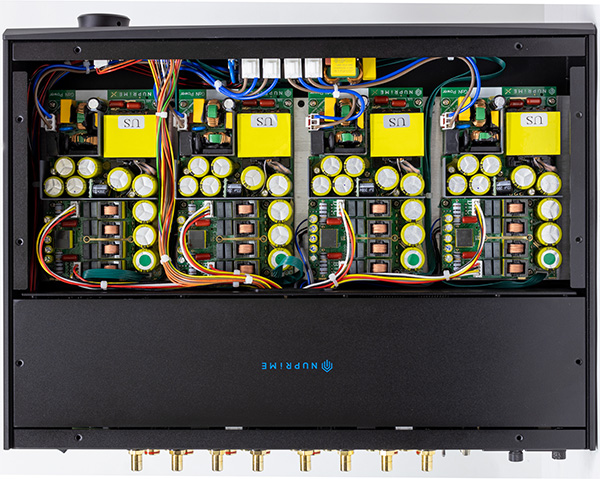 Out of the box
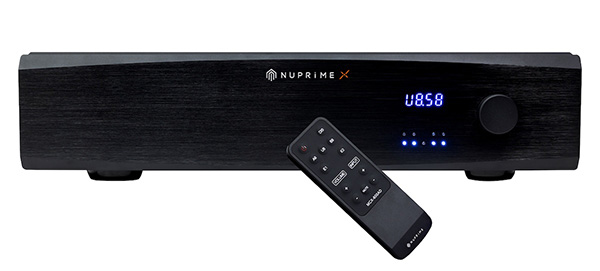
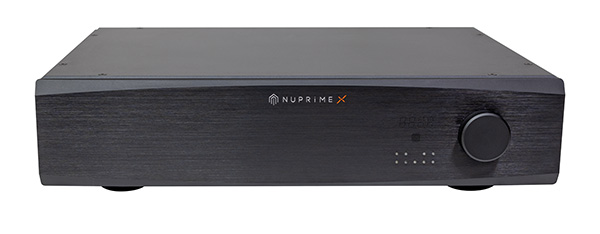
The MCX-800AD is a substantial black block with a clean, simple front panel and a back panel bristling with connectors and options. There is only one control on the front: a large, well-damped knob whose gently stepped rotation controls volume. Depressing the knob briefly switches the unit from one input to the next. Pressing it for 3 seconds puts it in standby or, if it is already in standby, takes it back out again.
Above the knob, a blue LED display indicates somewhat cryptically the active source and the volume level. Right now I see U8.71, which tells me that I am listening via the USB input at a relative level of 71 (out of 100). It's cryptic, but it's clear enough once you know how to read it. The display, though, could be sharper and brighter.
Below the knob are two rows of LEDs. The upper four communicate power/standby status as either orange (mute), blue (on), or off (power supply thermal protection). The lower five LEDs are fault indicators illuminated yellow (power amplifier fault) or red (overload protection). These seem to be offering quite granular diagnostic information during power cycling, except that there is no apparent association of any single LED with a specific component, and it isn't clear why more than a single LED is needed in each tier.
All this is fine if you have placed the MCX-800AD within arm's reach. For those who can't, a remote control duplicates the knob controls and then some, with discrete buttons for each of the five inputs and the ability to step through them. Second, it has a Mute button, a useful option if your source is not so equipped; the display blinks when the signal is muted. Third, and most appreciated, is the DIS (display) button, which when depressed briefly replaces the source/level display with the current sample rate. If you press DIS and the display goes blank, your input source is not active. I found this useful in setting up a complicated system and swapping around components.
 Around back
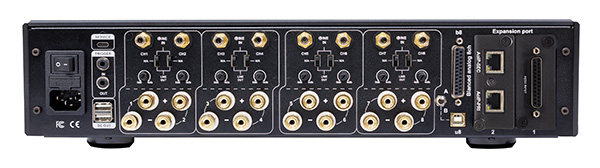
The back surface of the MCX-800AD bristles with connectors. It seems even denser than the back panel of top-tier AVRs with their scores of connectors, which at least find space for model identification, country of origin, and some fundamental electrical specs and warnings. With the NuPrime, it's all business. On the extreme left is a standard IEC power inlet, fuse mount, and switch. Next to it, from top to bottom, are a USB-C port for service, trigger input and output connectors, and dual USB-A connectors to provide power to external devices. On the extreme right are two expansion bays (footnote 1), a DB25 connector, a USB connector, and a toggle switch. The DB25 accepts a TASCAM-standard cable terminated in eight XLRs and conveying eight channels of balanced analog input, and the USB-B connector accepts eight channels of digital (PCM or DSD) input. The toggle switch selects the upper or lower set of eight channels in 16-channel setups. Filling out the rest of the space are four I/O panels, each supporting two channels. For each of the eight channels, there is an RCA jack at the top plus a three-way slide switch and a trim pot. The switch determines whether the associated RCA is an input (up), not used (mid), or an output (down). The trim pot adjusts the level at the RCA from 0 to –6dB; it is only active if the jack is used as an output. Below the trim pot is a pair of multiway speaker terminals. The channels are independent, so you can use a mix of speaker-level and line-level outputs as your setup requires. So many options!
Provided such an array of inputs and outputs, plus the ability to accept a wide range of PCM and DSD formats, I began with the easiest and connected a USB cable from my Windows and Mac servers (one at a time) and played music files via JRiver and Roon (also one at a time). As often happens, the Windows server needed an ASIO driver, which NuPrime provides, but the MacOS didn't. With the Windows PC, the MCX-800AD was able to play all the DSD formats specified in stereo (DSD256) and six channel (DSD128). In PCM, the limit is 192kHz in multichannel (as advertised); unfortunately that limitation also applies to stereo (footnote 2).
The Mac did just as well for PCM, but as with all Macs, it will not play DSD. Moreover, since the MCX-800AD does not support DoP (DSD over PCM), the Mac was called on to convert DSD to PCM. That may seem like a limitation, but a multichannel amp like the MCX-800AD is likely to be used with room correction and/or as an active crossover, which would require PCM conversion anyway. Counter-balancing this disadvantage is the fact that only the Mac is able to stream Atmos content. That is why I bought one.
I also took advantage of the NuPrime's ability to output speaker-level or line-level outputs on individual channels as required. For example, the MCX-800AD allowed me to use speaker-level outputs to connect directly to my left, center, and right channels while sending line-level outputs to my left-side and right-side powered speakers and my powered subwoofers. With this setup, I was listening to everything in the MCX-800AD: the DACs, the power amps, the power supplies, the volume control, and all the circuitry.
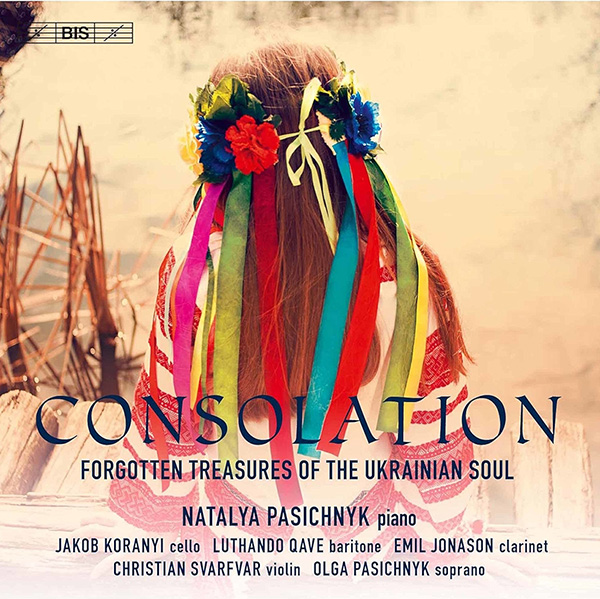 As a complete endpoint/amplifier, the sound was excellent. I turned to a lovely recording of Ukrainian music, one of many to appear in response to the public's growing attention since that country was invaded. Consolation (BIS BIS-2222, SACD, auditioned from a DSD64 download) consists of 21 selections of decidedly Ukrainian-flavored classical compositions by Ukrainian composers organized by Swedish-Ukrainian pianist Natalya Pasichnyk. She performs on all the tracks, joined on many by cello, clarinet, violin, and/or baritone and soprano voice, adding depth and flavor to a heartfelt, serious program. A tone of longing is set from the first notes, but that mood is often tempered with sweetness, charm, romance—even a Klezmer-like episode on one track. This album is affectionate and engaging.
The opening track, Lysenko's Dumka-shumka (Second Piano Rhapsody on Ukrainian Folk Themes), Op.18, has turned up in many collections. Pasichnyk's opening is quite soft, but it anticipates the wistful melodies to come. Even played quietly, the piano has real body and presence in an intimate acoustic space. Via the NuPrime, that presence and space was the recording's most obvious characteristic.
After four instrumental tracks, it was both surprising and thrilling to hear Luthando Qave's rich baritone appear in the space, intoning Lysenko's "Meni odnakovo" ("It Makes No Difference to Me"), which seriously states a commitment to Ukraine that is as fundamental today as when it was written more than 100 years ago. There are other great moments, such as soprano Olga Pasichnyk's lovely, earnest presentations of Stetsenko's "I Stood and Listened to Spring" and Kosenko's "I am Sad." As conveyed by the MCX-800AD, all the instruments and voices were clear and warm, delineated with an inviting presence just a few feet beyond the speaker plane. There are no audio tricks, so the ambience from the surround was subtle and only called on my attention when I turned it off.
At this point, I bypassed the DACs and fed the MCX-800AD directly via its balanced analog inputs, mediated by an eight-channel XLR–DB25 snake connected to the outputs of, alternately, the Merging Hapi and Okto DAC8 Pro DACs. This sounded marginally more direct and incisive, but the previously noted warmth in the shaping of the voices was maintained. Using the unbalanced RCA analog inputs required the insertion of XLR-to-RCA adapters, since my system has no single-ended sources. Even so, the sonic performance was consistent, suggesting that regardless of the means of connection or the DACs in operation, the amplifier was the dominant factor in determining the sound of the MCX-800AD, as it should be.
As a complete endpoint/amplifier, the sound was excellent. I turned to a lovely recording of Ukrainian music, one of many to appear in response to the public's growing attention since that country was invaded. Consolation (BIS BIS-2222, SACD, auditioned from a DSD64 download) consists of 21 selections of decidedly Ukrainian-flavored classical compositions by Ukrainian composers organized by Swedish-Ukrainian pianist Natalya Pasichnyk. She performs on all the tracks, joined on many by cello, clarinet, violin, and/or baritone and soprano voice, adding depth and flavor to a heartfelt, serious program. A tone of longing is set from the first notes, but that mood is often tempered with sweetness, charm, romance—even a Klezmer-like episode on one track. This album is affectionate and engaging.
The opening track, Lysenko's Dumka-shumka (Second Piano Rhapsody on Ukrainian Folk Themes), Op.18, has turned up in many collections. Pasichnyk's opening is quite soft, but it anticipates the wistful melodies to come. Even played quietly, the piano has real body and presence in an intimate acoustic space. Via the NuPrime, that presence and space was the recording's most obvious characteristic.
After four instrumental tracks, it was both surprising and thrilling to hear Luthando Qave's rich baritone appear in the space, intoning Lysenko's "Meni odnakovo" ("It Makes No Difference to Me"), which seriously states a commitment to Ukraine that is as fundamental today as when it was written more than 100 years ago. There are other great moments, such as soprano Olga Pasichnyk's lovely, earnest presentations of Stetsenko's "I Stood and Listened to Spring" and Kosenko's "I am Sad." As conveyed by the MCX-800AD, all the instruments and voices were clear and warm, delineated with an inviting presence just a few feet beyond the speaker plane. There are no audio tricks, so the ambience from the surround was subtle and only called on my attention when I turned it off.
At this point, I bypassed the DACs and fed the MCX-800AD directly via its balanced analog inputs, mediated by an eight-channel XLR–DB25 snake connected to the outputs of, alternately, the Merging Hapi and Okto DAC8 Pro DACs. This sounded marginally more direct and incisive, but the previously noted warmth in the shaping of the voices was maintained. Using the unbalanced RCA analog inputs required the insertion of XLR-to-RCA adapters, since my system has no single-ended sources. Even so, the sonic performance was consistent, suggesting that regardless of the means of connection or the DACs in operation, the amplifier was the dominant factor in determining the sound of the MCX-800AD, as it should be.
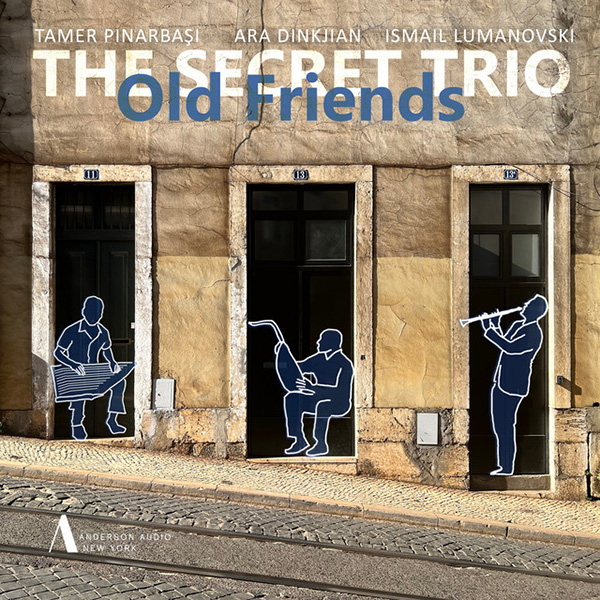 After living with the NuPrime MCX-800AD in my system for a month, I had a unique opportunity to see if my continuing enjoyment was real or a neural adaptation. This was made possible by a superb recent recording from recording-engineer friends Jim Anderson and Ulrike Schwarz of Anderson Audio New York. During a visit to the studio, which is located at NYU's Clive Davis Institute of Recorded Music—my NYU emeritus ID still gets me on campus—they played new releases from Donald Vega, Jane Ira Bloom, and The Secret Trio, all recorded in that studio and played over their monitoring system, which has many PMC speakers. At home afterwards, I played 24/352.8 5.1 files of the Secret Trio, a work entitled "Old Friends," with the MCX-800AD doing the heavy lifting. The Secret Trio is composed of three old friends, Ismail Lumanovski (clarinet), Ara Dinkjian (oud), and Tamer Pinarbasi (kanun). They play classical music, primarily Turkish, with harmonies that refresh my Western ears and whose complex, intertwining rhythms fascinate.
I played this loud to approximate the levels at the demo and to revel in it. The MCX provided all the necessary juice; the only thing that kept me from equaling the studio levels was my domestic situation. In my room, via my 5.3 system, including the NuPrime, I heard much less "immersion" than I had in the studio, but in compensation I heard a substantial gain in specificity. There was a more certain and closer placement of each of the three players, and the instruments had more character and warmth than in the studio, where they extended more widely around. In addition, at home the bass was tighter and seemed more coherent. Overall, I was better able to connect to the music than I managed in the studio.
The MCX-800AD was complicit in causing me to binge on an old/new set of Beethoven symphonies, performed by Anima Eterna Brugge conducted by Jos van Immerseel. These recordings were made between December 2005 and December 2007 and originally released in 2008 as Zig Zag ZZT080402.6 on six CDs. Bert van der Wolf of Northstar Recording remastered them in DXD for 2023 release as Alpha Classics 3803, available in multiple stereo, multichannel, and immersive formats. I downloaded the set in 5.1 24/352.8 from spiritofturtle.com.
These vigorous, inspiring performances are decidedly "historically informed," but they should appeal to anyone with a love for the music and an open mind. The recording is superb and in many instances spectacular. One highlight is the 7th symphony, which begins with stealth but quickly develops momentum and concludes with a thrilling coda.
After living with the NuPrime MCX-800AD in my system for a month, I had a unique opportunity to see if my continuing enjoyment was real or a neural adaptation. This was made possible by a superb recent recording from recording-engineer friends Jim Anderson and Ulrike Schwarz of Anderson Audio New York. During a visit to the studio, which is located at NYU's Clive Davis Institute of Recorded Music—my NYU emeritus ID still gets me on campus—they played new releases from Donald Vega, Jane Ira Bloom, and The Secret Trio, all recorded in that studio and played over their monitoring system, which has many PMC speakers. At home afterwards, I played 24/352.8 5.1 files of the Secret Trio, a work entitled "Old Friends," with the MCX-800AD doing the heavy lifting. The Secret Trio is composed of three old friends, Ismail Lumanovski (clarinet), Ara Dinkjian (oud), and Tamer Pinarbasi (kanun). They play classical music, primarily Turkish, with harmonies that refresh my Western ears and whose complex, intertwining rhythms fascinate.
I played this loud to approximate the levels at the demo and to revel in it. The MCX provided all the necessary juice; the only thing that kept me from equaling the studio levels was my domestic situation. In my room, via my 5.3 system, including the NuPrime, I heard much less "immersion" than I had in the studio, but in compensation I heard a substantial gain in specificity. There was a more certain and closer placement of each of the three players, and the instruments had more character and warmth than in the studio, where they extended more widely around. In addition, at home the bass was tighter and seemed more coherent. Overall, I was better able to connect to the music than I managed in the studio.
The MCX-800AD was complicit in causing me to binge on an old/new set of Beethoven symphonies, performed by Anima Eterna Brugge conducted by Jos van Immerseel. These recordings were made between December 2005 and December 2007 and originally released in 2008 as Zig Zag ZZT080402.6 on six CDs. Bert van der Wolf of Northstar Recording remastered them in DXD for 2023 release as Alpha Classics 3803, available in multiple stereo, multichannel, and immersive formats. I downloaded the set in 5.1 24/352.8 from spiritofturtle.com.
These vigorous, inspiring performances are decidedly "historically informed," but they should appeal to anyone with a love for the music and an open mind. The recording is superb and in many instances spectacular. One highlight is the 7th symphony, which begins with stealth but quickly develops momentum and concludes with a thrilling coda.
 Via the MCX-800AD (and the rest of my system), the tonal flavors of all the instruments, solo or tutti, were natural and distinctive, with no high-frequency glint. Their places in the soundfield were not spotlighted but were as they would be from Row H, center, at subjectively similar SPLs. Cellos and bass fiddles had appropriate heft such that their melodic contributions were clear. It was all so eminently gratifying that I gorged on the whole set in less than 2 days. To some symphonies, I listened more than once.
Now the home team
Via the MCX-800AD (and the rest of my system), the tonal flavors of all the instruments, solo or tutti, were natural and distinctive, with no high-frequency glint. Their places in the soundfield were not spotlighted but were as they would be from Row H, center, at subjectively similar SPLs. Cellos and bass fiddles had appropriate heft such that their melodic contributions were clear. It was all so eminently gratifying that I gorged on the whole set in less than 2 days. To some symphonies, I listened more than once.
Now the home team
When I switched from the NuPrime to my Benchmark AHB2s, the change was not jarring. The balance was similar. However, the different amps shaped instruments and rendered ambience somewhat differently. On "Just Friends," the Benchmarks projected a deeper, wider soundspace around the performers and placed them a little farther back. This allowed for higher listening levels without harming transparency. The instruments were more sharply defined, with a bit less warmth and roundness but comparable weight.
I had similar reactions listening to the Beethoven 7th, but here, with these larger but still modest forces, the more generous soundstage was a bigger advantage. The instruments were arrayed more widely and deeply, greatly benefitting my appreciation of the interplay among them. Solo instruments were a smidgeon less ripe than with the MCX-800AD. The impact of the full orchestra did not suffer, particularly at high levels.
The MCX-800AD was fully competitive. Someone else sitting in my chair at these same auditions might describe the results differently. I thought that the NuPrime did everything right. Its voice and instrument rendering was particularly appealing.
Conclusions
I am tempted to describe the NuPrime MCX-800AD as a jack-of-all-trades, with its eight channels of high–bit rate DACs, eight channels of power amplification, and its myriad of inputs and outputs. But it deserves more respect than that title implies: "master of none." It could serve as the electronic core of a complete multichannel audio system much more than competently. This single box can select, decode, and amplify high-quality music sources to energize an array of speakers that require considerable power. The MCX-800AD may be an unusual device, but for some systems, it will be just the ticket.
Footnote 1: NuPrime currently offers two options: 1. A dual RJ45 card for up to 16 channels of digital input or output via LAN conveyed by Dante or AES67. 2. An AES3 card with a DB25 connector providing eight channels of digital input. These serve to attach NuPrime's H16-AES and H16-AIP Atmos Decoders and other compatible equipment. Footnote 2: Despite attempts with both the WinPC and the Mac mini and with several different lengths and brands of USB cable, sample rates higher than 192kHz played only with high background noise and at slow speed.
I was led to this NuPrime DAC-amplifier by my curiosity about Dolby Atmos. The MCX-800 is ideal for Atmos because a single unit can support the minimal 5.1.2 Atmos configuration, and you can combine it with another MCX-800AD to support up to 16 channels. For now, I just want to hear music in 5.1 Atmos.
For listening to music in Atmos, the MCX-800AD is an excellent choice—except that it doesn't decode Dolby Atmos. For that you need a different box, like the NuPrime H16 decoder. NuPrime sent me two versions, one with four AES3 outputs (each supporting two channels), the other using Audio over Internet Protocol (AoIP). Both versions decode "Dolby Atmos (up to 7.1.4) and Dolby True HD and all downward Dolby audio formats" plus DTS:X, DTS-HD Master Audio, and "all compatible HD audio formats." Unfortunately, due to several failures I experienced, I judged the H16 not ready for prime time, but both versions worked well enough for long enough to allow me to give the MCX-800AD a proper audition—and in the process to get a sense for Dolby Atmos music.
The MCX-800AD incorporates NuPrime's Fusion-X architecture, which means that all eight digital audio inputs are reclocked and individually decoded by four high-performance DAC chips; it is more common to use a single eight-channel chip. Each DAC output is passed through a high-end I–V conversion circuit, which has its own dedicated power supply. The output stage uses four low-noisefloor, high–slew rate (20V/µs) OP2134 op amps, said to enable fast transient response, tight bass, crisp highs, and an accurate midrange. Fusion-X provides a 64-channel LAN-based AoIP bus that supports 16 channels of I2S inputs and outputs and eight channels of balanced and unbalanced analog outputs compatible with Dante and AES67. Each of the MCX's eight power amps consists of two class-D amplifier modules in a bridged-mono configuration with three levels of feedback control, individual power supplies for the analog and digital circuits, and an adaptive switching power supply (SMPS) serving just the amplifiers.
Out of the boxThe MCX-800AD is a substantial black block with a clean, simple front panel and a back panel bristling with connectors and options. There is only one control on the front: a large, well-damped knob whose gently stepped rotation controls volume. Depressing the knob briefly switches the unit from one input to the next. Pressing it for 3 seconds puts it in standby or, if it is already in standby, takes it back out again.
Around backThe back surface of the MCX-800AD bristles with connectors. It seems even denser than the back panel of top-tier AVRs with their scores of connectors, which at least find space for model identification, country of origin, and some fundamental electrical specs and warnings. With the NuPrime, it's all business. On the extreme left is a standard IEC power inlet, fuse mount, and switch. Next to it, from top to bottom, are a USB-C port for service, trigger input and output connectors, and dual USB-A connectors to provide power to external devices. On the extreme right are two expansion bays (footnote 1), a DB25 connector, a USB connector, and a toggle switch. The DB25 accepts a TASCAM-standard cable terminated in eight XLRs and conveying eight channels of balanced analog input, and the USB-B connector accepts eight channels of digital (PCM or DSD) input. The toggle switch selects the upper or lower set of eight channels in 16-channel setups. Filling out the rest of the space are four I/O panels, each supporting two channels. For each of the eight channels, there is an RCA jack at the top plus a three-way slide switch and a trim pot. The switch determines whether the associated RCA is an input (up), not used (mid), or an output (down). The trim pot adjusts the level at the RCA from 0 to –6dB; it is only active if the jack is used as an output. Below the trim pot is a pair of multiway speaker terminals. The channels are independent, so you can use a mix of speaker-level and line-level outputs as your setup requires. So many options!
Provided such an array of inputs and outputs, plus the ability to accept a wide range of PCM and DSD formats, I began with the easiest and connected a USB cable from my Windows and Mac servers (one at a time) and played music files via JRiver and Roon (also one at a time). As often happens, the Windows server needed an ASIO driver, which NuPrime provides, but the MacOS didn't. With the Windows PC, the MCX-800AD was able to play all the DSD formats specified in stereo (DSD256) and six channel (DSD128). In PCM, the limit is 192kHz in multichannel (as advertised); unfortunately that limitation also applies to stereo (footnote 2).
As a complete endpoint/amplifier, the sound was excellent. I turned to a lovely recording of Ukrainian music, one of many to appear in response to the public's growing attention since that country was invaded. Consolation (BIS BIS-2222, SACD, auditioned from a DSD64 download) consists of 21 selections of decidedly Ukrainian-flavored classical compositions by Ukrainian composers organized by Swedish-Ukrainian pianist Natalya Pasichnyk. She performs on all the tracks, joined on many by cello, clarinet, violin, and/or baritone and soprano voice, adding depth and flavor to a heartfelt, serious program. A tone of longing is set from the first notes, but that mood is often tempered with sweetness, charm, romance—even a Klezmer-like episode on one track. This album is affectionate and engaging.
After living with the NuPrime MCX-800AD in my system for a month, I had a unique opportunity to see if my continuing enjoyment was real or a neural adaptation. This was made possible by a superb recent recording from recording-engineer friends Jim Anderson and Ulrike Schwarz of Anderson Audio New York. During a visit to the studio, which is located at NYU's Clive Davis Institute of Recorded Music—my NYU emeritus ID still gets me on campus—they played new releases from Donald Vega, Jane Ira Bloom, and The Secret Trio, all recorded in that studio and played over their monitoring system, which has many PMC speakers. At home afterwards, I played 24/352.8 5.1 files of the Secret Trio, a work entitled "Old Friends," with the MCX-800AD doing the heavy lifting. The Secret Trio is composed of three old friends, Ismail Lumanovski (clarinet), Ara Dinkjian (oud), and Tamer Pinarbasi (kanun). They play classical music, primarily Turkish, with harmonies that refresh my Western ears and whose complex, intertwining rhythms fascinate.
I played this loud to approximate the levels at the demo and to revel in it. The MCX provided all the necessary juice; the only thing that kept me from equaling the studio levels was my domestic situation. In my room, via my 5.3 system, including the NuPrime, I heard much less "immersion" than I had in the studio, but in compensation I heard a substantial gain in specificity. There was a more certain and closer placement of each of the three players, and the instruments had more character and warmth than in the studio, where they extended more widely around. In addition, at home the bass was tighter and seemed more coherent. Overall, I was better able to connect to the music than I managed in the studio.
The MCX-800AD was complicit in causing me to binge on an old/new set of Beethoven symphonies, performed by Anima Eterna Brugge conducted by Jos van Immerseel. These recordings were made between December 2005 and December 2007 and originally released in 2008 as Zig Zag ZZT080402.6 on six CDs. Bert van der Wolf of Northstar Recording remastered them in DXD for 2023 release as Alpha Classics 3803, available in multiple stereo, multichannel, and immersive formats. I downloaded the set in 5.1 24/352.8 from spiritofturtle.com.
Via the MCX-800AD (and the rest of my system), the tonal flavors of all the instruments, solo or tutti, were natural and distinctive, with no high-frequency glint. Their places in the soundfield were not spotlighted but were as they would be from Row H, center, at subjectively similar SPLs. Cellos and bass fiddles had appropriate heft such that their melodic contributions were clear. It was all so eminently gratifying that I gorged on the whole set in less than 2 days. To some symphonies, I listened more than once.
Now the home teamWhen I switched from the NuPrime to my Benchmark AHB2s, the change was not jarring. The balance was similar. However, the different amps shaped instruments and rendered ambience somewhat differently. On "Just Friends," the Benchmarks projected a deeper, wider soundspace around the performers and placed them a little farther back. This allowed for higher listening levels without harming transparency. The instruments were more sharply defined, with a bit less warmth and roundness but comparable weight.
I am tempted to describe the NuPrime MCX-800AD as a jack-of-all-trades, with its eight channels of high–bit rate DACs, eight channels of power amplification, and its myriad of inputs and outputs. But it deserves more respect than that title implies: "master of none." It could serve as the electronic core of a complete multichannel audio system much more than competently. This single box can select, decode, and amplify high-quality music sources to energize an array of speakers that require considerable power. The MCX-800AD may be an unusual device, but for some systems, it will be just the ticket.
Footnote 1: NuPrime currently offers two options: 1. A dual RJ45 card for up to 16 channels of digital input or output via LAN conveyed by Dante or AES67. 2. An AES3 card with a DB25 connector providing eight channels of digital input. These serve to attach NuPrime's H16-AES and H16-AIP Atmos Decoders and other compatible equipment. Footnote 2: Despite attempts with both the WinPC and the Mac mini and with several different lengths and brands of USB cable, sample rates higher than 192kHz played only with high background noise and at slow speed.