My Russian neighbor Alex forges ax heads and smokes pig chests 5' from my bedroom window. At 2:00am, shirtless, in February. One especially cold night, I woke up to the sounds of hammering and loud music. When I looked out, Alex was blacksmithing a glowing red meat cleaver blade, with Rachmaninoff plays Rachmaninoff blaring from a cassette in his boom box. I once helped him break into a white-painted chest-high office safe that he bought at auction. After grinding the tips off a dozen long drill bits, we could see inside through a little hole, and there was nothing in it. No metals dealers would haul it away, so we dug a hole by the backyard fence and rolled it in. Unfortunately, the hole wasn't deep enough, so now, years later, one white corner (and its spoked 6" steel wheel) are poking up about a foot above ground.
Not infrequently, Alex and his blind father visit my studio to check out what's new in my gear array. Neither would call themselves audiophiles, but both are experienced, confident listeners with substantial collections of black discs. Alex places the highest value on "digging it" and can tap his feet harder than regular people. His father is into Elvis and Miles Davis and wants to see their bodies between his speakers. Falcon's $10,000/pair, 2024 Limited Edition LS3/5a was his favorite speaker ever, but it was he who pointed out that the Gold Badge version had a slight edge in tone truthfulness.
The beauty of guest listeners is how they notice things I've missed.
I seek out visitors' opinions to scale my emotions about a product, either tamping them down by pointing out things I missed or jacking them up by validating my enthusiasm. Every month, I choose the tone of my descriptions, hoping it sensibly reflects the character of the product under scrutiny. I prefer to err at first on the rah-rah positive side, because positive is easier to tamp down later. Nevertheless, these perception adjustments can be difficult. Sometimes 30 days is not enough to assess how companionable a product might be in a long-term relationship.
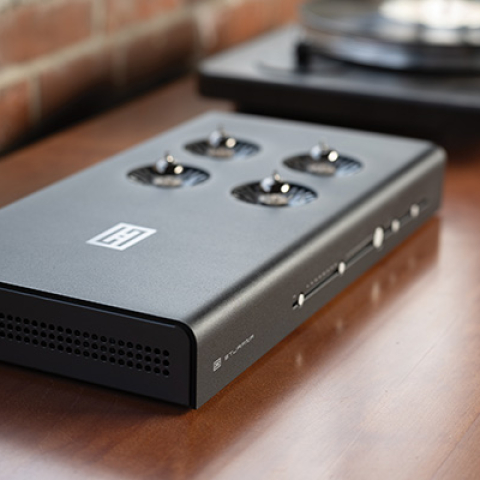
Such was the case with Schiit Audio's all-tube Stjarna phono stage I reported on last month (footnote 1).
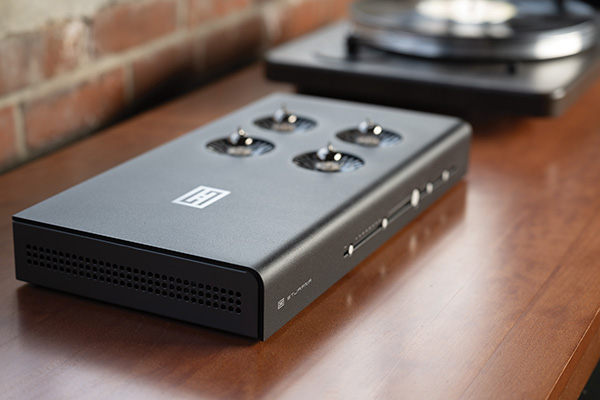 The Schiit Stjarna again
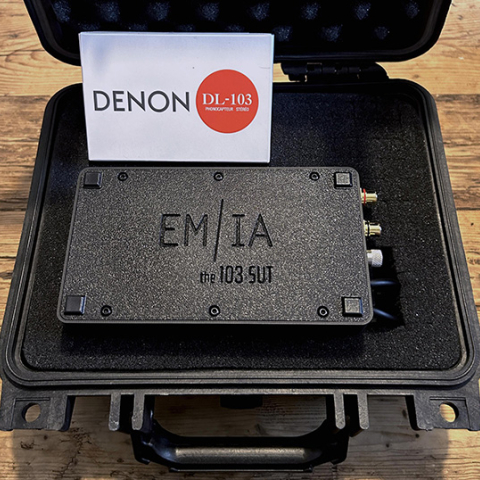
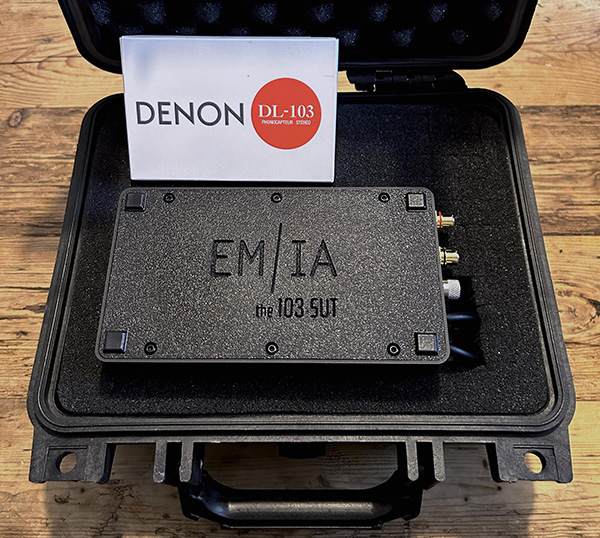
The day after I turned in my 99th Dream, I relaxed and let out my breath, and so did the Stjarna, which somehow became more rouged-cheeks seductive than it was the day before. This newly discovered pulchritude directed my thinking toward buying more records, trying more cartridges, and staying up late. That same day-after-deadline day, I was watching a compelling "Jana ♥ Hi-Fi" YouTube video, "How a Denon DL-103 Cartridge is Made" (footnote 2), when I realized I had neglected to try the $1699 Schiit Stjarna with the $349 Denon DL-103 moving coil—a cartridge many potential Stjarna owners will already be using.
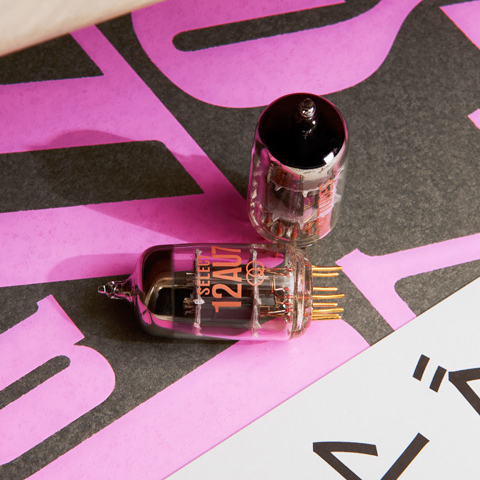
To remedy that oversight, I put a stock Denon DL-103 on a Jelco HS-20 headshell attached to my Sorane SL-1.2 tonearm, wired directly into the Stjarna with AudioQuest Yosemite tonearm cable. Until recently, when I began experimenting with 103 loads as low as 50 ohms, I'd always used either a 1:10 SUT or the recommended 400 ohm shunt load, so I set the all-tube Schiit pre to its maximum MC loading of 350 ohms. Life was good. The Schiit Stjarna has joined PrimaLuna's EVO 100 Phono as the only 21st century phono stage I've tried that has a tube's grid as the first circuit element a low-output moving coil cartridge sees. Driving a tube grid with a ~0.3mV signal and seeking 20dB of quiet gain is a Sisyphean enterprise that requires engineers to choose operating points that give low noise with maximum excitement and reasonable tube life—at a reasonable price.
The advent of the moving coil SUT
Back in the 1960s, at the start of audio's first Golden Age, American audiophiles were proudly converting to stereo by upgrading their high-output (~0.4V) ceramic pickups to much lower-output (~4mV) moving magnet cartridges from American manufacturers: Empire, Shure, Stanton, Pickering, Grado. These new stereophonic moving magnet cartridges dominated audiophile audio's first Golden Age, and this dominance spawned a legion of famously low-effective-mass (~5gm) tonearms from SME, Breuer Dynamic, Grace, and the tonearm with my favorite name, the Infinity Black Widow. One of those beauties came to me attached to a used Kenwood KD-600 direct-drive turntable, and I marveled at its build quality and exquisite form. With an ADC cartridge, it sounded like it looked. At that moment in the late '70s, tonearms and cartridges became my favorite component categories. I saw them as art and engineering combining to make playing records more enticing. I was sure these exotic bits would become collector's items.
Speaking of which, in 1977, Koetsu introduced audio's first "artisanal" moving coil cartridge. Unlike Shure's V15 or Denon's DL-103, which had plastic bodies and came in plastic boxes, a rosewood-bodied Koetsu came inside a perfectly crafted (and aromatic) cedarwood box. It was sold only at the most upscale audio salons.
The Koetsu cost just under $1000, which at the time seemed ridiculously high. Shure's V15 III cost less than $100 then, a Denon 103 maybe twice that much. I remember Stereo Review readers ridiculing the Koetsu, saying it measured worse and tracked worse than a Shure V15. MC aficionados ignored their troll noise while standing by the words of their guru-influencers, The Absolute Sound founder Harry Pearson and Stereophile founder J. Gordon Holt.
Best I can tell, it was prestigious moving coils attached to sci-fi–styled tonearms playing thick, exquisite-looking discs in carpeted, dimly lit listening rooms that ushered in what I consider the second Golden Age of Audio (1977–1985), during which top audiophile products became much-discussed celebrities that looked glamorous and spoke in rich tones.
At a fraction of a mV, the Koetsu's output voltage was much lower than that of my Shure and Grado cartridges, which meant my kit-built Hafler DH-101 phono preamp needed something I'd been trying to avoid: Hafler's magic-free DH-112 "pre-pre" headamp.
Along with 10× higher prices and 10× lower output, the self-impedance (DC resistance + inductance) of moving coil cartridges was 10× less than that of moving magnets from the '60s.
In 1978, W. Marshall Leach, Jr., a professor of electrical and computer engineering at Georgia Tech, published a now-famous DIY article in Audio magazine titled "Head Amps for Moving-Coil Cartridges" (footnote 3), wherein he described an "active circuit which boosts the output voltage [of a moving coil] by 20 to 30dB while exhibiting a purely resistive output impedance in the range of the output resistances of conventional cartridges. Thus, impedance interactions are eliminated, and the hum problem can be virtually eliminated."
According to Leach, Gene Pitts, then editor of Audio, changed the title of the article to "Build a Pre Preamp for Moving Coil Cartridges." "He told me that James Bongiorno, designer of the Ampzilla, had originated the term 'head amp' for a product, and Gene felt we should not use that term for my article."
By 1980, a slew of Leach headamp clones had entered the audio-salon MC step-up market, but old-school moving coil enthusiasts were way ahead of this new and uncertain headamp game. They were already using the venerable—and at the time almost free—Altec/Peerless 4722 microphone transformer as a moving coil step-up transformer (footnote 4).
I grew up near Evanston, Illinois, where Shure cartridges were manufactured, so I was a born-and-raised Shure loyalist. I swore by all their cartridges. When I moved to Brooklyn in 1977, I became a Grado loyalist, buying every new model as it came out. Then around 1992, a friend gave me a Denon DP-3000 turntable with a Denon DL-103 cartridge and its matching Denon step-up transformer, the AU-305. I've been a DL-103 loyalist ever since. I've worn out five or six; their spherical stylus lasts less than 500 hours.
In November 2015 Art Dudley wrote, "For LP enthusiasts who prize tone, touch, and timing above all else, I'd put the combination of Abis SA-1.2 and Denon DL-103 up against all but their priciest competitors; and for delivering the most of those performance characteristics for the least amount of money, it has few competitors."
When Denon announced it was shutting down production of the DL-103 (footnote 5), I bought three and worried it wasn't enough. Almost 30 years later, they're still available. My question for you is, how many audio products of any type remain in production, unchanged, and still usefully doing what they were created to do, 61 years after their introduction? How many audio products remain unchanged—and still competitive in their segment of the marketplace—six decades after their introduction? Denon's DL-103 might be the only product ever to accomplish both feats.
Footnote 1: Schiit Audio, 24900 Anza Dr., Unit A Valencia, CA 91355. Tel: (323) 230-0079. Web: schiit.com. Footnote 2: By former Stereophile video pro Jana Dagdagan. See youtu.be/dKDtNrN2jy8. Footnote 3: See leachlegacy.ece.gatech.edu/headamp. Footnote 4: By 1970, several other companies were also making step-up transformers suitable for use with MC cartridges, including Ortofon, Fidelity Research, UTC, Neumann, and of course Denon, but these were used mostly by professionals; they were not often spotted in the wild.
Footnote 5: In 1996, in the early days of Listener magazine, a US publicist for Denon told me that they planned to discontinue the DL-103. They didn't, obviously.
The Schiit Stjarna againThe day after I turned in my 99th Dream, I relaxed and let out my breath, and so did the Stjarna, which somehow became more rouged-cheeks seductive than it was the day before. This newly discovered pulchritude directed my thinking toward buying more records, trying more cartridges, and staying up late. That same day-after-deadline day, I was watching a compelling "Jana ♥ Hi-Fi" YouTube video, "How a Denon DL-103 Cartridge is Made" (footnote 2), when I realized I had neglected to try the $1699 Schiit Stjarna with the $349 Denon DL-103 moving coil—a cartridge many potential Stjarna owners will already be using.
Back in the 1960s, at the start of audio's first Golden Age, American audiophiles were proudly converting to stereo by upgrading their high-output (~0.4V) ceramic pickups to much lower-output (~4mV) moving magnet cartridges from American manufacturers: Empire, Shure, Stanton, Pickering, Grado. These new stereophonic moving magnet cartridges dominated audiophile audio's first Golden Age, and this dominance spawned a legion of famously low-effective-mass (~5gm) tonearms from SME, Breuer Dynamic, Grace, and the tonearm with my favorite name, the Infinity Black Widow. One of those beauties came to me attached to a used Kenwood KD-600 direct-drive turntable, and I marveled at its build quality and exquisite form. With an ADC cartridge, it sounded like it looked. At that moment in the late '70s, tonearms and cartridges became my favorite component categories. I saw them as art and engineering combining to make playing records more enticing. I was sure these exotic bits would become collector's items.
Footnote 1: Schiit Audio, 24900 Anza Dr., Unit A Valencia, CA 91355. Tel: (323) 230-0079. Web: schiit.com. Footnote 2: By former Stereophile video pro Jana Dagdagan. See youtu.be/dKDtNrN2jy8. Footnote 3: See leachlegacy.ece.gatech.edu/headamp. Footnote 4: By 1970, several other companies were also making step-up transformers suitable for use with MC cartridges, including Ortofon, Fidelity Research, UTC, Neumann, and of course Denon, but these were used mostly by professionals; they were not often spotted in the wild.