The all-in-one stereo component occupies the same territory as those Italian restaurants that also serve sushi and Texas barbecue. Every instinct says it's a dubious overreach: Few chefs master two or more distinct cuisines. But then you experience that rare eatery that somehow nails the California roll, the carbonara, and the brisket, and you realize that dismissing it on principle could mean missing something that's genuinely excellent.
While some of the products Eversolo makes do just one thing, like the AMP-F10 two-channel amplifier Tom Fine reviewed in Stereophile's August 2025 issue, most of the Chinese company's products perform double or triple duty. The $1980 DMP-A8 I assessed for this magazine in July 2024 is a truly excellent streamer, DAC, and preamp in one. I liked the similar but higher-performance A10 ($3999) so much that I made it part of my reference system.
Now there's an Eversolo product with almost boundless Swiss Army–knife aspirations. The $799 Play CD Edition is a music streamer, amplifier, preamp, DAC, and CD player, all housed in a small square box measuring 9" × 3" × 9". The Play's closest rivals are probably the WiiM Amp Ultra ($529 but no CD player) and the Technics SA-C600, which does have a CD drive but costs a bit more: $999 last summer; $1399 after the Trump tariffs hit. I never auditioned the Technics, but I own the WiiM Amp Ultra, and the Eversolo is a step above it in build quality and utility. But how does it perform sonically? Is it worth serious audiophile attention?
Little big man
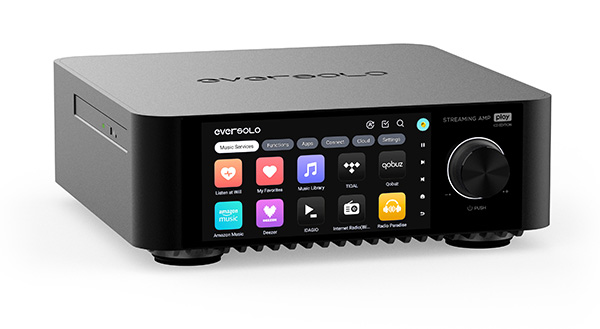
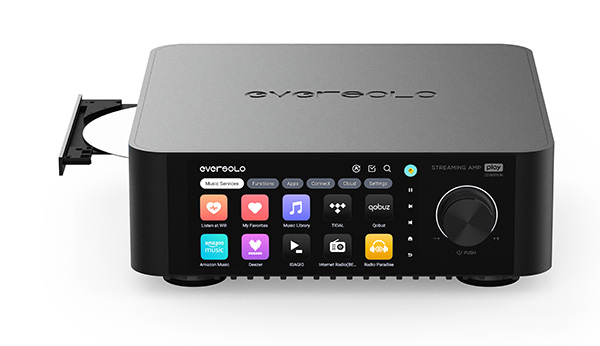
The Play is so small and light that when the UPS driver handed it to me, I found I could easily lift the custom shipping box and its contents with one hand. Despite that, after freeing the unit from its packaging, it felt pleasantly substantial, with no wobble in the chassis and no off-putting plasticky feeling. The Eversolo Play has a unibody chassis crafted from aluminum alloy. The design is intended to provide structural rigidity, cut electromagnetic interference, and aid heat dissipation. The heatsink is on the bottom, where 24 metal ridges span the surface, each sticking out barely 0.06" (1.5mm). True to its class-D nature, the Play doesn't run hot. After I'd played moderately loud music for a few hours, my infrared thermometer measured barely 81°F when I took a reading from the top of the unit. This was with the Play out in the open, with abundant ventilation. The fascia features a large volume knob on the right, which you can push to navigate the Play's various menus. To the left of it is a 5.5" color touch display—quite a bit larger than the 3.5" screen on the WiiM Amp Ultra.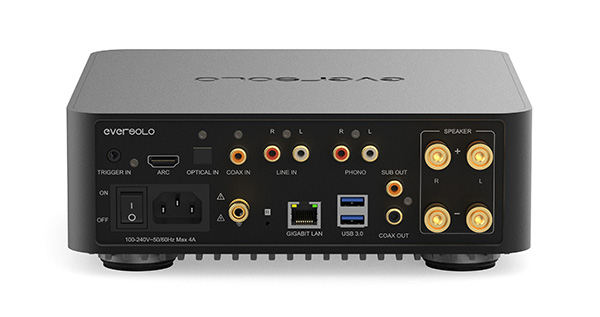 Facing the rear panel, on the left we find a tumbler switch for the universal power supply (100–240V, 50/60Hz); a standard IEC14 power receptacle; a Gigabit LAN port; a USB 3.0 port; and a USB digital audio output. There's also an RCA pre-out pair and a single subwoofer output. HDMI-ARC facilitates TV sound. TosLink and S/PDIF over RCA allow connection of other digital sources. Two RCA stereo pairs allow connection of a line-level device and an MC or MM phono cartridge. There's a screw-type ground wire connection for turntable grounding. There are no balanced ins and outs, which would have raised the price and increased the size of the box substantially. Wi-Fi and Bluetooth 5.3 are built in, though there are no external antennas. The Play's Bluetooth implementation sticks to SBC and AAC, skipping fancier aptX and LDAC options.
The pint-sized component handles quite the array of high-resolution formats: PCM up to 32/768, DSD up to DSD512, and various lossless-compressed formats including FLAC and APE. Digital conversion runs through a 32-bit AKM AK4493SEQ DAC chip with "Velvetsound technology," which Eversolo says prioritizes signal/ noise ratio and jitter rejection. Streaming flexibility is comprehensive: Roon Ready certification, AirPlay, Spotify Connect, Tidal Connect, Qobuz Connect, and UPnP/DLNA support. The Eversolo Control app integrates directly with Tidal, Qobuz, Amazon Music, Deezer, and comparable services.
Disc-appointing?
Facing the rear panel, on the left we find a tumbler switch for the universal power supply (100–240V, 50/60Hz); a standard IEC14 power receptacle; a Gigabit LAN port; a USB 3.0 port; and a USB digital audio output. There's also an RCA pre-out pair and a single subwoofer output. HDMI-ARC facilitates TV sound. TosLink and S/PDIF over RCA allow connection of other digital sources. Two RCA stereo pairs allow connection of a line-level device and an MC or MM phono cartridge. There's a screw-type ground wire connection for turntable grounding. There are no balanced ins and outs, which would have raised the price and increased the size of the box substantially. Wi-Fi and Bluetooth 5.3 are built in, though there are no external antennas. The Play's Bluetooth implementation sticks to SBC and AAC, skipping fancier aptX and LDAC options.
The pint-sized component handles quite the array of high-resolution formats: PCM up to 32/768, DSD up to DSD512, and various lossless-compressed formats including FLAC and APE. Digital conversion runs through a 32-bit AKM AK4493SEQ DAC chip with "Velvetsound technology," which Eversolo says prioritizes signal/ noise ratio and jitter rejection. Streaming flexibility is comprehensive: Roon Ready certification, AirPlay, Spotify Connect, Tidal Connect, Qobuz Connect, and UPnP/DLNA support. The Eversolo Control app integrates directly with Tidal, Qobuz, Amazon Music, Deezer, and comparable services.
Disc-appointing?
The Play should be connected to Ethernet for optimum functionality—although you can use it to play CDs. It's called the Play CD Edition, so obviously it has a built-in disc spinner, with a tray that slides out from the top left side of the unit—an unusual arrangement. Eversolo says it's a "Hitachi-LG optical CD-ROM assembly with a vibration-dampening chassis, significantly reducing operational resonance while ensuring stable disc rotation." The CD tray is springy and a little hesitant when it exits and retracts. It's thin enough that I'm afraid it might break if you drop a serious remote control on top of it—or, say, the end of a fat audiophile-quality cable—but it works.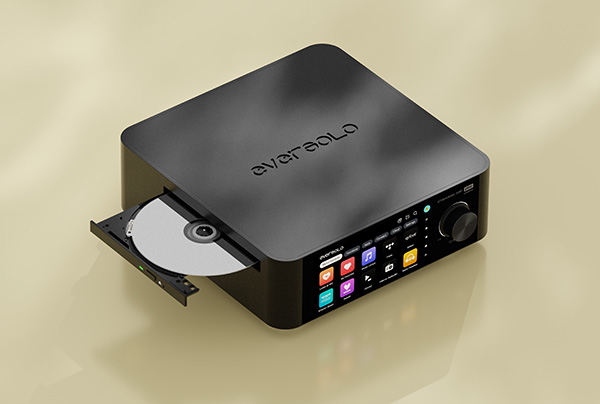 The CD-less version of the Play costs just $100 less, so you get a decent-sounding CD player for a song (ha!). Affordable and simply built things can last ages, says the optimist. But sometimes they fail, perhaps right after the warranty expires, counters the pessimist. Both are right. The non-CD version has fewer moving parts, fewer things that could break.
There is no remote control, a forgivable omission for an audio component that almost every user will operate with a smartphone or a tablet. Still, I missed having a dedicated remote when I wanted to quickly mute the music, adjust volume on the fly, or switch from streaming to CD. All those things are nicely doable via the very good Eversolo Control app, which has grown incredibly full-featured over the past couple of years. But there's a slightly cumbersome downside to control by smartphone or tablet: You have to grab your device, unlock it, find the Eversolo app if it isn't already open, and drag the tiny on-screen volume slider. That could mean six or seven taps/swipes or more compared to one or two clicks on a remote. One solution would be to buy the Eversolo BTR-12 Bluetooth remote control, which costs a measly $12 but has no dedicated buttons for the CD player; for that you'll still need to go through the mobile app. On the plus side, the app and the Play's front-panel GUI are smartly organized and chockablock with advanced functions—two things that can easily be at odds. Also on the app's plus side, when you need a remote, you probably won't have it in your pocket.
Initially I had a hard time figuring out how to switch from streaming to CD, assuming this option would present itself in the app's Source tile. Nope: There, you find only the inputs and outputs that you can enable (or disable) for music duty; the built-in CD player is not among them. But then I found the Setting that allows you to play a CD simply by inserting a disc and hitting Play.
Using the Play's CD Ripper feature was a delight. 32GB of built-in storage doesn't sound particularly giga, but it'll hold 65–85 Red Book CDs if you want FLAC files or around 50–55 albums ripped to WAV. That's not a bad little collection. The Play, which will slip easily into a messenger bag or attaché case, is just about perfect for moving between your home, office, and dacha without schlepping actual discs. (Then again, at this price, buying Plays for each location may well be the superior option.) If the built-in memory is too meager, you can expand it by supplying your own USB thumb drive or hard disk and connecting it to the USB OTG port.
Sound customization comes via 24 EQ presets, a 10-band graphic EQ, and a 10-band parametric one. The subwoofer output offers advanced bass-management capabilities including crossover-frequency selection, level control, and phase adjustment. The Play even has automatic room correction on board that you can run using your smartphone's microphone. It managed to somewhat tame a room mode I have around 35Hz, but the Eversolo technology isn't up to the standards set by REW, Dirac, and Anthem Room Correction, all of which offer more control and sophistication.
After I connected the Play to Ethernet, it auto-installed two rounds of firmware updates then let me seamlessly connect to Roon on my MacBook Air. I am a Roon enthusiast and generally preferred it over the Eversolo app, but the latter was still necessary for setting display options (including your favorite of seven virtual VU meters), selecting inputs and outputs, and switching from streaming to CD playback and vice versa. With the Eversolo app, you automatically stop CD playback when you start streaming. Disappointingly, if you're spinning a CD on the Play and instruct Roon to stream music instead, Roon may say it doesn't have the required permission—that it "lost control of the Audio device because its input was switched." Sometimes it did work, but not reliably.
One more niggle: As full-featured as the Eversolo Play is, it doesn't have a headphone jack—an odd oversight for an everything-plus-the-kitchen-sink device. The WiiM Amp Ultra has the same shortcoming. Of course, with either machine, you can feed a digital output into a DAC/headphone amp, but that ducks the do-every-thing ethos.
The CD-less version of the Play costs just $100 less, so you get a decent-sounding CD player for a song (ha!). Affordable and simply built things can last ages, says the optimist. But sometimes they fail, perhaps right after the warranty expires, counters the pessimist. Both are right. The non-CD version has fewer moving parts, fewer things that could break.
There is no remote control, a forgivable omission for an audio component that almost every user will operate with a smartphone or a tablet. Still, I missed having a dedicated remote when I wanted to quickly mute the music, adjust volume on the fly, or switch from streaming to CD. All those things are nicely doable via the very good Eversolo Control app, which has grown incredibly full-featured over the past couple of years. But there's a slightly cumbersome downside to control by smartphone or tablet: You have to grab your device, unlock it, find the Eversolo app if it isn't already open, and drag the tiny on-screen volume slider. That could mean six or seven taps/swipes or more compared to one or two clicks on a remote. One solution would be to buy the Eversolo BTR-12 Bluetooth remote control, which costs a measly $12 but has no dedicated buttons for the CD player; for that you'll still need to go through the mobile app. On the plus side, the app and the Play's front-panel GUI are smartly organized and chockablock with advanced functions—two things that can easily be at odds. Also on the app's plus side, when you need a remote, you probably won't have it in your pocket.
Initially I had a hard time figuring out how to switch from streaming to CD, assuming this option would present itself in the app's Source tile. Nope: There, you find only the inputs and outputs that you can enable (or disable) for music duty; the built-in CD player is not among them. But then I found the Setting that allows you to play a CD simply by inserting a disc and hitting Play.
Using the Play's CD Ripper feature was a delight. 32GB of built-in storage doesn't sound particularly giga, but it'll hold 65–85 Red Book CDs if you want FLAC files or around 50–55 albums ripped to WAV. That's not a bad little collection. The Play, which will slip easily into a messenger bag or attaché case, is just about perfect for moving between your home, office, and dacha without schlepping actual discs. (Then again, at this price, buying Plays for each location may well be the superior option.) If the built-in memory is too meager, you can expand it by supplying your own USB thumb drive or hard disk and connecting it to the USB OTG port.
Sound customization comes via 24 EQ presets, a 10-band graphic EQ, and a 10-band parametric one. The subwoofer output offers advanced bass-management capabilities including crossover-frequency selection, level control, and phase adjustment. The Play even has automatic room correction on board that you can run using your smartphone's microphone. It managed to somewhat tame a room mode I have around 35Hz, but the Eversolo technology isn't up to the standards set by REW, Dirac, and Anthem Room Correction, all of which offer more control and sophistication.
After I connected the Play to Ethernet, it auto-installed two rounds of firmware updates then let me seamlessly connect to Roon on my MacBook Air. I am a Roon enthusiast and generally preferred it over the Eversolo app, but the latter was still necessary for setting display options (including your favorite of seven virtual VU meters), selecting inputs and outputs, and switching from streaming to CD playback and vice versa. With the Eversolo app, you automatically stop CD playback when you start streaming. Disappointingly, if you're spinning a CD on the Play and instruct Roon to stream music instead, Roon may say it doesn't have the required permission—that it "lost control of the Audio device because its input was switched." Sometimes it did work, but not reliably.
One more niggle: As full-featured as the Eversolo Play is, it doesn't have a headphone jack—an odd oversight for an everything-plus-the-kitchen-sink device. The WiiM Amp Ultra has the same shortcoming. Of course, with either machine, you can feed a digital output into a DAC/headphone amp, but that ducks the do-every-thing ethos.
 Let's play/
I mostly auditioned the Play with the Monitor Audio Gold 100 6G three-way standmounts ($4599/pair, in for review). It was a fortuitous combination despite the speakers costing more than six times as much as this snazzy little box of electronics. For about a week, I used the Eversolo to feed the Vanatoo Transparent One Encore powered speakers ($649/pair) in my home office, where the Chinese unit took the place of my $1499 NAD C 700 streaming amplifier. At my desk, it's all nearfield listening; in my listening room, I sit about 10' from the speakers. The Monitor Audio Golds were 8' 10" apart and 6' from the front wall, their rear ports left open. The Monitors' 86.5dB sensitivity is on the low side, but the Play gave these English 4 ohm–rated transducers a generous-enough 110Wpc. I had no trouble achieving satisfying SPLs, though the music could sound slightly dry on the dynamic peaks in some orchestral works. A paucity of headroom perhaps; we'll see what the measurements show. Expecting world-class performance from a $799 audio component is like thinking you can win Wimbledon with a frying pan, but damned if the little (ch)amp didn't make me prick up my ears, usually for the right reasons. It sounded good out of the box and better as the hours slid by, either because burn-in subtly improved the sonics or because I unwittingly tuned my ear to what the Play had to offer. Maybe a bit of both.
 That's not to say I liked everything I heard. The Qobuz rerelease of 1973's Buckingham Nicks sounded a bit brittle and "digital." But I also had repeated "hell yeah that's good" moments, like when I played Slagwerk Den Haag's version of Philip Glass's "North Star," from Vitreous Body (24/48 FLAC, Orange Mountain/Qobuz). Those chimes and bells sound marvelous on just about any well-curated system, and they fully grabbed my attention all over again via the Play and the Monitor Audio Golds.
After a couple of weeks with the Eversolo, I realized that, with some exceptions, I liked how it rendered music I know well; I was more likely to find fault with new-to-me recordings. This probably reveals more about human perception than about the Play. With recordings you know well, your memory acts as a smoothing agent, and familiarity makes you forgiving. You anticipate what's coming and focus more on the emotional connection than on the sonic picture. When you play something new, however, the tonal balance and production quirks stand out more. That's no problem when you're wrapped in the comfort of an old favorite. To continue the gastronomy metaphor I used at the beginning of this review, it's a bit like dining at a favorite restaurant: You forgive a wobbly table at your go-to spot, but at a new place, every bent fork or late drink has the potential to annoy.
That's not to say I liked everything I heard. The Qobuz rerelease of 1973's Buckingham Nicks sounded a bit brittle and "digital." But I also had repeated "hell yeah that's good" moments, like when I played Slagwerk Den Haag's version of Philip Glass's "North Star," from Vitreous Body (24/48 FLAC, Orange Mountain/Qobuz). Those chimes and bells sound marvelous on just about any well-curated system, and they fully grabbed my attention all over again via the Play and the Monitor Audio Golds.
After a couple of weeks with the Eversolo, I realized that, with some exceptions, I liked how it rendered music I know well; I was more likely to find fault with new-to-me recordings. This probably reveals more about human perception than about the Play. With recordings you know well, your memory acts as a smoothing agent, and familiarity makes you forgiving. You anticipate what's coming and focus more on the emotional connection than on the sonic picture. When you play something new, however, the tonal balance and production quirks stand out more. That's no problem when you're wrapped in the comfort of an old favorite. To continue the gastronomy metaphor I used at the beginning of this review, it's a bit like dining at a favorite restaurant: You forgive a wobbly table at your go-to spot, but at a new place, every bent fork or late drink has the potential to annoy.
 Not that I got annoyed much—I was too busy marveling at how little you have to spend to get this much sonic goodness. The handclaps on Jonny Greenwood's "Nina Through Glass," from You Were Never Really Here (24/48 FLAC, Qobuz/Invada Records), were startlingly real through the Eversolo/Monitor Audio Gold combo.
I also cued up music by Australian blues great Lachy Doley, who plays the Hohner whammy clavinet, a '70s-style funky keyboard with a major mod: Rather than a pitch wheel, it has a whammy bar like those on lots of Fender and Gretsch guitars. The keyboard-version whammy bar is a serious piece of metal about 2' long, installed in a slot carved into the top of the cabinet. It allows anything from a slight vibrato to full-step bends, giving keyboard players a mode of expression previously reserved for guitarists.
There's probably no finer example of whammy-clavinet playing than Doley's fiery cover of Jimi Hendrix's "Voodoo Child," from Studios 301 Sessions (16/44.1 FLAC, Qobuz/All the Stops). Doley spent the COVID year indoors, not giving concerts, which evidently made him antsy. In 2021, he and his band released the pent-up energy in front of a small studio audience. Check out the recording on your preferred streaming service, but you may get just as much (or more) of a kick watching Doley at work in the single-take YouTube video (footnote 1). It's an exhilarating performance, and no matter the source, the Play–Monitor Audio Gold alliance brought it with drive and panache.
Not that I got annoyed much—I was too busy marveling at how little you have to spend to get this much sonic goodness. The handclaps on Jonny Greenwood's "Nina Through Glass," from You Were Never Really Here (24/48 FLAC, Qobuz/Invada Records), were startlingly real through the Eversolo/Monitor Audio Gold combo.
I also cued up music by Australian blues great Lachy Doley, who plays the Hohner whammy clavinet, a '70s-style funky keyboard with a major mod: Rather than a pitch wheel, it has a whammy bar like those on lots of Fender and Gretsch guitars. The keyboard-version whammy bar is a serious piece of metal about 2' long, installed in a slot carved into the top of the cabinet. It allows anything from a slight vibrato to full-step bends, giving keyboard players a mode of expression previously reserved for guitarists.
There's probably no finer example of whammy-clavinet playing than Doley's fiery cover of Jimi Hendrix's "Voodoo Child," from Studios 301 Sessions (16/44.1 FLAC, Qobuz/All the Stops). Doley spent the COVID year indoors, not giving concerts, which evidently made him antsy. In 2021, he and his band released the pent-up energy in front of a small studio audience. Check out the recording on your preferred streaming service, but you may get just as much (or more) of a kick watching Doley at work in the single-take YouTube video (footnote 1). It's an exhilarating performance, and no matter the source, the Play–Monitor Audio Gold alliance brought it with drive and panache.
 "Strange Game" (16/44.1 FLAC, Tidal/Polydor) by Mick Jagger, the theme song for the Apple+ TV series Slow Horses, is recorded with buckets of reverb, while the instruments sound as dirty as they do on old Rolling Stones records or post-'80s Tom Waits albums. The first time I heard the track, I thought it was a lost '60s Stones recording, but it hails from 2022. Jagger, 78 at the time, was in remarkable form, his swagger and energy indistinguishable from when he was half a century younger. The sonic grunge is reflected in the lyrics, which, like the TV script, are about a group of misery-loves-company British spies who've made career-derailing errors.
 I felt the same kind of appreciation when I played Debashish Bhattacharya's Slide Guitar Ragas From Dusk Till Dawn (16/44.1 FLAC, Qobuz/World Music). The raga genre can feel languid, especially in the alap, the unmetered, meditative intros. But Bhattacharya doesn't tend to stay there and soon makes his way to the jhala, sections where rapid-fire tablas make the recording intense and red-hot, each instrument exploding in ecstasy. The Play rendered it all without smearing or obscuring.
Fun and fidelity
I felt the same kind of appreciation when I played Debashish Bhattacharya's Slide Guitar Ragas From Dusk Till Dawn (16/44.1 FLAC, Qobuz/World Music). The raga genre can feel languid, especially in the alap, the unmetered, meditative intros. But Bhattacharya doesn't tend to stay there and soon makes his way to the jhala, sections where rapid-fire tablas make the recording intense and red-hot, each instrument exploding in ecstasy. The Play rendered it all without smearing or obscuring.
Fun and fidelity
Western audiophiles often greet newer China-based brands with trepidation. How reliable are these products? What happens if you must send a component in for repair? I've embraced Eversolo's DMP-A8 and DMP-A10 and have had no reason to complain; both have been glitch-free across more than 2000 cumulative hours of use. They measure fantastically well and sound better than they have any right to, given their price tags. I asked Lily Luo of Forté Distribution, Eversolo's US importer, what buyers can expect if something goes wrong. "We have service/repair centers in the US and Canada, handled by Forté and Motet Distribution, located in Connecticut and Ontario respectively," Luo replied. She added that typical turnaround time is one week, not including transit time. "Since most of the parts are modular, the after-warranty cost of repair is reasonable, and parts are provided and stocked at the repair centers." Even if that puts a cautious mind at ease regarding warranty and repairability, is the Play worth the purchase? I'd say so. It won me over in minutes. Eight hundred bucks is a pittance for an audio component that can singlehandedly function as the heart of a reputable home system, and I can't fault the Play on any serious metric. It's a jack-of-all-trades that makes you smile before you can say "master of none," even though that unkind addition is true. I mean, the Play does not best (or seriously threaten) the reference combo of my McIntosh MC462 power amp, Eversolo A10 streamer/preamp, and Sony S9000ES CD player. With that setup, I get better separation, a bigger soundstage, higher levels of timbral transparency and musicality, and more immersion—but at more than 20 times the price.
The Eversolo Play is just about unbeatable if the goal is to put together a second, third, or even a first stereo system for around two grand—just connect some quality speakers. (For a two-grand system, I'd recommend Monitor Audio Silver 7Gs or ELAC Debut Reference B6.2s.) The Play provides tons of fun and fidelity, and I'm always in the mood for those.
Footnote 1: See youtube.com/watch?v=IUDUCTsXPiE.
The Play is so small and light that when the UPS driver handed it to me, I found I could easily lift the custom shipping box and its contents with one hand. Despite that, after freeing the unit from its packaging, it felt pleasantly substantial, with no wobble in the chassis and no off-putting plasticky feeling. The Eversolo Play has a unibody chassis crafted from aluminum alloy. The design is intended to provide structural rigidity, cut electromagnetic interference, and aid heat dissipation. The heatsink is on the bottom, where 24 metal ridges span the surface, each sticking out barely 0.06" (1.5mm). True to its class-D nature, the Play doesn't run hot. After I'd played moderately loud music for a few hours, my infrared thermometer measured barely 81°F when I took a reading from the top of the unit. This was with the Play out in the open, with abundant ventilation. The fascia features a large volume knob on the right, which you can push to navigate the Play's various menus. To the left of it is a 5.5" color touch display—quite a bit larger than the 3.5" screen on the WiiM Amp Ultra.
Facing the rear panel, on the left we find a tumbler switch for the universal power supply (100–240V, 50/60Hz); a standard IEC14 power receptacle; a Gigabit LAN port; a USB 3.0 port; and a USB digital audio output. There's also an RCA pre-out pair and a single subwoofer output. HDMI-ARC facilitates TV sound. TosLink and S/PDIF over RCA allow connection of other digital sources. Two RCA stereo pairs allow connection of a line-level device and an MC or MM phono cartridge. There's a screw-type ground wire connection for turntable grounding. There are no balanced ins and outs, which would have raised the price and increased the size of the box substantially. Wi-Fi and Bluetooth 5.3 are built in, though there are no external antennas. The Play's Bluetooth implementation sticks to SBC and AAC, skipping fancier aptX and LDAC options.
The Play should be connected to Ethernet for optimum functionality—although you can use it to play CDs. It's called the Play CD Edition, so obviously it has a built-in disc spinner, with a tray that slides out from the top left side of the unit—an unusual arrangement. Eversolo says it's a "Hitachi-LG optical CD-ROM assembly with a vibration-dampening chassis, significantly reducing operational resonance while ensuring stable disc rotation." The CD tray is springy and a little hesitant when it exits and retracts. It's thin enough that I'm afraid it might break if you drop a serious remote control on top of it—or, say, the end of a fat audiophile-quality cable—but it works.
The CD-less version of the Play costs just $100 less, so you get a decent-sounding CD player for a song (ha!). Affordable and simply built things can last ages, says the optimist. But sometimes they fail, perhaps right after the warranty expires, counters the pessimist. Both are right. The non-CD version has fewer moving parts, fewer things that could break.
Let's play/I mostly auditioned the Play with the Monitor Audio Gold 100 6G three-way standmounts ($4599/pair, in for review). It was a fortuitous combination despite the speakers costing more than six times as much as this snazzy little box of electronics. For about a week, I used the Eversolo to feed the Vanatoo Transparent One Encore powered speakers ($649/pair) in my home office, where the Chinese unit took the place of my $1499 NAD C 700 streaming amplifier. At my desk, it's all nearfield listening; in my listening room, I sit about 10' from the speakers. The Monitor Audio Golds were 8' 10" apart and 6' from the front wall, their rear ports left open. The Monitors' 86.5dB sensitivity is on the low side, but the Play gave these English 4 ohm–rated transducers a generous-enough 110Wpc. I had no trouble achieving satisfying SPLs, though the music could sound slightly dry on the dynamic peaks in some orchestral works. A paucity of headroom perhaps; we'll see what the measurements show. Expecting world-class performance from a $799 audio component is like thinking you can win Wimbledon with a frying pan, but damned if the little (ch)amp didn't make me prick up my ears, usually for the right reasons. It sounded good out of the box and better as the hours slid by, either because burn-in subtly improved the sonics or because I unwittingly tuned my ear to what the Play had to offer. Maybe a bit of both.
That's not to say I liked everything I heard. The Qobuz rerelease of 1973's Buckingham Nicks sounded a bit brittle and "digital." But I also had repeated "hell yeah that's good" moments, like when I played Slagwerk Den Haag's version of Philip Glass's "North Star," from Vitreous Body (24/48 FLAC, Orange Mountain/Qobuz). Those chimes and bells sound marvelous on just about any well-curated system, and they fully grabbed my attention all over again via the Play and the Monitor Audio Golds.
After a couple of weeks with the Eversolo, I realized that, with some exceptions, I liked how it rendered music I know well; I was more likely to find fault with new-to-me recordings. This probably reveals more about human perception than about the Play. With recordings you know well, your memory acts as a smoothing agent, and familiarity makes you forgiving. You anticipate what's coming and focus more on the emotional connection than on the sonic picture. When you play something new, however, the tonal balance and production quirks stand out more. That's no problem when you're wrapped in the comfort of an old favorite. To continue the gastronomy metaphor I used at the beginning of this review, it's a bit like dining at a favorite restaurant: You forgive a wobbly table at your go-to spot, but at a new place, every bent fork or late drink has the potential to annoy.
Not that I got annoyed much—I was too busy marveling at how little you have to spend to get this much sonic goodness. The handclaps on Jonny Greenwood's "Nina Through Glass," from You Were Never Really Here (24/48 FLAC, Qobuz/Invada Records), were startlingly real through the Eversolo/Monitor Audio Gold combo.
"Strange Game" (16/44.1 FLAC, Tidal/Polydor) by Mick Jagger, the theme song for the Apple+ TV series Slow Horses, is recorded with buckets of reverb, while the instruments sound as dirty as they do on old Rolling Stones records or post-'80s Tom Waits albums. The first time I heard the track, I thought it was a lost '60s Stones recording, but it hails from 2022. Jagger, 78 at the time, was in remarkable form, his swagger and energy indistinguishable from when he was half a century younger. The sonic grunge is reflected in the lyrics, which, like the TV script, are about a group of misery-loves-company British spies who've made career-derailing errors.
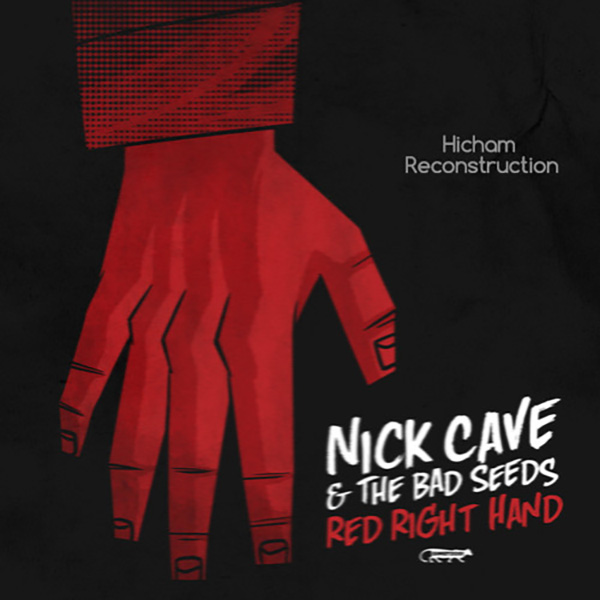
Surrounded by losersThe recording goes for atmosphere over theoretical perfection, something that may resonate with some tube lovers. Though I'm mostly a solid state guy, I suddenly had a hankering for valves, so I put my PrimaLuna EVO 400 integrated amplifier with KT150 tubes into the chain, using the pre-outputs of the Play, another example of its versatility. That sure hit the spot! Did the song sound worse when I subsequently replayed it on the Eversolo Play? Well, yes, a bit—but honestly, it wasn't a huge comedown. The PrimaLuna painted with warmer colors and better layering; the Play was arguably a little cleaner in the midrange, though perhaps more clinical. I was happy to find that the little Chinese unit gave up refinement but not engagement. The Jagger track put me in mind of Nick Cave and the Bad Seeds' "Red Right Hand," a song that was used as the theme for another glorious British TV series, Peaky Blinders. The recording's trademark bell strike can be difficult to reproduce; it often sounds shrill and hashy on shoestring equipment, and so it did on the Play. On the other hand, the güiro that enters at 2:46 was plenty fleshed out and realistic.
Misfits and boozers
Hanging by your fingernails
You made one mistake
You got burned at the stake
You're finished, you're foolish, you failed.
I felt the same kind of appreciation when I played Debashish Bhattacharya's Slide Guitar Ragas From Dusk Till Dawn (16/44.1 FLAC, Qobuz/World Music). The raga genre can feel languid, especially in the alap, the unmetered, meditative intros. But Bhattacharya doesn't tend to stay there and soon makes his way to the jhala, sections where rapid-fire tablas make the recording intense and red-hot, each instrument exploding in ecstasy. The Play rendered it all without smearing or obscuring.
Fun and fidelityWestern audiophiles often greet newer China-based brands with trepidation. How reliable are these products? What happens if you must send a component in for repair? I've embraced Eversolo's DMP-A8 and DMP-A10 and have had no reason to complain; both have been glitch-free across more than 2000 cumulative hours of use. They measure fantastically well and sound better than they have any right to, given their price tags. I asked Lily Luo of Forté Distribution, Eversolo's US importer, what buyers can expect if something goes wrong. "We have service/repair centers in the US and Canada, handled by Forté and Motet Distribution, located in Connecticut and Ontario respectively," Luo replied. She added that typical turnaround time is one week, not including transit time. "Since most of the parts are modular, the after-warranty cost of repair is reasonable, and parts are provided and stocked at the repair centers." Even if that puts a cautious mind at ease regarding warranty and repairability, is the Play worth the purchase? I'd say so. It won me over in minutes. Eight hundred bucks is a pittance for an audio component that can singlehandedly function as the heart of a reputable home system, and I can't fault the Play on any serious metric. It's a jack-of-all-trades that makes you smile before you can say "master of none," even though that unkind addition is true. I mean, the Play does not best (or seriously threaten) the reference combo of my McIntosh MC462 power amp, Eversolo A10 streamer/preamp, and Sony S9000ES CD player. With that setup, I get better separation, a bigger soundstage, higher levels of timbral transparency and musicality, and more immersion—but at more than 20 times the price.
Footnote 1: See youtube.com/watch?v=IUDUCTsXPiE.