In 1991, when Heinz Lichtenegger founded Pro-Ject, part of the Audio Tuning group of companies, he went against the advancing digital onslaught, demonstrating absolute confidence in analog record players, which at the time were in steep decline. He and his team made a remarkable success selling devices to play vinyl discs under the Pro-Ject brand and providing OEM product to other manufacturers. In the decades since, Pro-Ject has expanded to include a wide range of electronics, both digital and analog. One piece of Audio Tuning is Musical Fidelity, which was founded in the UK in 1982 by Antony Michaelson. Michaelson sold Musical Fidelity to Audio Tuning in 2018, continuing with the company in "a design capacity."
The very first Nu-Vista product was a preamplifier dubbed the Nu-Vista PRE. Launched in 1997, it was the second audio product to utilize nuvistors, small, metal-clad vacuum tubes introduced in 1959 to compete with bipolar-junction transistors after a Conrad-Johnson preamp 10 years earlier. The first power amplifier to utilize nuvistors was the ovoid Nu-Vista 300, reviewed in Stereophile by Michael Fremer in 1999. The immediate progenitor of the weighty, powerful product under review was the Nu-Vista 800, which was reviewed by John Atkinson in December 2024. I reviewed the original Nu-Vista 800 about a decade earlier for HIFICRITIC; Michael Fremer reviewed it for Stereophile in 2015.
Early Musical Fidelity products were designed and built in the UK. Starting in the early 2000s, manufacturing was outsourced. Today, under Audio Tuning's ownership, manufacturing is mixed. The Nu-Vista 600.2 ($9999)—the product I'm reviewing—is manufactured in Taiwan under close supervision. The Nu-Vista 600.2 is an extensive reworking of the original 600 from about 10 years ago.
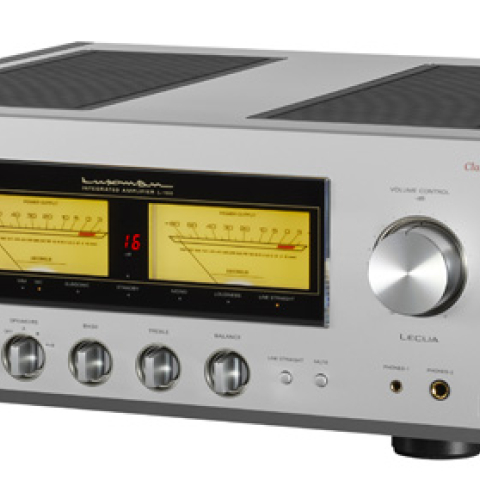
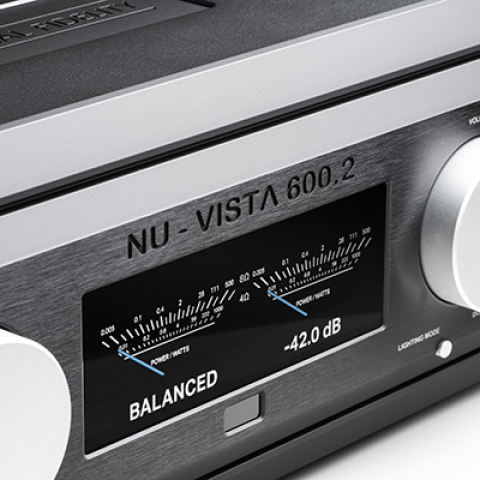
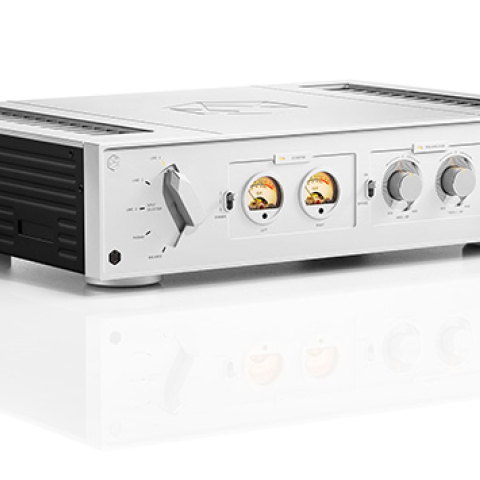
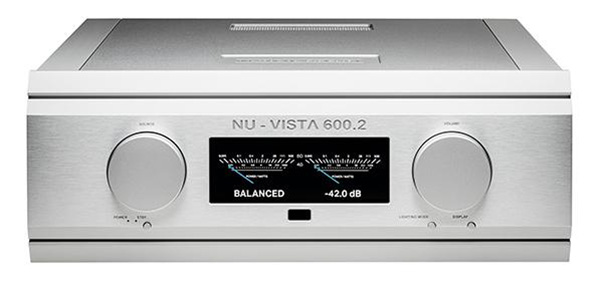 Of distinctive, pleasingly symmetrical appearance, the 600.2's aluminum-alloy fascia is cut from a substantial, finely machined extrusion. A color display and two large rotary knobs dominate the fascia: source selection on the left, volume control on the right. There is no channel-balance knob. The color display offers simulated VU meters of wide dynamic range, calibrated both in watts (based on an 8 ohm load) and in dB relative to full power. The meter's ballistics are not disclosed, but they appear to be of the averaging "VU," volume-unit variety. The display also indicates the chosen input mode (eg, "Balanced 1" or "Auxiliary 1"3) and the volume attenuation, eg, –42.0dB. When that numerical display reads "0dB," the amplifier has reached its maximum power, specified as 160Wpc into 8 ohms or 300Wpc into 4 ohms.
Front-panel buttons control display lighting color—white or blue—and let you choose the display mode for the meters: watts or dB. Even at moderate listening levels, those needles barely flicker. The IR beam from the remote handset is directional, though when it is pointed directly at the front panel, it has a good range.
Of distinctive, pleasingly symmetrical appearance, the 600.2's aluminum-alloy fascia is cut from a substantial, finely machined extrusion. A color display and two large rotary knobs dominate the fascia: source selection on the left, volume control on the right. There is no channel-balance knob. The color display offers simulated VU meters of wide dynamic range, calibrated both in watts (based on an 8 ohm load) and in dB relative to full power. The meter's ballistics are not disclosed, but they appear to be of the averaging "VU," volume-unit variety. The display also indicates the chosen input mode (eg, "Balanced 1" or "Auxiliary 1"3) and the volume attenuation, eg, –42.0dB. When that numerical display reads "0dB," the amplifier has reached its maximum power, specified as 160Wpc into 8 ohms or 300Wpc into 4 ohms.
Front-panel buttons control display lighting color—white or blue—and let you choose the display mode for the meters: watts or dB. Even at moderate listening levels, those needles barely flicker. The IR beam from the remote handset is directional, though when it is pointed directly at the front panel, it has a good range.
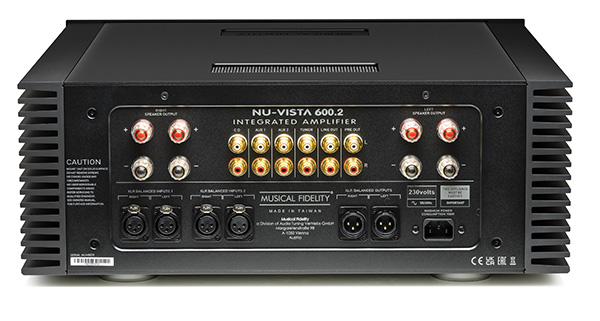 On the rear panel are heavy-duty speaker outputs (4mm socket/binding posts) for left and right channels—two sets, to facilitate biwiring. A handsome array of gold-plated phono sockets in the middle of the back panel are labeled CD, Aux 1, Aux 2, and Tuner. Two additional pairs offer, respectively, fixed line-level output and volume-controlled line-level output ("pre out"). Along the bottom of the back panel are XLR sockets for two pairs of balanced-mode inputs and matching balanced line-level outputs. Though all-analog and functionally simple, the 600.2 is versatile and well-equipped.
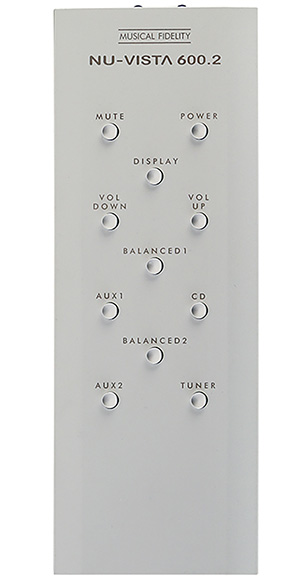
Those who want to make changes to the music without leaving their chair can manage all functions from a remote control with chassis milled from an aluminum-alloy bar, large enough to never get mislaid. Its legends are printed in low contrast on the anodized surface and can be hard to read in dim light, though once you know the remote by feel, this won't present a problem. And in decent light, the attractive sans-serif font looks stylish. The supplied, user-installable rubber feet are a good idea, since six tiny screws stand slightly proud of the remote's rear surface, presenting a potential hazard to delicate polished surfaces.
Speaking of: The hefty 600.2's large alloy feet have inset felt buffers to protect the surfaces it sits on, though the chassis is also threaded for fitting the provided machined cones, which are carved from an anodized alloy. Enthusiasts may experiment with other footers to investigate the subtle gains in sound quality achievable via vibration control.
On the rear panel are heavy-duty speaker outputs (4mm socket/binding posts) for left and right channels—two sets, to facilitate biwiring. A handsome array of gold-plated phono sockets in the middle of the back panel are labeled CD, Aux 1, Aux 2, and Tuner. Two additional pairs offer, respectively, fixed line-level output and volume-controlled line-level output ("pre out"). Along the bottom of the back panel are XLR sockets for two pairs of balanced-mode inputs and matching balanced line-level outputs. Though all-analog and functionally simple, the 600.2 is versatile and well-equipped.
Those who want to make changes to the music without leaving their chair can manage all functions from a remote control with chassis milled from an aluminum-alloy bar, large enough to never get mislaid. Its legends are printed in low contrast on the anodized surface and can be hard to read in dim light, though once you know the remote by feel, this won't present a problem. And in decent light, the attractive sans-serif font looks stylish. The supplied, user-installable rubber feet are a good idea, since six tiny screws stand slightly proud of the remote's rear surface, presenting a potential hazard to delicate polished surfaces.
Speaking of: The hefty 600.2's large alloy feet have inset felt buffers to protect the surfaces it sits on, though the chassis is also threaded for fitting the provided machined cones, which are carved from an anodized alloy. Enthusiasts may experiment with other footers to investigate the subtle gains in sound quality achievable via vibration control.
 The tech story
Nuvistors are miniature thermionic tubes. Introduced in 1959, they were intended to compete with early bipolar-junction transistors with their toughness and small size. They're smaller than most tubes, about the size of an acorn. Their microphony is close to zero, which should mean low sonic coloration. As for toughness, they're radiation hardened and designed to survive the high accelerations encountered in rocketry. You can expect a long service life—very long relative to most hi-fi tubes. In an email, Lichtenegger told Editor Jim Austin that the service life of a nuvistor was "definitely more than 100,000 hours," though other estimates put the lifetime anywhere between 5000 and 20,000 hours; a tube's lifetime, after all, depends on how it's implemented. In any case, unless there's a malfunction, you probably won't need to replace a nuvistor.
Another advantage of nuvistors is an intrinsic immunity to radio interference, including the ultrasonic and radio-frequency spuriae present in the output of some digital audio sources.
Musical Fidelity apparently maintains a large cache of nuvistors—"We have bought a huge stock to ensure long-term production of the products," Lichtenegger told Jim in that email back in June—specifically new old stock high-mu triodes, which in the US are called 7586 and in Russia are called 6S51N.
Sonically, nuvistors are said to impart a musical, low-order distortion signature to the completed hybrid tube/transistor design: a little more tubey than pure solid state if you like, though these distinctions are becoming blurred. In the 600.2, nuvistors are used as symmetrical, unity-gain buffers for the discrete, high-precision volume control and also in a triode buffer stage that follows the volume control to ensure a stable, constant-impedance drive for the preamp-stage output.
According to product designer Simon Quarry, who is based in the UK, the Nu-Vista 600.2 is a more extensive update of the original than the Nu-Vista 800.2 reviewed by John Atkinson was over its predecessor.
"The revised 600.2 now features the full Titan power amp structure, including substantial local decoupling for the output stage power supply rails combined with improvements to power supplies such as more generously rated toroidal power transformers." The main PCB track has been relaid and fitted with audiophile components including a laser-trimmed volume control, now specified to precise 0.5dB steps. The integrated circuit employed previously for input-source switching has been swapped for discrete relays. This will result in reduced crosstalk and greater contact integrity. In addition, selected polypropylene capacitors are used throughout the signal path.
The amplifier's output stage comprises four complementary parallel pairs of transistors per channel, equipped with substantial local decoupling reservoirs to minimize the supply impedance to each section of the output array and so to maximize the peak output current, which, power supply limitations aside, is rated at 12A per transistor. Both surface-mount and through-hole components are employed. Inside, the back panel includes a substantial circuit board supporting the input and output connectors except for the loudspeaker binding posts, which are instead hard wired to the output stage via the breaker relays of the protection circuitry, which is said to lower the mechanical and electrical noisefloor. Protection circuits will also detect unwanted DC at the output and shut the amplifier down until the condition has resolved.
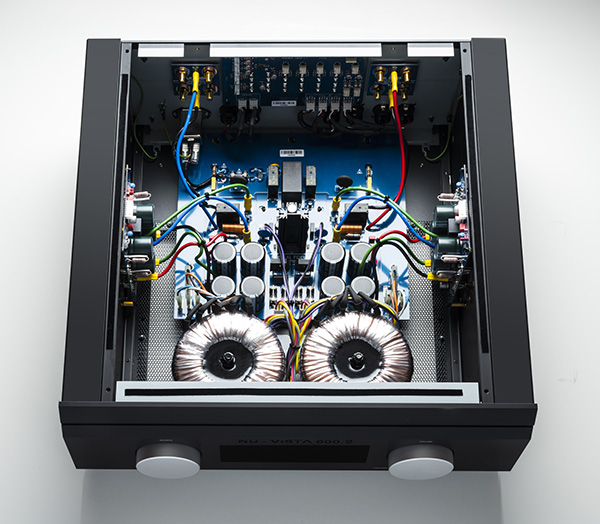 Topologically, this is a symmetrical, dual-mono amplifier, conveniently built in a single case, with dual toroidal power transformers, one for each channel, feeding an array of four high-capacity reservoir capacitors, one for each transistor. This arrangement is said to result in "better transient response and coincidentally ... improved ripple filtering at higher currents in conjunction with the supply capacitors situated elsewhere. The main supply capacitors are situated right on the rectifiers, also decreasing supply impedance and helping to keep rectification and hum noise away from the high-gain PA circuit."
The integrated circuit employed previously for input-source switching has been swapped for discrete relays. This should result in reduced crosstalk and greater contact integrity. Select polypropylene capacitors are used throughout the signal path.
The 600.2 has generous standing current—10Wpc biased into class-A, leading to nearly 50Wpc of power draw at idle mitigated by auto-standby, which is to say, the amplifier turns off when it's inactive. In standby, the amplifier draws less than 0.5W, and an LED light array glows pale blue as it awaits the "power up" command. When that command arrives, the array shifts first to red (indicating a Mute condition) and then, when operational, to orange, resembling a heated tube cathode.
I found that the 600.2 reached peak performance in short order; extended warmup was not required, though I heard a modest improvement over the first few minutes playing music.
The sound
Topologically, this is a symmetrical, dual-mono amplifier, conveniently built in a single case, with dual toroidal power transformers, one for each channel, feeding an array of four high-capacity reservoir capacitors, one for each transistor. This arrangement is said to result in "better transient response and coincidentally ... improved ripple filtering at higher currents in conjunction with the supply capacitors situated elsewhere. The main supply capacitors are situated right on the rectifiers, also decreasing supply impedance and helping to keep rectification and hum noise away from the high-gain PA circuit."
The integrated circuit employed previously for input-source switching has been swapped for discrete relays. This should result in reduced crosstalk and greater contact integrity. Select polypropylene capacitors are used throughout the signal path.
The 600.2 has generous standing current—10Wpc biased into class-A, leading to nearly 50Wpc of power draw at idle mitigated by auto-standby, which is to say, the amplifier turns off when it's inactive. In standby, the amplifier draws less than 0.5W, and an LED light array glows pale blue as it awaits the "power up" command. When that command arrives, the array shifts first to red (indicating a Mute condition) and then, when operational, to orange, resembling a heated tube cathode.
I found that the 600.2 reached peak performance in short order; extended warmup was not required, though I heard a modest improvement over the first few minutes playing music.
The sound
At the outset, I decided that the claim of a largely "analog" sonic character had been met. There was barely a trace of electronicky hardness or glare. It was obvious that the 600.2 made generous power available: There was no sense of any power limitation during large dynamic peaks. That power came with precision, natural timbre, and a well-focused power in the bass; the bass impressed right away. My speakers seemed to gain perhaps 10Hz of firm bass extension, perhaps to 33Hz in my room. There is no denying the massive headroom this powerful amplifier possesses, a subtle lifting of that evanescent dynamic ceiling that the largest amplifiers can impart. It really does have a natural, rather analog character. It warms up rapidly, reaching optimal performance within a few minutes from cold, its transparency improving over the first 10 minutes or so, after which point the listener is invited into a spacious stereo soundstage.
The review sample had some use on it and did not take long to settle. From standby, it sounded good right away, thanks no doubt to the generous output-stage biasing.
 The members of our listening team turned up right on cue. Tony Faulkner, Jon Honeyball, and I were eager to hear how consonant the 600.2 would be with analog sources in particular. I powered up my trusty references, the Linn/Naim LP playback chain, LP12-Armageddon-Cirkus-Karousel-Radikal–Naim ARO–Lyra Delos–Naim SuperLine-SuperCap RIAA EQ. I had not played LPs for a couple of weeks and had warmed up this signal chain for a day or two before serious listening. I began with original pressings of the pre-digital (1977) Bach Brandenburg Concertos LPs on Decca, with Benjamin Britten conducting at the Snape Maltings Concert Hall (LP, Decca SET 410-11), which Britten himself established.
At the very beginning, when the whole system was dead cold, the sound was a little recessed. A few minutes from switch-on, the 600.2 took control, first with convincing imaging and then with a stable focus on the performers, their timing, and their musical interplay. The stereo image was solid and concentrated, also spacious, with good perspectives. There was a natural bounce and vitality to this densely scored classical work, and we stayed with it to its conclusion to hear how it panned out.
The sweet sound of the contemporary recording electronics was unmistakable; that's a tribute to the transparency and neutrality of the 600.2. The digital transcription of this Brandenburg, on CD or streaming, is good, but it lacks the vitality and charm of this all-analog precursor.
Curiosity led me to an early mono edition of Dylan's Blowin' in the Wind (LP, BPG 62193), a recent purchase for a few pounds from the charity shop. This record is well worn, yet the 600.2 (with the rest of the system) readily conveyed the intimate atmosphere of this amazingly communicative solo performance. Once the record was playing, I could not bear to lift the needle, despite the wear.
I then tried my near-mint stereo cut of the same album and was disappointed. The sense of communication was lost thanks to this unconvincing acoustic, where the secondary isolated sound sources were panpotted across the front field like poster cutouts. At that same village junk shop, a solo piano recording on the Supraphon label had turned up, in better condition than expected. It was Sviatoslav Richter in his prime, Rachmaninoff's Prelude Op.23 No.5, a 1987 reissue (LP, Supraphon 10 4108). The 1960 recording was, of course, analog. I heard a few clicks in the early grooves, but after that, silence.
Richter's performance was articulate and spellbinding—expressive, commanding, and explosively dynamic. I suspect the very loudest moments were allowed to nudge the rails of the recorder. The Nu-Vista 600.2 could play realistically loud on this raw recording, delivering drama in spades and stunningly explosive dynamics.
The members of our listening team turned up right on cue. Tony Faulkner, Jon Honeyball, and I were eager to hear how consonant the 600.2 would be with analog sources in particular. I powered up my trusty references, the Linn/Naim LP playback chain, LP12-Armageddon-Cirkus-Karousel-Radikal–Naim ARO–Lyra Delos–Naim SuperLine-SuperCap RIAA EQ. I had not played LPs for a couple of weeks and had warmed up this signal chain for a day or two before serious listening. I began with original pressings of the pre-digital (1977) Bach Brandenburg Concertos LPs on Decca, with Benjamin Britten conducting at the Snape Maltings Concert Hall (LP, Decca SET 410-11), which Britten himself established.
At the very beginning, when the whole system was dead cold, the sound was a little recessed. A few minutes from switch-on, the 600.2 took control, first with convincing imaging and then with a stable focus on the performers, their timing, and their musical interplay. The stereo image was solid and concentrated, also spacious, with good perspectives. There was a natural bounce and vitality to this densely scored classical work, and we stayed with it to its conclusion to hear how it panned out.
The sweet sound of the contemporary recording electronics was unmistakable; that's a tribute to the transparency and neutrality of the 600.2. The digital transcription of this Brandenburg, on CD or streaming, is good, but it lacks the vitality and charm of this all-analog precursor.
Curiosity led me to an early mono edition of Dylan's Blowin' in the Wind (LP, BPG 62193), a recent purchase for a few pounds from the charity shop. This record is well worn, yet the 600.2 (with the rest of the system) readily conveyed the intimate atmosphere of this amazingly communicative solo performance. Once the record was playing, I could not bear to lift the needle, despite the wear.
I then tried my near-mint stereo cut of the same album and was disappointed. The sense of communication was lost thanks to this unconvincing acoustic, where the secondary isolated sound sources were panpotted across the front field like poster cutouts. At that same village junk shop, a solo piano recording on the Supraphon label had turned up, in better condition than expected. It was Sviatoslav Richter in his prime, Rachmaninoff's Prelude Op.23 No.5, a 1987 reissue (LP, Supraphon 10 4108). The 1960 recording was, of course, analog. I heard a few clicks in the early grooves, but after that, silence.
Richter's performance was articulate and spellbinding—expressive, commanding, and explosively dynamic. I suspect the very loudest moments were allowed to nudge the rails of the recorder. The Nu-Vista 600.2 could play realistically loud on this raw recording, delivering drama in spades and stunningly explosive dynamics.
 Turning to digital, happenstance led to Gustave Leonhart Concentus Musicus Wien playing J.S. Bach's Harpsichord Concertos in a 1995 recording (CD, Teldec 4509-97452-2). This is a digital transcription from the Teldec analog master. Replay was from an old Ariston CD transport feeding the Naim ND555 streamer/DAC by S/PDIF. The soundstage seemed mildly constrained at first, and a few minutes of play were necessary before we felt properly invited into this recording's drier acoustic. Acclimatization achieved, we began to appreciate this fine production. The performance took command and was not interrupted further thanks to the fine sound quality.
We had access to some raw, unedited orchestral outtakes recorded at 24/192 using recently restored triode-powered microphones. This promised to be a rewarding experience, and it was. The content must remain confidential for now, but the sound quality was unmistakably state of the art: utterly grainless, unlimited, flowing. There is hope for us yet in this digitized world. While my main system (including amplifiers) revealed much of the full extent of this delightful program content, it sounded very fine indeed on the Musical Fidelity Nu-Vista 600.2.
Served by Roon from my digital files at 24/96, London Grammar's "Hey Now" from the album If You Wait generated the usual massive envelopment and more: now, here was a fine sense of power and control, of scale and weight—indeed, of grace, especially from Hannah Reid's soaring vocals. There was that fulsome, well-controlled, well-timed baseline. The headroom seemed unlimited—say, a steadier-paced five-liter V8 compared with a turbocharged much smaller motor. You felt as if you could continue to mine this mind-filling experience for still more musical pleasure. On "Paper Aeroplane" from Memories of an Old Friend by Angus and Julia Stone (CD, EMI 0947432), the staging performance sounded crisp, bold, live, and delightfully immediate. Fink's Foot in the Door on Perfect Darkness (CD rip, ZENCD170) possessed fine vocal immediacy and projection, with the right degree of weighted attack in the bass. That massive MF power supply was facilitating impressive dynamics.
With larger works, this Nu-Vista design conveys a certain focus, gathering the notes to present them in well-dimensioned, highly spatial, very musical performances in your listening room. Call it image scale.
Turning to digital, happenstance led to Gustave Leonhart Concentus Musicus Wien playing J.S. Bach's Harpsichord Concertos in a 1995 recording (CD, Teldec 4509-97452-2). This is a digital transcription from the Teldec analog master. Replay was from an old Ariston CD transport feeding the Naim ND555 streamer/DAC by S/PDIF. The soundstage seemed mildly constrained at first, and a few minutes of play were necessary before we felt properly invited into this recording's drier acoustic. Acclimatization achieved, we began to appreciate this fine production. The performance took command and was not interrupted further thanks to the fine sound quality.
We had access to some raw, unedited orchestral outtakes recorded at 24/192 using recently restored triode-powered microphones. This promised to be a rewarding experience, and it was. The content must remain confidential for now, but the sound quality was unmistakably state of the art: utterly grainless, unlimited, flowing. There is hope for us yet in this digitized world. While my main system (including amplifiers) revealed much of the full extent of this delightful program content, it sounded very fine indeed on the Musical Fidelity Nu-Vista 600.2.
Served by Roon from my digital files at 24/96, London Grammar's "Hey Now" from the album If You Wait generated the usual massive envelopment and more: now, here was a fine sense of power and control, of scale and weight—indeed, of grace, especially from Hannah Reid's soaring vocals. There was that fulsome, well-controlled, well-timed baseline. The headroom seemed unlimited—say, a steadier-paced five-liter V8 compared with a turbocharged much smaller motor. You felt as if you could continue to mine this mind-filling experience for still more musical pleasure. On "Paper Aeroplane" from Memories of an Old Friend by Angus and Julia Stone (CD, EMI 0947432), the staging performance sounded crisp, bold, live, and delightfully immediate. Fink's Foot in the Door on Perfect Darkness (CD rip, ZENCD170) possessed fine vocal immediacy and projection, with the right degree of weighted attack in the bass. That massive MF power supply was facilitating impressive dynamics.
With larger works, this Nu-Vista design conveys a certain focus, gathering the notes to present them in well-dimensioned, highly spatial, very musical performances in your listening room. Call it image scale.
 I reached instinctively for Steve Reich's Sextet in Five Movements (CD, Nonesuch 979 138-2). I have played this work—this disc—often. Those complex percussion patterns and varied, subtle timbres now seem to be woven into my consciousness. With this music, some review components do well on the rhythmic interplay while other components explore depth, focus, and the characteristic timbres of the many tuneful percussion lines. This Musical Fidelity amplifier did both well while constructing a soundstage imbued with a fine sense of space, generously dimensioned but dry enough for the near dazzling, subtly layered complexity of this work to be rendered explicit.
Laid-back heavyweight
I reached instinctively for Steve Reich's Sextet in Five Movements (CD, Nonesuch 979 138-2). I have played this work—this disc—often. Those complex percussion patterns and varied, subtle timbres now seem to be woven into my consciousness. With this music, some review components do well on the rhythmic interplay while other components explore depth, focus, and the characteristic timbres of the many tuneful percussion lines. This Musical Fidelity amplifier did both well while constructing a soundstage imbued with a fine sense of space, generously dimensioned but dry enough for the near dazzling, subtly layered complexity of this work to be rendered explicit.
Laid-back heavyweight
The Musical Fidelity Nu-Vista 600.2 integrated amplifier is exceptionally powerful and load-tolerant and essentially neutral in timbre. It rewards listeners with fine transparency and detail. In reviewing the original Nu-Vista 800 a decade ago, I noted that I could have used a bit more pace and rhythm. Concentrated attention to the finer details of circuit design and topology has apparently paid off. With this second-generation Nu-Vista 600, I noted more introspection, transparency, vitality, dynamic expression, and temporal focus. The results of our analytical testing approached textbook standard—and that is how I think it sounds. Without a hint that it is working to force the pace, it powers its way through even the most complex and characterful tracks, delivering convincing and satisfying performances with dynamic authority and a grand sense of scale. It carves an even-handed, neutral path whether the music is delicate classical or head-banging rock.
Of distinctive, pleasingly symmetrical appearance, the 600.2's aluminum-alloy fascia is cut from a substantial, finely machined extrusion. A color display and two large rotary knobs dominate the fascia: source selection on the left, volume control on the right. There is no channel-balance knob. The color display offers simulated VU meters of wide dynamic range, calibrated both in watts (based on an 8 ohm load) and in dB relative to full power. The meter's ballistics are not disclosed, but they appear to be of the averaging "VU," volume-unit variety. The display also indicates the chosen input mode (eg, "Balanced 1" or "Auxiliary 1"3) and the volume attenuation, eg, –42.0dB. When that numerical display reads "0dB," the amplifier has reached its maximum power, specified as 160Wpc into 8 ohms or 300Wpc into 4 ohms.
Front-panel buttons control display lighting color—white or blue—and let you choose the display mode for the meters: watts or dB. Even at moderate listening levels, those needles barely flicker. The IR beam from the remote handset is directional, though when it is pointed directly at the front panel, it has a good range.
On the rear panel are heavy-duty speaker outputs (4mm socket/binding posts) for left and right channels—two sets, to facilitate biwiring. A handsome array of gold-plated phono sockets in the middle of the back panel are labeled CD, Aux 1, Aux 2, and Tuner. Two additional pairs offer, respectively, fixed line-level output and volume-controlled line-level output ("pre out"). Along the bottom of the back panel are XLR sockets for two pairs of balanced-mode inputs and matching balanced line-level outputs. Though all-analog and functionally simple, the 600.2 is versatile and well-equipped.
The tech storyNuvistors are miniature thermionic tubes. Introduced in 1959, they were intended to compete with early bipolar-junction transistors with their toughness and small size. They're smaller than most tubes, about the size of an acorn. Their microphony is close to zero, which should mean low sonic coloration. As for toughness, they're radiation hardened and designed to survive the high accelerations encountered in rocketry. You can expect a long service life—very long relative to most hi-fi tubes. In an email, Lichtenegger told Editor Jim Austin that the service life of a nuvistor was "definitely more than 100,000 hours," though other estimates put the lifetime anywhere between 5000 and 20,000 hours; a tube's lifetime, after all, depends on how it's implemented. In any case, unless there's a malfunction, you probably won't need to replace a nuvistor.
Topologically, this is a symmetrical, dual-mono amplifier, conveniently built in a single case, with dual toroidal power transformers, one for each channel, feeding an array of four high-capacity reservoir capacitors, one for each transistor. This arrangement is said to result in "better transient response and coincidentally ... improved ripple filtering at higher currents in conjunction with the supply capacitors situated elsewhere. The main supply capacitors are situated right on the rectifiers, also decreasing supply impedance and helping to keep rectification and hum noise away from the high-gain PA circuit."
The integrated circuit employed previously for input-source switching has been swapped for discrete relays. This should result in reduced crosstalk and greater contact integrity. Select polypropylene capacitors are used throughout the signal path.
The 600.2 has generous standing current—10Wpc biased into class-A, leading to nearly 50Wpc of power draw at idle mitigated by auto-standby, which is to say, the amplifier turns off when it's inactive. In standby, the amplifier draws less than 0.5W, and an LED light array glows pale blue as it awaits the "power up" command. When that command arrives, the array shifts first to red (indicating a Mute condition) and then, when operational, to orange, resembling a heated tube cathode.
At the outset, I decided that the claim of a largely "analog" sonic character had been met. There was barely a trace of electronicky hardness or glare. It was obvious that the 600.2 made generous power available: There was no sense of any power limitation during large dynamic peaks. That power came with precision, natural timbre, and a well-focused power in the bass; the bass impressed right away. My speakers seemed to gain perhaps 10Hz of firm bass extension, perhaps to 33Hz in my room. There is no denying the massive headroom this powerful amplifier possesses, a subtle lifting of that evanescent dynamic ceiling that the largest amplifiers can impart. It really does have a natural, rather analog character. It warms up rapidly, reaching optimal performance within a few minutes from cold, its transparency improving over the first 10 minutes or so, after which point the listener is invited into a spacious stereo soundstage.
The members of our listening team turned up right on cue. Tony Faulkner, Jon Honeyball, and I were eager to hear how consonant the 600.2 would be with analog sources in particular. I powered up my trusty references, the Linn/Naim LP playback chain, LP12-Armageddon-Cirkus-Karousel-Radikal–Naim ARO–Lyra Delos–Naim SuperLine-SuperCap RIAA EQ. I had not played LPs for a couple of weeks and had warmed up this signal chain for a day or two before serious listening. I began with original pressings of the pre-digital (1977) Bach Brandenburg Concertos LPs on Decca, with Benjamin Britten conducting at the Snape Maltings Concert Hall (LP, Decca SET 410-11), which Britten himself established.
At the very beginning, when the whole system was dead cold, the sound was a little recessed. A few minutes from switch-on, the 600.2 took control, first with convincing imaging and then with a stable focus on the performers, their timing, and their musical interplay. The stereo image was solid and concentrated, also spacious, with good perspectives. There was a natural bounce and vitality to this densely scored classical work, and we stayed with it to its conclusion to hear how it panned out.
Turning to digital, happenstance led to Gustave Leonhart Concentus Musicus Wien playing J.S. Bach's Harpsichord Concertos in a 1995 recording (CD, Teldec 4509-97452-2). This is a digital transcription from the Teldec analog master. Replay was from an old Ariston CD transport feeding the Naim ND555 streamer/DAC by S/PDIF. The soundstage seemed mildly constrained at first, and a few minutes of play were necessary before we felt properly invited into this recording's drier acoustic. Acclimatization achieved, we began to appreciate this fine production. The performance took command and was not interrupted further thanks to the fine sound quality.
We had access to some raw, unedited orchestral outtakes recorded at 24/192 using recently restored triode-powered microphones. This promised to be a rewarding experience, and it was. The content must remain confidential for now, but the sound quality was unmistakably state of the art: utterly grainless, unlimited, flowing. There is hope for us yet in this digitized world. While my main system (including amplifiers) revealed much of the full extent of this delightful program content, it sounded very fine indeed on the Musical Fidelity Nu-Vista 600.2.
I reached instinctively for Steve Reich's Sextet in Five Movements (CD, Nonesuch 979 138-2). I have played this work—this disc—often. Those complex percussion patterns and varied, subtle timbres now seem to be woven into my consciousness. With this music, some review components do well on the rhythmic interplay while other components explore depth, focus, and the characteristic timbres of the many tuneful percussion lines. This Musical Fidelity amplifier did both well while constructing a soundstage imbued with a fine sense of space, generously dimensioned but dry enough for the near dazzling, subtly layered complexity of this work to be rendered explicit.
The Musical Fidelity Nu-Vista 600.2 integrated amplifier is exceptionally powerful and load-tolerant and essentially neutral in timbre. It rewards listeners with fine transparency and detail. In reviewing the original Nu-Vista 800 a decade ago, I noted that I could have used a bit more pace and rhythm. Concentrated attention to the finer details of circuit design and topology has apparently paid off. With this second-generation Nu-Vista 600, I noted more introspection, transparency, vitality, dynamic expression, and temporal focus. The results of our analytical testing approached textbook standard—and that is how I think it sounds. Without a hint that it is working to force the pace, it powers its way through even the most complex and characterful tracks, delivering convincing and satisfying performances with dynamic authority and a grand sense of scale. It carves an even-handed, neutral path whether the music is delicate classical or head-banging rock.