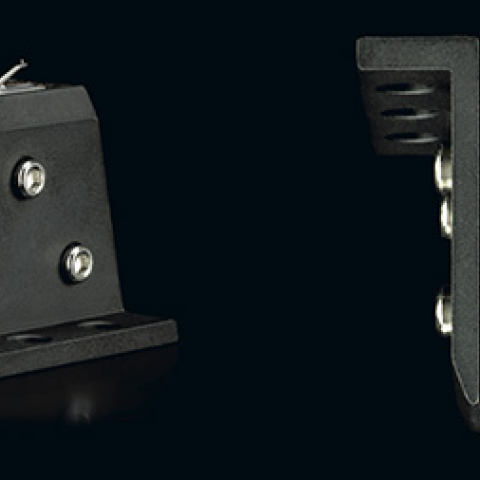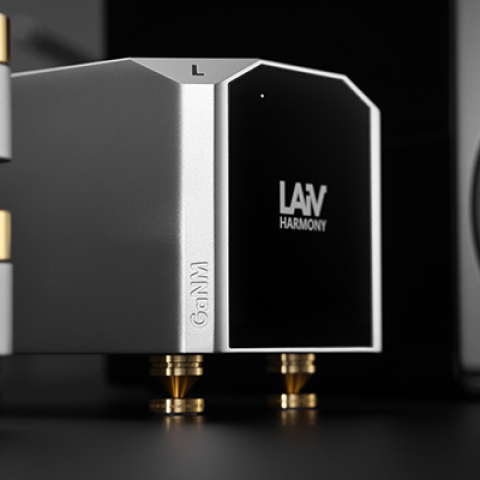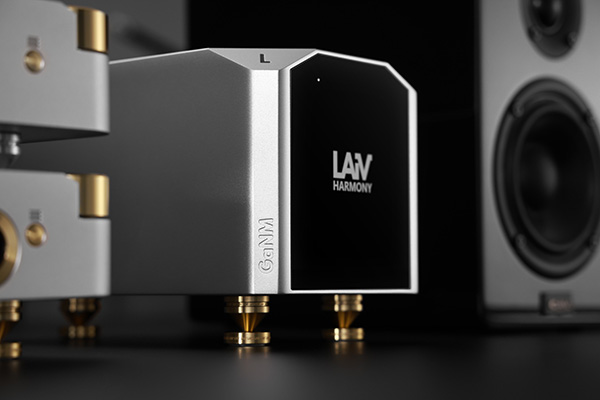
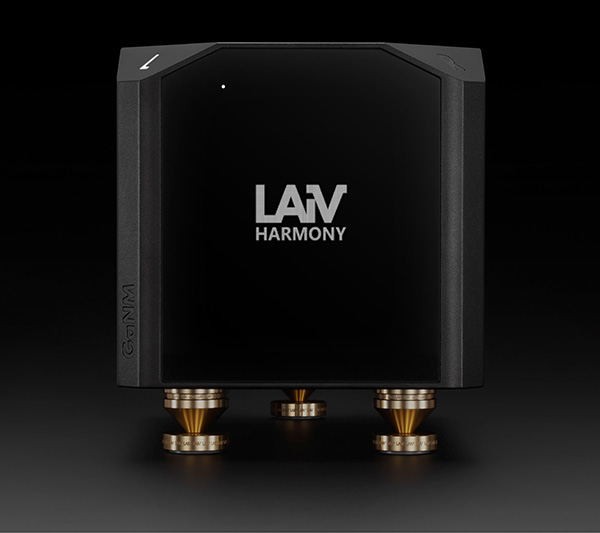
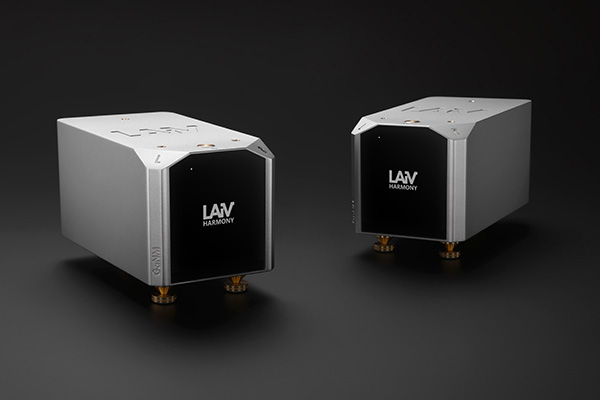
The first thing I noticed about the LAiV Audio GaNM monoblock amplifier ($4694/pair; footnote 1) is its unusual shape and size; it occupies space differently than the other, more basic amplifiers on my rack. The GaNMs sat there giving off a megalithic vibe. In either of their two finishes (silver and gold or black and gold), the solidity and seriousness of their sculptural form upstaged any glamor effects offered by their glossy OLED front panel, deeply engraved top-plate logo, and gold accents.
The LAiV Harmony GaNM monoblock
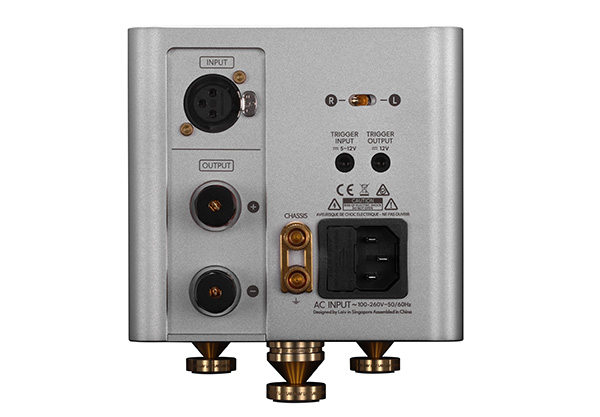
Opening a LAiV product box is a step-by-step graphically choreographed introduction to the company's aesthetic and forward-thinking engineering perspective. When I reviewed LAiV's Harmony µDAC in Stereophile's December 2025 issue, I was memorably impressed with the stylish intelligence of its packaging, but having now experienced unboxing the GaNM monoblocks, too, I understand better what LAiV is up to: They use their top-notch industrial design and smart product packaging like a smile and a handshake, greeting customers and helping them feel wise and safe for choosing the LAiV brand. Viewing their well-designed website has the same effect. According to the specifications on that website, each GaNM monoblock delivers 200 class-D watts into 8 ohms (footnote 2). Each chassis measures just 4.7" high, 5" wide, and 10.2" deep and weighs just 8.6lb. The only input is balanced (XLR) with a 94k ohm input impedance and a 1.4V sensitivity (for full output).
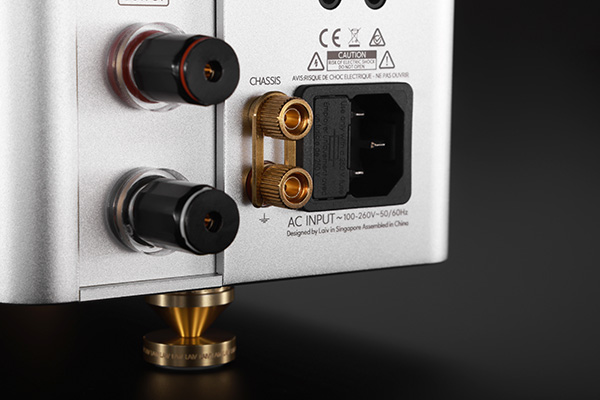
Gain is a highish 29dB. The power supply is a cool-running switching type, located inside the chassis (no wall wart). Its outputs feature high-quality binding posts that accept either spades or bananas.
The front-page news with the new LAiV monoblocks is gallium nitride FET transistors, used with no loop feedback. That's why I decided to audition these mysterious monoblocks: I was curious about class-D without global feedback.
 Listening: The hardest part of making a painting is getting up out of the chair, walking over to the canvas, dipping a brush in paint, and making a mark. It's the hardest part, yet any mark will do. That's because, for me, it is just a "start mark." Its job is to start flipping switches in my brain. Shutting off fear and vanity. The start mark initiates the closing of open thought windows, which continues until, free of distractions, my brain zones in and makes a second mark, followed by a thin wash and some charcoal lines. Then my mind's all in.
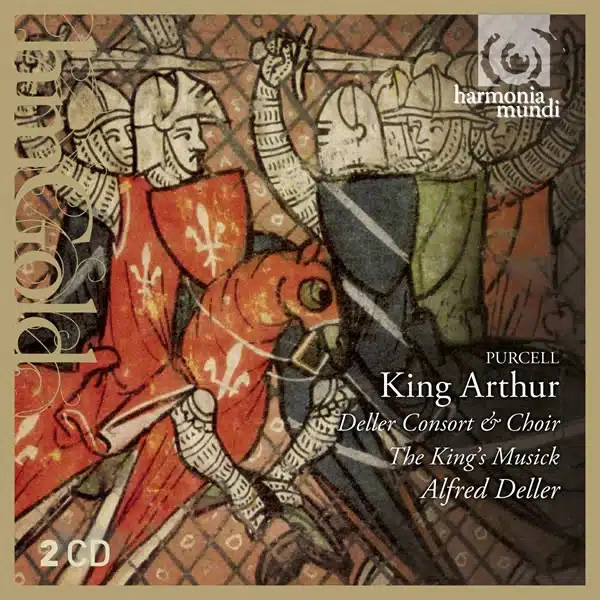
I'm describing how my brain works for painting because something similar happens for listening. I am sitting here now locked on to the inner workings of Henry Purcell's (1659–1695) King Arthur (extraits) played by the Deller Consort and Choir (HM E200). I am in awe of Purcell's, Alfred Deller's, and Harmonia Mundi France's ability to create such a fantastic visual spectacle between my speakers and in my mind. For this "lock on" to occur, my brain had to flip those same switches and close those same distracting thought windows. And guess what? The hardest part was getting up and pulling out the record. The start mark was the sound of the diamond contacting the record's surface. Soon after that, my mind was all in.
Listening: The hardest part of making a painting is getting up out of the chair, walking over to the canvas, dipping a brush in paint, and making a mark. It's the hardest part, yet any mark will do. That's because, for me, it is just a "start mark." Its job is to start flipping switches in my brain. Shutting off fear and vanity. The start mark initiates the closing of open thought windows, which continues until, free of distractions, my brain zones in and makes a second mark, followed by a thin wash and some charcoal lines. Then my mind's all in.
I'm describing how my brain works for painting because something similar happens for listening. I am sitting here now locked on to the inner workings of Henry Purcell's (1659–1695) King Arthur (extraits) played by the Deller Consort and Choir (HM E200). I am in awe of Purcell's, Alfred Deller's, and Harmonia Mundi France's ability to create such a fantastic visual spectacle between my speakers and in my mind. For this "lock on" to occur, my brain had to flip those same switches and close those same distracting thought windows. And guess what? The hardest part was getting up and pulling out the record. The start mark was the sound of the diamond contacting the record's surface. Soon after that, my mind was all in.
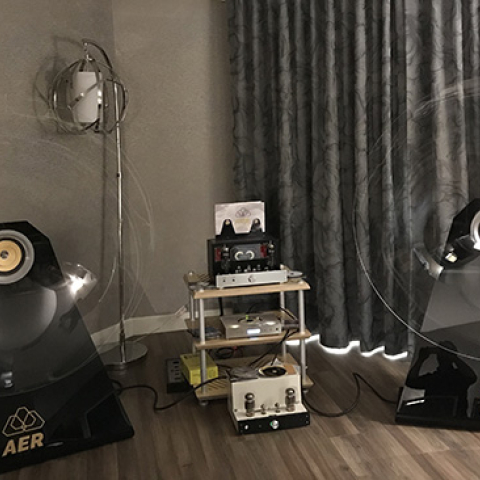
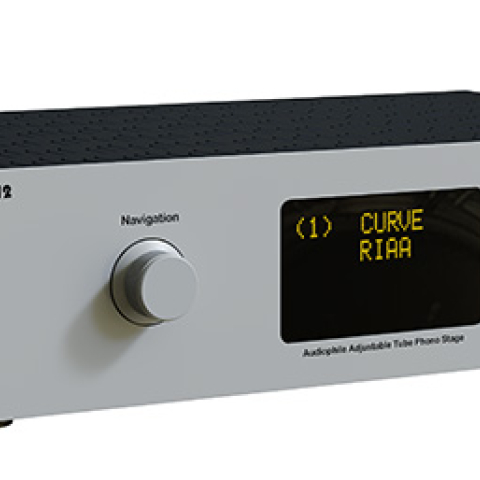
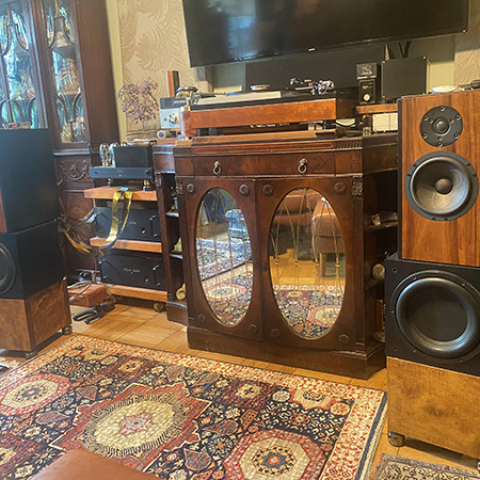
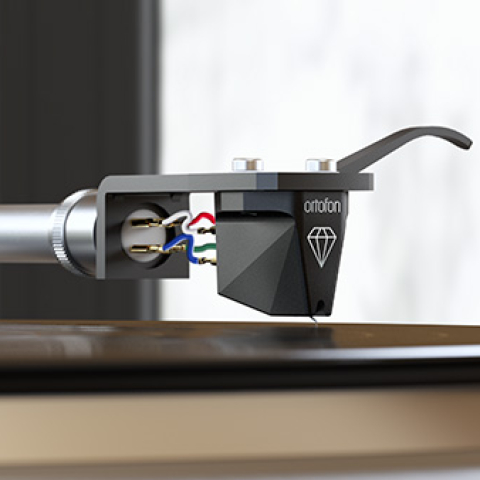
 The diamond that triggered this Henry Purcell start mark was attached to the Tzar Audio DST V1 Black Knight Corian moving coil cartridge into Lab12's Melto2 phono amplifier into the HoloAudio Serene line-level preamp into LAiV Audio's GaNM monoblock amplifiers driving my Falcon Gold Badge LS3/5a's. This component grouping showed me, in black and white, the singing faces of Deller's consort and choir and their relative positions in the recording venue. The microphones were my surrogate eyes. Those singing faces and Purcell's danceable tunes were a cheerful much-desired mood changer that kept my attention on the performances.
There was no blurring, hash, or uncertainty at the top or bottom of the Falcon's passband. No grain or noise. Only pure sound.
Purcell's most complex passages paraded through my room with a greater physicality and transparency but less color and sensuality than with the First Watt SIT-4.
The diamond that triggered this Henry Purcell start mark was attached to the Tzar Audio DST V1 Black Knight Corian moving coil cartridge into Lab12's Melto2 phono amplifier into the HoloAudio Serene line-level preamp into LAiV Audio's GaNM monoblock amplifiers driving my Falcon Gold Badge LS3/5a's. This component grouping showed me, in black and white, the singing faces of Deller's consort and choir and their relative positions in the recording venue. The microphones were my surrogate eyes. Those singing faces and Purcell's danceable tunes were a cheerful much-desired mood changer that kept my attention on the performances.
There was no blurring, hash, or uncertainty at the top or bottom of the Falcon's passband. No grain or noise. Only pure sound.
Purcell's most complex passages paraded through my room with a greater physicality and transparency but less color and sensuality than with the First Watt SIT-4.
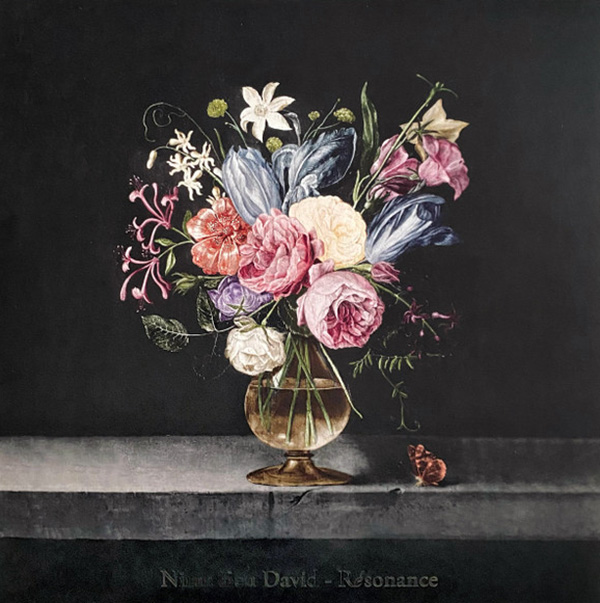 To take a look at how the GaNM presented force and texture, I played Todd Garfinkle's LP Résonance (M•A Recordings LP M088A-V), a masterpiece of recording from 2010 (now repressed to a level of quality that makes it the flattest, quietest black disc I've ever seen). Résonance features Nima Ben David performing a variety of composers' works on viola da gamba. From this super-silent, super-natural recording, I could sense through the Falcons how Ben David's instrument pressurized the air in front of Garfinkle's microphones and how that pressurized air was now energizing the space between my speakers. This recording forced my attention toward vibration-filled air, high-textured tones, and wave after wave of morphing harmonics.
Through my system, the textures of these harmonics were about as tangible as any I've experienced coming out of the little Falcon boxes. Definitely a "wow" moment. Maybe these LAiV monoblocks were emphasizing transients and kicking up the touch factor? Maybe the Falcons needed more quick-firing current to display these subtleties? Whatever the reason, Nima Ben David's viola da gamba sounded dockworker muscular with the Tzar DST and black-tights modern-dancer lithe with the My Sonic Lab Ultra Eminent Ex. This almost humorous comparison provided insight into both cartridges' characters.
As I switched between the GaNM, First Watt SIT-4, and Parasound Halo A21+ power amps, this dockworker-dancer contrast was most obvious with the LAiV GaNM. I took that as a promising sign of the GaNM's ability to push low-level dynamics through a 15 ohm load, something other class-D amps have struggled with.
To take a look at how the GaNM presented force and texture, I played Todd Garfinkle's LP Résonance (M•A Recordings LP M088A-V), a masterpiece of recording from 2010 (now repressed to a level of quality that makes it the flattest, quietest black disc I've ever seen). Résonance features Nima Ben David performing a variety of composers' works on viola da gamba. From this super-silent, super-natural recording, I could sense through the Falcons how Ben David's instrument pressurized the air in front of Garfinkle's microphones and how that pressurized air was now energizing the space between my speakers. This recording forced my attention toward vibration-filled air, high-textured tones, and wave after wave of morphing harmonics.
Through my system, the textures of these harmonics were about as tangible as any I've experienced coming out of the little Falcon boxes. Definitely a "wow" moment. Maybe these LAiV monoblocks were emphasizing transients and kicking up the touch factor? Maybe the Falcons needed more quick-firing current to display these subtleties? Whatever the reason, Nima Ben David's viola da gamba sounded dockworker muscular with the Tzar DST and black-tights modern-dancer lithe with the My Sonic Lab Ultra Eminent Ex. This almost humorous comparison provided insight into both cartridges' characters.
As I switched between the GaNM, First Watt SIT-4, and Parasound Halo A21+ power amps, this dockworker-dancer contrast was most obvious with the LAiV GaNM. I took that as a promising sign of the GaNM's ability to push low-level dynamics through a 15 ohm load, something other class-D amps have struggled with.
 Curious to see what the GaNM amps could do with the 10.3 ohm, 95dB-sensitive Voxativ Hagen2 loudspeakers, I used the Ultra Eminent Ex to play Résonance again. With the Hagen2s, the My Sonic Lab cartridge sounded substantially more muscular, with thicker bones and meatier flesh. Locomotion and jump factors increased by 20%–30%. Through the Hagen2s, the Ultra Eminent Ex sounded more completely fleshed out. And all I did was change the speaker. I think the GaNM amps did the rest.
I was impressed by how this ballet dancer, runway model moving coil could suddenly sound so pushy and muscular when the recording called for it.
Compared to two traditional solid state amplifiers: Years ago, I chose Parasound's Halo A21+ as my chief reviewer-reference amp because it powered all my speakers with old school linearity and never sounded dry or hard or transistory (footnote 3). Also because it was equally comfortable with 1 ohm and 15 ohm speaker loads. Best of all, it has added soundstage depth and inner detail to every speaker I've connected it to.
When I substituted the A21+, I was struck by how bright and forward the LAiV GaNM sounded. Same with the First Watt SIT-4—both transistor amps sounded darker and more recessed. Through the Voxativs and their full-range paper drivers, the GaNM presented like the sonic equivalent of a slightly overexposed photograph, but never once was it hard or strident. That brightness reduced contrasts slightly but did not fog the LAiV's transparency. The LAiV monoblocks made both the SIT-4 and the A21+ seem less than perfectly clear.
The silences in Todd Garfinkle's Résonance LP showed me how the GaNM's version of transparency was not like other transparencies I've experienced. It didn't sound digital or analog. I wouldn't call it natural or unnatural. With the Hagen2s, the GaNMs presented a cleaner, more spatial space, with more big-sound vibrancy than the SIT-4 or A21+.
Curious to see what the GaNM amps could do with the 10.3 ohm, 95dB-sensitive Voxativ Hagen2 loudspeakers, I used the Ultra Eminent Ex to play Résonance again. With the Hagen2s, the My Sonic Lab cartridge sounded substantially more muscular, with thicker bones and meatier flesh. Locomotion and jump factors increased by 20%–30%. Through the Hagen2s, the Ultra Eminent Ex sounded more completely fleshed out. And all I did was change the speaker. I think the GaNM amps did the rest.
I was impressed by how this ballet dancer, runway model moving coil could suddenly sound so pushy and muscular when the recording called for it.
Compared to two traditional solid state amplifiers: Years ago, I chose Parasound's Halo A21+ as my chief reviewer-reference amp because it powered all my speakers with old school linearity and never sounded dry or hard or transistory (footnote 3). Also because it was equally comfortable with 1 ohm and 15 ohm speaker loads. Best of all, it has added soundstage depth and inner detail to every speaker I've connected it to.
When I substituted the A21+, I was struck by how bright and forward the LAiV GaNM sounded. Same with the First Watt SIT-4—both transistor amps sounded darker and more recessed. Through the Voxativs and their full-range paper drivers, the GaNM presented like the sonic equivalent of a slightly overexposed photograph, but never once was it hard or strident. That brightness reduced contrasts slightly but did not fog the LAiV's transparency. The LAiV monoblocks made both the SIT-4 and the A21+ seem less than perfectly clear.
The silences in Todd Garfinkle's Résonance LP showed me how the GaNM's version of transparency was not like other transparencies I've experienced. It didn't sound digital or analog. I wouldn't call it natural or unnatural. With the Hagen2s, the GaNMs presented a cleaner, more spatial space, with more big-sound vibrancy than the SIT-4 or A21+.
 While the GaNMs were in the system, I decided to switch back to the Falcon speakers. I had an urge to check the LAiV's tone while playing Jarsden Fendrix's soundtrack to Yorgos Lanthimos's 2023 film Poor Things (24/48 FLAC Milan/Qobuz). This recording is my tone-and-tempo litmus test. With the HiFi Rose RD160 DAC (reviewed elsewhere in this issue) into the Serene preamp into the LAiV monoblocks, I heard deeper, more powerful, better-described bass than (I swear) I'd ever thought possible from the LS3/5a's. This was the #1 most "wow" discovery about the LAiV GaNM amps. Tone leaned toward cool but was still near perfect. The forms of bass sounds literally jumped out, with touchable presence and vivid detail.
The Falcon's 50–400Hz octaves presented images like those from a Weegee-era glass-bulb flash photo. The LAiV reduced low-frequency shadowing, brought bad-ass low notes out of the depths, brought performers in the foreground into extreme focus, and made every transient visible for admiration. I am not exaggerating: The tiny Gold Badges have never before shook floors and rattled windows like they did with the GaNM. Why were the LS3/5a's putting out this much more bass power with the LAiV monoblocks than they do with the Parasound A21+?
I can't answer that. But I was pleased by how effectively this class-D amp could drive 15 ohms. I hadn't seen that before. But how would it fare with 4 ohms, a tricky crossover, two passive radiators, and an AMT tweeter?
While the GaNMs were in the system, I decided to switch back to the Falcon speakers. I had an urge to check the LAiV's tone while playing Jarsden Fendrix's soundtrack to Yorgos Lanthimos's 2023 film Poor Things (24/48 FLAC Milan/Qobuz). This recording is my tone-and-tempo litmus test. With the HiFi Rose RD160 DAC (reviewed elsewhere in this issue) into the Serene preamp into the LAiV monoblocks, I heard deeper, more powerful, better-described bass than (I swear) I'd ever thought possible from the LS3/5a's. This was the #1 most "wow" discovery about the LAiV GaNM amps. Tone leaned toward cool but was still near perfect. The forms of bass sounds literally jumped out, with touchable presence and vivid detail.
The Falcon's 50–400Hz octaves presented images like those from a Weegee-era glass-bulb flash photo. The LAiV reduced low-frequency shadowing, brought bad-ass low notes out of the depths, brought performers in the foreground into extreme focus, and made every transient visible for admiration. I am not exaggerating: The tiny Gold Badges have never before shook floors and rattled windows like they did with the GaNM. Why were the LS3/5a's putting out this much more bass power with the LAiV monoblocks than they do with the Parasound A21+?
I can't answer that. But I was pleased by how effectively this class-D amp could drive 15 ohms. I hadn't seen that before. But how would it fare with 4 ohms, a tricky crossover, two passive radiators, and an AMT tweeter?
 I've given up on thinking of loudspeaker sensitivity ratings as even the slightest indicator of how a speaker might respond to a low-power amplifier. Especially when a power-sucking crossover is making waves in the impedance curve. GoldenEar's overachieving BRX standmounts are rated at 90dB/2.83V/1m with a nominal impedance of 8 ohms. JA's measurements tell a different story. "The BRX has minimum EPDRs of 2.15 ohms at 59Hz and 1.53 ohms at 135Hz, and the EPDR remains below 4 ohms in the midrange. This loudspeaker will work best with amplifiers that are comfortable driving loads below 4 ohms." That's why I decided to try the BRXs: to see how the GaNM drives recalcitrant loads.
The GoldenEar BRXs took more than a day to "loosen up" and sound as fluid and transparent as I know them to be. At first, they were thick and unclear, but they surrendered their full transparency when I played singer and harpist Arianna Savall and tenor Petter Udland Johansen's album, Silent Night – Early Christmas Music and Carols (24/96 FLAC Deutsche Harmonia Mundi/Qobuz). The tracks on Silent Night became my daily meditations on the yuletide (footnote 4).
Arianna's gambist/ensemble director father, Jordi Savall, is one of the major artists I've always enjoyed and admired. Arianna's mother, soprano Montserrat Figueras (1942–2011), was a goddess whose voice and face captured my heart in the 1980s. I still pine for more Montserrat, but this recording by her daughter enriched my month of December. The purity of its sound showed me that the 4 ohm BRX did not squirm or buckle under the GaNM's control. After three days, the tracks on Silent Night were haunting my waking hours with their dark cheer, sublime flow, and mesmerizing transparency.
I've given up on thinking of loudspeaker sensitivity ratings as even the slightest indicator of how a speaker might respond to a low-power amplifier. Especially when a power-sucking crossover is making waves in the impedance curve. GoldenEar's overachieving BRX standmounts are rated at 90dB/2.83V/1m with a nominal impedance of 8 ohms. JA's measurements tell a different story. "The BRX has minimum EPDRs of 2.15 ohms at 59Hz and 1.53 ohms at 135Hz, and the EPDR remains below 4 ohms in the midrange. This loudspeaker will work best with amplifiers that are comfortable driving loads below 4 ohms." That's why I decided to try the BRXs: to see how the GaNM drives recalcitrant loads.
The GoldenEar BRXs took more than a day to "loosen up" and sound as fluid and transparent as I know them to be. At first, they were thick and unclear, but they surrendered their full transparency when I played singer and harpist Arianna Savall and tenor Petter Udland Johansen's album, Silent Night – Early Christmas Music and Carols (24/96 FLAC Deutsche Harmonia Mundi/Qobuz). The tracks on Silent Night became my daily meditations on the yuletide (footnote 4).
Arianna's gambist/ensemble director father, Jordi Savall, is one of the major artists I've always enjoyed and admired. Arianna's mother, soprano Montserrat Figueras (1942–2011), was a goddess whose voice and face captured my heart in the 1980s. I still pine for more Montserrat, but this recording by her daughter enriched my month of December. The purity of its sound showed me that the 4 ohm BRX did not squirm or buckle under the GaNM's control. After three days, the tracks on Silent Night were haunting my waking hours with their dark cheer, sublime flow, and mesmerizing transparency.
 Everything I mock I become: Before the LAiV Harmony GaNM amp arrived, I had developed a yawning disinterest in class-D, plus an irrational disdain for fast-acting "high conductivity" GaN-FET transistors. (Last time I checked, free electrons were moving pretty fast already in 1000V vacuum tubes like a 211 or 845.) And everyone knows I've never been persuaded by weight, cost, and energy-saving switching power supplies. True to my boomer roots, I've stuck to old-school class-A linearity, plus wide bandwidth, tidy transfer functions, clean squarewaves, and lots of standing current.
What I care about most is tone, transparency, tactility, and having enough current and voltage to push the smallest recorded sounds and subtlest captured rhythms through diverse speakers. Which means I am laughing at my own foolishness, because I think I'm getting every one of these "care abouts" with class-D GaN-FET amps driving my Falcon LS3/5a's. I need the unnamed wizards behind these amps to explain why these things I once mocked are now thumbing their noses at me and mocking me back.
Based on what I've heard in my studio and what I've read on LAiV's website, I am guessing the GaNM amps are operating at a sampling frequency that's so high it does not require feedback, and as a result, current and voltage remain in phase. That probably accounts for the extra punch and transparency. I'm also guessing that in lieu of feedback, there is some amount of DSP shaping or controlling the output signal, and that processing is affecting how I perceive the GaNM amp's force, density, and transparency. That's all just speculation, but I don't care if it's true. This amp is the closest thing I've found to that mythical amp that will drive any speaker. At this moment, it's my favorite amp with the Falcons. I did not see that coming.
LAiV's GaNM monoblocks have converted my class-D disinterest into "Oh my God, hallelujah!" Seriously recommended.
All LAiV products are available exclusively from Alvin Chee's Vinshine Audio in Singapore. Their $4694/pair price includes free shipping worldwide, 30-day return privileges, and a two-year warranty.
Everything I mock I become: Before the LAiV Harmony GaNM amp arrived, I had developed a yawning disinterest in class-D, plus an irrational disdain for fast-acting "high conductivity" GaN-FET transistors. (Last time I checked, free electrons were moving pretty fast already in 1000V vacuum tubes like a 211 or 845.) And everyone knows I've never been persuaded by weight, cost, and energy-saving switching power supplies. True to my boomer roots, I've stuck to old-school class-A linearity, plus wide bandwidth, tidy transfer functions, clean squarewaves, and lots of standing current.
What I care about most is tone, transparency, tactility, and having enough current and voltage to push the smallest recorded sounds and subtlest captured rhythms through diverse speakers. Which means I am laughing at my own foolishness, because I think I'm getting every one of these "care abouts" with class-D GaN-FET amps driving my Falcon LS3/5a's. I need the unnamed wizards behind these amps to explain why these things I once mocked are now thumbing their noses at me and mocking me back.
Based on what I've heard in my studio and what I've read on LAiV's website, I am guessing the GaNM amps are operating at a sampling frequency that's so high it does not require feedback, and as a result, current and voltage remain in phase. That probably accounts for the extra punch and transparency. I'm also guessing that in lieu of feedback, there is some amount of DSP shaping or controlling the output signal, and that processing is affecting how I perceive the GaNM amp's force, density, and transparency. That's all just speculation, but I don't care if it's true. This amp is the closest thing I've found to that mythical amp that will drive any speaker. At this moment, it's my favorite amp with the Falcons. I did not see that coming.
LAiV's GaNM monoblocks have converted my class-D disinterest into "Oh my God, hallelujah!" Seriously recommended.
All LAiV products are available exclusively from Alvin Chee's Vinshine Audio in Singapore. Their $4694/pair price includes free shipping worldwide, 30-day return privileges, and a two-year warranty.
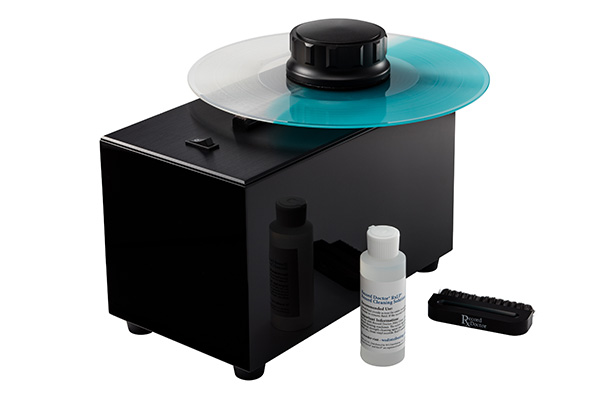 The Record Doctor VI (20th Anniversary Edition)
I've owned three record cleaning machines: the original Keith Monks, the VPI HW16, and a Spin Clean record washer. I rarely used them. When I owned 10,000 records, I only cleaned stoop-sale discs that came without an inner sleeve. All three cleaning devices tested my patience with how they looked, how much space they consumed, and their time-wasting tediousness. I gave them all to friends. When I worked in a record store as a teenager, I was taught to wash used records in the sink, with diluted Palmolive dish soap and—don't laugh—a horsehair shoe polish applicator brush. I learned to dry them by buffing both sides with a terrycloth towel. At home, when I cleaned a group of discs, I might add a few drops of Kodak's Photo-Flo as a wetting agent to my Palmolive and tap water mixture.
I was cleaning dirty discs like this until Christmas 2025, when a friend named Santa brought me the 20th Anniversary Edition of the Record Doctor VI record cleaning machine (footnote 5). The RD VI is a small, handsome, all-manual, vacuum-drying machine that measures just 12.56" × 9.93" × 7.12" and weighs a sturdy 11.5lb. I never owned a VI before, so I didn't notice, but Record Doctor claims the 20th Anniversary Edition was improved to be quieter. I didn't find the noise annoying (footnote 6). The noise lasts only a couple minutes. How it looks lasts all day, every day, possibly for years.
My refined taste in countertop appliances tells me this machine looks all-black sharp and Better Homes unobtrusive. Its looks are what earned it a place on my Formica kitchen counter, right next to the solder pot, anvil, and drill press.
It's easy to clean. At the end of each record-cleaning session, I rinsed the scrubbing brush under the faucet and wiped the VI's cabinet top with a moistened paper towel.
The first record I cleaned was a thick, heavy (375gm!) blue-label Columbia 78 (XCO 34303). When I started, it had a dense coating of gray dust, but after two full cleanings this shellac looked jet-black glossy like almost new. It was worth the effort just so I could hold it in the light and notice how pretty shellac looks when it's black and shiny.
The second record I cleaned was a scruffy, well-worn Doc Watson disc on Vanguard (VSD-10A) that weighed a floppy 125gm. This disc had a gray stain on one side, and, despite previous sink washings, 50 years of acquired sediment on both. The unknown stain required vigorous scrubbing during three applications of liquid, but after three trips over the vacuum, the album looked cleaner-than-new shiny. The stain was reduced by 90%. This noisy old album was now new-pressing quiet, including where the stain was.
I didn't plan on describing in detail how the records sounded after their cleaning, but now I can't stop myself. I've played this Doc and Merle Watson on Stage at least six times a year for four decades. I've washed it maybe twice. It has never sounded this fresh, quiet, and transparent. It has never before displayed this much 3D imaging. Yes, I said imaging. It never occurred to me that a good wash job could enhance the clarity of images this much.
The effects of cleaning were highly pleasurable—but not as joy-inducing as being able to keep record labels dry. Scrubbing under the faucet with a shoe shine brush, I could never do that.
After the Doc Watson disc, it occurred to me that I should be cleaning the "velvet" vacuum brush after each cleaned side. Spin Doctor Trei said he uses a dry toothbrush. Now I do too.
Next, I washed a few ancient test records. While doing this I realized how much patience and mindfulness determined the effectiveness of my cleaning regimen. Washing records well required my full attention and some practice.
After my test records, I washed one of my most-played reviewer discs: Duke Ellington's Blues in Orbit (Columbia MOVLP443). Bought used and played often, this disc probably is a hazy gray, with spindle marks. I was curious how much of its quiet and its luster the Record Doctor VI could restore. The answer was 110%. Maybe 130%. After two cleanings, it was jet black and glossy. Its grooves played quieter than a typical new record. I did not anticipate results like this.
Inspired, I cleaned a new record, freshly opened and played once. Even it looked blacker and glossier after the cleaning, and dang me if it didn't play with a little extra transparency.
I never thought record cleaning machines would lure me in. But that is exactly what the 20th Anniversary Edition of the Record Doctor VI did, for a mere $399. That's a small fraction of the cost of today's fancy ultrasound-based RCMs. I'm not going back to Palmolive, horsehair, and terrycloth.
Footnote 1: $4694/pair. LAiV, 24 Sin Ming Ln., Singapore 573970. Tel: +65 8066 9027. Email: info@laiv.audio. Web: laiv.audio. Footnote 2: See everythingpe.com/community/what-is-a-gan-transistor. Footnote 3: The A21+ is a John Curl–designed "high-bias" class-AB power amp that is specified to deliver 500W into 4 ohms, and 300W into 8 ohms in two-channel mode. JA measured clipping powers of 400Wpc into 8 ohms, 620Wpc into 4 ohms, and 900W (one channel) into 2 ohms. Footnote 4: You may be reading this in March 2026, but I wrote it in December 2025 into early January 2026, hence the Christmas music. Footnote 5: $349.95. Record Doctor is part of Pangea Audio Distributing LLC, 5500 Executive Pkwy SE, Grand Rapids, MI 49512 Tel: (866) 984-0677. Web: recorddoctor.com.
Footnote 6: My Oster blender (set to Smoothie) and the Record Doctor's vacuum both averaged 100dB (C-weighted) at a distance of 24" in my small kitchen.
Opening a LAiV product box is a step-by-step graphically choreographed introduction to the company's aesthetic and forward-thinking engineering perspective. When I reviewed LAiV's Harmony µDAC in Stereophile's December 2025 issue, I was memorably impressed with the stylish intelligence of its packaging, but having now experienced unboxing the GaNM monoblocks, too, I understand better what LAiV is up to: They use their top-notch industrial design and smart product packaging like a smile and a handshake, greeting customers and helping them feel wise and safe for choosing the LAiV brand. Viewing their well-designed website has the same effect. According to the specifications on that website, each GaNM monoblock delivers 200 class-D watts into 8 ohms (footnote 2). Each chassis measures just 4.7" high, 5" wide, and 10.2" deep and weighs just 8.6lb. The only input is balanced (XLR) with a 94k ohm input impedance and a 1.4V sensitivity (for full output).
Listening: The hardest part of making a painting is getting up out of the chair, walking over to the canvas, dipping a brush in paint, and making a mark. It's the hardest part, yet any mark will do. That's because, for me, it is just a "start mark." Its job is to start flipping switches in my brain. Shutting off fear and vanity. The start mark initiates the closing of open thought windows, which continues until, free of distractions, my brain zones in and makes a second mark, followed by a thin wash and some charcoal lines. Then my mind's all in.
The diamond that triggered this Henry Purcell start mark was attached to the Tzar Audio DST V1 Black Knight Corian moving coil cartridge into Lab12's Melto2 phono amplifier into the HoloAudio Serene line-level preamp into LAiV Audio's GaNM monoblock amplifiers driving my Falcon Gold Badge LS3/5a's. This component grouping showed me, in black and white, the singing faces of Deller's consort and choir and their relative positions in the recording venue. The microphones were my surrogate eyes. Those singing faces and Purcell's danceable tunes were a cheerful much-desired mood changer that kept my attention on the performances.
There was no blurring, hash, or uncertainty at the top or bottom of the Falcon's passband. No grain or noise. Only pure sound.
To take a look at how the GaNM presented force and texture, I played Todd Garfinkle's LP Résonance (M•A Recordings LP M088A-V), a masterpiece of recording from 2010 (now repressed to a level of quality that makes it the flattest, quietest black disc I've ever seen). Résonance features Nima Ben David performing a variety of composers' works on viola da gamba. From this super-silent, super-natural recording, I could sense through the Falcons how Ben David's instrument pressurized the air in front of Garfinkle's microphones and how that pressurized air was now energizing the space between my speakers. This recording forced my attention toward vibration-filled air, high-textured tones, and wave after wave of morphing harmonics.
Through my system, the textures of these harmonics were about as tangible as any I've experienced coming out of the little Falcon boxes. Definitely a "wow" moment. Maybe these LAiV monoblocks were emphasizing transients and kicking up the touch factor? Maybe the Falcons needed more quick-firing current to display these subtleties? Whatever the reason, Nima Ben David's viola da gamba sounded dockworker muscular with the Tzar DST and black-tights modern-dancer lithe with the My Sonic Lab Ultra Eminent Ex. This almost humorous comparison provided insight into both cartridges' characters.
Curious to see what the GaNM amps could do with the 10.3 ohm, 95dB-sensitive Voxativ Hagen2 loudspeakers, I used the Ultra Eminent Ex to play Résonance again. With the Hagen2s, the My Sonic Lab cartridge sounded substantially more muscular, with thicker bones and meatier flesh. Locomotion and jump factors increased by 20%–30%. Through the Hagen2s, the Ultra Eminent Ex sounded more completely fleshed out. And all I did was change the speaker. I think the GaNM amps did the rest.
I was impressed by how this ballet dancer, runway model moving coil could suddenly sound so pushy and muscular when the recording called for it.
While the GaNMs were in the system, I decided to switch back to the Falcon speakers. I had an urge to check the LAiV's tone while playing Jarsden Fendrix's soundtrack to Yorgos Lanthimos's 2023 film Poor Things (24/48 FLAC Milan/Qobuz). This recording is my tone-and-tempo litmus test. With the HiFi Rose RD160 DAC (reviewed elsewhere in this issue) into the Serene preamp into the LAiV monoblocks, I heard deeper, more powerful, better-described bass than (I swear) I'd ever thought possible from the LS3/5a's. This was the #1 most "wow" discovery about the LAiV GaNM amps. Tone leaned toward cool but was still near perfect. The forms of bass sounds literally jumped out, with touchable presence and vivid detail.
The Falcon's 50–400Hz octaves presented images like those from a Weegee-era glass-bulb flash photo. The LAiV reduced low-frequency shadowing, brought bad-ass low notes out of the depths, brought performers in the foreground into extreme focus, and made every transient visible for admiration. I am not exaggerating: The tiny Gold Badges have never before shook floors and rattled windows like they did with the GaNM. Why were the LS3/5a's putting out this much more bass power with the LAiV monoblocks than they do with the Parasound A21+?
I can't answer that. But I was pleased by how effectively this class-D amp could drive 15 ohms. I hadn't seen that before. But how would it fare with 4 ohms, a tricky crossover, two passive radiators, and an AMT tweeter?
I've given up on thinking of loudspeaker sensitivity ratings as even the slightest indicator of how a speaker might respond to a low-power amplifier. Especially when a power-sucking crossover is making waves in the impedance curve. GoldenEar's overachieving BRX standmounts are rated at 90dB/2.83V/1m with a nominal impedance of 8 ohms. JA's measurements tell a different story. "The BRX has minimum EPDRs of 2.15 ohms at 59Hz and 1.53 ohms at 135Hz, and the EPDR remains below 4 ohms in the midrange. This loudspeaker will work best with amplifiers that are comfortable driving loads below 4 ohms." That's why I decided to try the BRXs: to see how the GaNM drives recalcitrant loads.
The GoldenEar BRXs took more than a day to "loosen up" and sound as fluid and transparent as I know them to be. At first, they were thick and unclear, but they surrendered their full transparency when I played singer and harpist Arianna Savall and tenor Petter Udland Johansen's album, Silent Night – Early Christmas Music and Carols (24/96 FLAC Deutsche Harmonia Mundi/Qobuz). The tracks on Silent Night became my daily meditations on the yuletide (footnote 4).
Arianna's gambist/ensemble director father, Jordi Savall, is one of the major artists I've always enjoyed and admired. Arianna's mother, soprano Montserrat Figueras (1942–2011), was a goddess whose voice and face captured my heart in the 1980s. I still pine for more Montserrat, but this recording by her daughter enriched my month of December. The purity of its sound showed me that the 4 ohm BRX did not squirm or buckle under the GaNM's control. After three days, the tracks on Silent Night were haunting my waking hours with their dark cheer, sublime flow, and mesmerizing transparency.
Everything I mock I become: Before the LAiV Harmony GaNM amp arrived, I had developed a yawning disinterest in class-D, plus an irrational disdain for fast-acting "high conductivity" GaN-FET transistors. (Last time I checked, free electrons were moving pretty fast already in 1000V vacuum tubes like a 211 or 845.) And everyone knows I've never been persuaded by weight, cost, and energy-saving switching power supplies. True to my boomer roots, I've stuck to old-school class-A linearity, plus wide bandwidth, tidy transfer functions, clean squarewaves, and lots of standing current.
What I care about most is tone, transparency, tactility, and having enough current and voltage to push the smallest recorded sounds and subtlest captured rhythms through diverse speakers. Which means I am laughing at my own foolishness, because I think I'm getting every one of these "care abouts" with class-D GaN-FET amps driving my Falcon LS3/5a's. I need the unnamed wizards behind these amps to explain why these things I once mocked are now thumbing their noses at me and mocking me back.
Based on what I've heard in my studio and what I've read on LAiV's website, I am guessing the GaNM amps are operating at a sampling frequency that's so high it does not require feedback, and as a result, current and voltage remain in phase. That probably accounts for the extra punch and transparency. I'm also guessing that in lieu of feedback, there is some amount of DSP shaping or controlling the output signal, and that processing is affecting how I perceive the GaNM amp's force, density, and transparency. That's all just speculation, but I don't care if it's true. This amp is the closest thing I've found to that mythical amp that will drive any speaker. At this moment, it's my favorite amp with the Falcons. I did not see that coming.
The Record Doctor VI (20th Anniversary Edition)I've owned three record cleaning machines: the original Keith Monks, the VPI HW16, and a Spin Clean record washer. I rarely used them. When I owned 10,000 records, I only cleaned stoop-sale discs that came without an inner sleeve. All three cleaning devices tested my patience with how they looked, how much space they consumed, and their time-wasting tediousness. I gave them all to friends. When I worked in a record store as a teenager, I was taught to wash used records in the sink, with diluted Palmolive dish soap and—don't laugh—a horsehair shoe polish applicator brush. I learned to dry them by buffing both sides with a terrycloth towel. At home, when I cleaned a group of discs, I might add a few drops of Kodak's Photo-Flo as a wetting agent to my Palmolive and tap water mixture.
Footnote 1: $4694/pair. LAiV, 24 Sin Ming Ln., Singapore 573970. Tel: +65 8066 9027. Email: info@laiv.audio. Web: laiv.audio. Footnote 2: See everythingpe.com/community/what-is-a-gan-transistor. Footnote 3: The A21+ is a John Curl–designed "high-bias" class-AB power amp that is specified to deliver 500W into 4 ohms, and 300W into 8 ohms in two-channel mode. JA measured clipping powers of 400Wpc into 8 ohms, 620Wpc into 4 ohms, and 900W (one channel) into 2 ohms. Footnote 4: You may be reading this in March 2026, but I wrote it in December 2025 into early January 2026, hence the Christmas music. Footnote 5: $349.95. Record Doctor is part of Pangea Audio Distributing LLC, 5500 Executive Pkwy SE, Grand Rapids, MI 49512 Tel: (866) 984-0677. Web: recorddoctor.com.