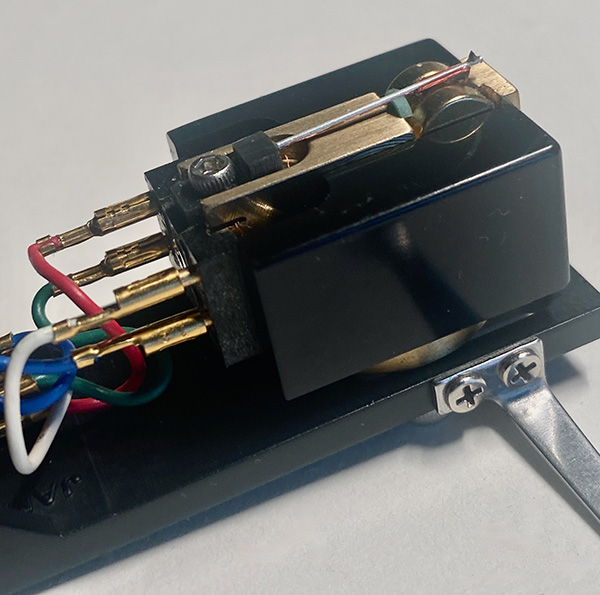
Whenever I hear a Tzar, my brain recites the words I spoke to Frank Schröder: "That's the best damn cartridge I've ever heard." But then everyone knows I speak in metaphors and flash hyperbole like a smile. What my brain meant by saying those words is that the Tzar's sound is so radically different than any other cartridge that I have nothing to compare it to.
Audio-Technica's AT-ART1000 "Direct Power Stereo Cartridge" comes to mind as a possibility. It uses the same coils-near-the-stylus strategy, but it features a nude line-contact stylus and a boron cantilever. The Tzar uses a carbon-fiber cantilever with a spherical tip. Not close enough.
The closest new-manufacture cartridge I've heard of—but never listened to—is the made-in-Japan Lumiere DST, which has an aluminum body, a carbon-fiber cantilever, and a conical stylus.
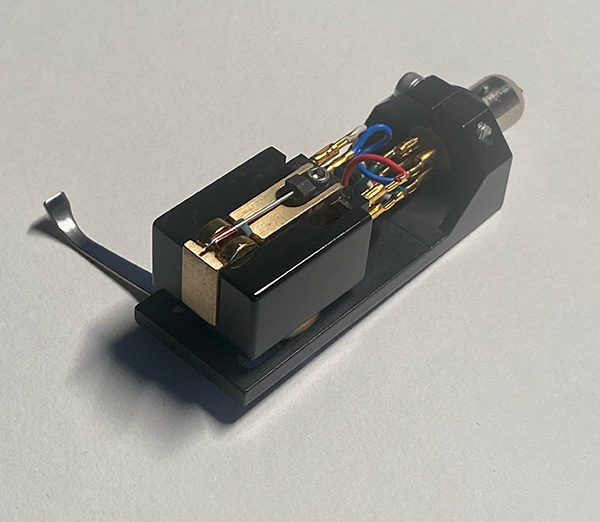
My review sample Tzar has a black Corian body, which at 17gm, weighs a half-gram less than its aluminum-bodied stablemate. Heavy tonearms with specified effective mass between 18 and 25gm are recommend, as are shunt loads of 600 to 2k ohms. The Tzar's output is specified as 0.25mV.
I'm against ratings and rankings, but, if I were forced to rank the Tzar DST among my favorite cartridges, I'd place the
Fuuga, the
Koetsu Black, the
Koetsu Rosewood longhorn, and the Miyabi 47 above it. The DST-inspired Tzar speaks with serious authority, but it doesn't do witchy magic or LSD spiderwebs like those cartridges do.

And speaking of magic, when I listened to
Beethoven's Complete Violin Sonatas with David Oistrakh on violin and Lev Oborin on piano (Philips 6768 036, a 1964 Dutch issue of recordings made in France and released in 1962 on five LPs as Le Chant du Monde LDX-A-8301/5) with the Tzar running into the
Robyatt MC-2 step-up transformer and on to the
Kitsuné HiFi KTE LCR-1 phono stage, I was surprised by how much like a "normal" cartridge the Tzar sounded than it than it did with Lab12's Melto2. It still sounded raw and direct and forceful, but now it felt more flat than vibey. It didn't expose as much of Beethoven's high-minded invention as the My Sonic Lab Ultra Eminent Ex. But!
When I played a British pressing of Deep Purple's
Machine Head from 1972 (Purple Records TPSA 7504), the Tzar plowed dead silent through it like a nuclear sub motoring toward Armageddon. With the Tzar and the LCR-1 MK5 phono stage, this disc had forge-hammer slam and an exceptionally natural contrast structure. With the LCR-1, the Tzar mustered full doses of its music-presenting power but with less color and tactility than it did with Lab12's Melto2.
My #1, use-it-all-the-time reviewer reference disc is the John McClure–produced
Stravinsky Conducts History du Soldat Suite and Pulcinella Suite (Columbia MS7093). This recording never fails to show me all the ways my system is affecting the signal. I use it to determine the degree and nature of change a new phono component imparts. With Tzar Audiology's DST V1 Black Knight Corian moving coil, the degree and nature of change was eye-poppingly dramatic. The heavy, low-compliance Tzar nuked every cartridge I'd ever used to play this recording. I doubt many cartridges could match the realism of the Tzar's bass or the uncolored clarity of its vocal region, which I'd say proves the Tzar was happy on the Sorane SA-1.2 tonearm. What the Tzar did that the
My Sonic Lab Ultra Eminent Ex,
Audio-Technica's ART20, and
Dynavector's XX2A could not do was sound direct, raw, solid, and powerful. What those cartridges could do that the Tzar couldn't do is sound precise, open, spacious, and microdetailed.
 The Ortofon 2M Black LVB 250, redux
I'm always curious how expensive moving coils, like the $10,995 Tzar, compare to well-regarded moving magnet cartridges like Ortofon's $1195 2M Black LVB 250 (footnote 5), which Michael Fremer first
reviewed in 2021. MM vs MC is always an interesting comparison.
In my racket, comparing one $1000 cartridge to another $1000 cartridge is the opposite of fun. Apples-to-apples comparisons show me nothing I regard as very interesting. In dramatic contrast, comparing cartridges as different in price and design brief as the Tzar Black Night Corian and Ortofon 2M Black LVB put each cartridge under a new type of microscope.
When I removed the 17gm Tzar and its 12gm Jelco headshell, it felt like a lead fishing sinker. Moments later, when I installed the 7.2gm LVB 250, it felt like a plastic fork. The Tzar tracks at a recommended 4.5–6.5gm. I tried it at 4, 5, and 6gm and thought the heavier VTFs might have brought out more of the Tzar's oil-tanker persona. In contrast, Ortofon's LVB is specified to track at 1.5–1.7gm. I used 1.6gm. The Tzar specifies its compliance as "very low," while Ortofon's LVB 250 is definitely high, at 22µm/mN.
If all those things aren't different enough, the stylus profile on the Tzar is a nude spherical on a carbon-fiber cantilever. The LVB 250 has a nude Shibata on a boron cantilever. Could two cartridges be more different from each other?
When I played that Stravinsky with the LVB, I laughed out loud, because I'd never experienced a moving magnet cartridge with that much alluring vibrancy. I never would have guessed it was a moving magnet. It showed the inner workings of the orchestra in great detail and mapped out where its various sections were located. It dosed me with some witchy MM magic.
Compared to the Tzar's bold generalissimus, the LVB came across as revealing, demure, delicate, exotic, and finely detailed.
As I played the LVB, I realized: It takes a radical
as-different-as-possible comparison like this to see exactly what these cartridges are doing with the music on the records they trace. I would have never noticed the feminine delicacy in the LVB's sound if I hadn't seen all those medals on the Tzar's chest.
It was impressive to witness the ease with which the Melto2 exposed the fundamental vibe of these contrasting personas. No doubt, some of that ease was the result of being able to fine-tune both cartridges' gain and load parameters.
The wildest part was how flat-out impressive the Ortofon sounded when compared directly to the Tzar. Forget diminishing returns: The Tzar did force, tone, texture, and dense presence, with more realism than any cartridge I've used. It was the master of what Art Dudley called "touch." But!
Playing through Lab12's Melto2, the 2M Black LVB 250 did everything the Tzar
couldn't do. Compared to the Siberian ruler, the LVB felt like a vacation in the tropics. It made shimmering, water-clear spaces with delectable details and long, delicious reverb tails. It played like an audiophile dream cartridge that reminded me of the Hana Umami series of moving coil cartridges.
The images spun by the LVB 250 were more ethereal and ghostlike than they are with my favorite moving coils, the Benz Micro Gullwing SLR and Audio-Technica's ART20, for example, but delicacy made the LVB 250 a sensible viable alternative to more expensive MCs.
These two cartridges could not present recordings more differently. Yet it would be impossible for me to say that one gave me more pleasure than the other. No doubt, legions of mainstream audiophiles would prefer the LVB, while scores of triode-horn cult members like me would die to own a Tzar.
This mad comparison exposed both cartridges' personalities, but it didn't tell me which one I should marry.
 Now is the time
I have never seen, nor have I ever believed, that dragging a tiny, sharp, correctly positioned diamond through the grooves of a clean vinyl disc causes significant wear. I've never worn out a record—have you? My black discs last forever if I put them back in their sleeves after I play them.
But I have worn out styli—a lot of them—and I blame my vinyl for that.
I've also never witnessed a styli melting or deforming the record grooves—yet I find goo on the diamond: Something is coating the needle, but I doubt it's melted vinyl. My guess is that needle goo is the same air-borne sediment that's coating my windows and everything else in my room (footnote 6).
I am old enough to remember the '60s, when companies like Shure began demonizing high–tracking-force cartridges to get readers to buy their light, high-compliance moving magnet cartridges. Unfortunately, like many others, I believed them. As a result, I've owned almost every Shure model. But today I can say with certainty that none of them came even close to reproducing recordings as powerfully and realistically as the Tzar tracking at 4gm. My
V15 Type III plays like a lost toy compared to the Tzar. The pro-focused, low-compliance
Shure SC35 sounds more like the Tzar than a V15.
I've witnessed a lot of moving coil cartridges tracking at 2gm fluttering and jitterbugging and IM-distorting their way through the last couple of inches before the leadout groove. Tell me that's not damaging the record. At 4, 5, and 6gm, the Tzar never fluttered or mistracked. It just inched along like a farm tractor using its high mass and low compliance to put some real-live torque behind the notes.
My biggest discovery
The biggest news this month was not the Tzar's torque. It was the Lab12 Melto2's ability to coax the tiniest, most delicate subtleties from every cartridge I tried. It put the Tzar in a tuxedo. It made the Ortofon 2M Black LVB 250 moving magnet sound like a top-shelf moving coil. It made the Nagaoka MP-200 sound like a Koetsu. It forced all my other phono stages to hide under the bed. At the moment, I can think of no phono stage I'd rather use than the $4995 Lab12 Melto2. Bravo, Stratos Vichos.
Footnote 5: Ortofon AS. Stavangervej 9, DK-4900 Nakskov, Denmark. Web: ortofon.com. US distributor: Ortofon Inc., 500 Executive Blvd., Suite 102, Ossining, NY 10562. Tel: (914) 762-8646. Email:
support@ortofon.us.
Footnote 6: Editor's note: I used to keep an old record on top of my platter to protect it from the dust and grime that accumulates here in New York City. After weeks or months of this, one evening while I was away, my son played that record. The result was a stylus covered in black goo that proved almost impossible to remove. I sent it off to J.R. Boisclair of WallyTools for imaging. While it was in his possession, Boisclair did his damnedest to clean it for me, and eventually he succeeded—I don't remember how. The point is: I think Herb is correct in attributing this to New York City grime.—
Jim Austin