There are craftspeople and companies in high-end audio doing admirable work. Those at the cost-no-object end of the business are pushing performance limits and doing new and better things with new and better materials.
The ones I especially admire, though, are in the high-value end of the business, making extraordinary equipment at approachable prices. Their good ears and clever engineering chops are accessible to the Average Joe Audiophile, people like me, with ambitions of sonic nirvana but earthbound means.
The 1970s-style inflation cycle we've just lived through and now an uncertain tariff landscape to navigate make it harder to define "high value." Everything costs considerably more than it did pre-COVID, including hi-fi equipment. The boundary between high-value and high-priced has shifted upward.
I don't define high value entirely on price. The sweet spot for me is superb sound quality and an ample set of features likely to be used by most buyers most of the time, built to last and backed by a reasonable warranty. I expect a high-value integrated amplifier to include a streamer/DAC under the hood. Adding a phono preamp indicates a good sense of the current audiophile consumer landscape. The DAC should include the usual digital inputs, and there should be at least a couple of analog inputs aside from a turntable so that legacy gear like a radio tuner, SACD player, or tape deck—or a preferred external phono preamp—can be connected. Since few of us listen to music in an exquisitely tuned anechoic chamber, well-designed tone controls are useful. Good fit and finish and eye-appealing design cues are expected.
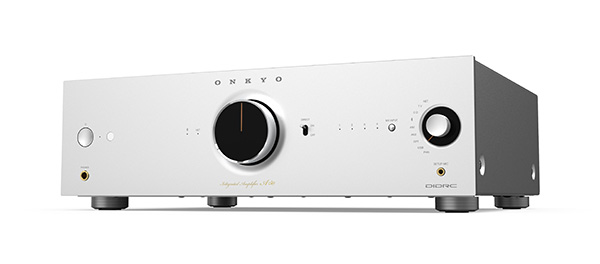
Is this asking too much? In the case of the Onkyo Icon A-50 streaming integrated amplifier ($1599.99), the answer is no.
 From the reborn Onkyo, a high-value proposition
In early 2025, Onkyo emerged from some turbulent times by announcing the new Icon line, aimed at the audiophile market and not the home-theater market, where the company had previously focused. (See the sidebar for details on Onkyo's odyssey from a bike shop in Osaka, Japan, in the late 1940s to its present ownership by an American automotive-electronics company.) Along with the A-50, the Icon line includes the P-80 streaming preamplifier and the M-80 power amplifier—all two-channel components. Onkyo also makes a line of multichannel AV receivers, a stereo receiver, two models of powered, small-format speakers, and two CD players, according to the company's website.
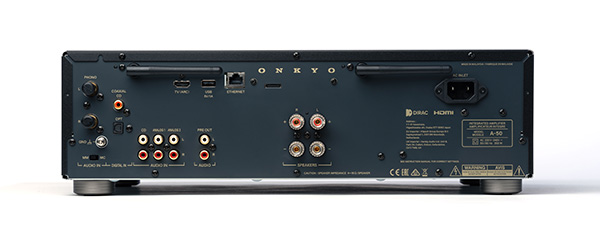
The Icon A-50 includes an onboard phono preamp (switchable to accommodate moving coil or moving magnet cartridges), three line-level analog inputs, a USB-C input (for a thumb drive full of music files), an HDMI-ARC socket—for using the A-50 with a modern video screen—optical and coaxial S/PDIF inputs, a preamp output, and connection to the home network via either a Wi-Fi antenna or an Ethernet cable. It will stream music directly from a smartphone or tablet via Bluetooth—and transmit over Bluetooth to wireless headphones or speakers—or with Apple AirPlay. Its onboard computer has extensive digital signal processing (DSP) facilities, including a form of loudness equalization calibrated to the system's speakers and listening seat location, and Dirac Live room correction, though you must purchase a Dirac license for full functionality. Calibration is achieved by using the included microphone, which plugs into the A-50's front panel. The A-50 arrives Roon Ready, set up for all the streaming service "casting"—Qobuz Connect, Spotify Connect, and so on—and connects to network-attached servers via Windows Media or UPnP. In short, the A-50 runs the full connectivity gamut (footnote 1).
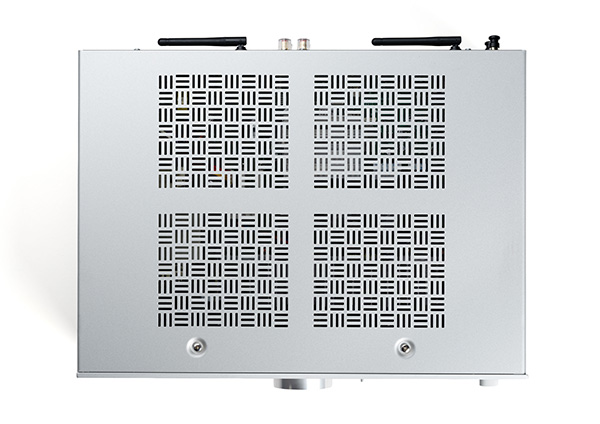
Output power is spec'd at 110Wpc into 8 ohms, via a class-AB inverted-Darlington amplifier with "high-quality 10000µF capacitors custom-made exclusively for Onkyo," connected to "a copper bus bar." There's a linear power supply for all analog and most digital functions. A small switch-mode power supply keeps it connected to the network during standby.
 Diving deeper
Onkyo Product Development Manager Yuya Ueda shared the following details about what's under the hood:
The digital/analog converter chip is AKM's AK4452VN, described by the company as "a new generation ... Premium DAC." The basic specs: 115dB, up to 32/768, two channels (footnote 2).
Treble and bass controls utilize DSP.
Analog inputs are converted to 24/48 digital for tone controls and other DSP functions by an AKM analog-to-digital converter chip.
On the front panel, a DIRECT on/off switch bypasses DSP functions so that an analog device like a turntable can maintain a completely analog path through the A-50. In that mode, digital inputs go through the DAC but bypass the DSP.
The internal phono preamp provides 54dB gain at 1kHz for MC cartridges, 34dB for MM cartridges. This is on the low end of typical phono preamp gain, and I did have to turn the volume up to listen to records, but nowhere near top volume.
The volume control is analog, motorized for use with the wireless remote. Volume can also be set by the Onkyo Controller phone/tablet app.
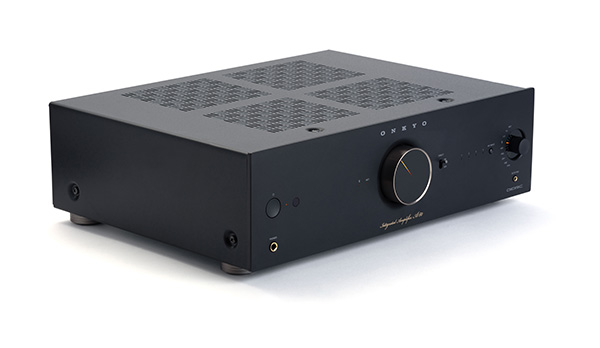
I asked Ueda about the A-50's spiffy-minimalist front panel (5mm-thick extruded aluminum), which swims against the current styling tide by not including a screen or much of anything as far as indicators—just some small LEDs for network and Bluetooth connection status, a rotary input-select knob, volume control knob, and power switch; that's all. He said, "Eliminating displays and multiple controls, featuring only the essential controls and LEDs, ... eliminates the gadget-like feel ... and creates a design that seamlessly blends into any space."
According to Ueda, "The A-50 offers a high level of functionality at an affordable price because it shares circuitry for streaming services and room calibration with other Onkyo products such as AV receivers, allowing for cost savings. However, there are no compromises in the audio circuitry. This product embodies Onkyo's technology and dedication, featuring a dedicated amplifier circuit and a DAC circuit employing our proprietary DIDRC technology." According to Onkyo's website, DIDRC stands for "Dynamic Intermodulation Distortion Reduction Circuitry," which "reduces beats generated in the ultra-high frequency band by DIDRC's High Slew Rate Circuit to improve the sound of analog recordings and stabilizes audio signals with positive and negative signal symmetry to reproduce minute signals such as those of MC cartridges even when amplified."
I asked Ueda where he sees the A-50 fitting in the competitive landscape. He replied, "We consider the Marantz Model 40n (footnote 3) to be our direct competitor. Other competitors we view include Denon, Yamaha, NAD, ARCAM, and Cambridge Audio."
So, the Icon A-50 is a feature-packed, sleek, powerful integrated amplifier priced at $1600—quite a bit less than some similarly featured, similarly powered competitors. It's quite a good value—if it sounds good.
 Setup and first listens
The A-50 arrived packed in a reasonably sturdy box. Inside that box was the A-50, a plastic wireless remote, the power cord, and a little black plastic disc with a long thin wire terminating in a three-connector, 1/8" plug—the omnidirectional microphone, needed to set up Dirac Live and FidelityIQ, which Onkyo describes as an "auto loudness control" tailored to the specific room and speakers (footnote 4). When I unpacked the silver-faced A-50 (it is also available in black), I noticed that the two RCA jacks for the phono input were filled with shorting plugs. Ueda explained, "Phono circuits have extremely high amplification, and if noise enters the signal path, it can affect other circuits. Therefore, the shorting pin is used to preemptively short it to ground, preventing noise intrusion." The plugs are removed when a turntable is connected—obviously. The first thing I wanted to hear was how the A-50 sounded through its all-analog signal path. I connected the Amphion One18 speakers that sit nearfield to my desk, at ear level, switched on DIRECT mode, plugged my Rega Jupiter CD player into the line-level RCA jacks marked "CD," and spun some discs. Since most of my CDs are ripped into a digital music library that lives on my NAS server, I rarely do this anymore. These CDs sounded as expected, with the added hassle of getting up and changing discs and using the tiny-button Rega remote to switch tracks.
 Next, I connected a Technics SL-50C turntable to the phono inputs and spun some vinyl. The A-50's phono preamp sounded punchier and wider-bandwidth than the one built into the SL-50C, which I compared by changing the connection to one of the line inputs. That first afternoon, I had a lot of fun playing the five LPs that make up the new deluxe reissue of the Rolling Stones' Black and Blue (which I reviewed in the March 2026 issue). The three-platter live concert from Earl's Court, London, 1976, was high-energy maximum rock'n'roll, effectively transmitted from groove to room by the modest system in my office.
It took a few tries to get the A-50 on my Wi-Fi network. I downloaded the Onkyo Controller app, connected to the A-50 via Bluetooth, and eventually got it signed on after powering it off and on once or twice. A few times during the three months I had it, it dropped the Wi-Fi connection, and the only way to get it back was to unplug it from the wall and let it sit for a minute then plug it in and turn it on. Apparently it likes to have a robust Wi-Fi connection; the connection was more stable in my living room, where a network node is located. Hardwired connection by Ethernet was trouble-free.
Once it was networked, via the Onkyo app, the A-50 found my MinimServer library, and I was able to play files of all formats and resolutions, from lossy MP3 to CD-resolution FLAC to HD AIFF and WAV to DSF rips from SACD. However, the search functions in the Onkyo Connect app did not work properly, and I ended up using the Folders View mode and finding tracks by hand, a time-wasting process. I had similar problems with early versions of T+A's app. The engineers at T+A eventually fixed those problems; presumably Onkyo's will, too. Meanwhile, Roon, Qobuz Connect, and Spotify Connect worked exactly as expected, including Spotify's newly lossless streaming.
After a few days in the office, I concluded that the A-50's sound leaned neutral but wasn't thin or wimpy. The low end was quick and present, not exaggerated or flabby. It sounded cleaner than my quarter-century-old McIntosh MA6500 integrated amp (similarly powered at 120Wpc into 8 ohms). With the Onkyo, the stereo image was more clearly defined and focused, but the sound wasn't bloodless or cold.
With the "Junior" system
Next, I connected a Technics SL-50C turntable to the phono inputs and spun some vinyl. The A-50's phono preamp sounded punchier and wider-bandwidth than the one built into the SL-50C, which I compared by changing the connection to one of the line inputs. That first afternoon, I had a lot of fun playing the five LPs that make up the new deluxe reissue of the Rolling Stones' Black and Blue (which I reviewed in the March 2026 issue). The three-platter live concert from Earl's Court, London, 1976, was high-energy maximum rock'n'roll, effectively transmitted from groove to room by the modest system in my office.
It took a few tries to get the A-50 on my Wi-Fi network. I downloaded the Onkyo Controller app, connected to the A-50 via Bluetooth, and eventually got it signed on after powering it off and on once or twice. A few times during the three months I had it, it dropped the Wi-Fi connection, and the only way to get it back was to unplug it from the wall and let it sit for a minute then plug it in and turn it on. Apparently it likes to have a robust Wi-Fi connection; the connection was more stable in my living room, where a network node is located. Hardwired connection by Ethernet was trouble-free.
Once it was networked, via the Onkyo app, the A-50 found my MinimServer library, and I was able to play files of all formats and resolutions, from lossy MP3 to CD-resolution FLAC to HD AIFF and WAV to DSF rips from SACD. However, the search functions in the Onkyo Connect app did not work properly, and I ended up using the Folders View mode and finding tracks by hand, a time-wasting process. I had similar problems with early versions of T+A's app. The engineers at T+A eventually fixed those problems; presumably Onkyo's will, too. Meanwhile, Roon, Qobuz Connect, and Spotify Connect worked exactly as expected, including Spotify's newly lossless streaming.
After a few days in the office, I concluded that the A-50's sound leaned neutral but wasn't thin or wimpy. The low end was quick and present, not exaggerated or flabby. It sounded cleaner than my quarter-century-old McIntosh MA6500 integrated amp (similarly powered at 120Wpc into 8 ohms). With the Onkyo, the stereo image was more clearly defined and focused, but the sound wasn't bloodless or cold.
With the "Junior" system
The next stop for the A-50 was what I call my "Junior" system: KEF LS-50 Meta speakers widely spaced (about 9' apart) with my listening seat about 7.5' from each speaker. This system, which I usually run using a WiiM Amp, spends a lot of time playing sound to accompany video, via an optical digital connection to my old but superb Samsung plasma TV, streaming via a little Roku box. I also enjoy listening to music on this system streaming from Qobuz, Spotify, or my NAS server while reading in my comfortable recliner. I am often astounded by how much high-quality sound those little KEFs put out and the cinema-sized stereo image—no hole in the middle—achieved spacing them so wide apart just a few feet from my ears.
Footnote 1: See onkyo.com/a-50-network-integrated-amplifier. There is a link at the bottom of the page to download the usefully detailed but relatively concise user manual.
Footnote 2: See www.akm.com/us/en/products/audio/audio-dac/ak4452vn/.
Footnote 3: See marantz.com/en-us/product/amplifiers/model-40n/300454.html.
Footnote 4: See support.onkyousa.com/hc/en-us/articles/40888599675924-A-50-Level-Calibration for a slightly more detailed description than is in the A-50 user manual.
From the reborn Onkyo, a high-value propositionIn early 2025, Onkyo emerged from some turbulent times by announcing the new Icon line, aimed at the audiophile market and not the home-theater market, where the company had previously focused. (See the sidebar for details on Onkyo's odyssey from a bike shop in Osaka, Japan, in the late 1940s to its present ownership by an American automotive-electronics company.) Along with the A-50, the Icon line includes the P-80 streaming preamplifier and the M-80 power amplifier—all two-channel components. Onkyo also makes a line of multichannel AV receivers, a stereo receiver, two models of powered, small-format speakers, and two CD players, according to the company's website.
Diving deeperOnkyo Product Development Manager Yuya Ueda shared the following details about what's under the hood:
Setup and first listensThe A-50 arrived packed in a reasonably sturdy box. Inside that box was the A-50, a plastic wireless remote, the power cord, and a little black plastic disc with a long thin wire terminating in a three-connector, 1/8" plug—the omnidirectional microphone, needed to set up Dirac Live and FidelityIQ, which Onkyo describes as an "auto loudness control" tailored to the specific room and speakers (footnote 4). When I unpacked the silver-faced A-50 (it is also available in black), I noticed that the two RCA jacks for the phono input were filled with shorting plugs. Ueda explained, "Phono circuits have extremely high amplification, and if noise enters the signal path, it can affect other circuits. Therefore, the shorting pin is used to preemptively short it to ground, preventing noise intrusion." The plugs are removed when a turntable is connected—obviously. The first thing I wanted to hear was how the A-50 sounded through its all-analog signal path. I connected the Amphion One18 speakers that sit nearfield to my desk, at ear level, switched on DIRECT mode, plugged my Rega Jupiter CD player into the line-level RCA jacks marked "CD," and spun some discs. Since most of my CDs are ripped into a digital music library that lives on my NAS server, I rarely do this anymore. These CDs sounded as expected, with the added hassle of getting up and changing discs and using the tiny-button Rega remote to switch tracks.
Next, I connected a Technics SL-50C turntable to the phono inputs and spun some vinyl. The A-50's phono preamp sounded punchier and wider-bandwidth than the one built into the SL-50C, which I compared by changing the connection to one of the line inputs. That first afternoon, I had a lot of fun playing the five LPs that make up the new deluxe reissue of the Rolling Stones' Black and Blue (which I reviewed in the March 2026 issue). The three-platter live concert from Earl's Court, London, 1976, was high-energy maximum rock'n'roll, effectively transmitted from groove to room by the modest system in my office.
It took a few tries to get the A-50 on my Wi-Fi network. I downloaded the Onkyo Controller app, connected to the A-50 via Bluetooth, and eventually got it signed on after powering it off and on once or twice. A few times during the three months I had it, it dropped the Wi-Fi connection, and the only way to get it back was to unplug it from the wall and let it sit for a minute then plug it in and turn it on. Apparently it likes to have a robust Wi-Fi connection; the connection was more stable in my living room, where a network node is located. Hardwired connection by Ethernet was trouble-free.
Once it was networked, via the Onkyo app, the A-50 found my MinimServer library, and I was able to play files of all formats and resolutions, from lossy MP3 to CD-resolution FLAC to HD AIFF and WAV to DSF rips from SACD. However, the search functions in the Onkyo Connect app did not work properly, and I ended up using the Folders View mode and finding tracks by hand, a time-wasting process. I had similar problems with early versions of T+A's app. The engineers at T+A eventually fixed those problems; presumably Onkyo's will, too. Meanwhile, Roon, Qobuz Connect, and Spotify Connect worked exactly as expected, including Spotify's newly lossless streaming.
The next stop for the A-50 was what I call my "Junior" system: KEF LS-50 Meta speakers widely spaced (about 9' apart) with my listening seat about 7.5' from each speaker. This system, which I usually run using a WiiM Amp, spends a lot of time playing sound to accompany video, via an optical digital connection to my old but superb Samsung plasma TV, streaming via a little Roku box. I also enjoy listening to music on this system streaming from Qobuz, Spotify, or my NAS server while reading in my comfortable recliner. I am often astounded by how much high-quality sound those little KEFs put out and the cinema-sized stereo image—no hole in the middle—achieved spacing them so wide apart just a few feet from my ears.
Footnote 1: See onkyo.com/a-50-network-integrated-amplifier. There is a link at the bottom of the page to download the usefully detailed but relatively concise user manual.