Sidebar 3: Measurements
The tubes in the preamp chassis and the power supply were installed when I unpacked the two shipping boxes, but I checked that they were correctly seated before starting the testing. I performed a complete set of tests with my Audio Precision SYS2722 system after powering up the preamplifier and letting it settle for 30 minutes.
The Treehaus inverted absolute polarity with all of its inputs and outputs, which is what I would expect from a circuit that uses a single triode in the signal path. The Treehaus's input impedance is specified as a minimum of 40k ohms; I measured 85k ohms at 20Hz, 89k ohms at 1kHz, and 79k ohms at 20kHz. The preamplifier's output impedance is specified as 150 ohms. I found that it was usefully low but different in the two gain settings: it varied from 521 ohms at 20Hz to 677 ohms at 20kHz with the High setting; from 103 ohms at 20Hz to 147 ohms at 20kHz with the Low setting.
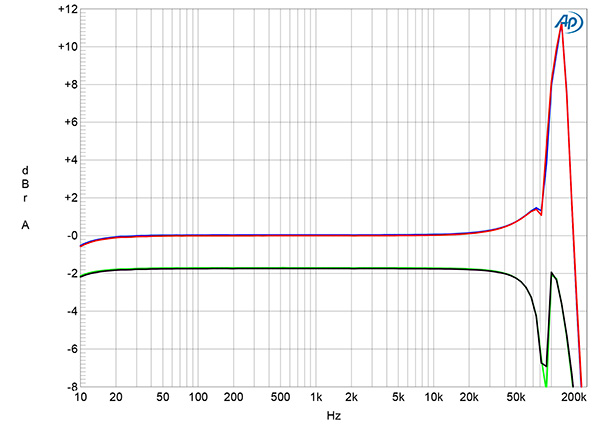
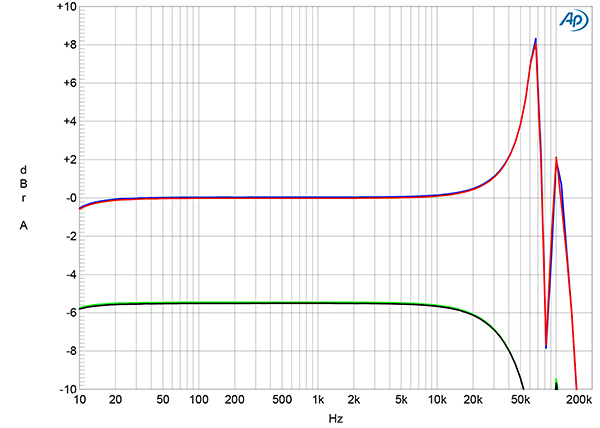
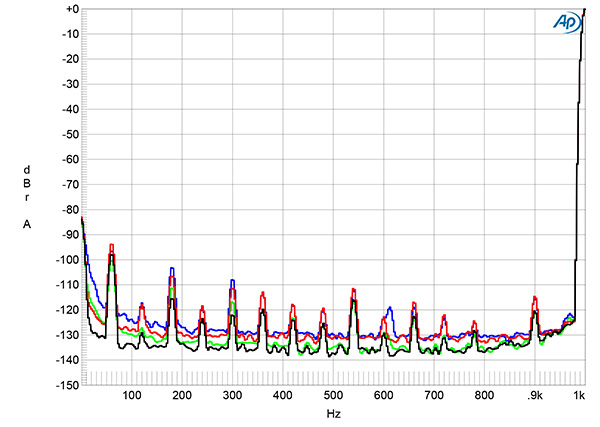
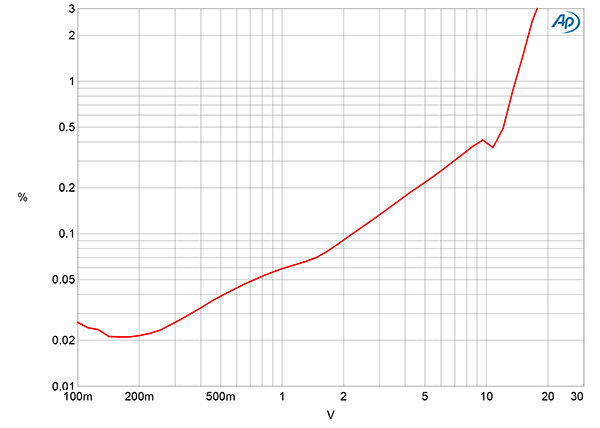
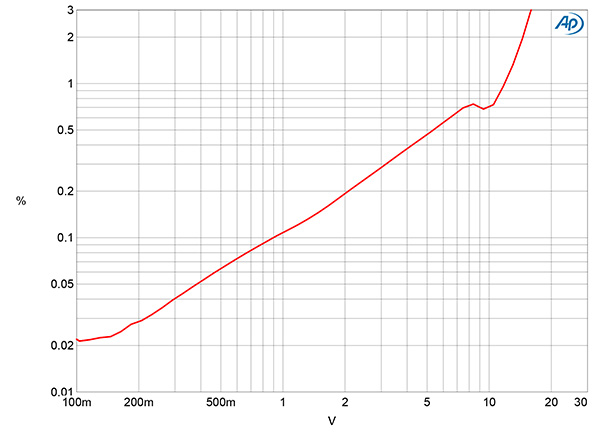
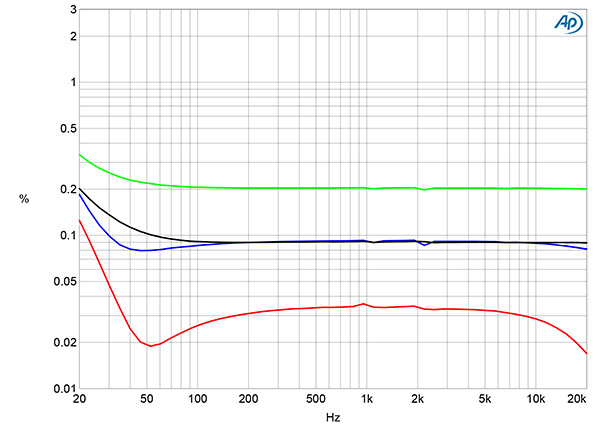
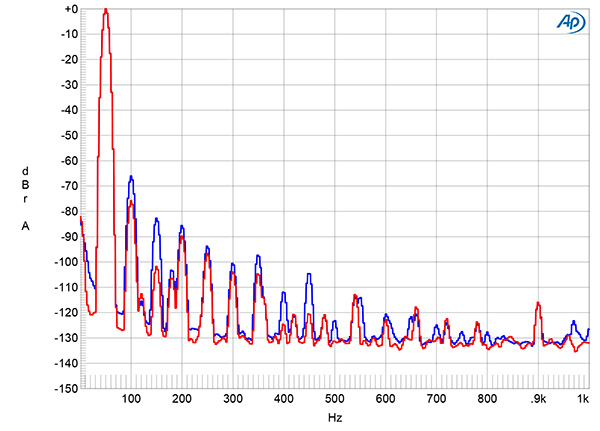
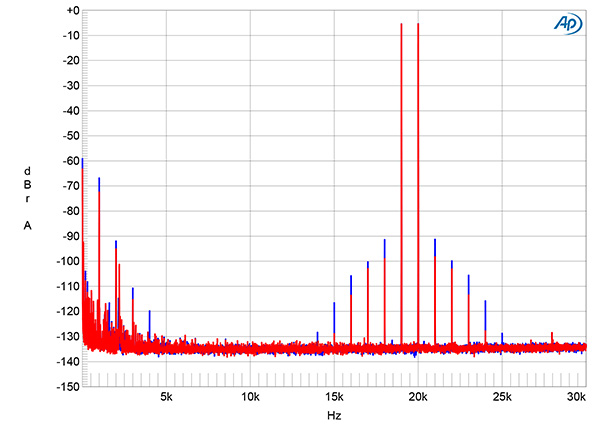
Fig.1 Treehaus Audiolab, Low gain, frequency response with volume control set to the maximum at 2V into 100k ohms (left channel blue, right red) and 600 ohms (left green, right gray) (2dB/vertical div.).
Fig.2 Treehaus Audiolab, High gain, frequency response with volume control set to the maximum at 2V into 100k ohms (left channel blue, right red) and 600 ohms (left green, right gray) (2dB/vertical div.).
The maximum gain was very close to the specified values, at 6.75dB, Low gain, and 12.95dB, High gain. Fig.1 plots the Treehaus's frequency response into 100k ohms (blue and red traces) and 600 ohms (green, gray traces) with the gain set to Low and the volume control set to its maximum. The response into both impedances is flat in the audioband, with excellent channel matching. However, the response into the higher impedance starts to rise above 30kHz, peaking by 11dB at 120kHz. This peak is suppressed into the low impedance and with the gain set to High, but is joined by a peak at 70kHz in the latter condition (fig.2). The response and the excellent channel matching were preserved at lower volume control settings.
Fig.3 Treehaus Audiolab, spectrum of 1kHz sinewave, DC–1kHz, at 2V into 100k ohms with volume control set to the maximum and gain set to High (left channel blue, right red) and to Low (left channel green, right gray) (linear frequency scale).
Channel separation was very good, varying from 110dB in both directions at 100Hz to 64dB at 20kHz. With the volume control set to the maximum, the gain set to Low, and the input shorted to ground, the wideband, unweighted S/N ratio (ref. 2V output) was an excellent 88.5dBdB, which increased to 97.5dB when the measurement bandwidth was reduced to the audioband, and to 105.5dB when A-weighted. These ratios were all 5–6dB lower with the gain set to High, but this is still excellent performance. Spectral analysis of the Treehaus's low-frequency noisefloor with the preamplifier set to Low gain and outputting a 1kHz tone at 2V with the volume control set to the maximum (fig.3, green and gray traces) indicated that there were supply-related spuriae present in the noisefloor but these were very low in level. Repeating the analysis with the gain set to High increased the levels of these spuriae and the random noisefloor, by 6–10dB (blue, red traces).
Fig.3 Treehaus Audiolab, spectrum of 1kHz sinewave, DC–1kHz, at 2V into 100k ohms with volume control set to –10dB and gain set to High (left channel blue, right red) and to Low (left channel green, right gray) (linear frequency scale).
With the volume control set to –10dB and the level of the input signal increased so that the output was the same 2V didn't raise the level of the random noisefloor, but the levels of the spuriae at 60Hz and its odd-order harmonics increased by up to 10dB (fig.4).
Fig.5 Treehaus Audiolab, Low gain, THD+N (%) vs 1kHz output voltage into 100k ohms.
Fig.6 Treehaus Audiolab, Low gain, THD+N (%) vs 1kHz output voltage into 600 ohms.
Fig.5 plots the THD+noise percentage in the Treehaus preamp's output against voltage into 100k ohms with a 1kHz signal, the gain set to Low, and the volume control set to the maximum. The distortion starts to rise above the noisefloor at 200mV, reaching 0.1% just above 2V, but the preamplifier doesn't actually clip, defined as when the THD+N is 1%, until 14V! With the gain set to High, the distortion remained below 0.1% until the output reached 4.5V, and the Treehaus now clipped at 28V into 100k ohms. With the gain set to Low (fig.6), the THD+N at low output voltages into 600 ohms was higher than it had been into 100k ohms, but the clipping voltage was a still high 12V.
Fig.7 Treehaus Audiolab, Low gain, THD+N (%) vs frequency at 2V into 100k ohms (left channel blue, right red) and 600 ohms (left green, right gray).
The Treehaus preamplifier's THD+N percentage, plotted at 2V into 100k ohms with the gain set to Low (fig.7), was very low across the audioband but higher in the left channel (blue trace) than the right (red). As expected from fig.5, the THD+N was higher into 600 ohms (green and gray traces). The distortion only rose slightly in the low bass, which suggests that the output transformers are high quality. The behavior with the preamplifier set to High gain was similar.
Fig.8 Treehaus Audiolab, High gain, spectrum of 50Hz sinewave, DC–1kHz, at 2V into 100k ohms (linear frequency scale).
Fig.9 Treehaus Audiolab, High gain, HF intermodulation spectrum, DC–30kHz, 19+20kHz at 2V into 100k ohms (linear frequency scale).
The distortion signature at the same voltage into 100k ohms was primarily the second and fourth harmonics (fig.7), though the second harmonic was higher in the left channel (blue trace), at –67dB (0.04%), and was joined by the third harmonic at –83dB (0.007%). This graph was taken with High gain; the second harmonic was slightly higher in level with Low gain, at –63dB (0.07%) in the left channel and –77dB (0.014%) in the right. Intermodulation distortion with an equal mix of 19 and 20kHz tones and the gain set to High was low in level (fig.8), the second-order difference product at 1kHz lying close to –70dB (0.03%) in both channels.
The Treehaus Audiolab's measured performance is considerably better than I was expecting from a circuit that uses a single triode as the active device. It offers respectably low levels of distortion and noise at typical output voltages in both gain modes, provided the preamplifier is used with a power amplifier that has a high input impedance. That the distortion signature is primarily the subjectively benign second harmonic is a bonus.—John Atkinson