Imagine navigating the hectic rooms of an audio show at which a sea of similar-looking, similar-sounding gear blends into a predictable thrum, drawing a chorus of familiar nods. Then you stumble into the room occupied by Rich Pinto and his Treehaus Audiolab components. Here, the expected evaporates, replaced by designs that offer something different, both inside and out, sparking curiosity among jaded journalists and seasoned listeners.
Now step into the Southport, Connecticut, workshop of Treehaus Audiolab, where Rich Pinto crafts Treehaus Audiolab's products, loosely but richly inspired by echoes of Western Electric and Klangfilm. Picture SET amplifiers and SUTs forged like '50s-era muscle car motors standing in contrast to field coil loudspeakers that recall large woodland sprites. Artistry and engineering intertwine: Pinto shapes the handsome, industrial-looking exteriors, while Radu Tarta of Simple Pleasure Tube Amps (footnote 1) handles the circuits. It's a collaboration of rugged beauty and sonic inventiveness.
"We approach our electronics, as well as our speakers and complete systems, as a recipe," Pinto wrote in an email when I asked him about his design goals. "We aim for a high degree of clarity and purity, with a bit of DHT (directly heated triode) tube seasoning and spice. DHTs have a magic about them, a bit of second-harmonic distortion, that fits the essence of the brand's sonic signature.
"To create the Treehaus preamplifier," Pinto continued, "we thought the signal path should be simple, with minimal componentry, based on classic designs. The power supplying this circuit should be modern and provide the best possible foundation for the amplification circuit to work its magic. We utilize transformer coupling rather than capacitor coupling, and we use a transformer volume control rather than the more common resistive designs to attenuate the signal. The 4P1L signal tube we use has unique specifications and sonic characteristics that allow us to provide a clean variant of the DHT sound. Filament bias provides further clarity, by eliminating the coloration a decoupling capacitor would introduce." The result—the two-chassis Treehaus Preamplifier—costs $24,000.
 Design
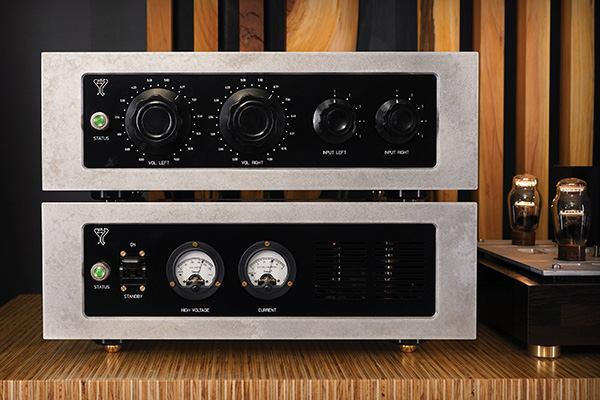
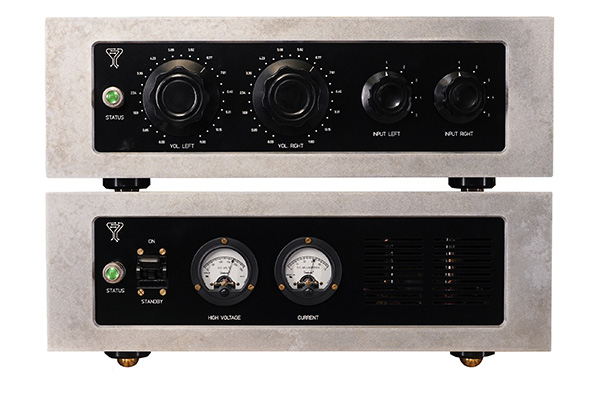
The Treehaus Audiolab website states that "The Treehaus preamplifier essentially is an SET amplifier in [its] design philosophy." I asked Pinto to explain. Its design "is very similar to what you would find in a traditional SET amplifier: a directly heated tube, in this case the 4P1L triode-strapped, outputting to a transformer, in this case the line-out transformer." The Treehaus Audiolab preamplifier, in its A/Machines version, has a forceful, weighty presence. Each chassis—the control unit and the matching power supply—measures a robust 20" wide × 13.5" deep × 7.1" tall. Each aluminum-enclosed unit weighs roughly a solid 30lb or so. The aluminum top, sidewalls, and bottom panels are 3mm thick, and the front and back plates are 5mm thick—all aluminum.
With its powder-coated Hammertone finish and chunky, retro control knobs (including separate L and R volume and source-selection buttons on my sample, though it is also available with a single knob for each), the Treehaus preamplifier evokes the industrial elegance of classic 1950s tube preamplifiers like the Stancil-Hoffman Western Electric Westrex or the Siemens Klangfilm 6S ELA 2117. This homage to vintage industrial design, Pinto told me, extends inside.
 "Finemet TVC"—that's Transformer Volume Control—"converts between current and voltage rather than obstructing the signal flow through a resistor, and we find they don't degrade the audio signal," Pinto continued. "In practice, at any volume level, the same amount of detail and energy is present in the music. Using multiple output taps to the rotary control switch, they carefully attenuate the incoming audio signal before the gain stage."
The cores of those Finemet transformers are made from a nanocrystalline soft magnetic metal, which offers high permeability, enabling efficiency, a smaller footprint, good temperature stability, and low hysteresis loss. Less energy is needed to magnetize and demagnetize.
"Finemet transformers offer the right balance of extension, clarity, and liquidity," Pinto noted.
"Finemet TVC"—that's Transformer Volume Control—"converts between current and voltage rather than obstructing the signal flow through a resistor, and we find they don't degrade the audio signal," Pinto continued. "In practice, at any volume level, the same amount of detail and energy is present in the music. Using multiple output taps to the rotary control switch, they carefully attenuate the incoming audio signal before the gain stage."
The cores of those Finemet transformers are made from a nanocrystalline soft magnetic metal, which offers high permeability, enabling efficiency, a smaller footprint, good temperature stability, and low hysteresis loss. Less energy is needed to magnetize and demagnetize.
"Finemet transformers offer the right balance of extension, clarity, and liquidity," Pinto noted.
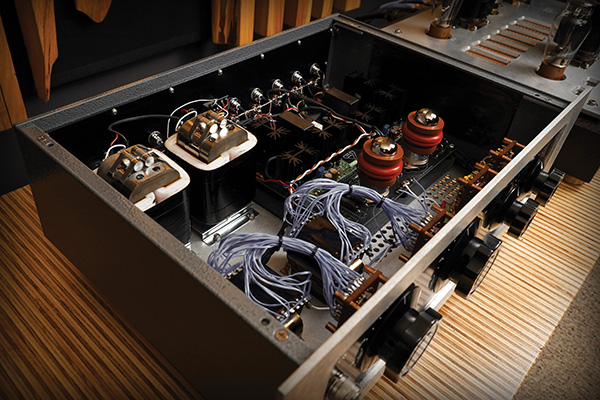 Other standout elements of the Treehaus preamplifier include a pair of NOS Russian 4P1L DHP vacuum tubes operating in a triode-strapped configuration with filament bias, utilizing Coleman Regulators, fed by a constant current source power supply. This supply uses Cornell Dubilier Knowles metallized polypropylene film capacitors, Amtrans carbon-film resistors, Seiden and Elma copper rotary switches (for input selection and volume attenuation), a custom-designed Finemet output transformer from General Transformer Japan with a high/low gain switch, and Mogami and Iconoclast internal wire. The main signal board is mounted to a TerraStone plinth, which in turn is mounted to the aluminum chassis through isolation bushings made of Sorbothane. These fancy, high-value components don't guarantee good sound, but their pedigree inspires confidence, as does the preamp's careful circuit layout.
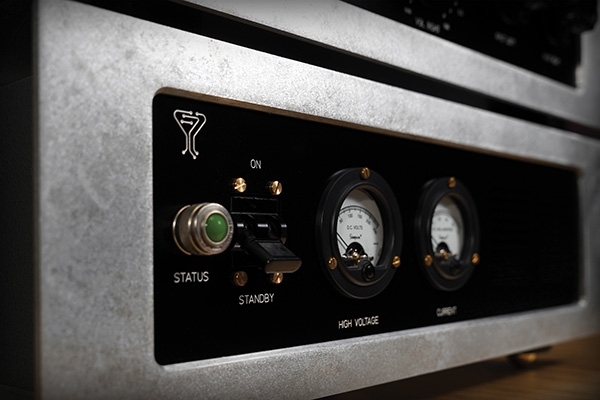
The coordinated power supply, which is connected to the preamp by a thick umbilical cord with robust MIL-spec Amphenol connectors, utilizes a CLCLC (capacitor-load-capacitor-load-capacitor) configuration for high-voltage power. It includes a toroidal power transformer with a Finemet choke in the final stage, dual 6CJ3 tube rectification, Cornell Dubilier Knowles aluminum electrolytic capacitors, and a Vishay film capacitor. Also used are Triad Magnetics power transformers for the 4P1L heater circuits, dual Simpson VU gauges, and a chunky power switch.
A key feature within the preamp is the extensive damping applied to the 4P1L tubes. Because the 4P1L tubes are microphonic, Pinto and Tarta have surrounded each one with three prominent tube-damping rings. "The tube damper rings are two variants of 'IsoDamp' proprietary material from edenSound," Pinto explained. "The smaller, darker ones are metal-infused and have a slightly different density, so they are placed where the insulating spacers in the tube contact the glass envelope. The larger red one provides better glass damping. They are spaced slightly to allow for some tube ventilation—though the 4P1L doesn't run too hot for a 'power' tube. It is a bit belt-and-suspenders, but a bit extra doesn't hurt to extract the best performance out of the tubes."
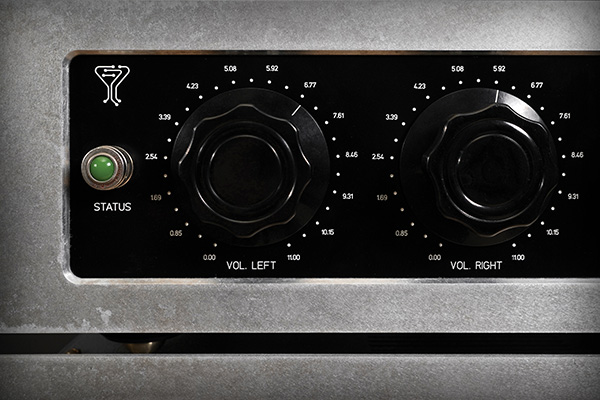
The Treehaus preamplifier's facade is imposing but also welcoming, a point of fascination at audio shows. The black knobs and glass power gauge on the power supply chassis recall a classic 1950s-era American preamp, as intended. Its dual volume potentiometers rotate with a satisfying, silent motion as they move among 26 positions, marked from 0.00 to 11.00. Two smaller (but no less chunky) knobs enable source selection from inputs 1–4. These controls are recessed in a black, powder-coated aluminum panel. The surrounding outer bezels are finished in house in an oxidized gray.
Other standout elements of the Treehaus preamplifier include a pair of NOS Russian 4P1L DHP vacuum tubes operating in a triode-strapped configuration with filament bias, utilizing Coleman Regulators, fed by a constant current source power supply. This supply uses Cornell Dubilier Knowles metallized polypropylene film capacitors, Amtrans carbon-film resistors, Seiden and Elma copper rotary switches (for input selection and volume attenuation), a custom-designed Finemet output transformer from General Transformer Japan with a high/low gain switch, and Mogami and Iconoclast internal wire. The main signal board is mounted to a TerraStone plinth, which in turn is mounted to the aluminum chassis through isolation bushings made of Sorbothane. These fancy, high-value components don't guarantee good sound, but their pedigree inspires confidence, as does the preamp's careful circuit layout.
The coordinated power supply, which is connected to the preamp by a thick umbilical cord with robust MIL-spec Amphenol connectors, utilizes a CLCLC (capacitor-load-capacitor-load-capacitor) configuration for high-voltage power. It includes a toroidal power transformer with a Finemet choke in the final stage, dual 6CJ3 tube rectification, Cornell Dubilier Knowles aluminum electrolytic capacitors, and a Vishay film capacitor. Also used are Triad Magnetics power transformers for the 4P1L heater circuits, dual Simpson VU gauges, and a chunky power switch.
A key feature within the preamp is the extensive damping applied to the 4P1L tubes. Because the 4P1L tubes are microphonic, Pinto and Tarta have surrounded each one with three prominent tube-damping rings. "The tube damper rings are two variants of 'IsoDamp' proprietary material from edenSound," Pinto explained. "The smaller, darker ones are metal-infused and have a slightly different density, so they are placed where the insulating spacers in the tube contact the glass envelope. The larger red one provides better glass damping. They are spaced slightly to allow for some tube ventilation—though the 4P1L doesn't run too hot for a 'power' tube. It is a bit belt-and-suspenders, but a bit extra doesn't hurt to extract the best performance out of the tubes."
The Treehaus preamplifier's facade is imposing but also welcoming, a point of fascination at audio shows. The black knobs and glass power gauge on the power supply chassis recall a classic 1950s-era American preamp, as intended. Its dual volume potentiometers rotate with a satisfying, silent motion as they move among 26 positions, marked from 0.00 to 11.00. Two smaller (but no less chunky) knobs enable source selection from inputs 1–4. These controls are recessed in a black, powder-coated aluminum panel. The surrounding outer bezels are finished in house in an oxidized gray.
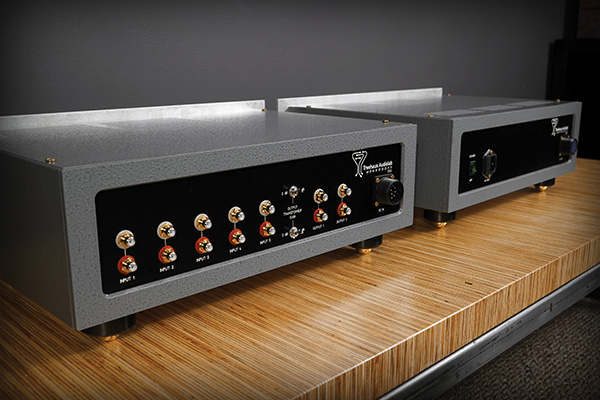 Around back are the usual assortment of RCA inputs and outputs, all Cardas-made, including five pairs of RCA inputs, two pairs of RCA outputs, and two toggle switches for setting the output transformer gain.
The preamp and power supply frames are lined internally with thin, combined layers of aluminum and butyl rubber mastic, carefully placed to dampen resonances. TerraStone Roller Bearings footers are used under each unit.
When I snapped the preamp's chunky Vulcan-Bomber-RAF Rotax double-tumbler power switch, the preamp emitted a series of pinging tones—those microphonic tubes. "The 4P1L is sensitive to microphony and will make a few sounds during warmup,"
Pinto explained. "In use, there is no issue, though physically tapping the chassis might be audible." He went on to say that the measures employed by Treehaus to mitigate microphony—dampers, the isolation platform—"keep this tube from interfering with music enjoyment during use. The benefits the 4P1L offers sonically outweighed these concerns."
Around back are the usual assortment of RCA inputs and outputs, all Cardas-made, including five pairs of RCA inputs, two pairs of RCA outputs, and two toggle switches for setting the output transformer gain.
The preamp and power supply frames are lined internally with thin, combined layers of aluminum and butyl rubber mastic, carefully placed to dampen resonances. TerraStone Roller Bearings footers are used under each unit.
When I snapped the preamp's chunky Vulcan-Bomber-RAF Rotax double-tumbler power switch, the preamp emitted a series of pinging tones—those microphonic tubes. "The 4P1L is sensitive to microphony and will make a few sounds during warmup,"
Pinto explained. "In use, there is no issue, though physically tapping the chassis might be audible." He went on to say that the measures employed by Treehaus to mitigate microphony—dampers, the isolation platform—"keep this tube from interfering with music enjoyment during use. The benefits the 4P1L offers sonically outweighed these concerns."
 Listening
In a recent video on my YouTube channel, Jazz Vinyl Audiophile (footnote 3), I reviewed releases from Analogue Productions/Verve Records' Acoustic Sounds Series. These 180gm vinyl LPs, pressed at QRP and housed in lovely tip-on gatefold sleeves, highlight the work of Bernie Grundman, Matthew Luthans, and Ryan J. Smith, who remastered and cut lacquers using the original analog tapes. The assorted 33 1/3 titles feature such jazz legends as Ella Fitzgerald, Oscar Peterson, Duke Ellington, Milt Jackson, Sonny Rollins, and Roland Kirk. They sound stupendous. To me, some recent jazz reissues sound as if they were dipped in butter and baked into a sticky pie, but Chad Kassem's AP/Verves sound lively, punchy, dynamic, and tonally rich. They retain the original pressings' jump and mojo while providing more of the luster of the original tapes. (I haven't heard the tapes, so this is an assumption.)
Pianist Oscar Peterson and vibraphonist Milt Jackson's tremendous Very Tall (Verve Records B0037378-01) presents velvety vibraphone, tepid acoustic piano, and taut, tight-fisted acoustic bass. With the Treehaus in the system, the soundfield never expanded beyond my Volti Audio Lucera loudspeakers, but it was more than satisfying. Instruments were palpable and upfront in the mix. The Treehaus preamplifier provided a largely neutral, silken, open conduit to the music.
 The Treehaus preamplifier's neutral mien, allied to its low noisefloor and impressive information retrieval, unmasked both downstream and upstream components. John Lee Hooker's menacing It Serves You Right to Suffer (Impulse! AS-9103/Verve Records 602475207733) places Hooker in your face, pacing the studio like an angry judge. With the Treehaus in the system, it punched hard, with the force of a freight train driven by a demon. Hooker's ragged vocals and his studio band of hard-scrabble blues guitar, relentless, pounding bass, and stomping and unruly drums struck with the impact of a blunt shovel blow. Despite a character that tends toward the silken, the Treehaus preamp allowed this cast of sonic marauders to engulf my listening space.
The Treehaus preamplifier revealed every subtlety and nuance in a recording. It was remarkably ego-free, allowing the system's other components to define the sound's color and tone. Along the way, it still delivered music with force and clarity I've rarely heard from other preamplifiers.
The Treehaus preamplifier partnered well with the colorful Tavish Audio Design Adagio phono preamp. It didn't gel as well with the Manley Chinook phono preamp—a bit too much neutrality, perhaps.
The Treehaus-based system made plain the character of the Lightnin' Hopkins album Lightnin' Strikes (Verve Records 602458538359), a less raucous outing but just as dynamic and engaging. This album came across like an acoustic traveling road band in my living room. This was a clear pattern: The Treehaus preamplifier consistently revealed a recording's soul and intent.
The Treehaus preamplifier's neutral mien, allied to its low noisefloor and impressive information retrieval, unmasked both downstream and upstream components. John Lee Hooker's menacing It Serves You Right to Suffer (Impulse! AS-9103/Verve Records 602475207733) places Hooker in your face, pacing the studio like an angry judge. With the Treehaus in the system, it punched hard, with the force of a freight train driven by a demon. Hooker's ragged vocals and his studio band of hard-scrabble blues guitar, relentless, pounding bass, and stomping and unruly drums struck with the impact of a blunt shovel blow. Despite a character that tends toward the silken, the Treehaus preamp allowed this cast of sonic marauders to engulf my listening space.
The Treehaus preamplifier revealed every subtlety and nuance in a recording. It was remarkably ego-free, allowing the system's other components to define the sound's color and tone. Along the way, it still delivered music with force and clarity I've rarely heard from other preamplifiers.
The Treehaus preamplifier partnered well with the colorful Tavish Audio Design Adagio phono preamp. It didn't gel as well with the Manley Chinook phono preamp—a bit too much neutrality, perhaps.
The Treehaus-based system made plain the character of the Lightnin' Hopkins album Lightnin' Strikes (Verve Records 602458538359), a less raucous outing but just as dynamic and engaging. This album came across like an acoustic traveling road band in my living room. This was a clear pattern: The Treehaus preamplifier consistently revealed a recording's soul and intent.
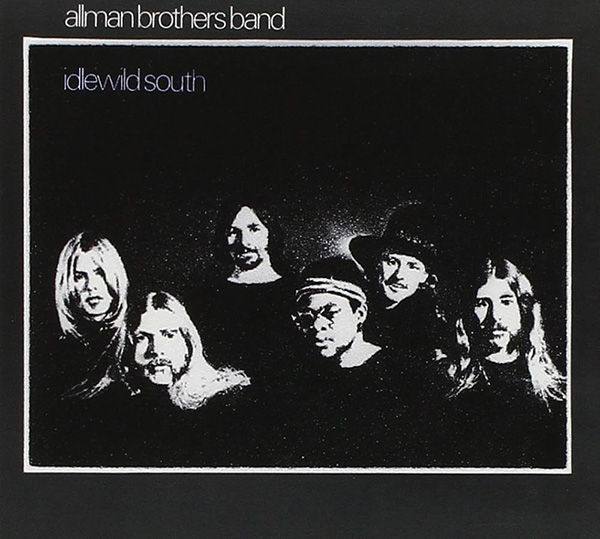 A shift of sonic landscape occurred as The Allman Brothers Band's Idlewild South (ATCO Records SD 33-342) played. The sound was rich and vibrant, achieving a gravitas via a harmonious balance between the Treehaus Audiolab preamp and the AirTight ATM-1 2024E stereo power amp. The Treehaus added a jolt of fresh energy and transparency; the AirTight conjured natural dynamics, fine-grained resolution, and vividness. The vocal chorus in "Revival" transported me to a Sunday morning Baptist church service; the feral howl of the harmonica and the careening wail of Duane Allman's slide guitar in "Don't Keep Me Wonderin'" peeled my ears back with their power.
The gravitas and power continued with Aphex Twin's Blackbox Life Recorder 21f / In a Room7 F760 (Warp Records WAP480EP) and the London Symphony Orchestra/Antal Dorati's The Birds / Brazilian Impressions (Mercury Living Presence SR90153). The Aphex Twin album found its electrifying advantage in the Treehaus's deep, space-black noisefloor, each ferocious punch and visceral jab striking like an assault with a sharp stick, but in a good way. The Respighi was soothing to the senses, luxuriously relaxing, deeply fragrant, sweetly layered, intellectually and emotionally satisfying. Here again, the Treehaus preamplifier seemed paradoxically both retiring and life-giving, disappearing in most respects while providing music with life-like pacing, full-bore dynamics, and a feeling of quiet reserve, allowing the music and the other components to find full expression.
Compared with the Rogue Audio RP-7
A shift of sonic landscape occurred as The Allman Brothers Band's Idlewild South (ATCO Records SD 33-342) played. The sound was rich and vibrant, achieving a gravitas via a harmonious balance between the Treehaus Audiolab preamp and the AirTight ATM-1 2024E stereo power amp. The Treehaus added a jolt of fresh energy and transparency; the AirTight conjured natural dynamics, fine-grained resolution, and vividness. The vocal chorus in "Revival" transported me to a Sunday morning Baptist church service; the feral howl of the harmonica and the careening wail of Duane Allman's slide guitar in "Don't Keep Me Wonderin'" peeled my ears back with their power.
The gravitas and power continued with Aphex Twin's Blackbox Life Recorder 21f / In a Room7 F760 (Warp Records WAP480EP) and the London Symphony Orchestra/Antal Dorati's The Birds / Brazilian Impressions (Mercury Living Presence SR90153). The Aphex Twin album found its electrifying advantage in the Treehaus's deep, space-black noisefloor, each ferocious punch and visceral jab striking like an assault with a sharp stick, but in a good way. The Respighi was soothing to the senses, luxuriously relaxing, deeply fragrant, sweetly layered, intellectually and emotionally satisfying. Here again, the Treehaus preamplifier seemed paradoxically both retiring and life-giving, disappearing in most respects while providing music with life-like pacing, full-bore dynamics, and a feeling of quiet reserve, allowing the music and the other components to find full expression.
Compared with the Rogue Audio RP-7
In my system, the $4995 RP-7, a full-function tubed preamp with remote control, is often paired with the tubed Rogue Stereo 100 power amplifier. While the core functions may be similar, the price and design of the two preamps are significantly different. The RP-7 offered a more traditional, rich tube sound than the Treehaus preamp, with slightly more visceral images, but it lacked the dynamic range and transparency of the much more expensive Treehaus, often blending instruments into a less well-defined sonic mass and occasionally exhibiting an ever-so-slightly wiry-sounding treble. Still, on its own, the RP-7 is a very solid day-to-day choice in a tubed preamplifier. Compared with the Shindo Laboratories Allegro
My long-term reference Shindo Allegro preamplifier, one of Ken Shindo's earliest creations, benefits from point-to-point wiring and separate chassis for left and right channels. It has the unmistakable Shindo sound and so provided an entirely different view into the music than the Treehaus did. The Shindo Allegro's noisefloor was noticeably higher, and its presentation lacked the layering, separation, and transparent personality of the Treehaus. On the other side of the ledger, it manifested more physicality and more flesh-and-blood tonality and texture, both very well-known Shindo strengths. The Shindo plays records with stunning force and apparent realism. The Shindo's soundstage is smaller than the Treehaus's, but within that soundstage it rendered a sense of intimate closeness, searing viscosity, and bristling texture never equaled in my system.
 Verdict
The Treehaus Audiolab Preamplifier is a beast in velvet gloves, with a silken, soothing personality that doesn't force itself on the music but rather invites it to bloom. With its subterranean noisefloor, clear, crystalline presentation, and cosmos-scale soundstage, it allows music of all styles to sing, swing, and engage. The Treehaus Preamplifier is one of the most exquisite preamps to ever grace my humble Greenwich Village crash pad.
Footnote 1: See simplepleasuretubeamps.com. Tarta also publishes Glow in the Dark Audio, a fascinating site that offers commentary on classic and unusual audio designs: speakers, amplifiers, drivers, and tubes. See glowinthedarkaudio.com/home.html.—Jim Austin Footnote 2: I asked and Pinto confirmed: "Kinsuido" is a reference to the picture-frame store where Luxman was founded 100 years ago.—Jim Austin
Footnote 3: See youtube.com/channel/UCjfY3q5vgp-JuoEDoHwoCkw.
DesignThe Treehaus Audiolab website states that "The Treehaus preamplifier essentially is an SET amplifier in [its] design philosophy." I asked Pinto to explain. Its design "is very similar to what you would find in a traditional SET amplifier: a directly heated tube, in this case the 4P1L triode-strapped, outputting to a transformer, in this case the line-out transformer." The Treehaus Audiolab preamplifier, in its A/Machines version, has a forceful, weighty presence. Each chassis—the control unit and the matching power supply—measures a robust 20" wide × 13.5" deep × 7.1" tall. Each aluminum-enclosed unit weighs roughly a solid 30lb or so. The aluminum top, sidewalls, and bottom panels are 3mm thick, and the front and back plates are 5mm thick—all aluminum.
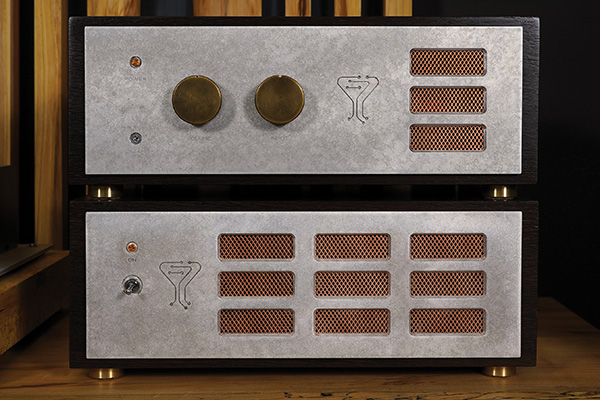
The alternative, "Kinsuido" version of the Treehaus Audiolab Preamplifier, built with just one volume and one source-selection knob. Both the A/Machines and Kinsuido versions can be built either way, with a single knob for those controls or with separate L and R volume and source-selection knobs.
I mentioned that this is the A/Machines version. There is another. "The preamplifier [you have] is the 'A/Machines' design, inspired heavily by vintage Klangfilm and Western Electric," Pinto said. The alternative design, called "Kinsuido," is quite different, with no chassis markings. Pinto says the two designs are electrically identical. "The 'Kinsuido' design draws from midcentury modern and vintage Japanese electronics. 'Kinsuido' is the shop where a very famous Japanese hi-fi brand got its start and whose industrial design work I greatly admire (footnote 2). Part of the design ethos at Treehaus is the products should look good anywhere in the home, not hidden away, which is why we like to offer such choices."
Peering inside the Treehaus Audiolab preamplifier, I saw a bundle of tiny wires running from those separate left and right rotary switches to dedicated Finemet transformers. "The signal path is selector switch to transformer volume control or TVC (attenuation only, no gain)," Pinto explained. "Then a 4P1L gain stage (one tube per channel) to the output transformer, which can provide additional gain via the switches on the back, for better amplifier matching.
"Finemet TVC"—that's Transformer Volume Control—"converts between current and voltage rather than obstructing the signal flow through a resistor, and we find they don't degrade the audio signal," Pinto continued. "In practice, at any volume level, the same amount of detail and energy is present in the music. Using multiple output taps to the rotary control switch, they carefully attenuate the incoming audio signal before the gain stage."
The cores of those Finemet transformers are made from a nanocrystalline soft magnetic metal, which offers high permeability, enabling efficiency, a smaller footprint, good temperature stability, and low hysteresis loss. Less energy is needed to magnetize and demagnetize.
"Finemet transformers offer the right balance of extension, clarity, and liquidity," Pinto noted.
Other standout elements of the Treehaus preamplifier include a pair of NOS Russian 4P1L DHP vacuum tubes operating in a triode-strapped configuration with filament bias, utilizing Coleman Regulators, fed by a constant current source power supply. This supply uses Cornell Dubilier Knowles metallized polypropylene film capacitors, Amtrans carbon-film resistors, Seiden and Elma copper rotary switches (for input selection and volume attenuation), a custom-designed Finemet output transformer from General Transformer Japan with a high/low gain switch, and Mogami and Iconoclast internal wire. The main signal board is mounted to a TerraStone plinth, which in turn is mounted to the aluminum chassis through isolation bushings made of Sorbothane. These fancy, high-value components don't guarantee good sound, but their pedigree inspires confidence, as does the preamp's careful circuit layout.
Around back are the usual assortment of RCA inputs and outputs, all Cardas-made, including five pairs of RCA inputs, two pairs of RCA outputs, and two toggle switches for setting the output transformer gain.
The preamp and power supply frames are lined internally with thin, combined layers of aluminum and butyl rubber mastic, carefully placed to dampen resonances. TerraStone Roller Bearings footers are used under each unit.
When I snapped the preamp's chunky Vulcan-Bomber-RAF Rotax double-tumbler power switch, the preamp emitted a series of pinging tones—those microphonic tubes. "The 4P1L is sensitive to microphony and will make a few sounds during warmup,"
ListeningIn a recent video on my YouTube channel, Jazz Vinyl Audiophile (footnote 3), I reviewed releases from Analogue Productions/Verve Records' Acoustic Sounds Series. These 180gm vinyl LPs, pressed at QRP and housed in lovely tip-on gatefold sleeves, highlight the work of Bernie Grundman, Matthew Luthans, and Ryan J. Smith, who remastered and cut lacquers using the original analog tapes. The assorted 33 1/3 titles feature such jazz legends as Ella Fitzgerald, Oscar Peterson, Duke Ellington, Milt Jackson, Sonny Rollins, and Roland Kirk. They sound stupendous. To me, some recent jazz reissues sound as if they were dipped in butter and baked into a sticky pie, but Chad Kassem's AP/Verves sound lively, punchy, dynamic, and tonally rich. They retain the original pressings' jump and mojo while providing more of the luster of the original tapes. (I haven't heard the tapes, so this is an assumption.)
The Treehaus preamplifier's neutral mien, allied to its low noisefloor and impressive information retrieval, unmasked both downstream and upstream components. John Lee Hooker's menacing It Serves You Right to Suffer (Impulse! AS-9103/Verve Records 602475207733) places Hooker in your face, pacing the studio like an angry judge. With the Treehaus in the system, it punched hard, with the force of a freight train driven by a demon. Hooker's ragged vocals and his studio band of hard-scrabble blues guitar, relentless, pounding bass, and stomping and unruly drums struck with the impact of a blunt shovel blow. Despite a character that tends toward the silken, the Treehaus preamp allowed this cast of sonic marauders to engulf my listening space.
The Treehaus preamplifier revealed every subtlety and nuance in a recording. It was remarkably ego-free, allowing the system's other components to define the sound's color and tone. Along the way, it still delivered music with force and clarity I've rarely heard from other preamplifiers.
A shift of sonic landscape occurred as The Allman Brothers Band's Idlewild South (ATCO Records SD 33-342) played. The sound was rich and vibrant, achieving a gravitas via a harmonious balance between the Treehaus Audiolab preamp and the AirTight ATM-1 2024E stereo power amp. The Treehaus added a jolt of fresh energy and transparency; the AirTight conjured natural dynamics, fine-grained resolution, and vividness. The vocal chorus in "Revival" transported me to a Sunday morning Baptist church service; the feral howl of the harmonica and the careening wail of Duane Allman's slide guitar in "Don't Keep Me Wonderin'" peeled my ears back with their power.
In my system, the $4995 RP-7, a full-function tubed preamp with remote control, is often paired with the tubed Rogue Stereo 100 power amplifier. While the core functions may be similar, the price and design of the two preamps are significantly different. The RP-7 offered a more traditional, rich tube sound than the Treehaus preamp, with slightly more visceral images, but it lacked the dynamic range and transparency of the much more expensive Treehaus, often blending instruments into a less well-defined sonic mass and occasionally exhibiting an ever-so-slightly wiry-sounding treble. Still, on its own, the RP-7 is a very solid day-to-day choice in a tubed preamplifier. Compared with the Shindo Laboratories Allegro
My long-term reference Shindo Allegro preamplifier, one of Ken Shindo's earliest creations, benefits from point-to-point wiring and separate chassis for left and right channels. It has the unmistakable Shindo sound and so provided an entirely different view into the music than the Treehaus did. The Shindo Allegro's noisefloor was noticeably higher, and its presentation lacked the layering, separation, and transparent personality of the Treehaus. On the other side of the ledger, it manifested more physicality and more flesh-and-blood tonality and texture, both very well-known Shindo strengths. The Shindo plays records with stunning force and apparent realism. The Shindo's soundstage is smaller than the Treehaus's, but within that soundstage it rendered a sense of intimate closeness, searing viscosity, and bristling texture never equaled in my system.
VerdictThe Treehaus Audiolab Preamplifier is a beast in velvet gloves, with a silken, soothing personality that doesn't force itself on the music but rather invites it to bloom. With its subterranean noisefloor, clear, crystalline presentation, and cosmos-scale soundstage, it allows music of all styles to sing, swing, and engage. The Treehaus Preamplifier is one of the most exquisite preamps to ever grace my humble Greenwich Village crash pad.
Footnote 1: See simplepleasuretubeamps.com. Tarta also publishes Glow in the Dark Audio, a fascinating site that offers commentary on classic and unusual audio designs: speakers, amplifiers, drivers, and tubes. See glowinthedarkaudio.com/home.html.—Jim Austin Footnote 2: I asked and Pinto confirmed: "Kinsuido" is a reference to the picture-frame store where Luxman was founded 100 years ago.—Jim Austin