Designers of hybrid amplifiers can use solid-state devices in an amp's input stage and tubes in its driver and output stages, as Music Reference's Roger Modjeski did in his RM-200 Mk.II—or they can use tubes in the input and transistors in the output, as Ypsilon Electronics' Demetris Baklavas prefers.
The advantage of solid-state at the input stage can be lower noise. In the RM-200 Mk.II's fully balanced design, carefully matched input devices result in high common-mode rejection and low-noise operation close to the levels achieved with the best input transformers. The RM-200 Mk.II's signal/noise ratio measured a healthy 95.4dB.
In Baklavas's original hybrid monoblock amplifier, the Aelius, the first gain stage was a new old stock (NOS) C3g pentode tube operating in single-ended mode and transformer-coupled to the output stage. The Aelius II added an input transformer, then newly developed, that permitted balanced input operation and the use of longer interconnects. The input stages of both Aeliuses featured tube rectification.
Obviously, the quality of transformers is key to power-amp designs from both Music Reference and Ypsilon. Modjeski offers an upgrade to a hand-wound output transformer, and Ypsilon specializes in designing and manufacturing transformers.
209 lbs of push-pull
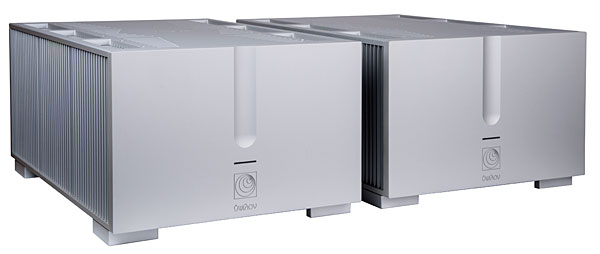
Ypsilon's new Hyperion monoblock ($93,000/pair), like the less powerful Aelius II, is a hybrid design with two gain stages. The first stage uses a single low-impedance dual-triode tube—either a 6H30 or a 5687 will work. The Hyperion comes with the former—a Sovtek 6H30 Pi—but to allow tube-rolling, there are separate sockets for the two tube types, which have different pinouts. Also included is a 6CA4/EZ81 rectifier tube. The input-stage tube's bias is fixed. Its dedicated negative power supply includes a custom C-core input transformer, wound with silver wire, that eliminates the DC bias voltage bypass and produces a true balanced input. The two halves of the input tube are paralleled via separate coil windings to provide independent paths for each half's bias current.
The interstage transformer is a step-down that couples the input triodes to the output devices and includes phase-splitting windings that drive each pair of MOSFET output-stage devices in opposite phase to each other. Using the interstage transformer, Baklavas avers, lowers the tube's output impedance, which better drives the output stage while providing a perfectly balanced, floating signal. Not using the transformer, he says, would require at least two additional gain stages plus power supplies, making for a more complex circuit. He prefers to keep things as simple and elegant as possible.
As with anything in life or audio, there's a drawback to such a design: the difficulty of producing a transformer with wide bandwidth and integrating it into a solid-state circuit requiring unconditional stability. But transformers are Baklavas's game, and the time I've spent with his trannies has convinced me to unconditionally trust them.
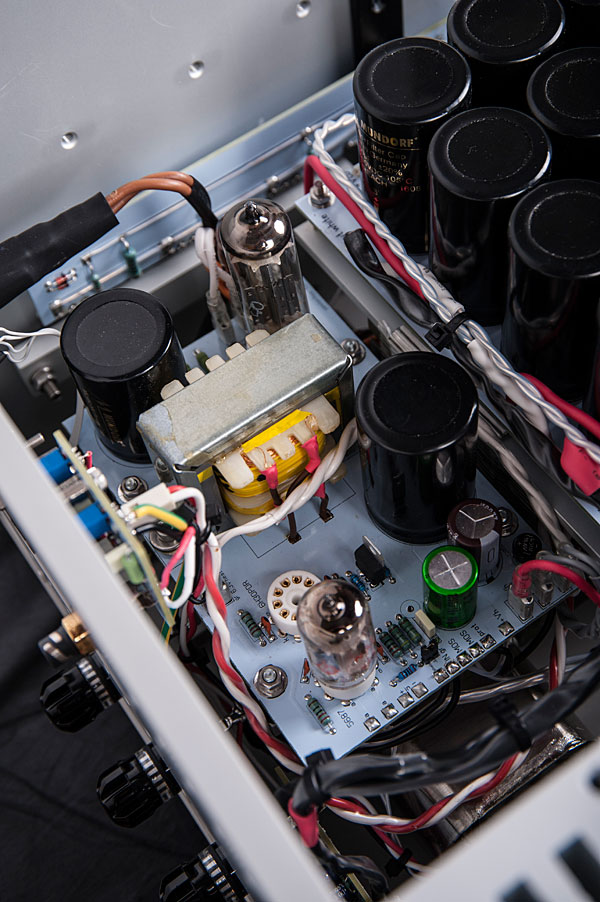 The Hyperion's output stage is biased in class-A for its first 100W into 8 ohms, and can output a total of more than 370W into 8 ohms, 650W into 4 ohms, and 1150W into 2 ohms. Each of its two stages has its own power-supply transformer, and both the tube input and solid-state output power supplies use inductive chokes, built in-house, for filtering. A great deal of attention was reportedly paid to the design, construction, and materials of the cores of these power-supply transformers, to minimize mechanical, magnetic, and electrically induced noise.
In addition to the chokes, the power supply incorporates 112,800µF of capacitance to keep ripple voltage negligible at all power-output levels. Internal connections are made with Ypsilon's own specially drawn silver wire, coated with Teflon.
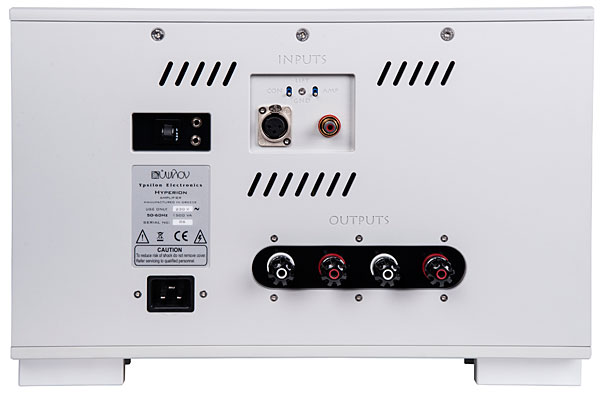
As in the Aelius, the Hyperion's output "floats"—neither the plus nor the minus terminals are grounded. The amp is well protected using a "crowbar" circuit. There's no output relay, though there is a circuit breaker on the rear panel, and inside the Hyperion's case is a fuse for the input transformer. If the output shorts, or sees a load of less than 1 ohm, or there's excessive DC offset, the Hyperion automatically shuts down. Once the problem is fixed, turning the amp back on restores output.
Roll 'em in, set 'em up
The Hyperion's output stage is biased in class-A for its first 100W into 8 ohms, and can output a total of more than 370W into 8 ohms, 650W into 4 ohms, and 1150W into 2 ohms. Each of its two stages has its own power-supply transformer, and both the tube input and solid-state output power supplies use inductive chokes, built in-house, for filtering. A great deal of attention was reportedly paid to the design, construction, and materials of the cores of these power-supply transformers, to minimize mechanical, magnetic, and electrically induced noise.
In addition to the chokes, the power supply incorporates 112,800µF of capacitance to keep ripple voltage negligible at all power-output levels. Internal connections are made with Ypsilon's own specially drawn silver wire, coated with Teflon.
As in the Aelius, the Hyperion's output "floats"—neither the plus nor the minus terminals are grounded. The amp is well protected using a "crowbar" circuit. There's no output relay, though there is a circuit breaker on the rear panel, and inside the Hyperion's case is a fuse for the input transformer. If the output shorts, or sees a load of less than 1 ohm, or there's excessive DC offset, the Hyperion automatically shuts down. Once the problem is fixed, turning the amp back on restores output.
Roll 'em in, set 'em up
Each Ypsilon Hyperion weighs 209 lbs—moving and unpacking the pair of them was a multiperson operation. The installation of a lawn-sprinkler system chez Fremer the day the crates arrived provided the necessary manpower—after the guys had washed their hands of topsoil.
The Hyperions arrived having been burned in for only 100 hours. I found that, even after they'd been broken in, they required at least an hour of play to develop their full potential. For the first hour or so, they sounded somewhat dynamically constricted and not entirely transparent.
 I first ran a long pair of TARA Labs Zero balanced interconnects between my darTZeel NHB-18S preamplifier and the Hyperions. A few weeks later, I swapped out the darTZeel for the Silver edition of Ypsilon's PST-100 Mk.II line preamp. So often, when swapping out familiar gear for new, there's a period during which my brain accentuates or exaggerates the differences between the old and new sounds. At such times the new can at first seem like an uninvited guest disrupting my system's musical harmony.
That wasn't the case here. Sure, it took me some time to get used to the Hyperion's sound, which was richer, fuller, creamier, more full-bodied than that of the darTZeel NHB-458 monoblocks—but that sound was also immediately familiar because it meshed well with the sound of Ypsilon's VPS-100 phono preamplifier. That model arrived here for review some nine years ago and never left—except briefly, to be upgraded to its Silver edition (footnote 1). Big hybrid amps running in class-A for the first 100W are good company during a record cold snap!
Power, Grip, Depth, Delicacy
I first ran a long pair of TARA Labs Zero balanced interconnects between my darTZeel NHB-18S preamplifier and the Hyperions. A few weeks later, I swapped out the darTZeel for the Silver edition of Ypsilon's PST-100 Mk.II line preamp. So often, when swapping out familiar gear for new, there's a period during which my brain accentuates or exaggerates the differences between the old and new sounds. At such times the new can at first seem like an uninvited guest disrupting my system's musical harmony.
That wasn't the case here. Sure, it took me some time to get used to the Hyperion's sound, which was richer, fuller, creamier, more full-bodied than that of the darTZeel NHB-458 monoblocks—but that sound was also immediately familiar because it meshed well with the sound of Ypsilon's VPS-100 phono preamplifier. That model arrived here for review some nine years ago and never left—except briefly, to be upgraded to its Silver edition (footnote 1). Big hybrid amps running in class-A for the first 100W are good company during a record cold snap!
Power, Grip, Depth, Delicacy
No doubt the single tube in the Hyperion's signal path subtly greased the musical proceedings with a smooth yet transparent overlay of richness. Having become acclimated in recent years years to the sound of the darTZeel NHB-458, which is less generous in the upper bass and lower midrange (detractors of solid-state designs might describe its sound as "thin") and is faster in the transient realm (detractors might say "overly and unrealistically sharply drawn"), the gross distinctions between these two great performers were easily audible for the first week or so of listening. But even while the contours of the new sound were still easily definable and the differences between the two amplifiers were still clear, the Hyperion's "additive" quality wasn't immediately—or ever, for that matter—identifiable as what's usually thought of as tube sound, but rather as a subtle harmonic and textural generosity that I think most listeners would find very pleasing and desirable, regardless of on which side of the tube/solid-state divide they stand. At the high performance level of my reference amps, and because of what I'd assumed I'd hear from the Hyperions, based on my experience with other Ypsilon gear, I expected to draw equal amounts of pleasure from both, and hear no new revelations.
Because of the immediately obvious added harmonic and textural richness, subtle though it was, once I'd begun listening critically, I found myself playing mostly classical and jazz. I'd received in the mail a two-LP set of pianist Daniil Trifonov, then 21 years old and the recent winner of the 14th International Tchaikovsky Competition (among many other awards), performing Tchaikovsky's Piano Concerto 1, with Valery Gergiev conducting the Mariinsky Orchestra. Disc 2 features Trifonov playing mostly Schubert songs, arranged for solo piano by Liszt (Mariinsky MAR0530-LP).
This is a prize-winning soloist and a world-class orchestra, well recorded in a fine-sounding hall. Whether on the vinyl (which had what sounded like a few "non-fill" problems) or the free 24-bit/96kHz FLAC download, the balance of direct to reflected orchestral sound was, for me, ideal, and the perspective was positively grand, à la recording engineer Dr. Keith O. Johnson. Not everyone likes this kind of somewhat distant sonic drama, but it went perfectly well with Trifonov's grand, sweeping, romantic playing, and left enough room for Gergiev's dramatic orchestral swells not to overwhelm the soloist.
Footnote 1: I reviewed the VPS-100 and VPS-100 Silver in "Analog Corner," in the August 2009 and March 2011 issues.
Ypsilon's new Hyperion monoblock ($93,000/pair), like the less powerful Aelius II, is a hybrid design with two gain stages. The first stage uses a single low-impedance dual-triode tube—either a 6H30 or a 5687 will work. The Hyperion comes with the former—a Sovtek 6H30 Pi—but to allow tube-rolling, there are separate sockets for the two tube types, which have different pinouts. Also included is a 6CA4/EZ81 rectifier tube. The input-stage tube's bias is fixed. Its dedicated negative power supply includes a custom C-core input transformer, wound with silver wire, that eliminates the DC bias voltage bypass and produces a true balanced input. The two halves of the input tube are paralleled via separate coil windings to provide independent paths for each half's bias current.
The Hyperion's output stage is biased in class-A for its first 100W into 8 ohms, and can output a total of more than 370W into 8 ohms, 650W into 4 ohms, and 1150W into 2 ohms. Each of its two stages has its own power-supply transformer, and both the tube input and solid-state output power supplies use inductive chokes, built in-house, for filtering. A great deal of attention was reportedly paid to the design, construction, and materials of the cores of these power-supply transformers, to minimize mechanical, magnetic, and electrically induced noise.
Each Ypsilon Hyperion weighs 209 lbs—moving and unpacking the pair of them was a multiperson operation. The installation of a lawn-sprinkler system chez Fremer the day the crates arrived provided the necessary manpower—after the guys had washed their hands of topsoil.
I first ran a long pair of TARA Labs Zero balanced interconnects between my darTZeel NHB-18S preamplifier and the Hyperions. A few weeks later, I swapped out the darTZeel for the Silver edition of Ypsilon's PST-100 Mk.II line preamp. So often, when swapping out familiar gear for new, there's a period during which my brain accentuates or exaggerates the differences between the old and new sounds. At such times the new can at first seem like an uninvited guest disrupting my system's musical harmony.
That wasn't the case here. Sure, it took me some time to get used to the Hyperion's sound, which was richer, fuller, creamier, more full-bodied than that of the darTZeel NHB-458 monoblocks—but that sound was also immediately familiar because it meshed well with the sound of Ypsilon's VPS-100 phono preamplifier. That model arrived here for review some nine years ago and never left—except briefly, to be upgraded to its Silver edition (footnote 1). Big hybrid amps running in class-A for the first 100W are good company during a record cold snap!
No doubt the single tube in the Hyperion's signal path subtly greased the musical proceedings with a smooth yet transparent overlay of richness. Having become acclimated in recent years years to the sound of the darTZeel NHB-458, which is less generous in the upper bass and lower midrange (detractors of solid-state designs might describe its sound as "thin") and is faster in the transient realm (detractors might say "overly and unrealistically sharply drawn"), the gross distinctions between these two great performers were easily audible for the first week or so of listening. But even while the contours of the new sound were still easily definable and the differences between the two amplifiers were still clear, the Hyperion's "additive" quality wasn't immediately—or ever, for that matter—identifiable as what's usually thought of as tube sound, but rather as a subtle harmonic and textural generosity that I think most listeners would find very pleasing and desirable, regardless of on which side of the tube/solid-state divide they stand. At the high performance level of my reference amps, and because of what I'd assumed I'd hear from the Hyperions, based on my experience with other Ypsilon gear, I expected to draw equal amounts of pleasure from both, and hear no new revelations.
Footnote 1: I reviewed the VPS-100 and VPS-100 Silver in "Analog Corner," in the August 2009 and March 2011 issues.