Sidebar 3: Measurements
I used DRA Labs' MLSSA system and a calibrated DPA 4006 microphone with an Earthworks microphone preamplifier to measure the Volti Audio Lucera's farfield frequency behavior and dispersion. I used an Earthworks QTC-40 mike for the nearfield responses and Dayton Audio's DATS V2 system to measure the impedance magnitude and electrical phase angle. I took a full set of farfield measurements with the microphone at my usual 50" on the tweeter axis, which is 36" from the floor.
Footnote 1: EPDR is the resistive load that gives rise to the same peak dissipation in an amplifier's output devices as the loudspeaker. See "Audio Power Amplifiers for Loudspeaker Loads," JAES, Vol.42 No.9, September 1994, and stereophile.com/reference/707heavy/index.html. Footnote 2: This means that the loudspeaker is firing into hemispherical space rather than a full sphere. A speaker that has a truly flat response in the usual "4pi" space will therefore appear to have a boosted upper-bass output with a nearfield measurement, the center frequency of that boost depending on the physical dimensions of the speaker and the woofer alignment. See stereophile.com/content/measuring-loudspeakers-part-three-page-6 or aes2.org/publications/elibrary-page/?id=7171.
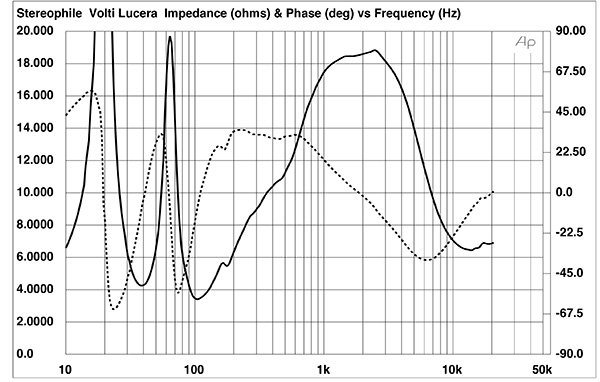
Fig.1 Volti Audio Lucera, electrical impedance (solid) and phase (dashed) (2 ohms/vertical div.).
Volti specifies the Lucera's sensitivity as 99dB/2.83V/1m. My B-weighted estimate was slightly lower, at 97.6dB(B)/2.83V/1m, but this sensitivity is still very much higher than average. (Listening tests I organized in the 1990s showed that by reducing the effect of high- and low-frequency extension, a B-weighted sensitivity correlated with a speaker's perceived loudness.) The Lucera's nominal impedance is specified as 8 ohms. My measurement (fig.1, solid trace) remained above 8 ohms for almost the entire midrange and treble, with a minimum value of 3.4 ohms at 104Hz. Despite the high average impedance, as the electrical phase angle (dashed trace) is occasionally high, the effective resistance, or EPDR (footnote 1), drops below 3 ohms for several regions between 25Hz and 250Hz. The minimum EPDR values are 1.82 ohms at 32Hz and 1.62 ohms at 91Hz. The Lucera s a demanding load for the partnering amplifier, though this will be ameliorated by the very high sensitivity.
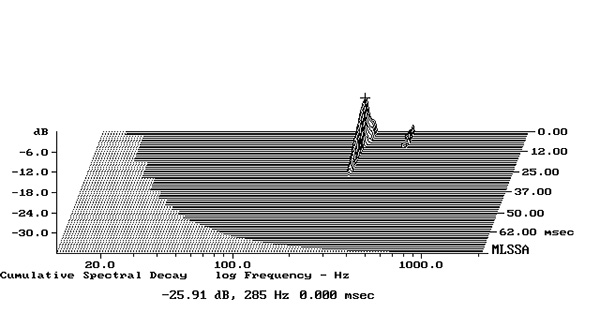
Fig.2 Volti Audio Lucera, cumulative spectral-decay plot calculated from output of accelerometer fastened to center of a sidewall, level with the woofer (measurement bandwidth, 2kHz).
The discontinuity in the impedance traces just below 200Hz suggests some kind of resonance. However, when I investigated the enclosure's vibrational behavior with a plastic-tape accelerometer, while I found low-level resonant modes on all the surfaces, these were all higher in frequency. For example, fig.2, which was taken on a sidewall level with the woofer, shows a single mode at 285Hz. This is low in level and has a high Q (Quality Factor); both factors will work against audible consequences.
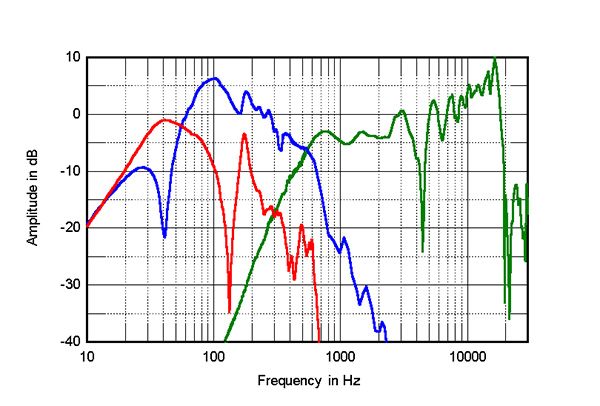
Fig.3 Volti Audio Lucera, farfield response on tweeter axis at 50" (green trace above 500Hz; woofer + port only, blue trace above 500Hz), corrected for microphone response, with the nearfield responses of the port (red trace), woofer, and midrange unit (green and blue traces,
The saddle centered on 38Hz in the impedance magnitude trace in fig.1 suggests that this is the tuning frequency of the port on the front baffle, which is just below the frequency of the lowest note on the four-string bass guitar and double bass. The red trace in fig.3 shows the nearfield response of the port. As expected, it peaks at the tuning frequency, but its upper-frequency rolloff is disturbed by a deep suckout at 133Hz and a peak at 173Hz; the latter is the frequency of the discontinuity in the impedance traces. The woofer's nearfield response (blue trace) has the expected minimum-motion notch at the port-tuning frequency, which is the frequency at which the back pressure from the port resonance holds the diaphragm stationary. However, the woofer's upper-frequency rolloff is disturbed by a small suckout and peak between 150Hz and 200Hz that appear to be related to the port's behavior.
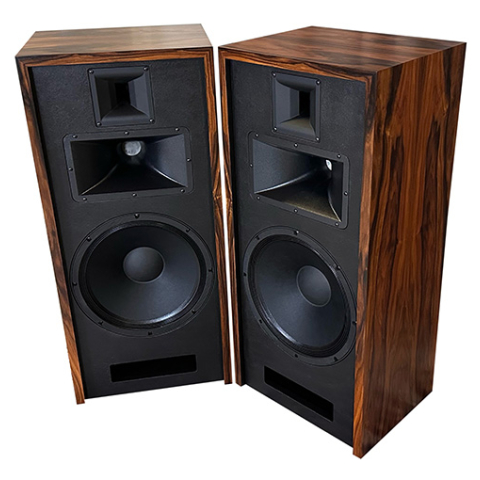
The green trace below 500Hz in fig.3 shows the nearfield response of the horn-loaded midrange unit; above that frequency, the green trace shows the farfield response of the midrange unit and the horn-loaded tweeter. The crossover between the midrange and the low-frequency drive unit lies around 550Hz, and the midrange unit's output is even before peaking at 3kHz. Above that frequency, there is a severe but narrow suckout followed by the tweeter's output rising to a peak at 16kHz.
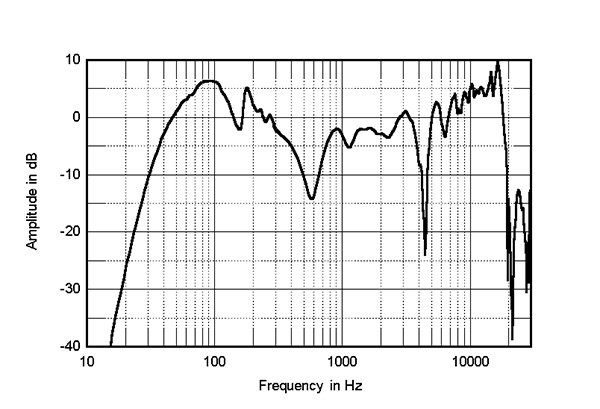
Fig.4 Volti Audio Lucera, anechoic response on tweeter axis at 50", averaged across 30° horizontal window and corrected for microphone response, with the complex sum of the nearfield woofer and port responses plotted below 310Hz.
This behavior can also be seen in fig.4, which shows the Lucera's quasi-anechoic farfield response above 310Hz, averaged across a 30° horizontal window centered on the tweeter axis. There is a major suckout in the middle of the midrange, which I suspect is due to the outputs of the woofer and midrange unit being in antiphase in the region where they cross over. The rise in the mid- and upper-bass regions in this graph will be due in part to the nearfield measurement technique, which assumes that the drive units are mounted in a true infinite baffle (footnote 2). However, the woofer does appear to be balanced too high in level.
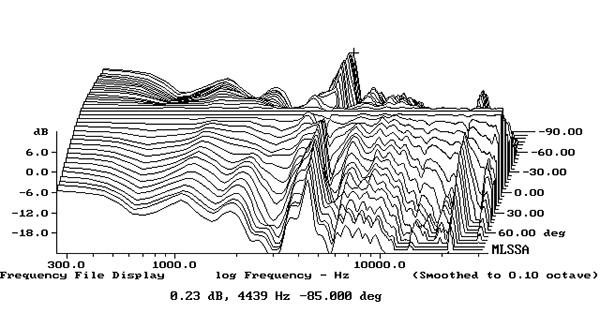
Fig.5 Volti Audio Lucera, lateral response family at 50", normalized to response on tweeter axis, from back to front: differences in response 90–5° off axis, reference response, differences in response 5–90° off axis.
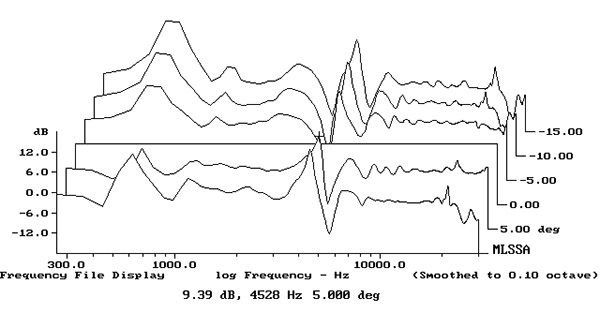
Fig.6 Volti Audio Lucera, vertical response family at 50", normalized to response on tweeter axis, from back to front: differences in response 15–5° above axis, reference response, differences in response 5–10° below axis.
Fig.5 shows the Lucera's horizontal dispersion, normalized to the response on the tweeter axis, which thus appears as a straight line. The radiation pattern narrows significantly in the top two octaves, but the suckout in the mid-treble region fills in to the speaker's sides. The Volti's radiation pattern in the vertical plane, again normalized to the response on the 36"-high tweeter axis, is shown in fig.6. (A survey performed by Stereophile in the 1990s indicated that 36" was the typical ear height of a seated listener.) The midrange suckout starts to fill in 5° above the tweeter axis, which suggests that Lucera owners should tilt the speakers forward or sit in something like a director's chair to get the optimal midrange balance.
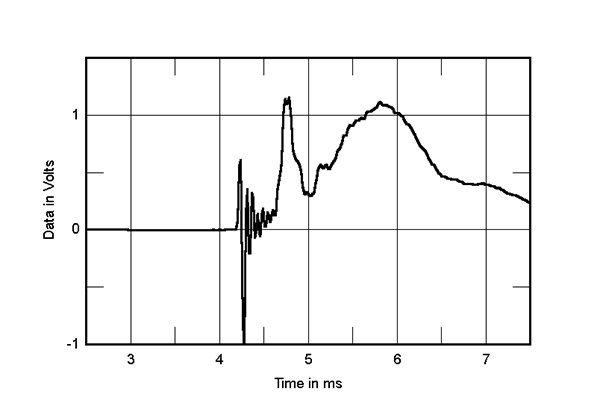
Fig.7 Volti Audio Lucera, step response on tweeter axis at 50" (5ms time window, 30kHz bandwidth).
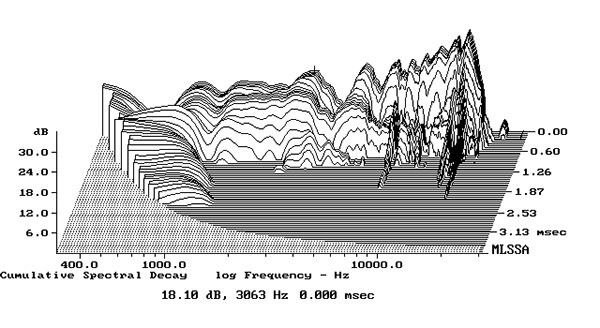
Fig.8 Volti Audio Lucera, cumulative spectral-decay plot on tweeter axis at 50" (0.15ms risetime).
In the time domain, the Lucera's step response on the tweeter axis (fig.7) indicates that all three drive units are connected in positive acoustic polarity, although, as this is a horn-loaded speaker with a flat baffle, the output is not time-coincident. The output of the tweeter arrives first at the microphone, followed by that of the midrange unit 0.5 milliseconds later, then by that of the woofer. The Lucera's cumulative spectral-decay (waterfall) plot, fig.8, is afflicted by several regions of delayed energy.
With its "tailored" frequency response and its very high sensitivity, the Volti Audio Lucera's measured performance is similar to that of the Volti Rival, which KM reviewed in June 2017, and that of the Volti Razz, which he reviewed in December 2023. Even with its current-hungry impedance, the Lucera will work well with flea-power amplifiers. Both the top-octave rise in the Lucera's on-axis response and the suckout in the mid-treble region could be compensated for by pointing the speakers straight ahead—by not toeing them toward the listening seat; that treble may also be subjectively balanced by the Volti's low-frequency behavior.—John Atkinson
Footnote 1: EPDR is the resistive load that gives rise to the same peak dissipation in an amplifier's output devices as the loudspeaker. See "Audio Power Amplifiers for Loudspeaker Loads," JAES, Vol.42 No.9, September 1994, and stereophile.com/reference/707heavy/index.html. Footnote 2: This means that the loudspeaker is firing into hemispherical space rather than a full sphere. A speaker that has a truly flat response in the usual "4pi" space will therefore appear to have a boosted upper-bass output with a nearfield measurement, the center frequency of that boost depending on the physical dimensions of the speaker and the woofer alignment. See stereophile.com/content/measuring-loudspeakers-part-three-page-6 or aes2.org/publications/elibrary-page/?id=7171.