Flashback: It was 2012—or maybe '13. I was in a small hotel room in midtown Manhattan. An array of five chunky black speakers teetering on tripod mounts almost filled the room. Every corner held a subwoofer, each with a tiny, unmarked box on top. On the coffee table sat an AVR, a disc player, and another, similar unmarked box connected to the AVR. No cables linked the coffee table stuff to the (powered) speakers and subs. But music was playing! In 5.1 at 24/96 with very low latency and absolute synchronization among the speakers. Wow!, I thought. This WiSA thing is the future of home audio!That box and what's in it
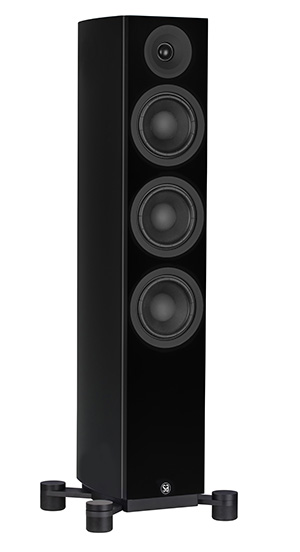
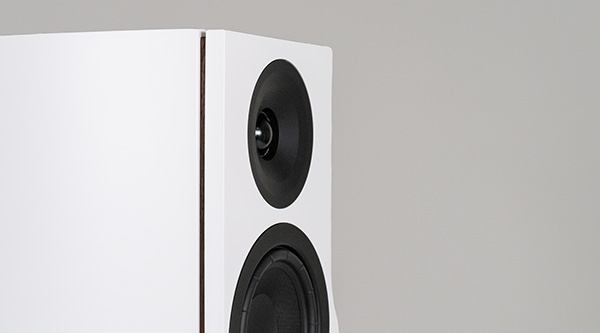
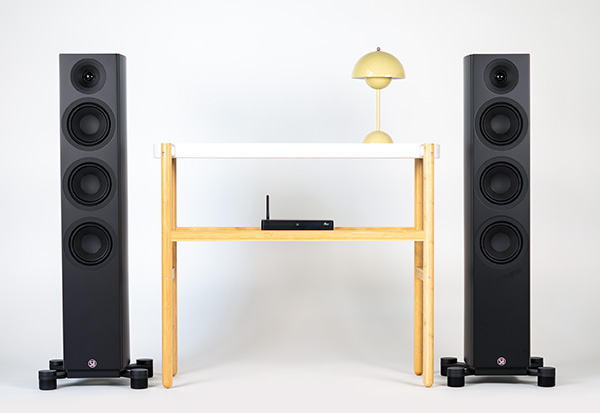
The System Audio Legend 40.2 Silverback DS ($6414.84/pair including the WiSA Stereo Hub HT) is a floorstanding loudspeaker system of modest size, significant weight, and impressive solidity. Its sides are gently bowed. A layer of dark material, which isolates its front baffle from the main cabinet (both white in my Satin White pair), makes for a striking visual accent. A sheer white grille, attached by hidden magnets, hides a vertical array of four black drivers. Sturdy black outriggers with adjustable, chunky rubber feet (or, optionally, spikes) ensure stability. The appearance is cool and calm, with or without the grille. In the Specifications sidebar, I refer to the 40.2 as a four-way speaker, but it's not a four-way in the conventional sense. Three of the drivers—all but the tweeter—are identical externally. They are not, however, identical on the inside. The three drivers include two woofers, which System Audio refers to as 15/6: 15 refers to the driver diameter, 15cm (though elsewhere the diameter is given as 5.5", which is slightly smaller), and 6 is the driver's nominal impedance, in ohms. The woofers are designed with "slightly heavier moving parts" than the midrange driver and a "long-stroke voice coil/motor system optimised for bass performance." The midrange drivers are 15/4—15cm and 4 ohms—with parts optimized for midrange performance.
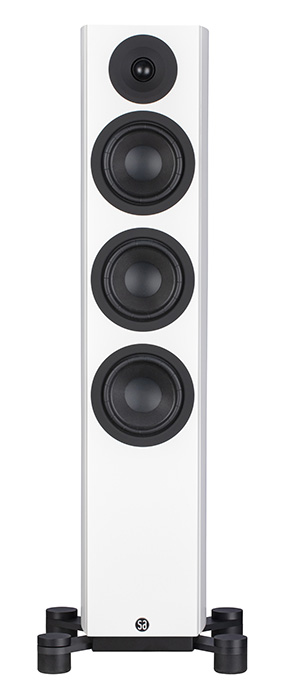 The speaker is a four way because it has four independent amplification channels, which is to say, each driver is driven separately. While the two woofers are driven over the same frequency range—both cross over at 200Hz with a fourth-order filter—the lower of the two "is delayed a little bit different than the other woofer," System Audio CEO and designer Ole Witthøft told me. The midrange driver is down by only about 8dB at 200Hz, and below that parallels the woofers, so all three cone drivers contribute to bass output.
Higher up, the midrange driver crosses over to the 1" tweeter at 2.8kHz, also with a fourth-order filter. The tweeter output is shaped by a DXT acoustic lens to match the midrange driver's dispersion near the transition frequency.
There's a port on the back of the speaker, but it is blocked by a permanent, internal foam plug. What's that about? For economy, presumably, the Silverback DS shares a cabinet with a ported passive speaker System Audio makes, but the Silverback DS design calls for a sealed enclosure. Hence the port.
The speaker is a four way because it has four independent amplification channels, which is to say, each driver is driven separately. While the two woofers are driven over the same frequency range—both cross over at 200Hz with a fourth-order filter—the lower of the two "is delayed a little bit different than the other woofer," System Audio CEO and designer Ole Witthøft told me. The midrange driver is down by only about 8dB at 200Hz, and below that parallels the woofers, so all three cone drivers contribute to bass output.
Higher up, the midrange driver crosses over to the 1" tweeter at 2.8kHz, also with a fourth-order filter. The tweeter output is shaped by a DXT acoustic lens to match the midrange driver's dispersion near the transition frequency.
There's a port on the back of the speaker, but it is blocked by a permanent, internal foam plug. What's that about? For economy, presumably, the Silverback DS shares a cabinet with a ported passive speaker System Audio makes, but the Silverback DS design calls for a sealed enclosure. Hence the port.
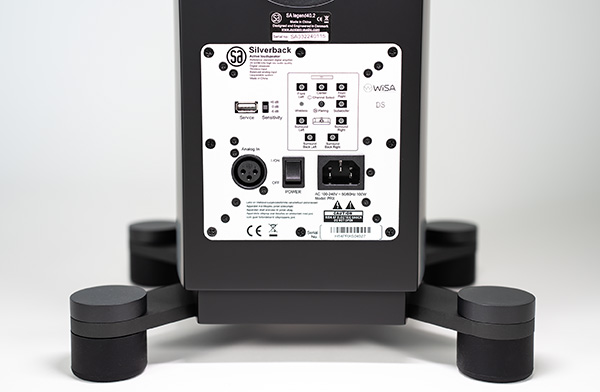 The XLR jack, labeled "Analog In," is the only physical input, and the sensitivity switch applies only to that source. Using these inputs makes it easy to incorporate the Silverbacks into wired stereo systems. When a Silverback speaker receives an analog input via its wired, line-level inputs, a pair of Burr-Brown ADCs digitizes the signal to 24/96. Even so—even though the signal is digitized—few of the DSP features that make the Silverbacks interesting are in play. Those features are applied in the Stereo Hub HT, which costs an extra $500 or so—that's a package price—but you should consider it an essential purchase. The Stereo Hub HT adds several digital inputs: one HDMI ARC/eARC, three TosLink, one coax S/ PDIF, one USB-B, one RJ45 Ethernet, one pair RCA analog line in, and another USB for connecting storage media, plus Wi-Fi streaming. But the main thing the Hub does is send music out wirelessly to the speakers and coordinate the timing. What's more, it's where all the most interesting DSP happens in the System Audio system.
Platin, a Danish company, made the WiSA receiver-amplifiers built into the System Audio speakers and the Stereo Hub HT. System Audio tuned both to suit its hardware and achieve the desired sound.
The XLR jack, labeled "Analog In," is the only physical input, and the sensitivity switch applies only to that source. Using these inputs makes it easy to incorporate the Silverbacks into wired stereo systems. When a Silverback speaker receives an analog input via its wired, line-level inputs, a pair of Burr-Brown ADCs digitizes the signal to 24/96. Even so—even though the signal is digitized—few of the DSP features that make the Silverbacks interesting are in play. Those features are applied in the Stereo Hub HT, which costs an extra $500 or so—that's a package price—but you should consider it an essential purchase. The Stereo Hub HT adds several digital inputs: one HDMI ARC/eARC, three TosLink, one coax S/ PDIF, one USB-B, one RJ45 Ethernet, one pair RCA analog line in, and another USB for connecting storage media, plus Wi-Fi streaming. But the main thing the Hub does is send music out wirelessly to the speakers and coordinate the timing. What's more, it's where all the most interesting DSP happens in the System Audio system.
Platin, a Danish company, made the WiSA receiver-amplifiers built into the System Audio speakers and the Stereo Hub HT. System Audio tuned both to suit its hardware and achieve the desired sound.
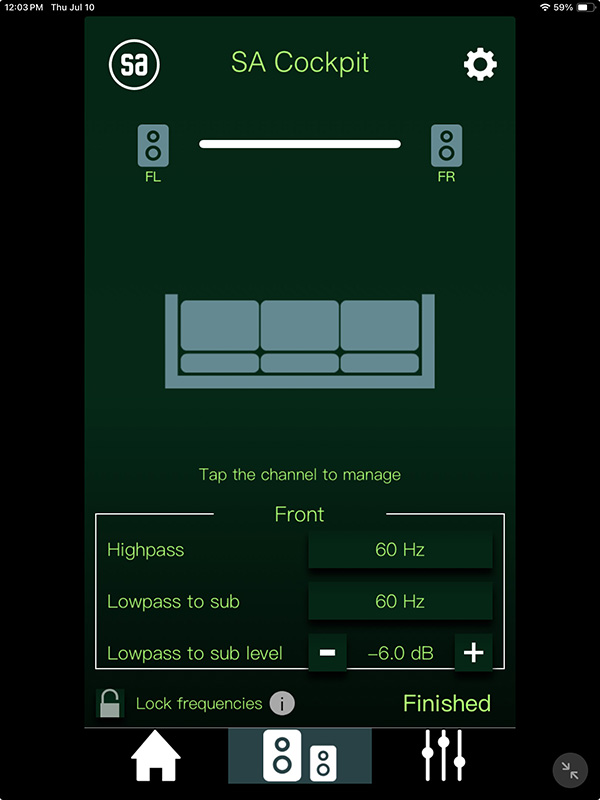 The user interface is an app called SA Cockpit, available for iOS and Android. It gives users access to speaker setup tools, bass management, parametric EQ (including presets), "RoomService" room EQ, and choice of input. You can also use it to change the volume.
A quick, easy, promising start
The user interface is an app called SA Cockpit, available for iOS and Android. It gives users access to speaker setup tools, bass management, parametric EQ (including presets), "RoomService" room EQ, and choice of input. You can also use it to change the volume.
A quick, easy, promising startI unpacked the Silverbacks, attached the outriggers, fitted the rubber feet, and placed them about a foot or so from my front wall and about 7' apart. I pulled my listening chair up to a listening distance of about 8'. I connected the Silverbacks via their analog inputs using the XLR output from my Hapi MkII DAC. The first music I played was the brilliant, intense Viola Sonata (1919) by Rebecca Clarke, in a performance by Tabea Zimmermann and Kirill Gerstein (DSD64 rip, Myios MYR004SACD). From the bold opening statement, the Silverbacks presented Zimmermann's luminous, singing viola center stage. Soon Zimmermann was joined by Gerstein's piano. The balance between the two instruments was lovely. Both sounded present, with a lively, comfortable ambience. Bass was notably tight and extended, though infrequently a low note seemed too prominent to fit the rest of what was happening.
 Next came a new DG release, Shostakovich Discoveries (16/44.1 download, Deutsche Grammophon 4867190). The opening "Anti-Formalist Rayok," with bassist Alexei Mochalov, Andrei Pushkarev on percussion, and Kremerata Baltica, is a sparking, cynical cantata; the Silverbacks rendered it with great detail and presence, and the organ in the "Entr'acte: In front of Kazan Cathedral" (Thomas Sanderling and Staatskapelle Dresden) had impressive weight. The spatial presentation of the ensembles was clear and coherent. The Silverbacks proved they can play plenty loud without distortion. But so far, the soundstage remained smallish, filling the space between the speakers, not more.
 This was a happy introduction, though in these early auditions I noted some brightness and a hint of roughness or grain, detectable especially on notes from the extreme right of the keyboard and the highest notes of a violin or viola. On or off, the grille seemed to make no difference. I felt that just a bit of treble shelving would fix this little problem. Remember though: I was using the analog inputs, so most of the DSP was not available.
A feature called RAM TWEAKS permits the user to tune the 40.2 with alternative sound optimizations. RAM TWEAKS can be downloaded from the System Audio website, loaded onto a USB stick, and installed in each speaker. I replaced the factory-installed one (DS1), which I learned is intended for rooms with good absorption, with DS2, which is intended for rooms with "more live[ly] acoustics." Graphs provided by System Audio show that with DS1, the Silverback's on-axis frequency response is remarkably flat to just above 4kHz; above that there's an upward slope reaching about +4dB at 20kHz. With DS2, the frequency response is flat to above 10kHz then rises to reach +2.5dB at 20kHz. Its effect was clearly audible—indeed, when I relistened to the above-mentioned tracks with DS2 installed, that high-frequency edge was gone.
This was a happy introduction, though in these early auditions I noted some brightness and a hint of roughness or grain, detectable especially on notes from the extreme right of the keyboard and the highest notes of a violin or viola. On or off, the grille seemed to make no difference. I felt that just a bit of treble shelving would fix this little problem. Remember though: I was using the analog inputs, so most of the DSP was not available.
A feature called RAM TWEAKS permits the user to tune the 40.2 with alternative sound optimizations. RAM TWEAKS can be downloaded from the System Audio website, loaded onto a USB stick, and installed in each speaker. I replaced the factory-installed one (DS1), which I learned is intended for rooms with good absorption, with DS2, which is intended for rooms with "more live[ly] acoustics." Graphs provided by System Audio show that with DS1, the Silverback's on-axis frequency response is remarkably flat to just above 4kHz; above that there's an upward slope reaching about +4dB at 20kHz. With DS2, the frequency response is flat to above 10kHz then rises to reach +2.5dB at 20kHz. Its effect was clearly audible—indeed, when I relistened to the above-mentioned tracks with DS2 installed, that high-frequency edge was gone.
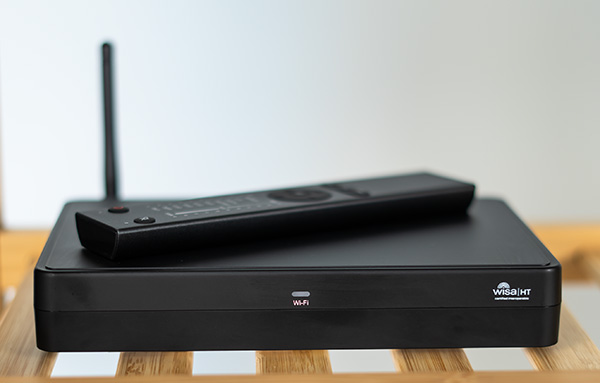 WiSA and the Stereo Hub HT
The Stereo Hub HT implements WiSA, which means you don't need speaker cables, and unlocks those more powerful DSP features. WiSA (footnote 2) allows wireless operation for up to eight channels of audio at 24 bits, at sample rates up to 96kHz, latency of just a few milliseconds, and synchronization of both (or all) speakers to within a remarkable 2µs. Without wires. It's now 2025, some 12 years after my first WiSA encounter, and I'm ready to finally realize the promise I sensed so long ago in my very own listening room, though only in stereo.
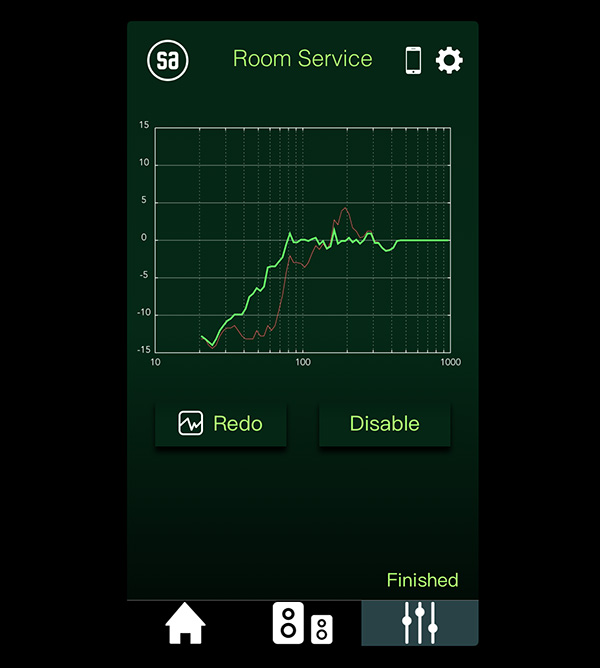 Within the Cockpit app, there's a section called RoomService (footnote 4), which measures and recalibrates the speakers to compensate for the room's influence on the sound. Running it took less than two minutes: I tapped on the RoomService option in the Cockpit app on my iPad and, as the speakers played noise (pink I think), I tiptoed around the listening area, iPad in hand, microphone exposed, dwelling longest near my listening seat so that the program would prioritize that area. RoomService analyzed the data and generated a calibration curve. The uncorrected FR displayed by the app showed a ~3dB peak at 200Hz and a broader trough of –10dB centered at 55–65Hz. The corrected FR was smooth down to about 60Hz (above), with an even, gradual rolloff below that. I cannot account for the rolloff, which appears in all my graphs from RoomService, including when a subwoofer is operating.
The Americus Brass Band Pays Tribute to James Reese Europe's Harlem Hell Fighters' Band (CD rip, Cambria Master Recordings CD-1263) continues to be one of my favorite albums, for music and for sound. The old-time, familiar songs are performed with zest and skill. The recording captured a lot of this goodness. The sound is thrilling, especially played loud, with transparency, good dynamics, and wide tonal range, from bass drum to flutes. The soundstage is tall and wide, though not particularly deep. After being tuned to my room, the Silverbacks pulled it off comfortably. The instruments and musicians were all present and intense, including the sparse vocal contributions emerging from the wall of instruments.
Within the Cockpit app, there's a section called RoomService (footnote 4), which measures and recalibrates the speakers to compensate for the room's influence on the sound. Running it took less than two minutes: I tapped on the RoomService option in the Cockpit app on my iPad and, as the speakers played noise (pink I think), I tiptoed around the listening area, iPad in hand, microphone exposed, dwelling longest near my listening seat so that the program would prioritize that area. RoomService analyzed the data and generated a calibration curve. The uncorrected FR displayed by the app showed a ~3dB peak at 200Hz and a broader trough of –10dB centered at 55–65Hz. The corrected FR was smooth down to about 60Hz (above), with an even, gradual rolloff below that. I cannot account for the rolloff, which appears in all my graphs from RoomService, including when a subwoofer is operating.
The Americus Brass Band Pays Tribute to James Reese Europe's Harlem Hell Fighters' Band (CD rip, Cambria Master Recordings CD-1263) continues to be one of my favorite albums, for music and for sound. The old-time, familiar songs are performed with zest and skill. The recording captured a lot of this goodness. The sound is thrilling, especially played loud, with transparency, good dynamics, and wide tonal range, from bass drum to flutes. The soundstage is tall and wide, though not particularly deep. After being tuned to my room, the Silverbacks pulled it off comfortably. The instruments and musicians were all present and intense, including the sparse vocal contributions emerging from the wall of instruments.
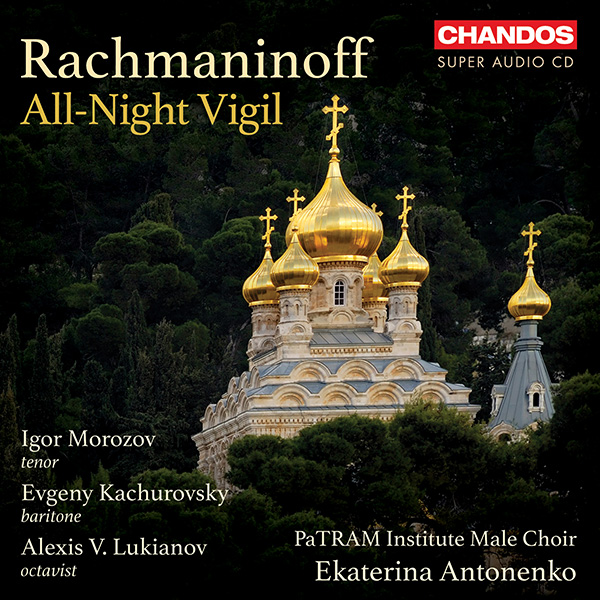 I have a recording where there is important musical content exactly where RoomService EQ shows a major correction. Octavists, singers whose range extends below that of a basso profundo, which is to say "down to contra B-flat and lower in a choral setting," are important elements in the performance of Rachmaninoff's All-Night Vigil, Op.37 (1915). I played a marvelous new recording of the Vigil with the PaTRAM Institute Male Choir conducted by Ekaterina Antonenko (auditioned from a 24/96 download, Chandos CHSA 5349; also available on SACD). When Alexis V. Lukianov, the octavist, intones the welcome to the service, my frequency analyzer showed a few moments of tones just at 60Hz—very low for a human voice!
Why add a subwoofer to the Silverbacks? First, because it's easy with the bass management and EQ tools the Silverbacks provide. Second, because, to quote Mae West, "Too much of a good thing is wonderful!" Despite there being no crying need for it, I connected one of my KEF KC92s to the subwoofer output on the Stereo Hub HT and, using the app, switched the configuration from 2.0 to 2.1. I was then offered choices for the high-pass frequency of the Silverbacks, the low-pass frequency for the sub, and the gain of the sub relative to the Silverbacks. Then I reran RoomService. The graphic display showed pre-EQ aberrations similar to those shown above, and, curiously, no additional energy due to the activation of the subwoofer. I confirmed its presence by hand, gently touching one of the diaphragms to sense its vibrations, and by ear. With most recordings and at normal listening levels, the Silverbacks didn't need the sub. However, I made it matter when I indulged my inner immaturity and turned the volume up to "what the hell" on the 2023 remastering of Norman Greenbaum's "Spirit in the Sky" from 1969 (24/192 download from prostudiomasters. com, Craft Recordings CR09354). All the music, including the bass, was clean, tight, and very loud. I will have to apologize to my neighbors, but it was worth it.
 A comparison and a reflection
Throughout the Silverback DS review process, I switched back and forth from the review speakers to the KEF Blade 2 Metas, using the latter as a reference for the setup and tweaking of the Silverbacks. Considering the differences in price and scale—the KEFs are much larger and more expensive—a comparison would be unfair. But lurking at the back of the room was a more appropriate option, my pair of KEF LS60 Wireless speakers. The Silverback and the LS60 are close in price (~$6k), not too different in size and style, both work wirelessly, and both offer streaming. In direct comparison, the Silverbacks held their own. They offered a warmer, more comfortable balance than the KEFs, thanks no doubt to the Silverbacks' measurement-based room EQ; the KEF's DSP is useful but limited. The sonic distinction remained even after I added a KEF KC92 sub to either pair of speakers.
 At higher frequencies, I appreciated the KEFs' ability to render massed voices and strings more distinctively than the Silverbacks. But I preferred the subtle warmth of the Silverbacks with jazz groups, guitar blues, solo piano, chamber music, and some rock and pop. With orchestral music and opera, the Silverbacks' soundstage width and depth was excellent and convincing—but the KEFs' soundstage was a bit wider and deeper. None of these differences would likely be noticeable without an A/B audition.
 Conclusion
In this review, I reported my journey from expectations and initial impressions to my ultimate appreciation of the System Audio Legend 40.2 Silverback DS wireless speaker system. I spent weeks with the system, but I went from unpacking the system to enjoying music in less than hour, including the crucial room-correction setup. Purchasers can expect to have the same experience.
Footnote 1: The Surround Hub supports many speaker configurations up to 7.1 or 5.1.2. Footnote 2: See wisatechnologies.com. Footnote 3: The RC provides volume control, source selection, start/stop and forward/back controls plus power on/off. However, all that is available on the app as well as a graphic display and access to DSP and setup controls. Frankly, the RC is also sluggish and poorly responsive, but the app is great. Footnote 4: System Audio also has a stand-alone RoomService app.