I've watched the DeVore Fidelity factory develop from its humble start as an early tenant in the Brooklyn Navy Yard—once a sprawl of crumbling ruins, now a sleek high-tech hub—into a thoroughly professional facility housing a cabinet shop, assembly, and R&D. It is also the legendary Monkeyhaus, where late-night listening sessions and pizza feasts are a tradition.
I've owned several DeVore Fidelity speakers, from the original Gibbon 8 and Super 8 to the Gibbon Nine and the O/93. I currently own the O/96. What unites DeVore speakers—the singular quality that has earned them a devoted following—is their versatility.
All of DeVore's primates—whether tall, sleek Gibbons or squat, broad Orangutans—possess at least above-average sensitivity and relatively unchallenging impedance characteristics,1 meaning that they can sing with almost any amplifier. But it's their voicing that truly sets them apart. They reproduce vocals and instruments with natural tone, lifelike texture, and human-scale dynamics. Since the company's founding 25 years ago, CEO and designer John DeVore has won over hundreds of discerning listeners, many of them for the long haul.
"I think the brand DeVore Fidelity is widely known in the industry, but I'd argue that our speakers can't really be considered popular," DeVore demurred over email. "We are a tiny company hand building only about 200 pairs of speakers a year, sold through a small dealer network. This makes us far smaller than the average hi-fi manufacturer."
Designing the Super Nine Design
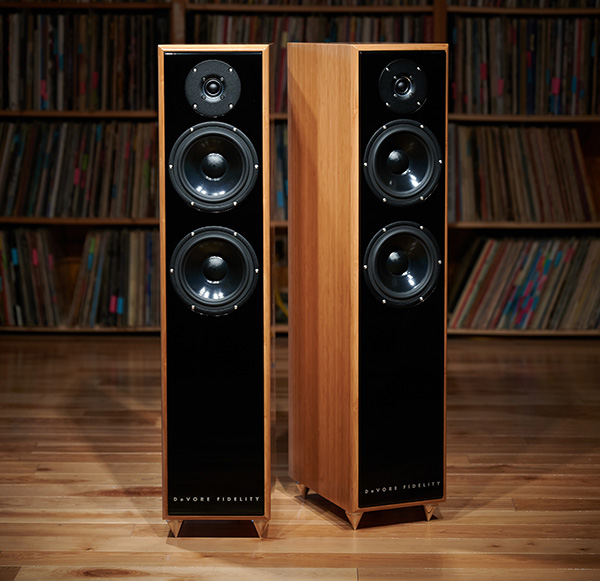
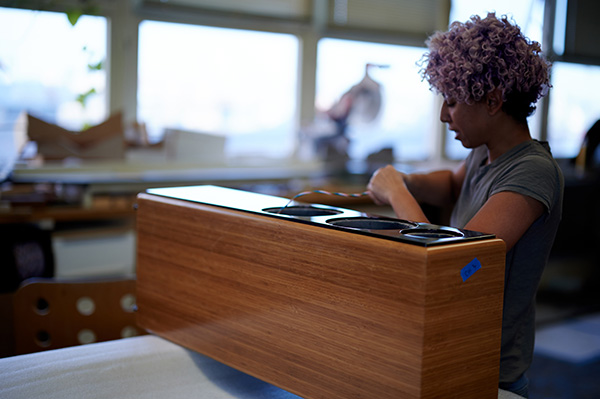
Each beautifully finished DeVore Fidelity Gibbon Super Nine ($9990/pair) stands 37" high × 8.5" wide × 13.75" deep and weighs 50lb. It is a 2.5-way, reflex-loaded floorstander made of bamboo, plywood, and composite. The frequency range is specified as 28Hz–38kHz—impressive for a small floorstanding tower—its sensitivity as 91dB/W/1m, and its nominal impedance as 8 ohms, with a 5.5 ohm minimum (footnote 1). "Gibbon cabinets are made from solid, butcherblock-style bamboo sheets, with multiple plywood braces within the cabinet," DeVore told me in an email. "The front and rear baffles are made from a composite material, with the front being a full 1" thick, the rear being 0.75". The cabinet walls vary from 0.75–1.5" thick. The drivers are attached to the baffles using T-nuts and machine screws for a precision, repeatable, metal-on-metal connection. The internal wiring of all Gibbon models is a proprietary cable, custom-made using copper and silver with an air-and-Teflon dielectric and vibration damping built into the insulation. We use Cardas solid, unplated copper binding posts. The feet are also custom-made for us. ... They are machined from solid brass with a polished nickel plating."
 John, please detail the damping and bracing within the Super Nine cabinet.
"The panels of the cabinet are all tuned to complement each other," he wrote, "so that they don't share any resonance modes. This is done with panel size, material, thickness, and several treatments inside."
DeVore has always been tight-lipped about his crossover designs, long presumed to be his secret sauce ... and so it is with the Super Nine. "Like every crossover for every speaker since the very first DeVore Fidelity model, it is a proprietary crossover circuit we call the 'Gibbon' circuit that is point-to-point hardwired with no circuit boards and potted for isolation from vibrations."
Since I used to own and enjoy a pair of the original DeVore Nines, I was curious as to how the Super Nine differs from the original.
"Like the Gibbon Nine before it, the Gibbon Super Nine is the most 'normal' speaker we make with regards to impedance," he continued. "It is an 8 ohm load primarily, but it drops to about 6 ohms in the bass. While probably not the best option for a single-ended 300B, it is still a very easy load."
"Similar to how the Gibbon X is related to the Silverback Reference, the Gibbon Super Nine is the same basic circuit as The Nine, updated with technology and techniques I've learned in the intervening years," he responded. "The Nine was the last DeVore Fidelity model to use a plastic [cone] woofer; we use paper in the Super Nine. In my opinion, this gives bass reproduction more realism, texture, clarity of tone, and dynamics. The original Nine used our original Silverback 0.75" textile tweeter, while the Super Nine uses the new 0.75" tweeter we designed for the Gibbon X. The new tweeter performs within a similar envelope to the older unit but has a broader listening axis, significantly lower distortion, and higher dynamic capability."
The original Nine used side-firing woofers that, while producing room-filling bass, were occasionally bloblike and boomy in my room. Why the change from side- to front-firing woofers in the Super Nine?
"Moving the lower woofer to the front improved the sound and significantly increased flexibility of in-room placement,"
John told me. "While the original side-mounted design had great upper-bass detail and low-bass extension, the new design far better integrates these two bass regions and improves dynamic impact. And the new design simplifies the way the speakers play music into the room and so are less affected by placement or other furniture."
Each speaker features a proprietary 0.75" textile-cone tweeter and two 7" paper-cone woofers. While many speaker brands use high-tech materials like beryllium, carbon, synthetic diamond, ceramic metal, Honeycomb Laminate, silicon, and aerogel silica in their drivers, DeVore prefers paper for woofers and textile for tweeters.
"As with the Nines before them, the Gibbon Super Nine drivers are all made for DeVore Fidelity by SEAS in Norway," DeVore explained. "I went from polypropylene to treated paper for the woofer cones. From years of experience designing the drivers for our other models, especially the Orangutan series, I believe paper is the best material for a midwoofer, meaning it has the best properties to cover the frequency range of both midrange and bass. Likewise, the new tweeter design incorporated a lot of what I learned with the Orangutan horn-loaded tweeters."
John, please detail the damping and bracing within the Super Nine cabinet.
"The panels of the cabinet are all tuned to complement each other," he wrote, "so that they don't share any resonance modes. This is done with panel size, material, thickness, and several treatments inside."
DeVore has always been tight-lipped about his crossover designs, long presumed to be his secret sauce ... and so it is with the Super Nine. "Like every crossover for every speaker since the very first DeVore Fidelity model, it is a proprietary crossover circuit we call the 'Gibbon' circuit that is point-to-point hardwired with no circuit boards and potted for isolation from vibrations."
Since I used to own and enjoy a pair of the original DeVore Nines, I was curious as to how the Super Nine differs from the original.
"Like the Gibbon Nine before it, the Gibbon Super Nine is the most 'normal' speaker we make with regards to impedance," he continued. "It is an 8 ohm load primarily, but it drops to about 6 ohms in the bass. While probably not the best option for a single-ended 300B, it is still a very easy load."
"Similar to how the Gibbon X is related to the Silverback Reference, the Gibbon Super Nine is the same basic circuit as The Nine, updated with technology and techniques I've learned in the intervening years," he responded. "The Nine was the last DeVore Fidelity model to use a plastic [cone] woofer; we use paper in the Super Nine. In my opinion, this gives bass reproduction more realism, texture, clarity of tone, and dynamics. The original Nine used our original Silverback 0.75" textile tweeter, while the Super Nine uses the new 0.75" tweeter we designed for the Gibbon X. The new tweeter performs within a similar envelope to the older unit but has a broader listening axis, significantly lower distortion, and higher dynamic capability."
The original Nine used side-firing woofers that, while producing room-filling bass, were occasionally bloblike and boomy in my room. Why the change from side- to front-firing woofers in the Super Nine?
"Moving the lower woofer to the front improved the sound and significantly increased flexibility of in-room placement,"
John told me. "While the original side-mounted design had great upper-bass detail and low-bass extension, the new design far better integrates these two bass regions and improves dynamic impact. And the new design simplifies the way the speakers play music into the room and so are less affected by placement or other furniture."
Each speaker features a proprietary 0.75" textile-cone tweeter and two 7" paper-cone woofers. While many speaker brands use high-tech materials like beryllium, carbon, synthetic diamond, ceramic metal, Honeycomb Laminate, silicon, and aerogel silica in their drivers, DeVore prefers paper for woofers and textile for tweeters.
"As with the Nines before them, the Gibbon Super Nine drivers are all made for DeVore Fidelity by SEAS in Norway," DeVore explained. "I went from polypropylene to treated paper for the woofer cones. From years of experience designing the drivers for our other models, especially the Orangutan series, I believe paper is the best material for a midwoofer, meaning it has the best properties to cover the frequency range of both midrange and bass. Likewise, the new tweeter design incorporated a lot of what I learned with the Orangutan horn-loaded tweeters."
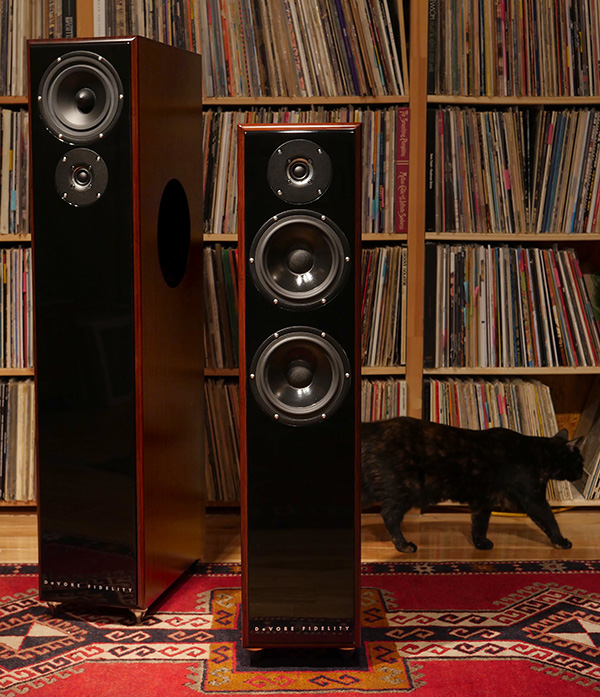 The Super Nine looks similar to the larger Gibbon X (left above), so I asked JD how they are similar and how they are different. Like the earlier Nine, the Super Nine is a 2.5-way; the Gibbon X is a full three-way. "This means the crossover and drivers are doing slightly different things in the two models," DeVore responded. In the Gibbon X, totally different signals are sent to the tweeter, midrange, and woofers by the crossover, with minimal overlap. In the Super Nine, the tweeter gets its own signal, and both woofers work together to reproduce bass, but only the upper woofer receives midrange signal. "Additionally, the Gibbon X is much larger, with two larger woofers optimized for low bass, the dedicated midrange driver has its own enclosure, and the tweeter is also isolated in its own enclosure within the cabinet.
"The Gibbon Super Nine is designed to be very flexible for room size and placement, more than any other Gibbon model to date. They are very full range but somewhat forgiving while maintaining great transparency to the music and the rest of the gear in the system.
"I truly do think of every speaker I am working on as 'the ideal speaker,'" DeVore added. "Within the parameters I'm working—size, cost, or whatever—the speaker evolves and improves over the years I take to finish a design until it really is the ideal version of what I'm trying to do. With the O/Bronze finished and in production, the DeVore Fidelity line is pretty complete, and the models we release always have very long production lifespans. I don't have a specific future project in mind at the moment."
Visitors to the Monkeyhaus are typically wowed by the wide variety of sources and amplifiers used to voice DeVore Fidelity loudspeakers. The sources include a modified Garrard 401 turntable with various arms and cartridges, the phono-centric (but also line-level) EMT JPA 66 preamplifier, an Intel NUC computer running Roon, a Totaldac streamer, and a Totaldac d1-six tube DAC, alongside huge racks of vinyl. Add tasteful paintings and sculpture, and the Monkeyhaus is a music- and gear-lover's dream.
"Since the beginning of my company, I've made use of a number of different amps for the speaker design process, covering various technologies and power levels," DeVore wrote. That long list includes "Air Tight and Komuro 300B SET amps, Audio Research VT130SE, Pass Labs Aleph 3, First Watt SIT-2, Parasound A21, and Sugden MPA-4 class-A monoblocks."
At the end of our interview, I asked DeVore to share his views on the current US import tariffs. How are they affecting a US-based manufacturer, the kind of business that tariffs are intended to help? "The tariffs are going to badly hurt the entire market, both because they cause uncertainty in the financial markets, reducing consumer confidence in the economy, and by interfering with the established markets for all brands: whether that's by making imported brands more expensive in the US or by raising manufacturing costs for American brands that use a lot of imported parts or assemblies—or as in our case making our speakers more expensive in overseas markets with reciprocal tariffs. It's a lose-lose-lose."
"We aren't raising prices, because tariffs don't affect our costs much," he continued. "Aside from the drivers made in Norway, everything is made here in the US with primarily US materials. However, it has affected our export business enormously, as it has for all US companies with markets outside the country. The tariff war is making it impossible to maintain a healthy export business."
Setup
The Super Nine looks similar to the larger Gibbon X (left above), so I asked JD how they are similar and how they are different. Like the earlier Nine, the Super Nine is a 2.5-way; the Gibbon X is a full three-way. "This means the crossover and drivers are doing slightly different things in the two models," DeVore responded. In the Gibbon X, totally different signals are sent to the tweeter, midrange, and woofers by the crossover, with minimal overlap. In the Super Nine, the tweeter gets its own signal, and both woofers work together to reproduce bass, but only the upper woofer receives midrange signal. "Additionally, the Gibbon X is much larger, with two larger woofers optimized for low bass, the dedicated midrange driver has its own enclosure, and the tweeter is also isolated in its own enclosure within the cabinet.
"The Gibbon Super Nine is designed to be very flexible for room size and placement, more than any other Gibbon model to date. They are very full range but somewhat forgiving while maintaining great transparency to the music and the rest of the gear in the system.
"I truly do think of every speaker I am working on as 'the ideal speaker,'" DeVore added. "Within the parameters I'm working—size, cost, or whatever—the speaker evolves and improves over the years I take to finish a design until it really is the ideal version of what I'm trying to do. With the O/Bronze finished and in production, the DeVore Fidelity line is pretty complete, and the models we release always have very long production lifespans. I don't have a specific future project in mind at the moment."
Visitors to the Monkeyhaus are typically wowed by the wide variety of sources and amplifiers used to voice DeVore Fidelity loudspeakers. The sources include a modified Garrard 401 turntable with various arms and cartridges, the phono-centric (but also line-level) EMT JPA 66 preamplifier, an Intel NUC computer running Roon, a Totaldac streamer, and a Totaldac d1-six tube DAC, alongside huge racks of vinyl. Add tasteful paintings and sculpture, and the Monkeyhaus is a music- and gear-lover's dream.
"Since the beginning of my company, I've made use of a number of different amps for the speaker design process, covering various technologies and power levels," DeVore wrote. That long list includes "Air Tight and Komuro 300B SET amps, Audio Research VT130SE, Pass Labs Aleph 3, First Watt SIT-2, Parasound A21, and Sugden MPA-4 class-A monoblocks."
At the end of our interview, I asked DeVore to share his views on the current US import tariffs. How are they affecting a US-based manufacturer, the kind of business that tariffs are intended to help? "The tariffs are going to badly hurt the entire market, both because they cause uncertainty in the financial markets, reducing consumer confidence in the economy, and by interfering with the established markets for all brands: whether that's by making imported brands more expensive in the US or by raising manufacturing costs for American brands that use a lot of imported parts or assemblies—or as in our case making our speakers more expensive in overseas markets with reciprocal tariffs. It's a lose-lose-lose."
"We aren't raising prices, because tariffs don't affect our costs much," he continued. "Aside from the drivers made in Norway, everything is made here in the US with primarily US materials. However, it has affected our export business enormously, as it has for all US companies with markets outside the country. The tariff war is making it impossible to maintain a healthy export business."
Setup
John DeVore delivered the Gibbon Super Nines to my Greenwich Village walkup and set them up in my vinyl-packed listening room. His placement surprised me: close to the sidewalls firing straight into the space. I kept this setup throughout the auditions.
Vinyl is my medium of choice, so that's what I listened to. The front-end consisted of the J.Sikora Standard Max Supreme turntable with KV9 tonearm and Aidas MC Tru-stone Gold Web cartridge. The Aidas cartridge's signal was routed through my Tavish Audio Design phono stage. I started out listening with the Unison Research S6 Black Edition, a tubed, 40Wpc integrated amplifier. Later, I employed the 30Wpc solid state Riviera Labs Levante integrated, the Sugden LA-4 preamp paired with 60Wpc Elekit TU-888 class-AB monoblocks and then the Air Tight ATM-1 2024 Edition power amplifier.
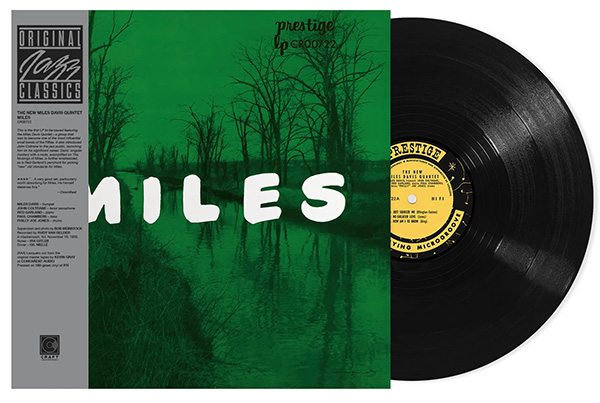 I started out by mining Craft Recordings' Original Jazz Classics (OJC) reissue series. Sourced from a catalog that includes classic titles from Prestige, Riverside, Contemporary, Debut, and Jazzland, these releases feature AAA lacquers cut directly from the original tapes by Kevin Gray and pressed at RTI. While they may not have the visceral impact of an original or early pressing, I've found them to be exceptionally quiet, pressed flat on high-quality vinyl, and presented in not-too-thick jackets that don't take up more shelf space than they need to. The sound is consistent across titles.
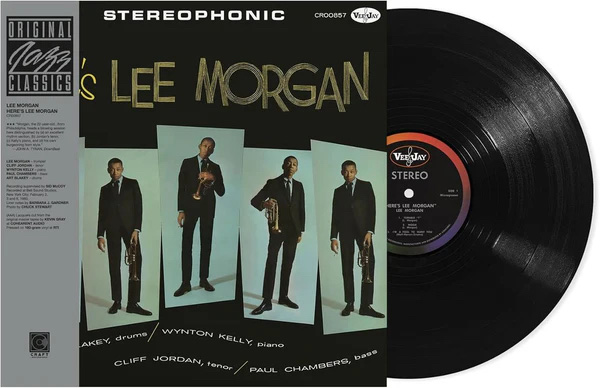
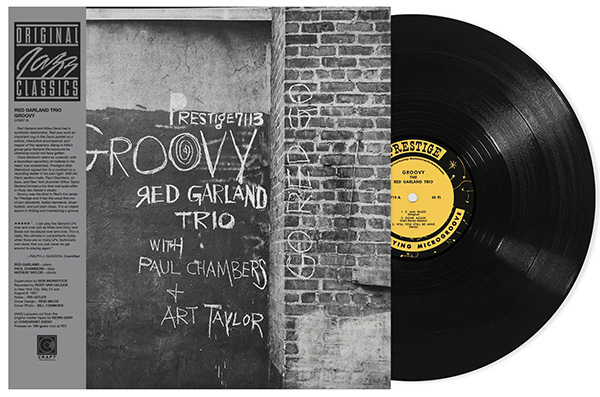
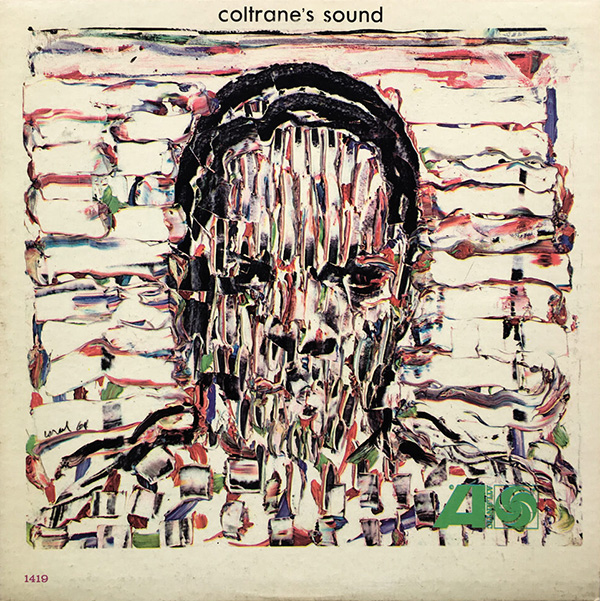
The OJC titles I employed to audition the Super Nines were the Red Garland Trio's Groovy (Craft Recordings CR00719), Lee Morgan's Here's Lee Morgan (Craft Recordings CR00857), The New Miles Davis Quintet's Miles (Craft Recordings CR00722), and Yusef Lateef's Eastern Sounds (Craft Recordings CR00615). For good measure, I added an original stereo pressing of John Coltrane's Coltrane's Sound (Atlantic SD 1419) and a less well-known album, cosmic pop purveyor Sébastien Tellier's L'Aventura (Record Makers REC 115).
I started out by mining Craft Recordings' Original Jazz Classics (OJC) reissue series. Sourced from a catalog that includes classic titles from Prestige, Riverside, Contemporary, Debut, and Jazzland, these releases feature AAA lacquers cut directly from the original tapes by Kevin Gray and pressed at RTI. While they may not have the visceral impact of an original or early pressing, I've found them to be exceptionally quiet, pressed flat on high-quality vinyl, and presented in not-too-thick jackets that don't take up more shelf space than they need to. The sound is consistent across titles.
The OJC titles I employed to audition the Super Nines were the Red Garland Trio's Groovy (Craft Recordings CR00719), Lee Morgan's Here's Lee Morgan (Craft Recordings CR00857), The New Miles Davis Quintet's Miles (Craft Recordings CR00722), and Yusef Lateef's Eastern Sounds (Craft Recordings CR00615). For good measure, I added an original stereo pressing of John Coltrane's Coltrane's Sound (Atlantic SD 1419) and a less well-known album, cosmic pop purveyor Sébastien Tellier's L'Aventura (Record Makers REC 115).
 Listening
With the 40Wpc Unison Research S6 Black Edition, the sound was clear, lush, and physical. Imaging was first-rate, with excellent separation of images and commendable scale. Assisted by the rest of the system, the Super Nines brought those OJCs to life. Music practically leaped into the room.
Jazz recorded in the 1950s at Rudy Van Gelder's Englewood Cliffs studio doesn't have soundstage depth to marvel at, but the DeVores mined everything else Red Garland's mono Groovy and the stereo Here's Lee Morgan have to offer. In the contest among octaves, my award goes to the highs, which afforded brass instruments bite, punch, and energy, carousing in my room like they owned the joint but without ever developing a bad attitude. The tweeter minded its manners. The music felt physical.
The Super Nines' rendition of Coltrane's Sound was rousing. Drums and piano surged in the right channel, while Coltrane's tenor saxophone glowed large and flowed powerfully in the center. Turned up loud, this was a full-bore sonic assault.
 Sébastien Tellier's hippie-electronic music flowed out of the Super Nines, filling the room with its dense images. A liquid-soft bass drum pulsed below as an angelic choir soared above, framed in an amphitheater of twinkling, physical sounds. The Super Nines' presentation of this dreamy music was daydream-worthy. The Super Nines came across as linear, with no frequency range or other characteristic standing out—well-balanced, consistent, forceful, whole. For all that, they demonstrated a sweetness that made this music engaging. The sound isn't overly romantic, but its tonality and flavor are "tasty," to borrow a term from 1970s musicians. Like a session drummer whose performance is both rhythmically solid and uniquely creative—think Andy Newmark, B.J. Wilson, or Harvey Mason—the Super Nines supported the music while adding its own flavor.
Replacing the Unison Research S6 Black Edition integrated with the 30Wpc Riviera Labs Levante integrated brought subtle but notable changes. Now the soundstage was even more physical. What was lost in tube sweetness—the Levante is a tube/solid state hybrid—it gained in attack, materiality, and scale. In the light of the Levante, what I was hearing before with the Unison Research amp now seemed a little bit soft. I was now hearing more detail, more resolution. Less romance, more assertiveness and power.
With the clarity added by the Levante's solid state output stage, the large mono spot of sound that is Red Garland's Groovy expanded, and instruments became more distinct. Bass took on more weight and better texture. Paul Chambers's acoustic bass on Lee Morgan's Here's Lee Morgan was tighter, deeper, funkier, and more dynamic, highlighting the Super Nines' command over the low end—or was it the Levante's command over the Nines' low end?
When paired with a suitable amplifier, these speakers are exceptionally adept at extracting the full depth and impact of the bass in any recording—impressive for such small speakers.
Sébastien Tellier's hippie-electronic music flowed out of the Super Nines, filling the room with its dense images. A liquid-soft bass drum pulsed below as an angelic choir soared above, framed in an amphitheater of twinkling, physical sounds. The Super Nines' presentation of this dreamy music was daydream-worthy. The Super Nines came across as linear, with no frequency range or other characteristic standing out—well-balanced, consistent, forceful, whole. For all that, they demonstrated a sweetness that made this music engaging. The sound isn't overly romantic, but its tonality and flavor are "tasty," to borrow a term from 1970s musicians. Like a session drummer whose performance is both rhythmically solid and uniquely creative—think Andy Newmark, B.J. Wilson, or Harvey Mason—the Super Nines supported the music while adding its own flavor.
Replacing the Unison Research S6 Black Edition integrated with the 30Wpc Riviera Labs Levante integrated brought subtle but notable changes. Now the soundstage was even more physical. What was lost in tube sweetness—the Levante is a tube/solid state hybrid—it gained in attack, materiality, and scale. In the light of the Levante, what I was hearing before with the Unison Research amp now seemed a little bit soft. I was now hearing more detail, more resolution. Less romance, more assertiveness and power.
With the clarity added by the Levante's solid state output stage, the large mono spot of sound that is Red Garland's Groovy expanded, and instruments became more distinct. Bass took on more weight and better texture. Paul Chambers's acoustic bass on Lee Morgan's Here's Lee Morgan was tighter, deeper, funkier, and more dynamic, highlighting the Super Nines' command over the low end—or was it the Levante's command over the Nines' low end?
When paired with a suitable amplifier, these speakers are exceptionally adept at extracting the full depth and impact of the bass in any recording—impressive for such small speakers.
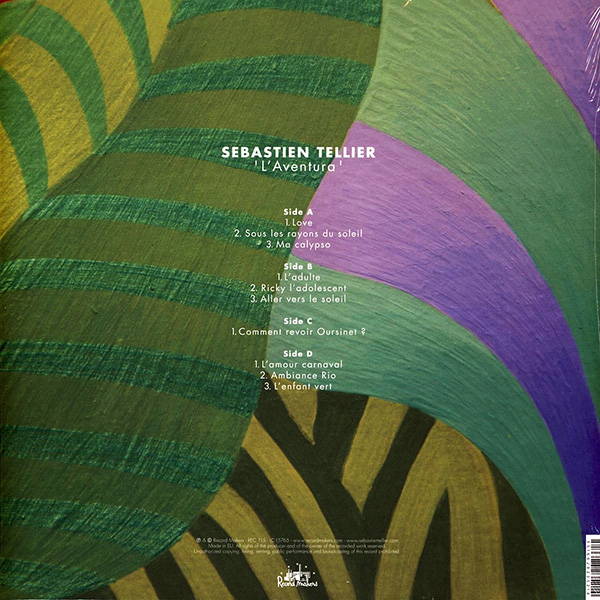 With the Levante in the system, the Sébastien Tellier record was transformed, taking on a completely new character. This music now sounded less spacy, tougher, more deliberate, and more forceful. Cymbals were more vivid—a shimmering gold—while the (formerly) indistinct bass drum gained definition. The angelic choir also underwent a remarkable shift: What was once a soft, ethereal chorus now presented as a grouping of individual singers.
Switching from an integrated amplifier to separates delivered an even more dramatic transformation. The first addition was the Sugden LA-4 preamp paired with 60Wpc Elekit TU-888 class-AB monoblocks. Each monoblock features two KT170s per side, producing a sound reminiscent of a high-quality single-ended triode. The change was immediately apparent on Coltrane's "The Night Has a Thousand Eyes." The performance revealed by the Super Nines was alive, brisk, animated. Steve Davis's acoustic bass was soft, warm, and weighty; McCoy Tyner's piano and Elvin Jones's drums burst with specific, intricate detail. Coltrane's tenor saxophone stood out in deep space; his rich, slightly coarse lower midrange tone and gritty textures were laid bare.
Next up: The Air Tight ATM-1 2024 Edition power amplifier. I also replaced the AudioQuest William Tell Zero speaker cables with my old-school Auditorium A23s with their green fabric cover.
Though creamier and quieter, the Air Tight recalled the liveliness and after-the-rain purity of the Elekit monos but more coherent and less forward. The OJCs now sounded closer to my early pressings. Coltrane's Sound barked at me, with Trane's tenor sleekly howling and Elvin Jones and McCoy Tyner's drums and piano chattering away like combustible, warring bird calls. The Super Nines plus the all-tube Air Tight produced a satisfying, whole-cloth sound.
With the Levante in the system, the Sébastien Tellier record was transformed, taking on a completely new character. This music now sounded less spacy, tougher, more deliberate, and more forceful. Cymbals were more vivid—a shimmering gold—while the (formerly) indistinct bass drum gained definition. The angelic choir also underwent a remarkable shift: What was once a soft, ethereal chorus now presented as a grouping of individual singers.
Switching from an integrated amplifier to separates delivered an even more dramatic transformation. The first addition was the Sugden LA-4 preamp paired with 60Wpc Elekit TU-888 class-AB monoblocks. Each monoblock features two KT170s per side, producing a sound reminiscent of a high-quality single-ended triode. The change was immediately apparent on Coltrane's "The Night Has a Thousand Eyes." The performance revealed by the Super Nines was alive, brisk, animated. Steve Davis's acoustic bass was soft, warm, and weighty; McCoy Tyner's piano and Elvin Jones's drums burst with specific, intricate detail. Coltrane's tenor saxophone stood out in deep space; his rich, slightly coarse lower midrange tone and gritty textures were laid bare.
Next up: The Air Tight ATM-1 2024 Edition power amplifier. I also replaced the AudioQuest William Tell Zero speaker cables with my old-school Auditorium A23s with their green fabric cover.
Though creamier and quieter, the Air Tight recalled the liveliness and after-the-rain purity of the Elekit monos but more coherent and less forward. The OJCs now sounded closer to my early pressings. Coltrane's Sound barked at me, with Trane's tenor sleekly howling and Elvin Jones and McCoy Tyner's drums and piano chattering away like combustible, warring bird calls. The Super Nines plus the all-tube Air Tight produced a satisfying, whole-cloth sound.
 Conclusion
The DeVore Fidelity Gibbon Super Nine joins the company of other DeVore Fidelity speakers that don't require top-tier amplification but nevertheless thrive with it. Every speaker has a character of its own, but the best still manage to express the character of the partnering hardware—source components, those amplifiers—and each record. That might be the Super Nine's most notable virtue.
Or maybe its most notable virtue is its balance. The Super Nine's treble is articulate and revealing but never bright or harsh. Its midrange is a clear, polished window. For so small a speaker, the bass goes deep, and there's enough of it to satisfy with most kinds of music. A pair of Super Nines projects expansive, precisely layered images across a large soundstage. The music the Super Nines make is rich in tone and timbre. There was a time—and here the original Nine comes to mind—when DeVore speakers had a reputation for being laid-back. Not so the Super Nine. Highly recommended.
Footnote 1: The Orangutans are especially easy loads, with sensitivity that's way above average and remarkably benign impedance curves, but even the Gibbons have sensitivity in the low 90s, 8 ohm nominal impedance, and impedance curves that don't drop much below 4 ohms.
Each beautifully finished DeVore Fidelity Gibbon Super Nine ($9990/pair) stands 37" high × 8.5" wide × 13.75" deep and weighs 50lb. It is a 2.5-way, reflex-loaded floorstander made of bamboo, plywood, and composite. The frequency range is specified as 28Hz–38kHz—impressive for a small floorstanding tower—its sensitivity as 91dB/W/1m, and its nominal impedance as 8 ohms, with a 5.5 ohm minimum (footnote 1). "Gibbon cabinets are made from solid, butcherblock-style bamboo sheets, with multiple plywood braces within the cabinet," DeVore told me in an email. "The front and rear baffles are made from a composite material, with the front being a full 1" thick, the rear being 0.75". The cabinet walls vary from 0.75–1.5" thick. The drivers are attached to the baffles using T-nuts and machine screws for a precision, repeatable, metal-on-metal connection. The internal wiring of all Gibbon models is a proprietary cable, custom-made using copper and silver with an air-and-Teflon dielectric and vibration damping built into the insulation. We use Cardas solid, unplated copper binding posts. The feet are also custom-made for us. ... They are machined from solid brass with a polished nickel plating."
John, please detail the damping and bracing within the Super Nine cabinet.
"The panels of the cabinet are all tuned to complement each other," he wrote, "so that they don't share any resonance modes. This is done with panel size, material, thickness, and several treatments inside."
DeVore has always been tight-lipped about his crossover designs, long presumed to be his secret sauce ... and so it is with the Super Nine. "Like every crossover for every speaker since the very first DeVore Fidelity model, it is a proprietary crossover circuit we call the 'Gibbon' circuit that is point-to-point hardwired with no circuit boards and potted for isolation from vibrations."
Since I used to own and enjoy a pair of the original DeVore Nines, I was curious as to how the Super Nine differs from the original.
The Super Nine looks similar to the larger Gibbon X (left above), so I asked JD how they are similar and how they are different. Like the earlier Nine, the Super Nine is a 2.5-way; the Gibbon X is a full three-way. "This means the crossover and drivers are doing slightly different things in the two models," DeVore responded. In the Gibbon X, totally different signals are sent to the tweeter, midrange, and woofers by the crossover, with minimal overlap. In the Super Nine, the tweeter gets its own signal, and both woofers work together to reproduce bass, but only the upper woofer receives midrange signal. "Additionally, the Gibbon X is much larger, with two larger woofers optimized for low bass, the dedicated midrange driver has its own enclosure, and the tweeter is also isolated in its own enclosure within the cabinet.
"The Gibbon Super Nine is designed to be very flexible for room size and placement, more than any other Gibbon model to date. They are very full range but somewhat forgiving while maintaining great transparency to the music and the rest of the gear in the system.
John DeVore delivered the Gibbon Super Nines to my Greenwich Village walkup and set them up in my vinyl-packed listening room. His placement surprised me: close to the sidewalls firing straight into the space. I kept this setup throughout the auditions.
I started out by mining Craft Recordings' Original Jazz Classics (OJC) reissue series. Sourced from a catalog that includes classic titles from Prestige, Riverside, Contemporary, Debut, and Jazzland, these releases feature AAA lacquers cut directly from the original tapes by Kevin Gray and pressed at RTI. While they may not have the visceral impact of an original or early pressing, I've found them to be exceptionally quiet, pressed flat on high-quality vinyl, and presented in not-too-thick jackets that don't take up more shelf space than they need to. The sound is consistent across titles.
The OJC titles I employed to audition the Super Nines were the Red Garland Trio's Groovy (Craft Recordings CR00719), Lee Morgan's Here's Lee Morgan (Craft Recordings CR00857), The New Miles Davis Quintet's Miles (Craft Recordings CR00722), and Yusef Lateef's Eastern Sounds (Craft Recordings CR00615). For good measure, I added an original stereo pressing of John Coltrane's Coltrane's Sound (Atlantic SD 1419) and a less well-known album, cosmic pop purveyor Sébastien Tellier's L'Aventura (Record Makers REC 115).
Listening
Sébastien Tellier's hippie-electronic music flowed out of the Super Nines, filling the room with its dense images. A liquid-soft bass drum pulsed below as an angelic choir soared above, framed in an amphitheater of twinkling, physical sounds. The Super Nines' presentation of this dreamy music was daydream-worthy. The Super Nines came across as linear, with no frequency range or other characteristic standing out—well-balanced, consistent, forceful, whole. For all that, they demonstrated a sweetness that made this music engaging. The sound isn't overly romantic, but its tonality and flavor are "tasty," to borrow a term from 1970s musicians. Like a session drummer whose performance is both rhythmically solid and uniquely creative—think Andy Newmark, B.J. Wilson, or Harvey Mason—the Super Nines supported the music while adding its own flavor.
Replacing the Unison Research S6 Black Edition integrated with the 30Wpc Riviera Labs Levante integrated brought subtle but notable changes. Now the soundstage was even more physical. What was lost in tube sweetness—the Levante is a tube/solid state hybrid—it gained in attack, materiality, and scale. In the light of the Levante, what I was hearing before with the Unison Research amp now seemed a little bit soft. I was now hearing more detail, more resolution. Less romance, more assertiveness and power.
With the clarity added by the Levante's solid state output stage, the large mono spot of sound that is Red Garland's Groovy expanded, and instruments became more distinct. Bass took on more weight and better texture. Paul Chambers's acoustic bass on Lee Morgan's Here's Lee Morgan was tighter, deeper, funkier, and more dynamic, highlighting the Super Nines' command over the low end—or was it the Levante's command over the Nines' low end?
With the Levante in the system, the Sébastien Tellier record was transformed, taking on a completely new character. This music now sounded less spacy, tougher, more deliberate, and more forceful. Cymbals were more vivid—a shimmering gold—while the (formerly) indistinct bass drum gained definition. The angelic choir also underwent a remarkable shift: What was once a soft, ethereal chorus now presented as a grouping of individual singers.
Switching from an integrated amplifier to separates delivered an even more dramatic transformation. The first addition was the Sugden LA-4 preamp paired with 60Wpc Elekit TU-888 class-AB monoblocks. Each monoblock features two KT170s per side, producing a sound reminiscent of a high-quality single-ended triode. The change was immediately apparent on Coltrane's "The Night Has a Thousand Eyes." The performance revealed by the Super Nines was alive, brisk, animated. Steve Davis's acoustic bass was soft, warm, and weighty; McCoy Tyner's piano and Elvin Jones's drums burst with specific, intricate detail. Coltrane's tenor saxophone stood out in deep space; his rich, slightly coarse lower midrange tone and gritty textures were laid bare.
ConclusionThe DeVore Fidelity Gibbon Super Nine joins the company of other DeVore Fidelity speakers that don't require top-tier amplification but nevertheless thrive with it. Every speaker has a character of its own, but the best still manage to express the character of the partnering hardware—source components, those amplifiers—and each record. That might be the Super Nine's most notable virtue.
Footnote 1: The Orangutans are especially easy loads, with sensitivity that's way above average and remarkably benign impedance curves, but even the Gibbons have sensitivity in the low 90s, 8 ohm nominal impedance, and impedance curves that don't drop much below 4 ohms.