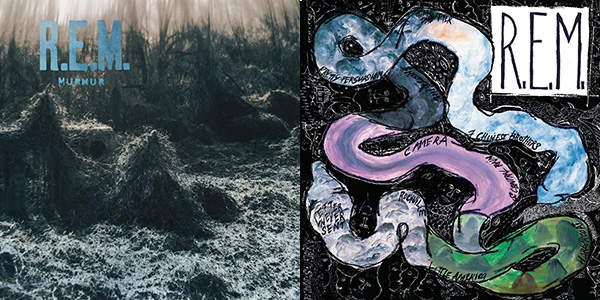
Over the past 40 years, R.E.M.'s 1983 full-length debut, Murmur, has come to seem ever more timeless. "There's something very special about that record that you can't put into words exactly," mused Don Dixon, who coproduced Murmur and its follow-up, Reckoning, in a recent interview.
"The band always wore its heart on its sleeve, very democratic. It was not a lead singer with a band. It was not two guys who controlled the band. [Drummer] Bill Berry was huge. And we had to figure out how to anchor everything around [Mike] Mills's more melodic and contrapuntal kind of bass playing," Dixon remembered. "We guided obviously the ultimate sounds, but they had very strict ideas. There couldn't be any overdriven guitar sounds. The guitars had to be pure. Peter Buck's style called for that. Nobody played like he played. I don't think anybody still does. Those arpeggios—he could just do it for hours. And he was super-accurate and is very underrated."
In a separate interview, Dixon's producing partner, Mitch Easter, agreed that Buck's guitar is central to the album's evergreen quality. "Maybe that's our genius use of an omnidirectional microphone," Easter said. "We used the venerable Electro-Voice EV 635A omni, and it was just perfect on Buck. We'd been hearing crunchy guitars forever, and they're great. But this was a way to have clean guitars that did not seem prim."
"It's not a fancy record by any stretch," Dixon said of Murmer, which has been paired with the 1982 EP Chronic Town in the new Definitive Sound Series (see this issue's feature on p.115). "We used compressors, nice classic stuff. A nice MCI console and a really nice Yamaha piano, and a tack piano that has that natural ticky-tacky thing. Also a B3 organ, vibe, and double bass to supplement. There wasn't a lot of overdubbing. Everybody played at the same time until we got a take that we liked. A few, like "Perfect Circle," were constructed. And I might have edited two takes together for a couple songs."
Dixon began his life in music as a teenager, playing a Danelectro Silvertone bass guitar ($79 from Sears). Later, he was a member of North Carolina rock band Arrogance, which in 1976 was incongruously signed to folk and blues label Vanguard Records. Dixon said that while Murmur and its follow-up, 1984's Reckoning, remain his most famous producing credits, since 1972, he has worked on more than 100 recording projects, for talents as diverse as Marshall Crenshaw, The Connells, James McMurtry, Guadalcanal Diary, Let's Active, and Matthew Sweet. He has also produced his own solo albums and those of his wife, singer/songwriter Marti Jones. His most famous near-miss was being considered to produce Nirvana's Nevermind, a gig that eventually went to Butch Vig.
The same year he worked on Reckoning, Dixon began producing Tommy Keene, a singer/songwriter/guitar player from the Washington, DC, area. After working on Keene's EP Back Again (Try...), Dixon and T Bone Burnett did the solo artist's 1986 major label debut on Geffen Records, Songs from the Film.
"Tommy was incredible," Dixon recalled. "When I started working with him, he wasn't sure what record making really was. He'd spent his life really sitting in the bedroom listening to records on headphones. He didn't understand the work involved. And he wasn't as good a singer then as he became. He and T Bone really butted heads, but I found out later that's part of T Bone's technique.
Everybody hated making records with T Bone, but they liked the results."
Dixon became the producer of a much-loved Austin, Texas, band for their 1987 album, Saturday. Originally called Zeitgeist, they discovered that there was already a band by that name and renamed themselves after a William Faulkner novel, The Reivers. Its members—John Croslin (vocals, guitar), Kim Longacre (vocals, guitars), Cindy Toth (bass, vocals), and Garrett Williams (drums)—subsequently became part of the short-lived "New Sincerity" trend, with other '80s-era Austin bands including The True Believers, Wild Seeds, and Glass Eye. "I love those guys," Dixon said about Croslin and Co. "They made some great recordings. A really original band. And the women, Kim and Cindy, were just killer." (footnote 1)
"I'm not there to turn a band into something that it isn't," Dixon told me. "I want them to be who they are. I usually don't mess with words. I don't mess with song structure too much. After the fact, I'll create intros, but I don't drop shit on top of people, because I might be wrong. I don't think I'm right all the time; I just spew out my ideas, and if they stick, that's great.
"Ninety percent of a band is hating somebody or being pissed off about something that doesn't matter. Part of my job is to get them to listen to each other. So much of it is guiding, and learning the dynamic of the band, finding out where it wants to go and why it sounds the way it does.
"I still insist on bands recording together, no matter how much we might fix things after the fact. I still love the way two-inch tape sounds, and I love the restrictions it puts on the band. ... You really have to be able to play."
Footnote 1: Writing in 1998's Records to Die For, Robert Baird called The Reivers "One of America's great lost bands."—Jim Austin
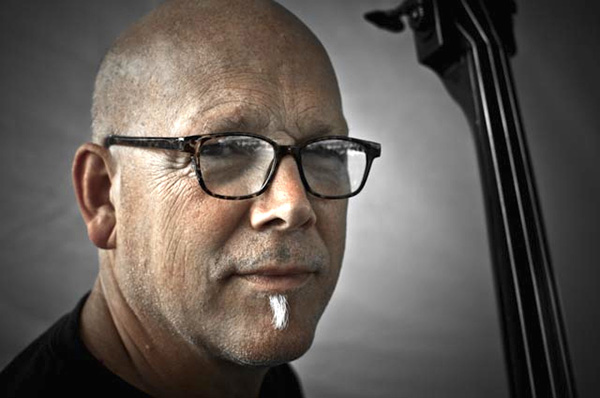
Don Dixon & bass. (Photo by William Campbell.)
Along the way, Dixon shaped the sound and vision of R.E.M. and other beloved '80s bands. "We made The Smithereens' first record at The Record Plant in New York, where John Lennon had done stuff years before," Dixon continued. "Green Thoughts (1988), a great record, was made in one of those classic studios in the basement of the Capitol Records building in Los Angeles. Harry Belafonte came in and hung out one afternoon during those sessions. Del Shannon came in and sang a song. It was fun."
Footnote 1: Writing in 1998's Records to Die For, Robert Baird called The Reivers "One of America's great lost bands."—Jim Austin