I have lost track of how many loudspeakers I have measured with DRA Labs' MLSSA system since Stereophile started accompanying its reviews with measurements in the late 1980s, but it must be close to 1000. Most of those speakers have long since faded from my memory, but there are some whose excellent measurements stick in my mind. One such is the Magico S5 Mk.II I reviewed in February 2017.
That large, heavy, expensive three-way tower featured an enclosure built on an aluminum space frame with extruded aluminum walls. I was impressed not only by how it measured but also by its lack of coloration and how effortlessly transparent it sounded. I concluded my review of the S5 Mk.II by writing that "it joins those speakers as ones I could live with when I'm done with this reviewing business."
Well, I am not done with this reviewing business, so when Editor Jim Austin asked if I would like to review a new incarnation of the S5, the S5 2024, which was introduced last year to celebrate the California company's 20th anniversary, I enthusiastically agreed.
The S5 2024
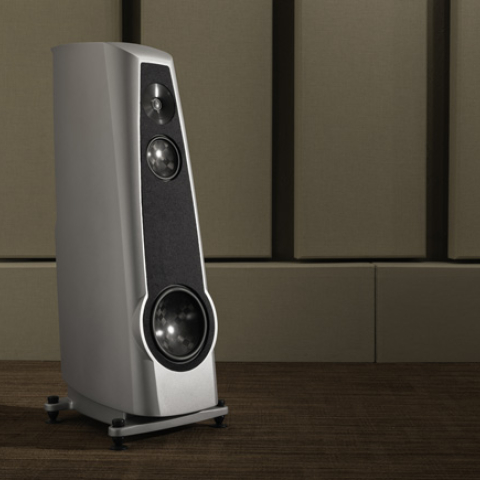
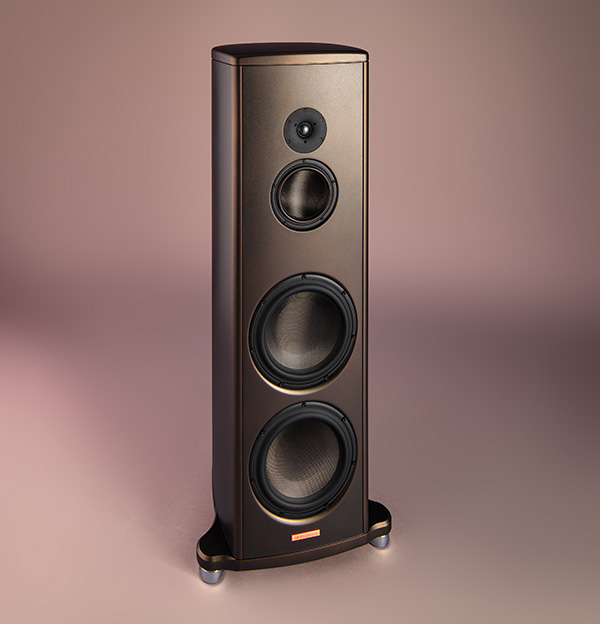
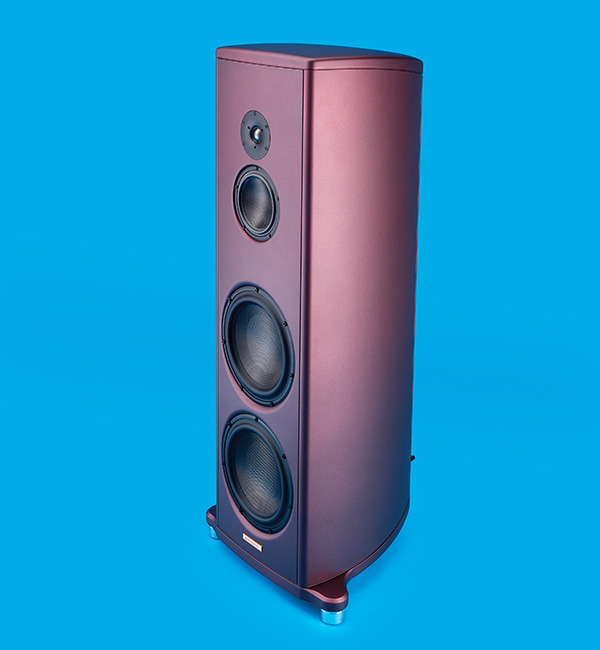
The S5 2024 costs $82,000/pair in "Softec" finishes, or $91,300/pair in High Gloss finishes. While it shares the name and some of the technology of its predecessor and is still a dual-woofer three-way in a sealed enclosure, the S5 2024 is otherwise a completely new design. Most obvious is that while the earlier speaker had a flat front baffle, the 2024's aluminum baffle is gently curved. In a Zoom interview, Magico founder Alon Wolf told me that this optimizes diffraction (footnote 1). In addition, the new speaker is 5" deeper than the 2017 version, which increases the internal volume by 31%. This lowers the response by 5Hz; Magico specifies the 2024's low frequencies as extending to 20Hz in-room. This is a massive loudspeaker, weighing 262lb. People often assume that adding mass minimizes resonant behavior, however, this isn't correct. When mathematically modeled, mass behaves as a reactance, either capacitive or inductive depending on the situation, and as any engineer will tell you, you cannot dissipate energy with a reactance. Only resistance will do that, and the mechanical analog of electrical resistance is frictional loss. By itself, therefore, an undamped massive structure is no less resonant than an undamped lightweight one, and in fact, by acting as a bigger capacitor, can make the situation worse. Mass and damping is what is required, along with strategic placement of bracing. Aluminum rings. I discussed this subject-vibration and mass—with Alon Wolf, who said that people think that's a bad thing. On the contrary, he explained, it's a good thing it rings because it means it releases energy quickly. He told me that before they actually build anything, the design is completely laid down. Three-dimensional modeling-simulation-is used to optimize the design of the S5 2024's aluminum enclosure, maximizing stiffness while enabling optimal damping. Following the simulation, a cabinet is assembled, and a Polytec laser Doppler vibrometer is used to examine the vibrational behavior at many points on its surface. The resultant data can then be used to calculate the sound-pressure levels generated by the vibrations, and the enclosure's construction is then remodeled by the simulator, addressing the problems found by the laser vibrometer. This iterative strategy enables Magico to ensure that the S5's cabinet doesn't add coloration. The end result, Wolf said, is the perfect enclosure.
This process appeared to have been successful. On the sidewalls of the earlier S5 Mk.II, I found two high-Q, low-level vibrational modes, at 436 and 744Hz, both audible when I listened to the enclosure walls with a stethoscope. As you can read in this review's Measurements and Listening sections, I neither measured nor heard any resonant behavior in the S5 2024's enclosure.
Wolf said that the vibration analysis methodology was also used to design the three feet on which the S5 sits. The feet are related to the more expensive MPods used on Magico's M-Series speakers. Like the MPods, they act as a low-pass filter, coupling low-frequency energy to the floor while dissipating higher-frequency energy as heat.
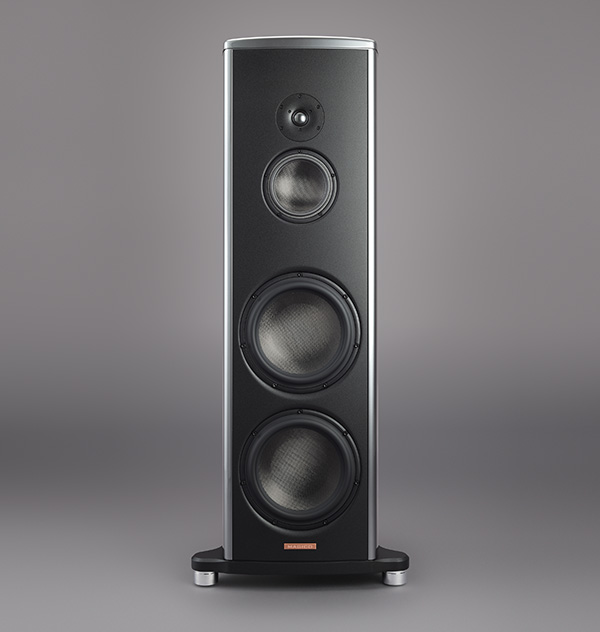 The S5 2024's drive units are all new. The 1.1" diamond-coated beryllium-dome tweeter is very similar to the one used in Magico's M-Series speakers, but with a slightly different neodymium-magnet motor system. Finite Element Analysis modeling was used to optimize the mechanical and acoustical performance of its back chamber.
The S5 2024's 6" midrange unit is built into a third-generation chassis and features a 3" titanium voice coil and two extra-large neodymium magnets. It employs Magico's latest Nano-Tec v.8 cone, which coats a curved aluminum-honeycomb core with a carbon-fiber layer covered with a graphene skin. While the 2017 S5 used two 10" aluminum-cone woofers, the new S5's 10" woofers, like the midrange, use Nano-Tec v.8 cones. Each woofer features a 5" titanium voice coil and is said to be capable of ½" of linear movement with low distortion.
The three-way crossover is still Magico's Elliptical Symmetry type, with Linkwitz-Riley low- and high-pass filters used to achieve 24dB/octave slopes. It features Mundorf MResist Ultra Resistors and MCoil Foil coils.
Those are the S5 2024's ingredients; the acoustic performance is realized with another iterative strategy, using a Klippel Near-Field Scanner. The speaker is placed on a high stand, and in an automatic process that takes 20 hours, a microphone takes a large number of acoustic measurements in a 3D sphere around it, generating a complete picture of the speaker's on- and off-axis behavior.
Alon Wolf is a big fan of the Klippel: "The Klippel allows us to have coherent measurement down to 20Hz, which is something that you cannot achieve in an anechoic chamber. I'm not aware of a chamber that is big enough. Even in the NRC [chamber in Ottawa], the measurements are only really viable down to 150Hz." He discussed how the design process used to be: "You design a speaker, everything is looking good, then you listen. You decide to change something a little bit. Sometimes a deviation of just half a dB makes a difference. You can spend months working on that voicing. And then you take the loudspeaker to another room, and it's not quite there. It's just an endless process. [With the Klippel] I don't need to do any voicing whatsoever. It's just amazing. The speaker comes out optimized in terms of performance and voicing. ... There's nothing for me to add. It allows us to build products that, at least from an engineering perspective, are as good as it gets."
The S5 2024's drive units are all new. The 1.1" diamond-coated beryllium-dome tweeter is very similar to the one used in Magico's M-Series speakers, but with a slightly different neodymium-magnet motor system. Finite Element Analysis modeling was used to optimize the mechanical and acoustical performance of its back chamber.
The S5 2024's 6" midrange unit is built into a third-generation chassis and features a 3" titanium voice coil and two extra-large neodymium magnets. It employs Magico's latest Nano-Tec v.8 cone, which coats a curved aluminum-honeycomb core with a carbon-fiber layer covered with a graphene skin. While the 2017 S5 used two 10" aluminum-cone woofers, the new S5's 10" woofers, like the midrange, use Nano-Tec v.8 cones. Each woofer features a 5" titanium voice coil and is said to be capable of ½" of linear movement with low distortion.
The three-way crossover is still Magico's Elliptical Symmetry type, with Linkwitz-Riley low- and high-pass filters used to achieve 24dB/octave slopes. It features Mundorf MResist Ultra Resistors and MCoil Foil coils.
Those are the S5 2024's ingredients; the acoustic performance is realized with another iterative strategy, using a Klippel Near-Field Scanner. The speaker is placed on a high stand, and in an automatic process that takes 20 hours, a microphone takes a large number of acoustic measurements in a 3D sphere around it, generating a complete picture of the speaker's on- and off-axis behavior.
Alon Wolf is a big fan of the Klippel: "The Klippel allows us to have coherent measurement down to 20Hz, which is something that you cannot achieve in an anechoic chamber. I'm not aware of a chamber that is big enough. Even in the NRC [chamber in Ottawa], the measurements are only really viable down to 150Hz." He discussed how the design process used to be: "You design a speaker, everything is looking good, then you listen. You decide to change something a little bit. Sometimes a deviation of just half a dB makes a difference. You can spend months working on that voicing. And then you take the loudspeaker to another room, and it's not quite there. It's just an endless process. [With the Klippel] I don't need to do any voicing whatsoever. It's just amazing. The speaker comes out optimized in terms of performance and voicing. ... There's nothing for me to add. It allows us to build products that, at least from an engineering perspective, are as good as it gets."
 Installation
Magico's VP for global sales and marketing, Peter Mackay, visited to unpack the S5 2024s from their crates and set them up in my listening room. He started with the speakers in the positions where the S5 Mk.IIs had sounded best. I connected the new speakers to a pair of Parasound JCA100 Tribute monoblock amplifiers with AudioQuest Robin Hood cables. The source was a Roon Ready MBL N31 CD player/DAC sent audio data over my network from my Roon Nucleus+ server. Peter accessed the network with his iPhone and streamed a variety of tracks, including some I hastily made a note of, from Belgian singer and flautist Melanie De Biasio and Brazilian guitarist and songwriter Lari Basilio, to get a handle on how the S5 2024s interacted with my room. After about an hour of adjusting the speakers' positions and installing the feet on each speaker's triangular outrigger base, he declared himself satisfied.
Then something unusual happened. After setting up a Dayton Audio OmniMic V2 on a microphone stand above the center of my listening chair and connecting it to a USB port on his laptop, Peter called Magico's CTO, Yair Tammam, at his home in Israel. Peter gave Tammam internet access to his laptop; I played the appropriate test-tone tracks from the OmniMic CD on my Ayre player; and Tammam measured each speaker's in-room response. Yair and Peter discussed the measurements; Peter made some slight adjustments to the speaker positions; and Yair signed off on the placements.
When, later, I interviewed Magico's Alon Wolf about the S5 2024, I mentioned that Tammam had remotely measured the speakers in my room. He explained that Magico started offering this service to help customers who buy subwoofers. "We can measure the room, log in to the subwoofer's DSP control panels, and do the adjustments so we have good integration with the main system."
The S5 2024s' front baffles ended up 86" from the wall behind the speakers; the center of the right-hand baffle was 56" from the books that line that speaker's closest sidewall; and the left-hand baffles were 37" from the LPs that line that speaker's sidewall. The Magico speakers were toed in not quite all the way toward the listening position, and the tweeters were a few inches above the height of my ears, which, when I was seated, were 36" from the floor.
 Listening
As always, I started my critical listening by playing the 1/3-octave warble tones on my Editor's Choice CD (footnote 2). The tones were cleanly reproduced down to the 25Hz band. The 63Hz tone was slightly higher in level, the 40Hz tone slightly lower in level. The 32Hz tone was boosted by my room's lowest-frequency mode, and I could readily hear the 20Hz tone. The half-step–spaced tonebursts on Editor's Choice spoke cleanly and evenly from 4kHz down to 32Hz, though with a slight touch of emphasis around 3kHz. The lower-frequency tonebursts and warble tones sounded clean, with no "doubling" (second-harmonic distortion). Listening with a stethoscope to the enclosure's walls while these test tones played, I couldn't hear any resonances. None at all! The dual-mono pink noise track on Editor's Choice was reproduced as a stable central image. The high frequencies sounded smooth, the midrange uncolored, though if I stood up, the noise sounded hollow. As I moved my head from side to side, I could hear very little comb filtering-what Stereophile founder the late J. Gordon Holt used to call "vertical Venetian blinding." Normally, when I audition a loudspeaker for the first time, various things catch my attention: maybe a touch of brightness in the presence region; perhaps more top-octave "air" than I was expecting; maybe a lack of midrange body to voices; or a lack of low-frequency control. When I started listening to my usual music tracks with the Magico S5 2024s, it was difficult to get a handle on what they were doing. The speakers kept stepping out of the way of the music I was playing.
 After many evenings of music, I realized that there was a clarity-a transparency-to the Magicos' presentation. This wasn't because anything was being unnaturally emphasized. It was due to the fact that my system's noisefloor had been lowered so that recorded backgrounds seemed blacker. For example, I must have played the late Lowell George's "20 Million Things to Do," from his solo album Thanks I'll Eat It Here (16/44.1 FLAC, Warner/Qobuz), hundreds of time since it was released in 1979, but the music stand George knocks over at the beginning and again at the end of the track sounded significantly farther away than I was used to.
The Magicos were superb at reproducing the scale of orchestral recordings. As accurate and stable as the stereo imaging is with my usual minimonitors, from KEF and GoldenEar, they produce a miniature orchestral image that I feel I am looking down on from a distance. In contrast, the S5 2024 presented an appropriately large soundstage, the images of the musicians stably placed in two dimensions between and behind the plane of the speakers. This was very obvious on a recording of Rachmaninoff's Paganini Rhapsody performed by Yuja Wang with the Los Angeles Philharmonic in 2023 (24/96 FLAC, DG/Qobuz). I first heard Ms. Wang performing Schubert and Franck piano quintets at a 2005 Santa Fe Chamber Music Festival concert. She was just 18 years old back then but played with extraordinary authority and emotional maturity. Listening to her Rachmaninoff on the Magicos, I stopped focusing on the sound and became absorbed in the music-such was the warm sweep of the sound, the realistic size of the soundstage.
I am a reviewer, so I should be discussing sound quality, not music. As I have written many times, piano recordings are revealing of problems in the midrange. Ms. Wang's instrument was reproduced without any notes emphasized at the expense of others. Similarly, Robert Silverman's Steinway on the 1993 Stereophile recording of the Liszt B-minor Piano Sonata (16/44.1 ALAC, STPH008-2) sounded uncannily uncolored.
After many evenings of music, I realized that there was a clarity-a transparency-to the Magicos' presentation. This wasn't because anything was being unnaturally emphasized. It was due to the fact that my system's noisefloor had been lowered so that recorded backgrounds seemed blacker. For example, I must have played the late Lowell George's "20 Million Things to Do," from his solo album Thanks I'll Eat It Here (16/44.1 FLAC, Warner/Qobuz), hundreds of time since it was released in 1979, but the music stand George knocks over at the beginning and again at the end of the track sounded significantly farther away than I was used to.
The Magicos were superb at reproducing the scale of orchestral recordings. As accurate and stable as the stereo imaging is with my usual minimonitors, from KEF and GoldenEar, they produce a miniature orchestral image that I feel I am looking down on from a distance. In contrast, the S5 2024 presented an appropriately large soundstage, the images of the musicians stably placed in two dimensions between and behind the plane of the speakers. This was very obvious on a recording of Rachmaninoff's Paganini Rhapsody performed by Yuja Wang with the Los Angeles Philharmonic in 2023 (24/96 FLAC, DG/Qobuz). I first heard Ms. Wang performing Schubert and Franck piano quintets at a 2005 Santa Fe Chamber Music Festival concert. She was just 18 years old back then but played with extraordinary authority and emotional maturity. Listening to her Rachmaninoff on the Magicos, I stopped focusing on the sound and became absorbed in the music-such was the warm sweep of the sound, the realistic size of the soundstage.
I am a reviewer, so I should be discussing sound quality, not music. As I have written many times, piano recordings are revealing of problems in the midrange. Ms. Wang's instrument was reproduced without any notes emphasized at the expense of others. Similarly, Robert Silverman's Steinway on the 1993 Stereophile recording of the Liszt B-minor Piano Sonata (16/44.1 ALAC, STPH008-2) sounded uncannily uncolored.
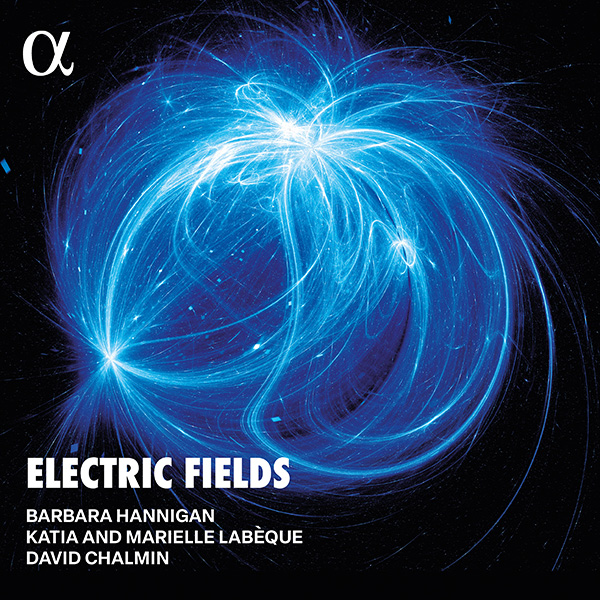 It wasn't just pianos that were well served by the Magico S5 2024. Provoked by Jason Victor Serinus's review in the May issue, I streamed Hildegard of Bingen's "O vis aeternitas" from Electric Fields (24/48 FLAC, Alpha Classic/Qobuz), performed by soprano Barbara Hannigan, the Labèque Sisters on pianos, and David Chalmin on synths and electronics. The way Hannigan's voice soars over the low-frequency pedal notes and what sounds like prepared piano punctuations, hanging hauntingly in space between the speakers with echoed images in the far distance, sent shivers down my spine, even on repeated listens.
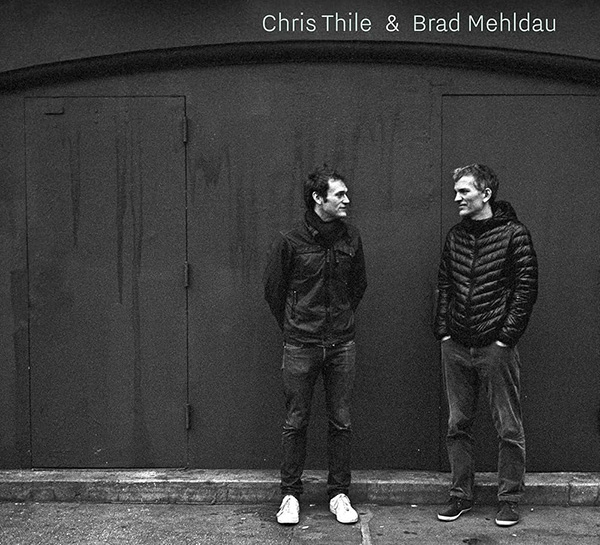
A recent discovery was the album Chris Thile and Brad Mehldau (24/96 FLAC, Nonesuch/Qobuz). More famed for his mandolin playing than his vocals, Thile sings Johnny Green and Edward Heyman's "I Cover the Waterfront" on this album. As reproduced by the Magicos, it seemed that mixing engineer James Farber had placed Thile's vocal quite a distance in front of Mehldau's piano. More likely, the S5 2024s' superb presentation of low-level ambient information was placing the piano further back in the soundstage than Farber anticipated. Nevertheless, Thile's image was as palpably reproduced as Hannigan's on the Hildegard of Bingen track, free of coloration or tonal emphasis.
It wasn't just pianos that were well served by the Magico S5 2024. Provoked by Jason Victor Serinus's review in the May issue, I streamed Hildegard of Bingen's "O vis aeternitas" from Electric Fields (24/48 FLAC, Alpha Classic/Qobuz), performed by soprano Barbara Hannigan, the Labèque Sisters on pianos, and David Chalmin on synths and electronics. The way Hannigan's voice soars over the low-frequency pedal notes and what sounds like prepared piano punctuations, hanging hauntingly in space between the speakers with echoed images in the far distance, sent shivers down my spine, even on repeated listens.
A recent discovery was the album Chris Thile and Brad Mehldau (24/96 FLAC, Nonesuch/Qobuz). More famed for his mandolin playing than his vocals, Thile sings Johnny Green and Edward Heyman's "I Cover the Waterfront" on this album. As reproduced by the Magicos, it seemed that mixing engineer James Farber had placed Thile's vocal quite a distance in front of Mehldau's piano. More likely, the S5 2024s' superb presentation of low-level ambient information was placing the piano further back in the soundstage than Farber anticipated. Nevertheless, Thile's image was as palpably reproduced as Hannigan's on the Hildegard of Bingen track, free of coloration or tonal emphasis.
 Farber also recorded and mixed two of the tracks on Sasha Matson's new album Fillmore Street/Little Woodstar, which I had co-produced. The second movement of the symphonic Fillmore Street features a multitracked vintage Moog accompanied by timpani and an orchestral bass drum. Even though these instruments occupy similar frequency ranges, they were cleanly differentiated by the S5 2024. The control and evenness of the Magico's low frequencies continued to impress throughout the six weeks the speakers resided in my listening room. The bass guitars on Lowell George's "20 Million Things to Do" and Jimmy Webb's "Friends to Burn" (from Suspending Disbelief, 321kbps AAC, Elektra) were reproduced with weight and power but without boom. The tonal differentiation between Ginger Baker's kickdrum(s) and Charlie Haden's double bass on "Ginger Blues" from Going Back Home was superbly clear (16/44.1 ALAC, Atlantic, produced by erstwhile Stereophile writer Chip Stern).
My ultimate test for bass articulation is the repeated 16th-note bass line in "Last Train Home" from Pat Metheny and Lyle Mays's Still Life (Talking) (16/44.1 ALAC, Geffen). Reflex-loaded woofers have a hard time keeping the onset of each bass note distinct from the overhang of the previous one. The Magicos had no problem keeping the low-frequency notes separate.
Farber also recorded and mixed two of the tracks on Sasha Matson's new album Fillmore Street/Little Woodstar, which I had co-produced. The second movement of the symphonic Fillmore Street features a multitracked vintage Moog accompanied by timpani and an orchestral bass drum. Even though these instruments occupy similar frequency ranges, they were cleanly differentiated by the S5 2024. The control and evenness of the Magico's low frequencies continued to impress throughout the six weeks the speakers resided in my listening room. The bass guitars on Lowell George's "20 Million Things to Do" and Jimmy Webb's "Friends to Burn" (from Suspending Disbelief, 321kbps AAC, Elektra) were reproduced with weight and power but without boom. The tonal differentiation between Ginger Baker's kickdrum(s) and Charlie Haden's double bass on "Ginger Blues" from Going Back Home was superbly clear (16/44.1 ALAC, Atlantic, produced by erstwhile Stereophile writer Chip Stern).
My ultimate test for bass articulation is the repeated 16th-note bass line in "Last Train Home" from Pat Metheny and Lyle Mays's Still Life (Talking) (16/44.1 ALAC, Geffen). Reflex-loaded woofers have a hard time keeping the onset of each bass note distinct from the overhang of the previous one. The Magicos had no problem keeping the low-frequency notes separate.
 I finished my critical listening to the Magico S5 2024s with "With All My Love," a track from Melanie De Biasio's album No Deal (24/44.1 FLAC, Play It Again Sam/Qobuz), which Peter Mackay had used when he set the speakers up in my room. De Biasio's contralto hung between the S5 2024s, set in front of what must have been a close-miked piano, judging by the occasional pedal and keyboard mechanism noises. And when brushed cymbals appear a couple of minutes into the track, these were set way back in the soundstage, as were the subsequent kickdrum interjections. The deep-pitched synthesizer pedal notes that underpin the arrangement were powerfully but cleanly reproduced by the Magicos. There was no indication that the sound and the stage were being produced by a pair of loudspeakers; the images simply hung in space at the end of my room.
Conclusion
I finished my critical listening to the Magico S5 2024s with "With All My Love," a track from Melanie De Biasio's album No Deal (24/44.1 FLAC, Play It Again Sam/Qobuz), which Peter Mackay had used when he set the speakers up in my room. De Biasio's contralto hung between the S5 2024s, set in front of what must have been a close-miked piano, judging by the occasional pedal and keyboard mechanism noises. And when brushed cymbals appear a couple of minutes into the track, these were set way back in the soundstage, as were the subsequent kickdrum interjections. The deep-pitched synthesizer pedal notes that underpin the arrangement were powerfully but cleanly reproduced by the Magicos. There was no indication that the sound and the stage were being produced by a pair of loudspeakers; the images simply hung in space at the end of my room.
Conclusion
They may be large and heavy (and expensive), but Magico's S5 2024s stepped out of the way of the music with every recording I played. It is a revelation of what can be achieved by an apparently conventional moving coil loudspeaker. And the fact that state-of-the-art measurement techniques played such a large role in its design appealed to this music lover's inner engineer. I have no doubts in declaring that the S5 2024 is one of the finest-sounding loudspeakers that I have experienced in my listening room.
Footnote 1: Alon Wolf discusses his design philosophy in Jason Victor Serinus's 2008 interview. Footnote 2: While this CD is out of print, the test-tone files can be downloaded free of charge from tinyurl.com/yfkvayat.
The S5 2024 costs $82,000/pair in "Softec" finishes, or $91,300/pair in High Gloss finishes. While it shares the name and some of the technology of its predecessor and is still a dual-woofer three-way in a sealed enclosure, the S5 2024 is otherwise a completely new design. Most obvious is that while the earlier speaker had a flat front baffle, the 2024's aluminum baffle is gently curved. In a Zoom interview, Magico founder Alon Wolf told me that this optimizes diffraction (footnote 1). In addition, the new speaker is 5" deeper than the 2017 version, which increases the internal volume by 31%. This lowers the response by 5Hz; Magico specifies the 2024's low frequencies as extending to 20Hz in-room. This is a massive loudspeaker, weighing 262lb. People often assume that adding mass minimizes resonant behavior, however, this isn't correct. When mathematically modeled, mass behaves as a reactance, either capacitive or inductive depending on the situation, and as any engineer will tell you, you cannot dissipate energy with a reactance. Only resistance will do that, and the mechanical analog of electrical resistance is frictional loss. By itself, therefore, an undamped massive structure is no less resonant than an undamped lightweight one, and in fact, by acting as a bigger capacitor, can make the situation worse. Mass and damping is what is required, along with strategic placement of bracing. Aluminum rings. I discussed this subject-vibration and mass—with Alon Wolf, who said that people think that's a bad thing. On the contrary, he explained, it's a good thing it rings because it means it releases energy quickly. He told me that before they actually build anything, the design is completely laid down. Three-dimensional modeling-simulation-is used to optimize the design of the S5 2024's aluminum enclosure, maximizing stiffness while enabling optimal damping. Following the simulation, a cabinet is assembled, and a Polytec laser Doppler vibrometer is used to examine the vibrational behavior at many points on its surface. The resultant data can then be used to calculate the sound-pressure levels generated by the vibrations, and the enclosure's construction is then remodeled by the simulator, addressing the problems found by the laser vibrometer. This iterative strategy enables Magico to ensure that the S5's cabinet doesn't add coloration. The end result, Wolf said, is the perfect enclosure.
The S5 2024's drive units are all new. The 1.1" diamond-coated beryllium-dome tweeter is very similar to the one used in Magico's M-Series speakers, but with a slightly different neodymium-magnet motor system. Finite Element Analysis modeling was used to optimize the mechanical and acoustical performance of its back chamber.
InstallationMagico's VP for global sales and marketing, Peter Mackay, visited to unpack the S5 2024s from their crates and set them up in my listening room. He started with the speakers in the positions where the S5 Mk.IIs had sounded best. I connected the new speakers to a pair of Parasound JCA100 Tribute monoblock amplifiers with AudioQuest Robin Hood cables. The source was a Roon Ready MBL N31 CD player/DAC sent audio data over my network from my Roon Nucleus+ server. Peter accessed the network with his iPhone and streamed a variety of tracks, including some I hastily made a note of, from Belgian singer and flautist Melanie De Biasio and Brazilian guitarist and songwriter Lari Basilio, to get a handle on how the S5 2024s interacted with my room. After about an hour of adjusting the speakers' positions and installing the feet on each speaker's triangular outrigger base, he declared himself satisfied.
ListeningAs always, I started my critical listening by playing the 1/3-octave warble tones on my Editor's Choice CD (footnote 2). The tones were cleanly reproduced down to the 25Hz band. The 63Hz tone was slightly higher in level, the 40Hz tone slightly lower in level. The 32Hz tone was boosted by my room's lowest-frequency mode, and I could readily hear the 20Hz tone. The half-step–spaced tonebursts on Editor's Choice spoke cleanly and evenly from 4kHz down to 32Hz, though with a slight touch of emphasis around 3kHz. The lower-frequency tonebursts and warble tones sounded clean, with no "doubling" (second-harmonic distortion). Listening with a stethoscope to the enclosure's walls while these test tones played, I couldn't hear any resonances. None at all! The dual-mono pink noise track on Editor's Choice was reproduced as a stable central image. The high frequencies sounded smooth, the midrange uncolored, though if I stood up, the noise sounded hollow. As I moved my head from side to side, I could hear very little comb filtering-what Stereophile founder the late J. Gordon Holt used to call "vertical Venetian blinding." Normally, when I audition a loudspeaker for the first time, various things catch my attention: maybe a touch of brightness in the presence region; perhaps more top-octave "air" than I was expecting; maybe a lack of midrange body to voices; or a lack of low-frequency control. When I started listening to my usual music tracks with the Magico S5 2024s, it was difficult to get a handle on what they were doing. The speakers kept stepping out of the way of the music I was playing.
After many evenings of music, I realized that there was a clarity-a transparency-to the Magicos' presentation. This wasn't because anything was being unnaturally emphasized. It was due to the fact that my system's noisefloor had been lowered so that recorded backgrounds seemed blacker. For example, I must have played the late Lowell George's "20 Million Things to Do," from his solo album Thanks I'll Eat It Here (16/44.1 FLAC, Warner/Qobuz), hundreds of time since it was released in 1979, but the music stand George knocks over at the beginning and again at the end of the track sounded significantly farther away than I was used to.
The Magicos were superb at reproducing the scale of orchestral recordings. As accurate and stable as the stereo imaging is with my usual minimonitors, from KEF and GoldenEar, they produce a miniature orchestral image that I feel I am looking down on from a distance. In contrast, the S5 2024 presented an appropriately large soundstage, the images of the musicians stably placed in two dimensions between and behind the plane of the speakers. This was very obvious on a recording of Rachmaninoff's Paganini Rhapsody performed by Yuja Wang with the Los Angeles Philharmonic in 2023 (24/96 FLAC, DG/Qobuz). I first heard Ms. Wang performing Schubert and Franck piano quintets at a 2005 Santa Fe Chamber Music Festival concert. She was just 18 years old back then but played with extraordinary authority and emotional maturity. Listening to her Rachmaninoff on the Magicos, I stopped focusing on the sound and became absorbed in the music-such was the warm sweep of the sound, the realistic size of the soundstage.
I am a reviewer, so I should be discussing sound quality, not music. As I have written many times, piano recordings are revealing of problems in the midrange. Ms. Wang's instrument was reproduced without any notes emphasized at the expense of others. Similarly, Robert Silverman's Steinway on the 1993 Stereophile recording of the Liszt B-minor Piano Sonata (16/44.1 ALAC, STPH008-2) sounded uncannily uncolored.
It wasn't just pianos that were well served by the Magico S5 2024. Provoked by Jason Victor Serinus's review in the May issue, I streamed Hildegard of Bingen's "O vis aeternitas" from Electric Fields (24/48 FLAC, Alpha Classic/Qobuz), performed by soprano Barbara Hannigan, the Labèque Sisters on pianos, and David Chalmin on synths and electronics. The way Hannigan's voice soars over the low-frequency pedal notes and what sounds like prepared piano punctuations, hanging hauntingly in space between the speakers with echoed images in the far distance, sent shivers down my spine, even on repeated listens.
A recent discovery was the album Chris Thile and Brad Mehldau (24/96 FLAC, Nonesuch/Qobuz). More famed for his mandolin playing than his vocals, Thile sings Johnny Green and Edward Heyman's "I Cover the Waterfront" on this album. As reproduced by the Magicos, it seemed that mixing engineer James Farber had placed Thile's vocal quite a distance in front of Mehldau's piano. More likely, the S5 2024s' superb presentation of low-level ambient information was placing the piano further back in the soundstage than Farber anticipated. Nevertheless, Thile's image was as palpably reproduced as Hannigan's on the Hildegard of Bingen track, free of coloration or tonal emphasis.
Farber also recorded and mixed two of the tracks on Sasha Matson's new album Fillmore Street/Little Woodstar, which I had co-produced. The second movement of the symphonic Fillmore Street features a multitracked vintage Moog accompanied by timpani and an orchestral bass drum. Even though these instruments occupy similar frequency ranges, they were cleanly differentiated by the S5 2024. The control and evenness of the Magico's low frequencies continued to impress throughout the six weeks the speakers resided in my listening room. The bass guitars on Lowell George's "20 Million Things to Do" and Jimmy Webb's "Friends to Burn" (from Suspending Disbelief, 321kbps AAC, Elektra) were reproduced with weight and power but without boom. The tonal differentiation between Ginger Baker's kickdrum(s) and Charlie Haden's double bass on "Ginger Blues" from Going Back Home was superbly clear (16/44.1 ALAC, Atlantic, produced by erstwhile Stereophile writer Chip Stern).
I finished my critical listening to the Magico S5 2024s with "With All My Love," a track from Melanie De Biasio's album No Deal (24/44.1 FLAC, Play It Again Sam/Qobuz), which Peter Mackay had used when he set the speakers up in my room. De Biasio's contralto hung between the S5 2024s, set in front of what must have been a close-miked piano, judging by the occasional pedal and keyboard mechanism noises. And when brushed cymbals appear a couple of minutes into the track, these were set way back in the soundstage, as were the subsequent kickdrum interjections. The deep-pitched synthesizer pedal notes that underpin the arrangement were powerfully but cleanly reproduced by the Magicos. There was no indication that the sound and the stage were being produced by a pair of loudspeakers; the images simply hung in space at the end of my room.
ConclusionThey may be large and heavy (and expensive), but Magico's S5 2024s stepped out of the way of the music with every recording I played. It is a revelation of what can be achieved by an apparently conventional moving coil loudspeaker. And the fact that state-of-the-art measurement techniques played such a large role in its design appealed to this music lover's inner engineer. I have no doubts in declaring that the S5 2024 is one of the finest-sounding loudspeakers that I have experienced in my listening room.
Footnote 1: Alon Wolf discusses his design philosophy in Jason Victor Serinus's 2008 interview. Footnote 2: While this CD is out of print, the test-tone files can be downloaded free of charge from tinyurl.com/yfkvayat.