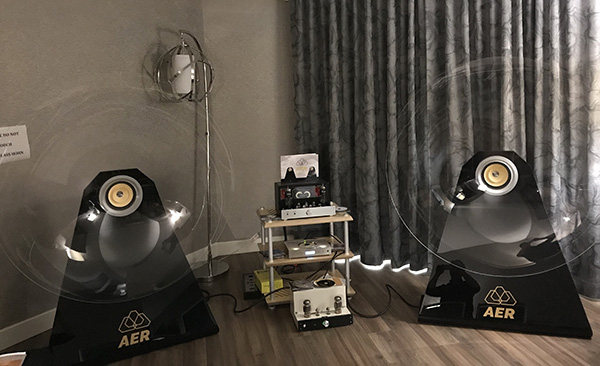
There was no limo, just a walk filled with Christmas-in-Chinatown sights from the F train east down East Broadway, past 169 Bar, under the Manhattan Bridge, to the Dim Sum Palace. I was having a dinner meetup with an artist-writer friend named Joe who invited me to catch up on old times and hear the wide-range AER drivers that he has bolted onto clear acrylic AER baffles with big, round, clear horns on the front. I auditioned these speakers at great length at Capital Audiofest, but I could not picture them in Joe's sixth floor walk-up.
Joe's apartment is small, like mine, with art, records, and hi-fi things piled everywhere. Starting by his front door, a narrow pathway leads straight to Joe's bedroom, where I found a vaguely defined empty space at the end of his bed—maybe 8' away from a pair of wild-looking horns placed about 8' apart.
Seating was borderline bring-your-own. I ended up sitting on Joe's bed because it was in the middle between the speakers. Joe sat at my side on a camping stool.
As I "watched" recordings materialize in the air surrounding the horns, I stared through the clear, 650mm round horn, thinking I could see the music signal bouncing around outside the wires on its way to the speaker-wire binding posts, which were visible through the horn and clear baffle.
The only thing clearer than the baffle and horn was the arc-lamp-lucid sound energy these speakers were projecting. I sat watching in admiration how this new type of hyper-vivid energy was occupying the room. One minute into the first disc, I declared, "I've never heard horns that sounded like this!" The sound was faster, more detailed, more vibed-up and reverb-strong than I'd ever heard from a home loudspeaker. Imagine Quad ESL-57s with unlimited dynamics, a supercharged Sound Lab, or a Stax ELS-F81 on nitromethane.
After a few records, I concluded that Joe was playing everything too quietly. I kept silently wishing he'd turn it up. But when I checked the dB meter on my phone, I found that the sound pressure was averaging 80dBs with peaks over 90dB—same as my usual home listening. Because they're not compressing the signal like a million box speakers I've heard, horn speakers often sound as if they're playing at lower volumes than they are. I remember being at Jeffrey Catalano's High Water Sound, his horns playing a parade of jazz drummers, averaging 95–110dB (C-weighted), as Ken Micallef and I sat la-dee-da on Jeffrey's sofa. Somehow conversation wasn't merely possible—it was easy.
Joe played his AER horns at modest volumes, but the sounds coming out of that quietness were rawer, more refined, and more transparent than I'd previously heard from any domestic loudspeaker, including the Stax F81 and Altec 604. If I were rating transducer transparency on a scale of 1 to 10, these AER horns would be 11 or 12. My Falcon boxes would be 6 or 7. Altec 604s would be a 5. Avantgarde Trios, a 9. Stax SR-X9000 electrostatic headphones would be a 10. RAAL's SR1a full-range ribbon headphones might be a 13.
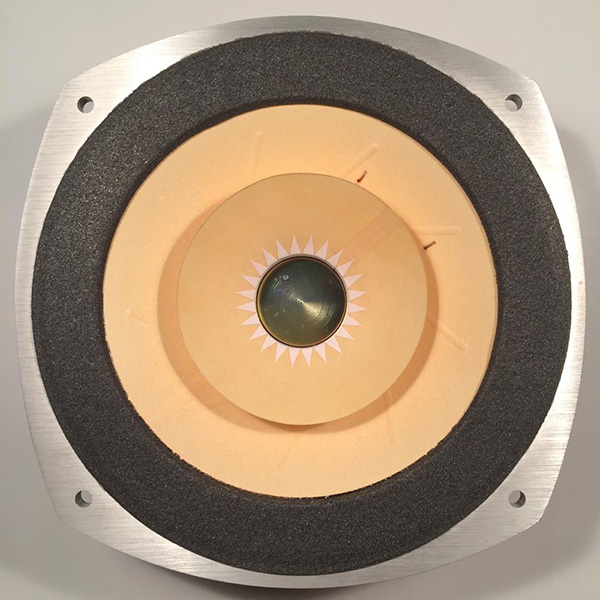
On its own, the AER's BD 3B driver's sensitivity is rated at 98dB/W/1m. Add the effect of the AER horn and this becomes 107dB/W/1m—about the same as an Altec VOTT, enough to test the quietness of any preamp (footnote 1).
Joe's system included AER's active "Subway" subwoofer, crossed over at 100Hz. There's no high-pass filtering on the BD 3B.
 Above 100Hz, this crossoverless setup has the following specifications:
As you may have deduced, this system matches my audio aesthetic pretty well. I sat at the center of the bottom of Joe's bed to listen, but I could have sat anywhere, because the sweet spot where the channels blended properly was at least 5' wide.
While I listened, I enjoyed seeing beat-up cardboard record boxes scattered around the floor, filled with fierce high-lonesome bluegrass, classic country, acoustic blues, gospel, and Jamaican music from Pressure Sounds. Loose records were everywhere, and each one I spotted became the one I wanted to hear next. Ralph Stanley presided as minister. George Jones and King Tubby wore crowns.
Above 100Hz, this crossoverless setup has the following specifications:
As you may have deduced, this system matches my audio aesthetic pretty well. I sat at the center of the bottom of Joe's bed to listen, but I could have sat anywhere, because the sweet spot where the channels blended properly was at least 5' wide.
While I listened, I enjoyed seeing beat-up cardboard record boxes scattered around the floor, filled with fierce high-lonesome bluegrass, classic country, acoustic blues, gospel, and Jamaican music from Pressure Sounds. Loose records were everywhere, and each one I spotted became the one I wanted to hear next. Ralph Stanley presided as minister. George Jones and King Tubby wore crowns.
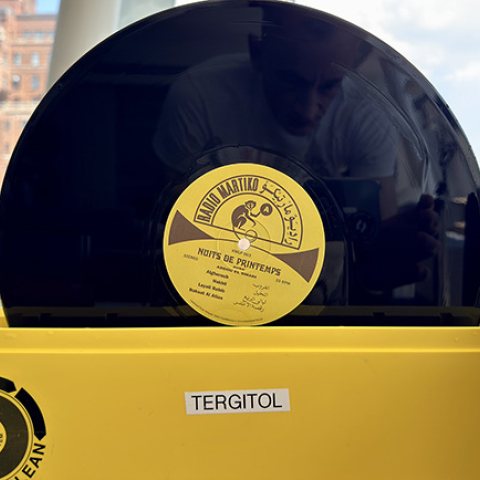
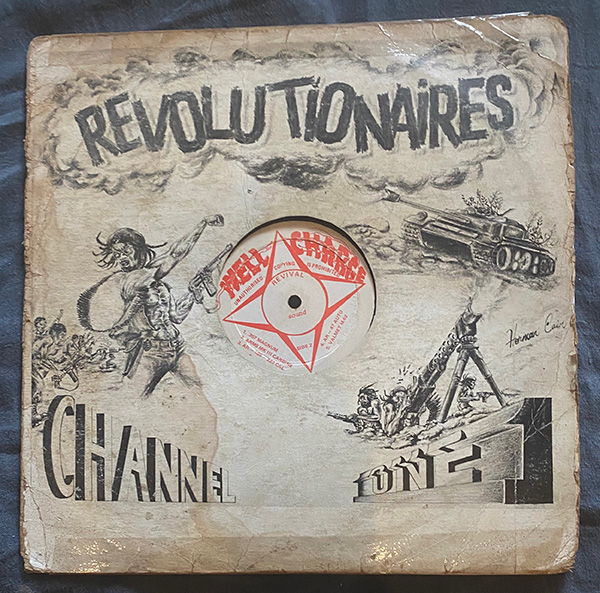 Some recordings, like The Revolutionaries LP featuring Sly and Robbie on Channel One Records from Kingston, Jamaica (no catalog number; see photo above), forced me to bliss out completely, no talking, as Joe played both sides. Joe's copy looked beat to the extreme: The top and bottom seams of its watermarked cover were split and clear-taped back together. Both sides were covered with a haze of light scratches and a carpet of dust. But with Joe's SPU, it played quietly and purposefully.
This system's sound was so micrograin clear that I had to get up from my seat and listen to the BD 3B cones close up, my right ear about 10" from the whizzer cone. That near, it was obvious that the speaker was not distorting. Its dispersion was such that the sharply focused 3D presentation remained stable as I walked around the room.
All the songs on Revolutionaries are named after weapons: "Luger 9mm Auto," "Arms Mk III Carbine," "AR 47 Auto," and so on. More than today's app-enhanced popular music, these tracks make clear that in its basic form, music is shaped energy. That's what I observed as I listened at Joe's. Channel One's dub rhythms merged with my nervous system in a direct, mesmerizing way. Sly and Robbie's loping pace adjusted my pulse and tuned up my thinking. Plate reverb moved my thoughts towards livity (footnote 2) and an earth-based heaven.
I enjoy dub sound most when I hear it outdoors in front of a large sound system. I picture myself chilling in a hammock smoking sacred wisdom as canyons of dub energy wash over me, restoring my peace.
Rocking about on the edge of Joe's bed, I carried on so much about this album, he gave it to me.
The last record Joe played through his Excenterhorns was Light in the Attic's 2024 reissue of Lou Reed's last album, from 2007: Hudson River Wind Meditations (LITA 190). I doubt anyone extant has experienced this Lou Reed sound poetry with microresolution equal to the scintillating level presented by the AERs. If you're a Lou Reed fan and don't already know this Hal Willner–produced album (I didn't), I suggest you check it out on Qobuz (16/44.1 FLAC, Light in the Attic/Qobuz). Lou's Meditations are a mind-bending light and sound vision that made me feel like I was inside Lou's head looking out through his window overlooking the Hudson, watching the operation of his mind.
These open-baffle AER horns projected images forward, sideways (as horns do), and backwards with some depth (like dipoles do). They generated a perfect soundspace for playing 21st century ambient.
After I listened to Lou's 31:35 "Find Your Note," I realized that these soundforms represented Lou's final thinking about what he believed is important in music. This may be ambient, but it's got hooks, brains, and spirituality.
The nature of this quest
Some recordings, like The Revolutionaries LP featuring Sly and Robbie on Channel One Records from Kingston, Jamaica (no catalog number; see photo above), forced me to bliss out completely, no talking, as Joe played both sides. Joe's copy looked beat to the extreme: The top and bottom seams of its watermarked cover were split and clear-taped back together. Both sides were covered with a haze of light scratches and a carpet of dust. But with Joe's SPU, it played quietly and purposefully.
This system's sound was so micrograin clear that I had to get up from my seat and listen to the BD 3B cones close up, my right ear about 10" from the whizzer cone. That near, it was obvious that the speaker was not distorting. Its dispersion was such that the sharply focused 3D presentation remained stable as I walked around the room.
All the songs on Revolutionaries are named after weapons: "Luger 9mm Auto," "Arms Mk III Carbine," "AR 47 Auto," and so on. More than today's app-enhanced popular music, these tracks make clear that in its basic form, music is shaped energy. That's what I observed as I listened at Joe's. Channel One's dub rhythms merged with my nervous system in a direct, mesmerizing way. Sly and Robbie's loping pace adjusted my pulse and tuned up my thinking. Plate reverb moved my thoughts towards livity (footnote 2) and an earth-based heaven.
I enjoy dub sound most when I hear it outdoors in front of a large sound system. I picture myself chilling in a hammock smoking sacred wisdom as canyons of dub energy wash over me, restoring my peace.
Rocking about on the edge of Joe's bed, I carried on so much about this album, he gave it to me.
The last record Joe played through his Excenterhorns was Light in the Attic's 2024 reissue of Lou Reed's last album, from 2007: Hudson River Wind Meditations (LITA 190). I doubt anyone extant has experienced this Lou Reed sound poetry with microresolution equal to the scintillating level presented by the AERs. If you're a Lou Reed fan and don't already know this Hal Willner–produced album (I didn't), I suggest you check it out on Qobuz (16/44.1 FLAC, Light in the Attic/Qobuz). Lou's Meditations are a mind-bending light and sound vision that made me feel like I was inside Lou's head looking out through his window overlooking the Hudson, watching the operation of his mind.
These open-baffle AER horns projected images forward, sideways (as horns do), and backwards with some depth (like dipoles do). They generated a perfect soundspace for playing 21st century ambient.
After I listened to Lou's 31:35 "Find Your Note," I realized that these soundforms represented Lou's final thinking about what he believed is important in music. This may be ambient, but it's got hooks, brains, and spirituality.
The nature of this quest
What I am doing here is something I've always wanted to do: evaluate a loudspeaker by trying it in a variety of different sound systems in a variety of rooms, then comparing it to my speakers at home. The main things a potential customer needs to know are might they like it and what kind of personality does this speaker have? And how might this speaker perform in their room with their type of amplification? Observing how a speaker is affected by different rooms, and different gear arrays, and different personalities doing the arranging and decorating, allows me to see from system to system what changes and what stays the same. I know it's a small sample—a few more rooms would have told me a lot more—but these systems gave me a good taste of what AER's 8" BD 3B (and the similar BD 3Bs, which are even more sensitive and intended for use with front-loaded horns) can do when properly unleashed.
The BD 3B's magnet is specified at 500,000 Maxwell (footnote 3), which helps make it very, as they say, "efficient." According to the AER website, with the BD 3B version, some efficiency "was omitted in order to obtain even more bass."
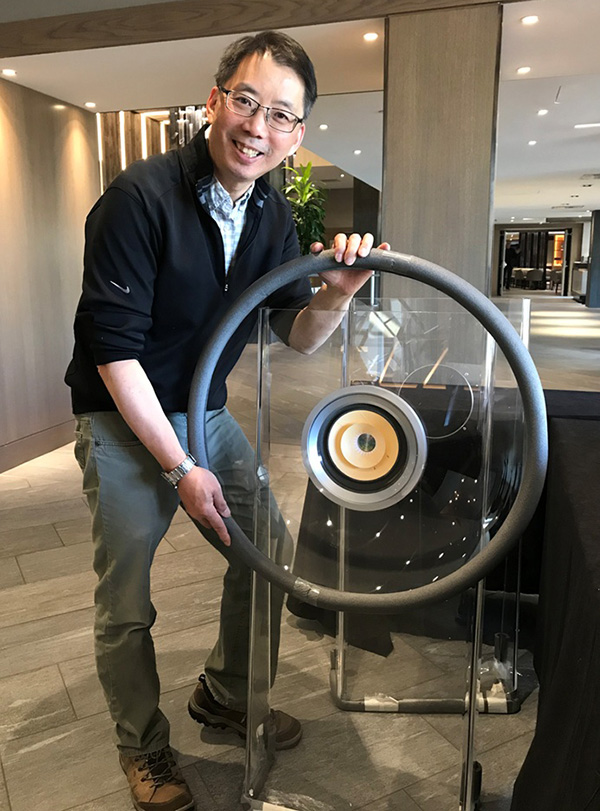 My first serious auditions of an AER wideband driver took place at 2023's Capital Audiofest when AER importer Victor Kung, of Vancouver's VK Music, took a listening room instead of his normal table in the marketplace. He was demonstrating the same wide-rangers as Joe's: BD 3B drivers in clear acrylic open baffles with AER's clear acrylic 650mm horn (above). Victor's were set close to the long wall of a narrow room. Listeners sat 7'–9' away. The speakers were powered by the Sun Valley SV-128ii SET power amplifier with custom-made Hashimoto power transformers, chokes, and output transformers. I listened to Victor's system five times in three days, dragging a different friend with me each time. These friends' candid observations evoked a series of internal dialogs that broadened my understanding of what the BD 3B transducer is capable of.
I texted Victor asking him to ask the horn's designer, Filip Keller, to explain his horn's expansion rate; is it exponential, tractrix, or what? Keller wrote back to Victor in an email: "We have our own horn expansion rate. It is called the AER Hyperbolic Curvature and Expansion Rate, and we don't want to give curvature in detail because it's so superior to all horns, which are misleading and wrong by substance. So please tell Herb we regard ours as proprietary."
If I designed a horn that works like Keller's, I wouldn't tell anyone how to make it either. Every time I listened into the Ex-centerhorns, I observed a bright, luminous galaxy of subtle dynamic energies that I had never noticed with other horns. Tin or plastic horns in chunky wood boxes could never approach this level of absolute clarity and vibrancy. I'm chalking that up to Keller's secret expansion rate.
What impressed me most about these horns was that they played recordings with such extreme transparency. Above 200Hz, they disappeared as an identifiable source of projected sound, even when played loud. And loud they could play! Imagine an 8" paper-cone driver that's an easy load (107dB/W/1m sensitivity) that can handle 100Wpc average and 300Wpc peak.
My first serious auditions of an AER wideband driver took place at 2023's Capital Audiofest when AER importer Victor Kung, of Vancouver's VK Music, took a listening room instead of his normal table in the marketplace. He was demonstrating the same wide-rangers as Joe's: BD 3B drivers in clear acrylic open baffles with AER's clear acrylic 650mm horn (above). Victor's were set close to the long wall of a narrow room. Listeners sat 7'–9' away. The speakers were powered by the Sun Valley SV-128ii SET power amplifier with custom-made Hashimoto power transformers, chokes, and output transformers. I listened to Victor's system five times in three days, dragging a different friend with me each time. These friends' candid observations evoked a series of internal dialogs that broadened my understanding of what the BD 3B transducer is capable of.
I texted Victor asking him to ask the horn's designer, Filip Keller, to explain his horn's expansion rate; is it exponential, tractrix, or what? Keller wrote back to Victor in an email: "We have our own horn expansion rate. It is called the AER Hyperbolic Curvature and Expansion Rate, and we don't want to give curvature in detail because it's so superior to all horns, which are misleading and wrong by substance. So please tell Herb we regard ours as proprietary."
If I designed a horn that works like Keller's, I wouldn't tell anyone how to make it either. Every time I listened into the Ex-centerhorns, I observed a bright, luminous galaxy of subtle dynamic energies that I had never noticed with other horns. Tin or plastic horns in chunky wood boxes could never approach this level of absolute clarity and vibrancy. I'm chalking that up to Keller's secret expansion rate.
What impressed me most about these horns was that they played recordings with such extreme transparency. Above 200Hz, they disappeared as an identifiable source of projected sound, even when played loud. And loud they could play! Imagine an 8" paper-cone driver that's an easy load (107dB/W/1m sensitivity) that can handle 100Wpc average and 300Wpc peak.
 Brian Charney Audio
Yesterday, my friend Richard Cirulnick, who builds drag race engines, introduced me to his speaker-builder/horn-designer friend Brian Charney, who also happened to be "a master Mercedes-Benz technician" currently working and teaching in Mercedes's certified pre-owned cars department. Many of the most interesting people I've met on the engineering side of audio are polymaths who come from automotive backgrounds. The late Tim de Paravicini was the prototypical polymath gearhead. I think Brian might aspire to that calling.
Right now, Charney is a mad speaker-building scientist that has worked years and years to create ultimate-level, hand-built wood cabinets featuring round, rear-loading horns for full-range drivers from Voxativ and AER. I regard Brian's quest for the best possible rear horns as an ambition worthy of more attention.
Front-loading horns tend to focus the upper octaves, while rear-loading horns focus and extend the bass frequencies. That's why I visited Brian: I wanted to compare front-loading personality to rear-loading personality. They had to be different.
A lot of loudspeaker manufacturers came out of domestic cabinet making. They already had a woodshop and a spray booth before they started cutting out weird shapes to make speakers. In contrast, Charney's background is in the precision cutting of hard metals—with industrial-scale lathes and one-ton milling machines—in his basement!
Besides being a Benz mechanic, Charney has raced motorcycles. "After getting hurt so many times, I decided to race remote-control boats, and within 4 years, I set a new world record, to be the first boater ever to reach 100mph. I had to teach myself how to chrome plate, how to heat treat, how to grind things, and how to design my own version of a two-stroke engine.
"I made my own sleeves, made my own heads, designed, and built tuned pipes, machined, and hardened my own bearing housings."
I can't convey to you how much that level of desire, perseverance, attention to detail, and focused thought impresses me. I bow to natural-born makers.
Audio manufacturers can be divided into two camps: the makers, who make all or most of their product in house, and the assemblers, who make nothing in house. Brian is manufacturing everything for his speakers except the drivers. I'm certain he could make his own drivers if he wanted to.
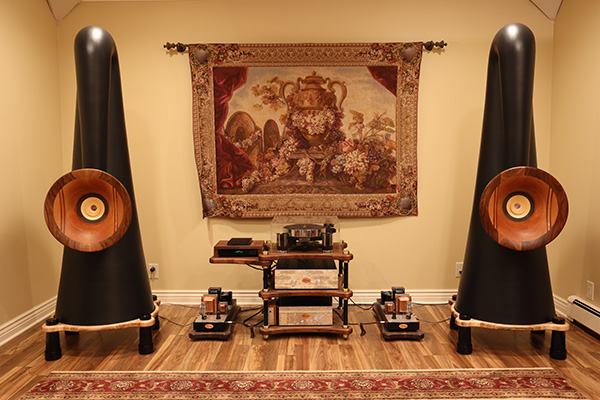
To manufacture Charney Audio's five separate series of rear-loaded horns, Brian built—from scratch—a 4' × 8' CNC router with a 24"-travel Z-drive. His top-level speaker series is called Lumaca (Italian for snail, which it resembles). It comes in three sizes of round rear horns: 6', 7', and 8' high. I auditioned the 7' Lumaca VII, which measures 84" high, 26" wide, and 26" deep. It weighs just 65lb. I saw Brian pick one up and move it around while talking and smiling. The walls to these round wood tractrix horns are 0.56" thick and strong like steel.
In Charney Audio's main demonstration room at last year's Capital Audiofest, I spent several hours listening to the Lumaca VIIs, which use AER BD 3 drivers, powered by an Audio Note Meishu Tonmeister integrated amplifier equipped with new-production Western Electric 300Bs. We listened exclusively to CDs via a Brian-built DAC and an Audio Note 4.1 CD transport. Brian's charming muse Lily (a Maltipoo—see photo) kept our focus on natural beauty and how dogs and their beds make good room treatments.
 The Lumaca VII's 126" long, round tractrix horns stood perched on feet made from solid 6061 aluminum billet Brian powder coated in his cellar. These feet permit the horn to empty into a space about 26" in diameter and 7" or 8" above the listening room floor. This is a very different kind of load and operating environment than Joe's or Victor's front horn/open baffles, with a dramatically different power response. In Brian's medium-sized room, the Lumaca's frequency response sounded smoother and flatter than the front horns did in Joe's small room.
Imagine near-perfectly rendered bass coupled to a tone-saturated high-texture midrange supporting a detail-rich treble. That's what Brian Charney's horns were delivering. That said, in Brian's room, with me sitting about 12' away, the Lumaca VIIs did not match the AER's front-mounted horns for air, treble detail, image specificity, or high-vibrancy presence.
Audiophiles considering speakers like this should remember that each design's power response is an important part of their long-term compatibility. Choose the one that best matches your room and your temperament.
Listening to three different systems curated by three different personalities convinced me that AER's BD 3 and BD 3B are upper-echelon high-performance drivers suitable for use with upper-echelon triode amplifiers using the lowest-power output tubes: the 10, 45, 46, 2A3, 300B. That's why Keller's and Charney's research is so important.
The Lumaca VII's 126" long, round tractrix horns stood perched on feet made from solid 6061 aluminum billet Brian powder coated in his cellar. These feet permit the horn to empty into a space about 26" in diameter and 7" or 8" above the listening room floor. This is a very different kind of load and operating environment than Joe's or Victor's front horn/open baffles, with a dramatically different power response. In Brian's medium-sized room, the Lumaca's frequency response sounded smoother and flatter than the front horns did in Joe's small room.
Imagine near-perfectly rendered bass coupled to a tone-saturated high-texture midrange supporting a detail-rich treble. That's what Brian Charney's horns were delivering. That said, in Brian's room, with me sitting about 12' away, the Lumaca VIIs did not match the AER's front-mounted horns for air, treble detail, image specificity, or high-vibrancy presence.
Audiophiles considering speakers like this should remember that each design's power response is an important part of their long-term compatibility. Choose the one that best matches your room and your temperament.
Listening to three different systems curated by three different personalities convinced me that AER's BD 3 and BD 3B are upper-echelon high-performance drivers suitable for use with upper-echelon triode amplifiers using the lowest-power output tubes: the 10, 45, 46, 2A3, 300B. That's why Keller's and Charney's research is so important.
 Voxativ Hagen2s revisited
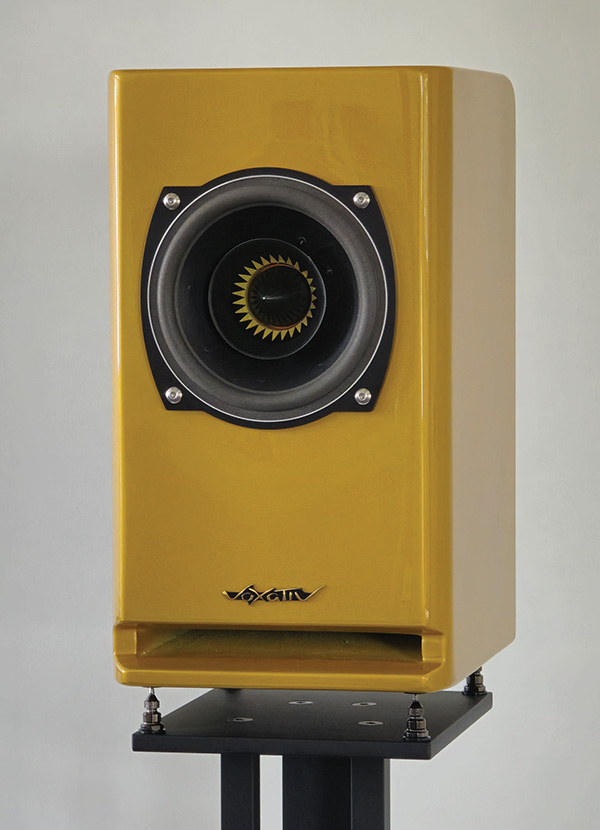
I'll quote myself from my Gramophone Dreams #95 report on the Voxativ Hagen2 standmount: "I experience the 'geometric center' of a loudspeaker's passband as a sensed bisection of the speaker's power response: where the energy on the bass side balances the energy on the treble side. This dividing line is not difficult to spot. If I add a subwoofer, the line moves lower. If I add a tweeter, it moves up." At home, when I exchanged my Falcon Gold Badges for the Voxativ Hagen2s, the first thing I noticed was the Voxativ's wider bandwidth and the lower frequency of its geometric power center.
My Hagen2 monitors are equipped with Voxativ's 5", 10.3 ohm AF-1.9 drivers, which in the Hagen2 boxes go satisfyingly low (50Hz) in the bass but are less sensitive (95dB) than their 97dB AF-2B siblings, which, like AER's BD 3, move the geometric center of power up an octave to a point where I think they need a subwoofer. (Voxativ thinks so, too.)
At home, the Hagen2s are my "open window," fresh-air speakers: When they are in the system, there is no power-grabbing, dynamics-crunching crossover between their voice coils and the power amplifier. The 2s are "short-horn" boxes measuring 14" × 8" × 11"—just a little bit bigger than my alcons and weighing just 14lb. The mouth of the rear-loading horn exits the front at bottom and adds a little boost at 50Hz.
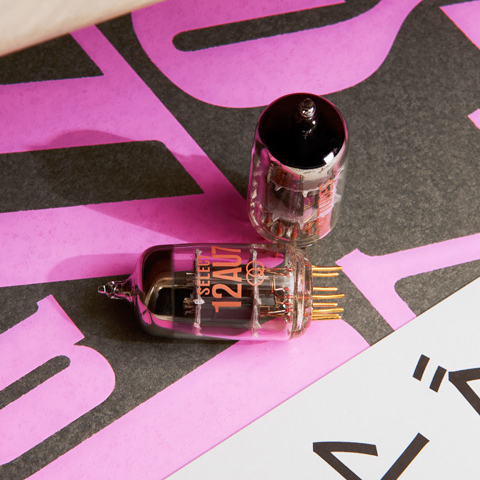
For the first day and night I drove the Hagen2s with my Parasound A21+ amplifier, the sound was smooth, fast, and effortless—but boring. Recordings did not light up my room. There was not enough push. Hoping for more push, I exchanged the megawatt Parasound for the 5W Elekit TU-8900 equipped with Brimar 6067/ECC82s and new-production Western Electric 300Bs, the ones Joe and Brian were both using in their amplifiers.
 When I played Lubomyr Melnyk's composition "The Pool of Memories," from his 2015 album Rivers and Streams (24/48 FLAC Erased Tapes/Qobuz), the room lit up as if someone had hit it with a carbon-arc searchlight. "Pool of Memories" was nice, attractive, and a little dark with the A21+ driving the Hagen2s. With WE 300Bs pushing Lundahl's amorphous-core output transformers, it came mega-awake: electrically charged and brilliantly lit.
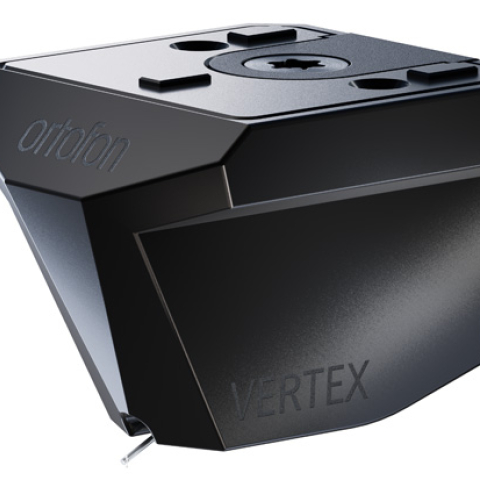
Using a Lyra Delos moving coil into the Lab 12 Melto2 phono stage loaded at 100 ohms, I played Promises, Sam Shepherd's composition for saxophone, strings, keyboards, and electronics (LP, Luaka Bop 6 80899 0097-1-3; footnote 4). This recording features the London Symphony Orchestra conducted by Sally Herbert and Pharoah Sanders on tenor saxophone and voice.
I was hoping the beautifully recorded Promises would show me how much transparency the Voxativ full rangers could produce in the absence of a big, expensive horn like the ones I just described. In that mindset, I connected the Melto2 to my Serene preamplifier with Black Cat Coppertone wires. Right away, on side 1 of Promises, the transparency I heard caused me to exclaim, "Wow! That Lyra Delos is a monster-good cartridge." I swear I could see the Delos's coils moving in the gap. This setup showcased high-toned clarity and lightspeed responsiveness—in a smaller room, at a smaller price.
This is raw beauty
When I played Lubomyr Melnyk's composition "The Pool of Memories," from his 2015 album Rivers and Streams (24/48 FLAC Erased Tapes/Qobuz), the room lit up as if someone had hit it with a carbon-arc searchlight. "Pool of Memories" was nice, attractive, and a little dark with the A21+ driving the Hagen2s. With WE 300Bs pushing Lundahl's amorphous-core output transformers, it came mega-awake: electrically charged and brilliantly lit.
Using a Lyra Delos moving coil into the Lab 12 Melto2 phono stage loaded at 100 ohms, I played Promises, Sam Shepherd's composition for saxophone, strings, keyboards, and electronics (LP, Luaka Bop 6 80899 0097-1-3; footnote 4). This recording features the London Symphony Orchestra conducted by Sally Herbert and Pharoah Sanders on tenor saxophone and voice.
I was hoping the beautifully recorded Promises would show me how much transparency the Voxativ full rangers could produce in the absence of a big, expensive horn like the ones I just described. In that mindset, I connected the Melto2 to my Serene preamplifier with Black Cat Coppertone wires. Right away, on side 1 of Promises, the transparency I heard caused me to exclaim, "Wow! That Lyra Delos is a monster-good cartridge." I swear I could see the Delos's coils moving in the gap. This setup showcased high-toned clarity and lightspeed responsiveness—in a smaller room, at a smaller price.
This is raw beauty
Every one of the systems I've just described supports my belief that in a world dominated by esoteric audio, less signal processing, active or passive, means more natural-sounding music. Can I get an amen?
Footnote 1: See aer-loudspeakers.com/aer-excenter-2/. Footnote 2: I had to look up "livity." It is a core Rastafarian concept representing the life force flowing through all things and emphasizing communion with nature and the divine. One key aspect of Livity is the Rasta concept of "I and I," which references the presence of God in all of us and the oneness of all people. So now I understand a little better the title of the brilliant reggae-punk album by Bad Brains, I Against I.—Jim Austin Footnote 3: The Maxwell is a unit of total magnetic flux, whereas the more familiar Gauss is a measure of magnetic flux density. To obtain the total magnetic flux, you calculate the (dot) product of the flux density with the (vectorial) cross-sectional area in the region of interest.—Jim Austin
Footnote 4: Sam Shepherd is also known as Floating Points.
Above 100Hz, this crossoverless setup has the following specifications:
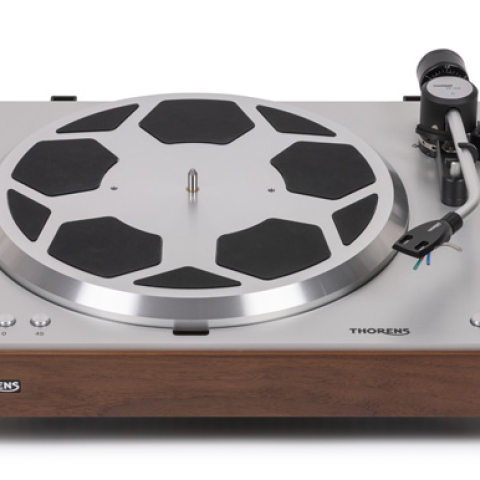
Power handling: 100Wpc, 300Wpc peakJoe was driving these horns with an Elekit TU-8600R like the one I reviewed in Gramophone Dreams #27. His was equipped with new-manufacture Western Electric 300Bs, the most solidly built and transparent-sounding of the 300Bs I've tried. No doubt, the WE tubes were a contributing factor in the AER horn's ability to project full-size, high-density images with state-of-the-art clarity. Their transparency was so intense, it was almost a distraction from the music. The rest of Joe's system was a TW-Acustic Raven 2 turntable with 12" Ortofon and Jelco arms and a Tron phono stage fed by Ortofon's 90th Anniversary SPU cartridge.
Nominal impedance: 16 ohms
Frequency range: 100Hz–70kHz
Dimensions: stand 41" (1050mm) H × 38" (960mm) W × 16.5" (420mm) D. Excenterhorn: 25" (650mm) diameter, 8.7" (220mm) deep. Weight for each speaker (not including the Subway): 154lb (70kg).
Some recordings, like The Revolutionaries LP featuring Sly and Robbie on Channel One Records from Kingston, Jamaica (no catalog number; see photo above), forced me to bliss out completely, no talking, as Joe played both sides. Joe's copy looked beat to the extreme: The top and bottom seams of its watermarked cover were split and clear-taped back together. Both sides were covered with a haze of light scratches and a carpet of dust. But with Joe's SPU, it played quietly and purposefully.
What I am doing here is something I've always wanted to do: evaluate a loudspeaker by trying it in a variety of different sound systems in a variety of rooms, then comparing it to my speakers at home. The main things a potential customer needs to know are might they like it and what kind of personality does this speaker have? And how might this speaker perform in their room with their type of amplification? Observing how a speaker is affected by different rooms, and different gear arrays, and different personalities doing the arranging and decorating, allows me to see from system to system what changes and what stays the same. I know it's a small sample—a few more rooms would have told me a lot more—but these systems gave me a good taste of what AER's 8" BD 3B (and the similar BD 3Bs, which are even more sensitive and intended for use with front-loaded horns) can do when properly unleashed.
My first serious auditions of an AER wideband driver took place at 2023's Capital Audiofest when AER importer Victor Kung, of Vancouver's VK Music, took a listening room instead of his normal table in the marketplace. He was demonstrating the same wide-rangers as Joe's: BD 3B drivers in clear acrylic open baffles with AER's clear acrylic 650mm horn (above). Victor's were set close to the long wall of a narrow room. Listeners sat 7'–9' away. The speakers were powered by the Sun Valley SV-128ii SET power amplifier with custom-made Hashimoto power transformers, chokes, and output transformers. I listened to Victor's system five times in three days, dragging a different friend with me each time. These friends' candid observations evoked a series of internal dialogs that broadened my understanding of what the BD 3B transducer is capable of.
I texted Victor asking him to ask the horn's designer, Filip Keller, to explain his horn's expansion rate; is it exponential, tractrix, or what? Keller wrote back to Victor in an email: "We have our own horn expansion rate. It is called the AER Hyperbolic Curvature and Expansion Rate, and we don't want to give curvature in detail because it's so superior to all horns, which are misleading and wrong by substance. So please tell Herb we regard ours as proprietary."
Brian Charney AudioYesterday, my friend Richard Cirulnick, who builds drag race engines, introduced me to his speaker-builder/horn-designer friend Brian Charney, who also happened to be "a master Mercedes-Benz technician" currently working and teaching in Mercedes's certified pre-owned cars department. Many of the most interesting people I've met on the engineering side of audio are polymaths who come from automotive backgrounds. The late Tim de Paravicini was the prototypical polymath gearhead. I think Brian might aspire to that calling.
The Lumaca VII's 126" long, round tractrix horns stood perched on feet made from solid 6061 aluminum billet Brian powder coated in his cellar. These feet permit the horn to empty into a space about 26" in diameter and 7" or 8" above the listening room floor. This is a very different kind of load and operating environment than Joe's or Victor's front horn/open baffles, with a dramatically different power response. In Brian's medium-sized room, the Lumaca's frequency response sounded smoother and flatter than the front horns did in Joe's small room.
Imagine near-perfectly rendered bass coupled to a tone-saturated high-texture midrange supporting a detail-rich treble. That's what Brian Charney's horns were delivering. That said, in Brian's room, with me sitting about 12' away, the Lumaca VIIs did not match the AER's front-mounted horns for air, treble detail, image specificity, or high-vibrancy presence.
Audiophiles considering speakers like this should remember that each design's power response is an important part of their long-term compatibility. Choose the one that best matches your room and your temperament.
Voxativ Hagen2s revisitedI'll quote myself from my Gramophone Dreams #95 report on the Voxativ Hagen2 standmount: "I experience the 'geometric center' of a loudspeaker's passband as a sensed bisection of the speaker's power response: where the energy on the bass side balances the energy on the treble side. This dividing line is not difficult to spot. If I add a subwoofer, the line moves lower. If I add a tweeter, it moves up." At home, when I exchanged my Falcon Gold Badges for the Voxativ Hagen2s, the first thing I noticed was the Voxativ's wider bandwidth and the lower frequency of its geometric power center.
When I played Lubomyr Melnyk's composition "The Pool of Memories," from his 2015 album Rivers and Streams (24/48 FLAC Erased Tapes/Qobuz), the room lit up as if someone had hit it with a carbon-arc searchlight. "Pool of Memories" was nice, attractive, and a little dark with the A21+ driving the Hagen2s. With WE 300Bs pushing Lundahl's amorphous-core output transformers, it came mega-awake: electrically charged and brilliantly lit.
Using a Lyra Delos moving coil into the Lab 12 Melto2 phono stage loaded at 100 ohms, I played Promises, Sam Shepherd's composition for saxophone, strings, keyboards, and electronics (LP, Luaka Bop 6 80899 0097-1-3; footnote 4). This recording features the London Symphony Orchestra conducted by Sally Herbert and Pharoah Sanders on tenor saxophone and voice.
I was hoping the beautifully recorded Promises would show me how much transparency the Voxativ full rangers could produce in the absence of a big, expensive horn like the ones I just described. In that mindset, I connected the Melto2 to my Serene preamplifier with Black Cat Coppertone wires. Right away, on side 1 of Promises, the transparency I heard caused me to exclaim, "Wow! That Lyra Delos is a monster-good cartridge." I swear I could see the Delos's coils moving in the gap. This setup showcased high-toned clarity and lightspeed responsiveness—in a smaller room, at a smaller price.
Every one of the systems I've just described supports my belief that in a world dominated by esoteric audio, less signal processing, active or passive, means more natural-sounding music. Can I get an amen?
Footnote 1: See aer-loudspeakers.com/aer-excenter-2/. Footnote 2: I had to look up "livity." It is a core Rastafarian concept representing the life force flowing through all things and emphasizing communion with nature and the divine. One key aspect of Livity is the Rasta concept of "I and I," which references the presence of God in all of us and the oneness of all people. So now I understand a little better the title of the brilliant reggae-punk album by Bad Brains, I Against I.—Jim Austin Footnote 3: The Maxwell is a unit of total magnetic flux, whereas the more familiar Gauss is a measure of magnetic flux density. To obtain the total magnetic flux, you calculate the (dot) product of the flux density with the (vectorial) cross-sectional area in the region of interest.—Jim Austin