On the first page of the Radiant Acoustics Clarity 4.2 Welcome Guide, Radiant Acoustics founder Peter Lyngdorf states, "The first thing you'll notice when listening to these speakers is the absence of distortion."
Seeing that, my brain responded: I hope not. When I listen to records, the first thing (or things) I want to notice is, who is singing what song and where might they be singing it?
I say this without cynicism. I understand that an engineering-focused company is likely to frame the virtues of their products in technical terms. But when I sit down to listen, I want the first thing I notice to be the music and its qualities.
Radiant Acoustics of Denmark is a technology-forward enterprise. Its declared intention is to make small, room-friendly speakers that put out clean, full-range bass and play loud with low harmonic and intermodulation distortion.
Radiant's website explains, "Founded by Peter Lyngdorf, [Radiant Acoustics] brings together three of his esteemed companies: HiFi Klubben, PURIFI, and Nordic Hi-Fi, combining over 80 years of expertise. This partnership unites PURIFI's cutting-edge technology, HiFi Klubben's industry knowledge and infrastructure, and Nordic Hi-Fi's direct-to-consumer model to create top-tier audio products at a reasonable price."
Attaining Clarity
The Radiant Clarity 4.2 ($2998/pair) is just 10.24" tall. It comes packed as a pair in a 14" × 12" × 18" cardboard box. They were tricky to remove from their packaging without sticking a finger through a driver: Each cabinet is inside a white bag, and every side I touched had little drivers on it. I kept feeling for a side with five-way binding posts, but there wasn't one, which puzzled me.
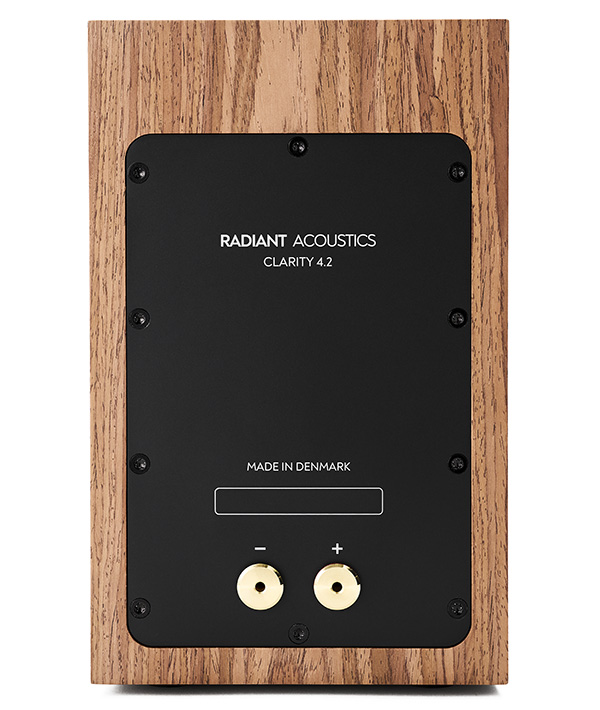 When, finally, I pulled one speaker box out of its bag, I spotted its black metal rear panel, with serial number and two flush-mounted sockets for receiving speaker cables with banana plugs—no spades. Likewise, no ports, no dome tweeters, and no grilles. Also no spikes or tiptoes—just four threaded T-nuts on the bottom for attaching the 4.2s to Radiant's 49.2lb, $898/pair adjustable-height aluminum stands. The specified height of those stands ranges from 23.86" to 25.47" depending on the tilt, so for this review I used my spiked, four-post 24" Sound Anchor Reference stands, which placed the tweeters about 31" off the ground. It was interesting to observe how much this super-solid foundation contributed to the Clarity's clarity.
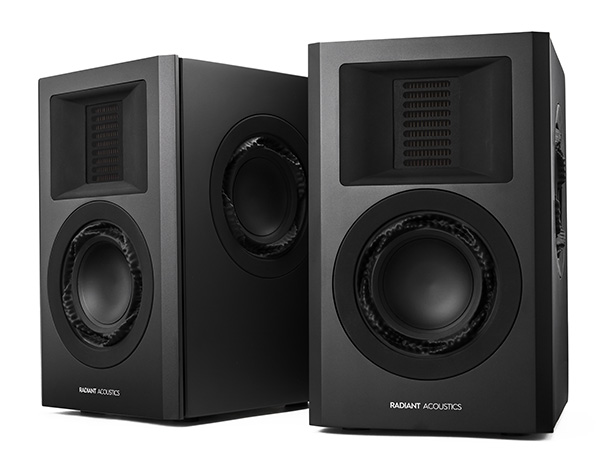
According to the glossy paper owner's manual, the Clarity 4.2's cabinets are made of 15mm MDF. The front panel is 12mm-thick CNC-machined aluminum with beveled edges. This thick aluminum front baffle struck me as a key feature that should help "purify" the sound; it seems too good to be true in a speaker costing only $2998/pair. The unusual PURIFI bass-mid driver and the Air Motion Transformer tweeter also seem fancy for a speaker at this price.
When, finally, I pulled one speaker box out of its bag, I spotted its black metal rear panel, with serial number and two flush-mounted sockets for receiving speaker cables with banana plugs—no spades. Likewise, no ports, no dome tweeters, and no grilles. Also no spikes or tiptoes—just four threaded T-nuts on the bottom for attaching the 4.2s to Radiant's 49.2lb, $898/pair adjustable-height aluminum stands. The specified height of those stands ranges from 23.86" to 25.47" depending on the tilt, so for this review I used my spiked, four-post 24" Sound Anchor Reference stands, which placed the tweeters about 31" off the ground. It was interesting to observe how much this super-solid foundation contributed to the Clarity's clarity.
According to the glossy paper owner's manual, the Clarity 4.2's cabinets are made of 15mm MDF. The front panel is 12mm-thick CNC-machined aluminum with beveled edges. This thick aluminum front baffle struck me as a key feature that should help "purify" the sound; it seems too good to be true in a speaker costing only $2998/pair. The unusual PURIFI bass-mid driver and the Air Motion Transformer tweeter also seem fancy for a speaker at this price.
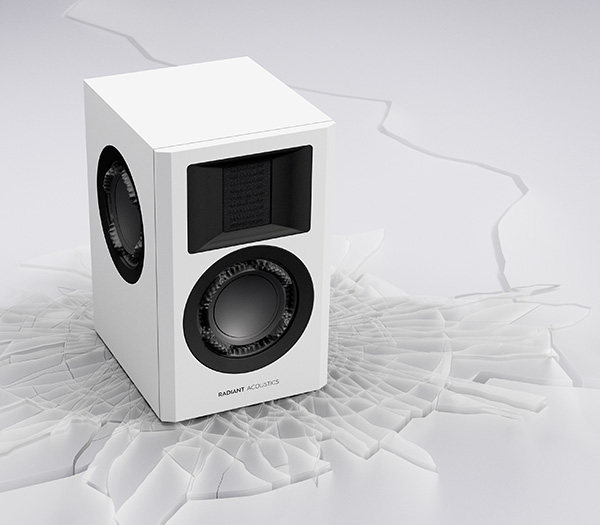 The plus-size AMT tweeter is framed in a broad, horizontally oriented waveguide that sets the 4.2 apart from run-of-the-mill box speakers.
The 4.2's distinctive-looking bass-mid driver, and the similarly distinctive-looking side-mounted passive radiators, are designed and manufactured by PURIFI, which was cofounded by Lars Risbo, Bruno Putzeys, and Peter Lyngdorf. PURIFI is located in Roskilde, Denmark, approximately 250km from the production facilities in Nørager.
I first heard of Lyngdorf when he purchased Snell Acoustics in 1990. That's also when I first heard that he had founded a Northern European distribution and audio store chain called HiFi Klubben. He had already founded DALI loudspeakers in the early 1980s.
I love how tech-forward engineering companies understand the power of naming things and use carefully chosen trigger words to attract tech-savvy consumers who aspire to sound unsullied by distortion (footnote 1). The first page of Radiant's exposition on "Pure Sound" offers an example.
"Combatting Distortion—a Prerequisite for Pure Sound
"PURIFI's research uncovered several sources of distortion, including Surround Radiation Distortion (SRD) and Force Factor Modulation (FFM), which require special attention to mitigate. In the pursuit of pure sound reproduction, it is essential to minimize these mechanisms."
FFM gets technical. "The topic of FFM ... goes way beyond merely looking at the position-dependent force factor, Bl(x), which is already a well-known metric. Also, with FFM comes a side order of Magnetic Hysteresis Distortion, which has a very different and more distinct sonic fingerprint.
"PURIFI's solution to FFM is a combination of several motor technologies collectively referred to as the PURIFI PureDrive system."
Before reading this, I had never heard of FFM—or SRD. But I've measured a lot of intermodulation distortion (IMD), which affects all audio-frequency amplifiers and all magnetic transducers in a way that is easily noticeable and that no one wants to experience.
As a former amplifier designer and transformer importer, I'd heard of Magnetic Hysteresis Distortion (MHD), but I thought today's large, coreless inductors had pretty much eliminated the issue. PURIFI says that the smaller iron-core coils used in the PureDrive system are more efficient, less costly, and radiate less-intense stray magnetic fields. The goal is to get full, clean-sounding bass down to 40Hz from a very small box at a low cost. That's an admirable ambition.
The plus-size AMT tweeter is framed in a broad, horizontally oriented waveguide that sets the 4.2 apart from run-of-the-mill box speakers.
The 4.2's distinctive-looking bass-mid driver, and the similarly distinctive-looking side-mounted passive radiators, are designed and manufactured by PURIFI, which was cofounded by Lars Risbo, Bruno Putzeys, and Peter Lyngdorf. PURIFI is located in Roskilde, Denmark, approximately 250km from the production facilities in Nørager.
I first heard of Lyngdorf when he purchased Snell Acoustics in 1990. That's also when I first heard that he had founded a Northern European distribution and audio store chain called HiFi Klubben. He had already founded DALI loudspeakers in the early 1980s.
I love how tech-forward engineering companies understand the power of naming things and use carefully chosen trigger words to attract tech-savvy consumers who aspire to sound unsullied by distortion (footnote 1). The first page of Radiant's exposition on "Pure Sound" offers an example.
"Combatting Distortion—a Prerequisite for Pure Sound
"PURIFI's research uncovered several sources of distortion, including Surround Radiation Distortion (SRD) and Force Factor Modulation (FFM), which require special attention to mitigate. In the pursuit of pure sound reproduction, it is essential to minimize these mechanisms."
FFM gets technical. "The topic of FFM ... goes way beyond merely looking at the position-dependent force factor, Bl(x), which is already a well-known metric. Also, with FFM comes a side order of Magnetic Hysteresis Distortion, which has a very different and more distinct sonic fingerprint.
"PURIFI's solution to FFM is a combination of several motor technologies collectively referred to as the PURIFI PureDrive system."
Before reading this, I had never heard of FFM—or SRD. But I've measured a lot of intermodulation distortion (IMD), which affects all audio-frequency amplifiers and all magnetic transducers in a way that is easily noticeable and that no one wants to experience.
As a former amplifier designer and transformer importer, I'd heard of Magnetic Hysteresis Distortion (MHD), but I thought today's large, coreless inductors had pretty much eliminated the issue. PURIFI says that the smaller iron-core coils used in the PureDrive system are more efficient, less costly, and radiate less-intense stray magnetic fields. The goal is to get full, clean-sounding bass down to 40Hz from a very small box at a low cost. That's an admirable ambition.
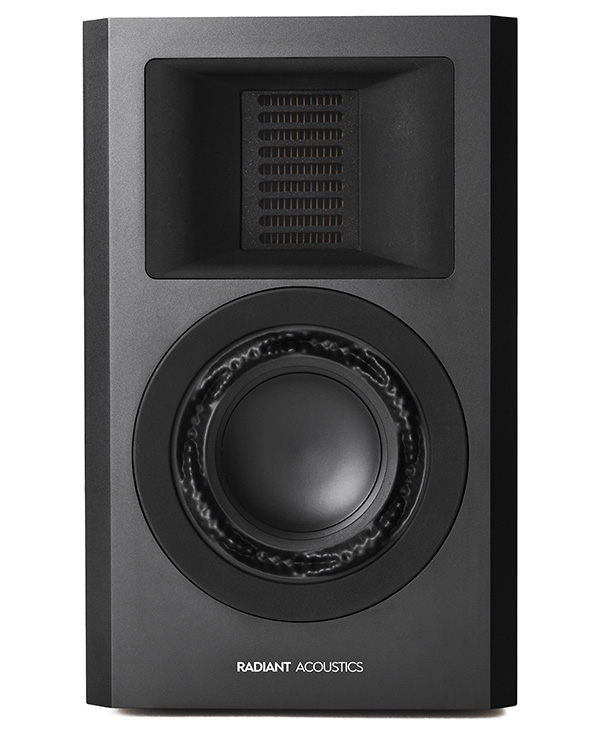 Radiant's solution to SRD—Surround Radiation Distortion—is an interesting story. SRD is a problem mainly in today's long-throw drive units, which require bigger surrounds to facilitate the drivers' long travel. A vibrating surround radiates sound, and the radiating area of a driver with such a surround depends on the driver's displacement. Also, the average radiating area varies with frequency. "The solution to SRD is a mathematically optimized surround geometry, which is known as PURIFI NeutralSurround" (footnote 2). Radiant explains. "In modern (ie, long-stroke) drive units, the surround can easily make up 20% of the total radiating surface. It would be optimistic in the extreme to expect that a piece of deforming rubber will end up radiating undistorted sound. Indeed, it does not—its distortion contribution exceeds that of the cone by orders of magnitude. Again, the distortion is second order in nature and most obvious at low frequencies. But that introduces intermodulation distortion affecting the entire frequency range of the driver. SRD is the second reason why large diameter short-stroke drivers have a leg up. The surround simply takes up a smaller percentage of the moving area."
PURIFI deploys multifaceted, organically shaped surrounds to neutralize SRD. "The precise shape of these PURIFI surrounds is determined by numerical optimization, but the result is that across the full excursion range, the surround moves an amount of air that's precisely proportional to excursion."
The Clarity 4.2 does not come with a grille, nor can one be ordered. In my mind, those roly-poly surrounds define Radiant's signature visual aesthetic. Don't laugh: I kept waiting to see their squiggly crinkly edges move.
I totally get how PURIFI's numerically optimized surround works, and I have little doubt that it does what PURIFI says it does. Readers, though, should remember that this technology applies to today's small long-throw drivers. As PURIFI says (see above): "large diameter short-stroke drivers have a leg up." That includes giant vintage and vintage-style woofers with pleated surrounds (footnote 3).
"The 4.2 is best positioned some distance from the wall, preferably 10-30 cm (~4-12")," the Clarity owner's manual said. I moved the Clarity 4.2s around my room. They sounded lowest in room-boundary coloration in the same spots as my Falcon Gold Badge and Voxativ Hagen2 speakers: 5' apart, 16" from the back of the speaker to the back wall, and 6–7' from my listening position.
"To reduce any unwanted reflections from the floor or ceiling, the dispersion is limited in the vertical plane; therefore, it is important to make sure your listening is at the exact height of the tweeters or that the speakers are tilted back to 'beam' the sound in the direction of the listening position." I listened in a variety of vertical positions, some as much as 8" above the tweeter's center; none seemed inadequate or treble-challenged.
Radiant's solution to SRD—Surround Radiation Distortion—is an interesting story. SRD is a problem mainly in today's long-throw drive units, which require bigger surrounds to facilitate the drivers' long travel. A vibrating surround radiates sound, and the radiating area of a driver with such a surround depends on the driver's displacement. Also, the average radiating area varies with frequency. "The solution to SRD is a mathematically optimized surround geometry, which is known as PURIFI NeutralSurround" (footnote 2). Radiant explains. "In modern (ie, long-stroke) drive units, the surround can easily make up 20% of the total radiating surface. It would be optimistic in the extreme to expect that a piece of deforming rubber will end up radiating undistorted sound. Indeed, it does not—its distortion contribution exceeds that of the cone by orders of magnitude. Again, the distortion is second order in nature and most obvious at low frequencies. But that introduces intermodulation distortion affecting the entire frequency range of the driver. SRD is the second reason why large diameter short-stroke drivers have a leg up. The surround simply takes up a smaller percentage of the moving area."
PURIFI deploys multifaceted, organically shaped surrounds to neutralize SRD. "The precise shape of these PURIFI surrounds is determined by numerical optimization, but the result is that across the full excursion range, the surround moves an amount of air that's precisely proportional to excursion."
The Clarity 4.2 does not come with a grille, nor can one be ordered. In my mind, those roly-poly surrounds define Radiant's signature visual aesthetic. Don't laugh: I kept waiting to see their squiggly crinkly edges move.
I totally get how PURIFI's numerically optimized surround works, and I have little doubt that it does what PURIFI says it does. Readers, though, should remember that this technology applies to today's small long-throw drivers. As PURIFI says (see above): "large diameter short-stroke drivers have a leg up." That includes giant vintage and vintage-style woofers with pleated surrounds (footnote 3).
"The 4.2 is best positioned some distance from the wall, preferably 10-30 cm (~4-12")," the Clarity owner's manual said. I moved the Clarity 4.2s around my room. They sounded lowest in room-boundary coloration in the same spots as my Falcon Gold Badge and Voxativ Hagen2 speakers: 5' apart, 16" from the back of the speaker to the back wall, and 6–7' from my listening position.
"To reduce any unwanted reflections from the floor or ceiling, the dispersion is limited in the vertical plane; therefore, it is important to make sure your listening is at the exact height of the tweeters or that the speakers are tilted back to 'beam' the sound in the direction of the listening position." I listened in a variety of vertical positions, some as much as 8" above the tweeter's center; none seemed inadequate or treble-challenged.
 Listening to Dance
Todd Garfinkle's 2003 recording Dance is currently my favorite MA Recording (MO66A) because virtuoso Jiang Ting's Pipa and Jia Peng Fang's Erhu (two-string Chinese violin) playing is quick, artful, and Brian Eno–like. This music feels 1970s edgy, and my temperament lines up sympathetically with the sentiments expressed in these tracks.
According to the liner notes, this album includes some of the most famous music in contemporary Chinese culture, including a duet arrangement of "The Olive Tree," a 1970s movie theme known to virtually every Chinese person. For this rendition, Jiang Ting sings the following lyrics, which set the tone for the whole album:
I can't say that listening to this one recording proved anything objective about the Clarity's expressive capabilities, but I could not stop listening. My brain registered what I heard as perfect sound, as in, who could ask for more? For a whole night, my brain savored every delectably separated Pipa note. The 4.2's presentation did not campaign exclusively to my left brain, as I thought it might. It let me delight in Dance's expressive beauty. It did not encourage analysis.
When I played this album a couple of days later, with maybe 10 more hours of playing the 4.2 and loosening up its moving parts, Jiang Ting was shredding like Buckethead and Jia Peng Fang was picking like Bill Monroe. This was not boring academic early music; this was good-golly, great-balls-of-fire Pipa playing. This was Cage and Eno at the Mercury Lounge. Every note had fire in it.
The Clarity's soundspace was as large as my Falcon Gold Badge LS3/5a's soundstage—not larger. Compared to the Falcons, which produce images drawn with a 6H pencil, which makes them stand out but not too much, the Clarity's images are drawn with firmer, darker lines. Outside the lines, empty spaces felt emptier than I've previously heard from a wood box with a dome and a cone—and therein lies the chief difference between the Radiant Clarity 4.2 and my Gold Badge Falcons: The spatial presentation is the same scale and size-wise, but the Clarity's AMT ribbon, which crosses in at 2.3kHz, makes all nine octaves of Clarity music feel water-clear and elegantly presented, more audio-salon provocateur than recording studio monitor.
The Falcons don't do inky blacks or ribbon-tweeter transparency. The 4.2 does both. Consequently, the 4.2 presents recordings like a much more modern speaker.
With the same Parasound A 21+ amp, the Falcons exhibit some grain and noticeable dynamic compression. The Clarity 4.2s sound grainless and more forcefully charged. Their descriptive prowess was alpha level. They exhibited force and immediacy almost never heard in backpack-size speakers.
In my system, with the Clarity 4.2s driven by the Parasound amplifier, every note of Jiang Ting's Pipa came through vibrant and fully described. When my left brain scanned for issues, nothing jumped out.
The 4.2's horizontal dispersion seemed conspicuously even. Listening off axis was unusually satisfying.
Were the Clarity's reverb tails as long as with the Falcons or Voxativ's Hagen2's? They might have been; I never felt a need to compare. I noticed easily that the 4.2's AMT tweeter was not a shouty little dome pinching out notes in a narrow power range. It moved air effortlessly, made treble seem infinitely clear, bass notes fit and naturally toned, and contributed to the elegance of the Clarity's overt transparency. I have not yet encountered a speaker with an AMT tweeter that did not give me pleasure and hope for the future of our hobby.
 I put on "Death Don't Have No Mercy" from Craft Recordings' 2024 remastering of Harlem Street Singer—Reverend Gary Davis (24/192 FLAC, Craft/Qobuz). The Radiant Clarity 4.2s made this 1960 Rudy Van Gelder recording (on Prestige) sound explosively real. Big. Clear. Vivid. Forward. Forceful. Unmuffled. Uncompromised. Very close to RVG master tapes from that era. You may need bigger speakers for your room. You may want to spend more to look more upmarket. But I can't imagine what audiophile excitements you'd be getting that I wasn't getting there and then.
I'd been powering the Radiants with Parasound's Halo A 21+ amplifier because the Clarity 4.2's low sensitivity makes them a challenging load, and the Parasound's 500W-into-4-ohm power is intended to drive any 4-ohm-or-higher speaker with effortless class-AB power that never clips on high-impact transients and never sounds hard, vapid, or excessively error-corrected. On my Falcons, the A 21+ plays supple, quick, and soulful, with tantalizing, deep-space imaging. Powering the Radiants, the A 21+ felt invisible and perfectly matched.
But this review would be boring if I didn't try the Claritys with my second most powerful amplifier, the Pass Labs XA25, which is rated at 50W into 4 ohms but produces much more power than specified—though not as much as the Parasound (footnote 4).
When the first album I played, Terry Allen's Lubbock (On Everything) (LP, Fate 33996), sounded flat and blah—barely listenable—I became concerned. Did the second and third albums sound better? It was hard to tell. Maybe the XA25's lowish gain—20dB—was dulling the proceedings? Or was the XA25 taking its usual own sweet don't-rush-me time waking up from its months-long sleep?
Those questions were answered with certainty with the fourth album, the original soundtrack for director Yorgos Lanthimos's Poor Things, with score by Jerskin Fendrix, aka Joscelin Dent-Pooley (24/48 FLAC, Milan/Qobuz). The album lit up the sound-space like an IMAX movie screen. This music came forward and outward, big and strong from the tiny Radiant boxes. Suddenly, the Clarity 4.2s were powering my 11' × 13' × 9' room with a depth and quality of bass that made for a bright, superclear wow moment. I doubt I've ever heard this album sound this enormous and pure. I've never heard its bass sound this controlled and natural. Poor Things from Qobuz via the dCS Lina, the Pass Labs amplifier, and the Radiant Acoustics Clarity 4.2s was big-screen audio on acid.
I put on "Death Don't Have No Mercy" from Craft Recordings' 2024 remastering of Harlem Street Singer—Reverend Gary Davis (24/192 FLAC, Craft/Qobuz). The Radiant Clarity 4.2s made this 1960 Rudy Van Gelder recording (on Prestige) sound explosively real. Big. Clear. Vivid. Forward. Forceful. Unmuffled. Uncompromised. Very close to RVG master tapes from that era. You may need bigger speakers for your room. You may want to spend more to look more upmarket. But I can't imagine what audiophile excitements you'd be getting that I wasn't getting there and then.
I'd been powering the Radiants with Parasound's Halo A 21+ amplifier because the Clarity 4.2's low sensitivity makes them a challenging load, and the Parasound's 500W-into-4-ohm power is intended to drive any 4-ohm-or-higher speaker with effortless class-AB power that never clips on high-impact transients and never sounds hard, vapid, or excessively error-corrected. On my Falcons, the A 21+ plays supple, quick, and soulful, with tantalizing, deep-space imaging. Powering the Radiants, the A 21+ felt invisible and perfectly matched.
But this review would be boring if I didn't try the Claritys with my second most powerful amplifier, the Pass Labs XA25, which is rated at 50W into 4 ohms but produces much more power than specified—though not as much as the Parasound (footnote 4).
When the first album I played, Terry Allen's Lubbock (On Everything) (LP, Fate 33996), sounded flat and blah—barely listenable—I became concerned. Did the second and third albums sound better? It was hard to tell. Maybe the XA25's lowish gain—20dB—was dulling the proceedings? Or was the XA25 taking its usual own sweet don't-rush-me time waking up from its months-long sleep?
Those questions were answered with certainty with the fourth album, the original soundtrack for director Yorgos Lanthimos's Poor Things, with score by Jerskin Fendrix, aka Joscelin Dent-Pooley (24/48 FLAC, Milan/Qobuz). The album lit up the sound-space like an IMAX movie screen. This music came forward and outward, big and strong from the tiny Radiant boxes. Suddenly, the Clarity 4.2s were powering my 11' × 13' × 9' room with a depth and quality of bass that made for a bright, superclear wow moment. I doubt I've ever heard this album sound this enormous and pure. I've never heard its bass sound this controlled and natural. Poor Things from Qobuz via the dCS Lina, the Pass Labs amplifier, and the Radiant Acoustics Clarity 4.2s was big-screen audio on acid.
 Despite what I wrote at the beginning of this review, the first thing I noticed playing Poor Things was indeed the absence of distortion. The absence of distortion began in the recording, proceeded through the dCS Lina, and finished, as it must, with the sound character of the XA25 energizing the Clarity 4.2's layered voice coils. The system including the Radiants played with extreme transparency, foot-pounding vigor, tonal neutrality, and big-screen mojo. What more could anyone ask from tiny, $2998/pair loudspeakers?
To get your fix
Despite what I wrote at the beginning of this review, the first thing I noticed playing Poor Things was indeed the absence of distortion. The absence of distortion began in the recording, proceeded through the dCS Lina, and finished, as it must, with the sound character of the XA25 energizing the Clarity 4.2's layered voice coils. The system including the Radiants played with extreme transparency, foot-pounding vigor, tonal neutrality, and big-screen mojo. What more could anyone ask from tiny, $2998/pair loudspeakers?
To get your fix
Radiant speakers are only sold direct. "For orders outside the EU, we provide Delivered Duty Paid (DDP) service, meaning shipping, duties, and taxes are fully covered, ensuring a smooth, hassle-free delivery." Customers can view estimated delivery times during checkout. According to the Radiant website, delivery times are typically 2–5 weekdays in Europe, 4–10 weekdays internationally. Radiant offers customers a 30-day return window with a 49 fee to cover restocking. With a more-than-fair all-inclusive price and near state-of-the-art sound quality, the Radiant Acoustic Clarity 4.2s might be the biggest bargain since nickel Cokes.
Footnote 1: See purifi-audio.com/ushindi. Footnote 2: See purifi-audio.com/blog/tech-notes-1/distortion-the-sound-that-dare-not-speak-its-name-8. Footnote 3: A current, radical example of an old-school, high-sensitivity, short-stroke, pleated-surround driver is the 30.5" Fostex FW800HS Super Woofer, with an X-max of only 2.4mm. Compare that to PURIFI's 5" PTT4.0X04-NLC-02, which has an X-max of 13.7mm. Footnote 4: JA's measurements found that the XA25 can produce 80Wpc into 8 ohms (19dBW) and 130Wpc into 4 ohms (18.1dBW).
The Radiant Clarity 4.2 ($2998/pair) is just 10.24" tall. It comes packed as a pair in a 14" × 12" × 18" cardboard box. They were tricky to remove from their packaging without sticking a finger through a driver: Each cabinet is inside a white bag, and every side I touched had little drivers on it. I kept feeling for a side with five-way binding posts, but there wasn't one, which puzzled me.
When, finally, I pulled one speaker box out of its bag, I spotted its black metal rear panel, with serial number and two flush-mounted sockets for receiving speaker cables with banana plugs—no spades. Likewise, no ports, no dome tweeters, and no grilles. Also no spikes or tiptoes—just four threaded T-nuts on the bottom for attaching the 4.2s to Radiant's 49.2lb, $898/pair adjustable-height aluminum stands. The specified height of those stands ranges from 23.86" to 25.47" depending on the tilt, so for this review I used my spiked, four-post 24" Sound Anchor Reference stands, which placed the tweeters about 31" off the ground. It was interesting to observe how much this super-solid foundation contributed to the Clarity's clarity.
According to the glossy paper owner's manual, the Clarity 4.2's cabinets are made of 15mm MDF. The front panel is 12mm-thick CNC-machined aluminum with beveled edges. This thick aluminum front baffle struck me as a key feature that should help "purify" the sound; it seems too good to be true in a speaker costing only $2998/pair. The unusual PURIFI bass-mid driver and the Air Motion Transformer tweeter also seem fancy for a speaker at this price.
The plus-size AMT tweeter is framed in a broad, horizontally oriented waveguide that sets the 4.2 apart from run-of-the-mill box speakers.
Radiant's solution to SRD—Surround Radiation Distortion—is an interesting story. SRD is a problem mainly in today's long-throw drive units, which require bigger surrounds to facilitate the drivers' long travel. A vibrating surround radiates sound, and the radiating area of a driver with such a surround depends on the driver's displacement. Also, the average radiating area varies with frequency. "The solution to SRD is a mathematically optimized surround geometry, which is known as PURIFI NeutralSurround" (footnote 2). Radiant explains. "In modern (ie, long-stroke) drive units, the surround can easily make up 20% of the total radiating surface. It would be optimistic in the extreme to expect that a piece of deforming rubber will end up radiating undistorted sound. Indeed, it does not—its distortion contribution exceeds that of the cone by orders of magnitude. Again, the distortion is second order in nature and most obvious at low frequencies. But that introduces intermodulation distortion affecting the entire frequency range of the driver. SRD is the second reason why large diameter short-stroke drivers have a leg up. The surround simply takes up a smaller percentage of the moving area."
Listening to DanceTodd Garfinkle's 2003 recording Dance is currently my favorite MA Recording (MO66A) because virtuoso Jiang Ting's Pipa and Jia Peng Fang's Erhu (two-string Chinese violin) playing is quick, artful, and Brian Eno–like. This music feels 1970s edgy, and my temperament lines up sympathetically with the sentiments expressed in these tracks.
Don't ask where I come from, my hometown is far awayThese lyrics convey the spirit of this captivating music. This music is core-level different than Dark Side, Kind of Blue, or Led Zeppelin II; it has trees, wind, rivers, and Chinese people's dreams in it. I played it twice all the way through to see if the Clarity 4.2's lower distortion would make its poetics more accessible.
Why do you roam, roam so far away
For the little birds flying in the sky
For the softly flowing streams In the mountains
For the broad grasslands
I roam, roam so far
And for the olive tree,
The olive tree of my dreams
I put on "Death Don't Have No Mercy" from Craft Recordings' 2024 remastering of Harlem Street Singer—Reverend Gary Davis (24/192 FLAC, Craft/Qobuz). The Radiant Clarity 4.2s made this 1960 Rudy Van Gelder recording (on Prestige) sound explosively real. Big. Clear. Vivid. Forward. Forceful. Unmuffled. Uncompromised. Very close to RVG master tapes from that era. You may need bigger speakers for your room. You may want to spend more to look more upmarket. But I can't imagine what audiophile excitements you'd be getting that I wasn't getting there and then.
I'd been powering the Radiants with Parasound's Halo A 21+ amplifier because the Clarity 4.2's low sensitivity makes them a challenging load, and the Parasound's 500W-into-4-ohm power is intended to drive any 4-ohm-or-higher speaker with effortless class-AB power that never clips on high-impact transients and never sounds hard, vapid, or excessively error-corrected. On my Falcons, the A 21+ plays supple, quick, and soulful, with tantalizing, deep-space imaging. Powering the Radiants, the A 21+ felt invisible and perfectly matched.
Despite what I wrote at the beginning of this review, the first thing I noticed playing Poor Things was indeed the absence of distortion. The absence of distortion began in the recording, proceeded through the dCS Lina, and finished, as it must, with the sound character of the XA25 energizing the Clarity 4.2's layered voice coils. The system including the Radiants played with extreme transparency, foot-pounding vigor, tonal neutrality, and big-screen mojo. What more could anyone ask from tiny, $2998/pair loudspeakers?
To get your fixRadiant speakers are only sold direct. "For orders outside the EU, we provide Delivered Duty Paid (DDP) service, meaning shipping, duties, and taxes are fully covered, ensuring a smooth, hassle-free delivery." Customers can view estimated delivery times during checkout. According to the Radiant website, delivery times are typically 2–5 weekdays in Europe, 4–10 weekdays internationally. Radiant offers customers a 30-day return window with a 49 fee to cover restocking. With a more-than-fair all-inclusive price and near state-of-the-art sound quality, the Radiant Acoustic Clarity 4.2s might be the biggest bargain since nickel Cokes.
Footnote 1: See purifi-audio.com/ushindi. Footnote 2: See purifi-audio.com/blog/tech-notes-1/distortion-the-sound-that-dare-not-speak-its-name-8. Footnote 3: A current, radical example of an old-school, high-sensitivity, short-stroke, pleated-surround driver is the 30.5" Fostex FW800HS Super Woofer, with an X-max of only 2.4mm. Compare that to PURIFI's 5" PTT4.0X04-NLC-02, which has an X-max of 13.7mm. Footnote 4: JA's measurements found that the XA25 can produce 80Wpc into 8 ohms (19dBW) and 130Wpc into 4 ohms (18.1dBW).