Every first love leaves a strong impression. Hopefully it's a good one. Those of us who are phonography-positive fondly remember our first good record playing system, the first turntable-cartridge combo that let the music turn us on. Maybe it was simple, maybe it was fussy, maybe it was unreliable—no matter, it had that special ability to bring the excitement, beauty, and humanity out of the vinyl grooves, through our audio systems, and into our souls.
For me, that first-loved turntable was a Technics SL-D2 semiautomatic direct drive (footnote 1). The cartridge was an Audio-Technica AT100E. I bought the Technics when I was in ninth grade for about $225 that I'd earned working after school at the local True Value hardware store. That's roughly $755 in 2025 dollars. I bought it from the local Tech HiFi store. It played well with my Philips receiver and was soon joined by Advent's largest loudspeakers, The New Advents.
That system rocked my world. It got me through high school and college and into young-adult life. I listened to it for thousands of hours, played hundreds of records, made dozens of cassette tapes, listened to CDs for the first time (with an added CD player), and thoroughly enjoyed it all. I wore out two of those blue Audio-Technica stylus assemblies then switched to a Grado Green cartridge, which I never liked as much. I also had a vintage Shure M44 with both conical 1mil and bonded-elliptical 0.7mil styluses, which I used frequently. The Shure had a loud, exciting sound quality that carried over to cassette mix tapes, which made the music leap out of the boombox speakers. The SL-D2 and accompanying cartridges treated my records right: I still own many platters I bought in my youth, and they still play without too much noise.
Here's the most impressive thing about that Technics SL-D2: It's still working. I gave it to a friend years ago when I upgraded to a Technics SL-1200MK2. He confirms: "It still plays the heck out of a record." These days, he uses it with an Ortofon 2M Blue. What a reliable, well-built product, a proud legacy from 1970s Japan, Inc.
A Technics starter turntable for the 21st century
Technics famously ceased production of turntables in 2010, then resumed in 2016, offering new direct-drive systems based on the digital direct-drive systems used in Panasonic Blu-ray players. The turntables are made in Malaysia. In recent years, the company branched out from the deejay-style SL-1200 platform into more home décor–friendly looks and simpler control layouts. The first move in that direction was the SL-1500C (list price $1500), introduced in 2019. That was followed by the SL-100C (list price $1400), in 2021. Both are sold with a starter cartridge: an Ortofon 2M Red (moving magnet, bonded elliptical stylus) with the SL-1500C and an Audio-Technica AT-VM95C (moving magnet, bonded conical stylus) with the SL-100. The SL-1500C has a built-in phono preamp, which can be switched off to connect the turntable to an external preamp, and a semiautomatic tonearm-return mechanism, which can be switched off for fully manual operation. The SL-100 is fully manual and doesn't include a built-in preamp.
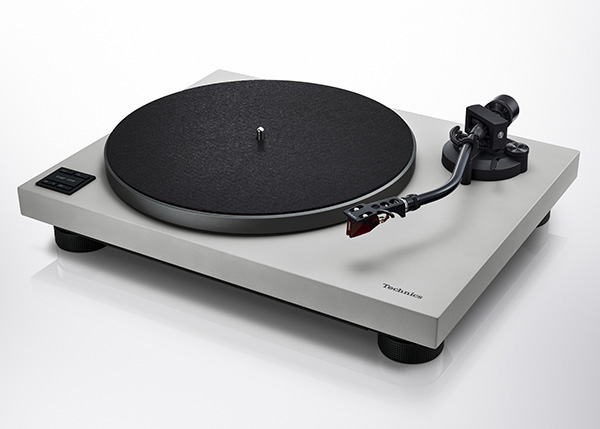
In late 2025, Technics introduced its lowest-priced record players since the 1990s: the SL-50C and the SL-40CBT, each retailing for $899.99. It's a new design: smaller footprint, new tonearm mechanics, new platter and mat. Both have a built-in phono preamp similar to the one in the SC-CX700 active loudspeaker system (footnote 2). The SL-40CBT comes with an AT-VM95C cartridge and has a Bluetooth 5.4 transmitter onboard with aptX Adaptive (accommodating up to "high quality" lossy audio). The SL-50C—the subject of this review—is the option for analog purists. It includes a 2M Red cartridge and doesn't do Bluetooth. Its extra value comes from the option for 78rpm playback, in addition to the usual 33 1/3 and 45rpm.
Small, light, colorful
The SL-50C is about 16.9" wide, 13.9" deep, and 5.1" high with its removable hinged dustcover. It weighs 15.7lb. Compare that with 17.8" × 14.6" × 6.7" and 21.2lb for the SL-1500C. The SL-50C (and SL-40CBT) platters have flat sides, like an entry-level Pro-Ject or Rega, not sloped sides like the SL-1200 and its spinoffs. In place of the rubber platter mat found on previous Technics turntables, there's a lightweight black mat made of "unwoven fabric." Think felt like on a Rega but stiffer, denser, and less likely to come off when you lift a record. The platter itself is single-layer die-cast aluminum; the platter on the SL-1500C is dual-layer die-cast aluminum and rubber. The SL-50C plinth body is made of medium-density fiberboard; on the 1500 it's "aluminum, ABS, and glass fiber." In contrast to the SL-1200 series and the similar SL-1500C, there is no tonearm-height adjustment, so if a buyer decides to replace the Ortofon 2M Red, a cartridge of the same height should be chosen.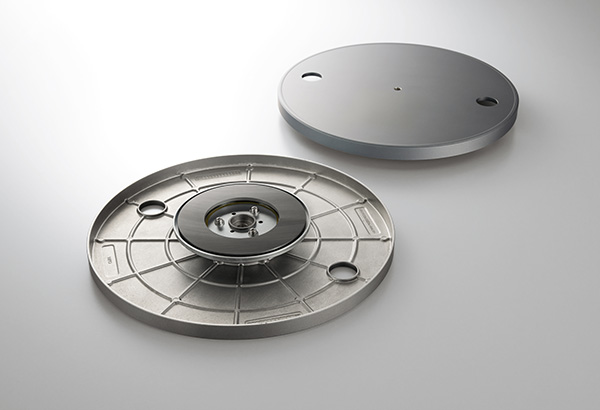 The SL-50C's DC motor—described by Technics as "a coreless direct-drive motor that uses stators without iron core"—and digital motor-control system are the same as those used in the SL-1500C and the SL-1200MK7 deejay turntable. The motor is further described as "12-pole, 9-coil, three-phase brushless." Technics's Bill Voss told me that the motor's torque is tuned for each turntable model, since the platters have different weights, and the SL-1200MK7 may be used for turntablist performances requiring extra motor torque (footnote 3). The SL-1200MK7's isolation feet were ported over to the SL-50C, with a new rubber piece between the turntable body and the spring on top of the feet.
Under the hood is a newly designed switch-mode power supply. Technics claims that digital motor control is superior to the Quartz phase-locked loop servo system used in SL-1200 turntables through the MK6 version.
The most radical design departure for the SL-50C (and the SL-40CBT) is the tonearm. Technics simplified their familiar S-shaped design and developed a new "plain bearing system" consisting of a 3mm "high precision steel" center shaft inside a "high-density PPS plastic" sleeve, rotating on a "thrust bearing with steel balls (sphericity 0.05µm)." Those prior S-shaped Technics tonearms used gimbal-suspension bearing systems as far back as my old SL-D2, according to Voss. The new tonearm tube is made of lightweight aluminum and accommodates the standard Technics screw-in headshell. The new tonearm design allows for lower height, lighter weight, and fewer parts, Voss said. The tonearm features a mechanical lifter and antiskate control similar to that on other Technics tonearms.
The SL-50C's DC motor—described by Technics as "a coreless direct-drive motor that uses stators without iron core"—and digital motor-control system are the same as those used in the SL-1500C and the SL-1200MK7 deejay turntable. The motor is further described as "12-pole, 9-coil, three-phase brushless." Technics's Bill Voss told me that the motor's torque is tuned for each turntable model, since the platters have different weights, and the SL-1200MK7 may be used for turntablist performances requiring extra motor torque (footnote 3). The SL-1200MK7's isolation feet were ported over to the SL-50C, with a new rubber piece between the turntable body and the spring on top of the feet.
Under the hood is a newly designed switch-mode power supply. Technics claims that digital motor control is superior to the Quartz phase-locked loop servo system used in SL-1200 turntables through the MK6 version.
The most radical design departure for the SL-50C (and the SL-40CBT) is the tonearm. Technics simplified their familiar S-shaped design and developed a new "plain bearing system" consisting of a 3mm "high precision steel" center shaft inside a "high-density PPS plastic" sleeve, rotating on a "thrust bearing with steel balls (sphericity 0.05µm)." Those prior S-shaped Technics tonearms used gimbal-suspension bearing systems as far back as my old SL-D2, according to Voss. The new tonearm tube is made of lightweight aluminum and accommodates the standard Technics screw-in headshell. The new tonearm design allows for lower height, lighter weight, and fewer parts, Voss said. The tonearm features a mechanical lifter and antiskate control similar to that on other Technics tonearms.
 Inside the plinth/body are separate circuit boards for the power supply, the motor-control system, and the phono preamp. The power supply and motor-control boards are positioned opposite the tonearm base. The preamp board is enclosed in a metal shield and positioned close to the tonearm base, so that there isn't much tonearm wire outside the metal shield.
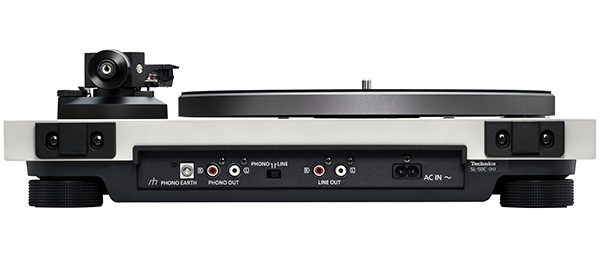
The rear panel includes separate RCA jacks for tonearm-direct and preamplified outputs and a grounding post. The two-wire AC cord connects in back. There is a "Phono-Line" slider switch: In the Phono position, the tonearm signal wires route directly to the Phono Out RCA jacks on the back; in the Line position, the tonearm wires route through the built-in phono preamp and out the Line Out jacks.
Technics likes to mention its foam-free, all-cardboard packaging, which it says reduces "environmental impact" by 98%. The design of the SL-50C box made it easier to manage and less likely to self-destruct than the packaging of the Technics SC-CX700 speaker-gadgets.
Speaking of which, the SL-50C and SL-40CBT are available in the same colors as the SC-CX700: Black, Grey, and Terracotta Brown. The review unit was black.
Initial impressions
Inside the plinth/body are separate circuit boards for the power supply, the motor-control system, and the phono preamp. The power supply and motor-control boards are positioned opposite the tonearm base. The preamp board is enclosed in a metal shield and positioned close to the tonearm base, so that there isn't much tonearm wire outside the metal shield.
The rear panel includes separate RCA jacks for tonearm-direct and preamplified outputs and a grounding post. The two-wire AC cord connects in back. There is a "Phono-Line" slider switch: In the Phono position, the tonearm signal wires route directly to the Phono Out RCA jacks on the back; in the Line position, the tonearm wires route through the built-in phono preamp and out the Line Out jacks.
Technics likes to mention its foam-free, all-cardboard packaging, which it says reduces "environmental impact" by 98%. The design of the SL-50C box made it easier to manage and less likely to self-destruct than the packaging of the Technics SC-CX700 speaker-gadgets.
Speaking of which, the SL-50C and SL-40CBT are available in the same colors as the SC-CX700: Black, Grey, and Terracotta Brown. The review unit was black.
Initial impressions
A little bit of assembly is required when the SL-50C is unboxed. The platter is gently placed on the center spindle, the fabric mat on the platter. The counterweight mechanism is twist-turned onto the rear of the tonearm, and the headshell with the Ortofon 2M Red cartridge already mounted is attached to the front. Then, after the plastic stylus guard is removed from the cartridge, the counterweight is adjusted so the tonearm is suspended horizontal to the turntable plinth-body. The counterweight indicator dial is then set to "0". Next, the counterweight is twisted inward toward the tonearm pivot until the cartridge tracking weight is 1.8gm. Although the SL-50C manual recommends setting antiskate to "the same setting as the stylus pressure control," I have long found, with Technics turntables and lower-end moving magnet cartridges, that antiskate is optimal at about half the tracking force setting. Your mileage may vary. See the writings of Jim Austin and Michael Trei regarding antiskate. To summarize: It's an inexact thing, partly because antiskate scales vary from one turntable to another. I found the SL-50C indicator dial and counterweight mechanism interaction with the tonearm to be reliably accurate; my digital tracking-weight scale read exactly 1.8gm after I set it up. This result is in line with every other Technics tonearm I own: They are precision mechanical systems.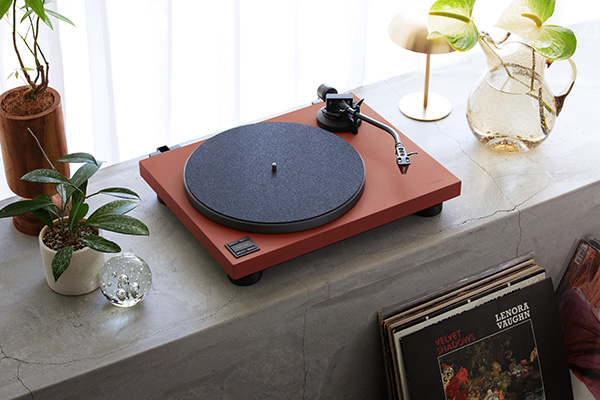 The tonearm lifter mechanism feels coarser and flimsier than those on my vintage SL-1200 turntables but about the same as the one on my few-years-old SL-1200MK7. The tonearm felt like what it is: smaller and lighter than the traditional SL-1200 types. It did not feel loose or imprecise. The platter and mat were lighter and simpler-looking than those on my other Technics turntables. That's not to say they don't do the job as well.
The hinged dustcover slid easily into its fittings at the rear of the turntable body. It is obviously designed for easy on-and-off action: The SL-50C manual states on page 14, "Remove the dust cover while playing." There are numerous opinions online about whether a record can be successfully or safely played on a Technics turntable with the dustcover closed, open, or removed. I have played plenty of records all three ways with no bad consequences, but removing the cover can help minimize rumble, and it stands to reason that when the cover is removed, the turntable will encounter fewer airborne vibrations.
Listening 1: As it is
The tonearm lifter mechanism feels coarser and flimsier than those on my vintage SL-1200 turntables but about the same as the one on my few-years-old SL-1200MK7. The tonearm felt like what it is: smaller and lighter than the traditional SL-1200 types. It did not feel loose or imprecise. The platter and mat were lighter and simpler-looking than those on my other Technics turntables. That's not to say they don't do the job as well.
The hinged dustcover slid easily into its fittings at the rear of the turntable body. It is obviously designed for easy on-and-off action: The SL-50C manual states on page 14, "Remove the dust cover while playing." There are numerous opinions online about whether a record can be successfully or safely played on a Technics turntable with the dustcover closed, open, or removed. I have played plenty of records all three ways with no bad consequences, but removing the cover can help minimize rumble, and it stands to reason that when the cover is removed, the turntable will encounter fewer airborne vibrations.
Listening 1: As it is
I decided to first evaluate the SL-50C as it is presented out of the box, with the Ortofon 2M Red cartridge and using the built-in phono preamp. On the one hand, the phono preamp in a turntable at this price can't be that great, but on the other hand, it's a good idea to have a phono pre built in to a record player so that those lowest-level signals are amplified before any long runs of wire, while keeping the turntable pickup well out of feedback range of your loudspeakers. Despite marketing photos, it's not a good idea to place a turntable within a couple feet of a speaker, worse yet on the same surface. Better to keep the turntable far away—at least 6' or so—to avoid feedback and rumble. I connected the SL-50C's preamp output via a 2m Monster RCA cable to my McIntosh MA6500 integrated amplifier, which fed a pair of Amphion One18 minimonitors, near-field to my head at my office desk.
Footnote 1: See vintage-turntable.com/technics-sl-d2.html. Footnote 2: I Follow-Up reviewed the SC-CX700 active loudspeaker system, focusing on the phono preamp and other features. To my ears, the phono preamp sounded quite good. See Kalman Rubinson's review, with a link to my Follow-Up here. Footnote 3: The SL-1200MK7 has three motor-torque settings, via a switch located under the platter.
Technics famously ceased production of turntables in 2010, then resumed in 2016, offering new direct-drive systems based on the digital direct-drive systems used in Panasonic Blu-ray players. The turntables are made in Malaysia. In recent years, the company branched out from the deejay-style SL-1200 platform into more home décor–friendly looks and simpler control layouts. The first move in that direction was the SL-1500C (list price $1500), introduced in 2019. That was followed by the SL-100C (list price $1400), in 2021. Both are sold with a starter cartridge: an Ortofon 2M Red (moving magnet, bonded elliptical stylus) with the SL-1500C and an Audio-Technica AT-VM95C (moving magnet, bonded conical stylus) with the SL-100. The SL-1500C has a built-in phono preamp, which can be switched off to connect the turntable to an external preamp, and a semiautomatic tonearm-return mechanism, which can be switched off for fully manual operation. The SL-100 is fully manual and doesn't include a built-in preamp.
The SL-50C is about 16.9" wide, 13.9" deep, and 5.1" high with its removable hinged dustcover. It weighs 15.7lb. Compare that with 17.8" × 14.6" × 6.7" and 21.2lb for the SL-1500C. The SL-50C (and SL-40CBT) platters have flat sides, like an entry-level Pro-Ject or Rega, not sloped sides like the SL-1200 and its spinoffs. In place of the rubber platter mat found on previous Technics turntables, there's a lightweight black mat made of "unwoven fabric." Think felt like on a Rega but stiffer, denser, and less likely to come off when you lift a record. The platter itself is single-layer die-cast aluminum; the platter on the SL-1500C is dual-layer die-cast aluminum and rubber. The SL-50C plinth body is made of medium-density fiberboard; on the 1500 it's "aluminum, ABS, and glass fiber." In contrast to the SL-1200 series and the similar SL-1500C, there is no tonearm-height adjustment, so if a buyer decides to replace the Ortofon 2M Red, a cartridge of the same height should be chosen.
The SL-50C's DC motor—described by Technics as "a coreless direct-drive motor that uses stators without iron core"—and digital motor-control system are the same as those used in the SL-1500C and the SL-1200MK7 deejay turntable. The motor is further described as "12-pole, 9-coil, three-phase brushless." Technics's Bill Voss told me that the motor's torque is tuned for each turntable model, since the platters have different weights, and the SL-1200MK7 may be used for turntablist performances requiring extra motor torque (footnote 3). The SL-1200MK7's isolation feet were ported over to the SL-50C, with a new rubber piece between the turntable body and the spring on top of the feet.
Inside the plinth/body are separate circuit boards for the power supply, the motor-control system, and the phono preamp. The power supply and motor-control boards are positioned opposite the tonearm base. The preamp board is enclosed in a metal shield and positioned close to the tonearm base, so that there isn't much tonearm wire outside the metal shield.
A little bit of assembly is required when the SL-50C is unboxed. The platter is gently placed on the center spindle, the fabric mat on the platter. The counterweight mechanism is twist-turned onto the rear of the tonearm, and the headshell with the Ortofon 2M Red cartridge already mounted is attached to the front. Then, after the plastic stylus guard is removed from the cartridge, the counterweight is adjusted so the tonearm is suspended horizontal to the turntable plinth-body. The counterweight indicator dial is then set to "0". Next, the counterweight is twisted inward toward the tonearm pivot until the cartridge tracking weight is 1.8gm. Although the SL-50C manual recommends setting antiskate to "the same setting as the stylus pressure control," I have long found, with Technics turntables and lower-end moving magnet cartridges, that antiskate is optimal at about half the tracking force setting. Your mileage may vary. See the writings of Jim Austin and Michael Trei regarding antiskate. To summarize: It's an inexact thing, partly because antiskate scales vary from one turntable to another. I found the SL-50C indicator dial and counterweight mechanism interaction with the tonearm to be reliably accurate; my digital tracking-weight scale read exactly 1.8gm after I set it up. This result is in line with every other Technics tonearm I own: They are precision mechanical systems.
The tonearm lifter mechanism feels coarser and flimsier than those on my vintage SL-1200 turntables but about the same as the one on my few-years-old SL-1200MK7. The tonearm felt like what it is: smaller and lighter than the traditional SL-1200 types. It did not feel loose or imprecise. The platter and mat were lighter and simpler-looking than those on my other Technics turntables. That's not to say they don't do the job as well.
I decided to first evaluate the SL-50C as it is presented out of the box, with the Ortofon 2M Red cartridge and using the built-in phono preamp. On the one hand, the phono preamp in a turntable at this price can't be that great, but on the other hand, it's a good idea to have a phono pre built in to a record player so that those lowest-level signals are amplified before any long runs of wire, while keeping the turntable pickup well out of feedback range of your loudspeakers. Despite marketing photos, it's not a good idea to place a turntable within a couple feet of a speaker, worse yet on the same surface. Better to keep the turntable far away—at least 6' or so—to avoid feedback and rumble. I connected the SL-50C's preamp output via a 2m Monster RCA cable to my McIntosh MA6500 integrated amplifier, which fed a pair of Amphion One18 minimonitors, near-field to my head at my office desk.
Footnote 1: See vintage-turntable.com/technics-sl-d2.html. Footnote 2: I Follow-Up reviewed the SC-CX700 active loudspeaker system, focusing on the phono preamp and other features. To my ears, the phono preamp sounded quite good. See Kalman Rubinson's review, with a link to my Follow-Up here. Footnote 3: The SL-1200MK7 has three motor-torque settings, via a switch located under the platter.