When it comes to phonography, I'm not terribly picky, but I do have preferences. I maintain my records well because I prefer to play clean records, with minimal pops, clicks, and crackle to distract me. I like a phono cartridge that tracks average platters perfectly and difficult sides at least very well. I prefer cartridge-turntable systems that keep up with the pace of the music, bring forth its beat, and don't muff quick dynamics. I like a phono preamp that runs quiet and interfaces with my cartridges in a hum-free way. Most of all, I like to keep fuss and fiddling from between me and musical enjoyment.
As such, I've generally preferred what I call workingman's phono rigs: moving magnet cartridges; Technics SL-1200–series turntables that are easy to set up and allow quick swapping of cartridge/headshell combos; and solid state phono preamplifiers with highly accurate RIAA deemphasis and low noisefloors. In fact, I own only two moving coil cartridges: a Denon DL-110 I've had for years and a recently acquired Hana SL MK II. Though I'm quite fond of those two MCs, most of my vinyl playing is with moving magnet (MM) cartridges.
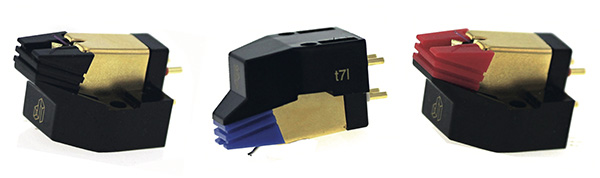
One of the best features of MM cartridges is that at least with many of them you can remove and replace the stylus assembly to replace a worn-out stylus or damaged cantilever or to try a different stylus profile—indeed it is easy to do. Common nowadays are MM cartridge lines where you can start out with a bonded elliptical stylus for close to a hundred bucks and upgrade all the way through a nude Shibata stylus assembly that rings up closer to a grand (footnote 1). Examples of such moving magnet cartridge systems are Audio-Technica's VMx and VM95 lines, Ortofon's Concorde Music and 2M series(footnote 2), and the subject of this review, The Vessel, made by Excel Sound in Japan and sold exclusively by Las Vegas–based LP Gear (footnote 3).
Excel Sound has been making moving magnet cartridges since the 1970s. The LP Gear website describes The Vessel as Excel's "3rd iteration motor," likely meaning that it's a descendant of the company's ES-70 line (footnote 4). Excel Sound has a long history of OEM (original equipment manufacturer) work—that is, making cartridges for other companies. From what I could gather about its current production, it owns the Hana brands and is in a joint venture called Etsuro Urushi with Dai-ichi Shoji Co., Ltd. (making high-end moving coil cartridges) (footnote 5). Very likely, Excel builds (or has built) cartridges from Rega, Shelter, Coral, Benz Micro, and Sumiko, among others. Finally, it makes The Vessel moving magnet line for LP Gear.
This is a review of the whole LP Gear Vessel cartridge system. At the same time, because of the versatility of the Vessel system, it's an opportunity to explore some interesting issues, such as, what is the sound of a boron cantilever? Of a nude elliptical or Shibata stylus? And what's the best combination for playing different types of music?
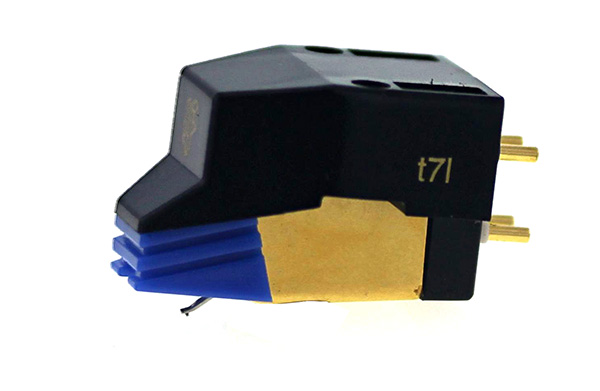
The Vessel can be bought with your choice of nine stylus/cantilever styles:
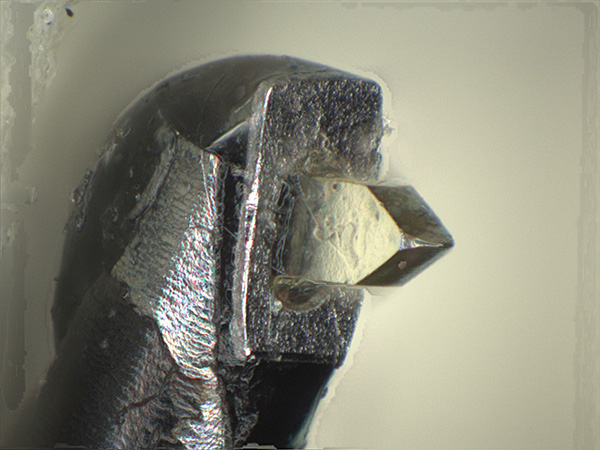
• A "Nude Super Shibata" stylus on a cantilever of aluminum pipe, "single crystal special cylindrical ruby," or "special high-grade boron." The patented Shibata profile was developed to play JVC's CD-4 discrete-quadraphonic LPs, which included an FM carrier for the rear channels and required reliably recovering signals from the grooves up to 45kHz. Today, the Shibata stylus is favored by some listeners for its precise tracking of minute groove details (when aligned properly).
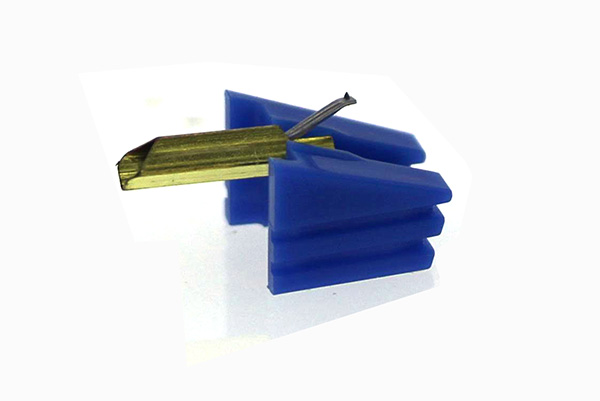
Generally, The Vessel features average output level for a MM cartridge (2.5mV), medium compliance on the higher side—the exact spec depends on which stylus/cantilever assembly you choose—and a recommended tracking force of 2gm. All the stylus assemblies are swappable and attach easily to the cartridge body.
Visually, The Vessel looks somewhat old-fashioned; some might say nostalgic. Its body is made of plastic and metal, in line with Excel Sound's MM lineage. While preparing this review, I did a lot of stylus swapping and found the fit firm and solid. It brought to my mind my youthful explorations of different stylus shapes with my old Shure M44, and trying out various stylus sizes to find the perfect mate for a wide-groove record with my Stanton 500. I found it easier to swap styli on The Vessel than with the similarly priced Ortofon 2M and Audio-Technica VM95 cartridge lines.
Sentience is a lot to claim for a phono cartridge, no matter how good it is.
Castellanes sent me one Vessel cartridge body and all nine of the available stylus/cantilever assemblies. I asked him what I should be listening for as I swapped styli. Here's what he said: "The purpose of the different cantilevers and tips is to reproduce the music as it was recorded. That is the critical mission, and that is how the cartridge and its stylus tip should be evaluated. But listeners have individual preferences: Some want the granular detail while others prefer warmth, others want visceral bass, etc. That's the rationale: Each should offer music closest to the original sound of the recording while considering individual preferences."
Castellanes conspicuously shied away from associating specific sonic qualities with a given stylus/cantilever assembly. I'll take a firmer stand and state some generalities based on years of playing records with a relatively wide variety of MM cartridges and styli.
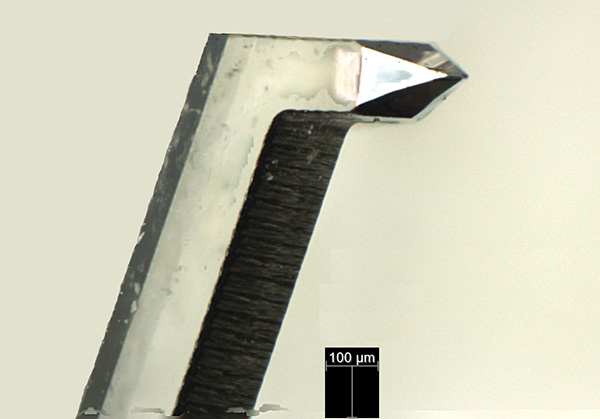
 To my ears, bonded elliptical styli tend to play the thump of the beat and boom of the low end well while deemphasizing the top and leaving out some high-frequency detail. Nude elliptical styli sound different to me than bonded elliptical on the same cartridge body: They tend to present a more even balance between beat and details. The "pointier" stylus shapes, like microline/MicroRidge and Shibata, require more care in setup to make them sit just right in the groove. When they're set up properly, they can catch details, treble extension, and stereo image width and depth that other stylus profiles miss. They may, however, capture more extra surface noise than extra music.
Some people prefer less-pointy stylus types because of the big beat and strong bassline they produce. I agree that with some music—an original pressing of a Sun or Stax LP from the early 1960s, say—a less-fussy (rounder) stylus is better. However, the detail and resolution extracted by a properly set up precision-profile stylus can add a lot of realism to playback if the record was well-made. Considering the age and simplicity of record-playing technology, I find that kind of playback of those kinds of records near-miraculous.
I may get pushback for writing this, but for mono records, I strongly advocate a conical or elliptical stylus—nothing too pointy.
Then there's my "90% rule": Some cartridges will play 90% of records on 90% of turntables to the satisfaction of 90% of listeners. Those cartridges tend to have nude elliptical styli; anything pointier requires effort and care in setup, to go after that last 10% of music. And, again, the pointier styli may well recover as much or more extra noise as extra musical details.
After much phonographic exploration, I've decided my priority is to spend as much time as possible playing records and enjoying music. At the same time, I'm willing to get a little tweaky with the playback system if I think there's more to be heard and I stand a good chance of hearing it.
Getting ready
To my ears, bonded elliptical styli tend to play the thump of the beat and boom of the low end well while deemphasizing the top and leaving out some high-frequency detail. Nude elliptical styli sound different to me than bonded elliptical on the same cartridge body: They tend to present a more even balance between beat and details. The "pointier" stylus shapes, like microline/MicroRidge and Shibata, require more care in setup to make them sit just right in the groove. When they're set up properly, they can catch details, treble extension, and stereo image width and depth that other stylus profiles miss. They may, however, capture more extra surface noise than extra music.
Some people prefer less-pointy stylus types because of the big beat and strong bassline they produce. I agree that with some music—an original pressing of a Sun or Stax LP from the early 1960s, say—a less-fussy (rounder) stylus is better. However, the detail and resolution extracted by a properly set up precision-profile stylus can add a lot of realism to playback if the record was well-made. Considering the age and simplicity of record-playing technology, I find that kind of playback of those kinds of records near-miraculous.
I may get pushback for writing this, but for mono records, I strongly advocate a conical or elliptical stylus—nothing too pointy.
Then there's my "90% rule": Some cartridges will play 90% of records on 90% of turntables to the satisfaction of 90% of listeners. Those cartridges tend to have nude elliptical styli; anything pointier requires effort and care in setup, to go after that last 10% of music. And, again, the pointier styli may well recover as much or more extra noise as extra musical details.
After much phonographic exploration, I've decided my priority is to spend as much time as possible playing records and enjoying music. At the same time, I'm willing to get a little tweaky with the playback system if I think there's more to be heard and I stand a good chance of hearing it.
Getting ready
Like most MM cartridges, The Vessel is pretty easy to set up. I started out with the Vessel's base bonded elliptical stylus assembly (A3SE) in case I did something stupid while installing it in a Technics headshell. Excel Sound/LP Gear didn't include a stylus guard, perhaps because they figure you don't need one when you can remove the stylus/cantilever assembly during installation.
The Vessel has the standard side slots through which the screws holding it to the headshell pass. Once it was securely fitted in the headshell, I installed the stylus assembly and lined the tip for correct VTA using the Technics alignment gauge. A trick I learned years ago is to eyeball the tip of the stylus to the edge of the gauge then carefully and firmly hold a razor blade perpendicular to the gauge, making sure to stay below the stylus tip so there is no chance of the blade touching it. If the blade is perpendicular and it's in line to touch the stylus tip, alignment is great. Hold the cartridge firmly in that exact position and tighten the screws. Whether you attach the headshell wires to the cartridge pins before or after securing its positioning is personal preference; I like to do it first. The form factor of The Vessel is such that it fits normally in a Technics headshell, not too snug as far as leaving some room for the wires behind it. The headshell I used was the deluxe version that Technics used to make, with gold-plated wire connectors and pins.
At 18mm, The Vessel is the same height as the Ortofon 2M series and very slightly higher than an Audio-Technica AT-VM95E. I swapped it in for my Ortofon 2M Blue and confirmed with a grid-gauge that the tonearm was parallel to the surface with the junker 180gm LP I use for setup. The 2M Blue, at 7.2gm, is heavier than the 6gm Vessel, plus the Ortofon was in a different type of headshell, with a different weight, so I rebalanced the tonearm and set 2.0gm tracking weight with my digital scale. I set the antiskate dial to about 1gm as a start. I use music to dial in antiskate, records with difficult-to-track content near the inner diameter. There is an antiskate setting at which every cartridge tracks the grooves best, with the least distortion or fuzz. Based on my understanding of Michael Trei's and others' writing, it depends on the cartridge+tonearm mass and the cartridge compliance. With most cartridges I own, the antiskate setting on my Technics turntables is lower than tracking weight, sometimes quite a bit lower.
It took me longer to write those last three paragraphs than it took to set up The Vessel and get the music spinning on my Technics SL-1200mkV with KAB fluid damping, tonearm rewiring, and 78rpm speed option. I decided to swap in the microline/aluminum cantilever assembly (A3SM), so a more precise tracking of grooves could reveal the sound qualities of the cartridge. I connected the cartridge to my Pro-Ject Phono Box RS2 preamp with a vintage SME RCA cable. Output gain was set to 43dB: The Vessel's output voltage is somewhat low for a MM.
One more adjustment was necessary: setting capacitance at the preamp. I used some familiar orchestral music records to find the best balance of a top end that was natural sounding but extended and a glare-free upper midrange.
To my surprise, I ended up preferring the maximum capacitance, 400pF. Most of my other MM cartridges sound best in the 150–250pF range. Too low a capacitance setting makes The Vessel sound dull and lacking color.
As I played more records, I sometimes turned the capacitance down, but only as low as 300pF, for especially bright-sounding sides (think 1960s Capitol or Command pop records). For this cartridge, I recommend using a preamp with adjustable capacitance with plenty of capacitance options and listening carefully to familiar full-frequency-range music to set it. Everyone's system and hearing are different, so there is no "right" setting except the one that sounds best with the music currently spinning.
 On to the music
This review happened at a great time because I had a stockpile of new vinyl to play. To get an idea of the Vessel sound, I started with three titles I have played a few times with my Hana SL MK II, so I knew their basic sound qualities. Maggie's Back in Town!! by trumpeter Howard McGhee was recorded in 1961 (Contemporary CR00710). I played a recent reissue, part of the ongoing Contemporary Records Acoustic Sounds Series, cut to lacquer by Bernie Grundman from original master tapes. The sound is extraordinary; the music is timeless. The Vessel sounded every bit as good as the Hana MC with McGhee's powerful trumpet and the quick piano moves by Phineas Newborn Jr. This record reminds me more of New York jazz of that era than the laid-back style associated with Contemporary. It's not quite Blue Note post-bop edgy, but it's certainly not all about sun and surf. Ben Webster At the Renaissance (Contemporary CR00388) also sounded great. The reissue LP, from the same Acoustic Sounds series, differs from the streaming/CD version in song sequence, and it doesn't include as many tracks. It beats the digital versions soundwise. The album was recorded in 1960, abruptly shelved, then revived by producer Ed Michel in 1985, 12 years after Webster's death. (Contemporary founder Lester Koenig had begun liner notes, which Michel completed.) It's a pity that this vibrant jazz languished 25 years. Kudos to the folks at Concord/Craft for including it in the new Contemporary reissue series. Brand new in the LP rack when I received The Vessel for review was an advance copy of the Rhino Reserve all-analog reissue of Otis Blue by Otis Redding (Volt RES1 412). Cut by Chris Bellman at Bernie Grundman Mastering from the original mono master tape, this version sounds way better than the old Rhino-Atlantic CD. I'm glad the Rhino folks chose to go with the mono version of this album because the stereo sounds weird. (You can stream both, at 24/192, on Qobuz.) Trying to capture the power of Otis Redding backed by Booker T. & The M.G.'s was likely a great challenge, and Stax is not a label one usually associates with "high fidelity," yet a ton of red-blooded, life-affirming soul leaped out of those grooves! This is a record that sounds just fine with a modest bonded elliptical stylus. It's all about the beat and momentum.
I then spun a few favorites, including a first pressing of the Rolling Stones' Exile on Main Street (Rolling Stones Records COC-2-2900) and the recent Pablo/Analogue Productions reissue of The Gifted Ones by Dizzy Gillespie, Count Basie, Ray Brown, and Mickey Roker (AJP-161). This early listening led me to conclude that The Vessel is a quick-sounding cartridge that doesn't impose much of a "sound" on the music. Its transducer engine, and the way the stylus assemblies are designed, seems focused on responding accurately to the grooves. It's capable of reproducing dynamics and quick transients and a clean (but not thin) tonality.
Footnote 1: Audio-Technica offers a good primer on phono stylus types and shapes at tinyurl.com/mt-vt9xjm. Ortofon's complete tutorial on phono cartridges and styli is at tinyurl.com/yurvcp49. Footnote 2: Ortofon's Concorde Music cartridges all share a common cartridge engine, with styli ranging from bonded elliptical to nude Shibata. For the 2M series, there are three different cartridge engines, and the styli are not interchangeable between the different cartridge engines.
Footnote 3: This link shows the whole Vessel line, from lowest-priced to highest: tinyurl.com/yez8axum.
Footnote 4: Vintage ES-70 brochures and other information can be downloaded at tinyurl.com/yck3z668.
Footnote 5: See etsurojapan.com.
The $129 A3SE phono cartridge, the base model in the LP Gear "The Vessel" series, features a bonded "special elliptical" stylus on an aluminum cantilever. If your tonearm supports detachable headshells, you can get it premounted for $178. From this starting point, the cartridge can be upgraded just by changing out the stylus, a 30-second process, all the way up to the $679 Vessel B3SS, which has a "Nude Super Shibata tip" and a boron cantilever.
One cartridge, many optionsThe Vessel can be bought with your choice of nine stylus/cantilever styles:
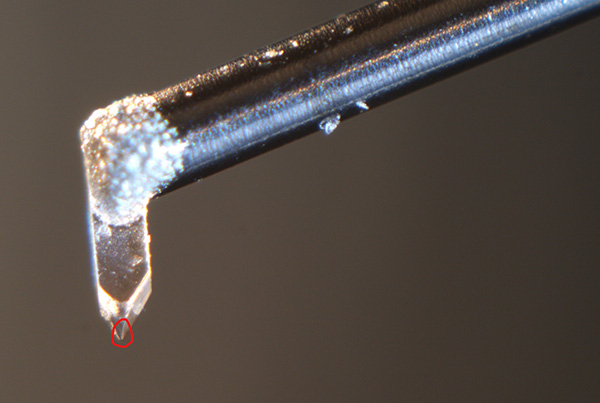
The stylus on a Lyra Atlas phono cartridge, shown to illustrate the profile of a line-contact stylus (photo courtesy of J.R. Boisclair and Wallytools).
• A "Nude Super Vivid Line Contact" stylus with either an aluminum pipe or ruby cantilever. This stylus shape is similar to the hyperelliptical version of the Shure V15 Type III.
• Two versions with a "Nude Super Micro Line" stylus, with aluminum pipe or ruby. The microline stylus shape is advertised to be most similar to a modern cutting stylus used to make a lacquer master. Theoretically, when aligned properly, it traces the groove in a manner most similar to how the groove was cut.
A Shibata stylus tip (photo courtesy of J.R. Boisclair and Wallytools).
• A "special elliptical" bonded stylus with an aluminum cantilever. A bonded elliptical stylus is generally considered the starting point for high-fidelity stereo record playing.
• A 3-mil (wide-groove) "super conical" bonded stylus on an aluminum cantilever. This is a general-use starting point to play old 78s and other wide-groove records. (Precise playback of wide-groove records is a rabbit hole I won't be going down in this review.)
Rome Castellanes, the owner of LP Gear, told me that Excel sources the nude diamond styli from Orbray (formerly Namiki), which seems to have exclusive rights to make the patented Shibata tip and makes a full line of nude and bonded stylus types. He didn't say whether Excel Sound makes its own bonded-tip stylus assemblies or buys them from an outside supplier. For a deep dive into the present-day world of cartridge manufacturing, see Phono Cartridge Variations and the Modern Industry.
The one-piece diamond MicroRidge stylus/cantilever on this DS Audio Grand Master Extreme cartridge is a fine example of a MicroRidge stylus (photo courtesy of J.R. Boisclair and Wallytools).
LP Gear's description of The Vessel sets a high bar. "Designed by golden Japanese engineers and crafted by long-experienced artisans, The Vessel is wonderfully disruptive. Its unique core excellence is its ability to capture and convey Full Spectra Sound. It unveils the totality of the musical experience: its direct, angular, spatial, and reflective acoustic—thus enabling shape constancy, depth, and the emotional content within. It is at its core sentient."
To my ears, bonded elliptical styli tend to play the thump of the beat and boom of the low end well while deemphasizing the top and leaving out some high-frequency detail. Nude elliptical styli sound different to me than bonded elliptical on the same cartridge body: They tend to present a more even balance between beat and details. The "pointier" stylus shapes, like microline/MicroRidge and Shibata, require more care in setup to make them sit just right in the groove. When they're set up properly, they can catch details, treble extension, and stereo image width and depth that other stylus profiles miss. They may, however, capture more extra surface noise than extra music.
Some people prefer less-pointy stylus types because of the big beat and strong bassline they produce. I agree that with some music—an original pressing of a Sun or Stax LP from the early 1960s, say—a less-fussy (rounder) stylus is better. However, the detail and resolution extracted by a properly set up precision-profile stylus can add a lot of realism to playback if the record was well-made. Considering the age and simplicity of record-playing technology, I find that kind of playback of those kinds of records near-miraculous.
I may get pushback for writing this, but for mono records, I strongly advocate a conical or elliptical stylus—nothing too pointy.
Like most MM cartridges, The Vessel is pretty easy to set up. I started out with the Vessel's base bonded elliptical stylus assembly (A3SE) in case I did something stupid while installing it in a Technics headshell. Excel Sound/LP Gear didn't include a stylus guard, perhaps because they figure you don't need one when you can remove the stylus/cantilever assembly during installation.
On to the musicThis review happened at a great time because I had a stockpile of new vinyl to play. To get an idea of the Vessel sound, I started with three titles I have played a few times with my Hana SL MK II, so I knew their basic sound qualities. Maggie's Back in Town!! by trumpeter Howard McGhee was recorded in 1961 (Contemporary CR00710). I played a recent reissue, part of the ongoing Contemporary Records Acoustic Sounds Series, cut to lacquer by Bernie Grundman from original master tapes. The sound is extraordinary; the music is timeless. The Vessel sounded every bit as good as the Hana MC with McGhee's powerful trumpet and the quick piano moves by Phineas Newborn Jr. This record reminds me more of New York jazz of that era than the laid-back style associated with Contemporary. It's not quite Blue Note post-bop edgy, but it's certainly not all about sun and surf. Ben Webster At the Renaissance (Contemporary CR00388) also sounded great. The reissue LP, from the same Acoustic Sounds series, differs from the streaming/CD version in song sequence, and it doesn't include as many tracks. It beats the digital versions soundwise. The album was recorded in 1960, abruptly shelved, then revived by producer Ed Michel in 1985, 12 years after Webster's death. (Contemporary founder Lester Koenig had begun liner notes, which Michel completed.) It's a pity that this vibrant jazz languished 25 years. Kudos to the folks at Concord/Craft for including it in the new Contemporary reissue series. Brand new in the LP rack when I received The Vessel for review was an advance copy of the Rhino Reserve all-analog reissue of Otis Blue by Otis Redding (Volt RES1 412). Cut by Chris Bellman at Bernie Grundman Mastering from the original mono master tape, this version sounds way better than the old Rhino-Atlantic CD. I'm glad the Rhino folks chose to go with the mono version of this album because the stereo sounds weird. (You can stream both, at 24/192, on Qobuz.) Trying to capture the power of Otis Redding backed by Booker T. & The M.G.'s was likely a great challenge, and Stax is not a label one usually associates with "high fidelity," yet a ton of red-blooded, life-affirming soul leaped out of those grooves! This is a record that sounds just fine with a modest bonded elliptical stylus. It's all about the beat and momentum.
Footnote 1: Audio-Technica offers a good primer on phono stylus types and shapes at tinyurl.com/mt-vt9xjm. Ortofon's complete tutorial on phono cartridges and styli is at tinyurl.com/yurvcp49. Footnote 2: Ortofon's Concorde Music cartridges all share a common cartridge engine, with styli ranging from bonded elliptical to nude Shibata. For the 2M series, there are three different cartridge engines, and the styli are not interchangeable between the different cartridge engines.