Sidebar 3: Measurements
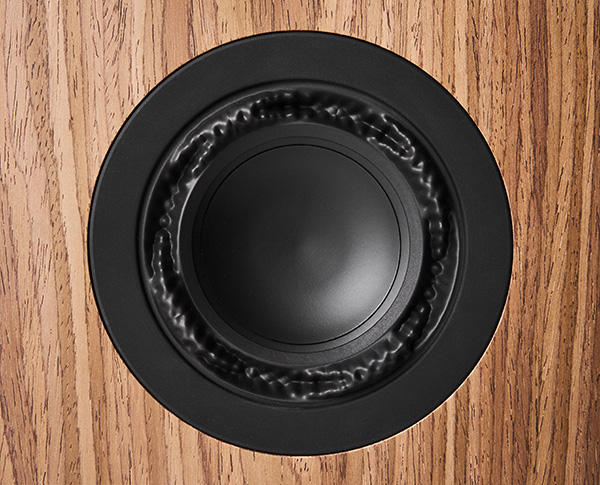 Lars Risbo, the man behind Purifi's range of innovative drive units, is not only the brand's co-founder but also the designer of the legendary TacT Millennium amplifier, one of the first genuinely digital class-D amplifiers to emerge in the 1990s and forerunner of the Lyngdorf models of today. That ability to think "out of the box" is equally evident in Lars's approach to improving the mechanical and electromagnetic parameters of the classic moving-coil driver, realized here in these small-cone, extended-stroke woofers. Called Ushindi (Swahili for victory), these drivers combine a deep magnet, voice coil and suspension with the exceedingly novel "NeutralSurround" (pictured above) to "exceed the bass performance of a large-cone/short-stroke driver." The new surround profile endows the Ushindi's smaller cone with a longer, more linear throw—also extending its reach into the midrange—while working with the suspension spider to prevent the voice-coil position from modulating the motor's force factor.
Low harmonic and intermodulation distortion is promised, and indeed the Clarity 4.2 achieves a very low ~0.05% THD before crossover in the midband while holding to just 0.7% at 100Hz (all ref. 90dB SPL/1m). This is particularly impressive bearing in mind that the Clarity 4.2 musters a mere 78.7dB (ref. 2.83V/1m) sensitivity, or 78.3dB over 500Hz–8kHz. The rated sensitivity is 78dB at 2.83V/1m, so Radiant Acoustics is not only bang on the money here but also fully transparent about the tradeoff between achievable bass extension, response uniformity, distortion, load impedance, and sensitivity, competing parameters that all speaker designers face—but bass and sensitivity are especially tricky to optimize in a box as compact as the Clarity 4.2.
The low-frequency reach of the Clarity 4.2 is as impressive as its low distortion, aided by Radiant's use of two opposed passive radiators instead of a cheaper reflex port. The latter, in small enclosures, almost always ends up bringing pipe modes into play or exposing quarterwave modes within the cabinet.
Lars Risbo, the man behind Purifi's range of innovative drive units, is not only the brand's co-founder but also the designer of the legendary TacT Millennium amplifier, one of the first genuinely digital class-D amplifiers to emerge in the 1990s and forerunner of the Lyngdorf models of today. That ability to think "out of the box" is equally evident in Lars's approach to improving the mechanical and electromagnetic parameters of the classic moving-coil driver, realized here in these small-cone, extended-stroke woofers. Called Ushindi (Swahili for victory), these drivers combine a deep magnet, voice coil and suspension with the exceedingly novel "NeutralSurround" (pictured above) to "exceed the bass performance of a large-cone/short-stroke driver." The new surround profile endows the Ushindi's smaller cone with a longer, more linear throw—also extending its reach into the midrange—while working with the suspension spider to prevent the voice-coil position from modulating the motor's force factor.
Low harmonic and intermodulation distortion is promised, and indeed the Clarity 4.2 achieves a very low ~0.05% THD before crossover in the midband while holding to just 0.7% at 100Hz (all ref. 90dB SPL/1m). This is particularly impressive bearing in mind that the Clarity 4.2 musters a mere 78.7dB (ref. 2.83V/1m) sensitivity, or 78.3dB over 500Hz–8kHz. The rated sensitivity is 78dB at 2.83V/1m, so Radiant Acoustics is not only bang on the money here but also fully transparent about the tradeoff between achievable bass extension, response uniformity, distortion, load impedance, and sensitivity, competing parameters that all speaker designers face—but bass and sensitivity are especially tricky to optimize in a box as compact as the Clarity 4.2.
The low-frequency reach of the Clarity 4.2 is as impressive as its low distortion, aided by Radiant's use of two opposed passive radiators instead of a cheaper reflex port. The latter, in small enclosures, almost always ends up bringing pipe modes into play or exposing quarterwave modes within the cabinet.
Lars Risbo, the man behind Purifi's range of innovative drive units, is not only the brand's co-founder but also the designer of the legendary TacT Millennium amplifier, one of the first genuinely digital class-D amplifiers to emerge in the 1990s and forerunner of the Lyngdorf models of today. That ability to think "out of the box" is equally evident in Lars's approach to improving the mechanical and electromagnetic parameters of the classic moving-coil driver, realized here in these small-cone, extended-stroke woofers. Called Ushindi (Swahili for victory), these drivers combine a deep magnet, voice coil and suspension with the exceedingly novel "NeutralSurround" (pictured above) to "exceed the bass performance of a large-cone/short-stroke driver." The new surround profile endows the Ushindi's smaller cone with a longer, more linear throw—also extending its reach into the midrange—while working with the suspension spider to prevent the voice-coil position from modulating the motor's force factor.
Low harmonic and intermodulation distortion is promised, and indeed the Clarity 4.2 achieves a very low ~0.05% THD before crossover in the midband while holding to just 0.7% at 100Hz (all ref. 90dB SPL/1m). This is particularly impressive bearing in mind that the Clarity 4.2 musters a mere 78.7dB (ref. 2.83V/1m) sensitivity, or 78.3dB over 500Hz–8kHz. The rated sensitivity is 78dB at 2.83V/1m, so Radiant Acoustics is not only bang on the money here but also fully transparent about the tradeoff between achievable bass extension, response uniformity, distortion, load impedance, and sensitivity, competing parameters that all speaker designers face—but bass and sensitivity are especially tricky to optimize in a box as compact as the Clarity 4.2.
The low-frequency reach of the Clarity 4.2 is as impressive as its low distortion, aided by Radiant's use of two opposed passive radiators instead of a cheaper reflex port. The latter, in small enclosures, almost always ends up bringing pipe modes into play or exposing quarterwave modes within the cabinet.
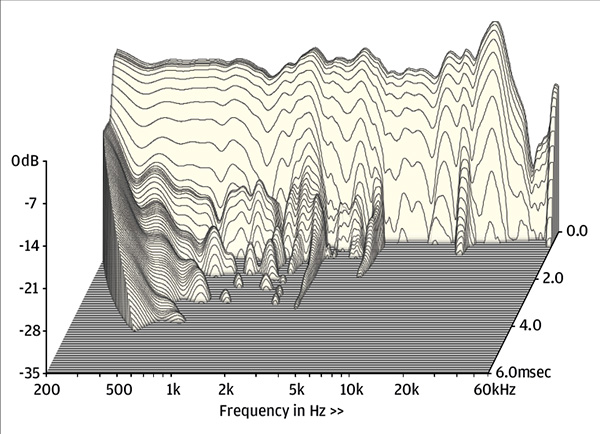
Fig.1 Radiant Clarity 4.2, CSD waterfall plot over 6ms and across a 60kHz bandwidth. The initial impulse decays quickly, leaving very minor bass modes and resonances between 2-6kHz.
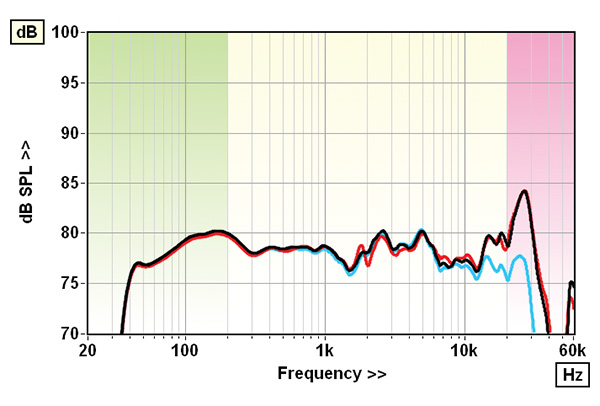
Fig.2 Radiant Clarity 4.2, frequency response including nearfield, summed bassdriver plus passive radiators (green shaded area), freefield corrected to 1m at 2.83V (yellow shade), ultrasonic (pink shade). Left, black; right, red; ±15°, blue.
The Clarity 4.2's PTT4.0PR-NL2-03 passive radiators are specially modified, with slightly heavier membranes to further reduce the tuned resonance frequency. In practice, the sharp 41Hz tuning of these two Ushindi passive radiators draws out the 59Hz (–6dB) rolloff of the front-facing 100mm Purifi unit to a diffraction-corrected 37Hz. This is very low for the box size, but the rolloff is also very steep beyond this point (green shaded area, fig.2).
Measured at the standard 1m, the forward response is very flat (fig.2). The largest irregularities appear above the crossover at 2.3kHz, but these are a mere ±2.0dB and ±1.8dB, respectively. Pair matching is a tight 0.8dB (ref. 200Hz– 20kHz). Minor resonances are present on the CSD waterfall (fig.1) between 2–6kHz. the figure shows one of the two samples; the other was a bit different. The AMT tweeter is broadly free of resonances outside the main breakup mode at 26kHz and offers a full 39kHz extension (pink shaded area, fig.2). That said, Radiant acknowledges that the speaker is "hot" on axis and recommends a 20° toe-in (blue trace, fig.2).
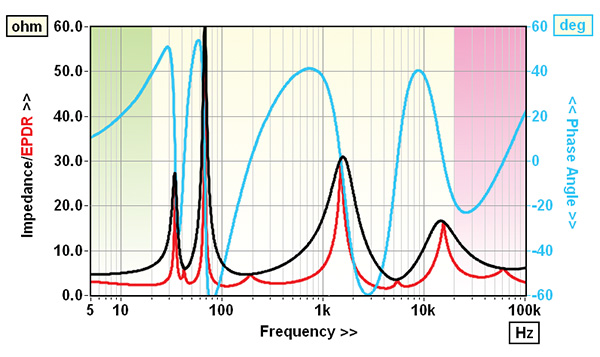
Fig.3 Radiant Clarity 4.2, impedance modulus (black) and phase (blue) and EPDR (equivalent peak dissipation resistance, red) over an extended, 5Hz–100kHz bandwidth, yellow shade; infrasonic, green shade; ultrasonic, pink.
Fortunately, there's no double whammy. The Radiant Clarity 4.2's low sensitivity is not tied to a punishing load. It may require a lot of volts, but it's not especially current-hungry. The 4 ohm rated impedance is warranted thanks to the 3.5 ohm minimum impedance (fig.3), but this is at a high 5.3kHz where maximum +40/–60° swings in phase angle contribute to a manageable 1.6 ohms/4.3kHz minimum EPDR.—Paul Miller