It wasn't too many years ago that no audio perfectionist would even consider owning speakers having woofers of less than a 12" diameter. Everyone knew that it took a BIG speaker to reproduce real bass, and pointed at the size of a double bass and an organ bass pipe as proof that there was no way of circumventing that particular law of physics. Consumer audio products, which boasted 5" "woofers," were derided by the knowledgeable as outright frauds. But in recent years loudspeaker design has been going through a slow but productive evolutionary process, which has proven to even the most skeptical that, while you can't break a law of physics you can certainly bend it a lot.
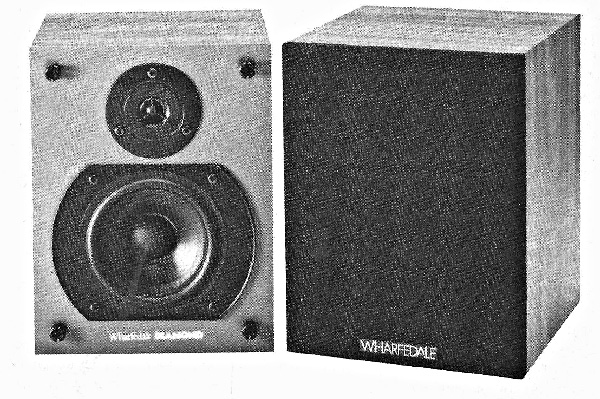
Of course, as we are constrained to point out in every review of every little box, small speakers don't produce any deep bass. A 40Hz fundamental is still as far from the capability of a mini-speaker as it ever was, but what has changed is the quality of small-speaker bass above that limit. As speaker design has become more of a technology than a black art, manufactuers have learned how to balance efficiency, low-end range, and LF resonance against each other in order to come up with systems that sound as though they produce much deeper bass than they really do. Most of these design refinements have turned up in systems in the $300–$400/pair price range, which has long been what we considered the least you could pay for speakers and still get acceptable sound. The Wharfedale Diamonds almost forced us to reconsider that judgment.
Although we did request the loan of a pair of Diamonds for testing, my first glimpse of them and their ridiculously low price tag caused second thoughts. I don't like to give bad reviews to products that are so inexpensive they can be assumed to be lousy, but these sure didn't look very encouraging. Well, Sir ... The sound of these silly-looking little things came as a shock. When auditioning, I usually respond first to overall balance, then to colorations (or freedom therefrom), then to range and smooth ness, and finally to imaging and soundstage presentation. My initial response to the Diamonds was disbelief! They are among the best balanced speaker systems I have heard! And they do not do poorly enough in any other area to discourage me from saying that they are among the most listenable speakers I have heard in the under-$300 class.
There is, however, a lot of music filtered out by the Diamonds. Subjectively, they sound flat to around 70Hz with usable output to around 60. You don't hear much below that, yet even so there is a surprising amount of weight and body to the sound. Wharfedale recommends placing the Diamonds close to the rear wall of the listening room, but I found this to produce too much low end in my room. (Other rooms will, of course, behave differently.)
Like practically every tiny speaker system I have heard, they image superbly, producing (from minimally-miked recordings) a very wide and deep soundstage extending to slightly beyond the speakers, stable and specific imaging of instruments, a coherent left-to-right spread (with no center hole or bhunching), and a somewhat exaggerated impression of front-to-back depth. Detail and clarity are quite good, but, in comparison with the best speakers, the Diamonds are noticeably veiled and a trifle grainy. Unlike most audiophile systems, the Wharfedale Diamonds do not have a markedly laid-back (sucked-out) middle range. Instrumental timbres, including the lower brasses, are surprisingly well rendered, albeit with a somewhat thin tonality.
In fact, the only real problem I noticed in these speakers was an increasing tendency toward some high-end sizzle when the system was turned up to levels above moderate, This problem colors vocal sibilants, brushed cymbals, and massed violins, and while it is not a serious problem in itself, it could well become one in the context of the kind of components that these inexpensive speakers are likely to be used with. Virtually every flaw that one finds in moderately priced amplifiers, preamps, and cartridges adds roughness and edginess to the high end, and this situation is not going to be helped one bit by these speakers. The Diamonds will play quite loudly (up to 90-some dB) without other evidence of strain, but when the volume goes up, the ol' Fletcher-Munson effect comes into play and that slight high end problem becomes doubly audible.
If their only faults were ones of omission, I would have given these a minor rave review with a clear conscience, not because they are serious competition for an Infinity IRS (obviously), but because they do so well through the fairly modest range they are designed to encompass. That small but pronounced HF resonance, however, could be a liability which cannot easily be overlooked. If your hearing dies at 12kHz, you won't hear it at all. My hearing goes out beyond that point, enough so that I heard the problem but was not driven crazy by it. But if you're one of those rare souls blessed (cursed?) with a 20kHz upper limit, you probably won't be very happy with the Diamonds.
For the rest of our readers—who I suspect are in a large majority&mdash.the Diamonds are the most inexpensive speaker I've come across that can be recommended.
Footnote: Subsequent Stereophile reviews of Wharfedale Diamond-series standmount loudspeakers can be found here, here, here, and here, and John Marks's review of the history of Wharfedale book, A Pair of Wharfedales, can be found here.—Ed.
Footnote: Subsequent Stereophile reviews of Wharfedale Diamond-series standmount loudspeakers can be found here, here, here, and here, and John Marks's review of the history of Wharfedale book, A Pair of Wharfedales, can be found here.—Ed.