Herb Senior raised me to be a wrench twirler. A problem solver. A mechanic. Not an intellectual. Or an artist. Following his example, I've devoted my life to measuring, cutting, and fastening. To putting things together.
Wherever I travel, I see pipes and wires and steel girders and concrete before I see trees and houses. I evaluate the cultures of the places I visit by what I perceive as the IQ of their infrastructure and the skills of their builders.
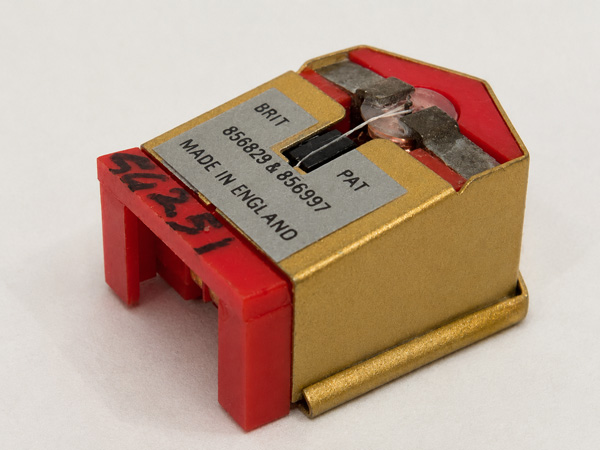
My first impressions on my first visit to Germany were amazements: It seemed that everywhere I looked, Germans had designed and built everything, from utility poles to toilet bowls, smarter than we did. I felt exactly that way about British people as I installed the London Decca Super Gold Type II phono cartridge on my LP Gear headshell It's a little phono-bob bursting with bright British ideas.
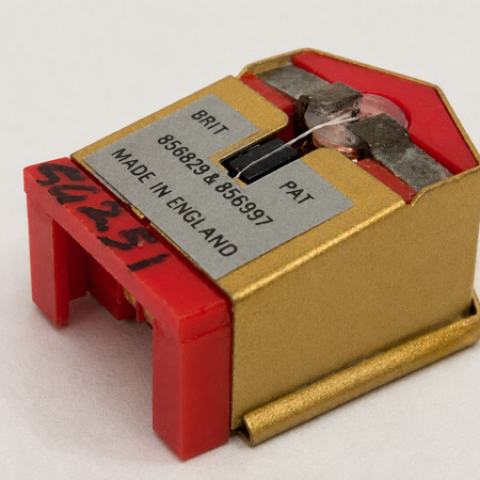
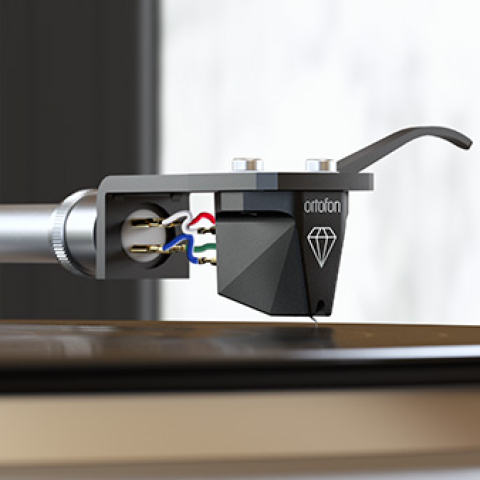
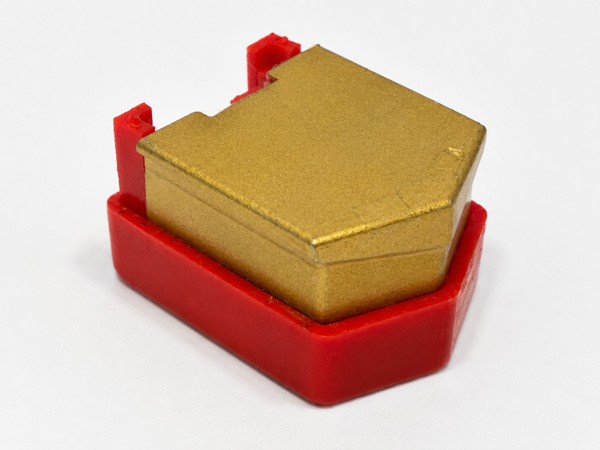
The Super Gold Type II's unique physical form results from the originality of its design precepts. For example, on the back of the Super Gold's iconic, bright-red, L-shaped mounting bracket, the Type II's pure-silver connector pins are splayed open, with each pin pointing outwards in a different direction. This puts maximum space between pin tips. I laughed out loud at how easy that small, smart change made connecting and dressing the headshell wires. Why doesn't everybody do this?
Then there's the Type II's pointy metal body, which, on this new Type II, is finished in gold Cerakote, a ceramic-polymer composite that's used for (among other things) painting race car headers because it is hard and durable and adheres extremely well to metal, is stable at high temperatures, and resists corrosion. I presume it damps loose energy, too.
A favorite Decca innovation is the Super Gold's lipstick-red plastic stylus guard. It is a well-considered design that is easy and safe to put on and take off.
Innovative, high-IQ design work is even more evident where it matters most: in the Type II's stylus-cantilever assembly and its electromagnetic circuitry. I'll say more about this below.
 London Decca history
Founded in 1929 primarily as a record label specializing in leading-edge recording technology, London Decca began making phonograph cartridges in 1965. Their Special Products division introduced the Super Gold model in 1985. According to their website, in 1989 London Decca's then-owner Racal decided to close Decca Radio & TV and its hi-fi division, after which the Decca name was sold to Tatung, a multinational corporation based in Taiwan.
At the same time, Decca granted a license to continue to manufacture the cartridges under the London brand name to Decca engineer John Wright. Worldwide distribution and service and repair were moved to Brian Smith of Presence Audio. That agreement with Decca expired in the early 1990s, whereupon Wright continued manufacturing cartridges under the London brand name, introducing refinements over the years (footnote 1).
By 2023, it was time for Wright to retire. Andy Whittle of Rogers and Audio Note owned a Super Gold cartridge. He had communicated with Wright about having it serviced. When he learned of Wright's retirement, he got in touch, and a change of ownership was arranged. Wright taught Whittle everything he needed to continue production and service (footnote 2).
I have good memories of Andy Whittle from my Audio Note days. I remember somewhere buying some model (I can't remember which) of London cartridge around 1992 and breaking off the cantilever—on the second day I used it. For one day, I thought it was the best cartridge I'd ever encountered: Tone was Quad ESL-level true. But unlike those old dynamics-challenged Quads, dynamics and transient speed were the Decca's main attractions.
What was gold is new again
Whittle's company is called London Decca, like the original. Its sales and marketing are handled in the US by the affable, knowledgeable Stewart Suda. Andy Whittle oversees manufacturing and service in the UK. Under Whittle's stewardship, London Decca's cartridge lineup has been distilled to five distinct models: the Maroon Mono Type II ($1650), the Maroon Type II ($1750), the Super Gold Type II ($2895), the Jubilee ($5895), and the brand-new Reference Type II ($8495). Whittle has made some smart electro-mechanical improvements to the cartridge lineup. He changed the material of the Super Gold's stylus carrier from hard-sprung steel to a thicker, soft iron to "improve vertical compliance and tracking ability." According to Andy, "Soft iron has a different permeability and gives a more natural sound; piano has more structure, sax more air." Another equally important change in the new Super Gold is how Whittle has opted to replace the original's samarium cobalt magnets with lower-power Alnico 5 magnets, which Andy says "... yields a more linear magnetic circuit." The original mild steel lateral poles are now gold plated and made of "radiometal 4550." The sonic significance of these changes to the Super Gold's stylus assembly and magnetic circuit should not be underestimated.
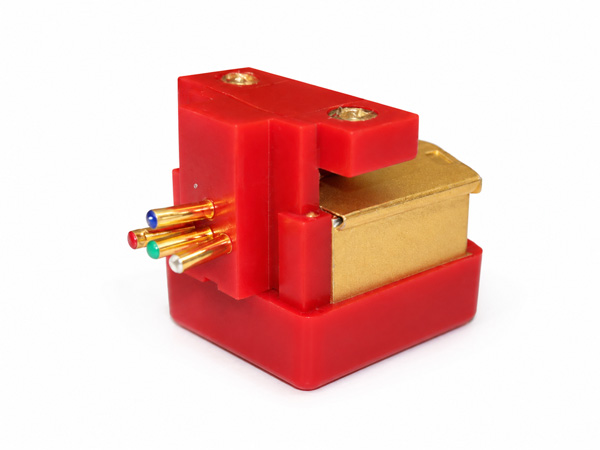 Setup: These days, I favor cartridges where I can see the full cantilever sticking out in front, since it makes precise setup easy. The Super Gold is not that kind of cartridge. In fact, the London Deccas are not quite like any other cartridge.
On its bottom, the Super Gold has a tiny little pointy thing—its line-contact stylus—tied back with a twisted string attached to the hidden-from-sight L-shaped cantilever (also called a stylus carrier). The Gold's flat-bottomed "tin can" body rides low, no more than 2mm from the record surface. Even with good eyes, a strong light, and a magnifying glass, I struggled to see it while doing my best to set overhang, azimuth, and zenith. As I struggled to get it right, I listened at various un-right stages and noticed that the II did not seem fussy about setup. That ship's prow point on the Super Gold front is there so that users can aim the hidden needle into the groove of their choice.
The Super Gold Type II's recommended "playing weight" is 1.8–2.0gm. Lateral compliance is specified as 15 × 106 cm/dyne, while vertical compliance is listed as a lower 10 × 106 cm/ dyne. DC resistance (internal impedance) is 2k ohms. The output voltage is 4mV.
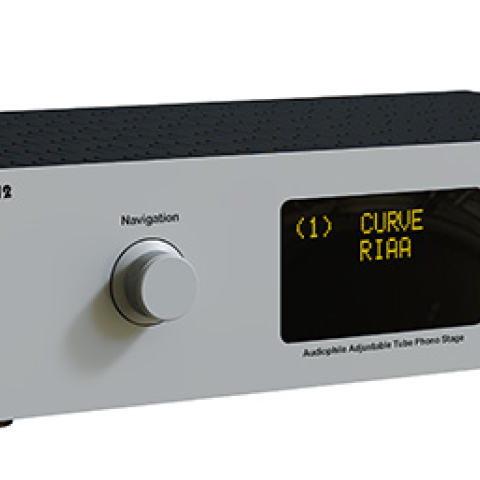
I started by connecting the Super Gold to the moving magnet input on the Lab12 Melto2 phono stage, with 200pF total load capacitance and a load resistance of 47k ohms. I thought the Type II sounded like I hoped and imagined it would: quick-revving, with extraordinary tone and sensational dynamics. That's what Decca cartridges are known for, and that's what I heard.
According to London Decca's specifications, 33k ohms is the "optimum" load, and the Lab12 Melto2 let me set it to 32k ohms. Both 47k and 32k sounded perfectly fine playing a variety of discs, but I stuck with 32k ohms for most of my listening because I thought it sounded slightly more supple and transparent.
I laughed when Spin Doctor Michael Trei told me, "Decca cartridges handle like go-karts ... or like the British-made Ariel Atom." That's a tube-framed street-legal one-seater sports roadster that doesn't have a body (footnote 3). I knew what he meant: The stylus turns on a dime and stays glued to the track. But there's more to the Super Gold Type II than its Lotus-like handling: Attached to my Sorane SA-1.2 tonearm, the Super Gold Type II played relaxed, smooth, dead quiet, and supple.
I've driven a few high-power go-karts, and they were the opposite of quiet, smooth, or supple. In my system, with my Falcon LS3/5a's powered by SE 300Bs, the Type II did not feel like a go-kart. It felt smooth as British custard and Jaguar XJ6-luxurious, with leather seats and a proper windscreen.
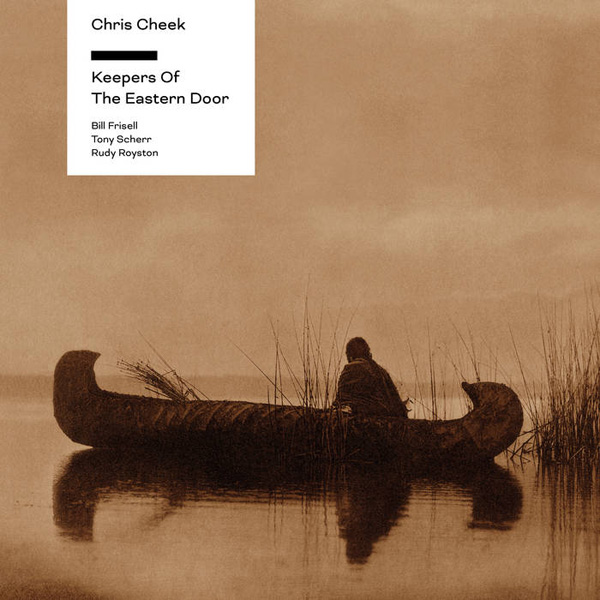 Listening: After playing maybe 10 sides to loosen up the stylus carrier, I put on Keepers of the Eastern Door performed by Chris Cheek on sax, Bill Frisell on guitar, Tony Scherr on bass, and Rudy Royston on drums (Analog Tone Factory ATF 002).
I threw it on thoughtlessly because it was laying in front of me, but by the end of side 1 I felt spiritually converted and baptized by the religion of the music they were playing and gobsmacked by the sound. I had played this disc several times before, with a variety of high-toned moving coil cartridges, so I knew how good this LP sounded—it was after all recorded by James Farber at Power Station New York "live to ½ inch two track on a custom tube Ampex 351 at 30ips" and mastered and cut by Bernie Grundman—but it had never sounded as lifelike and physically present as it did with the Super Gold Type II. While playing this record, my system oozed tubey analog.
There are many varieties of correct and authentic tone, and some of them might seem truer to life than others, but none I've heard sounded truer than the Super Gold Type II did playing Keepers of the Eastern Door.
And what the Decca's pure, authentic tone accomplished was to show me why and how I should appreciate the music it was reproducing. It did this overtly, showing me myriad new pathways into the artist's mind. The Type II offered this level of engagement because the sound was straightforward and unfettered.
When I describe reproduction as "well-sorted," I mean that all the sound bits recovered are laid out in their right places. All the instruments and musicians are arranged and separated from each other. But when random bits are missing, in their wrong place, nebulous, or blurred, the sound will not feel whole or solid or of a piece. And folks, better even than My Sonic Lab's Ultra Eminent Ex, or my Etsuro Urushi Cobalt Blue, this Decca Super Gold fit all the sound bits together into a complete, exquisitely sorted whole that felt distinctly of a piece. That, I reckon, is the Super Gold Type II's greatest accomplishment.
To further assess this cartridge's sorting abilities, I tried Erik Satie Mercure—Socrate (EMI C 069-11677). The Super Gold had already helped me find spirituality and poetic rigor in a recording I had dismissed as noodling cocktail jazz. The Decca did that again with this Erik Satie.
Satie is an artist I respect but have not yet learned to enjoy. I knew this disc, with Pierre Dervaux conducting the Orchestre de Paris, would be a good sorting test, but I never thought I'd get sucked into the drama and poetics of Satie's brand of early Modernism. I never thought I'd be eyes-closed listening to Erik Satie. But with the Decca cartridge, this record felt so much "of a piece" I found my brain locked inside its workings studying the architecture of its building blocks. Once again, the London Decca Super Gold Type II exploited its propensity for evenly sorted wholeness to show me why and how I should appreciate the music it was playing. Before the Super Gold, I never imagined "evenly sorted wholeness." Now I look for it everywhere.
Folks, if you've never experienced a Decca cartridge, I encourage you to try one now. The time in audio history is right. It will give you a radically fresh look at your record collection—I promise. It could make you buy more records. It could make you a better listener. It could force you to join a cult. It could be the last cartridge you'll ever want.
 Tails from the recent past
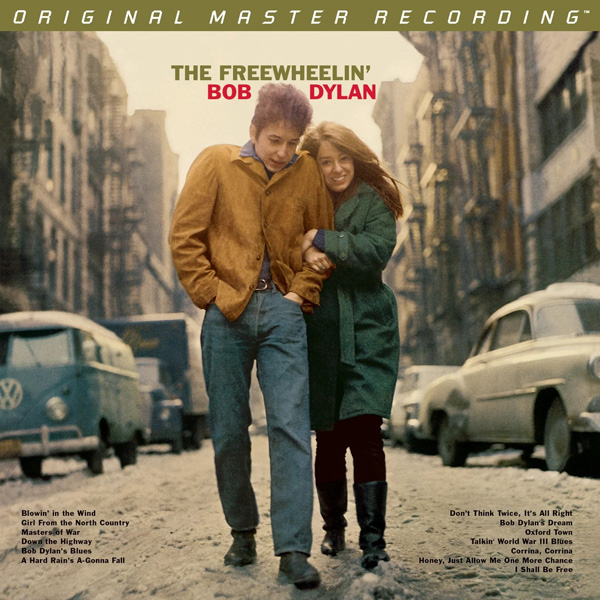
I like all genres of music, just as I like all types of people. I believe the essence of every global culture is embedded in its rhymes and rhythms, and I believe I've built a sound system that specializes in conveying cultural essence. It pleased me greatly when my old pal and writing guide Alex Halberstadt came over, and my system was playing its earnest best. (My system never sounds good when I play it for visitors.) I began our afternoon with "Honey, Just Allow Me One More Chance," from my current repeat-play obsession, MoFi's 2021 reissue of Bob Dylan's 1963 album Freewheelin' (MFSL 2-378). On this disc, Bob's voice and guitar are as dead-on tone- and presence-wise as they were on a 15ips dub from a master tape I'd heard only a week before at my friend Walter's house. I imagined this disc would impress Alex because I played it the minute I got home from hearing the master tape three times, and I was surprised by how much the MoFi disc sounded like Walter's tape. Imagine raw and unprocessed, with absolute transparency. Transients and details were barely noticeable because they were absorbed into the physicality of Dylan's voice and acoustic guitar. What we experienced in my room was Bob from Minnesota—up close—spilling out the wonderments of his creative mind.
Together, we fell into a shared trance with Dylan singing mind-twisting compositions such as "Talkin' World War III Blues," "A Hard Rain's a-Gonna Fall," and "Masters of War"—all a far cry from "Surfin' U.S.A." or "She Loves You," which were big hits that summer. Alex wasn't born yet, and I was an impressionable 14-year-old with a penchant for music made by black people from the South. Then this white boy from the north released this album, and it felt timeless and important for its dramatic originality, as if it existed in a different realm than any music that preceded it.
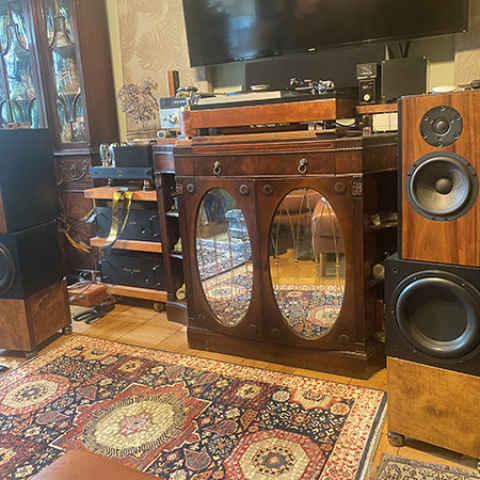
I am telling you about Alex and me in my tiny room is because that day my system was making me proud. My curated assemblage of loaner components was letting each disc be its unabashed self. My Falcon speakers were doing their best imitations of Quad ESLs. With top-level Ray Tubes, Lundahl amorphous core output transformers, and Audio Note caps and resistors, the Elekit TU-8900 amplifiers seemed perfectly matched to Dylan's voice and my LS3/5a's. I've put years into creating a system that shows off presence, vibe, and artists' personalities. That day it made Dylan sound like a god, and it played the devil out of his harmonica.
 My Sonic Lab's Ultra Eminent Ex moving coil mounted on EMT's 912-HI tonearm—loaded at 400 ohms into the Lab12 Melto2 phono stage—made the system sound deep and dark with peering-into-the-abyss transparency. Nothing hyped or exaggerated. No hailstorm of detail. No too-tight bass. No etched highs. Just Dylan airing out his creative powers.
I gave Alex free rein over the record player, which right away inspired him to look through all 300 of my records, finally choosing a fantastic Maria Callas recital from 1958: Callas portrays Verdi Heroines (Warner Classics/Parlophone LP 0190295844431). I have no doubt that Maria Callas radiated the same high-wattage persona in her private life as she did on stage and in the recital hall. To me she stands with Marlene Dietrich and Barbara Stanwyck as a grand dame of the 20th century. I call her the Queen of Dramatic Tension. Her voice quivers my heart, especially in recital.
My system was making Maria sound neither amped up nor repressed—just vivid and mesmerizing. I credited the My Sonic Lab Ultra Eminent Ex moving coil and the EMT 912-HI tonearm for the smooth, relaxed clarity of her entire vocal range; that's what this arm and cartridge specialize in. The top octaves of Callas's vocal range were beautiful to observe, and when the stars lined up induced goosebumps.
 The Shure SC35C
In my review of Pioneer's excellent PLX-1000 turntable in Gramophone Dreams #3, I wrote, "the Shure M44-7 cartridge"—included with the Pioneer—"was unlikely to satisfy many audiophiles. The M44-7 is a killer at the job it was designed to do which is: make people feel good, keep the party going, and not break down under abuse. [But] I couldn't live with it for as long as a day."
When I wrote that, I had completely forgotten that between 1975 and 1977, I used a 44-7 all the time on my Technics SL-1200 turntable. It was on there because it made punk, ska, and reggae records sound like they sounded coming from jukeboxes. It punched through my hazy-sounding stacked Advents and was perfect for coked-up loft parties where total strangers used my record player. I don't remember the 44-7 ever breaking, but if it ever did, J&R Records sold replacement styli for $19.
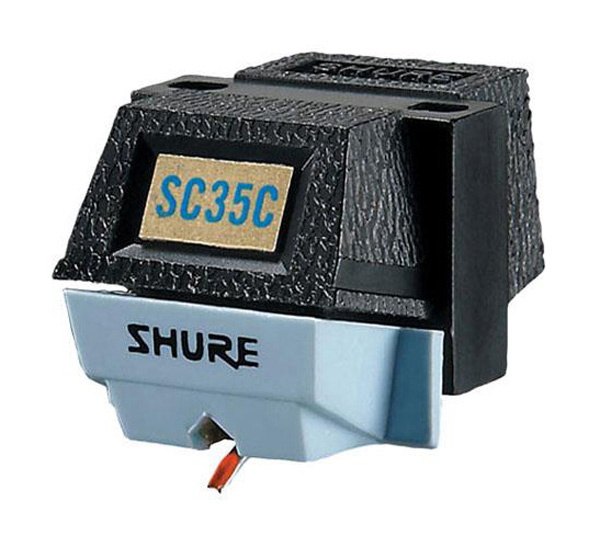
When I moved to Brooklyn, I began buying lots of classical records, which caused my people at J&R to move me up to the Shure SC35C (footnote 4). Compared to the 44, it showed greater ease and more as it plowed through big orchestral discs. The SC35C gave me flawless tracking and, of all things, nuance—something the 44-7 did not specialize in.
This was the fall of 1978, and suddenly, because of how the SC35C handled the subtler aspects of note attack, I got sucked into the history of solo piano. I listened to David Dubal on WQXR FM radio. Under his guidance with this new, improved Shure, I could hear fingers touching keys, wood hammers hitting metal strings, and high-powered energy pulsing from soundboards. Dubal showed me who these pianists were and taught me how to listen to them (footnote 5).
I've had a decades-long relationship with the Shure SC35C, and even now, after all those Koetsu, Dynavector, and Audio-Technica MCs, I'm happy when I'm using it. It's a sturdy, almost-free moving magnet that puts out 5mV and tracks at 4–5gm. It's been out of production since 2018, but 1974 to 2018 is a long run, and my Google search indicated that LP Gear is selling what I presume are NOS SC35C cartridges for $157 and SS35C replacement styli for $119. Used ones on eBay go for about $50.
I know it's impossible for a conical stylus on an aluminum cantilever to deliver anything close to the liquid transparency of a My Sonic Lab Ultra Eminent Ex or the transient excitements of the Dynavector XX-2A, but the SC35C reproduces the density of piano notes exceedingly well. It's worth noting that, after sitting for months, the more new hours I put on my well-used 35C, the more dynamic and transparent it became.
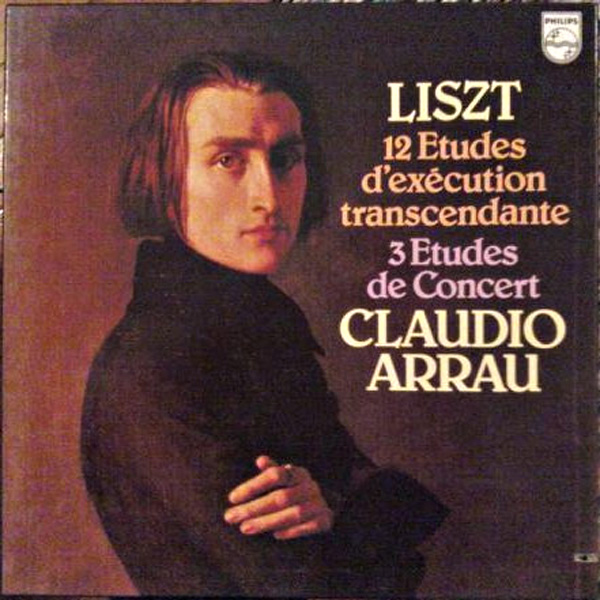 While listening to Franz Liszt's 12 Etudes d'exécution transcendante played by Claudio Arrau (LP, Dutch Philips 6598 490), I realized that the SC35C came out in '74 and that this disc was released in 1977. That means that the disc and the cartridge are period correct and that I might have heard David Dubal play these Liszt etudes on his WQXR FM program "Reflections from the Keyboard." The SC35C was co-developed by the BBC and was popular in broadcast studios, so David might have used it for his show. That program and David's book3 have played a significant role in teaching me how to listen and what to listen for.
In 1978, at the urging of my J&R gurus, I played these Philips discs at home with a Shure V15 III, which tracked at 1.5gm and excavated a lot more small-scale data than the less expensive SC35C. Symphonies and concertos came through the "III" better sorted, with much less grainy generator noise. But with he III, Liszt sounded snoozy compared to how it did with the SC35C dynamo. Pianist Claudio Arrau played this Liszt like Dubal said he did: "In the Liszt literature, Arrau is titanic. For him, Liszt is never small minded or merely glittering. He finds in Liszt a large landscape—the nature poet, the gypsy, the inventor of an unprecedented technique, a Faustian, a religious ecstatic, and an impressionist." For me, Liszt is an authentic visionary whose art conjures tempestuous, lucid dreaming, and that's exactly how the SC35C presented him.
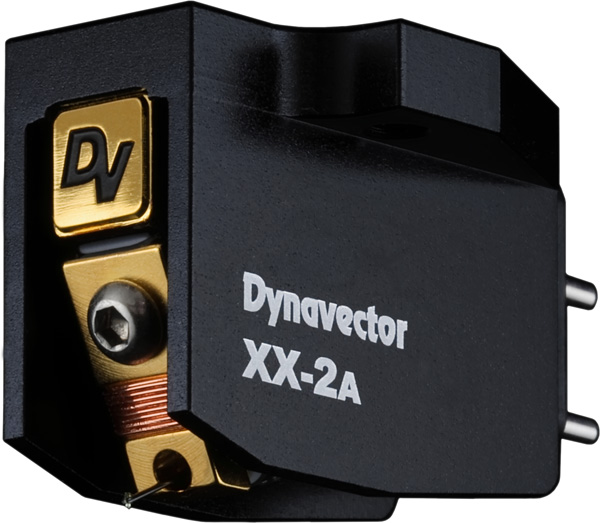 The Dynavector XX-2A
The first thing I noticed when I switched from the Shure SC35C to the Dynavector XX-2A moving coil (footnote 6) was how much smaller, quieter, and more delicate Claudio Arrau's piano became. With the 35C, the piano was an arm's reach away and overtly loud. I pictured the microphones just above the strings. With the Dynavector, the soundstage didn't shrink—the piano did. The second thing I noticed was how speedy, micro-detailed, and refined the sound had become. By "refined," I mean that grain and noise had vanished almost completely. Transparency dominated. Edge focus was sharper and individual notes felt more complete. The air surrounding notes felt ethereal. The XX-2A put speed and energy up front.
The SC35C's conical stylus offers only 20dB of channel separation, while the XX-2A's Pathfinder line-contact stylus delivers 30dB. That extra 10dB enhances transparency, exposes detail, and draws out image forms. But it does not increase presence or immediacy, which in my estimation the XX-2A lacked when loaded with a 100 ohms shunt resistance. Fortunately, those traits returned when I loaded it at 37 ohms through the Lab12's Lundahl SUTs. At that setting, the XX-2A moving coil cartridge closely matched the force and immediacy of the SC35C moving magnet, without sacrificing an iota of transparency, detail, or fluidity.
Vintage, retro, and exotic phono cartridges have made fascinating guests to my listening room, but so far none have been more captivating or satisfying than London Decca's Super Gold Type II. Bravo, Andy Whittle!
Footnote 1: London Decca cartridges were reviewed for Stereophile by Martin Colloms in 1995, by Michael Fremer in 2005, and by Art Dudley in 2015.—Ed.
Footnote 2: See londondecca.com/ld-shop/p/super-gold. London Decca, 2582 Clive Street, Green Bay, WI 54313. Tel: (920) 965-8390. Email: salesoffice@londondecca.com. Web: londondecca.com
Footnote 3: See youtube.com/watch?v=kQpq6iwGwlE.
Footnote 4: The Shure SC35C and replacement styli are no longer made, but they're still available at LP Gear, 3024 Via Venezia, Henderson, NV 89052. Web: lpgear. com.
Footnote 5: David Dubal, The Art of the Piano, Amadeus Press, Cambridge, UK, p.21.
Footnote 6: Dynavector Systems Ltd., 3-2-7 Higashi-Kanda, Chiyoda-ku, Tokyo 101- 0031, Japan. Tel: +81 (0) 3-3861-4341. Web: dynavector.com. US distributor: Toffco/Dynavector USA, 8116 Gravois Rd., St. Louis, MO 63123. Tel: (314) 454-9966. Web: dynavector-usa.com.
London Decca historyFounded in 1929 primarily as a record label specializing in leading-edge recording technology, London Decca began making phonograph cartridges in 1965. Their Special Products division introduced the Super Gold model in 1985. According to their website, in 1989 London Decca's then-owner Racal decided to close Decca Radio & TV and its hi-fi division, after which the Decca name was sold to Tatung, a multinational corporation based in Taiwan.
Whittle's company is called London Decca, like the original. Its sales and marketing are handled in the US by the affable, knowledgeable Stewart Suda. Andy Whittle oversees manufacturing and service in the UK. Under Whittle's stewardship, London Decca's cartridge lineup has been distilled to five distinct models: the Maroon Mono Type II ($1650), the Maroon Type II ($1750), the Super Gold Type II ($2895), the Jubilee ($5895), and the brand-new Reference Type II ($8495). Whittle has made some smart electro-mechanical improvements to the cartridge lineup. He changed the material of the Super Gold's stylus carrier from hard-sprung steel to a thicker, soft iron to "improve vertical compliance and tracking ability." According to Andy, "Soft iron has a different permeability and gives a more natural sound; piano has more structure, sax more air." Another equally important change in the new Super Gold is how Whittle has opted to replace the original's samarium cobalt magnets with lower-power Alnico 5 magnets, which Andy says "... yields a more linear magnetic circuit." The original mild steel lateral poles are now gold plated and made of "radiometal 4550." The sonic significance of these changes to the Super Gold's stylus assembly and magnetic circuit should not be underestimated.
Setup: These days, I favor cartridges where I can see the full cantilever sticking out in front, since it makes precise setup easy. The Super Gold is not that kind of cartridge. In fact, the London Deccas are not quite like any other cartridge.
On its bottom, the Super Gold has a tiny little pointy thing—its line-contact stylus—tied back with a twisted string attached to the hidden-from-sight L-shaped cantilever (also called a stylus carrier). The Gold's flat-bottomed "tin can" body rides low, no more than 2mm from the record surface. Even with good eyes, a strong light, and a magnifying glass, I struggled to see it while doing my best to set overhang, azimuth, and zenith. As I struggled to get it right, I listened at various un-right stages and noticed that the II did not seem fussy about setup. That ship's prow point on the Super Gold front is there so that users can aim the hidden needle into the groove of their choice.
The Super Gold Type II's recommended "playing weight" is 1.8–2.0gm. Lateral compliance is specified as 15 × 106 cm/dyne, while vertical compliance is listed as a lower 10 × 106 cm/ dyne. DC resistance (internal impedance) is 2k ohms. The output voltage is 4mV.
Listening: After playing maybe 10 sides to loosen up the stylus carrier, I put on Keepers of the Eastern Door performed by Chris Cheek on sax, Bill Frisell on guitar, Tony Scherr on bass, and Rudy Royston on drums (Analog Tone Factory ATF 002).
I threw it on thoughtlessly because it was laying in front of me, but by the end of side 1 I felt spiritually converted and baptized by the religion of the music they were playing and gobsmacked by the sound. I had played this disc several times before, with a variety of high-toned moving coil cartridges, so I knew how good this LP sounded—it was after all recorded by James Farber at Power Station New York "live to ½ inch two track on a custom tube Ampex 351 at 30ips" and mastered and cut by Bernie Grundman—but it had never sounded as lifelike and physically present as it did with the Super Gold Type II. While playing this record, my system oozed tubey analog.
Tails from the recent pastI like all genres of music, just as I like all types of people. I believe the essence of every global culture is embedded in its rhymes and rhythms, and I believe I've built a sound system that specializes in conveying cultural essence. It pleased me greatly when my old pal and writing guide Alex Halberstadt came over, and my system was playing its earnest best. (My system never sounds good when I play it for visitors.) I began our afternoon with "Honey, Just Allow Me One More Chance," from my current repeat-play obsession, MoFi's 2021 reissue of Bob Dylan's 1963 album Freewheelin' (MFSL 2-378). On this disc, Bob's voice and guitar are as dead-on tone- and presence-wise as they were on a 15ips dub from a master tape I'd heard only a week before at my friend Walter's house. I imagined this disc would impress Alex because I played it the minute I got home from hearing the master tape three times, and I was surprised by how much the MoFi disc sounded like Walter's tape. Imagine raw and unprocessed, with absolute transparency. Transients and details were barely noticeable because they were absorbed into the physicality of Dylan's voice and acoustic guitar. What we experienced in my room was Bob from Minnesota—up close—spilling out the wonderments of his creative mind.
My Sonic Lab's Ultra Eminent Ex moving coil mounted on EMT's 912-HI tonearm—loaded at 400 ohms into the Lab12 Melto2 phono stage—made the system sound deep and dark with peering-into-the-abyss transparency. Nothing hyped or exaggerated. No hailstorm of detail. No too-tight bass. No etched highs. Just Dylan airing out his creative powers.
The Shure SC35CIn my review of Pioneer's excellent PLX-1000 turntable in Gramophone Dreams #3, I wrote, "the Shure M44-7 cartridge"—included with the Pioneer—"was unlikely to satisfy many audiophiles. The M44-7 is a killer at the job it was designed to do which is: make people feel good, keep the party going, and not break down under abuse. [But] I couldn't live with it for as long as a day."
While listening to Franz Liszt's 12 Etudes d'exécution transcendante played by Claudio Arrau (LP, Dutch Philips 6598 490), I realized that the SC35C came out in '74 and that this disc was released in 1977. That means that the disc and the cartridge are period correct and that I might have heard David Dubal play these Liszt etudes on his WQXR FM program "Reflections from the Keyboard." The SC35C was co-developed by the BBC and was popular in broadcast studios, so David might have used it for his show. That program and David's book3 have played a significant role in teaching me how to listen and what to listen for.
The Dynavector XX-2AThe first thing I noticed when I switched from the Shure SC35C to the Dynavector XX-2A moving coil (footnote 6) was how much smaller, quieter, and more delicate Claudio Arrau's piano became. With the 35C, the piano was an arm's reach away and overtly loud. I pictured the microphones just above the strings. With the Dynavector, the soundstage didn't shrink—the piano did. The second thing I noticed was how speedy, micro-detailed, and refined the sound had become. By "refined," I mean that grain and noise had vanished almost completely. Transparency dominated. Edge focus was sharper and individual notes felt more complete. The air surrounding notes felt ethereal. The XX-2A put speed and energy up front.
Footnote 1: London Decca cartridges were reviewed for Stereophile by Martin Colloms in 1995, by Michael Fremer in 2005, and by Art Dudley in 2015.—Ed.