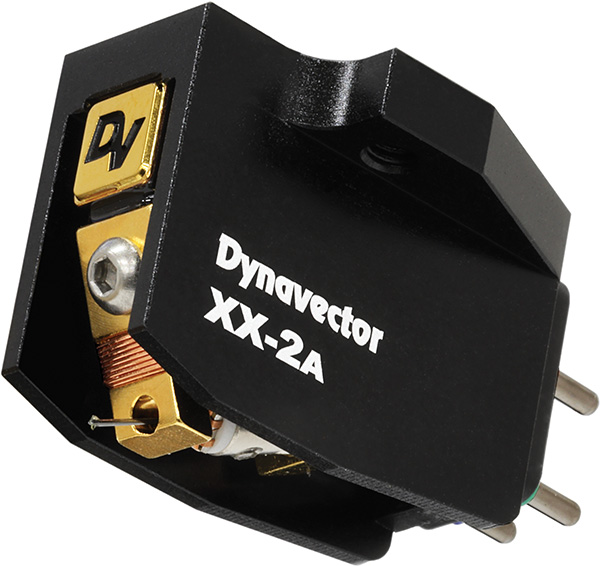
 Dynavector XX-2A Low-Output Moving Coil
Almost every Friday, I meet with a tightknit group of friends for a casual lunch where we yak away a couple of hours about anything and everything to do with hi-fi. Last Friday, my friend Bill chimed in with, "Why do so many of you reviewer guys have Dynavector cartridges?" It's true, and it's a good question. Dynavector cartridges are not the most talked-about or the most glitzy, glamorous cartridges, but people who own them sure seem to like them. I have owned a Dynavector DRT XV-1s cartridge for many years, and coming back to it after a dalliance with some other more exotic cartridge model always feels like putting on a pair of comfortable old shoes. I think one reason you don't often see splashy news about Dynavector is that the launch of an all-new model from the Japanese company is a pretty rare event. Occasionally, they introduce a new version of one of their existing cartridges, which is exactly what the XX-2A I'm covering here is. It's based on their XX series, first seen as the XX-1 in 1989. Today, Dynavector has six cartridge lines, the newest of which is the XV-1, introduced in 1999 (footnote 4). The 10X and Karat Diamond models are now well into middle age, having been around since the company began selling cartridges in the late 1970s. A great resource for researching audio gear from decades past is the online archive at worldradiohistory.com. There, you can find scanned copies of thousands of magazines, including the late great Audio. I remember as a young audiophile waiting eagerly each year for the October issue to arrive, as this was the issue with the famous Equipment Directory. In the pre-internet era, the directory was a kind of bible for researching what audio gear was out there. When Audio folded in 2000, the annual directory continued to live on as part of Stereophile partner Sound & Vision. In the early 2000s, that magazine hired me for a couple of months each summer to work on the directory issue. My job was to pore over endless spreadsheets of manufacturer-submitted specifications and other data, trying to root out clear mistakes, such as 300" woofers and cassette decks with a frequency response out to 1MHz. It was a mind-numbing task, but it sure kept me in the loop about what manufacturers and products were out there.
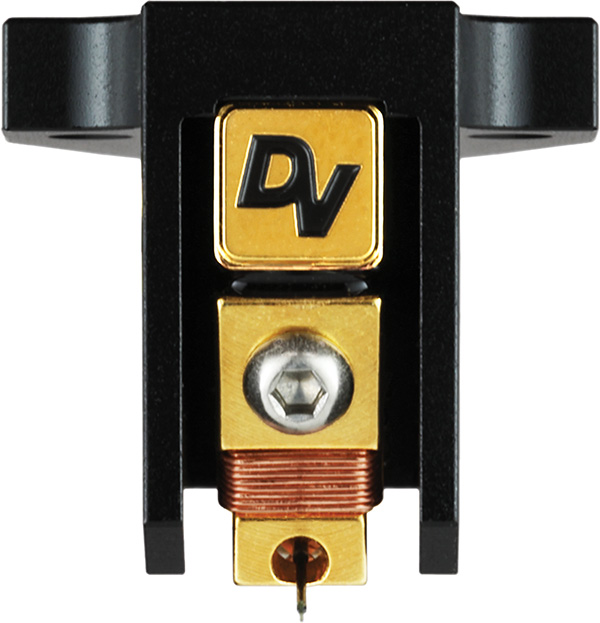 Launched 35 years ago, the original XX-1 introduced what Dynavector calls a flux dumper, a length of thin wire wrapped around the front yoke of the cartridge's generator structure (above). They found that this helps to minimize signal-modulated fluctuations in the magnetic field within the pole piece. As the first model with this feature, the XX-1 had a tiny switch on the front of the cartridge that allowed you to switch the flux dumper on and off; you could hear its effect on the sound. Since then, the flux dumper has been incorporated into all Dynavector cartridges, and on models like the XV-1 and XX-2, you can see the wire wrapped around the front yoke.
More recently, Dynavector discovered that the standard annealing process used while manufacturing the pole pieces was affecting the crystalline structure of the iron being used, constricting the permeability of the iron. They developed a new annealing process which preserves the structure of the iron, greatly enhancing its permeability. Dynavector claims that this change results in improved resolution, dynamics, and dimensionality. This new annealing process is what sets the XX-2A apart from its predecessor.
I have installed a half-dozen XX-2 MKIIs over the years but have never heard one in my own system. To make things super easy, Dynavector's US distributor Toffco sent me both the new XX-2A and the older XX-2 MKII, so I could compare them directly. Both cartridges already had some hours under them, so break-in wasn't a concern.
Launched 35 years ago, the original XX-1 introduced what Dynavector calls a flux dumper, a length of thin wire wrapped around the front yoke of the cartridge's generator structure (above). They found that this helps to minimize signal-modulated fluctuations in the magnetic field within the pole piece. As the first model with this feature, the XX-1 had a tiny switch on the front of the cartridge that allowed you to switch the flux dumper on and off; you could hear its effect on the sound. Since then, the flux dumper has been incorporated into all Dynavector cartridges, and on models like the XV-1 and XX-2, you can see the wire wrapped around the front yoke.
More recently, Dynavector discovered that the standard annealing process used while manufacturing the pole pieces was affecting the crystalline structure of the iron being used, constricting the permeability of the iron. They developed a new annealing process which preserves the structure of the iron, greatly enhancing its permeability. Dynavector claims that this change results in improved resolution, dynamics, and dimensionality. This new annealing process is what sets the XX-2A apart from its predecessor.
I have installed a half-dozen XX-2 MKIIs over the years but have never heard one in my own system. To make things super easy, Dynavector's US distributor Toffco sent me both the new XX-2A and the older XX-2 MKII, so I could compare them directly. Both cartridges already had some hours under them, so break-in wasn't a concern.
 At one point, I changed my electronics for those of another well-regarded company that shall remain nameless. I remember my deep disappointment with their performance. Little Creatures by Talking Heads was in heavy rotation at the time, and I played the song "Give Me Back My Name" (Naim) repeatedly. Ultimately, I got my wish and returned to Naim gear, though that too would pass.
While I still enjoy the Little Creatures album, "Give Me Back My Name" now brings back too many tortured memories of that time nearly 40 years ago, so to compare the XX-2 MKII and XX-2A, I played "Walk It Down" instead. Like many mid-1980s rock recordings, Little Creatures suffers from short, hard reverb on the drum kit, but the resolving power of the XX-2A lets you hear subtleties in the mix that aren't so obvious with many cartridges. Details, like how David Byrne's vocal sound changes during each line, creating a call-and-response effect, become clearer, with more contrast with the newer Dynavector. Background vocals had better-defined layering and a richer palette of tonal color.
At one point, I changed my electronics for those of another well-regarded company that shall remain nameless. I remember my deep disappointment with their performance. Little Creatures by Talking Heads was in heavy rotation at the time, and I played the song "Give Me Back My Name" (Naim) repeatedly. Ultimately, I got my wish and returned to Naim gear, though that too would pass.
While I still enjoy the Little Creatures album, "Give Me Back My Name" now brings back too many tortured memories of that time nearly 40 years ago, so to compare the XX-2 MKII and XX-2A, I played "Walk It Down" instead. Like many mid-1980s rock recordings, Little Creatures suffers from short, hard reverb on the drum kit, but the resolving power of the XX-2A lets you hear subtleties in the mix that aren't so obvious with many cartridges. Details, like how David Byrne's vocal sound changes during each line, creating a call-and-response effect, become clearer, with more contrast with the newer Dynavector. Background vocals had better-defined layering and a richer palette of tonal color.
Footnote 4: Dynavector Systems Ltd., 3-2-7 Higashi-Kanda. Chiyoda-ku. Tokyo 101-0031, Japan. Tel: +81 (0) 3-3861-4341. Web: dynavector.com. US distributor: Toffco/Dynavector USA, 8116 Gravois Rd., St. Louis, MO 63123. Tel: (314) 454-9966. Web: dynavector-usa.com.