Before I moved to the boat, I lived in a big old firehouse with a shiny brass pole and a red door. The fire engines were gone but it was still a boy-toy pilgrimage site. The first thing one noticed on entering was a red 356 Porsche coupe. Behind it was a black '32 Ford hot rod with a flat-head V8 and triple Strombergs. Behind that was a 1939 Lincoln convertible from some Godfather movie. On the second floor . . .
It was Saturday night, and I was making a soirée demonstration of some new tractrix horn loudspeakers driven by 5W single-ended amps. I had two turntables: a borrowed Linn Sondek LP12 with an Ittok arm and a Koetsu Rosewood Signature cartridge, and my own Denon DP-3000 with matching Denon DL-103 cartridge. Partway through my demo, I switched from the LP12 to the DP-3000.
Half of my audience got up and walked into the kitchen—not because they were hungry or thirsty, but because, to their minds, it was insane enough I was playing horns ("Can't you hear those horn colorations?") and a 5W amp ("There's no loudspeakers for those!"), but . . . a direct-drive turntable? These seasoned audiophiles knew better than to hang around for that kind of tomfoolery. "Can't you hear the cogging?" "What about that hunt-and-peck servo?" Frowns, wrinkled brows, mutterings. "All that motor noise . . . and, and it's made in Japan!"
My mad little protests were tiny compared to the decades-long chorus of audio reviewers and European turntable manufacturers telling audiophiles that direct-drive motor/platter/servo assemblies produce mechanical noise—chattering—that corrupts the still, black silences of the recording. They said that the servo violated the musical flow. I say that's all bunk.
In my view, high-end audio is not now, and never really was, about creating or assessing gear with the sound of live music as a reference. It's about manufacturers, engineers, and journalists (like me) talking self-serving, evangelistic, messianic crap. (Hold on—someone just threw a rock through my window.) Audio is really about staunchly held beliefs; most people can't remember where they got those beliefs, or why they believe them. Forget analog vs digital or tubes vs solid-state; the most pervasive and poorly considered belief of all is that only belt-drive turntables are worthy of audiophile consideration.
Had any of those believers ever actually compared a direct-drive, rim-drive, or idler-drive turntable to their belt-driven model, they'd have realized that each of these technologies presents music with varying amounts of force, weight, and forward momentum. A human voice, an electric guitar, or a piano—all sound more or less real with the best of each type. But do you know which type best reproduces the scale, impact, and dynamic presence of live music? Direct drive.
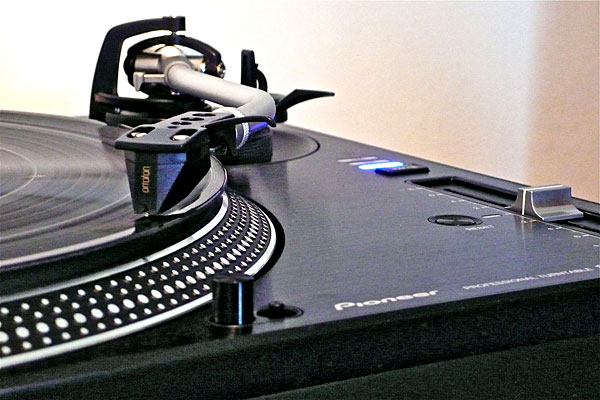
Don't believe me? Be brave and try Pioneer's PLX-1000 direct-drive record player, introduced in August 2014 (footnote 1). It costs only $699, complete with tonearm. But be forewarned: The PLX-1000 has no audiophile approval rating. If you require an audiophile-endorsed direct-drive, you'll have to spend a little more and try the Brinkmann Audio Bardo ($9490 without arm), or the Grand Prix Audio Monaco ($19,500 without arm), or the truly unassailable VPI Classic Direct Drive ($30,000 with arm)—all of which have been reviewed in Stereophile.
A little backstory . . .
One fun night in 1968, at New York City's Salvation II nightclub, MC Francis Grasso put on a pair of headphones and, using his Thorens TD 124 turntable, began "slip-cueing" and "beat-matching" one dance record into another. The DJ revolution had begun. In 1969, in an attempt to break into the radio broadcast market, Technics introduced the first direct-drive turntable, the SP-10. The following year, Technics added the beautiful SL-1100. DJs gravitated to both models because their rugged high-torque motors allowed almost instant pushbutton startup of a pre-cued musical selection. Sensing even larger potentials in the professional and consumer markets, in 1972 Technics introduced the SL-1200, and in 1978 the much-improved SL-1200MK2.
 In 1972, most hi-fi enthusiasts were using the Dual 1019, the AR XA, or the more upscale Thorens TD 150 belt-drive tables. That same year, Ivor Tiefenbrun introduced the now legendary Linn Sondek LP12. If I remember correctly, in 1972, Stereophile's founder, J. Gordon Holt, was using an idler-drive Garrard 301 in his reference system—just as our venerable Editor at Large, Art Dudley, uses now.
Despite strong protests, Technics discontinued the SL-1200MK2 in 2010. During its 38-year life, the SL-1200 completely dominated the broadcast, DJ, and turntablist markets. More than 3 million were sold, but only a few audiophiles ever gave it a thought.
Description
In 1972, most hi-fi enthusiasts were using the Dual 1019, the AR XA, or the more upscale Thorens TD 150 belt-drive tables. That same year, Ivor Tiefenbrun introduced the now legendary Linn Sondek LP12. If I remember correctly, in 1972, Stereophile's founder, J. Gordon Holt, was using an idler-drive Garrard 301 in his reference system—just as our venerable Editor at Large, Art Dudley, uses now.
Despite strong protests, Technics discontinued the SL-1200MK2 in 2010. During its 38-year life, the SL-1200 completely dominated the broadcast, DJ, and turntablist markets. More than 3 million were sold, but only a few audiophiles ever gave it a thought.
Description
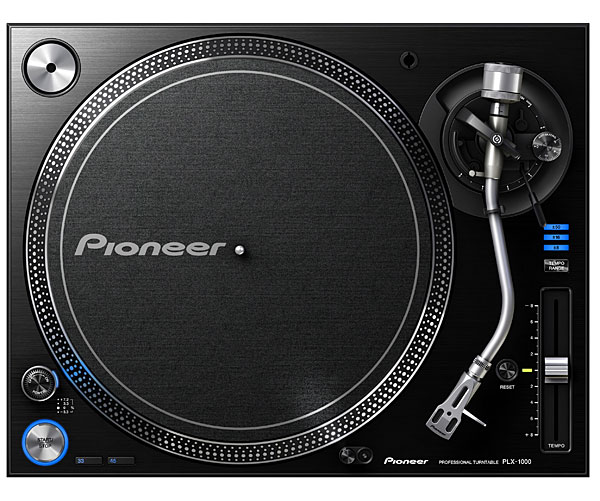
Pioneer's new PLX-1000 was engineered to fill the still-significant need for a professional-quality turntable designed for playing records in clubs, and durable enough to be hauled around in the back of a van and dropped on the ground. The PLX-1000 looks and is laid out like the iconic Technics machine. Why? Because Pioneer correctly assumed that seasoned DJs would want a 'table that "fell into the hands" like the pro-quality tool they'd been using for decades.
Pioneer has made a few subtle but (I think) important improvements over the SL-1200MK2. They've made the PLX-1000's power cord detachable. They've added gold-plated RCA jacks and a sturdy ground-wire post, instead of the Technics's captive cables. (Who likes schlepping a turntable with a bunch of dangling wires?) Hoping for even quieter playback, Pioneer has added 1.15 lbs' worth of damping to the plinth and rubber-damped the tonearm. (The PLX-1000 weighs 28.9 lbs) The new three-phase, brushless DC motor has more than twice the torque of the old Technics motor. Startup time is 0.3 second! (It was 0.7s for the Technics.)
Pioneer has changed the red lights to blue, and added a little well at the back to store a second headshell with cartridge. And as a sort of personal touch, Pioneer has replaced the Technics's square on/off button with a more elegant, blue-lit, round one.
With the PLX-1000's platter removed, I could see that its motor mounts and interior construction were completely different from (but possibly sturdier and more serviceable than) those of the venerable Technics machine. Musically and mechanically, the new PLX-1000 seems more heavy-duty and sure-footed than the vintage, near-mint SL-1200MK2 I borrowed for comparisons.
Like the SL-1200, the PLX-1000 was engineered for putting on and taking off records, and using it was akin to driving a good sports car. Everything "handled" with assurance. Installing and aligning the cartridge, setting the vertical tracking force (VTF) and antiskate force, and especially setting the vertical tracking angle (VTA), were easier and more stress-free than with any other analog front-end I've used. This is the only turntable I know of that is designed to let you change records in complete darkness.
Listening
In honor of the Pioneer PLX-1000's roots, I began my review with some first-class electropunk dance music from New York's own Fischerspooner. I played the 45rpm remix (Junkie XL) of their 2002 hit, "Emerge" (Capital Y 7243 8 77886), using a Shure M44-7 cartridge. This DJ cartridge has been popular for so long because it's indestructible, and plays music with agile and muscular authority. The combo of PLX-1000 and M44-7 played the Fischerspooner and every EDM disc I tried with athletic, fast-moving bass, sweet but rolled-off highs, and that weighty, stimulating midrange energy that opens people's eyes, penetrates their bloodstreams, and gets 'em up and out on the dance floor. Unfortunately, the average audiophile is not likely to appreciate the strong points of the venerable Shure M44-7, a keep-the-line-moving, feel-good kind of cartridge. Those of you with fancy moving-coils will likely find it unsubtle, unrefined, and lacking in tonal purity. I would, of course, have no choice but to agree.
Footnote 1: Pioneer Electronics (USA), Inc., 1925 E. Dominguez Street, Long Beach, CA 90810. Tel: (800) 421-1404. Fax: (310) 952-2990. Web: www.pioneerelectronics.com.
One fun night in 1968, at New York City's Salvation II nightclub, MC Francis Grasso put on a pair of headphones and, using his Thorens TD 124 turntable, began "slip-cueing" and "beat-matching" one dance record into another. The DJ revolution had begun. In 1969, in an attempt to break into the radio broadcast market, Technics introduced the first direct-drive turntable, the SP-10. The following year, Technics added the beautiful SL-1100. DJs gravitated to both models because their rugged high-torque motors allowed almost instant pushbutton startup of a pre-cued musical selection. Sensing even larger potentials in the professional and consumer markets, in 1972 Technics introduced the SL-1200, and in 1978 the much-improved SL-1200MK2.
In 1972, most hi-fi enthusiasts were using the Dual 1019, the AR XA, or the more upscale Thorens TD 150 belt-drive tables. That same year, Ivor Tiefenbrun introduced the now legendary Linn Sondek LP12. If I remember correctly, in 1972, Stereophile's founder, J. Gordon Holt, was using an idler-drive Garrard 301 in his reference system—just as our venerable Editor at Large, Art Dudley, uses now.
Despite strong protests, Technics discontinued the SL-1200MK2 in 2010. During its 38-year life, the SL-1200 completely dominated the broadcast, DJ, and turntablist markets. More than 3 million were sold, but only a few audiophiles ever gave it a thought.
DescriptionPioneer's new PLX-1000 was engineered to fill the still-significant need for a professional-quality turntable designed for playing records in clubs, and durable enough to be hauled around in the back of a van and dropped on the ground. The PLX-1000 looks and is laid out like the iconic Technics machine. Why? Because Pioneer correctly assumed that seasoned DJs would want a 'table that "fell into the hands" like the pro-quality tool they'd been using for decades.
In honor of the Pioneer PLX-1000's roots, I began my review with some first-class electropunk dance music from New York's own Fischerspooner. I played the 45rpm remix (Junkie XL) of their 2002 hit, "Emerge" (Capital Y 7243 8 77886), using a Shure M44-7 cartridge. This DJ cartridge has been popular for so long because it's indestructible, and plays music with agile and muscular authority. The combo of PLX-1000 and M44-7 played the Fischerspooner and every EDM disc I tried with athletic, fast-moving bass, sweet but rolled-off highs, and that weighty, stimulating midrange energy that opens people's eyes, penetrates their bloodstreams, and gets 'em up and out on the dance floor. Unfortunately, the average audiophile is not likely to appreciate the strong points of the venerable Shure M44-7, a keep-the-line-moving, feel-good kind of cartridge. Those of you with fancy moving-coils will likely find it unsubtle, unrefined, and lacking in tonal purity. I would, of course, have no choice but to agree.
Footnote 1: Pioneer Electronics (USA), Inc., 1925 E. Dominguez Street, Long Beach, CA 90810. Tel: (800) 421-1404. Fax: (310) 952-2990. Web: www.pioneerelectronics.com.