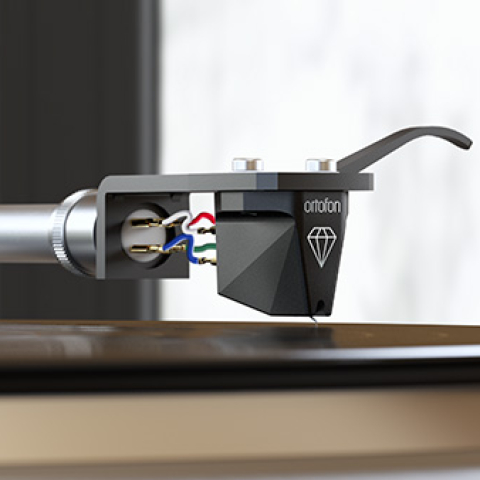
My mother Lily Mae was a Lutheran from Norway. She sent me to Jerusalem Evangelical Lutheran School so that I'd become a well-mannered, tea-with-her-friends choirboy, with starched white shirts and a secret penchant for wildness that was nurtured by those free-thinking Catholic girls at the elementary school next to ours. I always think of Mom when I install an Ortofon cartridge because their sound character strikes me as so Scandinavian—like my mother: smart, tall, well-tailored, well-mannered, neat, understated.
Everyone knows I think audio components tend to sound like how they look, what they're made of, the place they were made, and the people who make them. Transducers from the North are tailored differently and show the music differently than transducers from the South. And then there's Japan. Fashionably dressed audiophiles buy suits and shoes styled in the country that matches their self-image. Some like British tailoring: structured, traditional, never flashy. Others prefer the fit, flair, and fancy fabrics of Italy. Alfa Romeos, Saabs, and Jaguars deliver different types of driving experiences. Audiophiles apply regional stereotypes to their phono cartridges—and also sometimes to cars, cigars, and wine.
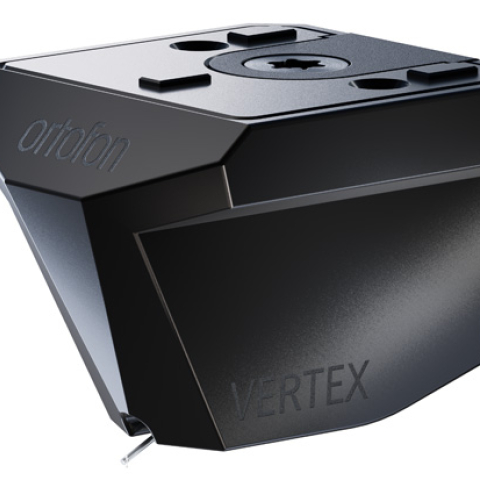
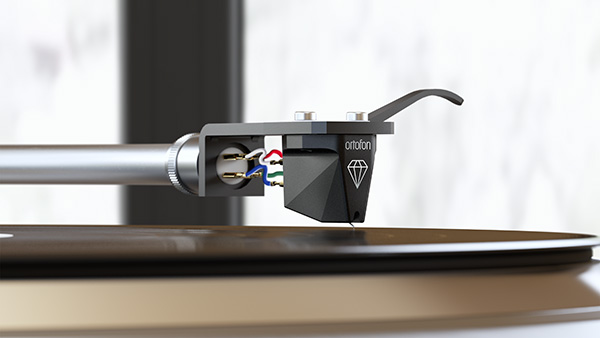
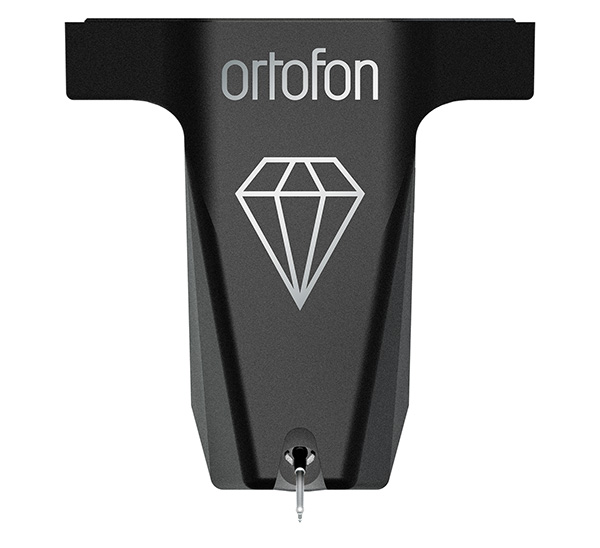
The new MC X-series moving coil cartridges appear to have jumped the fence and broken free of what I long perceived as Ortofon's traditional Scandinavian style. This month, I'm auditioning the top of the X series, the MC X40, which costs $1150 and sounds almost Japanese. The three models below the X40 are, as you might expect, the X30, the X20, and the X10 (footnote 1).
I confess I've never heard a system with any of the Ortofon Quintet series moving coils. My at-home experience with Ortofon is limited to their SPU MCs and 2M Red, Blue, Black, and Black LVB 250 moving magnets. My most recent experiences have been with the $1150 Black LVB 250, which I felt projected a clearer, brighter, wetter, more rhythmically charged sound than its 2M siblings. This felt like a small step away from Ortofon's house sound.
The bottom three X-series cartridges all use an aluminum cantilever. The $330 X10 uses a bonded elliptical stylus. The $540 X20 ups the game with a nude elliptical. The $780 X30 employs a nude fine-line stylus. The X40 is the only X-series cartridge to employ a boron cantilever. Its stylus is a nude Shibata.
All four X-series models use high-purity solid silver wire on their cross-form coil armatures. This silver wire is the first thing transmitting energy off the diamond in the groove, so it may contribute, possibly substantially, to the character of the X series's sound.
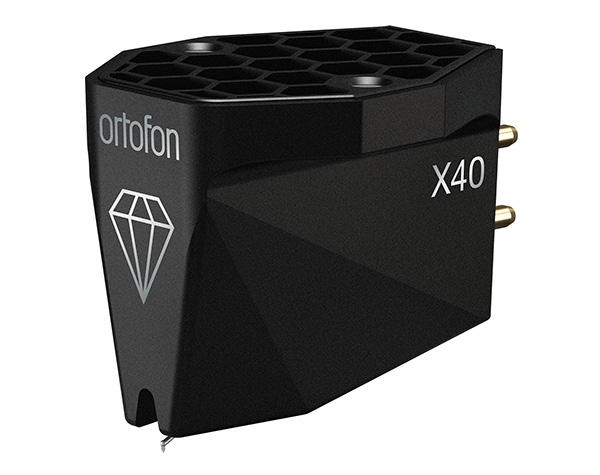 All cartridges in the X series employ a metal injection molded (MIM) honeycomb steel frame between the X40 motor and the tonearm, "to ensure the sort of mechanical stability required for analog accuracy." Its job is to be stiff and hard so as not to lose the front part of transients. The surfaces of this honeycomb frame are finished by physical vapor deposition (PVD), which Ortofon says "will extend the frame's material integrity over time." I suspect the stylus will nub out and the doughnut will dry out long before the honeycomb mounting frame fails or gets rusty. Nevertheless, it is fair to say the "new from the ground up" MC X40 moving coil looks and feels more solidly constructed than its 2M-series stablemates.
Another change: The X series features a new rubber doughnut—Ortofon specializes in rubber formulation and molds its doughnuts in-house—for positioning, supporting, stabilizing, and damping its cantilever assembly. The doughnuts are elements of a newly developed magnet system that features a single-segment cylindrical pole piece integrated into a rear magnet yoke, designed to "maximize magnetic efficiency." Presumably this construction keeps the coils positioned in the sweet spot of the flux field.
All cartridges in the X series employ a metal injection molded (MIM) honeycomb steel frame between the X40 motor and the tonearm, "to ensure the sort of mechanical stability required for analog accuracy." Its job is to be stiff and hard so as not to lose the front part of transients. The surfaces of this honeycomb frame are finished by physical vapor deposition (PVD), which Ortofon says "will extend the frame's material integrity over time." I suspect the stylus will nub out and the doughnut will dry out long before the honeycomb mounting frame fails or gets rusty. Nevertheless, it is fair to say the "new from the ground up" MC X40 moving coil looks and feels more solidly constructed than its 2M-series stablemates.
Another change: The X series features a new rubber doughnut—Ortofon specializes in rubber formulation and molds its doughnuts in-house—for positioning, supporting, stabilizing, and damping its cantilever assembly. The doughnuts are elements of a newly developed magnet system that features a single-segment cylindrical pole piece integrated into a rear magnet yoke, designed to "maximize magnetic efficiency." Presumably this construction keeps the coils positioned in the sweet spot of the flux field.
 My setup primer: I am a lucky guy. I get to pester Spin Doctor Michael Trei almost daily with all sorts of dumb Herb questions. I have this same privilege with Dave Slagle (EM/IA), and to a lesser extent with tonearm designer Frank Schröder. I get to ask these smart fellas how they set up cartridges and what electromechanical convictions inform their methods. I've learned that Mike Trei and Frank Schröder both have a few favorite discs they play passages from to check their work. They know from a thousand previous plays when these passages sound glorious or less than glorious.
Based on knowing Frank's, Dave's, and Michael's methods, I've developed my own simple setup procedure, one that even newbies can master. The #1 problem all analog beginners face is knowing when the setup job is finished—and when it is finished well. My simple method answers both questions unambiguously.
I start by checking to see that the cantilever is facing perfectly straight forward and not bent to one side.
Then I set the stylus overhang and fine-tune cantilever alignment with a Dr. Feickert alignment protractor.
After setting tracking force precisely with a Riverstone VTF gauge, I set SRA/VTA by leveling the cartridge's top by eye, checking my work with a tiny round level and a clear acrylic-block Azimuth/VTA gauge I bought on eBay for almost nothing. When everything looks straight and plumb through the acrylic block, I fine-tune azimuth with a Musical Surroundings Fozgometer V2.
At this point, I know the diamond is sitting very close to where it should be sitting, but that's not the end of the story. With any phono cartridge with a dramatically non-spherical stylus profile—and that applies to the X40's Shibata tip—it makes sense to spare a thought about zenith.
In case zenith is unfamiliar, it refers to the alignment of the stylus itself with respect to the record groove; in other words, the stylus isn't mounted to the cantilever precisely enough. Research by J.R. Boisclair of WallyTools has shown that even very expensive cartridges can have significant error in this parameter, as much as 5° or more.
Unfortunately, aligning the stylus with respect to the groove requires exactly the same adjustment as aligning overhang—but if the stylus is mounted poorly, then if overhang is set correctly, zenith isn't. While innocuous stylus profiles such as conical or elliptical are unlikely to cause problems, aggressive profiles like fine line, super fine line, MicroRidge, or Shibata can cause problems. My experience and Boisclair's research both show that the distortion caused by zenith error is more objectionable than that caused by incorrect overhang adjustment.
Unless you have a very specialized setup with a powerful microscope—or are willing to send your cartridge to Boisclair for a paid analysis—it is impossible to know how well your stylus is aligned. Which means, first, that with a phono cartridge with an aggressive stylus profile, getting the overhang adjustment correct isn't the end of the story. Setting up the cartridge so that the cantilver aligns perfectly with the groove at the two null points may not result in the best possible sound. So unless you're inclined to send your cartridge off for analysis, all you can do is listen. Which really is the best approach anyway.
My setup primer: I am a lucky guy. I get to pester Spin Doctor Michael Trei almost daily with all sorts of dumb Herb questions. I have this same privilege with Dave Slagle (EM/IA), and to a lesser extent with tonearm designer Frank Schröder. I get to ask these smart fellas how they set up cartridges and what electromechanical convictions inform their methods. I've learned that Mike Trei and Frank Schröder both have a few favorite discs they play passages from to check their work. They know from a thousand previous plays when these passages sound glorious or less than glorious.
Based on knowing Frank's, Dave's, and Michael's methods, I've developed my own simple setup procedure, one that even newbies can master. The #1 problem all analog beginners face is knowing when the setup job is finished—and when it is finished well. My simple method answers both questions unambiguously.
I start by checking to see that the cantilever is facing perfectly straight forward and not bent to one side.
Then I set the stylus overhang and fine-tune cantilever alignment with a Dr. Feickert alignment protractor.
After setting tracking force precisely with a Riverstone VTF gauge, I set SRA/VTA by leveling the cartridge's top by eye, checking my work with a tiny round level and a clear acrylic-block Azimuth/VTA gauge I bought on eBay for almost nothing. When everything looks straight and plumb through the acrylic block, I fine-tune azimuth with a Musical Surroundings Fozgometer V2.
At this point, I know the diamond is sitting very close to where it should be sitting, but that's not the end of the story. With any phono cartridge with a dramatically non-spherical stylus profile—and that applies to the X40's Shibata tip—it makes sense to spare a thought about zenith.
In case zenith is unfamiliar, it refers to the alignment of the stylus itself with respect to the record groove; in other words, the stylus isn't mounted to the cantilever precisely enough. Research by J.R. Boisclair of WallyTools has shown that even very expensive cartridges can have significant error in this parameter, as much as 5° or more.
Unfortunately, aligning the stylus with respect to the groove requires exactly the same adjustment as aligning overhang—but if the stylus is mounted poorly, then if overhang is set correctly, zenith isn't. While innocuous stylus profiles such as conical or elliptical are unlikely to cause problems, aggressive profiles like fine line, super fine line, MicroRidge, or Shibata can cause problems. My experience and Boisclair's research both show that the distortion caused by zenith error is more objectionable than that caused by incorrect overhang adjustment.
Unless you have a very specialized setup with a powerful microscope—or are willing to send your cartridge to Boisclair for a paid analysis—it is impossible to know how well your stylus is aligned. Which means, first, that with a phono cartridge with an aggressive stylus profile, getting the overhang adjustment correct isn't the end of the story. Setting up the cartridge so that the cantilver aligns perfectly with the groove at the two null points may not result in the best possible sound. So unless you're inclined to send your cartridge off for analysis, all you can do is listen. Which really is the best approach anyway.
 I wrote about this in "The Importance of Tells" in the January 2022 Stereophile. Fortunately, I've found a tell that works for me. When the stylus's contact patches are not contacting the groove walls equally and at the exact same time in both channels, the cartridge exhibits audible low-level mistracking. With small amounts of zenith error, the consequences of this mistracking are most audible at highly modulated high frequencies, such as the harmonics spewing from Miles Davis's trumpet. I use the MoFi reissue of Davis's In a Silent Way (MFSL LP 1-377), but most any Teo Macero–produced Miles LP will work. If the high notes from Miles's trumpet sound glary or flary, I rotate the cartridge no more than a degree clockwise. If that doesn't improve things or makes things worse, I'll nudge it the other way: counterclockwise. This method is hit or miss, but sometimes the tiniest nudge makes a huge sonic difference.
The most important step is the last, wherein I use a Shure Era IV trackability record (TTR 115). I use it to verify that my cartridge is not mistracking at the beginning and end of record sides, where the alignment is assumed to be at its worst. This record takes all the guesswork out of being a newbie. It uses orchestral bells, flute, and harp tracks at five scaled recording levels. If your setup plays the 5th level, you're done. How this record sounds is how all your records will sound. If your cartridge can track level 5 and sound the way the narrator says it should, you won't need a professional setter upper to ease your mind.
For the record—pun intended—the Ortofon MC X40 tracked all five levels perfectly even with a dust ball stuck to the stylus.
Listening: During six decades of flipping through record bins, I always skipped the Tchaikovsky, thinking it too bombastic. Yet I always enjoyed the musical-toes movements and body-bouncing rhythms of ballet music, so I made an exception for Swan Lake, especially the RCA VICS disc with the Degas drawing on the cover (Excerpts from the Ballet Swan Lake, RCA VICS-1002; the S in VICS indicates the stereo version). The plum-label copies
I wrote about this in "The Importance of Tells" in the January 2022 Stereophile. Fortunately, I've found a tell that works for me. When the stylus's contact patches are not contacting the groove walls equally and at the exact same time in both channels, the cartridge exhibits audible low-level mistracking. With small amounts of zenith error, the consequences of this mistracking are most audible at highly modulated high frequencies, such as the harmonics spewing from Miles Davis's trumpet. I use the MoFi reissue of Davis's In a Silent Way (MFSL LP 1-377), but most any Teo Macero–produced Miles LP will work. If the high notes from Miles's trumpet sound glary or flary, I rotate the cartridge no more than a degree clockwise. If that doesn't improve things or makes things worse, I'll nudge it the other way: counterclockwise. This method is hit or miss, but sometimes the tiniest nudge makes a huge sonic difference.
The most important step is the last, wherein I use a Shure Era IV trackability record (TTR 115). I use it to verify that my cartridge is not mistracking at the beginning and end of record sides, where the alignment is assumed to be at its worst. This record takes all the guesswork out of being a newbie. It uses orchestral bells, flute, and harp tracks at five scaled recording levels. If your setup plays the 5th level, you're done. How this record sounds is how all your records will sound. If your cartridge can track level 5 and sound the way the narrator says it should, you won't need a professional setter upper to ease your mind.
For the record—pun intended—the Ortofon MC X40 tracked all five levels perfectly even with a dust ball stuck to the stylus.
Listening: During six decades of flipping through record bins, I always skipped the Tchaikovsky, thinking it too bombastic. Yet I always enjoyed the musical-toes movements and body-bouncing rhythms of ballet music, so I made an exception for Swan Lake, especially the RCA VICS disc with the Degas drawing on the cover (Excerpts from the Ballet Swan Lake, RCA VICS-1002; the S in VICS indicates the stereo version). The plum-label copies
 I bought were on thick vinyl, and I thought they sounded less studio-affected than the original RCA Victor Red Seal pressings. In the late '80s, the bins by the windows in Tower Records Annex were filled with M–/Ex+ plum-label VICS for $2 each. I thought I was smarter than those Shaded Dog hunters, so I bought every Swan Lake VICS I found, to give to friends as presents.
A friend just gave me a Classic Records reissue of this Swan Lake VICS, and the first time I played it, the hard drive in my brain started skipping due to cognitive dissonance. It did not feel or sound like any VICS or RCA I remember. It made me feel like the Royal Opera House orchestra was attacking me with 3kHz energy. I wondered if I set up Ortofon's MC X40 wrong. It was getting late, so I slept on it.
In the morning, I played Swan Lake with the MC X40 and the Ortofon 2M LVB 250. Dang me to the hot place if the LVB 250 didn't play the record sweeter, smoother, more relaxed, and more ballet-like than the X40. The X40 put more pressure behind the sound, which put the sound in my room with more presence and light. The LVB 250—a moving magnet cartridge—made this Tchaikovsky disc sound vibey and tubey, as I imagine its producers heard it.
With the X40's Shibata stylus dragging though its grooves, a newly acquired box set, Beethoven: The Middle Quartets by the Fine Arts Quartet of Chicago (Concert Disc SP 506/3), came across like a joy-of-listening demonstration disc. The sound was neither dark nor bright, neither hard nor soft, just unobtrusively focused, steady in its momentum and relaxed. I locked on easily to the Quartet in F, Op.59, No.1, because the Fine Arts group played it briskly, with rhythms forward, each instrument boulder-stable in its position within the recording's precisely mapped soundspace. Cello tone was the color-filled pleasure I savored most.
I bought were on thick vinyl, and I thought they sounded less studio-affected than the original RCA Victor Red Seal pressings. In the late '80s, the bins by the windows in Tower Records Annex were filled with M–/Ex+ plum-label VICS for $2 each. I thought I was smarter than those Shaded Dog hunters, so I bought every Swan Lake VICS I found, to give to friends as presents.
A friend just gave me a Classic Records reissue of this Swan Lake VICS, and the first time I played it, the hard drive in my brain started skipping due to cognitive dissonance. It did not feel or sound like any VICS or RCA I remember. It made me feel like the Royal Opera House orchestra was attacking me with 3kHz energy. I wondered if I set up Ortofon's MC X40 wrong. It was getting late, so I slept on it.
In the morning, I played Swan Lake with the MC X40 and the Ortofon 2M LVB 250. Dang me to the hot place if the LVB 250 didn't play the record sweeter, smoother, more relaxed, and more ballet-like than the X40. The X40 put more pressure behind the sound, which put the sound in my room with more presence and light. The LVB 250—a moving magnet cartridge—made this Tchaikovsky disc sound vibey and tubey, as I imagine its producers heard it.
With the X40's Shibata stylus dragging though its grooves, a newly acquired box set, Beethoven: The Middle Quartets by the Fine Arts Quartet of Chicago (Concert Disc SP 506/3), came across like a joy-of-listening demonstration disc. The sound was neither dark nor bright, neither hard nor soft, just unobtrusively focused, steady in its momentum and relaxed. I locked on easily to the Quartet in F, Op.59, No.1, because the Fine Arts group played it briskly, with rhythms forward, each instrument boulder-stable in its position within the recording's precisely mapped soundspace. Cello tone was the color-filled pleasure I savored most.
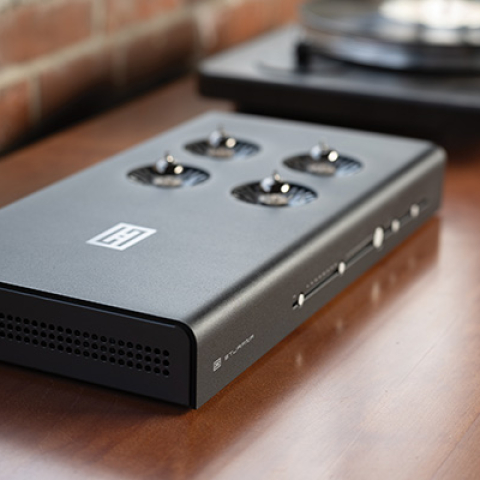
 With the Schiit Stjarna phono preamp loaded at 100 ohms, the X40 never felt hi-fi–delic or too stereo-graphic—just focused, natural, and steady.
When I switched from the Stjarna to the Mobile Fidelity MasterPhono phono stage, the X40's sound character went from tuneful, smooth, and lucid to brighter, clearer, and more dynamic. The Ortofon mated exceptionally well with the MasterPhono, which amped up the force of the X40's sound then disappeared. I was unable to detect the MoFi phono pre's thumbprint, even on recordings I know well. Paired with the MoFi, the X40 sounded similar to but considerably more refined than Dynavector's similarly priced 10X5 MkII: Transient reproduction was delicate, transparency and focus were at a level any audiophile would applaud. The X40's overall presentation was more in line with that of the more expensive Dynavector XX-2A, though it could not match the 2A's raw drive and precision. The delicacy and descriptiveness of the X40's top octaves exceeded what either Dynavector could equal.
I tried the X40 into the 50 ohm JFET load on the Sun Valley EQ1616D phono equalizer, and it was an instant hookup. These two products sang opera and flat-picked bluegrass and smirked while they were doin' it. They knew they were good together. The sound was super-tactile and delightfully unfettered.
With all three phono stages I tried, the Ortofon MC X40 delivered peak-level mid-price phonography. You'd have to spend thousands more for improvements that would be noticeable every day.
With the Schiit Stjarna phono preamp loaded at 100 ohms, the X40 never felt hi-fi–delic or too stereo-graphic—just focused, natural, and steady.
When I switched from the Stjarna to the Mobile Fidelity MasterPhono phono stage, the X40's sound character went from tuneful, smooth, and lucid to brighter, clearer, and more dynamic. The Ortofon mated exceptionally well with the MasterPhono, which amped up the force of the X40's sound then disappeared. I was unable to detect the MoFi phono pre's thumbprint, even on recordings I know well. Paired with the MoFi, the X40 sounded similar to but considerably more refined than Dynavector's similarly priced 10X5 MkII: Transient reproduction was delicate, transparency and focus were at a level any audiophile would applaud. The X40's overall presentation was more in line with that of the more expensive Dynavector XX-2A, though it could not match the 2A's raw drive and precision. The delicacy and descriptiveness of the X40's top octaves exceeded what either Dynavector could equal.
I tried the X40 into the 50 ohm JFET load on the Sun Valley EQ1616D phono equalizer, and it was an instant hookup. These two products sang opera and flat-picked bluegrass and smirked while they were doin' it. They knew they were good together. The sound was super-tactile and delightfully unfettered.
With all three phono stages I tried, the Ortofon MC X40 delivered peak-level mid-price phonography. You'd have to spend thousands more for improvements that would be noticeable every day.
Footnote 1: Ortofon AS. Stavangervej 9, DK-4900 Nakskov, Denmark. Web: ortofon.com. US distributor: Ortofon Inc., 500 Executive Blvd., Suite 102, Ossining, NY 10562. Tel: (914) 762-8646. Email: support@ortofon.us.
All cartridges in the X series employ a metal injection molded (MIM) honeycomb steel frame between the X40 motor and the tonearm, "to ensure the sort of mechanical stability required for analog accuracy." Its job is to be stiff and hard so as not to lose the front part of transients. The surfaces of this honeycomb frame are finished by physical vapor deposition (PVD), which Ortofon says "will extend the frame's material integrity over time." I suspect the stylus will nub out and the doughnut will dry out long before the honeycomb mounting frame fails or gets rusty. Nevertheless, it is fair to say the "new from the ground up" MC X40 moving coil looks and feels more solidly constructed than its 2M-series stablemates.
Another change: The X series features a new rubber doughnut—Ortofon specializes in rubber formulation and molds its doughnuts in-house—for positioning, supporting, stabilizing, and damping its cantilever assembly. The doughnuts are elements of a newly developed magnet system that features a single-segment cylindrical pole piece integrated into a rear magnet yoke, designed to "maximize magnetic efficiency." Presumably this construction keeps the coils positioned in the sweet spot of the flux field.
My setup primer: I am a lucky guy. I get to pester Spin Doctor Michael Trei almost daily with all sorts of dumb Herb questions. I have this same privilege with Dave Slagle (EM/IA), and to a lesser extent with tonearm designer Frank Schröder. I get to ask these smart fellas how they set up cartridges and what electromechanical convictions inform their methods. I've learned that Mike Trei and Frank Schröder both have a few favorite discs they play passages from to check their work. They know from a thousand previous plays when these passages sound glorious or less than glorious.
I wrote about this in "The Importance of Tells" in the January 2022 Stereophile. Fortunately, I've found a tell that works for me. When the stylus's contact patches are not contacting the groove walls equally and at the exact same time in both channels, the cartridge exhibits audible low-level mistracking. With small amounts of zenith error, the consequences of this mistracking are most audible at highly modulated high frequencies, such as the harmonics spewing from Miles Davis's trumpet. I use the MoFi reissue of Davis's In a Silent Way (MFSL LP 1-377), but most any Teo Macero–produced Miles LP will work. If the high notes from Miles's trumpet sound glary or flary, I rotate the cartridge no more than a degree clockwise. If that doesn't improve things or makes things worse, I'll nudge it the other way: counterclockwise. This method is hit or miss, but sometimes the tiniest nudge makes a huge sonic difference.
I bought were on thick vinyl, and I thought they sounded less studio-affected than the original RCA Victor Red Seal pressings. In the late '80s, the bins by the windows in Tower Records Annex were filled with M–/Ex+ plum-label VICS for $2 each. I thought I was smarter than those Shaded Dog hunters, so I bought every Swan Lake VICS I found, to give to friends as presents.
A friend just gave me a Classic Records reissue of this Swan Lake VICS, and the first time I played it, the hard drive in my brain started skipping due to cognitive dissonance. It did not feel or sound like any VICS or RCA I remember. It made me feel like the Royal Opera House orchestra was attacking me with 3kHz energy. I wondered if I set up Ortofon's MC X40 wrong. It was getting late, so I slept on it.
In the morning, I played Swan Lake with the MC X40 and the Ortofon 2M LVB 250. Dang me to the hot place if the LVB 250 didn't play the record sweeter, smoother, more relaxed, and more ballet-like than the X40. The X40 put more pressure behind the sound, which put the sound in my room with more presence and light. The LVB 250—a moving magnet cartridge—made this Tchaikovsky disc sound vibey and tubey, as I imagine its producers heard it.
With the Schiit Stjarna phono preamp loaded at 100 ohms, the X40 never felt hi-fi–delic or too stereo-graphic—just focused, natural, and steady.
When I switched from the Stjarna to the Mobile Fidelity MasterPhono phono stage, the X40's sound character went from tuneful, smooth, and lucid to brighter, clearer, and more dynamic. The Ortofon mated exceptionally well with the MasterPhono, which amped up the force of the X40's sound then disappeared. I was unable to detect the MoFi phono pre's thumbprint, even on recordings I know well. Paired with the MoFi, the X40 sounded similar to but considerably more refined than Dynavector's similarly priced 10X5 MkII: Transient reproduction was delicate, transparency and focus were at a level any audiophile would applaud. The X40's overall presentation was more in line with that of the more expensive Dynavector XX-2A, though it could not match the 2A's raw drive and precision. The delicacy and descriptiveness of the X40's top octaves exceeded what either Dynavector could equal.
Footnote 1: Ortofon AS. Stavangervej 9, DK-4900 Nakskov, Denmark. Web: ortofon.com. US distributor: Ortofon Inc., 500 Executive Blvd., Suite 102, Ossining, NY 10562. Tel: (914) 762-8646. Email: support@ortofon.us.