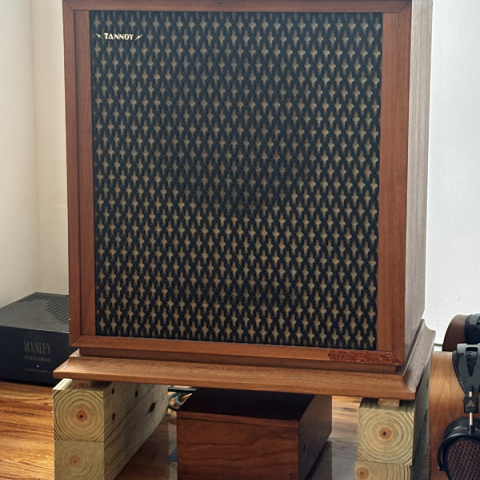
I'd been building and repairing tube amplifiers for a few years when my first Altec A5 Voice of the Theater speakers arrived. I bought them to help me evaluate the sound of low-powered triode amps—but whoa! The moment I turned that VOT system on, I heard from 30' away the sound of either a waterfall or a large AM radio tuned between stations.
When I checked my amplification for hum and standing noise, everything was at or near what I considered "spec" for zero-feedback tube amps. Apparently those specs needed revising. Meanwhile, I was fascinated by how a very sensitive speaker could show me so clearly what free electrons were doing inside my amplifiers. What's the best tube tester? A 107dB/watt speaker!
One reason audiophiles like me use step-up transformers is to make that extra 20–30dB of moving coil gain as quiet and uncolored as possible. Accept and adapt is my mantra, so I switched from the Linn LP12 with a Koetsu amplified by WE 417A's to my Denon DL-103 with matching step-up transformer. With the Altecs, the Denon SUT made the system quiet enough for me, but probably not for audiophiles raised on the digital version of quiet.
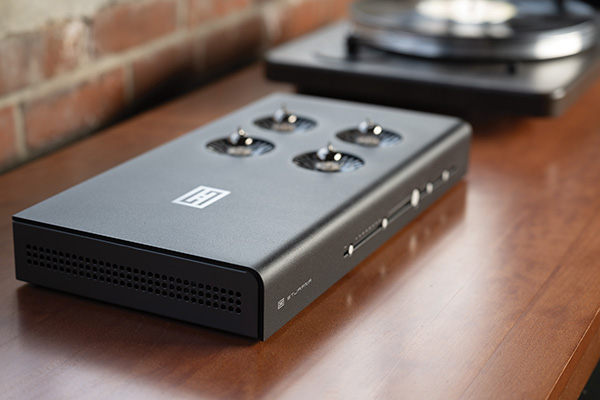
Schiit Audio's Stjarna phono stage
To me, miniature nine-pin small-signal tubes will always be the beating heart sound creators of tubed audio devices. Their job is to preserve the life energy of the recording, and the best ones are really good at that. But because of their glass size and the diameter of their pins, they can also be wiggly wobbly pingy screechy staticky hissy hummy. And unpredictable. Regardless, like most small creatures, miniature tubes are adorable. The $1699 Schiit Audio Stjarna (footnote 1) uses four Russian-made 6N1P tubes. These tubes are famously quiet, high in transconductance, low in microphonics, and roughly akin to 6DJ8/6922s—the chief difference being that the 6N1P draws twice the heater current as a 6DJ8. In my Midwestern hayseed mind, the all-tube Schiit Audio Stjarna MM/MC phono stage will forever be pronounced Saint Jarna. The correct Swedish pronunciation sounds more like a country: chi-na. The old Norse pronunciation is more nasal: stat-na (footnote 2). Google says the word means star in the Norse legends that Schiit co-founder Jason Stoddard appropriates product names from. So maybe it should be pronounced Starna? Call it what you like, this is a seriously high-value product.
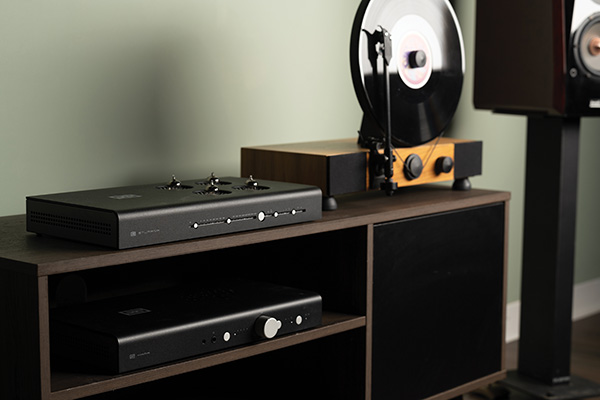
The moment I spotted the Stjarna on the Schiit website, I fell for its broad, shelf-hugging form. On my rack, that form occupied its 16" × 8" × 3" space very smartly. Its colors and textures and the scale of its buttons and lights gave off a tasteful north-latitudes vibe. I especially liked how and where its four 6N1P tubes were mounted and displayed. When the Stjarna lights up, it looks perky and alluring in sunlight and suave and romantic in the dark.
That's me you see applauding Schiit's industrial designer.
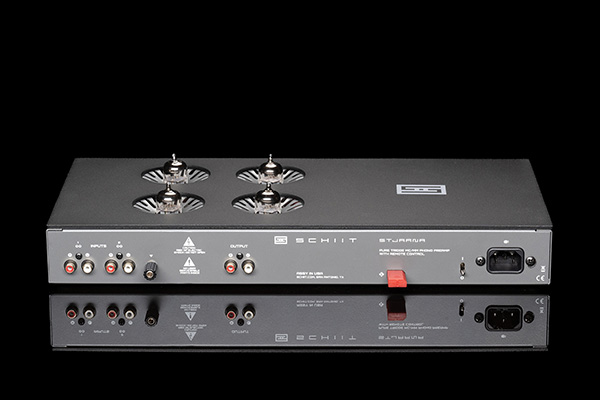 Looking at its backside, I observed two pairs of phono inputs near a high-quality binding post for turntable ground wires. I also spotted a pair of single-ended RCA outputs, an IEC socket near a power switch, and a covered slot for Schiit's Forkbeard dongle.
I spent a lot of time staring at the Stjarna's asymmetric front panel because I admired how it looked and how it operates. On the far left is a button that does two important things. Press it quickly to toggle through the Stjarna's nine resistive loads: 10, 50, 100, 150, 200, 250, 300, 350, and 47k ohms. Press it slowly, and the Stjarna goes into standby.
The next button adjusts the capacitive load in eight steps between 50pF and 400pF. The larger third button selects between inputs 1 and 2. To its right, the fourth button offers four wisely chosen gain levels: 40dB, 47dB, 55dB, and 60dB. In practice, the two lowest gains are for high-output MC or MM cartridges; the two high-gain choices are for low-output moving coils. In the course of this review, I adjusted gain for the best compromise between best dynamic charge and least noise.
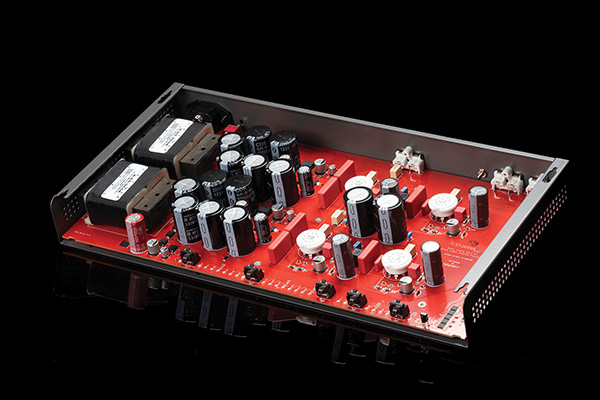
The fifth button, Mode Select, allows users to engage the Stjarna's subsonic filter or switch to Mono mode. For me, the Stjarna's feature attraction was its four cool-running 6N1P dual triodes operating in true dual mono, with twin power transformers. The power supply is also dual mono, all the way from its single IEC inlet.
Looking at its backside, I observed two pairs of phono inputs near a high-quality binding post for turntable ground wires. I also spotted a pair of single-ended RCA outputs, an IEC socket near a power switch, and a covered slot for Schiit's Forkbeard dongle.
I spent a lot of time staring at the Stjarna's asymmetric front panel because I admired how it looked and how it operates. On the far left is a button that does two important things. Press it quickly to toggle through the Stjarna's nine resistive loads: 10, 50, 100, 150, 200, 250, 300, 350, and 47k ohms. Press it slowly, and the Stjarna goes into standby.
The next button adjusts the capacitive load in eight steps between 50pF and 400pF. The larger third button selects between inputs 1 and 2. To its right, the fourth button offers four wisely chosen gain levels: 40dB, 47dB, 55dB, and 60dB. In practice, the two lowest gains are for high-output MC or MM cartridges; the two high-gain choices are for low-output moving coils. In the course of this review, I adjusted gain for the best compromise between best dynamic charge and least noise.
The fifth button, Mode Select, allows users to engage the Stjarna's subsonic filter or switch to Mono mode. For me, the Stjarna's feature attraction was its four cool-running 6N1P dual triodes operating in true dual mono, with twin power transformers. The power supply is also dual mono, all the way from its single IEC inlet.
 What's a Forkbeard? I'd never heard of Schiit's Forkbeard app, which promises "total control" over "stacks" of Schiit products. When I first read about it, I pictured Jason as a fierce Viking with a beard like a snake's tongue, covered in ice droplets. Later, when I found out that Forkbeard was an iPad app—an Android version is promised for summer 2025—his face became clean shaven, and he was sitting at a desk looking out the window at an immense California parking lot.
The Stjarna was the only Schiit product I had that was "forkable," and I had no desire to change any of its settings remotely or on the fly. I installed the app anyway just to see what it looked like. On my iPad, it looked like a tidy rapidograph drawing of the Stjarna's sleek, palm-sized aluminum remote.
Listening
What's a Forkbeard? I'd never heard of Schiit's Forkbeard app, which promises "total control" over "stacks" of Schiit products. When I first read about it, I pictured Jason as a fierce Viking with a beard like a snake's tongue, covered in ice droplets. Later, when I found out that Forkbeard was an iPad app—an Android version is promised for summer 2025—his face became clean shaven, and he was sitting at a desk looking out the window at an immense California parking lot.
The Stjarna was the only Schiit product I had that was "forkable," and I had no desire to change any of its settings remotely or on the fly. I installed the app anyway just to see what it looked like. On my iPad, it looked like a tidy rapidograph drawing of the Stjarna's sleek, palm-sized aluminum remote.
Listening
After playing six sides of six records with the Stjarna, I played The Barbra Streisand Album (Columbia LP CL 2007), and when I came to "Happy Days Are Here Again," I said "whoa, this is not a happy day for my record player." Instead of sounding round and real, my beloved Streisand was sounding flat and fake, and I was not connecting with her like I usually do.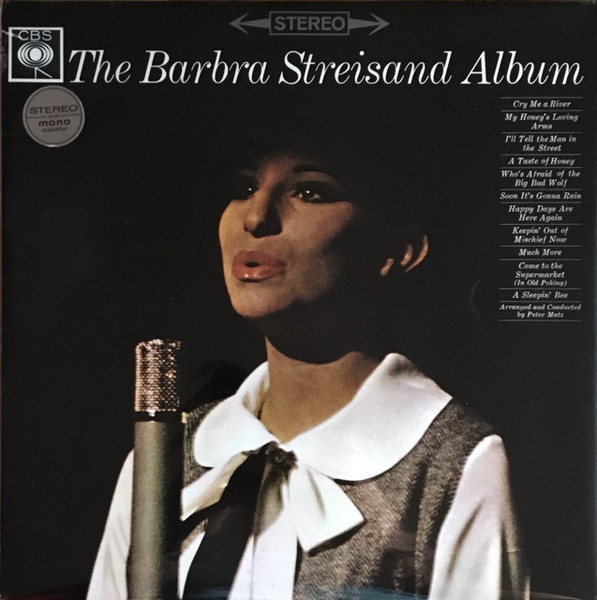 Dynavector's XX2A cartridge was feeding the Stjarna's MC input set to 60dB of gain and loaded at 100 ohms (footnote 3). Streisand sounded gray and hissy-boring. The sound got more relaxed and colorful when I reduced the Stjarna's gain to 55dB, but there was still no pizzazz.
Hoping to understand this better, I bypassed the Schiit's tube MC stage and added the Dynavector DV SUP-200 step-up transformer, which has 26dB of gain. The output from the SET fed the Stjarna in MM mode, with 47k ohms into only 40dB of gain.
The last time I tried the SUP-200 (with the PrimaLuna EVO 100 phono stage), I was disappointed. Despite its high-nickel alnico core, it sounded slightly dull and flat, and I didn't know why.
When I play a Barbra Streisand album, I want the full Streisand experience. I want to feel her personality in my room, between my speakers. The XX2A + SUP-200 + Stjarna combination did every tone and tempo thing I needed to enjoy The Barbra Streisand Album. It felt explosive. Barbra sounded fully present and in charge. She dominated a wide, brightly lit stage. Her voice came through as clear and powerful as it's supposed to. I was especially impressed by how 1963 it sounded; that's the year this album was issued.
I credit this to the "nickel" tone the SUP-200's "high-permeability core" was adding, and to the Stjarna's RIAA stage being so precise and deathly quiet. I know Dynavector's XX2A cartridge and SUT perfectly well, so everything new to my ears must have been from the Schiit Stjarna's 40dB-gain moving magnet stage. What I noticed about the Stjarna was how well-sorted it was (as well-sorted as a phono stage could be) and how gleaming tube beautiful—more so than anything even remotely near its price.
Dynavector's XX2A cartridge was feeding the Stjarna's MC input set to 60dB of gain and loaded at 100 ohms (footnote 3). Streisand sounded gray and hissy-boring. The sound got more relaxed and colorful when I reduced the Stjarna's gain to 55dB, but there was still no pizzazz.
Hoping to understand this better, I bypassed the Schiit's tube MC stage and added the Dynavector DV SUP-200 step-up transformer, which has 26dB of gain. The output from the SET fed the Stjarna in MM mode, with 47k ohms into only 40dB of gain.
The last time I tried the SUP-200 (with the PrimaLuna EVO 100 phono stage), I was disappointed. Despite its high-nickel alnico core, it sounded slightly dull and flat, and I didn't know why.
When I play a Barbra Streisand album, I want the full Streisand experience. I want to feel her personality in my room, between my speakers. The XX2A + SUP-200 + Stjarna combination did every tone and tempo thing I needed to enjoy The Barbra Streisand Album. It felt explosive. Barbra sounded fully present and in charge. She dominated a wide, brightly lit stage. Her voice came through as clear and powerful as it's supposed to. I was especially impressed by how 1963 it sounded; that's the year this album was issued.
I credit this to the "nickel" tone the SUP-200's "high-permeability core" was adding, and to the Stjarna's RIAA stage being so precise and deathly quiet. I know Dynavector's XX2A cartridge and SUT perfectly well, so everything new to my ears must have been from the Schiit Stjarna's 40dB-gain moving magnet stage. What I noticed about the Stjarna was how well-sorted it was (as well-sorted as a phono stage could be) and how gleaming tube beautiful—more so than anything even remotely near its price.
 If there is one record I cherish most in my collection, one that I would carry out in a fire—one I pay extra-close attention to when it is playing—it is Astor Piazzolla: The American Clavé Recordings (Nonesuch 075597915297).
This landmark trio of albums—Tango: Zero Hour, La Camorra: The Solitude of Passionate Provocation, and The Rough Dancer and the Cyclical Night (Tango Apasionado)—is being reissued as a set. It's the first time these albums have been available on vinyl since their initial release on American Clavé in the 1980s.
Artistically, The Rough Dancer and the Cyclical Night (Tango Apasionado) appeals to me on many levels. But the truest reason I love it is because it is deeply mysterious and mesmerizing, and I equate mystery with beauty. Rough Dancer's recorded sound is dark, heavily textured, and impenetrably dense and shadowy. The Stjarna exposed more layers of low-level sounds than I could keep track of.
Listening through this density, I tried to see into Piazzolla's mind. I wanted to feel his thinking while he was making his art at this level of intensity. To my delight, the Dynavector–Stjarna combo excelled at letting me zero in and mind-meld with Tango's master creator.
Hum and hissing vipers returned when I connected the Dynavector cartridge directly into the Stjarna's MC input, set to 55dB gain and shunted with 100 ohms. As before, I didn't care about noise, because the swerving rhythms and the melody lines of individual instruments were more pronounced while going straight in, making mind melding with Astor even easier. I felt that on its own, without the Dynavector SUT, the tube input Stjarna did a better job communicating the depth and complexity of The Rough Dancer and the Cyclical Night.
I chose the $2250, 0.28mV output Dynavector XX2A moving coil to begin this report because Dynavector's cartridges are the sound I know best through the widest variety of phono stages. When the XX2A arrived, I had already put 1000+ hours on my daily-driver XX2, and before that, I wore the tip to a nub on a DV-20X2. Using the Dynavector XX2A made it easier to identify what part of the sound was from the cartridge and what part was the Schiit Stjarna's tubed circuitry.
Unfortunately, the Dynavector's low output (0.28mV at 1kHz) and preferred 100 ohms load meant I had to run the Stjarna's tube gain high, at 55dB, just one stop below its 60dB maximum, and the LTA Z10e virtually wide open (90%–100%), which meant I heard hiss and hum from my listening position about 7' away.
Standing noise from the Schiit was reduced when I installed the $850 Hana SL MK II (footnote 4), which has slightly higher output at 0.4mV, an 8 ohm internal impedance, and a recommended loading of 80 ohms or greater. With the Hana SL MK II, for normal listening, the Z10e's volume control was a little lower, between 85% and 95%. Apparently, that was just enough, since noise was no longer a distraction. It was fun to watch and listen as the SL MK II got kissy cozy with the Schiit Stjarna, playing record after record as if they were honeymooning. Piazzolla's Rough Dancer came out with lush, intricate detail and a clear view of its compositional complexity.
These were the moments where I first noticed the 6N1P tube's subtle stoic beauty. The Stjarna's view into this recording showed mildly overcast lighting and relaxed, naturally contrasted images. The Hana played yin to the Dynavector's yang. I'm glad I tried it; I imagine this was the sound designer Jason Stoddard had in mind for this product.
One of this month's most delight-filled moments occurred while the Schiit and Hana were playing Barbra Streisand singing "A Sleepin' Bee" off The Barbra Streisand Album from 1963. Tone-wise and expression-wise, Barbra's voice sounded like the perfect sum of every time I ever heard it. The all-tube Stjarna did not sound tubey or dull or silicon bright or feedback. It simply got Barbra's tone and charisma right.
As I mentioned above, when I play Streisand records, especially this first one, I need to connect to each song quickly and to feel Barbra's persona reaching through the microphones and speakers. Then I need to smile with fanboy pride and feel like congratulating myself for having the aesthetic bandwidth to appreciate the fullness of Barbra's immense talent. The Hana SL MK II cartridge with the Stjarna's moving coil stage satisfied those needs while showing off the excellent quality of this legendary recording.
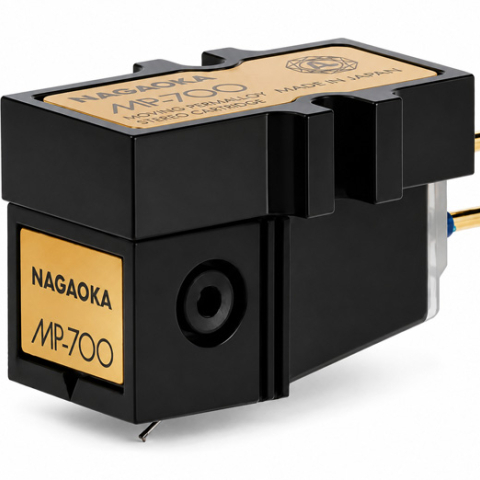
I was curious how the Stjarna might get on with my Nagaoka MP-200 moving magnet cartridge. Using the Dynavector XX2A with Dynavector's SUP-200 step-up transformer gave me enough sense of the Stjarna's RIAA stage to know it is precisely EQ'd with a faint blush of tube radiance.
If there is one record I cherish most in my collection, one that I would carry out in a fire—one I pay extra-close attention to when it is playing—it is Astor Piazzolla: The American Clavé Recordings (Nonesuch 075597915297).
This landmark trio of albums—Tango: Zero Hour, La Camorra: The Solitude of Passionate Provocation, and The Rough Dancer and the Cyclical Night (Tango Apasionado)—is being reissued as a set. It's the first time these albums have been available on vinyl since their initial release on American Clavé in the 1980s.
Artistically, The Rough Dancer and the Cyclical Night (Tango Apasionado) appeals to me on many levels. But the truest reason I love it is because it is deeply mysterious and mesmerizing, and I equate mystery with beauty. Rough Dancer's recorded sound is dark, heavily textured, and impenetrably dense and shadowy. The Stjarna exposed more layers of low-level sounds than I could keep track of.
Listening through this density, I tried to see into Piazzolla's mind. I wanted to feel his thinking while he was making his art at this level of intensity. To my delight, the Dynavector–Stjarna combo excelled at letting me zero in and mind-meld with Tango's master creator.
Hum and hissing vipers returned when I connected the Dynavector cartridge directly into the Stjarna's MC input, set to 55dB gain and shunted with 100 ohms. As before, I didn't care about noise, because the swerving rhythms and the melody lines of individual instruments were more pronounced while going straight in, making mind melding with Astor even easier. I felt that on its own, without the Dynavector SUT, the tube input Stjarna did a better job communicating the depth and complexity of The Rough Dancer and the Cyclical Night.
I chose the $2250, 0.28mV output Dynavector XX2A moving coil to begin this report because Dynavector's cartridges are the sound I know best through the widest variety of phono stages. When the XX2A arrived, I had already put 1000+ hours on my daily-driver XX2, and before that, I wore the tip to a nub on a DV-20X2. Using the Dynavector XX2A made it easier to identify what part of the sound was from the cartridge and what part was the Schiit Stjarna's tubed circuitry.
Unfortunately, the Dynavector's low output (0.28mV at 1kHz) and preferred 100 ohms load meant I had to run the Stjarna's tube gain high, at 55dB, just one stop below its 60dB maximum, and the LTA Z10e virtually wide open (90%–100%), which meant I heard hiss and hum from my listening position about 7' away.
Standing noise from the Schiit was reduced when I installed the $850 Hana SL MK II (footnote 4), which has slightly higher output at 0.4mV, an 8 ohm internal impedance, and a recommended loading of 80 ohms or greater. With the Hana SL MK II, for normal listening, the Z10e's volume control was a little lower, between 85% and 95%. Apparently, that was just enough, since noise was no longer a distraction. It was fun to watch and listen as the SL MK II got kissy cozy with the Schiit Stjarna, playing record after record as if they were honeymooning. Piazzolla's Rough Dancer came out with lush, intricate detail and a clear view of its compositional complexity.
These were the moments where I first noticed the 6N1P tube's subtle stoic beauty. The Stjarna's view into this recording showed mildly overcast lighting and relaxed, naturally contrasted images. The Hana played yin to the Dynavector's yang. I'm glad I tried it; I imagine this was the sound designer Jason Stoddard had in mind for this product.
One of this month's most delight-filled moments occurred while the Schiit and Hana were playing Barbra Streisand singing "A Sleepin' Bee" off The Barbra Streisand Album from 1963. Tone-wise and expression-wise, Barbra's voice sounded like the perfect sum of every time I ever heard it. The all-tube Stjarna did not sound tubey or dull or silicon bright or feedback. It simply got Barbra's tone and charisma right.
As I mentioned above, when I play Streisand records, especially this first one, I need to connect to each song quickly and to feel Barbra's persona reaching through the microphones and speakers. Then I need to smile with fanboy pride and feel like congratulating myself for having the aesthetic bandwidth to appreciate the fullness of Barbra's immense talent. The Hana SL MK II cartridge with the Stjarna's moving coil stage satisfied those needs while showing off the excellent quality of this legendary recording.
I was curious how the Stjarna might get on with my Nagaoka MP-200 moving magnet cartridge. Using the Dynavector XX2A with Dynavector's SUP-200 step-up transformer gave me enough sense of the Stjarna's RIAA stage to know it is precisely EQ'd with a faint blush of tube radiance.
 The difference in sound character between the $509 Nagaoka MP-200 and the $850 Hana SL MK II was more dramatic than I expected. The Nagaoka really sounds good playing This Boot Is Made for Fonk-N by Bootsy's Rubber Band (Warner Brothers LP BSK 3295). It put a Cadillac's trunk full of Bootsy's swaggering funk into my room and out into my hall by the elevator, where my 20-something neighbors danced and hooted approval. The Nagaoka was at its best pulling out Bootsy Collins and George Clinton grooves while showing off all that late-'70s solid state recording gear. With the MP-200, the sound was rough, dry, and period-correct.
When I played this Rubber Band album with the Hana SL MK II, it got all Shibata-stylus-detailed and refined sounding, which did not feel right. While the MP-200's elliptical stylus showed more big Bootsy hats and mad Bootsy grins, Hana's Shibata preferred Nina Simone emoting quietly from her piano.
Across all these cartridge swaps, the Schiit Stjarna stayed clear, unshakable, and exceedingly neutral. That's a word I typically scowl at, but it was the Stjarna's best trait: its lack of affect, its ability to disappear and put the vital core of the music coming from the cartridge stage-forward. By not adding color to the sound of the Dynavector, Hana, and Nagaoka cartridges, the Schiit phono stage allowed each cartridge to speak unfiltered, with its own voice. That's a rare, five-star virtue.
The difference in sound character between the $509 Nagaoka MP-200 and the $850 Hana SL MK II was more dramatic than I expected. The Nagaoka really sounds good playing This Boot Is Made for Fonk-N by Bootsy's Rubber Band (Warner Brothers LP BSK 3295). It put a Cadillac's trunk full of Bootsy's swaggering funk into my room and out into my hall by the elevator, where my 20-something neighbors danced and hooted approval. The Nagaoka was at its best pulling out Bootsy Collins and George Clinton grooves while showing off all that late-'70s solid state recording gear. With the MP-200, the sound was rough, dry, and period-correct.
When I played this Rubber Band album with the Hana SL MK II, it got all Shibata-stylus-detailed and refined sounding, which did not feel right. While the MP-200's elliptical stylus showed more big Bootsy hats and mad Bootsy grins, Hana's Shibata preferred Nina Simone emoting quietly from her piano.
Across all these cartridge swaps, the Schiit Stjarna stayed clear, unshakable, and exceedingly neutral. That's a word I typically scowl at, but it was the Stjarna's best trait: its lack of affect, its ability to disappear and put the vital core of the music coming from the cartridge stage-forward. By not adding color to the sound of the Dynavector, Hana, and Nagaoka cartridges, the Schiit phono stage allowed each cartridge to speak unfiltered, with its own voice. That's a rare, five-star virtue.
 The Goldring Ethos and Lundahl's fancy metal
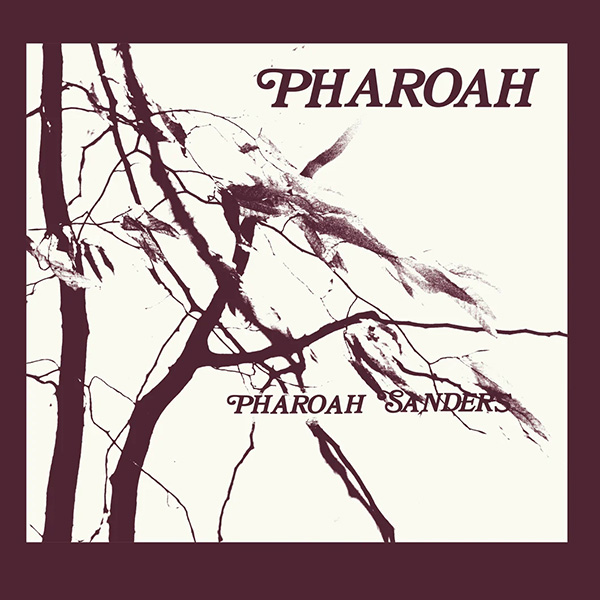
Directly into Schiit's first tube, the higher output Hana SL MK II played quieter and more relaxed than the 6 ohm, 0.28mV Dynavector. I was curious how the even higher output (0.5mV) of the Goldring Ethos ($1599) and its lower (4 ohm) impedance would get on with the Stjarna's 6N1P grid. Coming through the Stjarna, Luaka Bop's LP reissue (LB 0090) of Pharoah Sanders's 1976 performance of "Harvest Time" (India navigation IN 1027) felt dark, introspective, and atmospheric. Its droning tones and high-tactility saxophone textures forced my mind into something like LSD wonderment. Standing between my Falcon Gold Badge speakers, Pharoah Sanders was a fully charged specter speaking from The Other Side, and I couldn't take my eyes off him. The value of a premium cartridge and phono stage, like Goldring's Ethos and Schiit's Stjarna, lies in their ability to connect listeners with the personas of artists.
Schiit's Stjarna tube input presented Pharoah's "Harvest Time" as an earnest mystical exploration. Listening to it was intense yet gently rewarding and overtly contemplative. But even with 60dB gain, this rcording's sound was not as bold, sharp, or intense as I remembered it. Stjarna's 6N1P tube was providing evocative glow and atmosphere, but the music felt light and distant, with minimal punch'n'presence.
On a seasoned hunch, I inserted Lundahl's silver-wired, amorphous-cored LL1931 Ag step-up transformer ($1500 from VK Music), switching the gain to 40dB and the loading to 47k ohms. That made Pharoah Sanders taller and pushed him forward in my room. Striking, powerful, vivid, and affecting—these adjectives did not apply while I ran these cartridges straight into the Schiit's 6N1P tubes, but they were conspicuous traits with the Lundahl step-up transformer inserted.
I can't remember Pharoah's "Harvest Time" ever sounding this in-my-room close or vibey and immediate. Lundahl's silver-wired amorphous-core step-up was amping up the wow and pizzazz, and I loved it. I didn't care if it was accurate; I find this kind of super-immediate sound exciting to listen to.
This $1600 cartridge, $1500 transformer, and $1800 phono stage played this Pharoah Sanders track with force and immediacy that I could settle down and count anniversaries with. With these three components, the sound was never forward, in my face, impolite, too polite, overstated, or understated. It was just strong and dramatically present.
The Goldring Ethos MC + Lundahl Ag SUT + Schiit Stjarna MM phono stage put a charge of brilliance into a David Lewiston Nonesuch Explorer Series recording that has fascinated me for 50 years. During the '90s, I used it as a demo record at CES, where it could empty a room in 10 seconds. The record is Tibetan Buddhism–Tantras of Gyütö: Mahakala (H-72055). It's an inspired field recording recorded at Gyütö Tantric College, Dalhousie, Himachal Pradesh, India, featuring a dozen or more chanting monks, a spattering of Lamas, gongs, bells, chimes, and one extremely large drum. These elements of traditional Buddhist chant do more than create sonic orgies; they invoke wholeness of spirit while inclining listeners towards a "we" mindset. But they need a proper hi-fi to help with that.
Sometimes, the intention of chordal chanting is to invoke a deity. On this recording, that deity is Mahakala (Tib.: Gonpo): The Great Black Lord of Transcending Awareness. With the Goldring, Lundahl, and Schiit, this record reproduced the sounds of wood, metal, and flesh in a manner that consecrated their materialities.
Most of all, this recording is a sonic spectacular. It excites me with its bass and treble. The sound of its sound is its chief gift to listeners.
Besides adding scale and presence, the most noticeable thing that changed when I added the Lundahl LL1931 Ag was the extension and quality of its bass. Straight into the Stjarna, the bass was soft and mostly in the background. With Lundahl's SUT, the big drum moved forward and pounded my chest hard, like it surely did to those monks and Lamas.
 In Sum
On the basis of a lifetime of listening, I judge that perhaps eight out of 10 phono stages make cartridges sound flatter, drier, grayer, and more boring than they really are. Like cheap DACs, a mediocre phono stage's own sound colors all signals passing through. Premium phono stages like Schiit's new Stjarna do the opposite: Their neutrality and transparency let the colors of all sounds pass through.
Making analog recordings sound vital requires a lot more than accurate RIAA and low noise. No one knows that better than Mike Moffat and Jason Stoddard at Schiit. Likewise, nobody knows better than Mike and Jason how to make phono stages sound vibrant and compelling. They have been making preamps that sound that way since high-end audio's Golden Era in the 1980s. You could put the Stjarna in a thick, CNC-made box and charge five figures for it, and no one would question its quality or pedigree.
Its vivo, tone purity, and overall neutrality make the Stjarna a strong candidate for Stereophile's Budget Product of the Year.
Thank you, Mike and Jason, well done.
Footnote 1: Schiit Audio, 24900 Anza Dr., Unit A, Valencia, CA 91355. Tel: (323) 230-0079. Web: schiit.com. Footnote 2: See forvo.com/word/stjarna. Footnote 3: The rest of the system was the LTA Z10e driving my Falcon Gold Badge LS3/5a's.
Footnote 4: A little more than 1/3 the price of the Dynavector cartridge.
To me, miniature nine-pin small-signal tubes will always be the beating heart sound creators of tubed audio devices. Their job is to preserve the life energy of the recording, and the best ones are really good at that. But because of their glass size and the diameter of their pins, they can also be wiggly wobbly pingy screechy staticky hissy hummy. And unpredictable. Regardless, like most small creatures, miniature tubes are adorable. The $1699 Schiit Audio Stjarna (footnote 1) uses four Russian-made 6N1P tubes. These tubes are famously quiet, high in transconductance, low in microphonics, and roughly akin to 6DJ8/6922s—the chief difference being that the 6N1P draws twice the heater current as a 6DJ8. In my Midwestern hayseed mind, the all-tube Schiit Audio Stjarna MM/MC phono stage will forever be pronounced Saint Jarna. The correct Swedish pronunciation sounds more like a country: chi-na. The old Norse pronunciation is more nasal: stat-na (footnote 2). Google says the word means star in the Norse legends that Schiit co-founder Jason Stoddard appropriates product names from. So maybe it should be pronounced Starna? Call it what you like, this is a seriously high-value product.
Looking at its backside, I observed two pairs of phono inputs near a high-quality binding post for turntable ground wires. I also spotted a pair of single-ended RCA outputs, an IEC socket near a power switch, and a covered slot for Schiit's Forkbeard dongle.
I spent a lot of time staring at the Stjarna's asymmetric front panel because I admired how it looked and how it operates. On the far left is a button that does two important things. Press it quickly to toggle through the Stjarna's nine resistive loads: 10, 50, 100, 150, 200, 250, 300, 350, and 47k ohms. Press it slowly, and the Stjarna goes into standby.
What's a Forkbeard? I'd never heard of Schiit's Forkbeard app, which promises "total control" over "stacks" of Schiit products. When I first read about it, I pictured Jason as a fierce Viking with a beard like a snake's tongue, covered in ice droplets. Later, when I found out that Forkbeard was an iPad app—an Android version is promised for summer 2025—his face became clean shaven, and he was sitting at a desk looking out the window at an immense California parking lot.
After playing six sides of six records with the Stjarna, I played The Barbra Streisand Album (Columbia LP CL 2007), and when I came to "Happy Days Are Here Again," I said "whoa, this is not a happy day for my record player." Instead of sounding round and real, my beloved Streisand was sounding flat and fake, and I was not connecting with her like I usually do.
Dynavector's XX2A cartridge was feeding the Stjarna's MC input set to 60dB of gain and loaded at 100 ohms (footnote 3). Streisand sounded gray and hissy-boring. The sound got more relaxed and colorful when I reduced the Stjarna's gain to 55dB, but there was still no pizzazz.
If there is one record I cherish most in my collection, one that I would carry out in a fire—one I pay extra-close attention to when it is playing—it is Astor Piazzolla: The American Clavé Recordings (Nonesuch 075597915297).
This landmark trio of albums—Tango: Zero Hour, La Camorra: The Solitude of Passionate Provocation, and The Rough Dancer and the Cyclical Night (Tango Apasionado)—is being reissued as a set. It's the first time these albums have been available on vinyl since their initial release on American Clavé in the 1980s.
The difference in sound character between the $509 Nagaoka MP-200 and the $850 Hana SL MK II was more dramatic than I expected. The Nagaoka really sounds good playing This Boot Is Made for Fonk-N by Bootsy's Rubber Band (Warner Brothers LP BSK 3295). It put a Cadillac's trunk full of Bootsy's swaggering funk into my room and out into my hall by the elevator, where my 20-something neighbors danced and hooted approval. The Nagaoka was at its best pulling out Bootsy Collins and George Clinton grooves while showing off all that late-'70s solid state recording gear. With the MP-200, the sound was rough, dry, and period-correct.
When I played this Rubber Band album with the Hana SL MK II, it got all Shibata-stylus-detailed and refined sounding, which did not feel right. While the MP-200's elliptical stylus showed more big Bootsy hats and mad Bootsy grins, Hana's Shibata preferred Nina Simone emoting quietly from her piano.
The Goldring Ethos and Lundahl's fancy metalDirectly into Schiit's first tube, the higher output Hana SL MK II played quieter and more relaxed than the 6 ohm, 0.28mV Dynavector. I was curious how the even higher output (0.5mV) of the Goldring Ethos ($1599) and its lower (4 ohm) impedance would get on with the Stjarna's 6N1P grid. Coming through the Stjarna, Luaka Bop's LP reissue (LB 0090) of Pharoah Sanders's 1976 performance of "Harvest Time" (India navigation IN 1027) felt dark, introspective, and atmospheric. Its droning tones and high-tactility saxophone textures forced my mind into something like LSD wonderment. Standing between my Falcon Gold Badge speakers, Pharoah Sanders was a fully charged specter speaking from The Other Side, and I couldn't take my eyes off him. The value of a premium cartridge and phono stage, like Goldring's Ethos and Schiit's Stjarna, lies in their ability to connect listeners with the personas of artists.
In SumOn the basis of a lifetime of listening, I judge that perhaps eight out of 10 phono stages make cartridges sound flatter, drier, grayer, and more boring than they really are. Like cheap DACs, a mediocre phono stage's own sound colors all signals passing through. Premium phono stages like Schiit's new Stjarna do the opposite: Their neutrality and transparency let the colors of all sounds pass through.
Footnote 1: Schiit Audio, 24900 Anza Dr., Unit A, Valencia, CA 91355. Tel: (323) 230-0079. Web: schiit.com. Footnote 2: See forvo.com/word/stjarna. Footnote 3: The rest of the system was the LTA Z10e driving my Falcon Gold Badge LS3/5a's.