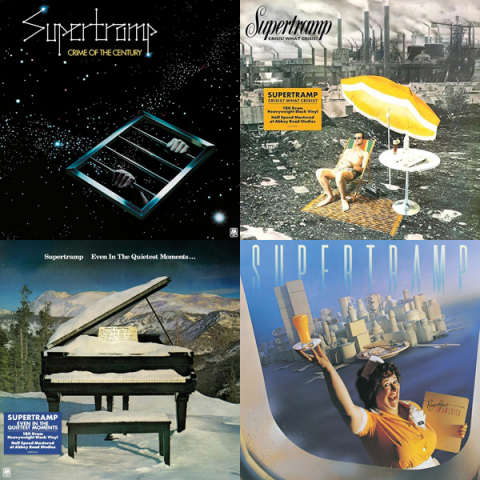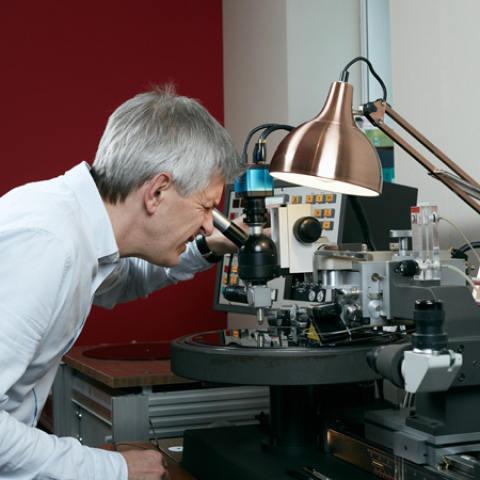

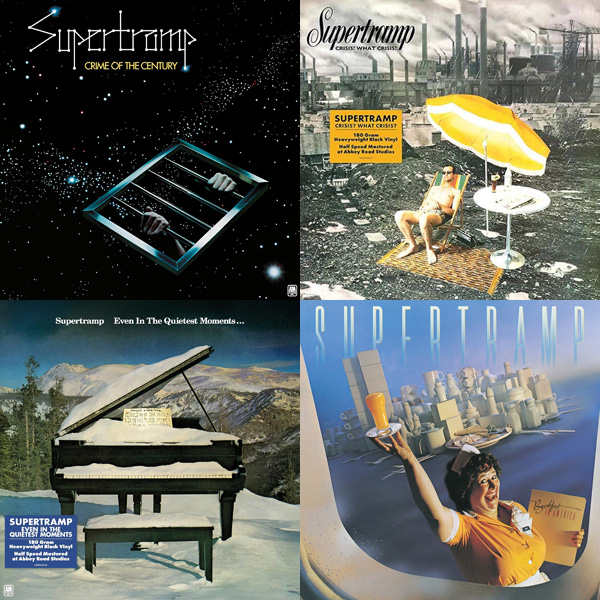
Miles Showell, the modern master of the half-speed master, has been busy. Besides helming a score of reissues from the Alan Parsons Project's Arista heyday (see "Miles Showell, Half-Speed Master"), the affable audio engineer found time to put an indelible half-speed stamp on seven entries in Supertramp's studio catalog, initially released on A&M between 1974 and 1987, plus two solo releases by band expat Roger Hodgson (also on A&M).
Parent label UMe rolled out this nine-album series in four parts to spread the half-speed love (and perhaps spare the wallet). Crime of the Century (1974) and Crisis? What Crisis? (1975) came first, in August 2025, followed by Even in the Quietest Moments... (1977), Breakfast in America (1979), and ...famous last words... (1982) in March 2026. Brother Where You Bound (1985) and Free as a Bird (1987) comprised the third wave, in June 2026. The two Hodgson solo LPs, In the Eye of the Storm (1984) and Hai Hai (1987), completed the series in August 2026. All nine are worthy listens/acquisitions, depending on your level of interest/fanaticism.
"We went through all sorts of hoops," Showell told me via a Zoom call from Abbey Road Studios. "We had every tape that was in the US vault plus every tape in the UK vault pulled and sent to me at Abbey Road. It's very, very rare that tapes travel overseas these days. For the first two albums, I was here with [original producer] Ken Scott, and we both went through everything we had. We had to go through them all to try and find the best source for each album."
It wasn't easy, especially shepherding the record many (yours truly included) consider Supertramp's pinnacle, Crime of the Century. "We didn't have the master," Showell said. "What we had were the UK production tapes. In the late '90s, [the label] became aware that the tapes that had been sent to the A&M vaults in America were getting fairly worn, so they made one-to-one analog safety copies of all of them. These were half-inch, 30ips tapes that were really beautifully done, by engineer Ken Villeneuve. The idea was, 'Let's prevent any further damage.'
"For the first album"—that's Crime—"we used Ken's copy, which was taken from the master. ... Even that one wasn't perfect, because bits of 'Dreamer' were damaged. We had to fly in a little bit of 'Dreamer' from another source—just, like, 15 seconds' worth."
I've since listened to the half-speed version of the jaunty "Dreamer" numerous times, and I'm still at a loss as to where that fly-in takes place.
After spinning all nine, I've zeroed in on one selection on each album that I feel best represents the range of Supertramp and Hodgson's whisper-to-controlled-caterwaul dynamics. I nominate "School" from Crime, "Another Man's Woman" from Crisis, "Fool's Overture" from Quietest, "Just Another Nervous Wreck" from Breakfast, "Don't Leave Me Now" from famous, the admittedly overlong title track from Brother, and the album-closing "An Awful Thing to Waste" from Bird.
 For Hodgson, I'm going with "Had a Dream (Sleeping with the Enemy)" from Storm and the snarling "My Magazine" from Hai.
For Showell, the aforementioned "School" remains a touchstone. "It's a very clean recording. 'School' goes from absolutely nothing to full-on go, which no one does these days in popular music," he said. "Having never heard the tape before, what really struck me was how dynamic it was, so we tried to keep it like it was. Some people have been saying, 'Oh, it's not as loud as the original'—well, it is, in places." (He's right—especially when Rick Davies's piano-pounding sequence enters at 3:16, and in the "maybe I'm mistaken" section with the recurring cymbal crashes, which commences at 4:48.)
Crisis, which is among the most overlooked albums in the Supertramp canon, had issues before Showell (and Scott) got it up to half-speed snuff. "We had the original master for Crisis, bar about 20 seconds: ... someone had just cut it out!" Showell recounted. "There was a whole piece missing—but with 50-year-old tapes, that just happens.
"Lots of things were against them for that album, but I actually like it," the engineer continued. "Although it sounds different to Crime, it doesn't sound terrible. It's got some great songs on there, like 'Ain't Nobody but Me,' but Ken didn't really want me to do loads of wild EQ on it. Crisis is not as commercial as Crime, but it's got a lot of merit. It's a good album. It missed its mark in the day, but I think it'll get revisited and hopefully find a new audience."
Finally, I asked Showell if UMe had charged him with doing his half-speed magic for the two albums Supertramp released prior to Crime—the self-titled 1970 debut some have nicknamed Flowerhead and the 1971 sophomore LP with the crude tattooed cover art, Indelibly Stamped. To my ear, "It's a Long Road," "Surely," and "Try Again" from Supertramp—plus "Your Poppa Don't Mind" and "Rosie Had Everything Planned" from Stamped—are key building blocks of the Supertramp sound, but they could all use some half-speed love.
"People knew very little about Supertramp before Crime of the Century, which is their gateway album," Showell replied. "I've not yet been asked to do those really early albums—but maybe that will come." If everyone was listening, you know, then surely that call must be made.
For Hodgson, I'm going with "Had a Dream (Sleeping with the Enemy)" from Storm and the snarling "My Magazine" from Hai.
For Showell, the aforementioned "School" remains a touchstone. "It's a very clean recording. 'School' goes from absolutely nothing to full-on go, which no one does these days in popular music," he said. "Having never heard the tape before, what really struck me was how dynamic it was, so we tried to keep it like it was. Some people have been saying, 'Oh, it's not as loud as the original'—well, it is, in places." (He's right—especially when Rick Davies's piano-pounding sequence enters at 3:16, and in the "maybe I'm mistaken" section with the recurring cymbal crashes, which commences at 4:48.)