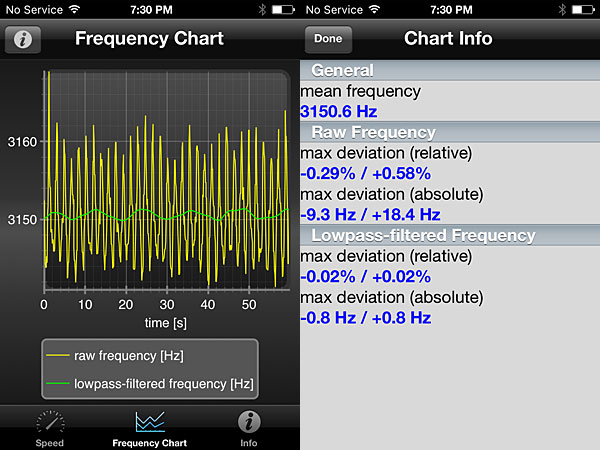
I found that one end of the acceptable belt tension range produced greater absolute speed variation measurements but impressively flat and stable high-pass–filtered results (smooth green line), while at the other end, there were smaller absolute speed variations but greater filtered speed undulations.
 Crisply executed commands
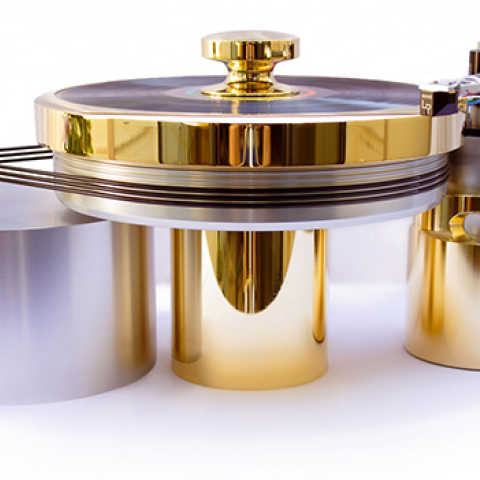
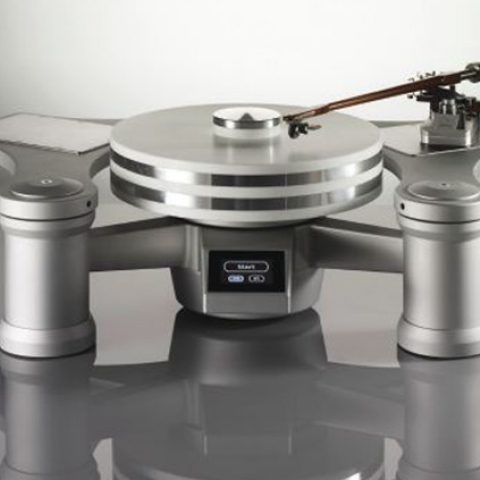
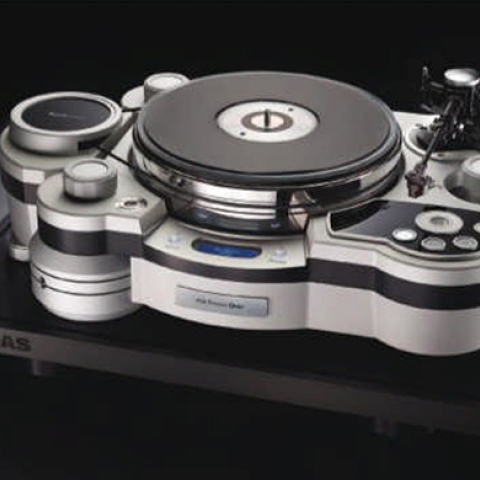
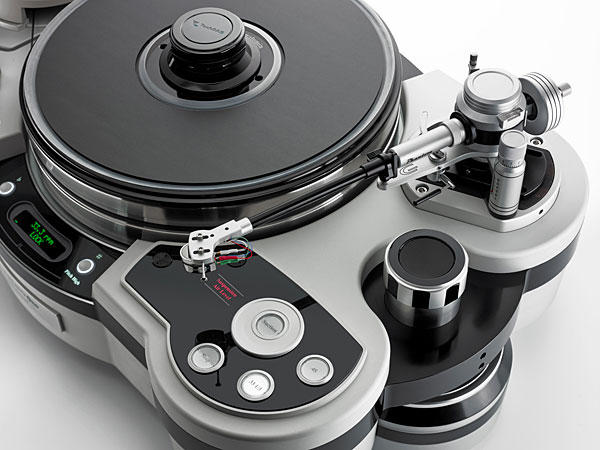
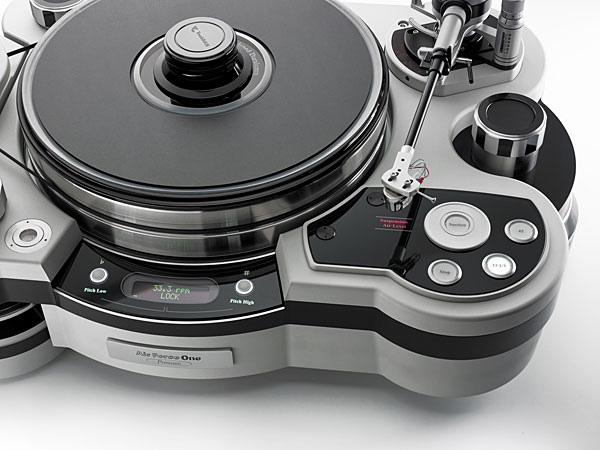
For this kind of money, you should expect your playback wishes to be obeyed. The Air Force One Premium does not disappoint. Once set up, it remains set up. It's physically quiet (including the pumps), responsive, and neither finicky nor tweaky. The status screen lets you know when the platter has achieved speed and "locked," and with the push of a pair of buttons, you can adjust pitch up or down in increments of 0.1%, or, by holding down the buttons, by 1% per second up to 10% maximum. Hold down the "stop" button and the 'table goes into "standby" mode, which turns off the compressor and "unfloats" the platter. The Graham Engineering Elite tonearm
Graham Engineering, which imports and distributes TechDAS turntables, loaned me one of their Phantom Elite Tonearms ($13,500; the price varies somewhat depending upon armwand length). TechDAS has distributed Graham tonearms in Japan and recommends the Phantom Elite for use with the Air Force One Premium, so supplying one for this review made sense.
The Elite is a completely redesigned and substantially upgraded (in terms of parts and execution) reimagining of the basic and highly regarded Phantom design. Like the less-costly Phantom, the Elite uses an inverted unipivot bearing featuring Graham's patented Magneglide magnetic stabilization system, which mitigates the typical unipivot "wobble" and ensures that the arm will not deviate from correct azimuth as it pivots across the record.
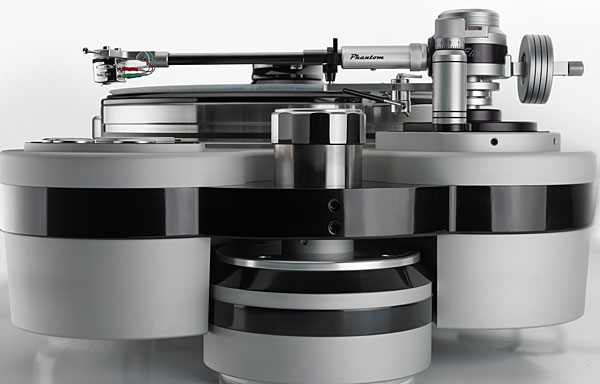 Graham supplied an additional armwand: an optional TechDAS-manufactured wand made from titanium (approximately $4000). I auditioned both it and the standard armwand. I've not had any previous experience with the Elite, so it's impossible for me to strictly separate the sonic performance of the arm and the turntable. Switching out the armwands, though, allowed me to get some insight into what the tonearm was doing, as discussed below.
What price serenity?
Graham supplied an additional armwand: an optional TechDAS-manufactured wand made from titanium (approximately $4000). I auditioned both it and the standard armwand. I've not had any previous experience with the Elite, so it's impossible for me to strictly separate the sonic performance of the arm and the turntable. Switching out the armwands, though, allowed me to get some insight into what the tonearm was doing, as discussed below.
What price serenity?
Referring to the aforementioned two extremes of the belt-tension range, though the audible differences were minor even when comparing solo piano and other music with long sustained notes, the flatter green line produced a smoother, more serene, and one could even say "creamy" sound, which I believe is the goal of designer Hideaki Nishikawa.
The reason I think that's his goal is that the smooth-midband, "bubbly" sonic character of the two TechDAS cartridges I've heard was very similar, especially the top-of-the-line TDC01 Ti titanium-bodied cartridge ($15,500; not supplied for this review). That cartridge has a smooth, rich, midrange-to-die-for sonic signature—not surprising since Nishikawasan is a big opera fan, and vocals are critical in his musical world.
That cartridge, combined with the $450,000 Air Force Zero demonstrated earlier last year at The Audio Salon in Santa Monica and later at High End Munich 2019, produced among the most realistic and convincing vocals I've ever experienced from an analog front end.
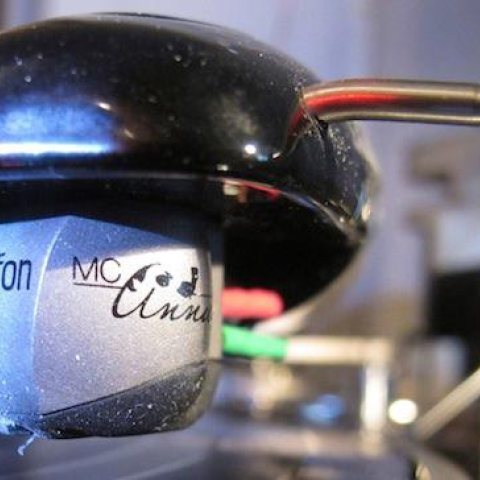
When I compared TechDAS's titanium armwand for the Graham Elite with Graham's standard Elite armwand, using, among other cartridges, the Ortofon Anna D, the differences were not subtle; those differences helped me distinguish between the sound of the arm and that of the 'table—as well as the sonic differences between the armwands, which were considerable.
While I stand by everything I wrote in the January 2020 Stereophile about the $15,000 VPI HW-40, the TechDAS Air Force One Premium, at 10 times the price, produces dramatically blacker backgrounds and a far more sophisticated level of transient subtlety and precision. You wonder how much blacker backgrounds can get until you hear them. The blackest by far were on the Zero, but the One Premium comes close! Can you measure serenity? No, but listen to the Air Force One Premium and you'll immediately hear it.
 On the Blue Note Tone Poet release of Grant Green's Born to Be Blue (Blue Note BST 84432), on which the guitarist performs a set of six standards with Ike Quebec, Sonny Clark, Sam Jones, and Louis Hayes, the ensemble exploded almost violently from the speakers. Green's precisely placed single-note lines were richly textured yet endowed with sharply and cleanly delivered transients and surrounded by a satisfying and subtle decay envelope. Each note was like a major event, as were Hayes's rim shots. Clark's piano, centered in the stereo mix (and lower in the mix on some tracks than on others), was rendered between the speakers with unforced clarity.
Equally impressive (and expressive) was the 'table's microdynamic performance on a new, superbly mastered, pressed, and packaged Deutsche Grammophon box set reissue of Pierre Fournier and Friedrich Gulda's Beethoven: Complete Works for Cello and Piano (3 LPs, DGG 483 7316), recorded in June 1959 and originally released individually.
The limited-edition (1700 copies) set was half-speed mastered at Emil Berliner Studios and, like the Bernstein Beethoven cycle box set issued earlier this year, includes facsimiles of the original production sheets, and I can attest that the set's Cello Sonata in D major sounds far better than on my single-LP original (DG 138 083). Pressing quality, on my set at least, was absolutely perfect: black backgrounds, not a single pop or click. The recording quality is "you-are-in-the-hall" natural.
Gulda's piano is center stage, Fournier's cello stage left (right channel), and the recording space—the 600-seat Brahms-Saal of the Wiener Musikverein—subtly reveals itself behind and around the two players. Fournier's low-note "growls" have appropriate traction—sufficient grit to excite and be believable—and Gulda's precise playing is well-preserved both in the mastering and especially in the Air Force One Premium/Phantom Elite's transcription of it. Image stability was rock solid. Attack, sustain, and decay were natural. (Attack was neither edgy nor too soft.) It was believable on all well-recorded material.
No wonder that, lights out, you can time-travel back to 1959 and be in the hall for the performance. This recording is why people with the cash (and some without it) lay it down for a turntable like this.
The Air Force One Premium's smooth and serene personality doesn't mean it can't transmit grit when grit is in the recording. The Kinks' overlooked concept album Arthur (Or the Decline and Fall of the British Empire) (Pye NSPL 18317) has just been reissued, but since I have two original UK pressings and a 1983 Japanese PRT label reissue (SP-20-5030) that's spectrally better balanced, I'm set!
This is a bright, bass-shy, in-your-face but oddly in-the-studio–natural recording that the 'table does not smooth over or make pretty. But the Air Force One Premium's commendably low coloration and nimble bottom end helped reveal inner details, like Dave Davies' complex, unusual, "Middle Eastern" overdubbed guitar lines on "Mr. Churchill Says." Ray's voice on the 1920's "flapper" tune "She's Bought a Hat Like Princess Marina" hovers between the speakers, sounding as if you are listening from the microphone side while all of the sound effects and oldfashioned sonic ephemera shimmer, well-defined, bright, and silly, more clearly defined than is necessary—but the Air Force One Premium laid it all out evenhandedly.
On the Blue Note Tone Poet release of Grant Green's Born to Be Blue (Blue Note BST 84432), on which the guitarist performs a set of six standards with Ike Quebec, Sonny Clark, Sam Jones, and Louis Hayes, the ensemble exploded almost violently from the speakers. Green's precisely placed single-note lines were richly textured yet endowed with sharply and cleanly delivered transients and surrounded by a satisfying and subtle decay envelope. Each note was like a major event, as were Hayes's rim shots. Clark's piano, centered in the stereo mix (and lower in the mix on some tracks than on others), was rendered between the speakers with unforced clarity.
Equally impressive (and expressive) was the 'table's microdynamic performance on a new, superbly mastered, pressed, and packaged Deutsche Grammophon box set reissue of Pierre Fournier and Friedrich Gulda's Beethoven: Complete Works for Cello and Piano (3 LPs, DGG 483 7316), recorded in June 1959 and originally released individually.
The limited-edition (1700 copies) set was half-speed mastered at Emil Berliner Studios and, like the Bernstein Beethoven cycle box set issued earlier this year, includes facsimiles of the original production sheets, and I can attest that the set's Cello Sonata in D major sounds far better than on my single-LP original (DG 138 083). Pressing quality, on my set at least, was absolutely perfect: black backgrounds, not a single pop or click. The recording quality is "you-are-in-the-hall" natural.
Gulda's piano is center stage, Fournier's cello stage left (right channel), and the recording space—the 600-seat Brahms-Saal of the Wiener Musikverein—subtly reveals itself behind and around the two players. Fournier's low-note "growls" have appropriate traction—sufficient grit to excite and be believable—and Gulda's precise playing is well-preserved both in the mastering and especially in the Air Force One Premium/Phantom Elite's transcription of it. Image stability was rock solid. Attack, sustain, and decay were natural. (Attack was neither edgy nor too soft.) It was believable on all well-recorded material.
No wonder that, lights out, you can time-travel back to 1959 and be in the hall for the performance. This recording is why people with the cash (and some without it) lay it down for a turntable like this.
The Air Force One Premium's smooth and serene personality doesn't mean it can't transmit grit when grit is in the recording. The Kinks' overlooked concept album Arthur (Or the Decline and Fall of the British Empire) (Pye NSPL 18317) has just been reissued, but since I have two original UK pressings and a 1983 Japanese PRT label reissue (SP-20-5030) that's spectrally better balanced, I'm set!
This is a bright, bass-shy, in-your-face but oddly in-the-studio–natural recording that the 'table does not smooth over or make pretty. But the Air Force One Premium's commendably low coloration and nimble bottom end helped reveal inner details, like Dave Davies' complex, unusual, "Middle Eastern" overdubbed guitar lines on "Mr. Churchill Says." Ray's voice on the 1920's "flapper" tune "She's Bought a Hat Like Princess Marina" hovers between the speakers, sounding as if you are listening from the microphone side while all of the sound effects and oldfashioned sonic ephemera shimmer, well-defined, bright, and silly, more clearly defined than is necessary—but the Air Force One Premium laid it all out evenhandedly.
 The turntable's uncolored nature and freedom from resonances and stored and released energy guarantees that almost every record you play is likely to reveal, in an unforced way, details that, even if not previously hidden, seem to fit more comfortably into the fabric of the whole.
While I couldn't directly compare the SAT CF1-09 tonearm and the 75% less expensive Graham Phantom Elite on the TechDAS 'table, going back and forth between the former on my Continuum Caliburn and the latter on the Air Force One Premium made it clear: As good as the Elite's overall performance was in every parameter, the SAT's bottom-end extension, drive, and definition remain unchallenged in my listening experience.
Conclusion
The turntable's uncolored nature and freedom from resonances and stored and released energy guarantees that almost every record you play is likely to reveal, in an unforced way, details that, even if not previously hidden, seem to fit more comfortably into the fabric of the whole.
While I couldn't directly compare the SAT CF1-09 tonearm and the 75% less expensive Graham Phantom Elite on the TechDAS 'table, going back and forth between the former on my Continuum Caliburn and the latter on the Air Force One Premium made it clear: As good as the Elite's overall performance was in every parameter, the SAT's bottom-end extension, drive, and definition remain unchallenged in my listening experience.
Conclusion
With its ultraquiet backgrounds, the generosity of its presentation of instrumental sustain and decay, its neutral spectral balance, and a dynamic presentation that seems to project and establish the musical picture far from the speaker boundaries and without limitations, the Air Force One Premium has a knack for getting out of the way and letting your cartridge of choice exhibit its sonic character without restrictions. It's as much reliable test instrument as supreme carrier of unassuming musical pleasure. Up to now, I've avoided comparison between the Air Force One Premium and my long-term reference Continuum Caliburn (which over the few years it was in production underwent significant running upgrades), because the latter is now almost 14 years old. However, in terms of smoothness, sonic sophistication, background blackness, and yes, the unmeasurable aforementioned serenity (which is not a euphemism for boredom!), I have to give the nod to the Air Force One Premium. The longer you listen to it, the more musically surefooted and certain its performance becomes.
Crisply executed commandsFor this kind of money, you should expect your playback wishes to be obeyed. The Air Force One Premium does not disappoint. Once set up, it remains set up. It's physically quiet (including the pumps), responsive, and neither finicky nor tweaky. The status screen lets you know when the platter has achieved speed and "locked," and with the push of a pair of buttons, you can adjust pitch up or down in increments of 0.1%, or, by holding down the buttons, by 1% per second up to 10% maximum. Hold down the "stop" button and the 'table goes into "standby" mode, which turns off the compressor and "unfloats" the platter. The Graham Engineering Elite tonearm
Graham Engineering, which imports and distributes TechDAS turntables, loaned me one of their Phantom Elite Tonearms ($13,500; the price varies somewhat depending upon armwand length). TechDAS has distributed Graham tonearms in Japan and recommends the Phantom Elite for use with the Air Force One Premium, so supplying one for this review made sense.
Graham supplied an additional armwand: an optional TechDAS-manufactured wand made from titanium (approximately $4000). I auditioned both it and the standard armwand. I've not had any previous experience with the Elite, so it's impossible for me to strictly separate the sonic performance of the arm and the turntable. Switching out the armwands, though, allowed me to get some insight into what the tonearm was doing, as discussed below.
What price serenity?Referring to the aforementioned two extremes of the belt-tension range, though the audible differences were minor even when comparing solo piano and other music with long sustained notes, the flatter green line produced a smoother, more serene, and one could even say "creamy" sound, which I believe is the goal of designer Hideaki Nishikawa.
On the Blue Note Tone Poet release of Grant Green's Born to Be Blue (Blue Note BST 84432), on which the guitarist performs a set of six standards with Ike Quebec, Sonny Clark, Sam Jones, and Louis Hayes, the ensemble exploded almost violently from the speakers. Green's precisely placed single-note lines were richly textured yet endowed with sharply and cleanly delivered transients and surrounded by a satisfying and subtle decay envelope. Each note was like a major event, as were Hayes's rim shots. Clark's piano, centered in the stereo mix (and lower in the mix on some tracks than on others), was rendered between the speakers with unforced clarity.
Equally impressive (and expressive) was the 'table's microdynamic performance on a new, superbly mastered, pressed, and packaged Deutsche Grammophon box set reissue of Pierre Fournier and Friedrich Gulda's Beethoven: Complete Works for Cello and Piano (3 LPs, DGG 483 7316), recorded in June 1959 and originally released individually.
The turntable's uncolored nature and freedom from resonances and stored and released energy guarantees that almost every record you play is likely to reveal, in an unforced way, details that, even if not previously hidden, seem to fit more comfortably into the fabric of the whole.
With its ultraquiet backgrounds, the generosity of its presentation of instrumental sustain and decay, its neutral spectral balance, and a dynamic presentation that seems to project and establish the musical picture far from the speaker boundaries and without limitations, the Air Force One Premium has a knack for getting out of the way and letting your cartridge of choice exhibit its sonic character without restrictions. It's as much reliable test instrument as supreme carrier of unassuming musical pleasure. Up to now, I've avoided comparison between the Air Force One Premium and my long-term reference Continuum Caliburn (which over the few years it was in production underwent significant running upgrades), because the latter is now almost 14 years old. However, in terms of smoothness, sonic sophistication, background blackness, and yes, the unmeasurable aforementioned serenity (which is not a euphemism for boredom!), I have to give the nod to the Air Force One Premium. The longer you listen to it, the more musically surefooted and certain its performance becomes.