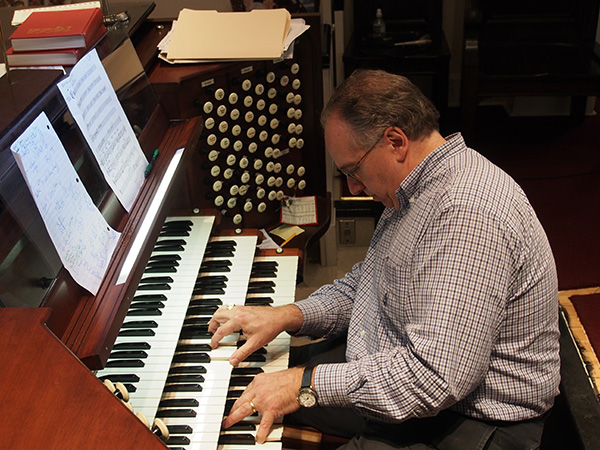
In May 2013 Michael Fremer attended a concert in Douglaston, NY that featured the late Robert J. Reina improvising on a church organ.
In the old days, this column would have covered last May's High End show in Munich and T.H.E. Show Newport Beach. Today, live online blogging renders obsolete magazine reports that arrive in your mailbox months after the events. It also makes life difficult for a monthly magazine columnist. I wasn't home a good part of the month, so how much serious listening do you think I managed?
But what a month!
 Colleen Murphy's Bowie Fest
On May 5, I attended Colleen Murphy's Classic Album Sundays event at the New Museum, in the Bowery. Part of the Red Bull Music Festival, Murphy's event featured the playing of three David Bowie LPs, and was co-hosted by the albums' original producers. The vinyl was played through an Audio Note UK system and a pair of Robert Lighton Audio RL-10 speakers. Lighton and Audio Note's Peter Qvortrup were on hand to set up and supervise the sound. Though when I entered the room I was skeptical about the system's ability to fill it, it managed to spray a large space with considerable musical depth and weight.
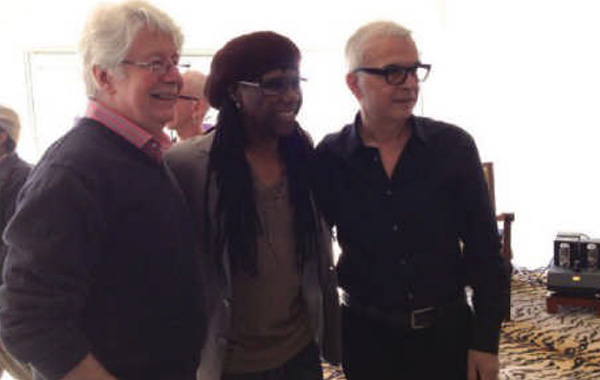
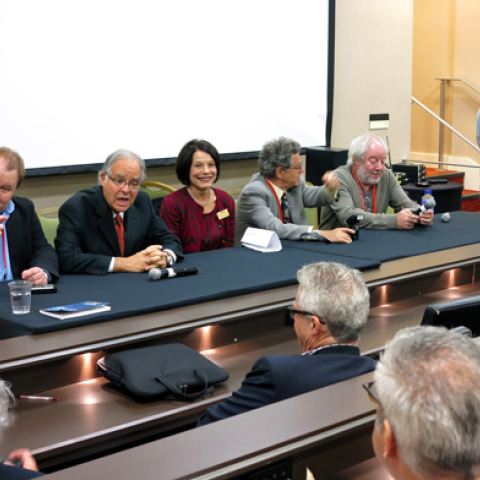
From left: Acclaimed music producers Ken Scott, Nile Rodgers, and Tony Visconti at the Red Bull Music Academy and Classic Album Sundays presentation of David Bowie's classic records.
To Munich via DusseldorfWednesday, May 8. Rather than leave myself a day to recover from jet lag, I opted to land the morning of High End's first day and hit the ground running. Sitting next to me on the plane was a young man headed for a festival of electronic dance music in Berlin, where he was to speak. We talked music for hours, and I barely slept. Following the bus ride from the airport to Munich's Schwabing district and dropping off my bags at the hotel, I managed to just catch the last morning shuttle bus to the Munich Convention Center (MOC), where jet lag was once again overpowered, this time by the excitement of the show (footnote 1). So far, everything was going according to my tight script.
Me? Sunday afternoon, May 12, after two more tumultuous days at High End, GoPro video camera strapped to my head, I flew to London. That evening I had dinner with another old friend, former Columbia/Legacy reissue producer and now independent reissue producer (still working for Sony) Steve Berkowitz (Bob Dylan, Miles Davis, etc.), who brought along his old friend, drummer-composer Steve Jordan, who was then touring the UK with Eric Clapton. Clapton likes to stay home evenings, so he nightly flew his band back to London on a private plane. Tough life for an old sock.
 London Recalling
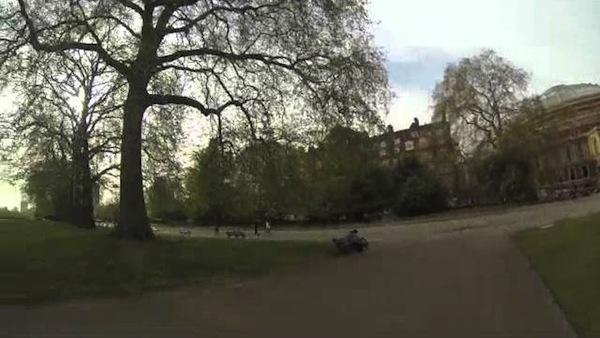
Another Monday morning, May 13: I ran three miles in Kensington Gardens (above), GoPro strapped to my head (see Analogplanet.com; video here), and later had lunch with European importer and distributor Ricardo Franassovici of Absolute Sounds, one of the audio industry's greatest characters, and always fun to hang out with and talk music, not audio. Afterward, we traveled to the Electric Recording Company, which recently reissued two legendary sets from the very early days of the long-playing record: Johanna Martzy's three discs of J.S. Bach's Sonatas and Partitas for Unaccompanied Violin, originally released on EMI; and French Pathé's sumptuous seven-disc boxed set, Mozart à Paris, both with original graphics and paper stocks faithfully reproduced, and sourced from the original analog master tapes (footnote 2) and mastered on an all-tube cutting system restored by Sean Davies—a real analog guru whom I've yet to meet, but vow to some day soon.
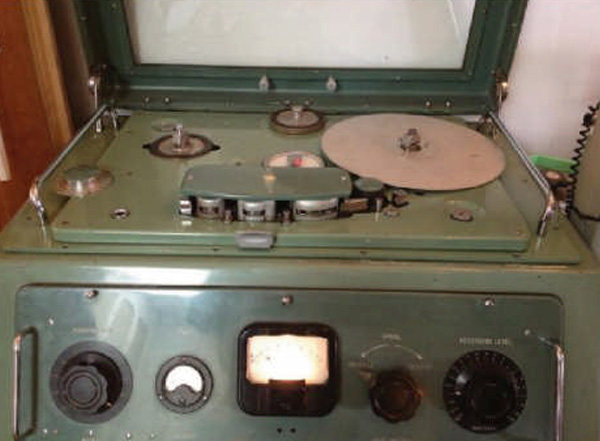
The vintage gear used by the Electric Recording Company includes this fully restored EMI BTR2 tape deck.
That evening, I had dinner with Constellation's Murali Murugasu, who was in London visiting family. His favorite Indian restaurant was directly across from my hotel. We discussed the logistics of my upcoming review of the Centaur monoblock amplifier ($54,000/pair), part of Constellation's second-tier Performance series, which VP of engineering Peter Madnick was set to deliver to my house that Friday, the morning after my return from Europe.
I'll spare you the details of boring Tuesday (there was a fantastic museum exhibit of David Bowie artifacts in town, but it was sold out, and my ballsy e-mailed ticket requests to Tony Visconti, whom I'd barely met at the Classic Album Sundays event, had gone unanswered).
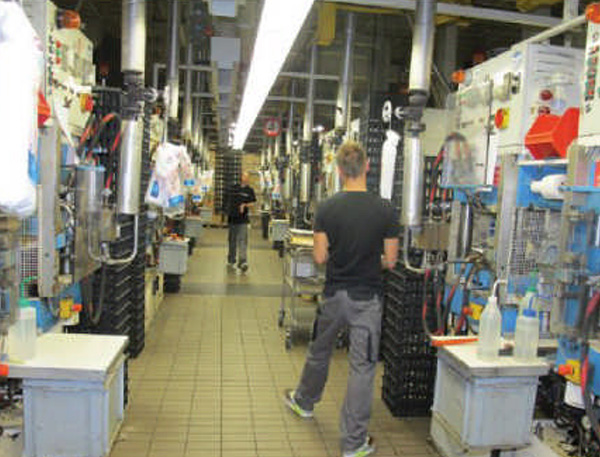
A magnificent row of record presses at the Netherlands Record Industry, the largest vinyl pressing plant in Europe.
The Record Industry pressing plant is in Haarlem, just outside Amsterdam, and was formerly owned by Sony. It's a large, impressive, one-stop facility capable of printing and producing record jackets, cutting lacquers or DMM metal parts from tape or digital files, and plating and stamping LPs of various thicknesses on its 32 presses. I toured the plant that afternoon, and that evening, in Amsterdam, enjoyed a memorable dinner at an Italian restaurant, Toscanini, with Vermeulen, his wife, some friends, and Dutch journalist Robert Haagsma, who was writing a book about the Record Industry, to be published this fall.
On the day I'd e-mailed Vermeulen to tell him I'd be in the UK and available to fly over to tour the factory, he also received an e-mail from Haagsma with a wish list of people Haagsma wanted to interview for his book. I was on the list, and he interviewed me the next morning, Thursday, at a local audio emporium, where I sat for what must have been a bleary-eyed photo. The store had a good selection of used LPs, so I . . . bought some.
Footnote 1: For our on-line coverage of the Munich show, see here and here.— John Atkinson Footnote 2: See "Listening #127," July 2013.—John Atkinson